
Silver Futures: SI vs Micro Silver vs 100-oz SIC


Contents
- Silver futures in 30 seconds
- What is a silver future?
- SI, SIL and SIC side by side
- Which silver future fits your risk budget?
- Margin, costs and liquidity
- Delivery, cash settlement and deadlines
- Trading hours and the roll
- Pros and limits of the small silver futures
- Which contract for whom?
- Silver futures: my conclusion
- Frequently asked questions about silver futures
- About the author
When silver moves by $1 an ounce, one silver future gains or loses $5,000, $1,000 or $100, depending on whether you trade SI, Micro Silver (SIL) or the 100-Ounce Silver future (SIC). All three trade on COMEX, the metals exchange of CME Group, and all three follow the same reference market. They still differ in more than size: in settlement, in expiry and even in whether you can trade them at the weekend.
This comparison answers one practical question: which contract fits your risk budget? You get the contract specifications straight from CME, a worked example with the same stop for all three, and the deadlines that matter for the December 2026 contracts. This article follows our editorial policy and is for education, not investment advice.
Silver futures in 30 seconds
- Three sizes, one reference market. SI covers 5,000 troy ounces, SIL 1,000 and SIC 100. A $1 move per ounce is worth $5,000, $1,000 or $100 per contract; the smallest tick is worth $25, $5 or $1.
- Delivery or cash. SI and SIL are physically deliverable. SIC is cash-settled at a price CME derives from the SI settlement.
- Margin is not a loss buffer. On 31 October 2026, CME listed a maintenance margin of $19,711 (SI), $3,943 (SIL) and $395 (SIC) for the December contract. Your broker can ask for more.
- SIC expires a month earlier. The December SIC trades for the last time on 25 November 2026. For December SI and SIL, the first notice day is 30 November 2026.
- No trade is a valid result. If the risk of a single SIC is already larger than your budget for the trade, no silver future fits.
What is a silver future?
A silver future is an exchange-traded contract for a fixed amount of silver at a price agreed today, delivered or settled in cash at the end.
Profits and losses are booked every day, not only at expiry. The exchange values every open position each evening and credits or debits the difference to your account. This guide covers only the three silver contracts of COMEX; how the curve between contract months behaves is explained in our guide to contango and backwardation.
The settlement price is the official closing price the exchange sets at the end of every trading day.
For SI, it is not simply the last trade. For the active month, CME uses the volume-weighted average price of trades between 12:24 and 12:25 p.m. Chicago time. SIL takes over this value from SI, and SIC derives its price from SI, rounded to its own tick.
The three codes stand for three contract sizes. SI is the classic silver future with 5,000 ounces. SIL is called “Micro Silver Futures” by CME and covers 1,000 ounces, although the product address on CME’s site still reads “1000-oz-silver”. SIC is the “100-Ounce Silver Future”, which CME launched on 9 February 2026.
Micro Silver (SIL) is the COMEX silver future on 1,000 troy ounces, one fifth of the SI contract.
The 100-Ounce Silver future (SIC) is a cash-settled COMEX contract on 100 troy ounces whose settlement price is derived from SI.
There is one more small silver contract next to these three. CME also lists an E-mini Silver (QI), which is cash-settled. It is not part of this comparison because we have not checked all of its contract terms. Gold has the same ladder of sizes with GC, MGC and 1OZ.
SI, SIL and SIC side by side
A tick is the smallest price change a contract can make.
The tables deliberately separate three kinds of tick: the outright tick for a normal order in one month, the spread tick for calendar spreads between two months, and the settlement increment for the daily settlement price. Mixing them up is how you end up with a wrong SIL tick value of $1.
| Contract | Tick (outright) | $1 per ounce is worth |
|---|---|---|
| SI | $0.005 = $25 | $5,000 |
| SIL | $0.005 = $5 | $1,000 |
| SIC | $0.01 = $1 | $100 |
SI: Silver Futures
| Feature | SI |
|---|---|
| Size | 5,000 troy ounces |
| Quoted in | US dollars per ounce |
| Tick | $0.005 = $25 |
| Spread tick | $0.001 = $5 |
| Settlement price | steps of $0.001 |
| Settlement method | physical delivery |
| Last trade | third last business day of the contract month, 12:25 p.m. CT |
| Months listed | 26 consecutive months, plus July and December up to 60 months |
| Rulebook | COMEX chapter 112 |
SIL: Micro Silver Futures
| Feature | SIL |
|---|---|
| Size | 1,000 troy ounces |
| Quoted in | US dollars per ounce |
| Tick | $0.005 = $5 |
| Spread tick | $0.001 = $1 |
| Settlement price | steps of $0.001, taken from SI |
| Settlement method | physical delivery through ACE certificates |
| Last trade | third last business day of the contract month |
| Months listed | 3 consecutive months, plus Jan, Mar, May, Jul, Sep, Dec up to 12 months |
| Rulebook | COMEX chapter 121 |
SIC: 100-Ounce Silver Futures
| Feature | SIC |
|---|---|
| Size | 100 troy ounces |
| Quoted in | US dollars per ounce |
| Tick | $0.01 = $1 |
| Settlement price | derived from SI, rounded to $0.01 per CME’s settlement procedure (the rulebook differs, see below) |
| Settlement method | cash settlement |
| Last trade | third last business day of the month before the contract month, 12:25 p.m. CT |
| Months listed | Mar, May, Jul, Sep, Dec up to 24 months |
| Rulebook | COMEX chapter 130 |
Source: CME Group contract specifications for SI, SIL and SIC, COMEX rulebook chapters 112, 121 and 130, and the CME settlement procedure for silver, read on 29 October 2026. CT = US Central Time (Chicago).
A quick check shows that the tick values add up. Tick times contract size gives the tick value: 0.005 × 5,000 = $25, 0.005 × 1,000 = $5, 0.01 × 100 = $1. A $1 rise in silver is 200 ticks in SI and SIL and 100 ticks in SIC. In dollars it stays $5,000, $1,000 and $100, however your platform displays the ticks.
One CME document differs on the settlement step of SIC. The FAQ, the fact card and the settlement procedure state $0.01; rulebook chapter 130 states $0.005. What counts for your trading is the trading tick of $0.01, which is the same in every source. The difference only affects how the settlement price is rounded. The rulebook also words the cash-settlement reference as the contract month, while trading already ends in the month before; CME’s settlement procedure says the final settlement follows the daily procedure based on SI.
Which silver future fits your risk budget?
The choice of contract starts with the stop, not with the margin. First you decide how much you accept to lose on this trade, your risk budget. Then you work out what one contract costs if the stop is hit. Only then does the number of contracts follow. Our guide to position sizing explains the principle in detail.
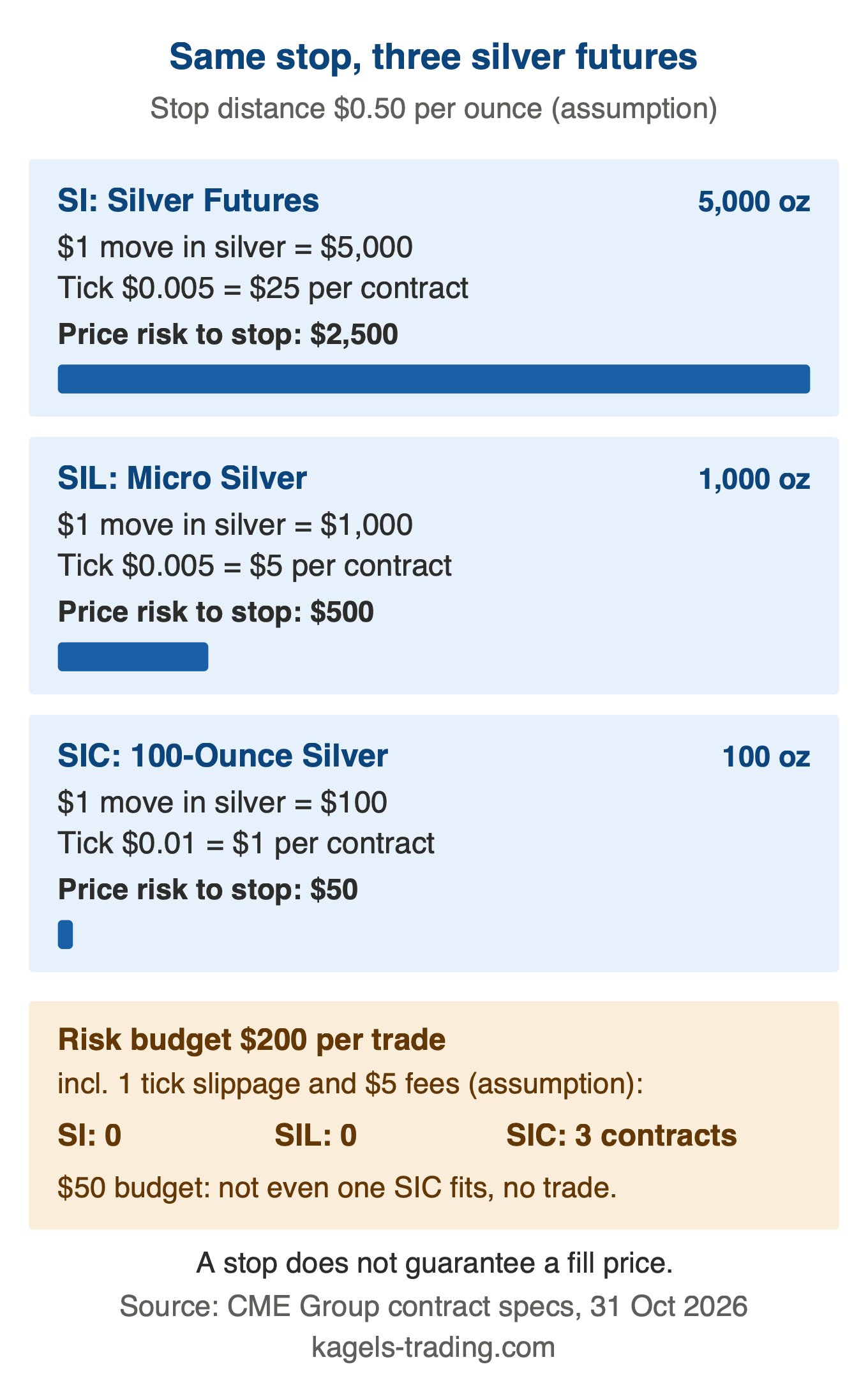
For the comparison we use the same stop for all three contracts. All figures are assumptions for the calculation, not a recommendation and not a price forecast:
- Stop distance $0.50 per ounce: an assumed distance, not a suggestion for a real trade.
- Fill one tick worse: we add one tick of slippage, a fill one tick worse than planned. This is an assumption, not a limit.
- Fees of $5 per contract round trip: this figure is deliberately the same for all three. Your real costs are in your broker’s fee schedule and differ by contract.
 Click to enlarge
Source: CME Group contract specs.
| Contract | Price risk to stop | With slippage and fees |
|---|---|---|
| SI | $2,500 | $2,530 |
| SIL | $500 | $510 |
| SIC | $50 | $56 |
The table shows the planned loss under these assumptions, not a guaranteed one. After a price gap, for example on news or at the start of the week, your stop can be filled much worse. Depending on the order type, it may not be filled at first at all. A stop decides when you want to get out, not at which price.
The number of contracts follows from the risk per contract, and it is always rounded down. The table shows three risk budgets in US dollars. SI does not fit in any of them, so it is left out. The graphic above sums up the case of a $200 budget.
| Budget per trade | SIL | SIC |
|---|---|---|
| $50 | 0 | 0: no trade |
| $200 | 0 | 3 ($168 risk) |
| $600 | 1 ($510 risk) | 10 ($560 risk) |
With a $50 budget the answer is: no trade. A single SIC would already risk $56 and exceed the budget. COMEX has no smaller silver future. You can only set a tighter stop if the market offers one, or skip the trade. Shrinking the stop just to make the numbers work moves the problem elsewhere: the stop belongs at a meaningful level on the chart, not where the arithmetic fits.
With a $600 budget you can choose between one SIL and ten SIC. Both carry the same 1,000 ounces and almost the same risk. With fees assumed equal per contract, the SIC route pays $50 instead of $5. Always convert your broker’s real fee to 1,000 ounces before you choose several small contracts over one larger one.
Risk budget and margin are two separate conditions. The number of contracts has to fit your risk budget, and your account also has to carry the margin for all of them. At CME’s figures of 31 October 2026, ten SIC need at least $3,950 in maintenance margin and one SIL $3,943. Without the margin the trade is not possible, even if the risk fits.
In this example, SI only comes into play for much larger accounts. With a $0.50 stop and the assumed costs, one SI needs a risk budget of $2,530. If you risk at most 1 percent per trade, that takes an account of about $253,000. A tighter stop or a higher risk share lowers the threshold; a wider stop raises it. To run your own numbers, multiply your stop per ounce by 5,000, 1,000 or 100 and add your costs.
Margin, costs and liquidity
The maintenance margin is the minimum your account must hold as collateral for each open contract; if it falls below that, you face a margin call or the position is closed.
Margin is a deposit, not a price and not a loss limit. CME distinguishes the initial margin to open a position and the maintenance margin to hold it. The margin that applies to you when you open a trade is set by your broker.
| Contract | Maintenance margin Dec 2026 | Share of contract value |
|---|---|---|
| SI | $19,711 | 8.0% |
| SIL | $3,943 | 8.0% |
| SIC | $395 | 8.0% |
Source: CME Group, silver margins, read on 31 October 2026; contract value at the settlement of 30 October 2026 ($49.276 per ounce for SI and SIL, $49.28 for SIC). Margins change often.
At these CME figures, the margin rate is the same for all three contracts. A smaller contract therefore brings no lower margin rate; it only allows smaller steps in position size. How much leverage your account really carries depends on your equity and the number of contracts, not on the contract type.
Margin is not a cushion that absorbs losses up to its amount. On paper, $395 in SIC equals $3.95 per ounce. But once your account drops below the maintenance margin, your broker can ask for more money or close the position. Some brokers offer a lower intraday margin during the day. That says nothing about a sensible account size: the loss to the stop stays the same.
If your account is not in US dollars, currency risk comes on top. Profits, losses and margin run in US dollars. If your broker holds the account in another currency, it converts, or it creates a dollar balance that may carry interest. How your broker handles this is in its terms.
You can lose more than the money you deposited. CME states in its product documents that futures losses can exceed the amount deposited, because only a fraction of the contract value is posted as margin.
Whether and how you may trade futures depends on where you live and on your broker. Some regulators restrict futures for retail clients, require a negative balance protection or limit products to certain client categories. What applies to you, including what happens if your broker closes a position, is set out in your broker agreement and in the rules of the regulator responsible for your account.
Open interest is the number of contracts that are still open at the end of the day.
Volume and open interest give a hint of trading activity. For Friday, 30 October 2026, the CME daily bulletin reported these figures in contracts, across all months:
| 30 Oct 2026 | Globex volume | Open interest |
|---|---|---|
| SI | 77,213 | 116,030 |
| SIL | 90,949 | 26,335 |
| SIC | 17,710 | 11,735 |
Source: CME daily bulletin, section 62, metals futures, bulletin no. 210, preliminary, trading day 30 October 2026. SI also had 1,910 contracts agreed off the order book (PNT). The final figures can differ slightly; the link always shows the latest bulletin.
More contracts do not mean more silver. SIL had the highest Globex volume in contracts that day. In ounces, though, that was only 90.9 million against 386.1 million in SI and 1.8 million in SIC. Most of it traded in the December contract. The bulletin does not show how tight the order book was, and we have not measured spreads ourselves. What open interest tells you about positioning is part of our guide to the COT report.
Delivery, cash settlement and deadlines
SI and SIL are deliverable contracts, and that has consequences for you. If you hold a long position too long, you can end up in delivery. In SIL, delivery runs through ACE certificates: according to the rulebook, one certificate stands for 20 percent of a 5,000-ounce warrant. For private traders, delivery is almost never wanted. Brokers set their own close-out deadlines, which can come before the exchange dates.
The first notice day is the first day on which buyers can be notified that a delivery has been assigned to them.
For the December 2026 contracts, CME’s calendar shows these dates. SI and SIL also have a first position day, 27 November 2026. On that day the exchange takes the first delivery intentions and assigns them to open long positions; the notice follows on the first notice day.
| December 2026 | First notice day | Last trading day |
|---|---|---|
| SI (SIZ26) | 30 Nov 2026 | 29 Dec 2026 |
| SIL (SILZ26) | 30 Nov 2026 | 29 Dec 2026 |
| SIC (SICZ26) | none, cash-settled | 25 Nov 2026 |
Source: CME Group, silver futures calendar and the calendars of the sister contracts, read on 31 October 2026. Your broker’s deadline can be earlier.
The December SIC ends in November. According to the rulebook, trading ends on the third last business day of the month before the contract month. For SICZ26 that is 25 November 2026, more than a month before the December SI. If you only look at the month name, you roll too late.
Cash settlement means that a future is not delivered at the end but closed out in money at a settlement price.
“No delivery” does not mean “no risk”. If you hold SIC to its last trading day, it is closed at a final settlement price that CME derives from the SI settlement. That price can be far from your stop. SIC also has only five contract months a year, so your roll calendar differs from SI and SIL.
Trading hours and the roll
Trading hours differ, and SIC is the exception. SI and SIL trade on the electronic platform CME Globex from Sunday 5:00 p.m. to Friday 4:00 p.m. Chicago time, with a daily 60-minute break from 4:00 p.m. According to CME, SIC trades around the clock, seven days a week, with two maintenance windows.
| Contract | Chicago (CT) | New York (ET) |
|---|---|---|
| SI and SIL | Sun 5:00 p.m. to Fri 4:00 p.m. | Sun 6:00 p.m. to Fri 5:00 p.m. |
| Break SI, SIL | daily 4:00 to 5:00 p.m. | daily 5:00 to 6:00 p.m. |
| SIC | 24/7 | 24/7 |
| Maintenance SIC | Mon to Fri 4:00 to 4:02 p.m. | Mon to Fri 5:00 to 5:02 p.m. |
| Maintenance SIC | Sat 2:00 to 4:00 a.m. | Sat 3:00 to 5:00 a.m. |
Source: CME Group contract specifications and FAQ on the 100-Ounce Silver futures, read on 29 October 2026.
Outside the US, daylight saving time shifts these hours twice a year. The times above are local Chicago and New York time. Europe changes its clocks on the last Sunday in March and October, the US on the second Sunday in March and the first Sunday in November. In the weeks between, the gap to Chicago is one hour smaller than usual for European traders; in autumn 2026 that is from 25 October to 1 November. Our guide to futures market hours covers all CME sessions and this trap in detail.
SIC trades at the weekend, the large SI does not. That sounds like an advantage. But SIC takes its settlement price from SI, and SI is closed on Saturday and Sunday. How many participants quote prices at the weekend and how wide the bid-ask spread is then, we have not measured. Check it in your broker’s order book before you rely on a weekend stop.
Rolling means closing an expiring future and opening the same position in the next contract month.
In SI and SIL you roll at the latest before the first position day or your broker’s earlier deadline; in SIC, before its last trading day. Make sure your chart shows the right contract. Continuous charts such as “SI1!” switch contracts automatically and can show price jumps that never happened in the single contract. That is why the levels in our silver price forecast refer to spot silver, XAG/USD, and not to one future.
Pros and limits of the small silver futures
The small contracts solve a real problem but create their own. The two lists sum up what speaks for SIL and SIC and where you need to be careful.
What speaks for Micro Silver and the 100-ounce future
- Finer position size: SIL and SIC let you size risk in steps of $1,000 or $100 per dollar of silver movement instead of blocks of $5,000.
- The same reference market: SIL and SIC take their settlement price from SI, the contract with the highest open interest.
- No delivery risk in SIC: the 100-ounce future is cash-settled. A contract held by mistake does not end in a warehouse warrant.
- Longer trading time in SIC: according to CME, SIC can be traded around the clock seven days a week.
Where the small contracts reach their limits
- No lower margin rate: at CME’s figures of 31 October 2026, margin for all three contracts was about 8 percent of contract value. Small does not mean less risk per ounce.
- Higher costs per ounce: fixed fees per contract weigh more on 100 ounces than on 1,000 or 5,000. Always compare the same amount of silver.
- Earlier expiry in SIC: SIC ends a month before its contract month and has only five months a year.
- Delivery possible in SIL: Micro Silver is physically deliverable. Your broker’s deadlines apply here just as in SI.
- Weekend trading without the main market: at the weekend, SIC trades without SI as its pacemaker. The price quality then is not documented.
Which contract for whom?
The choice follows from three questions, not from the margin. How large is your risk per trade, how far away is your stop, and how long do you want to hold the position?
- SIC if your budget is small or your stop is wide: in the example with a $200 risk budget and a $0.50 stop, it is the only contract that fits. Plan for the early expiry and the costs per ounce.
- SIL if your budget per trade is several hundred dollars: it had the highest Globex volume in contracts on 30 October 2026 and, with the same fee per contract, is cheaper per ounce than several SIC. Keep the first notice day in view.
- SI if one contract risks only a small part of your account: it is the reference market with the highest open interest. In the example above it needs an account in the six-figure dollar range.
- No silver future if even one SIC breaks your budget: then not trading is the right position size.
Access is a question for your broker. CME itself writes that clients have to ask their broker to enable SIC if it is missing on the platform. Whether your broker offers SIL and SIC, what margin it asks for and until when it closes positions before delivery is only in its own documents. For the small index contracts of CME, see our guide to micro futures.
Silver futures: my conclusion
I consider the stop the most important number when choosing a silver future. Only once the stop sits at a meaningful level does the contract size decide whether the position fits your budget. SIC has made this calculation much easier for smaller accounts: $100 per dollar of silver movement is a size you can work with.
That does not make it cheaper or safer. At CME’s figures of 31 October 2026 its margin rate was as high as for SI, fees weigh more per ounce, and the December SIC is over on 25 November. With Micro Silver, on the other hand, you have to watch the delivery deadlines.
Before you trade your first silver future, check three things with your broker. What fee do you pay per contract, converted to 1,000 ounces? How high is the initial margin, and can you lose more than your deposit? By which date do you have to close SI and SIL? With these answers you can redo the example above with your own numbers.
Frequently asked questions about silver futures
What is the smallest silver future on COMEX?
The smallest silver future is the 100-Ounce Silver future with the code SIC. It covers 100 troy ounces and is cash-settled. CME launched it on 9 February 2026.
What is a tick worth in silver futures?
That depends on the contract. In SI, one tick is $0.005 per ounce and worth $25; in Micro Silver (SIL) it is also $0.005, but worth only $5. In SIC, one tick is $0.01 = $1. The smaller step of $0.001 in SIL applies only to spreads and the settlement price.
How much money do I need for one Micro Silver future?
Margin alone does not answer this question. On 31 October 2026, CME listed a maintenance margin of $3,943 for the December SIL; your broker sets the margin to open the trade. What also matters is what one contract costs to your stop: at a $0.50 stop about $500 plus costs. That amount should be only a small part of your account.
Can you trade silver futures at the weekend?
Only SIC. According to CME it trades around the clock seven days a week, with a maintenance window on Saturday from 2:00 to 4:00 a.m. Chicago time. SI and SIL pause from Friday afternoon to Sunday evening Chicago time.
Is silver delivered in Micro Silver futures?
Yes, SIL is a deliverable contract. Delivery runs through ACE certificates on exchange-stored silver. If you do not want to make or take delivery, close or roll the position before the first position day, for December 2026 before 27 November 2026, or before your broker’s earlier deadline.
Can retail traders trade silver futures?
That depends on your country and your broker. CME sets the contract rules, but who may trade futures and under which conditions is decided by the regulator responsible for your account and by your broker agreement. Some regulators restrict futures for retail clients or require protection against a negative balance. Check both before you open a position.
What does SIL stand for in silver futures?
SIL is the code of the COMEX Micro Silver future. It stands for a contract on 1,000 troy ounces, one fifth of SI.
This English edition is based on our German edition on kagels-trading.de and has been adapted for international readers.
More Markets and Brokers guides
- Choose a broker
Interactive Brokers Review 2026: Fees and Platforms
Fees, platforms, investor protection and real futures commissions from a client since 1996.
- Check an offshore broker
PU Prime Review 2026: FCA Warning, Licences and Costs
Which PU Prime company you contract with, what the FCA warning means, and what 1:1000 leverage and the deposit bonus do to your account.
- Understand your price
Market Makers: Who Sets Your Price and How They Profit
How market makers earn on the spread, who sets prices at German trading venues and what the EU ban on payment for order flow changed.
- Read bond market stress
MOVE Index: The VIX of the Bond Market, Explained
What the MOVE index measures, which readings signal stress, how it differs from the VIX and where its limits are.
- Size an index future
Micro Futures: MES vs MNQ, Tick Values and Risk
MES and MNQ tick values, a worked sizing example from the stop with costs and slippage, and why margin is not your risk.
- Read the futures curve
Contango vs Backwardation: Futures Curves Explained
What contango and backwardation mean, what rolling does to a position in each case, and real gold, oil and gas curves from 28 October 2026.
- Read the chip sector
SOX Index: Holdings, Weighting and How to Use It
What the SOX holds, how Nasdaq caps the weights, its largest declines since 2004 against the Nasdaq-100 and which ETFs really track it.
- Read the biotech sector
Nasdaq Biotechnology Index: Holdings, Weighting and Risks
What the NBI holds, how Nasdaq caps the weights, its long declines since 2003 against the Nasdaq-100 and which ETFs really track it.
- Research stocks
InvestingPro Review: Screener, ProPicks AI and WarrenAI
What the InvestingPro screener, ProPicks AI and WarrenAI do, what Pro and Pro+ cost and who needs which plan.
- Use the free news portal
Investing.com Review: Free Tools, Data and Limitations
What the free Investing.com portal does well, where the quote prices come from and when InvestingPro is worth paying for.
- Follow an IPO
Anthropic Stock: IPO Date, Valuation and How to Invest
Where the Anthropic IPO stands, how the valuation compares with revenue and how to get exposure before and after the listing.
- Invest in OpenAI before the IPO
OpenAI Stock: Can You Buy It, and Who Owns OpenAI?
Why there is no OpenAI stock yet, who owns OpenAI, where the IPO stands and how much OpenAI you get through Microsoft or SoftBank.
- Value a new listing
SpaceX Stock (SPCX): Valuation, Risks and How to Buy
How to buy SpaceX stock, what the company is worth after the IPO and which risks the lock-up calendar brings.