
Stock Splits Explained: Forward and Reverse Splits


Contents
- Stock splits in 30 seconds
- What is a stock split?
- What changes and what does not
- Why companies split their stock
- The dates that matter
- Nvidia’s 2024 split on the chart
- Famous stock splits
- What is a reverse stock split?
- Reverse splits and the $1 rule
- What happens to your options
- Splits, fractional shares and taxes
- How I read a split as a trader
- Conclusion: a split changes the slices, not the cake
- Frequently asked questions about stock splits
- Sources
- About the author
A stock split changes the number of shares, not the value of the company. If a company splits its stock 10 for 1, you get ten shares for each one you held, and each share trades at about a tenth of the old price. Your position value, your share of the company and the company’s market value stay the same at the moment of the split.
Splits still matter, because they change prices, charts, options and sometimes your account. This guide explains forward and reverse splits with worked numbers, the dates that decide who gets the new shares, what happens to options and fractional shares, and why a lower share price alone does not make a stock cheaper. Rules, ratios and dates are checked against company filings, the exchanges and the regulators as of 31 October 2026.
Stock splits in 30 seconds
- A forward split gives you more shares at a lower price per share. In a 4-for-1 split, 10 shares at $400 become 40 shares at $100.
- A reverse split does the opposite. In a 1-for-10 split, 1,000 shares at $0.50 become 100 shares at $5.
- Nothing changes in value at the moment of the split. A lower price does not make the business cheaper; the valuation per share falls in the same ratio.
- Charts are adjusted backwards. Nvidia closed at $1,208.88 before its 2024 split, but today’s charts show about $120.89 for that day.
- Reverse splits are often a warning sign. Many come from companies whose shares trade below $1 and risk being delisted.
What is a stock split?
A stock split is an increase in the number of a company’s shares without any change in the shareholders’ equity. That is how the US Securities and Exchange Commission’s investor site Investor.gov defines it. The company divides each existing share into several new ones, and the share price falls in the same ratio.
The ratio tells you how many new shares you get for each old one. In a 2-for-1 split each share becomes two, in a 10-for-1 split each share becomes ten. The first number is the number of shares after the split, the second the number before. In the United States most forward splits are legally paid as a stock dividend: Tesla, CrowdStrike and Amphenol announced theirs “in the form of a stock dividend”.
| Before the split | Ratio | After the split | Value |
|---|---|---|---|
| 10 shares at $400 | 4-for-1 | 40 shares at $100 | $4,000 |
| 5 shares at $1,200 | 10-for-1 | 50 shares at $120 | $6,000 |
| 1,000 shares at $0.50 | 1-for-10 reverse | 100 shares at $5 | $500 |
| 105 shares at $0.50 | 1-for-10 reverse | 10 shares at $5 plus $2.50 cash for half a share | $52.50 |
Worked examples at the moment of the split, before any price change on the next trading day. The last row assumes cash in lieu of the fractional share at the split price; the company’s terms and your broker decide the actual amount.
What changes and what does not
Everything that is counted per share changes, everything counted for the whole company stays. After a 10-for-1 split the earnings per share, the dividend per share and the book value per share are a tenth of what they were. The price-to-earnings ratio stays the same, because price and earnings per share both fall by the same factor. Your ownership share does not change either.
- Changes: number of shares, price per share, earnings and dividend per share, option strikes and contract counts, the scale of the historical chart.
- Does not change: market value of the company, value of your position, your percentage of the company, your voting share, the valuation ratios.
A lower price per share is not a discount. A stock at $120 after a 10-for-1 split is exactly as expensive as it was at $1,200 the day before. Whether a stock is cheap depends on the business and its valuation, not on the number on the price tag. Nvidia raised its quarterly dividend at the same time as its 2024 split, from $0.04 to $0.10 before the split, which is $0.01 per share after it. That was a separate dividend decision, not an effect of the split.
Why companies split their stock
Companies usually split after a long rise, when the share price has become high. All five large US splits of 2024 and 2025 that this guide checked came at share prices above $175: Walmart at $175.56, Nvidia at $1,208.88, Chipotle at $3,283.04, Broadcom at $1,700.67 and Netflix at $1,112.17. In 2026 Booking Holdings split 25-for-1 at $4,194.31 and KLA 10-for-1 at $2,411.64.
The reasons companies give are about access, not about value. A lower price makes it easier for employees to receive whole shares and for small investors to buy round amounts. With fractional shares now common at many brokers, this argument is weaker than it used to be. A split also signals that management expects the higher price level to hold, but that is a signal, not a fact about the business.
Research on returns after splits is mixed. Ikenberry, Rankine and Stice (1996) and Desai and Jain (1997) reported positive returns after splits, while Byun and Rozeff (2003), with 12,747 splits from 1927 to 1996, found no significant long-run outperformance for splits of 25 percent or more. The honest summary: a split is no reliable buy signal on its own.
The dates that matter
A split runs through three dates, and the last one is the one you see on your screen. The record date decides who receives the new shares. The payment date is when the company distributes them, normally after the close. The first split-adjusted trading day comes after that, and this is when the price on your screen drops.
- CompanyAnnouncement22 May 2024: 10-for-1 split announced with the quarterly results
- CompanyRecord date6 June 2024: holders at the close are on the list; shares sold before the ex-date pass the entitlement to the buyer
- Company and transfer agentDistribution7 June 2024, after the close: nine new shares for each share held
- Exchange and brokerSplit-adjusted trading10 June 2024: the price opens at about a tenth, your account shows ten times the shares
Dates from Nvidia's Form 8-K of 22 May 2024. For splits and stock dividends of 25 percent or more, FINRA Rule 11140 sets the ex-date on the first business day after the payable date.
If you sell between the record date and the first split-adjusted day, you sell the new shares with them. FINRA’s Rule 11140 sets the ex-date for splits and stock dividends of 25 percent or more on the first business day after the payable date. Until then the shares trade with a due bill, an obligation to hand the additional shares to the buyer. In practice your broker handles this; you only need to know that the record date alone does not decide it.
Nvidia’s 2024 split on the chart
 Click to enlarge
Source: Yahoo Finance.
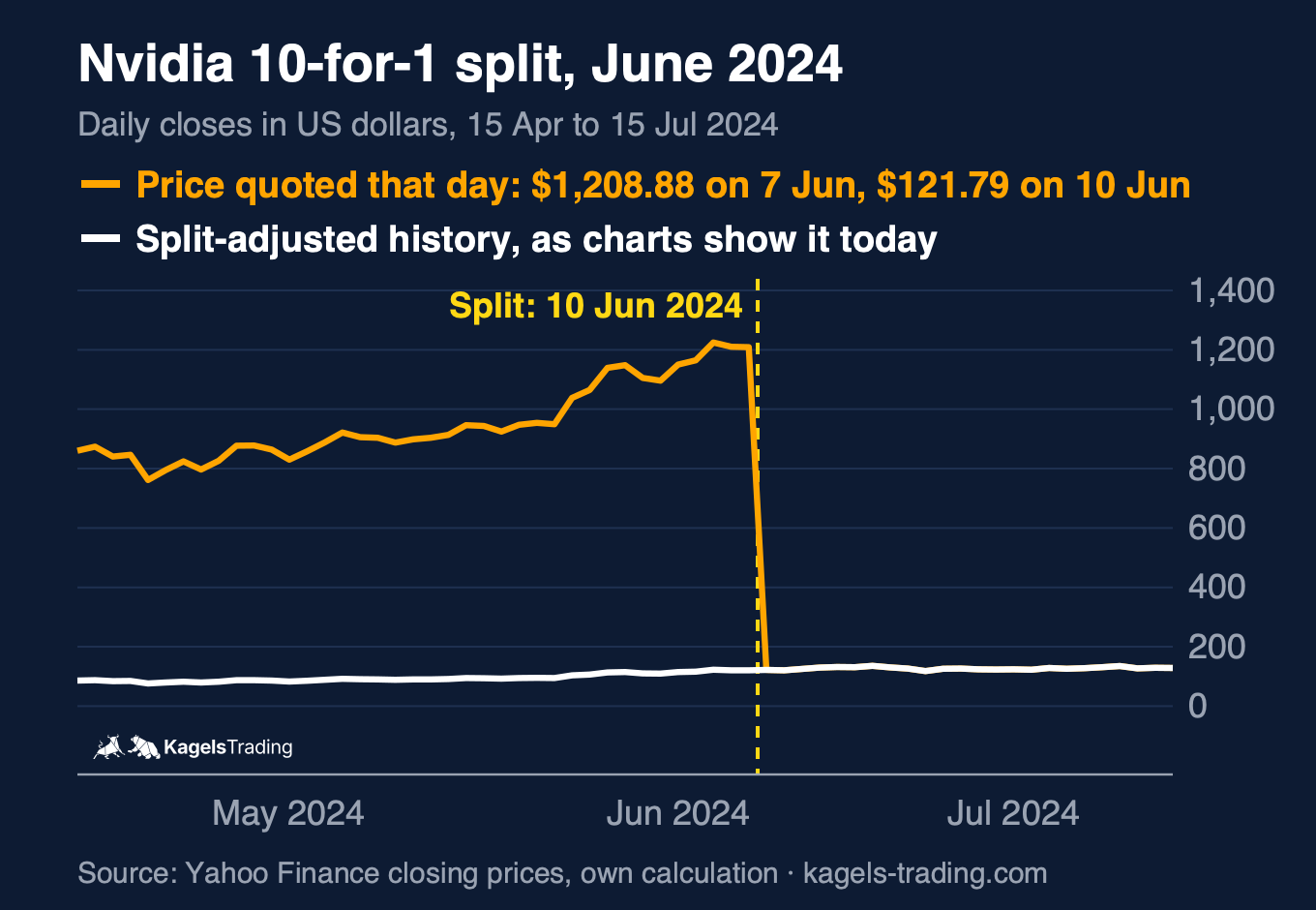
The chart shows why split-adjusted data is the standard. On Friday, 7 June 2024, Nvidia closed at $1,208.88. On Monday, 10 June, the first split-adjusted day, it opened at $120.37 and closed at $121.79. The orange line shows the price you saw on each day; it falls by 90 percent in one step, although no value was lost. The white line divides all earlier prices by ten, so the trend stays readable.
Chart platforms usually show split-adjusted prices by default, so old price levels change after a split. If you noted a support level at $1,000 in May 2024, it sits at $100 on today’s chart. Price alerts, stop orders and saved drawings need checking after a split; most brokers adjust open orders, but conditions differ, so read your broker’s notice. Some data providers also adjust history for spin-offs and dividends, which is why old prices on two websites can differ.
Famous stock splits
Many of the largest US companies have split their stock, and the later price path followed the business, not the ratio. The table lists checked examples with the last close before the split and the first close after it. Prices are actual traded prices, not adjusted ones.
| Company | Ratio | First split-adjusted day | Last close before | First close after |
|---|---|---|---|---|
| Apple | 4-for-1 | 31 Aug 2020 | $499.23 | $129.04 |
| Tesla | 5-for-1 | 31 Aug 2020 | $2,213.40 | $498.32 |
| Tesla | 3-for-1 | 25 Aug 2022 | $891.29 | $296.07 |
| Walmart | 3-for-1 | 26 Feb 2024 | $175.56 | $59.60 |
| Nvidia | 10-for-1 | 10 Jun 2024 | $1,208.88 | $121.79 |
| Chipotle | 50-for-1 | 26 Jun 2024 | $3,283.04 | $65.86 |
| Broadcom | 10-for-1 | 15 Jul 2024 | $1,700.67 | $171.42 |
| Netflix | 10-for-1 | 17 Nov 2025 | $1,112.17 | $110.29 |
| Booking Holdings | 25-for-1 | 6 Apr 2026 | $4,194.31 | $176.19 |
| KLA | 10-for-1 | 12 Jun 2026 | $2,411.64 | $254.54 |
Ratios and dates from each company’s Form 8-K or press release; prices are raw (unadjusted) daily closes of the consolidated US tape from the market data vendor Alpaca, checked on 31 October 2026.
Tesla shows that a split does not change the trend. After the 5-for-1 split in August 2020 the stock kept rising; after the 3-for-1 split in August 2022 it kept falling into the bear market of that year. In both cases the split was not the reason. In 2026 CrowdStrike split 4-for-1 and Amphenol 2-for-1, and Sandisk announced an 8-for-1 split on 29 October 2026, with post-split trading planned from 20 November 2026.
What is a reverse stock split?
A reverse split combines several old shares into one new share. In a 1-for-10 reverse split, ten shares become one, and the price rises tenfold. The value again stays the same at the moment of the split. Investor.gov notes that companies often do it to raise a low trading price, for example to meet an exchange’s minimum price.
Fractional entitlements are often paid out in cash. The company’s terms and your broker’s handling decide the result. If you hold 105 shares, the ratio is 1-for-10 and the company pays cash in lieu, you receive ten new shares and a cash payment for the remaining half share. General Electric’s 1-for-8 reverse split in 2021 and Citigroup’s 1-for-10 reverse split in 2011 both issued no fractional shares and paid cash in lieu. In the United States that cash counts as the sale of the fractional share for tax purposes.
GE and Citigroup were large companies repairing their image after a crisis. GE closed at $12.95 on 30 July 2021 and opened at $104.48 on 2 August 2021, the first split-adjusted day; its shares outstanding fell from about 8.8 billion to about 1.1 billion. Citigroup’s reverse split took effect after the close on 6 May 2011 and cut about 29 billion shares to about 2.9 billion. Both companies also used the step to make their shares look less like a penny stock.
Reverse splits and the $1 rule
Many reverse splits come from small companies whose shares trade below $1. On Nasdaq a stock fails the minimum bid price rule if its closing bid price stays below $1.00 for 30 consecutive business days. The company then has 180 calendar days to close at a bid of at least $1.00 for a minimum of ten consecutive business days (Nasdaq can require longer), and a reverse split is the fastest way to do that.
Since 2025 the exchanges have limited this repair. Under a Nasdaq rule approved by the SEC in January 2025, a company that fails the bid price test again within one year of a reverse split gets no compliance period; Nasdaq issues a delisting determination instead. Under a further change approved in December 2025, a closing bid of $0.10 or less for ten consecutive business days leads to a delisting determination and suspension regardless of any compliance period. The SEC approved a similar one-year limit for NYSE in January 2025.
For you as a shareholder, a reverse split is a reason to look closer. The split itself costs nothing, but in my experience it often follows years of losses and new share issues, and the dilution can continue afterwards. The FINRA investor note on reverse splits puts it plainly: the amount you have invested does not change, just the number of shares. Check why the price is so low before you buy the “higher” price.
What happens to your options
Options are adjusted by the Options Clearing Corporation, and the method depends on the ratio. For Nvidia’s 10-for-1 split, OCC turned each old contract into ten new contracts with a tenth of the old strike; a $300 call became ten $30 calls, each still for 100 shares. The option symbol stayed NVDA, so the new contracts were standard options.
In a reverse split the strike stays and the deliverable shrinks. When DuPont carried out a 1-for-3 reverse split in June 2026, the option symbol changed from DD to DD2, and each contract delivered 33 new shares plus cash for the fraction instead of 100 shares. Such non-standard options often trade with wide spreads. If you hold options on a company that announces a split, read the OCC information memo or your broker’s notice for the exact terms.
Splits, fractional shares and taxes
Brokers handle the split automatically, but fractional shares and older records can need a check. After a forward split your account shows the new number of shares, usually on the first split-adjusted day. If your broker supports fractional shares, a fraction may remain after a reverse split instead of a cash payment; this depends on the broker, so read its corporate action notice.
In the United States a normal split is not a taxable event. IRS Publication 550 says stock dividends are generally not taxable and that you divide your original cost basis over the old and new shares; splits of identical stock are handled the same way. Cash for a fractional share is treated as a sale and reported on Form 8949. Other countries have their own rules, so check with a tax adviser where you live; this guide does not cover them.
How I read a split as a trader
I treat a split as a mechanical event, not as news about the business. On the chart I always work with split-adjusted data, otherwise every old support and resistance level is wrong by the split factor. I check my alerts and stop orders on the first split-adjusted day, because not every platform converts conditional orders the same way.
A forward split after a strong run tells me where the stock has been, not where it goes. The examples above show both: Tesla kept rising after one split and fell after the next. A reverse split of a small company tells me more, and usually nothing good. In both cases the business, the valuation and the trend decide, not the ratio.
Conclusion: a split changes the slices, not the cake
A stock split divides the same company into more or fewer pieces. Your position value, your share of the company and the valuation stay the same at the moment of the split. What changes are the numbers per share, the history on the chart, your options and, in a reverse split, sometimes a small cash payment.
Watch the dates and the reason, then ignore the hype. The first split-adjusted trading day is when your screen changes. A forward split is no proof of a future rise, and a reverse split below $1 is often a warning sign. If you want to see which large chip companies split recently, our semiconductor stocks guide compares them by business model and valuation; for a broker that handles corporate actions and fractional shares, see our Interactive Brokers review.
Frequently asked questions about stock splits
What is a stock split in simple terms?
A stock split divides each share into several smaller shares. In a 2-for-1 split you get two shares for each one, and each trades at about half the price. The value of your position and your share of the company stay the same.
Is a stock split good or bad?
A stock split is neither good nor bad on its own. It does not change the company’s value or business. Forward splits often follow strong rises, and studies on later returns are mixed. Reverse splits of small companies are more often a warning sign.
Does a stock split make a stock cheaper?
No, a split only makes each share cheaper, not the company. After a 10-for-1 split the price and the earnings per share both fall to a tenth, so the price-to-earnings ratio stays the same. Whether a stock is cheap depends on its valuation.
When do I get the new shares after a split?
You get the new shares if you still hold the stock when it starts trading split-adjusted. For splits of 25 percent or more the ex-date is the first business day after the payment date. If you sell between the record date and the ex-date, the buyer receives the new shares through a due bill; if you buy in that window, you receive them. For Nvidia in 2024 the record date was 6 June, the distribution 7 June and the ex-date 10 June.
What is a reverse stock split?
A reverse split combines several shares into one. In a 1-for-10 reverse split, ten shares become one share at about ten times the price. Companies often use it to lift a share price below $1 to meet listing rules; fractions are usually paid out in cash.
What happens to my options after a stock split?
The Options Clearing Corporation adjusts them so that their value stays the same. In a whole-number forward split you usually get more contracts with lower strikes. In a reverse split the strike usually stays, the contract delivers fewer shares and becomes a non-standard option with a new symbol.
Are stock splits taxable?
In the United States a normal stock split is generally not taxable. You spread your original cost basis over the new number of shares, according to IRS Publication 550. Cash paid for a fractional share counts as a sale. Rules in other countries differ, so check them with a tax adviser.
Sources
Rules, ratios and dates in this guide are checked against primary sources as of 31 October 2026. Figures come from company filings, exchange rules and regulators; prices are raw closes of the consolidated US tape from a market data vendor (Alpaca, consolidated SIP feed) unless the chart says otherwise.
- Rules and definitions: Investor.gov: stock split, Investor.gov: reverse stock splits, Investor.gov: ex-dividend dates for stock dividends, FINRA Rule 11140, IRS Publication 550, SEC order on Nasdaq bid price rules, January 2025, SEC order on the $0.10 rule, December 2025, SEC order on NYSE reverse splits, January 2025.
- Company filings: Nvidia 8-K, 22 May 2024, Apple, 30 July 2020, Tesla, 11 August 2020, Tesla, 5 August 2022, Walmart, Chipotle, Broadcom, Netflix, Booking Holdings, KLA, CrowdStrike, Amphenol, Sandisk, GE reverse split, Citigroup reverse split.
- Options: OCC information memos as published by BOX Exchange: Nvidia 10-for-1, DuPont 1-for-3 reverse.
- Research: Ikenberry, Rankine and Stice (1996), Journal of Financial and Quantitative Analysis 31(3); Desai and Jain (1997), Journal of Business 70(3); Byun and Rozeff (2003), Journal of Finance 58(3).
This article is market information, not investment or tax advice.
This English edition is based on our German edition on kagels-trading.de and has been adapted for international readers.
More Markets and Brokers guides
- Choose a broker
Interactive Brokers Review 2026: Fees and Platforms
Fees, platforms, investor protection and real futures commissions from a client since 1996.
- Check an offshore broker
PU Prime Review 2026: FCA Warning, Licences and Costs
Which PU Prime company you contract with, what the FCA warning means, and what 1:1000 leverage and the deposit bonus do to your account.
- Understand your price
Market Makers: Who Sets Your Price and How They Profit
How market makers earn on the spread, who sets prices at German trading venues and what the EU ban on payment for order flow changed.
- Read bond market stress
MOVE Index: The VIX of the Bond Market, Explained
What the MOVE index measures, which readings signal stress, how it differs from the VIX and where its limits are.
- Size an index future
Micro Futures: MES vs MNQ, Tick Values and Risk
MES and MNQ tick values, a worked sizing example from the stop with costs and slippage, and why margin is not your risk.
- Read the futures curve
Contango vs Backwardation: Futures Curves Explained
What contango and backwardation mean, what rolling does to a position in each case, and real gold, oil and gas curves from 28 October 2026.
- Choose a silver future
Silver Futures: SI vs Micro Silver vs 100-oz SIC
SI, Micro Silver and the 100-ounce SIC compared by tick value, risk per contract, margin and December 2026 deadlines.
- Read the chip sector
SOX Index: Holdings, Weighting and How to Use It
What the SOX holds, how Nasdaq caps the weights, its largest declines since 2004 against the Nasdaq-100 and which ETFs really track it.
- Read the biotech sector
Nasdaq Biotechnology Index: Holdings, Weighting and Risks
What the NBI holds, how Nasdaq caps the weights, its long declines since 2003 against the Nasdaq-100 and which ETFs really track it.
- Research stocks
InvestingPro Review: Screener, ProPicks AI and WarrenAI
What the InvestingPro screener, ProPicks AI and WarrenAI do, what Pro and Pro+ cost and who needs which plan.
- Use the free news portal
Investing.com Review: Free Tools, Data and Limitations
What the free Investing.com portal does well, where the quote prices come from and when InvestingPro is worth paying for.
- Find real AI revenue
AI Stocks 2026: How Listed Companies Earn From AI
Which listed companies earn from AI in cloud, software, infrastructure and chips, disclosed AI revenue against hope, plus AI ETFs and risks.
- Follow an IPO
Anthropic Stock: IPO Date, Valuation and How to Invest
Where the Anthropic IPO stands, how the valuation compares with revenue and how to get exposure before and after the listing.
- Invest in OpenAI before the IPO
OpenAI Stock: Can You Buy It, and Who Owns OpenAI?
Why there is no OpenAI stock yet, who owns OpenAI, where the IPO stands and how much OpenAI you get through Microsoft or SoftBank.
- Value a new listing
SpaceX Stock (SPCX): Valuation, Risks and How to Buy
How to buy SpaceX stock, what the company is worth after the IPO and which risks the lock-up calendar brings.