
SpaceX Stock (SPCX): Valuation, Risks and How to Buy


Contents
- SpaceX stock in 30 seconds
- What is SpaceX?
- How can you buy SpaceX stock?
- What indirect ways are there to invest in SpaceX?
- How is SpaceX stock valued?
- The SpaceX IPO in 2026
- What are the risks of SpaceX stock?
- The most common mistakes when buying SpaceX stock
- Conclusion: a fascinating company, an ambitious valuation
- Frequently asked questions about SpaceX stock
- About the author
SpaceX is one of the most valuable technology companies in the world. Since its IPO on Nasdaq you can buy the stock like any other US share. After the rally in June, the price fell far below the IPO price, won it back in August and closed at $162.57 on 9 October 2026. So the questions today are different from the first trading day: how do you get the stock, what is the company worth now, and does buying make sense at all?
As a discretionary trader, I care less about the Mars vision than about one sober question: is the price right? Here you get the hard numbers from the official prospectus, the practical ways to buy for readers outside Germany, and an honest assessment instead of hype. The chart levels and scenarios are in our SpaceX stock forecast, which currently works with the weekly close of 2 October. This article follows our editorial policy.
SpaceX stock in 30 seconds
- Ticker SPCX, ISIN US84615Q1031. SpaceX has traded on Nasdaq since 12 June 2026.
- Back above the IPO price. After the all-time high of $225.64 on 16 June, the stock fell to $104.83 in early August. On 9 October 2026 it closed at $162.57, clearly above the IPO price of $135.
- Valuation about $2.21 trillion. That is about 118 times the company’s 2025 revenue, with about 13.57 billion shares.
- Starlink carries the business, AI costs money. The satellite unit is the profitable engine, while the xAI segment burns billions.
- Earnings and lock-up digested. On 4 August 2026, revenue jumped 92 percent. From 6 August up to 911.5 million insider shares could be sold, without a wave of selling. More lock-up tranches follow until December.
What is SpaceX?
SpaceX (Space Exploration Technologies) is a US space and satellite company led by Elon Musk that ranks among the most valuable technology companies in the world with its Falcon and Starship rockets, the Starlink satellite internet and its own AI division.
SpaceX has long stopped being a pure rocket company. The group combines three very different businesses under one roof, and that is exactly what makes it so hard to value:
- Launch business: with its reusable Falcon rockets, SpaceX dominates the commercial launch market. On 28 September 2026, the heavy-lift system Starship reached orbit for the first time. This unit has the biggest vision, but also the biggest need for capital.
- Starlink: the satellite internet is the real profit engine. It delivers broadband worldwide through a growing fleet of satellites and today brings in most of the revenue.
- The AI division: since the takeover of xAI in early 2026, an artificial intelligence business belongs to the group. With the purchase of the AI developer Cursor for about $60 billion in its own shares, this bet keeps growing. It burns a lot of capital and dilutes existing shareholders.
If you buy SpaceX stock, you buy three bets in one share: space, connectivity and AI. That is opportunity and risk at the same time.
How can you buy SpaceX stock?
This is the question I am asked most often, and the answer is pleasantly simple. Since 12 June 2026 you trade SpaceX stock like any other US stock through your broker, as long as the broker offers it.
What you need is a brokerage account with access to the US market. On Nasdaq you pay in US dollars. If your account is in another currency, your broker converts it, and the currency conversion costs something. Which international broker we use ourselves, and what it charges for US stocks, is in our Interactive Brokers review.
Check three points before you place the first order. First, the order fees for US stocks, which differ widely between brokers. Second, the trading venue: some brokers also offer SPCX on European exchanges in euros, but outside US trading hours the spread between bid and ask is often much wider. Third, the trading hours (see the IPO section below). How market makers set that spread is explained in our guide to the market maker.
The subscription phase is long over. Anyone who buys today simply buys on the exchange at the market price. A look back still helps, because many investors mix up the two ways to this day.
To subscribe to a share means to order it at the IPO price before the first trading day. In large IPOs this is usually reserved mainly for institutional investors.
My practical advice from decades in the market: the first trading day of a heavily hyped stock is often extremely volatile. If you buy the opening blindly, you can get a price far away from where the day ends. On its first day SpaceX opened at $150, traded between $149.34 and $176.52 and closed at $160.95. Four days later it marked its all-time high, and a few weeks after that it traded below the IPO price.
Subscribing did not automatically mean getting shares
In the SpaceX IPO, retail investors in many countries could subscribe directly through their brokers for the first time. The plan included an unusually large retail tranche of up to 30 percent of the shares offered. Demand still overwhelmed supply: an order book of about $150 billion met a base offering of $75 billion. Anyone who subscribed received few shares or none at all.
The free float is the part of all shares that can be traded freely and is not held firmly by founders or large investors. At SpaceX it was only about five percent at the IPO.
This small free float explains both extremes. First, a lot of money met very few shares and drove the price to the all-time high within days. Since 6 August the balance has been shifting, because the lock-up releases allow fresh supply to come to the market.
What indirect ways are there to invest in SpaceX?
Maybe you would rather spread your risk through a fund than buy the single stock. There are indirect ways to invest in SpaceX, and you may already be using one of them.
Since its index inclusions, SpaceX is part of many standard ETFs. At the end of June 2026, MSCI added the stock to the MSCI World and the MSCI ACWI. Since 7 July it has also been part of the Nasdaq 100 through a fast-track rule for very large IPOs. Every World ETF and every Nasdaq 100 ETF has held SPCX since then. After the index rebalancing in September, its weight is about 2.8 percent according to reports, more than twice as much as at the start. A world ETF still does not become a SpaceX bet. How the index itself is doing, we follow in our Nasdaq forecast.
Before the listing, some special funds and proxies were the only way in. The ERShares Private-Public Crossover ETF (XOVR) gave access to late-stage private companies, and the listed EchoStar was seen as a kind of proxy because of its direct stake. The catch is the same with both: you do not buy SpaceX, but a basket or a proxy whose price also depends on completely different factors. Now that the stock trades on Nasdaq, such detours make little sense.
And then there are the “pre-IPO” offers, which still circulate even though the stock has long been listed. Since SPCX trades on Nasdaq, an offer of pre-IPO SpaceX shares today is a red flag.
Pre-IPO investing means buying exposure to a company before its listing, either through real private shares or fund stakes, which usually require investor eligibility and the company’s approval, or through synthetic products such as CFDs or tokens that only track a price.
Real private shares and synthetic products are two different things. Private shares carry their own risks: little information, high fees and long holding periods, as the SEC’s investor alert on pre-IPO offerings explains. With a CFD or token you buy a bet, not a stake in the company, and you get no shareholder rights. In the EU, CFD providers must show the share of their retail accounts that lose money; when the regulator restricted CFDs in 2018, national authorities had measured 74 to 89 percent, so check your provider’s current figure. In the US, CFDs are generally not offered to retail investors. As a trader who works with real instruments, I do not see this as an investment.
How is SpaceX stock valued?
SpaceX set its IPO price at $135 per share on 11 June 2026. The base offering of about 555.6 million shares came to $75 billion and stood for a valuation of about $1.77 trillion. Because the underwriting banks fully used their over-allotment option, 638.9 million shares were placed in the end, for gross proceeds of about $86.25 billion before costs, according to the final prospectus. The start was euphoric. The stock opened at $150 and closed the first day at $160.95, a gain of a good 19 percent.
A few weeks later, the picture had turned completely. On 16 June, SPCX marked its all-time high at $225.64, and a downtrend followed. In mid-July the stock fell below the IPO price for the first time, and on 3 August it reached its all-time low at $104.83. It first closed above $135 again on 10 August and has closed above it every day since 21 August. In the first week of October the stock rose to $176.42, its highest level since late June, and closed at $162.57 on 9 October, about 20 percent above the IPO price. With about 13.57 billion shares after the Cursor deal (SEC filing), the market capitalisation is about $2.21 trillion. Anyone who subscribed at the IPO is no longer at a loss.
The first quarterly results explain the swings in August. On 4 August 2026, SpaceX reported a 92 percent jump in second-quarter revenue to $7.81 billion, and the net loss shrank to $541 million. Another line disturbed the market: $18.4 billion of capital spending in a single quarter, of which $15.8 billion went into AI data centres.
The stock first rose a good 9 percent, gave up the whole gain the next day and then recovered above the IPO price. The turn came as the first lock-up release passed without a wave of selling, and as SpaceX announced its own chip plant called Terafab in Texas, whose first phase costs more than $16.8 billion.
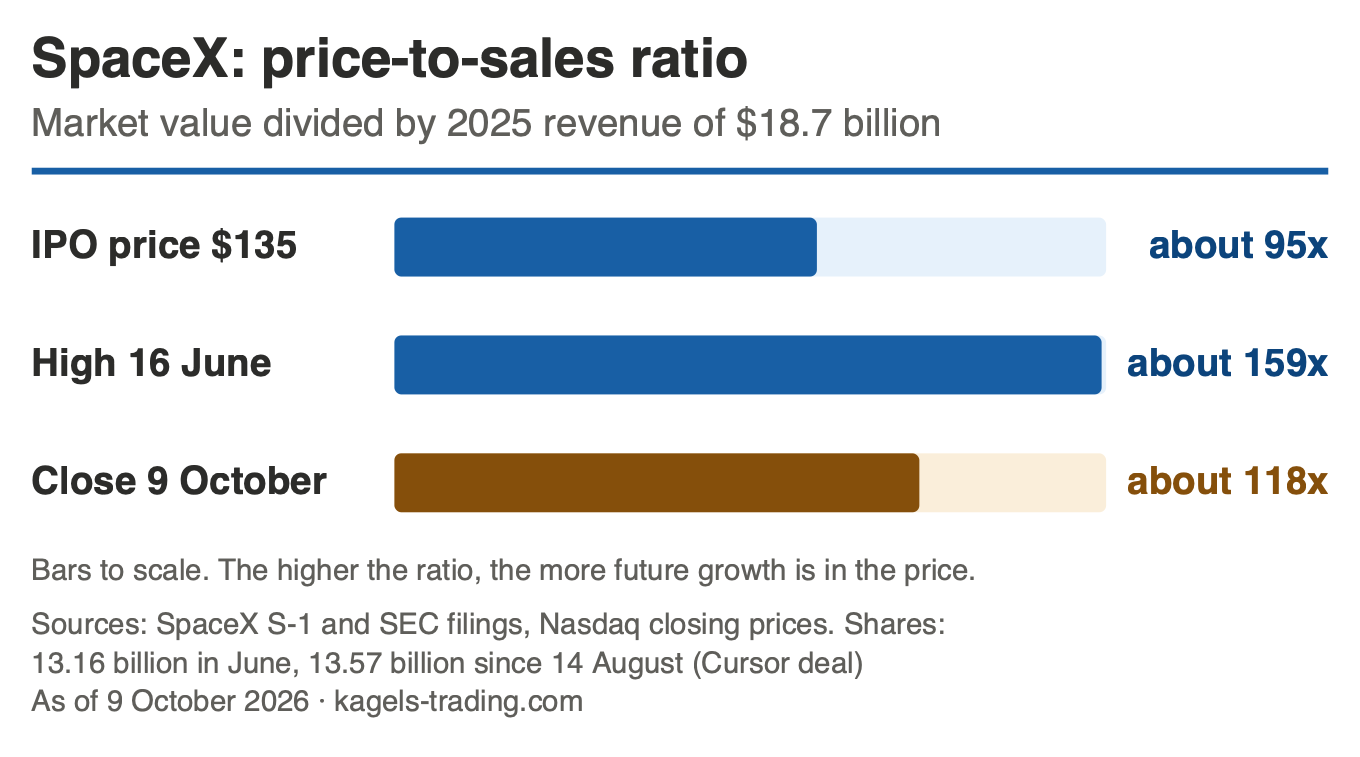
The price-to-sales ratio puts the price in relation to revenue. At the IPO price, SpaceX was valued at about 95 times its 2025 revenue, at the all-time high about 159 times. At the close on 9 October 2026, the ratio is about 118 times. The market still prices in growth that does not exist yet. The chart shows the ratio at each point:
 Click to enlarge
Source: SpaceX S-1 prospectus (SEC).
The figures in the official prospectus (S-1) at the SEC show the tension. They refer to the 2025 financial year:
- Revenue 2025: $18.7 billion, up about 33 percent from $14.1 billion in 2024. The growth is real and strong.
- Net loss 2025: $4.9 billion, plus an accumulated deficit of $41.3 billion as of 31 March 2026. On the bottom line, the company does not make money.
- Starlink carries the business: the connectivity unit brought in $11.4 billion of revenue, about 61 percent of the group total, with 10.3 million subscribers.
- AI burns capital: the xAI segment alone lost $6.355 billion in 2025. In effect, Starlink’s profits subsidise the AI ambitions.
One detail from the prospectus often gets lost in the headlines, but it is decisive. The average revenue per Starlink user fell from $91 a month (2024) to $81 (2025) and most recently to $66 in the first quarter of 2026. The growth comes from volume. Whether the margin per customer also falls depends on costs, which this figure does not show. At such a high price-to-sales ratio, the direction still matters.
How big the expectations are shows in a statement by Elon Musk himself. Shortly after the listing, he held out the prospect of $1 trillion in annual revenue by 2030. That would be a 53-fold increase from the $18.7 billion of 2025. Such numbers fuel the price, but nothing backs them up. Exactly this gap between vision and balance sheet makes the stock so speculative.
A second promise is more concrete and therefore easier to check. On the earnings call in early August, Musk said that an annual revenue run-rate of $100 billion by December was beyond question. Doing the maths, that is ambitious: the second quarter equals a run-rate of about $31 billion. By December, that would take more than a tripling in five months.
It is remarkable who disagrees. Of all banks, Deutsche Bank, which considers the goal achievable in principle, expects only $45 to 50 billion by the end of the year. That is less than half. For you as an investor, this does not mean the business is weak. It means there is a large gap between the announcement and the model. If you justify the stock with the AI revenue, you should know which of the two figures you are using.
The professionals disagree too, and the range is huge. Right after the IPO, CFRA issued a sell rating with a target of $115, which the price even fell below in July and August. Morningstar puts the fair value at only about $780 billion, about a third of the valuation on 9 October. At the other end, Morgan Stanley has a price target of $300 and a best case of $600. Oppenheimer names $280, Pivotal Research $220 and Mizuho $200. At the end of September, the average price target was about $236, according to reports. Between the lowest and the highest view lies a factor of ten.
A curiosity on the side for crypto traders: according to the prospectus, SpaceX holds 18,712 bitcoin. Their fair value was $1.29 billion as of 31 March 2026. How the price of the cryptocurrency could develop, we assess in our Bitcoin forecast.
The SpaceX IPO in 2026
The IPO is complete, and all key data are confirmed. They still matter, because every later price is measured against the IPO price.
The SpaceX IPO was the listing of Space Exploration Technologies on Nasdaq under the ticker SPCX on 12 June 2026, in which the company raised about $86 billion including the over-allotment option and reached a valuation of about $1.77 trillion at an IPO price of $135 per share.
Trading in SPCX therefore follows the hours of this exchange. The regular session runs from 9:30 a.m. to 4:00 p.m. Eastern Time (15:30 to 22:00 CEST). Before and after that, many brokers offer pre-market trading from 4:00 a.m. and after-hours trading until 8:00 p.m. Eastern Time. What changes in those sessions is in our guide to pre-market and after-hours trading, and all session times are in our overview of stock exchange hours.
The timetable was tight. SpaceX even brought it forward at the end, because the US Securities and Exchange Commission (SEC) finished its review faster than expected. Four dates are worth remembering:
- 20 May 2026: the prospectus (S-1) was published with the first real figures.
- 4 June 2026: the roadshow began, the marketing phase with the large investors.
- 11 June 2026: the IPO price was set at $135.
- 12 June 2026: first trading day, closing at about $161.
A roadshow is the marketing phase before an IPO, in which the company presents the offer to institutional investors before the final IPO price is set.
One important point: the price range in the S-1 was still empty. The actual price per share only emerged during the roadshow, based on demand. According to news reports, including Reuters, the timetable was kept.
What are the risks of SpaceX stock?
No honest article without the risks. I list them without sugar-coating, because this is where the sober trader parts ways with the hype-driven buyer.
- The record valuation: a price-to-sales ratio of about 118 times combined with high losses leaves hardly any margin of safety. The price action since June shows how fast such a valuation can shrink.
- The lock-up supply: since 6 August 2026, up to 911.5 million insider shares may be sold, about 43 percent more than the 638.9 million from the IPO. Further tranches of up to 319 million followed on 20 August and 9 September, and up to 328 million each on 24 September and 9 October. Next come up to 328 million on 24 October, then up to 1.3 billion shares two trading days after the third-quarter results in November. These are maximum amounts under the lock-up terms, not actual sales.
- Dilution through acquisitions: the Cursor purchase is paid in the company’s own shares instead of cash. Every such deal increases the share count and spreads future profits over more shares.
- Debt and cash outflow: in June, the group placed bonds for the first time, $25 billion in five maturities. The capital needs for Starship and the AI unit remain huge, and interest is due even in bad years.
- Hardly any say: as a shareholder you have practically no control. Elon Musk alone decides the strategic direction.
A dual-class share structure is a share setup with different voting rights through which founders like Elon Musk keep the voting majority despite an IPO, in the case of SpaceX about 82 percent after the IPO.
With the lock-up, it pays to look at the calendar. The release is staggered rather than tied to a single date, and the regular 180-day period ends on 8 December 2026. Musk’s own shares stay locked for 366 days, until June 2027. Under the prospectus, a bonus tranche of up to 455.8 million shares would have been released early if the stock had closed at least 30 percent above the IPO price, at $175.50 or higher, on 5 of the 10 trading days up to the second-quarter results on 4 August. That did not happen, so these shares wait for December as well, when up to about 798 million become free.
- High volatility: this risk has already shown itself. Between mid-July and early August, SPCX traded below the IPO price, at times more than 50 percent below the all-time high.
- Concentration risk Musk: the mere announcement of new share issues made Tesla stock fall about 5 percent in early June. The Musk-loyal investor base is spread across several companies, and that can weigh on both sides.
The most common mistakes when buying SpaceX stock
From decades of experience, I know the same pitfalls again and again. They have less to do with the stock itself than with the behaviour around it. These five cost retail investors money most often:
- Buying on the headline: “the largest IPO in history” was never a reason to buy, and “almost halved” is not one either. A lower price does not automatically make an expensive stock cheap.
- Using the IPO price as an anchor: the IPO price was the result of a roadshow, not a fair value. The market broke through it clearly in July, and it gives you no buy signal.
- Catching a falling knife: if you buy because the price “has already fallen so far”, you trade an opinion instead of a signal. I wait until the chart shows a reliable structure.
- Ignoring known dates: quarterly results and lock-up releases are in the calendar long in advance. If you build a position without this view, the extra supply will surprise you.
- Choosing a position that is too large: a highly volatile new issue should not take a large share of your account. How to size a position is in our guide to risk management.
These mistakes are likely to repeat at the next mega IPO. How the Anthropic IPO is shaping up and what is different from SpaceX, we cover separately. While there is no price yet, we assess Anthropic in our Anthropic stock forecast. OpenAI will take longer: why there is no OpenAI stock yet is explained separately, and we assess the valuation before a listing in our OpenAI stock forecast.
Conclusion: a fascinating company, an ambitious valuation
I find SpaceX impressive as a company, and Starlink is a real profit engine with huge growth. But as a trader, I separate my enthusiasm for the technology from the question of the right entry price. Even after the recovery, you pay about 118 times 2025 revenue for a group that loses billions on the bottom line. That simply leaves me no margin of safety.
The price action has confirmed the pattern I see again and again with new issues: first euphoria, then disillusionment. From the all-time high in June to below the IPO price took less than five weeks. Anyone who bought the hype spent weeks at a loss, the first quarterly results shook the price again in early August, and only since late August has the stock held above the IPO price for good. I look at the stock when the chart shows a reliable structure, not because a headline demands it.
Frequently asked questions about SpaceX stock
What is the ticker symbol of SpaceX stock?
SpaceX stock trades on Nasdaq under the ticker SPCX. Its ISIN is US84615Q1031. It has been trading since 12 June 2026.
Is SpaceX on the stock market?
Yes, SpaceX has been listed on Nasdaq since 12 June 2026. Before that, the company was private, and only with the first listing did its shares become publicly tradable. Since the end of June the stock has also been part of the MSCI World, and since early July of the Nasdaq 100.
Where can I buy SpaceX stock?
You can buy SPCX through any broker with access to the US stock market. On Nasdaq you pay in US dollars, and some brokers also offer it on European exchanges in euros. Subscribing like at the IPO is no longer needed, you simply trade at the market price.
Why did SpaceX stock fall below the IPO price?
After the all-time high of $225.64 on 16 June 2026, a downtrend began, and in mid-July the price fell below the IPO price of $135. Several factors worked together: the extremely high valuation, the enormous pace of capital spending of $18.4 billion in the second quarter alone, and the prospect of extra supply from the lock-up releases from August. The stock first closed above $135 again on 10 August and has stayed above it since 21 August, because the feared wave of selling did not come.
Is SpaceX stock worth it for traders?
That depends strongly on your time horizon. For active traders, the high volatility can offer opportunities, because the stock has moved in wide ranges since the IPO. For longer-term investors, the risk from a valuation of about $2.21 trillion combined with billions in losses outweighs.
Which bank led the SpaceX IPO?
Goldman Sachs led the IPO as lead underwriter, supported by about 21 other banks. That underlines the size of this IPO.
How much does SpaceX stock cost?
The IPO price was $135 per share, and the all-time high was $225.64. On 9 October 2026, SPCX closed at $162.57, above the IPO price. You find the current price at your broker, and the ongoing chart analysis in our SpaceX stock forecast linked above.
This English edition is based on our German edition on kagels-trading.de and has been adapted for international readers.
More Markets and Brokers guides
- Choose a broker
Interactive Brokers Review 2026: Fees and Platforms
Fees, platforms, investor protection and real futures commissions from a client since 1996.
- Understand your price
Market Makers: Who Sets Your Price and How They Profit
How market makers earn on the spread, who sets prices at German trading venues and what the EU ban on payment for order flow changed.
- Read bond market stress
MOVE Index: The VIX of the Bond Market, Explained
What the MOVE index measures, which readings signal stress, how it differs from the VIX and where its limits are.
- Research stocks
InvestingPro Review: Screener, ProPicks AI and WarrenAI
What the InvestingPro screener, ProPicks AI and WarrenAI do, what Pro and Pro+ cost and who needs which plan.
- Follow an IPO
Anthropic Stock: IPO Date, Valuation and How to Invest
Where the Anthropic IPO stands, how the valuation compares with revenue and how to get exposure before and after the listing.
- Invest in OpenAI before the IPO
OpenAI Stock: Can You Buy It, and Who Owns OpenAI?
Why there is no OpenAI stock yet, who owns OpenAI, where the IPO stands and how much OpenAI you get through Microsoft or SoftBank.