
OANDA Review 2026: Fees, TradingView and US Rules


Contents
- OANDA in 30 seconds
- What is OANDA?
- What US clients can trade at OANDA
- OANDA spreads and fees: two pricing models
- Leverage, margin, FIFO and hedging: the US rules
- OANDA platforms: web, mobile, MetaTrader 4 and the API
- OANDA on TradingView: how the connection works
- The OANDA demo account
- Deposits and withdrawals: why a withdrawal can stall
- Is OANDA legit and safe? Regulation and penalties
- OANDA vs FOREX.com
- Pros and cons of OANDA
- Conclusion: who should use OANDA?
- Frequently asked questions about OANDA
- About the author
OANDA is a forex broker whose US company, OANDA Corporation, is regulated by the CFTC and the NFA. US clients trade 68 currency pairs on OANDA’s own web and mobile apps, on MetaTrader 4 or directly from TradingView charts. Spot crypto is available too, but through a partner, Paxos, and not as a leveraged product.
We did not open an OANDA account or a demo account for this review, and we placed no orders. Everything below comes from OANDA’s US website and help center, TradingView’s help pages and the NFA BASIC database of the National Futures Association, all checked on November 12, 2026. Where two sources disagree, we say so. OANDA is not a partner of Kagels Trading, and this review has no affiliate link. It follows our editorial policy.
Risk warning: forex trading on margin is high risk, and you can lose more than you deposit. This review is not investment advice.
What do you want to do?
- Trade forex from TradingView chartsOANDA on TradingView
- Practice forex with virtual money firstOANDA demo account
- Trade forex often with a large accountCore pricing or Elite Trader
- Buy Bitcoin with leverage or sell it shortNot at OANDA US
- Trade US stocks, options or futuresAnother broker
- Not sure yetRead the fees section, then the regulation section
Click a line to jump to the section that explains it.
OANDA in 30 seconds
- Who it is for: US forex traders who want TradingView or MetaTrader 4 with a CFTC and NFA regulated dealer.
- Costs: spread-only pricing with no commission, or core spreads plus $0.70 per 10,000 units per side from a balance of $10,000.
- Rules: leverage up to 50:1 on major pairs, the FIFO rule and no hedging, as for every US forex dealer.
- Demo: free, with virtual money that does not expire.
- Watch out for: a $20 monthly inactivity fee after 12 months without trading, and three regulatory penalties between 2020 and 2025.
- Our rating: no score, because we did not test OANDA with an account.
What is OANDA?
OANDA Corporation is a futures commission merchant and retail foreign exchange dealer registered with the CFTC and a member of the NFA under NFA ID 0325821. That is how OANDA’s US website describes itself. According to NFA BASIC, retrieved on November 12, 2026, the firm is an “NFA Member Approved”, registered as a futures commission merchant (FCM) since March 14, 2003 and as a retail foreign exchange dealer (RFED) since October 5, 2010, with the designation Forex Dealer Member. The office is at 17 State Street in New York, and the firm also does business as FXTRADE.COM.
In forex, OANDA is your counterparty, not an exchange. A retail forex dealer quotes its own buy and sell prices and takes the other side of your trade. OANDA’s pricing page says its prices come from a network of banks and that nobody at OANDA can “hunt your stops”. You cannot check that claim from outside. On request, OANDA sends a Trade Execution Report with up to 15 of its own trades in the same pair from the 15 minutes before and after your order. Our guide to market makers explains how dealers like this earn money.
OANDA has other companies outside the US, and their rules differ. OANDA’s help center has separate sections for OANDA Corporation, OANDA (Canada) Corporation, OANDA Europe Limited, OANDA Australia, OANDA Asia Pacific, OANDA Global Markets and OANDA TMS. This review covers only OANDA Corporation, the company that serves US residents.
What US clients can trade at OANDA
| Market | What OANDA US offers (as of November 12, 2026) |
|---|---|
| Forex | 68 currency pairs, leverage up to 50:1 on majors and 20:1 on other pairs |
| Spot crypto | Bitcoin, Ethereum, Litecoin, Bitcoin Cash, PAX Gold, Chainlink, Aave, Uniswap and Solana through Paxos; no leverage, no short selling |
| Not offered | Stocks, options, futures, CFDs, crypto with leverage |
Spot crypto at OANDA US runs through Paxos, not through OANDA. OANDA’s footer says all crypto trades take place on the Paxos Trust Company exchange, that Paxos is not an NFA member and that OANDA does not hold your coins. According to OANDA’s spot crypto guide, only individual live accounts can activate it, and Paxos approves the application. IRA accounts, corporate accounts and ECP accounts are excluded.
OANDA publishes two different crypto fees, so we do not state which one you will pay. OANDA’s spot crypto guide in its help center, checked on November 12, 2026, says there is no spread markup or custody fee and that a fee of 0.75 percent applies to every executed order, with a minimum of $0.01. OANDA’s crypto page, checked the same day, advertises Bitcoin commissions “as low as 0.25%” without saying who gets that rate. Ask OANDA which fee schedule applies to your account before you fund the crypto account.
OANDA spreads and fees: two pricing models
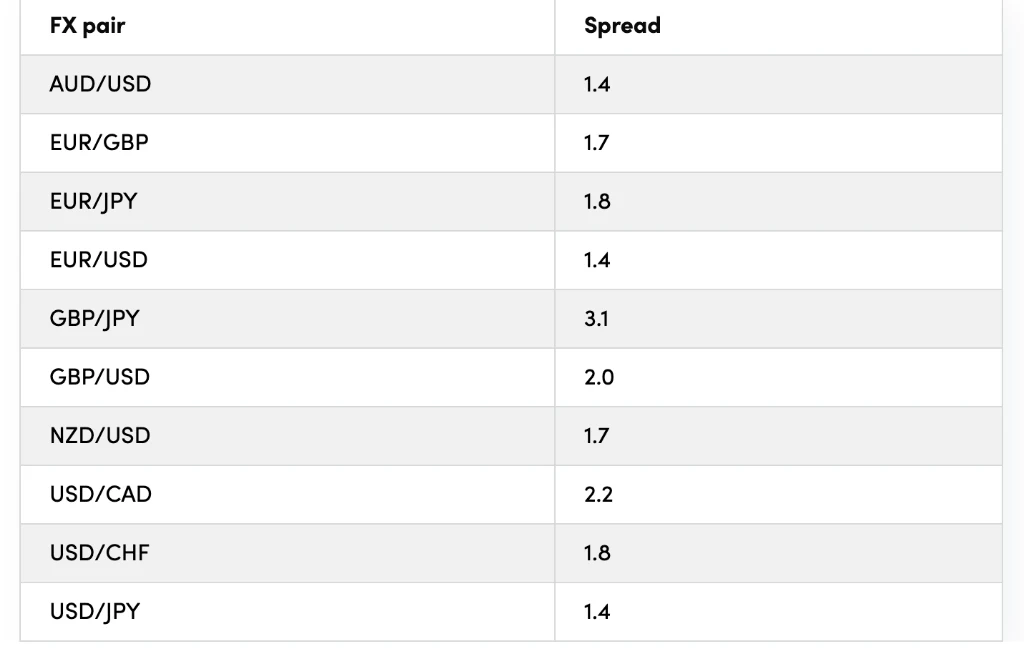
OANDA US offers two pricing models: spread-only and core spreads plus commission. With spread-only pricing, OANDA’s fee is built into the spread, the gap between the buy and the sell price, and you pay no commission. With core pricing, the spread is smaller and you pay a fixed commission on top. The spread is a real cost even when no fee appears on your statement.
 Click to enlarge
| Pair | Spread on OANDA’s pricing page (pips) |
|---|---|
| EUR/USD | 1.4 |
| USD/JPY | 1.4 |
| AUD/USD | 1.4 |
| EUR/GBP | 1.7 |
| NZD/USD | 1.7 |
| EUR/JPY | 1.8 |
| USD/CHF | 1.8 |
| GBP/USD | 2.0 |
| USD/CAD | 2.2 |
| GBP/JPY | 3.1 |
The spread table on OANDA’s pricing page has no date and no label. On November 12, 2026, the pricing page listed the spreads above for its most popular pairs, without saying whether they are averages, minimums or typical values. OANDA’s separate historical spreads tool shows minimum, average and maximum spreads in 15-minute steps. OANDA also says spreads can be wider around market opens and closes and during major news.
Core pricing needs at least $10,000 and costs $0.70 per 10,000 units on each side of a trade. According to OANDA’s help page on core pricing, you need a deposit or balance of at least $10,000 and must register for it. The commission is charged when you open and again when you close, so a round trip of 10,000 units costs $1.40 plus the spread. Spreads start “as low as 0.0” on selected majors such as EUR/USD, USD/JPY, USD/CAD and AUD/USD, and they rise when liquidity is low.
A quick comparison for one standard lot of EUR/USD (100,000 units), using OANDA’s own numbers. At the listed spread of 1.4 pips, spread-only pricing costs about $14 per round trip, because one pip on 100,000 EUR/USD is worth $10. Core pricing costs $14 in commission alone, so the commission already equals the whole listed spread: with a core spread of 0.0 pips the two models tie, and with 0.2 pips core pricing costs about $16. Before rebates, core pricing is only cheaper when the spread-only spread at that moment is more than 1.4 pips wider than the core spread. Check both models with your own pairs and times, for example in the historical spreads tool.
High-volume traders can earn cash rebates in the Elite Trader program. From $10 million traded a month, OANDA pays rebates per million traded: the pricing page lists five tiers from $5 to $17 per million. The Elite Trader page adds an Elite Extra level with higher rebates of up to $20 per million, which needs a deposit or balance of $50,000. Elite traders also get a TradingView subscription reimbursement, a dedicated relationship manager and free wire transfers.
| Fee (OANDA Corporation, November 12, 2026) | Amount |
|---|---|
| Minimum deposit | None |
| Deposits and withdrawals | No OANDA fee (your bank may charge) |
| Inactivity fee | $20 a month after 12 months without trading |
| Currency conversion | 1.0% on the mid rate when profit or loss is in another currency |
| Overnight financing | Tom-next rate plus an admin fee of 1.0% a year on most pairs (2.0% or 4.0% on some exotics) |
| Crypto (Paxos) | Two different figures on OANDA’s pages (0.75% in the help center, “as low as 0.25%” on the crypto page) |
The inactivity fee hits accounts that sit unused. According to OANDA’s charges page, a $20 monthly fee starts when an account has had no trading activity for 12 months. It is not charged while a position is open, it never takes the balance below zero, and if you start trading again you can ask for up to three months back. Crypto trades at Paxos do not count as activity in your forex account.
Holding a position overnight costs or earns financing. Positions open at 5 p.m. Eastern Time are charged or credited every day, based on the interest rate difference between the two currencies plus OANDA’s admin fee. On Wednesdays the charge is usually three times as high, because it covers the weekend.
Leverage, margin, FIFO and hedging: the US rules
US forex rules limit leverage to 50:1 on major pairs and 20:1 on all other pairs. OANDA’s spreads and margin page names the CFTC as the source of these limits. With 50:1, a $100,000 EUR/USD position needs $2,000 of margin. If your account stays under the required margin for two trading days in a row, OANDA closes all open positions; a margin closeout can also happen at once when the closeout level reaches 100 percent.
US accounts must follow the FIFO rule: first in, first out. According to OANDA’s FIFO page, the oldest trade has to be closed first when you hold several trades in the same pair and size. Since August 16, 2019, trades with a stop loss, take profit or trailing stop must each have a unique size. A pending order that would break the rule is cancelled when it triggers, and on MetaTrader 4 an expert advisor is not warned; only the MT4 mailbox shows it. The rule also applies to demo accounts.
Hedging, holding a buy and a sell in the same pair at once, is not allowed. OANDA’s help center says hedging is not available for OANDA Corporation clients, except for eligible contract participant (ECP) accounts, a category for large investors and companies. If your strategy or expert advisor needs hedging, an OANDA US account will not run it.
OANDA platforms: web, mobile, MetaTrader 4 and the API
OANDA US offers four ways to trade: OANDA Web, the OANDA mobile app, MetaTrader 4 and TradingView. OANDA Web and the mobile app are OANDA’s own platforms. Spot crypto works in the mobile app, not on the web platform or MT4; whether it also works on TradingView is disputed, see the next section. MetaTrader 4 is the classic platform for expert advisors, with the FIFO limits described above.
Developers can trade through the v20 REST API. According to OANDA’s API guide, the API can place, change and close trades, stream prices and download candle data for backtesting. It works with v20 and MT4 v20 accounts, and live and demo accounts need separate tokens. A FIX API exists only for institutional clients. Our guides to algo trading and the Python trading bot show what comes before an automated order.
OANDA on TradingView: how the connection works
OANDA connects its US accounts to TradingView without an extra fee; normal spreads and commissions apply. You log in to TradingView, open OANDA’s broker profile, click Trade and sign in with your OANDA email and password or a passkey. According to OANDA’s TradingView guide, you need a live OANDA account for this. Deposits and withdrawals still run through OANDA, not TradingView.
OANDA’s own guide notes that TradingView chart prices are indicative. The prices on the chart show the trend but are not the execution prices; the order ticket uses OANDA’s quotes. The symbol list can also contain symbols you cannot trade. When you place an order from the chart, check the price in the order panel, not on the candles.
For crypto on TradingView, OANDA’s and TradingView’s help pages contradict each other, so we do not count it as a feature. OANDA’s guide says “Forex instruments and spot crypto are available in TradingView”, with crypto symbols ending in .SPOT.US. TradingView’s help page for OANDA says that OANDA Corporation clients “can only trade on forex instruments” and that spot crypto is not available there. Both sources agree on forex, so that is what this review treats as the TradingView offer; if you want crypto on TradingView, ask OANDA before you fund the crypto account.
OANDA also advertises a free TradingView plan for new clients, but its own terms conflict. The TradingView page gives December 31, 2026 as the end date, while the linked promotion terms end the offer on December 31, 2025, so we leave the details out; ask OANDA for the current terms. For all other TradingView brokers in the US, see our TradingView brokers guide.
The OANDA demo account
OANDA’s demo account is free, opens instantly and its virtual money does not expire. According to OANDA’s demo page, you enter your country, name, email and phone number and get the demo account right away. You can add virtual funds yourself in OANDA’s account portal. MetaTrader 4 demo sub-accounts are closed after 90 days without activity and cannot be reopened.
The demo uses “usually” the same prices as the live account, but it is a separate account. You cannot put real money into a demo or turn it into a live account; you open the live account separately. OANDA’s FIFO rule applies in the demo as well, so you practice under the same US rules.
OANDA’s US guide describes demo and live sub-accounts side by side on TradingView, but asks for a live account first. According to its TradingView guide, you sign in with your OANDA credentials: if demo and live accounts use the same email, they are linked and you sign in with the live password; if the emails differ, you use the credentials of the account you want. After that, your demo and live sub-accounts appear in a list at the bottom of the chart. If you do not have a live account yet, practice on OANDA’s own platforms or with TradingView’s own simulator, explained in our TradingView paper trading guide. Our day trading simulator comparison lists other practice options.
Deposits and withdrawals: why a withdrawal can stall
OANDA US accepts debit cards, ACH bank transfers and wire transfers, and charges no fee of its own for deposits or withdrawals. Debit cards must be Visa or Mastercard, prepaid cards are refused, and OANDA names Wise, Revolut and Robinhood among the card providers it does not accept. Card deposits are limited to $20,000 a month, an ACH deposit to $50,000. OANDA does not accept money from third parties, checks or cash.
Several OANDA rules can delay or limit a withdrawal. According to OANDA’s withdrawal page, money must first go back to the debit card you deposited with, up to the amount deposited, and only profits above that go out by wire. The name and address on your bank account must match your OANDA account, and a new bank account needs a statement no older than three months. Card deposits older than 400 days cannot go back to the card. OANDA says withdrawals usually take one to five business days; keep enough money in the account to avoid a margin call on open trades.
Is OANDA legit and safe? Regulation and penalties
Yes, OANDA Corporation is a registered US forex dealer, and you can check it in NFA BASIC under NFA ID 0325821. As a retail foreign exchange dealer, OANDA must meet capital requirements set by the CFTC and the NFA. But protection is limited: OANDA’s footer says forex accounts are not protected by SIPC and get no preference in a bankruptcy under the CFTC’s Part 190 rules. Crypto held at Paxos is not covered by SIPC either.
 Click to enlarge
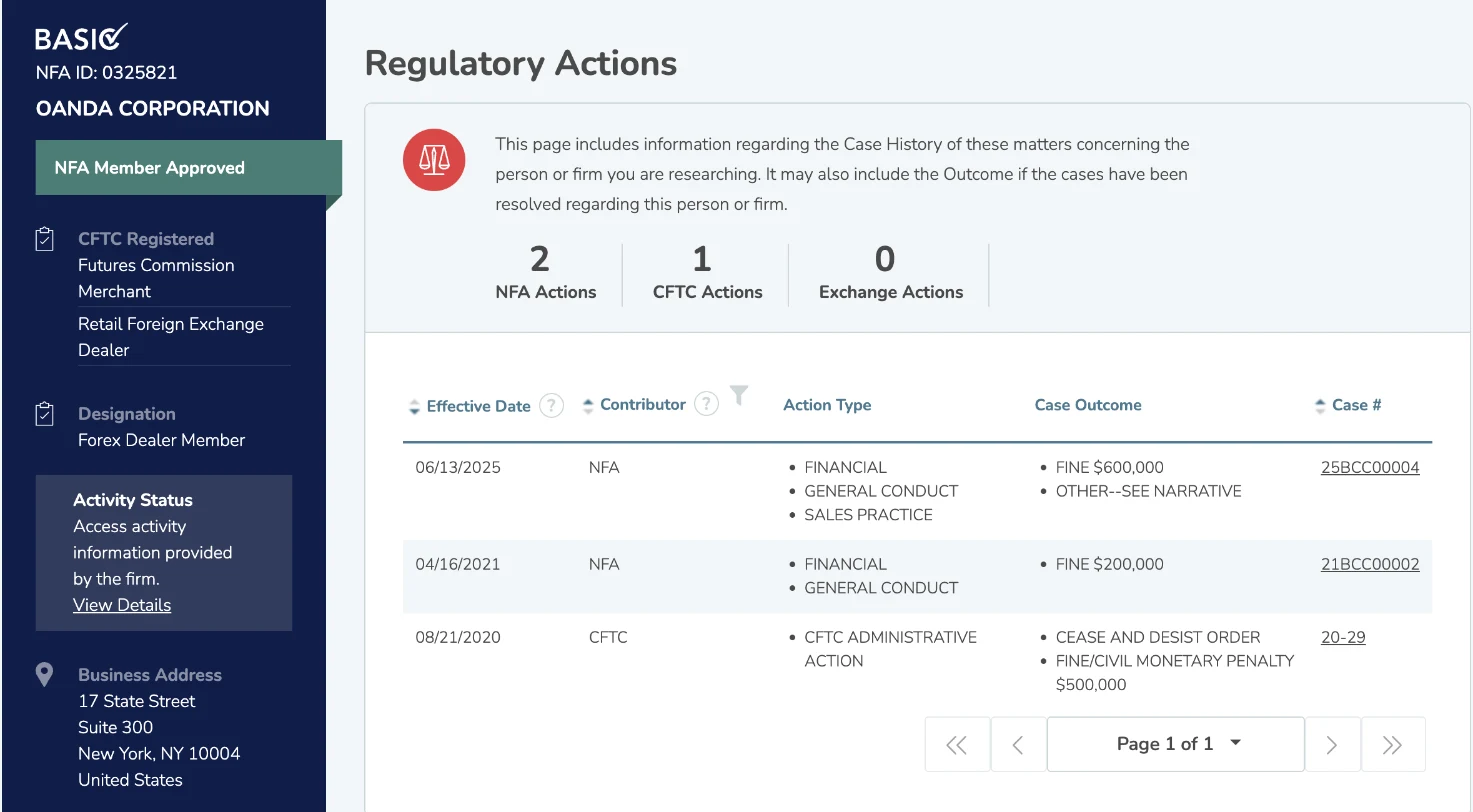
According to NFA BASIC, retrieved on November 12, 2026, there are three regulatory actions against OANDA Corporation: two by the NFA and one by the CFTC. All three were settled with fines. BASIC also lists four CFTC reparations cases, customer claims handled by the CFTC, which we did not review. You can check the current state yourself in NFA BASIC under ID 0325821.
| Effective | Case | Outcome |
|---|---|---|
| Aug 21, 2020 | CFTC 20-29 | $500,000 penalty, cease and desist |
| Apr 16, 2021 | NFA 21-BCC-002 | $200,000 fine |
| Jun 13, 2025 | NFA 25-BCC-004 | $600,000 fine, restitution effort up to $428,592.26 |
The 2025 NFA case included a pricing display problem that cost some customers money. On May 29, 2025, NFA’s Business Conduct Committee issued a complaint with five counts: inadequate net capital in transactions with an affiliate, wrong security deposits from customers, a pricing display issue for customers on a third-party platform OANDA allowed them to use, deficient advertising of its partnership with a crypto broker, and failure to supervise. The same day, it accepted OANDA’s settlement offer. OANDA neither admitted nor denied the allegations, but accepted that the decision includes findings that it broke NFA rules. It was ordered to pay a fine of $600,000 and to make a good faith effort to pay restitution of up to $428,592.26 to the affected customers within 45 days after the decision’s effective date. The NFA decision does not name the platform.
The 2021 NFA case and the 2020 CFTC case concerned controls and capital. In 2021, the NFA complaint named the anti-money laundering program, information security, complaint procedures, daily forex reports and supervision; the decision found violations of the reporting and supervision rules and fined OANDA $200,000. In 2020, the CFTC found that OANDA had missed net capital requirements in 2018 and 2019, paid dividends in breach of a capital rule and failed to supervise; it noted no indication that customers lost money from these capital violations.
OANDA vs FOREX.com
OANDA and FOREX.com both connect their US forex accounts to TradingView, and both call themselves number one in the US. OANDA bases its claim on the number of active forex accounts in published RFED data for the third quarter of 2025; FOREX.com, a subsidiary of StoneX Group, bases its claim on client assets in the 2025 CFTC reports. Both offer a spread-only account and a commission account with spreads from 0.0 pips.
| OANDA US | FOREX.com US | |
|---|---|---|
| Commission account | $0.70 per 10,000 currency units, charged on opening and on closing; from a $10,000 balance | $7 per $100,000 of USD notional value, charged on opening and on closing |
| Spread-only account | EUR/USD 1.4 pips on the pricing page | “as low as 1.2 pips” on the home page |
| MetaTrader | MT4 | MetaTrader (MT5 named) |
| Spot crypto | Through Paxos | not checked |
The table compares what each broker publishes, not tested costs. We took FOREX.com’s numbers from its US home page and its RAW pricing page on November 12, 2026, and did not check its regulatory record in the same depth. The two commissions are measured differently: OANDA counts units of the currency you trade, FOREX.com the value in US dollars, so 100,000 EUR/USD at 1.1000 costs $7.70 per side at FOREX.com in its own example. Before you choose, compare both brokers’ historical spreads for your pairs and times.
Pros and cons of OANDA
| Pros | Cons |
|---|---|
| Regulated in the US by the CFTC and NFA (NFA ID 0325821) | Forex accounts are not covered by SIPC |
| No minimum deposit, no OANDA fee for deposits or withdrawals | $20 monthly inactivity fee after 12 months |
| Direct TradingView connection at no extra cost | Crypto on TradingView unclear: OANDA and TradingView disagree |
| Free demo that does not expire | No hedging, FIFO rule limits some MT4 strategies |
| Core pricing from 0.0 pips plus commission | Core pricing needs $10,000; spread table has no date or label |
| v20 REST API for own code | Three regulatory penalties (2020, 2021, 2025) |
OANDA is a forex broker, not a broker for everything. If you want US stocks, options or futures, OANDA US does not offer them; Interactive Brokers covers far more markets, and API traders can compare Alpaca and Tradier. If you want to hold crypto in your own wallet, a crypto exchange fits better, for example Coinbase. OANDA’s strength is plain forex trading from TradingView or MT4 under US rules.
Conclusion: who should use OANDA?
OANDA fits US forex traders who want TradingView or MetaTrader 4 with a regulated US dealer and no minimum deposit. The demo account is free and does not expire, the TradingView connection costs nothing extra, and active traders with $10,000 or more can switch to core pricing. The US rules on leverage, FIFO and hedging apply as at every US forex dealer.
Before you open an account, check three things. First, compare the spreads for your pairs and trading times in the historical spreads tool, not only the table on the pricing page. Second, read OANDA’s entries in NFA BASIC, including the 2025 decision. Third, if you plan to trade crypto, confirm in your own account whether it works on TradingView and which fee applies. Fund a live account only with money you can afford to lose. Website: oanda.com.
Frequently asked questions about OANDA
Is OANDA legit?
Yes, OANDA Corporation is registered with the CFTC as a futures commission merchant and retail foreign exchange dealer and is an NFA member. You can check it in NFA BASIC under NFA ID 0325821. BASIC also lists three settled penalties: $500,000 by the CFTC in 2020, and $200,000 and $600,000 by the NFA in 2021 and 2025.
How much does OANDA charge per trade?
On spread-only pricing, OANDA charges no commission; the cost is in the spread. On November 12, 2026, its pricing page listed 1.4 pips for EUR/USD. With core pricing, from a $10,000 balance, you pay $0.70 per 10,000 units when you open and again when you close, plus a smaller spread.
Does OANDA have a demo account?
Yes, OANDA offers a free demo account with virtual money that does not expire. It opens instantly after you enter your contact details. MetaTrader 4 demo sub-accounts close after 90 days without activity.
Can I use OANDA on TradingView?
Yes, OANDA US clients with a live account can connect to TradingView at no extra cost. Normal spreads and commissions apply, and both OANDA and TradingView’s help confirm forex trading. For crypto on TradingView the two help pages contradict each other, so ask OANDA before you rely on it.
Why can’t I withdraw my money from OANDA?
Several OANDA rules can delay or limit a withdrawal. Card deposits must go back to the same debit card first, profits above that go out by wire, and the name and address on your bank account must match your OANDA account. OANDA may also ask for a recent bank statement. It says withdrawals usually take one to five business days; for a specific case, contact OANDA’s support.
Does OANDA allow hedging in the US?
No, OANDA Corporation does not allow hedging, except for eligible contract participant accounts. US accounts also follow the FIFO rule: with several trades of the same pair and size, the oldest must be closed first. Since 2019, trades with a stop loss or take profit must have a unique size.
What leverage does OANDA offer in the US?
Up to 50:1 on major currency pairs and 20:1 on all other pairs. These are the limits the CFTC sets for retail forex traders in the US. Crypto at OANDA US has no leverage at all.
Does OANDA charge an inactivity fee?
Yes, $20 a month once your account has had no trading activity for 12 months. It is not charged while a position is open and never takes the balance below zero. If you trade again, you can ask for up to three months of fees back.
More Markets and Brokers guides
- Open your first account
What Is a Brokerage Account? A US Beginner's Guide
How to open and fund a US brokerage account, cash vs margin, what it costs and what SIPC and FDIC really cover.
- Know what trading really costs
Trading Costs: Every Fee You Pay and How to Cut It
Spread, commissions, SEC and FINRA fees, market data, margin interest and tax, with yearly totals for three trading styles.
- Choose a broker
Interactive Brokers Review 2026: Fees and Platforms
Fees, platforms, investor protection and real futures commissions from a client since 1996.
- Check an offshore broker
PU Prime Review 2026: FCA Warning, Licences and Costs
Which PU Prime company you contract with, what the FCA warning means, and what 1:1000 leverage and the deposit bonus do to your account.
- Check an EU CFD broker
Tradeview Review 2026: Tradeview Europe, MFSA and Costs
What the Malta licence of Tradeview Europe covers, how it differs from the Cayman company, and what the three MetaTrader 5 accounts cost.
- Check ZuluTrade
ZuluTrade Review 2026: Costs, Regulation and US Status
Who runs the copy trading platform, what it costs through your broker, why the US was missing from its sign-up form and what the CFTC fined its US company for.
- Check CopyX
CopyX Review 2026: Is TAG Markets Copy Trading Legit?
Who runs the TAG Markets copy trading platform, which regulators warn about it, why US residents are excluded and how fast the 12x Amplify account eats your deposit.
- Check a commission-free app broker
Webull Review 2026: Fees, Margin Rates and Safety
Webull from its own fee schedule and FINRA records: what is free, margin rates and Premium, overnight trading, crypto and three fines.
- Understand your price
Market Makers: Who Sets Your Price and How They Profit
How market makers earn on the spread, who sets prices at German trading venues and what the EU ban on payment for order flow changed.
- Size up a bull market
Bull Market: How Long It Lasts and How to Spot the End
When a rise becomes a bull market, how long the 27 completed S&P 500 bull markets since 1928 lasted and gained, and where the current one stands.
- Read bond market stress
MOVE Index: The VIX of the Bond Market, Explained
What the MOVE index measures, which readings signal stress, how it differs from the VIX and where its limits are.
- Read stock market fear
VIX Index: What the Fear Gauge Measures and Normal Levels
What the VIX measures, which levels have been normal since 1990, how closely it tracks the S&P 500 and how VIX futures, options and ETPs work.
- Read the risk mood
Risk-On vs Risk-Off: Meaning, Assets and Indicators
What risk-on and risk-off mean, which assets rise and fall in each mode, five market shocks since 2008 and the VIX, DXY and AUD/JPY signals.
- Read market sentiment
Fear and Greed Index: How It Works, Tested Since 2021
How CNN builds its Fear and Greed Index from seven measures, what the zones mean and how the S&P 500 moved after readings below 20.
- Size up a bear market
Bear Market: How Long It Lasts and How to Spot One
When a decline becomes a bear market, how long the 27 S&P 500 bear markets since 1928 lasted, how long the recovery took and why Bitcoin had three since 2025.
- Trade an index CFD
Index CFDs at Interactive Brokers: Symbols, Costs and Trading
All 13 IBKR index CFDs, margin, stop and close-out worked through for IBDE40, financing, UK hours and the TradingView limit.
- Size an index future
Micro Futures: MES vs MNQ, Tick Values and Risk
MES and MNQ tick values, a worked sizing example from the stop with costs and slippage, and why margin is not your risk.
- Choose between futures and CFDs
Futures vs CFDs: Regulation, Order Execution and Costs
Who your counterparty is, EU, UK and US rules, how stops are triggered on CME and at CFD providers, and booked costs in a DAX example.
- Read the futures curve
Contango vs Backwardation: Futures Curves Explained
What contango and backwardation mean, what rolling does to a position in each case, and real gold, oil and gas curves from 28 October 2026.
- Understand the spot market
Spot Market Explained: Definition and Settlement Times
What a spot market is, why two days is a minimum and not a limit, and when stocks settle at T+1 in the US, EU, UK and Switzerland.
- Choose a silver future
Silver Futures: SI vs Micro Silver vs 100-oz SIC
SI, Micro Silver and the 100-ounce SIC compared by tick value, risk per contract, margin and December 2026 deadlines.
- Read the chip sector
SOX Index: Holdings, Weighting and How to Use It
What the SOX holds, how Nasdaq caps the weights, its largest declines since 2004 against the Nasdaq-100 and which ETFs really track it.
- Read the biotech sector
Nasdaq Biotechnology Index: Holdings, Weighting and Risks
What the NBI holds, how Nasdaq caps the weights, its long declines since 2003 against the Nasdaq-100 and which ETFs really track it.
- Read the transport sector
Dow Jones Transportation Average: Stocks and Dow Theory
The 20 stocks in the Dow transport index, why the share price sets their weight, declines since 1992 and what Dow Theory can and cannot tell you.
- Read the French market
CAC 40 Index Explained: All 40 Stocks, Weights and Trading Hours
All 40 CAC 40 stocks, how Euronext caps the weights at 15 percent, trading hours in Eastern Time and how it differs from the DAX.
- Research stocks
InvestingPro Review: Screener, ProPicks AI and WarrenAI
What the InvestingPro screener, ProPicks AI and WarrenAI do, what Pro and Pro+ cost and who needs which plan.
- Judge a stock-picking newsletter
Motley Fool Stock Advisor Review: Cost and Track Record
What Motley Fool Stock Advisor costs after the first year, how the advertised return is calculated, refund and renewal terms, and who it suits.
- Use the free news portal
Investing.com Review: Free Tools, Data and Limitations
What the free Investing.com portal does well, where the quote prices come from and when InvestingPro is worth paying for.
- Find real AI revenue
AI Stocks 2026: How Listed Companies Earn From AI
Which listed companies earn from AI in cloud, software, infrastructure and chips, disclosed AI revenue against hope, plus AI ETFs and risks.
- Compare AI data center suppliers
AI Infrastructure Stocks: 10 Data Center Suppliers Compared
Ten suppliers for power, cooling, servers and optics compared on free cash flow, customer concentration and next dates, with filters and a two-stock comparison.
- Follow an IPO
Anthropic Stock: IPO Date, Valuation and How to Invest
Where the Anthropic IPO stands, how the valuation compares with revenue and how to get exposure before and after the listing.
- Invest in OpenAI before the IPO
OpenAI Stock: Can You Buy It, and Who Owns OpenAI?
Why there is no OpenAI stock yet, who owns OpenAI, where the IPO stands and how much OpenAI you get through Microsoft or SoftBank.
- Understand a stock split
Stock Splits Explained: Forward and Reverse Splits
What forward and reverse splits change and what they do not, the dates that matter, what happens to options and the $1 listing rule.
- Analyze a company
Fundamental Analysis: 12 Ratios, a Worked Example, 5 Steps
Twelve ratios with formulas and rules of thumb, worked through Microsoft's 2026 annual report, a five-step process and the fundamentals of forex, commodities and crypto.
- Value a stock
Value Investing: Intrinsic Value, Margin of Safety, Traps
Intrinsic value against price, a worked DCF with a sensitivity table, Coca-Cola as a real example, the value premium since 1926 and value traps.
- Value a new listing
SpaceX Stock (SPCX): Valuation, Risks and How to Buy
How to buy SpaceX stock, what the company is worth after the IPO and which risks the lock-up calendar brings.