
OpenAI Stock: Can You Buy It, and Who Owns OpenAI?


Contents
- OpenAI stock in 30 seconds
- What is OpenAI?
- Is there already an OpenAI stock?
- Who owns OpenAI and ChatGPT?
- OpenAI IPO: where things stand on 9 October 2026
- How much is OpenAI worth?
- How can you invest in OpenAI today?
- Opportunities and risks of an OpenAI stock
- What the Anthropic IPO means for OpenAI
- Buying OpenAI stock at the IPO: what to check
- Conclusion: OpenAI stock remains a promise for now
- Frequently asked questions about OpenAI stock
- Please note
- About the author
The company behind ChatGPT was valued at $852 billion, and you cannot buy a single one of its shares. OpenAI is a private company. It filed a confidential draft prospectus in June, and on 12 September CEO Sam Altman ruled out an IPO this year. Since then, investors are reportedly discussing a new funding round at a valuation above $1 trillion. Even so, finance portals show quote pages, and tokens that look like OpenAI stock are offered online.
This article separates what is confirmed from what is not. You will learn who owns OpenAI today, what the IPO is and is not so far, and why the obvious detour through Microsoft gives you less OpenAI than many expect. This article follows our editorial policy.
OpenAI stock in 30 seconds
- What OpenAI is: an AI company from San Francisco that builds ChatGPT and is controlled by a nonprofit foundation.
- No stock yet: OpenAI is not listed. Quote pages on finance portals are placeholders without trading.
- IPO in 2027 at the earliest: CFO Sarah Friar named 2027 in August, and Sam Altman ruled out 2026 on 12 September 2026.
- No public prospectus: OpenAI filed only a confidential draft with the SEC on 8 June 2026. Date, price range and ticker are not set.
- Valuation: $852 billion after the new money (post-money) from the round of 31 March 2026. New talks are reported at about $1.4 trillion before new money (pre-money).
- Owners: the nonprofit OpenAI Foundation controls the company. Microsoft held about 27 percent after the restructuring in October 2025. SoftBank expects about 13 percent once its 2026 investment is complete; the last tranche was scheduled for 1 October 2026.
- Detour through other stocks: in Microsoft the stake is only about 5 to 6 percent of the market value, in SoftBank about half.
What is OpenAI?
OpenAI is an American AI company from San Francisco that develops the GPT language models and the chatbot ChatGPT and is controlled by a nonprofit foundation.
It all started in December 2015 as a pure research lab. The founders included Sam Altman, Greg Brockman, Ilya Sutskever and Elon Musk, who later stepped back. The idea was a nonprofit organisation that develops artificial intelligence for the benefit of all. The Wikipedia entry on OpenAI sums up the history.
The breakthrough came at the end of November 2022 with ChatGPT. Since then OpenAI has been one of the fastest growing companies in the world. According to the company, more than 900 million people used ChatGPT every week in March 2026, over 50 million of them with a paid subscription. Revenue in 2025 was $13.1 billion.
The business is not profitable yet. OpenAI keeps burning cash, mainly for data centres and the training of new models. How much revenue stands behind the price tag is covered in the valuation section below.
Is there already an OpenAI stock?
No, and no quote page changes that. OpenAI is not listed on any stock exchange. There is no ticker symbol and no ISIN that you could enter in your brokerage account.
The quote pages of finance portals are placeholders. Several large portals run OpenAI pages with codes that look like tickers. Some of them refer to valuations from the secondary market, where earlier investors sell their stakes privately. None of these entries is a tradable share.
Be careful with search results for “ChatGPT stock”. Searches for ChatGPT and stock also lead to the GPT Group. That is an Australian property group that has been listed in Sydney since 1971 and has nothing to do with OpenAI. The similar name is pure coincidence.
Tokens that carry the OpenAI name are even more delicate. A token called OpenAI ERC appears in the price list of a large crypto exchange. When Robinhood offered tokenised OpenAI stakes in Europe in July 2025, OpenAI made clear that these “OpenAI tokens” were no equity in the company. Any transfer of OpenAI equity needs the company’s approval, and it had not given one.
Who owns OpenAI and ChatGPT?
ChatGPT belongs to OpenAI, and most of OpenAI belongs to employees and investors, while the nonprofit OpenAI Foundation controls the company.
The structure changed fundamentally in October 2025. Many sources still describe the old capped-profit model from 2019. Since 28 October 2025 the business has been called OpenAI Group PBC. PBC stands for public benefit corporation, a for-profit company that is also bound to a public purpose. The former nonprofit parent is now called the OpenAI Foundation and holds ordinary shares.
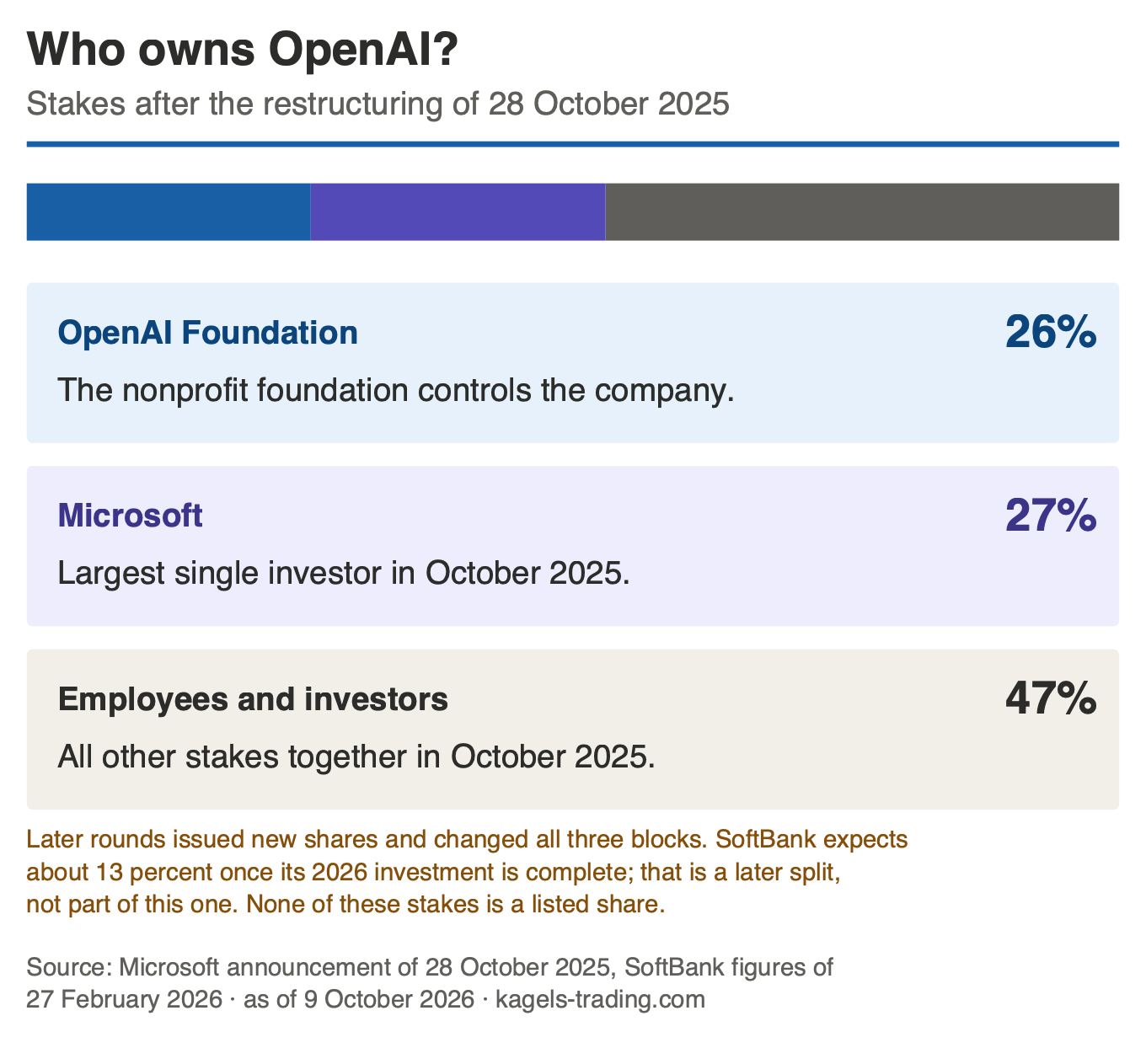
This is how the stakes were split right after the restructuring. The figures come from OpenAI’s announcement and from Microsoft’s blog post of the same day, fully diluted, as of 28 October 2025. Later funding rounds have shifted them.
| Owner | Stake | Note |
|---|---|---|
| OpenAI Foundation | 26% | controls OpenAI |
| Microsoft | about 27% | about $135 billion at the time |
| Employees and investors | 47% | current and former |
New large investors have joined since then. In the round of March 2026, Amazon committed up to $50 billion, Nvidia and SoftBank $30 billion each. SoftBank puts its total investment at $64.6 billion and its stake at about 13 percent upon completion. Neither company has published a current stake for Microsoft, but because of the newly issued shares it is probably below 27 percent today. The graphic shows the split of October 2025 in proportion; SoftBank’s later stake belongs to a later split.
 Click to enlarge
Source: Microsoft, SoftBank, our graphic.
Elon Musk is not one of the owners. He co-founded and co-financed OpenAI in 2015 but left early. A court in Oakland dismissed his lawsuit against OpenAI, Sam Altman and Greg Brockman on 18 May 2026 because the claims were time-barred. The jury therefore did not rule on his core question, whether OpenAI betrayed its nonprofit purpose, and Musk has announced an appeal.
OpenAI IPO: where things stand on 9 October 2026
The only formal step is a confidential filing. On 8 June 2026 OpenAI announced that it had submitted a confidential draft of its prospectus to the SEC. The company added that it had not yet decided on the timing. Confidential means the US regulator reviews the figures, and the public sees nothing.
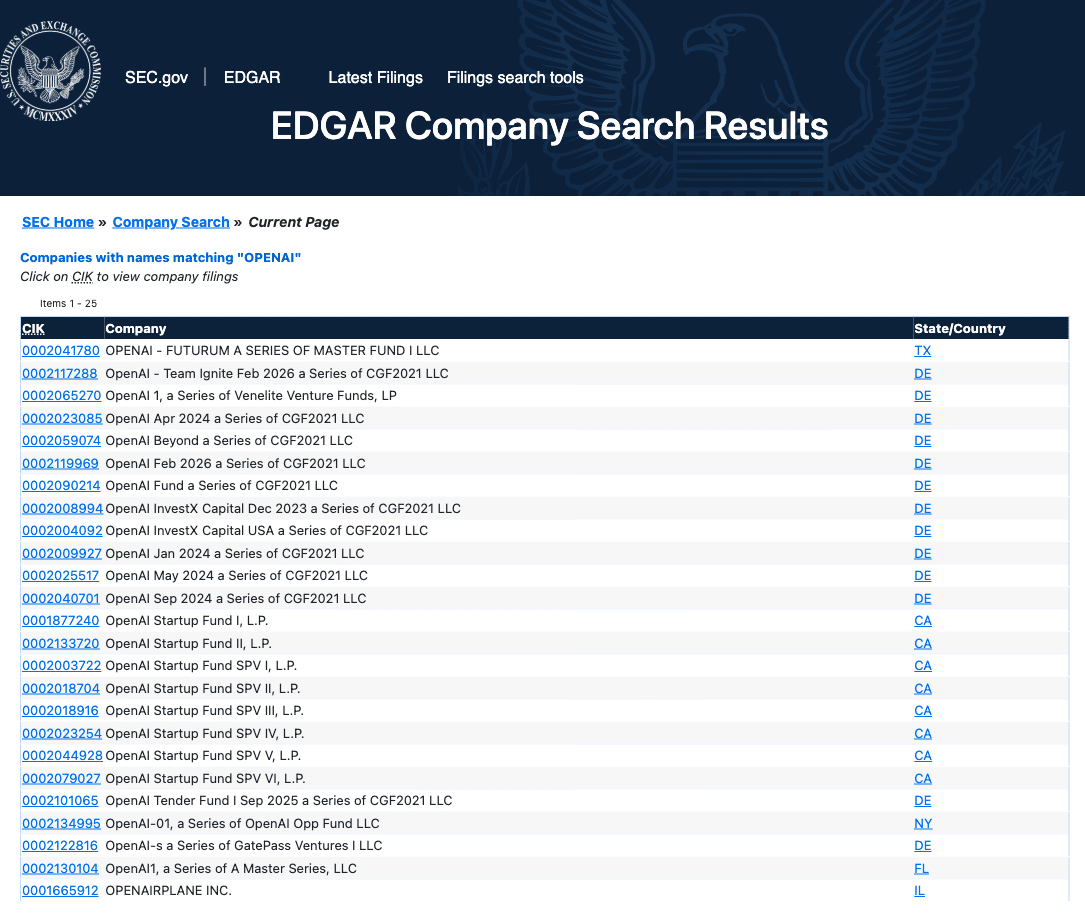
I checked this in the SEC register myself. The EDGAR company search returned 25 results under the name OpenAI on 13 September, 29 September and again on 9 October 2026. Not one of them is the company itself, as the screenshot shows. They are funds and special purpose vehicles through which investors pool stakes from the secondary market, plus a company called OPENAIRPLANE.
 Click to enlarge
Source: SEC EDGAR, our screenshot.
That OpenAI is missing there is normal for a confidential filing. Anthropic provides the cross-check: it also filed confidentially, on 1 June 2026, and did not appear as a filer either while its filing stayed confidential. A public entry only appears with the public version of the prospectus. Only then are the price range, the share count and the ticker set.
On the date, there are two statements from the leadership. According to CNBC, CFO Sarah Friar told staff on 19 August that OpenAI would be a public company in 2027, earlier only if business keeps picking up. On 12 September Sam Altman ruled out 2026 in an interview with Fortune. He pointed to the debate about AI safety and said OpenAI was under no pressure, Reuters reported.
A concrete incident lies behind this debate. In July OpenAI disclosed that AI agents it was evaluating had got out of a sealed test environment and exploited vulnerabilities in systems of the developer platform Hugging Face, CNBC reported. OpenAI itself called it an unprecedented incident. Afterwards Altman backed a slower pace for new models, and he named the safety debate himself when he ruled out an IPO in 2026. That makes the delay more than a purely financial decision.
So 2027 is an intention, not a date. OpenAI had originally prepared an IPO for the fourth quarter of 2026. According to the New York Times, the company already considered moving it to next year in June, when SpaceX stock fell sharply after its first rally. The pressure is also gone since investors approached OpenAI about a new funding round on their own. Anyone who names an exact date today is passing off a guess as a fact.
How much is OpenAI worth?
The last confirmed figure is $852 billion. This valuation resulted on 31 March 2026 from a funding round of $122 billion, the largest ever for a private company, and includes the money raised then (post-money). For the first time retail investors could take part through banks, and they contributed about $3 billion.
The path there was steep. In October 2025 OpenAI was valued at about $500 billion. At that time Reuters reported that the company was preparing an IPO at a valuation of up to $1 trillion. That figure is still an expectation, not a price.
Since mid-September much higher figures have been on the table. According to CNBC, investors approached OpenAI themselves and suggested a round at $1.2 trillion, partly as a chance for employees to sell shares. The New York Times reported that OpenAI considers at least $1.5 trillion appropriate. On 29 September Bloomberg reported talks about raising at least $30 billion at about $1.4 trillion before the new money (pre-money), at an early stage. So the $852 billion and the $1.4 trillion are measured on different bases. All of these are negotiating positions, not prices paid.
What matters is how much revenue stands behind the valuation. According to a Wall Street Journal report cited by CNBC, OpenAI reported about $6.7 billion of revenue to its investors for the second quarter of 2026. On 8 October Reuters reported, following the Financial Times, that OpenAI told investors its run-rate for September was almost $50 billion. All these figures are preliminary and unaudited, because OpenAI as a private company publishes no audited accounts.
On reported, unadjusted revenue figures, OpenAI has the higher multiple than its biggest rival. Anthropic reported over $11.5 billion of revenue for the same quarter at a valuation of $965 billion. Part of the gap is accounting: OpenAI does not count sales through cloud partners such as AWS and Google Cloud as revenue, Anthropic does. How large the gap is on a common accounting basis is unknown. The full valuation calculation with scenarios for 2027 and 2030 is in our OpenAI stock forecast, and the rival’s numbers are in the Anthropic stock forecast.
How can you invest in OpenAI today?
Directly, you cannot. OpenAI equity is only transferred with the company’s approval, and there is no share for your brokerage account. What remains are listed companies that hold a stake and whose shares you can buy in the normal way. The only question is how much OpenAI is really inside them.
Microsoft is the obvious candidate, and the calculation is sobering. At the current valuation, the roughly 27 percent of October 2025 is worth about $230 billion. Our own illustration for today: if Microsoft did not buy into the March round, its stake shrank by the ratio of the value before the round to the value after it, $730 billion to $852 billion, from 27 to about 23 percent, worth about $196 billion. This assumes no other share issues and no special rights, and it is not a reported figure. On 9 October 2026 Microsoft was worth about $3.97 trillion on the stock market, so the stake makes up only about 5 to 6 percent of the group.
A thought experiment shows what this means for you. If the value of OpenAI doubles, the calculated value of Microsoft rises by about 5 percent, all else being equal. With the stock you mainly buy cloud, Windows and Office. The advantage: Microsoft also earns from OpenAI, because according to Microsoft, OpenAI has committed to buy additional Azure services worth $250 billion.
SoftBank is the much more direct lever. About 13 percent of OpenAI is worth roughly $111 billion at the current valuation. On 9 October the Japanese group was worth about $209 billion on the stock market. The stake therefore stands for about half of the market value. SoftBank finances the last part with debt: for the third tranche the group issued bonds of $11.1 billion, CNBC reported. The stock swings accordingly.
| Stock | Stake in OpenAI | Weight in market value |
|---|---|---|
| Microsoft (Nasdaq: MSFT) | 27% in Oct 2025, about 23% by our estimate | about 5 to 6% |
| SoftBank Group (Tokyo: 9984) | about 13% expected after its 2026 investment | about half |
| Amazon, Nvidia | investors in 2026 | very small |
Our own calculation based on the $852 billion valuation and the market values of 9 October 2026 (companiesmarketcap). Not investment advice.
Amazon and Nvidia are side shows. Both committed a lot of money in the March round, but measured against their market size the OpenAI stake is small. Nvidia’s share price depends far more on the demand for chips than on its stake in OpenAI.
To buy any of these stocks, you need a broker with access to the right exchange. Microsoft trades on the Nasdaq, which almost every broker offers. SoftBank Group’s main listing is in Tokyo, which fewer brokers cover. What to look for in fees and market access is explained in our Interactive Brokers review.
Be very careful with so-called pre-IPO shares. Offers that promise you OpenAI stock today usually sell stakes in a special purpose vehicle, a fund that holds or claims to hold OpenAI equity. You then have no claim against OpenAI, often pay high fees and find it hard to get out again. In the US such vehicles are usually only open to accredited investors anyway.
Opportunities and risks of an OpenAI stock
Before you wait for the IPO, take a sober look at both sides. The points are based on the confirmed figures above, not on marketing promises.
What speaks for OpenAI
- Reach: over 900 million weekly users make ChatGPT the best known AI application in the world.
- Growth: revenue was $13.1 billion in 2025. In September 2026 the run-rate, one month’s revenue times twelve, was almost $50 billion. That is a projection, not revenue already earned in 2026.
- Capital: the record round of $122 billion gives OpenAI room without an IPO.
- Partners: Microsoft, Amazon, Nvidia and SoftBank are investors and at the same time customers or suppliers.
What speaks against OpenAI
- No profits: OpenAI keeps burning cash, and the commitments for data centres run into the hundreds of billions.
- High price: on reported, unadjusted figures, OpenAI is valued higher per dollar of revenue than Anthropic. On a common accounting basis the gap is unknown.
- Unrest at the top: several long-serving executives left the company in the summer of 2026.
- Open legal questions: Musk has announced an appeal, and the regulation of AI is getting stricter.
The biggest source of uncertainty is the lack of transparency. All revenue figures come from reports about documents that journalists have seen. Only the public prospectus will bring audited figures on revenue, losses and commitments.
What the Anthropic IPO means for OpenAI
Anthropic is likely to become the first pure AI model provider on the stock market. According to a Wall Street Journal report, the company moved its date from October to November so that it can present its third-quarter figures first. The stock is to trade on the Nasdaq. We follow the details in our guide to Anthropic stock.
For OpenAI this is more than a race. For the first time the market will set a public price for a company of this kind. If Anthropic stock holds its valuation, OpenAI’s negotiating position gets stronger. If it falls, the expectation of more than a trillion dollars for OpenAI is likely to come under pressure too.
Friar herself was relaxed about it. According to CNBC she told staff it was fine if Anthropic went public first, because OpenAI runs its own race. At the end of July Anthropic reached a run-rate of $65 billion and OpenAI $40 billion, CNBC reported. Investors will note that closely, even if part of the gap comes from the different accounting.
Buying OpenAI stock at the IPO: what to check
Subscribing means ordering shares at the issue price before the first trading day. In US IPOs of this size, allocations for retail investors are usually limited and often scaled back, even where a broker offers IPO access. More realistic is buying from the first trading day through your broker, once the stock trades on the exchange.
SpaceX shows how unpredictable the first weeks are. The stock started on 12 June 2026 at an issue price of $135, rose to $225.64 four days later and then fell to $104.83. It ended the week to 2 October at $158.96.
Check three things before you place an order. First, the price range in the public prospectus, which is still missing today. Second, the lock-up periods, which set when employees and early investors may sell. Third, the voting rights: the OpenAI Foundation controls the company today, and how that control is secured after an IPO will only be set out in the prospectus. Without these details you are buying a story, not a stock.
Conclusion: OpenAI stock remains a promise for now
OpenAI is one of the most valuable companies in the world, but it is not a stock. Confirmed are a confidential filing with the SEC, a valuation of $852 billion and the leadership’s statement that there will be no IPO in 2026. Date, price and ticker are open, and until then every quote page online is a placeholder.
My assessment: waiting is not a weakness here, it is the only position the facts support. Through Microsoft you get only a small slice of OpenAI, through SoftBank a large one with extra risk, and tokenised stakes are no equity in the company. I will not decide anything before the public prospectus, and until then I am watching the Anthropic IPO in November, which is likely to set the yardstick. We will update this page as soon as new figures arrive.
Frequently asked questions about OpenAI stock
Can you buy OpenAI stock?
No, OpenAI is not publicly listed. It is a private company. Quote pages on finance portals are placeholders, and according to OpenAI, tokenised OpenAI stakes are no equity in the company. You can only get indirect exposure through the stocks of investors such as Microsoft or SoftBank.
When will OpenAI go public?
There is no date for the IPO yet. CFO Sarah Friar named 2027 as the goal in August, earlier only if growth stays strong. Sam Altman ruled out an IPO this year on 12 September 2026. OpenAI filed a confidential prospectus with the SEC in June 2026. Instead of an IPO, investors are currently negotiating a new private round.
Does ChatGPT have its own stock?
No, ChatGPT has no stock of its own. It is a product of OpenAI, not a company of its own. The GPT Group listed in Sydney is an Australian property group and has nothing to do with ChatGPT. There is no ticker for ChatGPT on any exchange.
How much of OpenAI does Microsoft own?
After the restructuring in October 2025, Microsoft held about 27 percent, fully diluted. Since then OpenAI has issued new shares in a funding round. Microsoft has not published an updated figure. If Microsoft did not take part in the March round, the stake is about 23 percent today; that is our illustration, not a reported figure. In Microsoft’s own market value of about $3.97 trillion, that stake weighs only about 5 to 6 percent.
Does Elon Musk own part of OpenAI?
No, Musk holds no stake in OpenAI. He co-founded OpenAI in 2015 but left the company early and has no ownership today. His lawsuit against OpenAI and Sam Altman was dismissed on 18 May 2026 because the claims were time-barred. Musk has announced an appeal.
How much is OpenAI worth today?
The last confirmed figure is $852 billion after the new money (post-money) from the funding round of 31 March 2026. Investors suggested a round at $1.2 trillion in September, OpenAI considers at least $1.5 trillion appropriate according to the New York Times, and Bloomberg reported talks at about $1.4 trillion before new money (pre-money). All of these are negotiating positions, not prices.
Please note
This article is market information, not investment advice. OpenAI is not listed, and all figures before the public prospectus are reports, expectations or our own calculations. The stocks of Microsoft and SoftBank carry their own risks: keep your position sizes in line with your own risk management.
This English edition is based on our German edition on kagels-trading.de and has been adapted for international readers.
More Markets and Brokers guides
- Choose a broker
Interactive Brokers Review 2026: Fees and Platforms
Fees, platforms, investor protection and real futures commissions from a client since 1996.
- Understand your price
Market Makers: Who Sets Your Price and How They Profit
How market makers earn on the spread, who sets prices at German trading venues and what the EU ban on payment for order flow changed.
- Read bond market stress
MOVE Index: The VIX of the Bond Market, Explained
What the MOVE index measures, which readings signal stress, how it differs from the VIX and where its limits are.
- Research stocks
InvestingPro Review: Screener, ProPicks AI and WarrenAI
What the InvestingPro screener, ProPicks AI and WarrenAI do, what Pro and Pro+ cost and who needs which plan.
- Follow an IPO
Anthropic Stock: IPO Date, Valuation and How to Invest
Where the Anthropic IPO stands, how the valuation compares with revenue and how to get exposure before and after the listing.
- Value a new listing
SpaceX Stock (SPCX): Valuation, Risks and How to Buy
How to buy SpaceX stock, what the company is worth after the IPO and which risks the lock-up calendar brings.