
tastytrade Review 2026: Options Fees, Margin and Safety


Contents
- tastytrade in 30 seconds
- Who is tastytrade?
- What can you trade at tastytrade?
- Platforms: desktop, web and app
- Tools for options traders
- Education: tastylive
- Account types, paper trading and minimum deposit
- Opening an account, deposits and withdrawals
- Is tastytrade safe?
- Fees and margin rates
- tastytrade vs. Interactive Brokers and thinkorswim
- Support and experiences
- Pros and cons of tastytrade
- Conclusion: who should use tastytrade?
- Frequently asked questions about tastytrade
- About the author
tastytrade is a Chicago broker built for options and futures traders, and it has belonged to the London-listed IG Group since 2021. The platform does one thing very well: it lets you find, build and manage options trades in a few clicks, at low and capped commissions. It is less suited to investors who want bonds, mutual funds or a paper trading account.
This review is based on my own trading through tastytrade and has been kept up to date since 2020. The screenshots come from my own account, opened from Germany. Everything that only applies to US clients, such as IRAs, ACH transfers and the new margin rate, comes from tastytrade’s own documents and FINRA records, dated in the text. This article follows our editorial policy.
tastytrade in 30 seconds
- What it is: a US broker for options, futures, stocks, ETFs and crypto, launched in 2017 as tastyworks and owned by IG Group since June 2021.
- What it costs: stocks and ETFs $0; stock and ETF options $1 per contract to open, $0 to close, capped at $10 per leg; futures $1 per contract per side; clearing fees come on top.
- Margin: a new 6.75% flat rate since October 2026 for new margin clients; otherwise 11% to 8% depending on the balance.
- What stands out: IV rank and probability of profit in every order ticket, nearly 24-hour trading in SPX options, prediction markets and a free backtester.
- What is missing: no paper trading, no bonds or mutual funds, and a $75 fee to transfer your account out.
- Safety: FINRA member and SIPC member; futures, event contracts and crypto are not covered by SIPC. FINRA fined the firm three times between 2024 and 2026, for a total of $1.08 million.
Who is tastytrade?
tastytrade, Inc. is a Chicago online broker that specializes in low-cost options and futures trading and has been owned by IG Group since 2021. It is registered with FINRA under CRD number 277027; BrokerCheck still lists its former name, tastyworks, Inc. Futures trading is overseen by the NFA as well.
The broker started in 2017 as tastyworks and took the name tastytrade in 2023. It grew out of the tastytrade video network, now called tastylive, which the same team had run since 2011. Its pitch from day one was simple: options trading for private traders should be cheap and fast.
IG Group bought the company for about $1 billion, and the deal closed on June 28, 2021. The price was $300 million in cash plus 61 million new IG shares. tastytrade belongs to IG’s North America business, whose CEO is Michael Vaughan according to IG’s release of July 8, 2026. At its strategy event in October 2026, IG said it wants to grow in the US mainly through tastytrade, with more stocks, crypto and prediction markets next to options.
The founders and Tom Sosnoff
The four founders had built thinkorswim before, the options platform that TD Ameritrade bought in 2009. Tom Sosnoff and Scott Sheridan were former floor traders at the CBOE; Kristi Ross ran finance and Linwood Ma the technology. thinkorswim is now part of Charles Schwab, which is why “tastytrade vs thinkorswim” is such a common comparison.
Tom Sosnoff became the best-known face of the company through its daily shows. Today the broker is run inside IG Group, and the shows on tastylive continue.
What can you trade at tastytrade?
tastytrade covers the main US markets an options and futures trader needs. The list for US clients, who get the full product range:
- Options on stocks, ETFs and indexes such as SPX and NDX.
- Futures and micro futures from CME Group (indexes, rates, currencies, energy, metals, grains), plus options on futures.
- Stocks and ETFs, including fractional shares.
- Crypto such as bitcoin and ether through Zero Hash; you have to enable it first under trading preferences.
- Prediction markets: CFTC-regulated event contracts on Fed decisions, inflation and jobs data, commodities and crypto.
There are no bonds, no mutual funds and no foreign stock exchanges. If you need those, a broker such as Interactive Brokers is the better fit for international markets; our Interactive Brokers review covers that side.
For options traders, the bitcoin and ether spot ETFs are often the better way into crypto than the coins. ETFs such as IBIT or FBTC trade commission-free, fall under SIPC protection and have listed options, so you get IV rank and the usual options strategies on them. Coins cost a percentage commission and have no options at tastytrade.
Prediction markets since July 2026
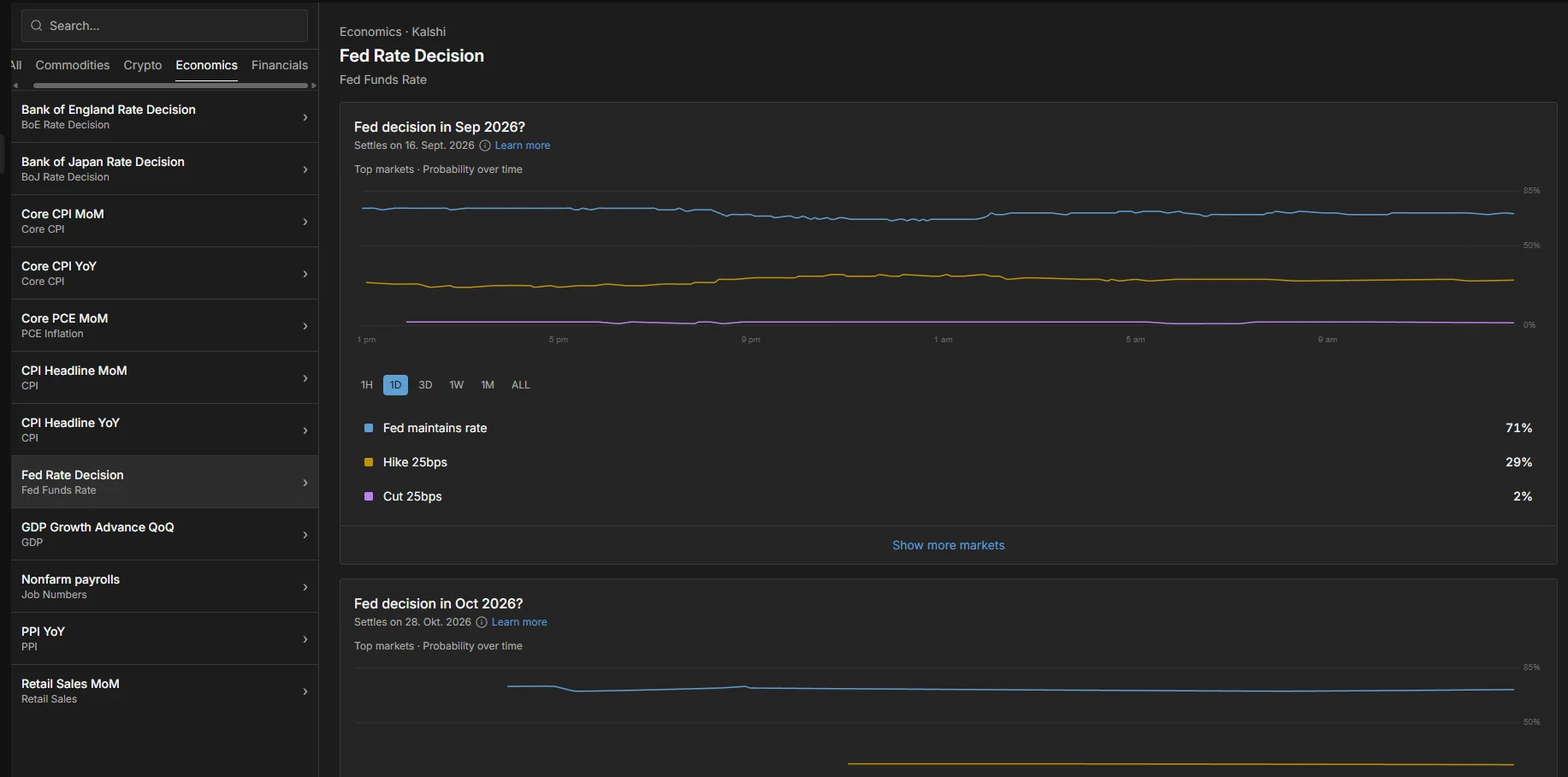
tastytrade launched prediction markets as a separate product on July 27, 2026. You trade yes/no contracts on economic events, volatility, commodities such as gold and oil, and crypto; the contracts in my screenshot come from Kalshi. The categories on tastytrade’s prediction markets page did not include sports when we checked on November 15, 2026. How these exchanges work and where they are legal is explained in our guide to prediction markets.
 Click to enlarge
Source: Own screenshot, Christian Möhrer.
Event contracts cost no commission, but two small fees per contract. According to the fee schedule of October 28, 2026, each contract carries $0.01 clearing plus $0.01 regulatory and exchange fees. My account from Germany could see the section but not enable it; it is meant for US clients.
Nearly 24-hour index options since August 2026
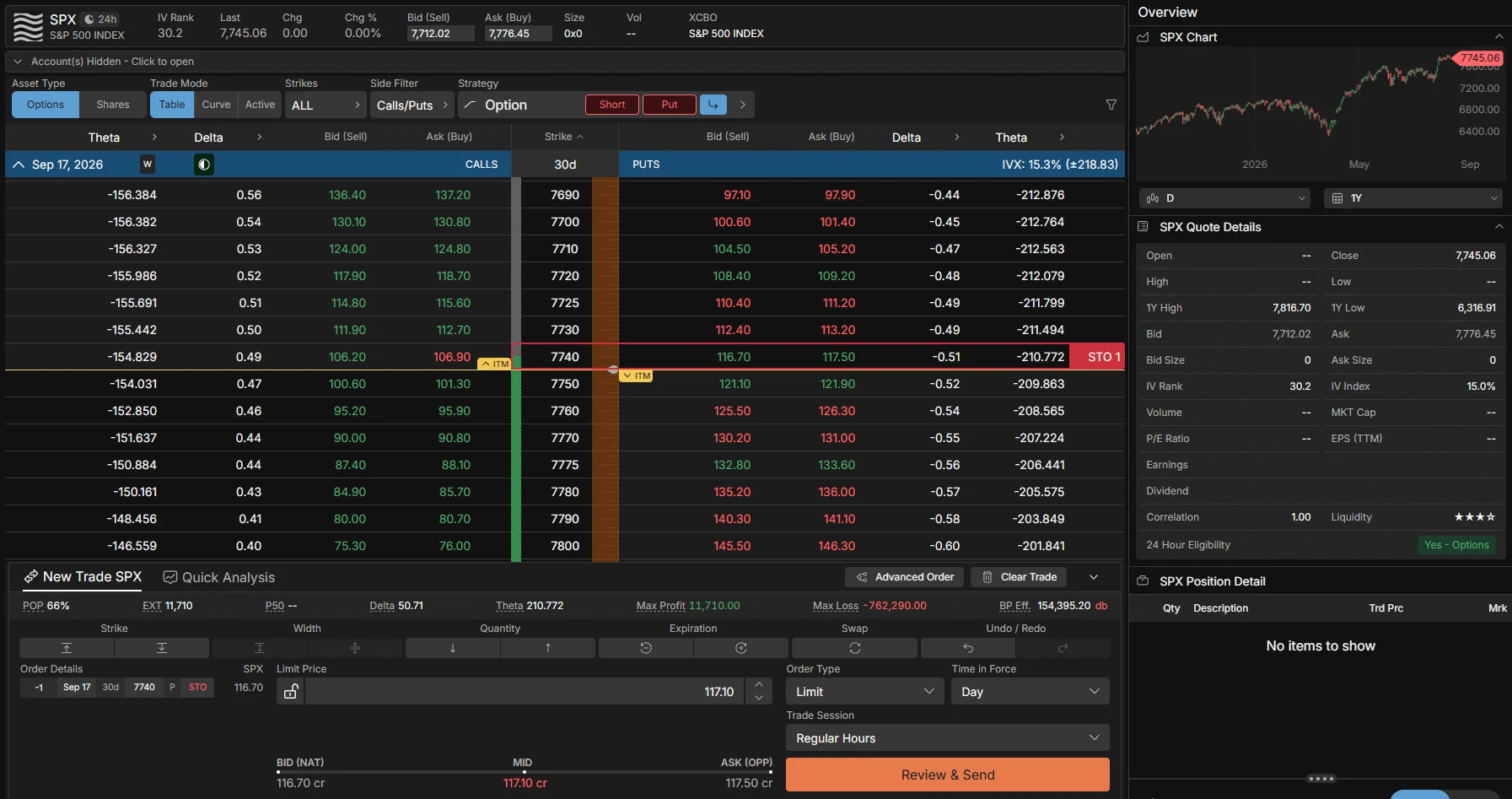
Since August 10, 2026, tastytrade has supported Cboe’s Global Trading Hours for SPX, VIX, XSP and RUT options. These index options now trade almost around the clock on five days a week: in the overnight session from 8:15 p.m. to 9:25 a.m. ET (Cboe), Sunday evening to Friday morning, and in the curb session from 4:15 to 5:00 p.m. ET. That lets you react to overnight news instead of waiting for the opening bell.
 Click to enlarge
Source: Own screenshot, Christian Möhrer.
Liquidity is thinner outside regular hours, so spreads are wider. Use limit orders in these sessions and avoid market orders. Since October 22, 2026, tastytrade also offers extended-hours options on selected stocks and ETFs; the platform marks eligible symbols with a 24h label.
Platforms: desktop, web and app
tastytrade offers three platforms with the same order routing behind them. All three are built around speed: few clicks from the watchlist to the order, and the options data you need in the ticket itself.
Desktop platform
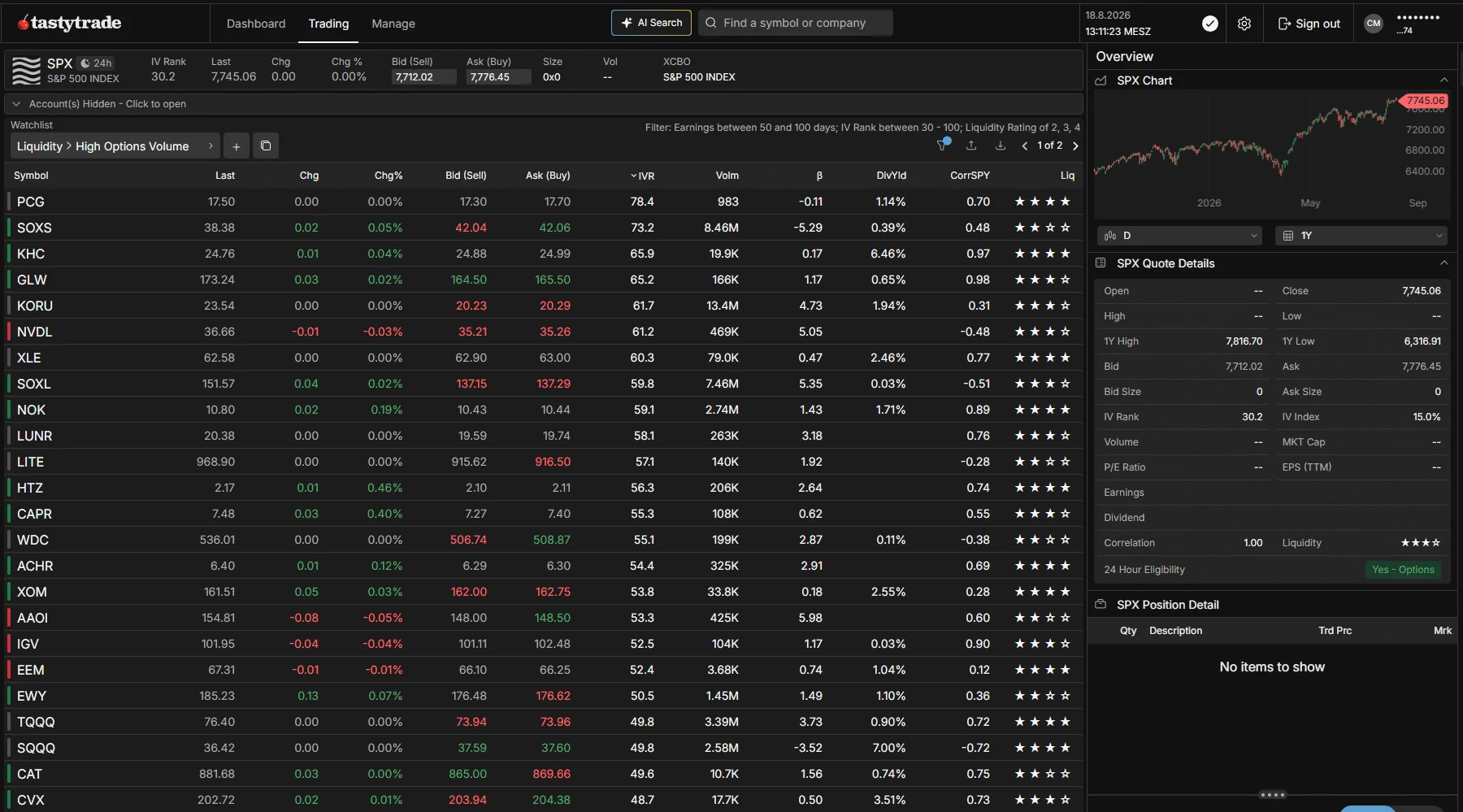
The installable desktop version is the most complete one and runs on Windows, macOS and Linux. It has the most chart tools and indicators, and now an AI search in the header that finds symbols and functions in plain language. You need an account to log in.
 Click to enlarge
Source: Own screenshot, Christian Möhrer.
Web platform and mobile app
The web platform runs in any current browser without installation and is fine for trading from several computers. The mobile app for iPhone and Android keeps the options strategies of the main platform, watchlists and the Follow Feed.
TradingView and the API
Since December 2024, you can trade your tastytrade account directly from TradingView charts. You connect the account in TradingView and send orders from the chart, which combines TradingView’s charting with tastytrade’s order routing. Our list of TradingView brokers compares tastytrade with other brokers you can connect there.
For your own scripts and journals, tastytrade publishes an open API. It needs programming skills, but such an open interface is not a given at US brokers. Real-time quotes for US stocks and ETFs appeared in my account as soon as it was funded, without a market data fee.
Tools for options traders
The platform thinks like an options trader. Instead of hiding options behind the stock quote, it starts with the numbers that decide an options trade: implied volatility, probability and risk.
IV rank, probability of profit and the filter
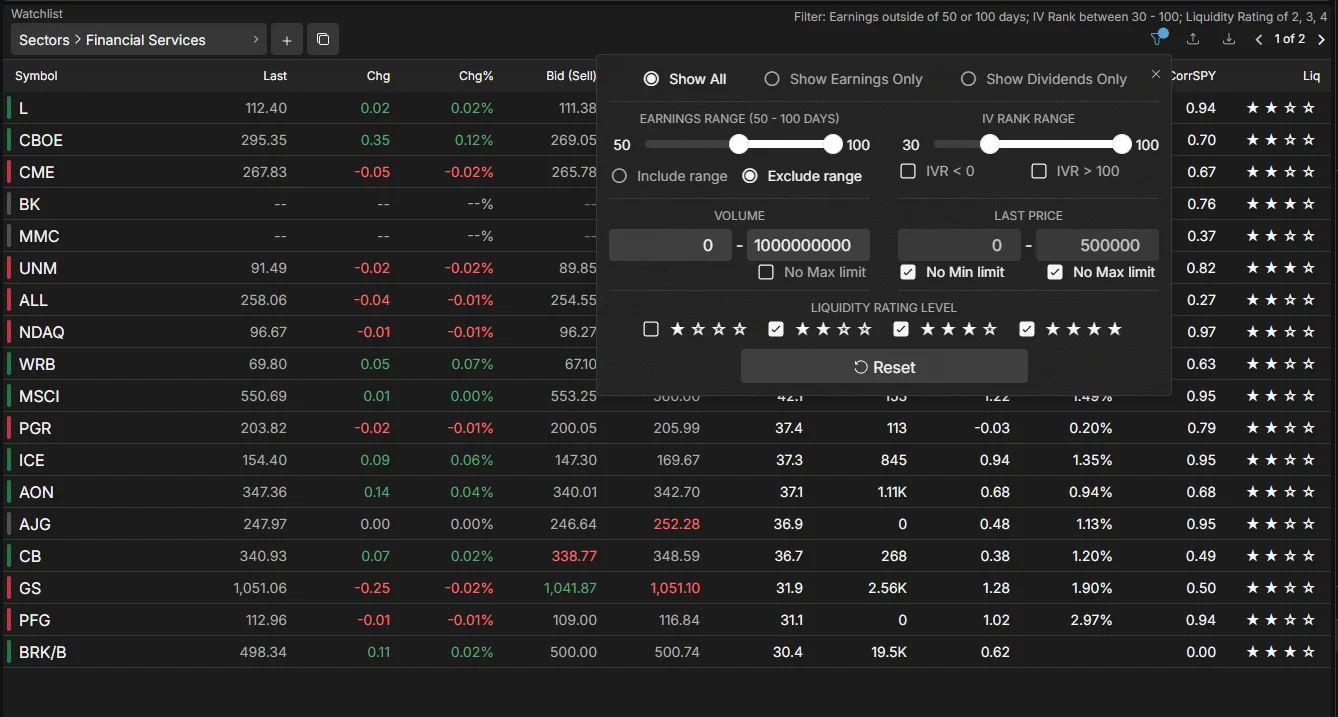
Implied volatility shows how expensive options are, and tastytrade ranks it with IV rank (IVR). Many of the strategies taught on tastylive combine IVR with probability of profit (POP), and both appear directly in the order ticket and for open positions. The watchlist filter narrows the market by earnings dates, IV rank, volume, price and an options liquidity rating.
 Click to enlarge
Source: Own screenshot, Christian Möhrer.
Backtesting instead of paper trading
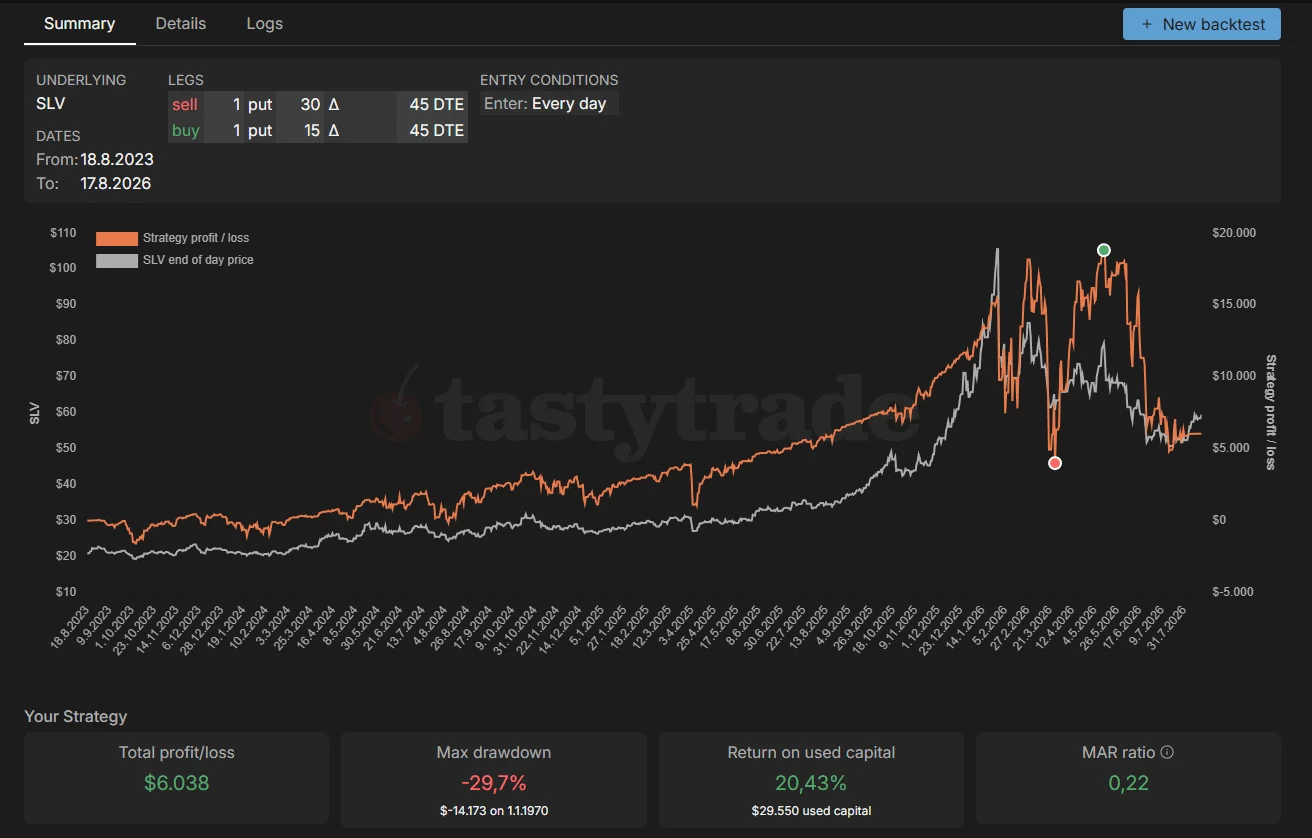
tastytrade has a built-in backtester for single options and multi-leg strategies. You pick an underlying, the legs by delta and days to expiration, and a period; the result shows total profit, maximum drawdown, return on capital used and the MAR ratio. A Lookback function adds how an idea would have done in past market phases.
 Click to enlarge
Source: Own screenshot, Christian Möhrer.
A backtest is a useful plausibility check, not a substitute for practice. It assumes fills at historical prices and cannot show how you react when a position runs against you. How to judge backtest results in general is covered in our guide to backtesting.
P&L profile and the Follow Feed
The platform draws the profit and loss zones of a strategy in the option chain and for open positions. You can even show the P&L curve of all running trades together. The charts are simple, but you see the Greeks of the chosen strategy next to them.
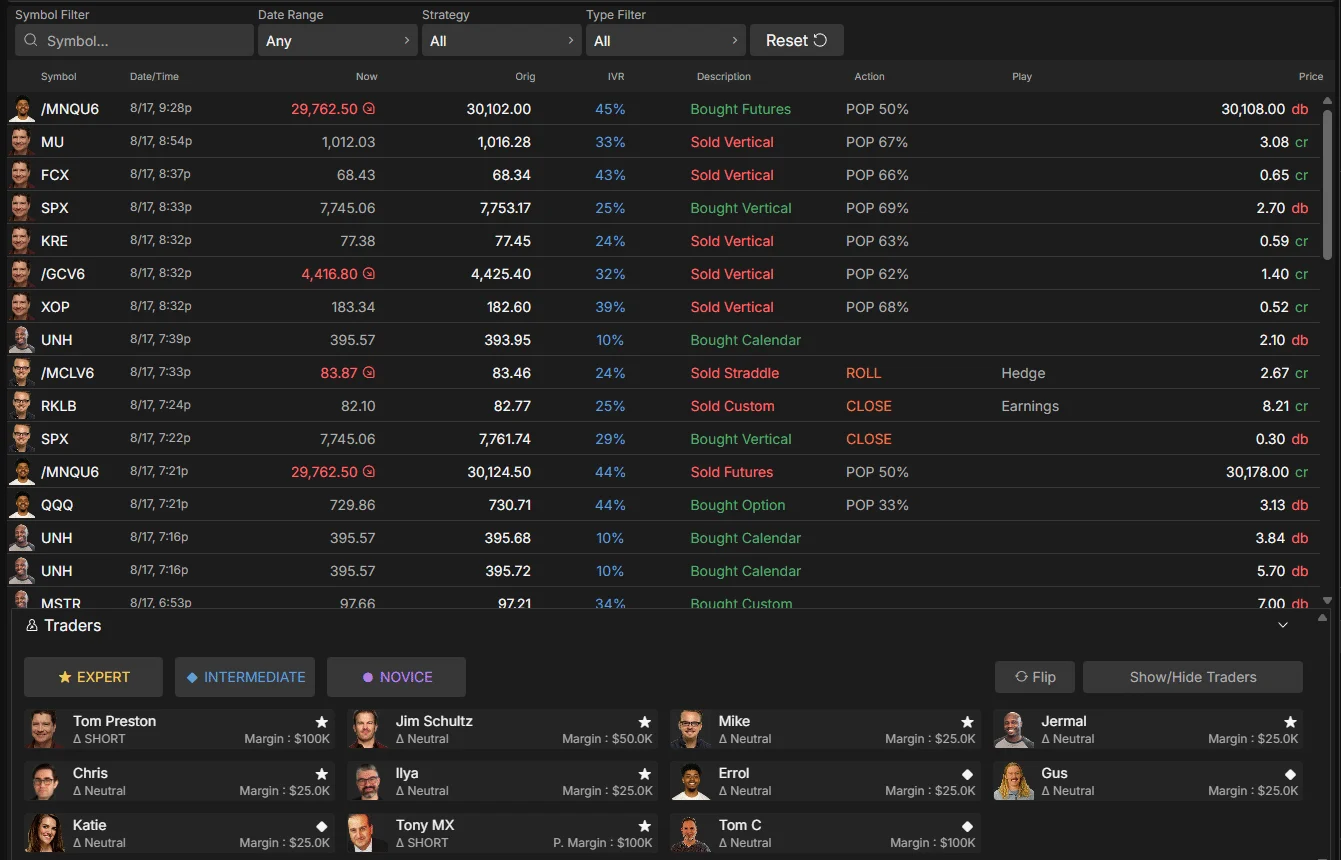
The Follow Feed shows the trades of tastytrade staff, with strategy, IV rank and probability of profit. Each trader has a short profile with style and account size, and you can copy a published trade into your order ticket with one click. Check the number of contracts and the limit price before you send it.
 Click to enlarge
Source: Own screenshot, Christian Möhrer.
Education: tastylive
tastylive is the video network the broker grew out of, and it is free. On trading days it runs several hours of live shows, and its library covers options and futures from the basics up. The help center also explains the platform functions in short videos. If you are new to options, start with our guide to options trading for beginners before you place a real trade.
Account types, paper trading and minimum deposit
tastytrade offers the usual US account types, all without a minimum deposit. You choose cash or margin when you open the account and can change it later.
- Individual: the standard account for one person, as a cash or margin account.
- Joint: for two people, either as tenants in common (TIC), where each owner’s share goes to their heirs, or with rights of survivorship (WROS).
- IRAs: traditional, Roth, SEP and beneficiary IRAs; no annual IRA fee, but $60 to close one.
- Entity and trust accounts for companies and trusts.
Portfolio margin needs at least $125,000 to activate and $100,000 to keep. It also needs the highest trading level, The Works; cash accounts and IRAs are not eligible. Portfolio margin calculates the requirement from the risk of the whole portfolio, which can allow far more leverage than a standard margin account, and far larger losses.
Is there paper trading at tastytrade?
No, tastytrade does not offer a paper trading or demo account for its broker platform. The backtester and the Lookback function work on historical data, which is not the same as simulated trading in real time. The demo account at tastyfx is for forex at a separate company. If you want to practice first, our day trading simulator guide compares the alternatives, including paper trading in TradingView.
Minimum deposit and the end of the PDT rule
There is no minimum deposit to open an account. Some products need more: portfolio margin as above, and trading on margin needs at least $2,000 in equity under FINRA’s margin rule. Real-time data becomes active after your first deposit.
Small margin accounts are no longer limited by the pattern day trader rule. FINRA replaced it with intraday margin standards on June 4, 2026, and tastytrade states that traders of all account sizes can now day trade without the $25,000 minimum. What changed in detail is explained in our day trading guide.
Opening an account, deposits and withdrawals
You open the account online in a few steps. You need your ID details, your Social Security number as a US client and information about your trading experience, which decides the options level you get. Opening and keeping the account are free.
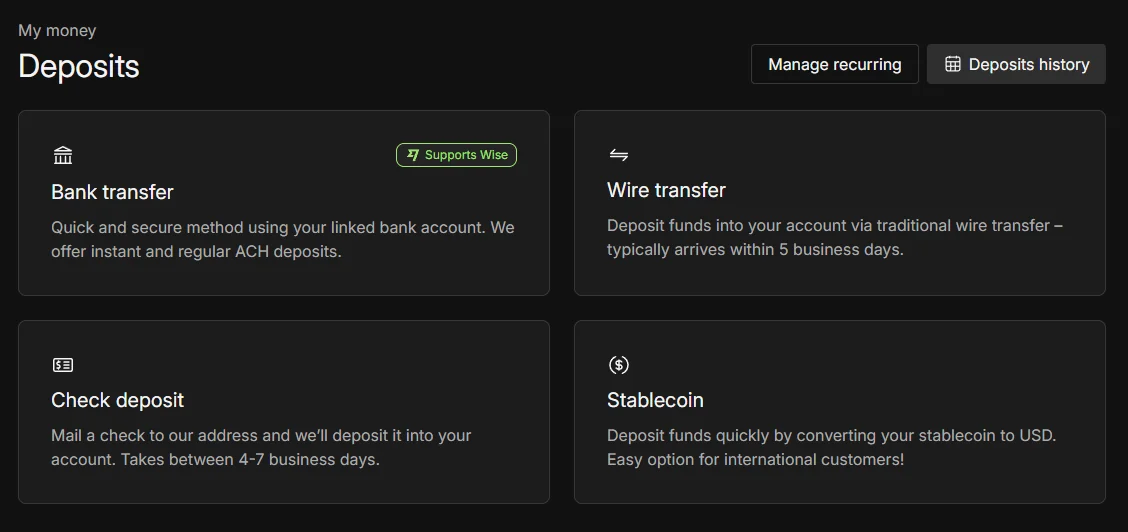
You can fund the account by ACH, wire, check or stablecoin. ACH deposits and withdrawals are free; a wire typically arrives within five business days, and a check takes four to seven. Since July 2025, tastytrade also accepts deposits in stablecoins such as USDC through Zero Hash, which needs crypto trading enabled.
 Click to enlarge
Source: Own screenshot, Christian Möhrer.
The fees come when money or positions leave the account. According to the fee schedule of October 28, 2026, an outgoing domestic wire costs $25, a foreign wire $45, and an outgoing ACAT transfer of your whole account $75. Plan for the ACAT fee if you might move to another broker later.
Is tastytrade safe?
tastytrade, Inc. is a registered broker-dealer and a member of FINRA, NFA and SIPC. SIPC protects the securities account up to $500,000 per customer, including up to $250,000 in cash, if a member firm fails; it does not protect against market losses. What SIPC covers in general is explained in our guide to brokerage accounts.
Futures, event contracts and crypto are not covered by SIPC. Futures and event contract accounts are segregated by Apex Clearing, which is meant to keep client money apart from the broker’s own assets, but it is not insurance. Crypto is held by the custodian Zero Hash. If you trade mostly futures, you rely on the segregation rules and the oversight of the CFTC and NFA.
Three FINRA fines between 2024 and 2026
FINRA’s BrokerCheck lists three final regulatory events for tastytrade, all settled without admitting or denying the findings. We checked the BrokerCheck report on November 15, 2026, and all three are final:
| Date | Fine | What FINRA found |
|---|---|---|
| July 21, 2026 | $850,000 | From January 2020 to January 2023, no reasonable best execution reviews: all customer equity orders went to five market makers that paid for order flow, without comparing competing markets |
| May 29, 2026 | $200,000 | At least 71 written customer complaints were not reported to FINRA |
| November 6, 2024 | $30,000 | Weak supervision of outside accounts of employees |
The largest fine concerns how stock orders were routed, not how client money was held. Selling order flow to market makers is legal in the US, but a broker must still check whether its customers get the best available price. How market makers earn on your orders is explained in our guide to the market maker. FINRA’s findings state that the firm improved its supervision in January 2023.
Fees and margin rates
The fee model is simple and favors options traders. All figures below come from tastytrade’s Commissions & Fees schedule, last updated October 28, 2026. Dollar amounts are per contract, crypto in percent of the order value:
| Product | To open | To close |
|---|---|---|
| Stocks and ETFs | $0 | $0 |
| Stock and ETF options | $1.00, max. $10 per leg | $0 |
| Index options (SPX and others) | $1.00, no cap | $0 |
| Futures | $1.00 | $1.00 |
| Micro futures | $0.75 | $0.75 |
| Options on futures | $1.25, no cap | $1.25 |
| Options on micro futures | $0.75 | $0.75 |
| Crypto (bitcoin and ether) | 0.75% | 0.75% |
| Other crypto | 1.00% | 1.00% |
| Event contracts | $0 | $0 |
The cap of $10 per leg applies only to stock and ETF options. From the eleventh contract in one leg, you trade those commission-free. Index options and options on futures are excluded from the cap, and index options carry an extra exchange fee per contract.
Clearing and regulatory fees come on top of stock, options, futures and event contract trades, also the free ones. They are small: $0.10 per contract for stock, ETF and index options, $0.0008 per share and $0.30 per contract for futures and options on futures, plus exchange and NFA fees there. Crypto orders are exempt. FINRA’s trading activity fee is waived from October 1 to December 31, 2026. An option exercise or assignment costs $5. A full breakdown of costs across brokers is in our guide to trading costs.
Crypto is the one product with a percentage commission. A $5,000 bitcoin purchase costs $37.50 to buy, and the same again to sell if the position is still worth $5,000. The minimum commission is $1, with a 3% cap for orders below about $33.33. For pure crypto trading, tastytrade is not cheap; the spot ETFs above are commission-free.
Margin rates: 6.75% flat or 11% to 8%
Since late October 2026, tastytrade has offered a flat margin rate of 6.75% on the whole debit balance. It equals the base rate minus 3.25 percentage points. New clients qualify when they open their first tastytrade account with margin on or after October 23, 2026. Existing clients qualify by opening their first margin account, or by bringing at least $25,000 in new assets from outside tastytrade on or after October 23, 2026; deposits count once settled and not reversed, and transfers between tastytrade accounts do not count. For existing clients, the rate starts with the next interest cycle on the 15th of a month and is not applied retroactively.
Everyone else pays the standard rates. They are based on a base rate of 10% since January 1, 2025, and fall with the size of the debit balance:
| Debit balance | Standard rate |
|---|---|
| $0 to $24,999 | 11.00% |
| $25,000 to $49,999 | 10.50% |
| $50,000 to $99,999 | 10.00% |
| $100,000 to $249,999 | 9.50% |
| $250,000 to $499,999 | 9.00% |
| $500,000 to $999,999 | 8.50% |
| $1,000,000 and more | 8.00% |
The flat rate is tied to the base rate and can change. tastytrade says it moves with the base rate after Fed decisions and can be ended with 30 days’ written notice. If you borrow on margin, check the current rate before you rely on it; our guide to the margin call shows what happens when the account equity falls too far.
tastytrade vs. Interactive Brokers and thinkorswim
Against Interactive Brokers, the difference is focus more than price. Interactive Brokers offers far more markets, including foreign exchanges and bonds, and more order types, but its platform is much more complex. tastytrade wins on ease of use for US options: from the filter to a finished spread order takes only a few clicks. Some traders keep both accounts.
Against thinkorswim, you compare two platforms built by the same founders. thinkorswim now belongs to Charles Schwab and offers paper trading with paperMoney, which tastytrade lacks. tastytrade has the simpler pricing for active options traders, with $0 to close and the cap per leg on stock options. If you want to practice before you trade real money, thinkorswim has the edge.
Support and experiences
The first stop is the help center at support.tastytrade.com, with articles and short videos on the common questions. In my tests, answers by email and contact form came within a few hours. Deposits, withdrawals and orders went through correctly and on time. When I placed limit orders on illiquid options, they showed up on the bid or ask at once, which I could see from an account at another broker; that is one observation for options, not proof of how all orders are routed or of best execution.
Independent reviewers rate the broker highly for options. In January 2026, Investopedia named tastytrade the best overall options trading platform, and StockBrokers.com ranked it first for options trading, according to tastytrade’s newsroom. Both awards look at platform and pricing, not at order routing.
Pros and cons of tastytrade
In our view, tastytrade is one of the best brokers for active US options trading. Outside that niche, it has clear limits:
What speaks for tastytrade:
- Built for options: IV rank, probability of profit and the P&L profile right in the order ticket.
- Low, capped commissions: $1 to open a stock option, $0 to close, at most $10 per leg.
- New margin rate: 6.75% flat for qualifying accounts since October 2026.
- Long trading hours: SPX, VIX, XSP and RUT options nearly 24 hours on five days.
- Extras: backtester, Follow Feed, TradingView connection and an open API.
What speaks against it:
- No paper trading: only backtests on historical data.
- Limited product range: no bonds, no mutual funds, no foreign exchanges.
- Exit costs: $75 to transfer your account out, $25 for a domestic wire.
- Crypto is expensive: 0.75% to 1.00% per side.
- Regulatory record: three FINRA fines between 2024 and 2026, the largest $850,000 for best execution.
Conclusion: who should use tastytrade?
tastytrade is a strong choice if you trade US options or futures actively and want a platform that does the options math for you. Costs are low, the cap per leg helps larger traders, and the new flat margin rate makes borrowing cheaper for qualifying accounts. The FINRA record is worth knowing, but it concerns order routing, complaint reporting and supervision, not the safekeeping of client money.
If you are a beginner or want bonds, funds or paper trading, start somewhere else. Learn puts and calls first, practice in a simulator, and come back when you place your own trades. This review describes the offer as of November 15, 2026; fees and rates can change. Links to tastytrade on this page are plain links, not affiliate links. Trading options and futures carries a high risk of loss; this is not investment advice.
Frequently asked questions about tastytrade
Who owns tastytrade?
tastytrade is owned by IG Group, a broker listed in London. IG completed the purchase on June 28, 2021, for about $1 billion in cash and shares. It belongs to IG’s North America business.
Who founded tastytrade?
tastytrade was founded by Tom Sosnoff, Scott Sheridan, Kristi Ross and Linwood Ma, the team that had built thinkorswim. It launched in 2017 as tastyworks and took its current name in 2023.
Is tastytrade safe?
tastytrade is a FINRA, NFA and SIPC member, and SIPC protects its securities accounts up to $500,000, including $250,000 in cash. Futures, event contracts and crypto are not covered by SIPC; futures and event contracts are segregated by Apex Clearing. FINRA fined the firm three times between 2024 and 2026, the largest fine being $850,000 for best execution reviews.
Does tastytrade have paper trading?
No, tastytrade has no paper trading or demo account for its broker platform. It offers a backtester on historical data. If you want to practice in real time, you need a simulator at another provider, for example paperMoney on thinkorswim.
How much does tastytrade charge for options?
Stock and ETF options cost $1 per contract to open and $0 to close, capped at $10 per leg. Index options cost $1 to open without the cap, options on futures $1.25 per side. Clearing fees come on top: $0.10 per contract for stock, ETF and index options, $0.30 for options on futures.
What is tastytrade’s margin rate?
Since October 2026, qualifying accounts pay a flat 6.75% on the whole margin balance. It applies to new clients who open their first account with margin on or after October 23, 2026, and to existing clients who open their first margin account or bring at least $25,000 in new assets. The standard rates run from 11% below $25,000 to 8% from $1 million.
Does tastytrade have a minimum deposit or monthly fee?
No, there is no minimum deposit, no monthly fee and no inactivity fee. Costs arise from trading, from wires and from transferring the account out. Portfolio margin needs at least $125,000.
This US edition is based on our German edition on kagels-trading.de and has been adapted for US readers.
More Markets and Brokers guides
- Open your first account
What Is a Brokerage Account? A US Beginner's Guide
How to open and fund a US brokerage account, cash vs margin, what it costs and what SIPC and FDIC really cover.
- Know what trading really costs
Trading Costs: Every Fee You Pay and How to Cut It
Spread, commissions, SEC and FINRA fees, market data, margin interest and tax, with yearly totals for three trading styles.
- Choose a broker
Interactive Brokers Review 2026: Fees and Platforms
Fees, platforms, investor protection and real futures commissions from a client since 1996.
- Check an offshore broker
PU Prime Review 2026: FCA Warning, Licences and Costs
Which PU Prime company you contract with, what the FCA warning means, and what 1:1000 leverage and the deposit bonus do to your account.
- Check an EU CFD broker
Tradeview Review 2026: Tradeview Europe, MFSA and Costs
What the Malta licence of Tradeview Europe covers, how it differs from the Cayman company, and what the three MetaTrader 5 accounts cost.
- Check ZuluTrade
ZuluTrade Review 2026: Costs, Regulation and US Status
Who runs the copy trading platform, what it costs through your broker, why the US was missing from its sign-up form and what the CFTC fined its US company for.
- Check CopyX
CopyX Review 2026: Is TAG Markets Copy Trading Legit?
Who runs the TAG Markets copy trading platform, which regulators warn about it, why US residents are excluded and how fast the 12x Amplify account eats your deposit.
- Choose a US forex broker
OANDA Review 2026: Fees, TradingView and US Rules
OANDA from its own pages and NFA records: spreads and fees, TradingView and the demo, FIFO and three penalties.
- Check a commission-free app broker
Webull Review 2026: Fees, Margin Rates and Safety
Webull from its own fee schedule and FINRA records: what is free, margin rates and Premium, overnight trading, crypto and three fines.
- Understand your price
Market Makers: Who Sets Your Price and How They Profit
How market makers earn on the spread, who sets prices at German trading venues and what the EU ban on payment for order flow changed.
- Size up a bull market
Bull Market: How Long It Lasts and How to Spot the End
When a rise becomes a bull market, how long the 27 completed S&P 500 bull markets since 1928 lasted and gained, and where the current one stands.
- Read bond market stress
MOVE Index: The VIX of the Bond Market, Explained
What the MOVE index measures, which readings signal stress, how it differs from the VIX and where its limits are.
- Read stock market fear
VIX Index: What the Fear Gauge Measures and Normal Levels
What the VIX measures, which levels have been normal since 1990, how closely it tracks the S&P 500 and how VIX futures, options and ETPs work.
- Read the risk mood
Risk-On vs Risk-Off: Meaning, Assets and Indicators
What risk-on and risk-off mean, which assets rise and fall in each mode, five market shocks since 2008 and the VIX, DXY and AUD/JPY signals.
- Read market sentiment
Fear and Greed Index: How It Works, Tested Since 2021
How CNN builds its Fear and Greed Index from seven measures, what the zones mean and how the S&P 500 moved after readings below 20.
- Size up a bear market
Bear Market: How Long It Lasts and How to Spot One
When a decline becomes a bear market, how long the 27 S&P 500 bear markets since 1928 lasted, how long the recovery took and why Bitcoin had three since 2025.
- Trade an index CFD
Index CFDs at Interactive Brokers: Symbols, Costs and Trading
All 13 IBKR index CFDs, margin, stop and close-out worked through for IBDE40, financing, UK hours and the TradingView limit.
- Size an index future
Micro Futures: MES vs MNQ, Tick Values and Risk
MES and MNQ tick values, a worked sizing example from the stop with costs and slippage, and why margin is not your risk.
- Choose between futures and CFDs
Futures vs CFDs: Regulation, Order Execution and Costs
Who your counterparty is, EU, UK and US rules, how stops are triggered on CME and at CFD providers, and booked costs in a DAX example.
- Read the futures curve
Contango vs Backwardation: Futures Curves Explained
What contango and backwardation mean, what rolling does to a position in each case, and real gold, oil and gas curves from 28 October 2026.
- Understand the spot market
Spot Market Explained: Definition and Settlement Times
What a spot market is, why two days is a minimum and not a limit, and when stocks settle at T+1 in the US, EU, UK and Switzerland.
- Choose a silver future
Silver Futures: SI vs Micro Silver vs 100-oz SIC
SI, Micro Silver and the 100-ounce SIC compared by tick value, risk per contract, margin and December 2026 deadlines.
- Read the chip sector
SOX Index: Holdings, Weighting and How to Use It
What the SOX holds, how Nasdaq caps the weights, its largest declines since 2004 against the Nasdaq-100 and which ETFs really track it.
- Read the biotech sector
Nasdaq Biotechnology Index: Holdings, Weighting and Risks
What the NBI holds, how Nasdaq caps the weights, its long declines since 2003 against the Nasdaq-100 and which ETFs really track it.
- Read the transport sector
Dow Jones Transportation Average: Stocks and Dow Theory
The 20 stocks in the Dow transport index, why the share price sets their weight, declines since 1992 and what Dow Theory can and cannot tell you.
- Read the French market
CAC 40 Index Explained: All 40 Stocks, Weights and Trading Hours
All 40 CAC 40 stocks, how Euronext caps the weights at 15 percent, trading hours in Eastern Time and how it differs from the DAX.
- Research stocks
InvestingPro Review: Screener, ProPicks AI and WarrenAI
What the InvestingPro screener, ProPicks AI and WarrenAI do, what Pro and Pro+ cost and who needs which plan.
- Judge a stock-picking newsletter
Motley Fool Stock Advisor Review: Cost and Track Record
What Motley Fool Stock Advisor costs after the first year, how the advertised return is calculated, refund and renewal terms, and who it suits.
- Use the free news portal
Investing.com Review: Free Tools, Data and Limitations
What the free Investing.com portal does well, where the quote prices come from and when InvestingPro is worth paying for.
- Find real AI revenue
AI Stocks 2026: How Listed Companies Earn From AI
Which listed companies earn from AI in cloud, software, infrastructure and chips, disclosed AI revenue against hope, plus AI ETFs and risks.
- Compare AI data center suppliers
AI Infrastructure Stocks: 10 Data Center Suppliers Compared
Ten suppliers for power, cooling, servers and optics compared on free cash flow, customer concentration and next dates, with filters and a two-stock comparison.
- Follow an IPO
Anthropic Stock: IPO Date, Valuation and How to Invest
Where the Anthropic IPO stands, how the valuation compares with revenue and how to get exposure before and after the listing.
- Invest in OpenAI before the IPO
OpenAI Stock: Can You Buy It, and Who Owns OpenAI?
Why there is no OpenAI stock yet, who owns OpenAI, where the IPO stands and how much OpenAI you get through Microsoft or SoftBank.
- Understand a stock split
Stock Splits Explained: Forward and Reverse Splits
What forward and reverse splits change and what they do not, the dates that matter, what happens to options and the $1 listing rule.
- Analyze a company
Fundamental Analysis: 12 Ratios, a Worked Example, 5 Steps
Twelve ratios with formulas and rules of thumb, worked through Microsoft's 2026 annual report, a five-step process and the fundamentals of forex, commodities and crypto.
- Value a stock
Value Investing: Intrinsic Value, Margin of Safety, Traps
Intrinsic value against price, a worked DCF with a sensitivity table, Coca-Cola as a real example, the value premium since 1926 and value traps.
- Value a new listing
SpaceX Stock (SPCX): Valuation, Risks and How to Buy
How to buy SpaceX stock, what the company is worth after the IPO and which risks the lock-up calendar brings.