
Market Makers: Who Sets Your Price and How They Profit


Contents
- Market makers in 30 seconds
- What is a market maker?
- How does a market maker make money?
- Market maker, designated sponsor, specialist: three roles at German exchanges
- Who is the market maker behind your order? The list for Germany
- Payment for order flow: what changed in July 2026
- Market makers in CFD and forex trading
- When market makers become a risk for traders
- Pros and cons of trading through a market maker
- How to recognize a fair price
- Conclusion: the market maker is a service provider, not an opponent
- Frequently asked questions about market makers
- About the author
Since 2 July 2026, Trade Republic has executed customer orders “against Trade Republic”, in the broker’s own words. The broker that holds your account is now the counterparty to your trade. Until then, that role belonged to someone else: a market maker. If you want to know what price you really pay, you need to know who sets that price and how they earn money on it.
This article explains how market makers work, how they make money and who sets prices at each German trading venue. You will learn what the ban on payment for order flow changed, why a market maker can also be a risk for you, and how to recognize a fair price.
Market makers in 30 seconds
- What a market maker does: It continuously quotes binding buy and sell prices for a security and so provides liquidity, within the trading hours and rules of each market.
- How it earns money: From the gap between the bid and the ask price, the spread. It buys slightly cheaper than it sells, millions of times over.
- Its biggest risk: Inventory that loses value before it can be sold on. That is why it widens the spread as soon as the market gets nervous.
- Who sets prices in Germany: At gettex, Baader Bank for shares; at LS Exchange, Lang & Schwarz; at EIX, Scalable Capital and mwb fairtrade; at Tradegate, mainly Tradegate AG.
- What changed in 2026: Since 1 July 2026, brokers in the EU may no longer be paid for sending orders to a particular market maker. Trade Republic and Scalable Capital now act as the counterparty themselves.
What is a market maker?
A market maker is a dealer that continuously quotes binding buy and sell prices for a security and so provides liquidity, within the trading hours and rules of each market.
The price at which it buys is called the bid. The price at which it sells is called the ask (or offer). If you buy from a market maker, you pay the ask. If you sell, you receive the bid.
The difference from a central order-book market lies in who takes the other side of your trade. In the central order book of Xetra, the Deutsche Börse trading system, the orders of many participants meet, and the price comes from how they interact. With a market maker, you trade with a single company that sets the price itself. That is not better or worse. It is a different model, with its own strengths and drawbacks.
Without market makers, many securities would simply have no price. For a small-cap stock or a structured investment product known in Germany as a certificate, there are often hours when no two private investors are on opposite sides at the same time. The market maker fills that gap. It provides liquidity, so buying and selling is easier even when nobody has entered a matching order, and it charges for this service through the spread.
How does a market maker make money?
The business model is surprisingly simple and hard to master at the same time. A market maker does not want to guess whether a price will rise or fall. It wants to earn a small margin on every single trade and repeat that as often as possible.
The casino logic: a small edge, huge volume
A casino does not need to win every game. It only needs a small mathematical edge on every bet and a very large number of bets. A market maker works in a similar way. Its margin per share is tiny, often just one or two cents. Across millions of trades a day, that adds up to a large business, but not a guaranteed one: price moves, hedging and trading costs can eat up the spread.
An example with assumed numbers shows how thin that margin is and how quickly it disappears. A stock has a bid of €50.00 and an ask of €50.02. The market maker buys 1,000 shares from a seller and passes them on to a buyer shortly afterwards.
| Case | Calculation | Result |
|---|---|---|
| Trade works | 1,000 × €0.02 | +€20 |
| Price falls 10 cents first | 1,000 × −€0.08 | −€80 |
| Trades needed to recover | €80 ÷ €20 | 4 profitable round trips |
A single price drop wipes out the margin of several clean trades. So a market maker does not live on the spread alone, but on the skill of holding as little inventory as possible. The goal is to end the day as close to flat as it can.
Inventory risk and how it is kept small
A market maker has three tools against inventory risk. It can shift its quotes: with too much stock on its books, it lowers both bid and ask a little so that more buyers come in. And it can widen the spread: in nervous markets, it asks for a bigger margin as a buffer.
The third tool is hedging. The market maker offsets its risk, for example with futures or with opposite trades on another exchange. That way it keeps the margin while most of the price risk goes away.
The hidden risk is the better-informed counterparty. If someone buys from the market maker because they know a piece of news first, the market maker almost certainly loses on that trade. Professionals call this adverse selection. The only defense is to update its own quotes faster than new information moves the price.
This is the real reason for the race for speed. The faster a market maker adjusts its quotes to new information, the shorter it carries an outdated risk. Large firms therefore invest millions in data centers right next to the exchanges and in algorithms that react in microseconds.
Market maker, designated sponsor, specialist: three roles at German exchanges
In German exchange trading, liquidity providers go by different names, depending on the trading model. All three post prices, but with different duties and different degrees of control.
A designated sponsor is a liquidity provider on Xetra that commits to posting binding buy and sell offers in the central order book for less liquid securities.
Deutsche Börse describes the duties of designated sponsors like this: they must keep to a maximum spread, a minimum quote size and a minimum quoting time, and a security can have one or several of them. That is what the Deutsche Börse page on designated sponsors says (in German). The key difference: a designated sponsor is only one participant in the order book. Other participants can submit more competitive bids or offers.
At the Frankfurt Stock Exchange, these liquidity providers are called specialists. They look after the securities assigned to them, post quotes and match orders. According to the Deutsche Börse list of specialists, there are currently seven firms, among them Baader Bank, ICF Bank, mwb fairtrade and ODDO BHF.
Market making exists both on and off the exchange. In off-exchange direct trading, your trading partner gives you a price and you decide whether to trade at it. gettex, LS Exchange and EIX, by contrast, are exchange trading systems with their own rules and market surveillance, where market makers set the prices. A market maker model is therefore not automatically off-exchange direct trading.
Who is the market maker behind your order? The list for Germany
Which market maker you face depends on the trading venue, not on the broker. The following overview shows who sets prices at the main venues. All details come from the websites of the exchanges and their operators, as of September 2026. The graphic below sorts the six venues by model, and the table after it sums them up for quick reference.
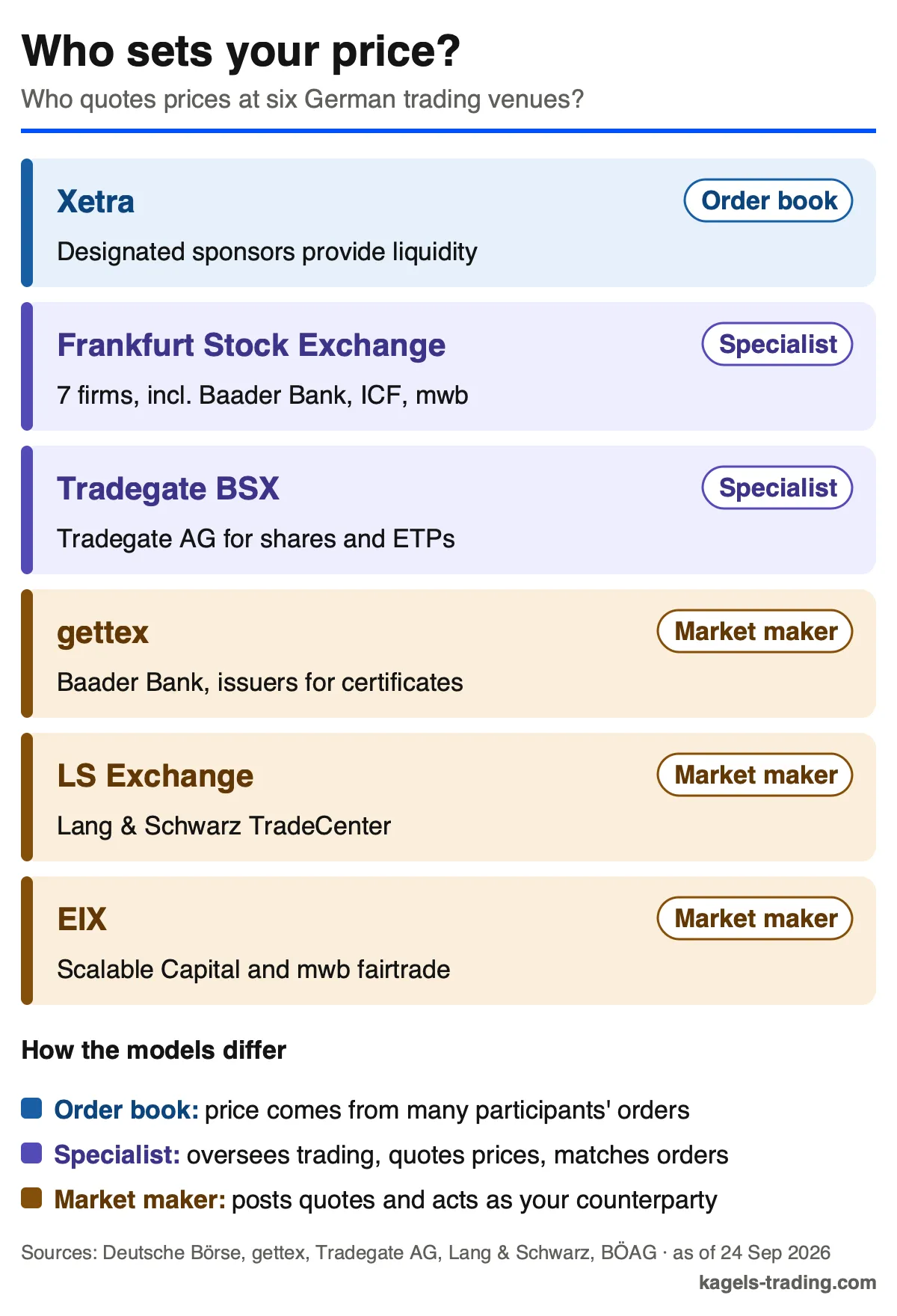 The color shows the trading model: order book, specialist or market maker. Graphic by Kagels Trading. Sources: Deutsche Börse, gettex, Tradegate AG, Lang & Schwarz, BÖAG, as of 24 September 2026.
| Venue | Liquidity provider | Model |
|---|---|---|
| Xetra | Designated sponsors | Order book |
| Frankfurt | 7 specialists | Specialist |
| Tradegate | Tradegate AG | Specialist |
| gettex | Baader Bank, issuers | Market maker |
| LS Exchange | Lang & Schwarz | Market maker |
| EIX | Scalable, mwb fairtrade | Market maker |
At gettex, two groups share the job of setting prices. For shares, funds, ETPs and bonds, the market maker is Baader Bank, according to gettex (in German). For certificates and leveraged products, you trade directly with the issuer, that is BNP Paribas, Goldman Sachs, HSBC or UniCredit.
LS Exchange is an electronic trading system at the Hamburg Stock Exchange, which runs Monday to Friday from 7:30 a.m. to 11:00 p.m. Frankfurt local time (CET in winter, CEST in summer), according to the operator’s website. Market maker and liquidity provider is Lang & Schwarz TradeCenter AG & Co. KG, the trading company of the group, according to the company website.
The European Investor Exchange (EIX) started on 10 December 2024 at the Hannover Stock Exchange. According to a press release by Börsen AG, Scalable acts as market maker there, and the second market maker is mwb fairtrade Wertpapierhandelsbank. At Tradegate, market making is a business line of Tradegate AG. By its own account, it is the sole liquidity provider for shares and ETPs there as a specialist.
In the US, concentration is even higher. Citadel Securities states on its company website that it handles more than 23 percent of all US equity volume and around 35 percent of retail volume. A single market maker there stands behind more than one in three orders from private investors.
Payment for order flow: what changed in July 2026
Payment for order flow (PFOF) is a payment that a market maker makes to a broker so that the broker sends it its customers’ orders for execution.
For years, PFOF was the basis of many zero-commission accounts. The broker charged no order fee, or just one euro, and earned money from the market maker’s payment instead. To the customer, it felt free. They still paid, through the spread and through a trading venue they had not chosen themselves.
The EU has banned this model. The legal basis is Regulation (EU) 2024/791 of 28 February 2024. Under the new Article 39a of MiFIR, investment firms may no longer accept payments from third parties for executing or forwarding orders of retail clients and certain professional clients.
Germany had a grace period. Member states where PFOF was already common were allowed to grant an exemption until 30 June 2026. The German Federal Ministry of Finance used this option for Germany, and since 1 July 2026 the ban applies there too. For you, this means: the payment from a third party for your order is gone. A conflict of interest can still remain, as the next section shows.
What Trade Republic and Scalable did
At the two big neobrokers, the broker itself is now the counterparty, although in different ways. In its press release of 2 July 2026 (in German), Trade Republic writes that orders are executed “at the best price among all relevant exchanges against Trade Republic”. The broker derives that price from an aggregated order book of the connected exchanges. If you want a particular venue, you can choose one of 30 exchanges yourself for an extra charge.
Scalable Capital took this route earlier. With EIX, the broker has run its own trading venue since December 2024, where it acts as market maker itself. In this model, no third party pays the broker. Scalable earns directly on the spread.
The conflict of interest has not gone away, it has only moved. In the past, a third party set the price and paid the broker. Today, at the big neobrokers, the broker itself is the counterparty and earns on your trade.
For you, the checking job stays the same. You compare the quoted price with the Xetra order book at the same moment.
Market makers in CFD and forex trading
With CFDs, the broker is almost always the market maker itself. A CFD is a contract between you and the broker, not a security traded on an exchange. So there is no exchange and no outside order book, only the price the broker quotes. The broker is your counterparty, and every euro you win is at first a euro it pays, unless it passes the position on.
The industry therefore distinguishes two basic models. In the market maker model, often called dealing desk, the broker holds the opposite position itself or offsets it internally between customers. In the STP or ECN model, it passes the order on to outside liquidity providers and earns a commission or a markup.
A market maker broker is not automatically dubious. In the EU, CFD brokers are supervised and must apply, among other things, leverage limits and protection against losses beyond your deposit for retail clients. But you should know who you are dealing with: a company that sets its own price.
When market makers become a risk for traders
As long as the market is calm, you notice little of the market maker. It becomes critical at exactly the moments when you need it most. There are three situations you should know.
Off-hours and news: the spread opens up
Outside main trading hours, the market maker relies on substitute prices. When a stock’s home exchange is closed or important data is due, it lacks a reliable reference and widens the spread as a safety buffer. A market order is then filled at the prices available at that moment. If the fill price differs from the price you expected when you placed the order, that is called slippage. A plain gap to the last exchange price is not slippage in itself, because that price may be out of date or come from another venue.
Trading halts: the price disappears
A market maker can suspend its quotes. After a price-sensitive company announcement (an ad hoc announcement under EU rules) or during extreme moves, it stops quoting a security for a while, and trading in it pauses. That protects the market maker, not you. If you want to get out during such a phase, you only can once the market maker resumes trading, and then at its new price.
Stop orders depend on the market maker’s price as well. If your venue triggers them on its own quotes, a briefly widened spread can trigger a stop that the Xetra order book would never have reached.
Technology: 45 minutes that almost ruined a market maker
The most striking example of speed risk is Knight Capital. On 1 August 2012, this large US market maker at the time rolled out new software. In the first 45 minutes or so after the open, its system sent more than 4 million orders into the market, according to the US Securities and Exchange Commission, although it was only supposed to handle 212 customer orders. It traded more than 397 million shares and built up unwanted positions worth several billion dollars.
The damage threatened the firm’s survival. Knight put its pre-tax loss at around $440 million, and the SEC states more than $460 million in its announcement. A few days later, the company had to raise $400 million in fresh capital from investors, and later the SEC fined it $12 million. For you as an investor, the lesson was a different one: the speed that makes market makers profitable makes their mistakes just as fast.
Pros and cons of trading through a market maker
Trading against a market maker has two sides, and both are real. Here are the advantages and disadvantages for retail investors and traders.
Pros
- More liquidity: Even in small caps and certificates, market makers can offer tradable prices without a matching investor order at the same time. Execution is not guaranteed, though.
- Long trading hours: gettex and LS Exchange trade until 11:00 p.m. Frankfurt local time (CET in winter, CEST in summer), well beyond Xetra’s main session.
- Single-price execution: A market maker may execute your order at a single quoted price, up to the size it quotes, instead of filling it in parts across several price levels.
- Low extra costs: Many market maker venues charge no exchange fee. You pay through the spread.
Cons
- One company sets the price: You trade against a firm that earns on your trade, not against other investors.
- Wide spreads in off-hours: In the evening and around news, the spread opens up, and a market order becomes expensive.
- Trading can pause: If the market maker suspends its quotes, you cannot get out until it resumes trading.
- Little insight: How the quoted price comes about is a trade secret. You can only check the result.
How to recognize a fair price
An example from the US shows how much spreads have narrowed over the past few decades. Until 2001, US stocks were quoted in sixteenths of a dollar, so the smallest possible spread was 6.25 cents. With the switch to decimals, it fell to one cent, as the SEC notes in its testimony on decimalization. Market makers today earn much smaller margins than before, but on many more trades.
Trading is only cheap if you keep an eye on the spread. It is the fee that does not appear on any statement. With four habits, you pay it no more often than necessary:
- Compare with Xetra: Compare the quoted price with the bid and ask in the Xetra order book at the same moment. When buying, the ask counts; when selling, the bid. If the quote is clearly off, wait or switch venues.
- Trade during main hours: Between 9:00 a.m. and 5:30 p.m. Frankfurt local time (CET in winter, CEST in summer), liquidity on Xetra is highest and market makers have their tightest reference. In the evening and early morning, spreads are wider.
- Use limits instead of market orders: A limit sets the most you will pay, but it does not guarantee a fill. Outside main hours, this is not caution, it is a must.
- Avoid the minutes around news: Shortly before and after important data, all market makers widen their spreads. If you trade then, you pay the risk premium too.
My advice for your next order: Look at the spread before you click and convert it into a percentage of the price. An example: a 3-cent spread at a price of €122.40 is about 0.025 percent, and on a single buy you pay only half of that compared with the mid price. If the spread on your security is a multiple of what you are used to during main hours, either the time or the venue is wrong.
Conclusion: the market maker is a service provider, not an opponent
Without market makers, trading would be slower and more expensive for private investors, and for many securities not possible at all. They post prices when nobody else is there, trade late into the evening and can execute orders at a single quoted price. They charge for this through the spread, and that is a fair deal as long as the spread stays tight.
At the same time, the market maker is not a neutral referee. It earns on your trade, it widens the spread when things get risky for it, and it can suspend trading. Since the PFOF ban, big neobrokers have even become the counterparty themselves. That makes the question of who sets your price more important than ever.
My conclusion after more than forty years in the markets: use market makers consciously, not blindly. Trade during main hours, set limits, compare with the Xetra order book and convert the spread into a percentage. Then you get the benefits of the model without overlooking the bill for it.
Frequently asked questions about market makers
What does a market maker do?
A market maker continuously quotes binding buy and sell prices for a security and so provides liquidity. This often lets a security be traded even when no other investor is on the other side at that moment, but only within the trading hours and rules of each market.
How does a market maker make money?
It buys at the lower bid and sells at the higher ask. The difference, the spread, is its margin. Per share it is often only one or two cents, but it is earned millions of times over. Its risk is inventory that loses value before it can be sold on.
Who is the market maker at Trade Republic?
Since 2 July 2026, Trade Republic has executed orders at the best price among all relevant exchanges against Trade Republic, according to its own press release. If you want a particular venue, you can choose from 30 exchanges for an extra charge. The earlier default routing to Lang & Schwarz has ended.
Is payment for order flow banned in Germany?
Yes. Article 39a of MiFIR, introduced by Regulation (EU) 2024/791, bans investment firms from accepting third-party payments for executing or forwarding retail client orders. Germany had used a grace period until 30 June 2026, and since 1 July 2026 the ban applies there too.
Is trading through a market maker worse than on Xetra?
Not in general. During Xetra’s main hours, market maker prices are usually close to the order book. In the evening, around news and in small caps, however, they widen their spreads. Then it pays to compare with Xetra and to use a limit order.
What is the difference between a market maker and a designated sponsor?
A designated sponsor posts buy and sell offers on Xetra into an open order book and can face more competitive bids or offers from other participants. A market maker in off-exchange direct trading, by contrast, is the only counterparty and sets the price alone.
This article is market analysis and education, not investment advice.
This article is translated from the German edition on kagels-trading.de.
More Markets and Brokers guides
- Choose a broker
Interactive Brokers Review 2026: Fees and Platforms
Fees, platforms, investor protection and real futures commissions from a client since 1996.
- Read bond market stress
MOVE Index: The VIX of the Bond Market, Explained
What the MOVE index measures, which readings signal stress, how it differs from the VIX and where its limits are.
- Research stocks
InvestingPro Review: Screener, ProPicks AI and WarrenAI
What the InvestingPro screener, ProPicks AI and WarrenAI do, what Pro and Pro+ cost and who needs which plan.
- Follow an IPO
Anthropic Stock: IPO Date, Valuation and How to Invest
Where the Anthropic IPO stands, how the valuation compares with revenue and how to get exposure before and after the listing.
- Invest in OpenAI before the IPO
OpenAI Stock: Can You Buy It, and Who Owns OpenAI?
Why there is no OpenAI stock yet, who owns OpenAI, where the IPO stands and how much OpenAI you get through Microsoft or SoftBank.
- Value a new listing
SpaceX Stock (SPCX): Valuation, Risks and How to Buy
How to buy SpaceX stock, what the company is worth after the IPO and which risks the lock-up calendar brings.