
AI Stocks 2026: How Listed Companies Earn From AI


Contents
- AI stocks in 30 seconds
- What are AI stocks?
- The four layers of the AI business
- Cloud: the hyperscalers
- Software: where AI shows up as a product
- Infrastructure: servers, networks and power
- Chips: the first layer, covered in detail elsewhere
- AI stocks by market value
- OpenAI, Anthropic and xAI: the AI leaders you cannot buy directly
- AI ETFs
- Risks of AI stocks
- How to check an AI stock yourself
- Conclusion: assess the business behind the AI label
- Frequently asked questions about AI stocks
- Sources
- About the author
An AI stock is only as good as the money its business earns from artificial intelligence. Many lists of “AI stocks” mix companies that already report billions from AI with companies that only mention it in their presentations. This guide sorts the listed companies by where they earn from AI: cloud, software, infrastructure and chips.
The most important distinction is between disclosed AI revenue, AI-exposed revenue and hope. Only a few companies put a dollar figure on their AI revenue. Most report segments, such as a cloud business, that grow with AI but also sell other things. All figures here come from the latest company reports available on 31 October 2026; prices and market values are from the close on 30 October 2026.
AI stocks in 30 seconds
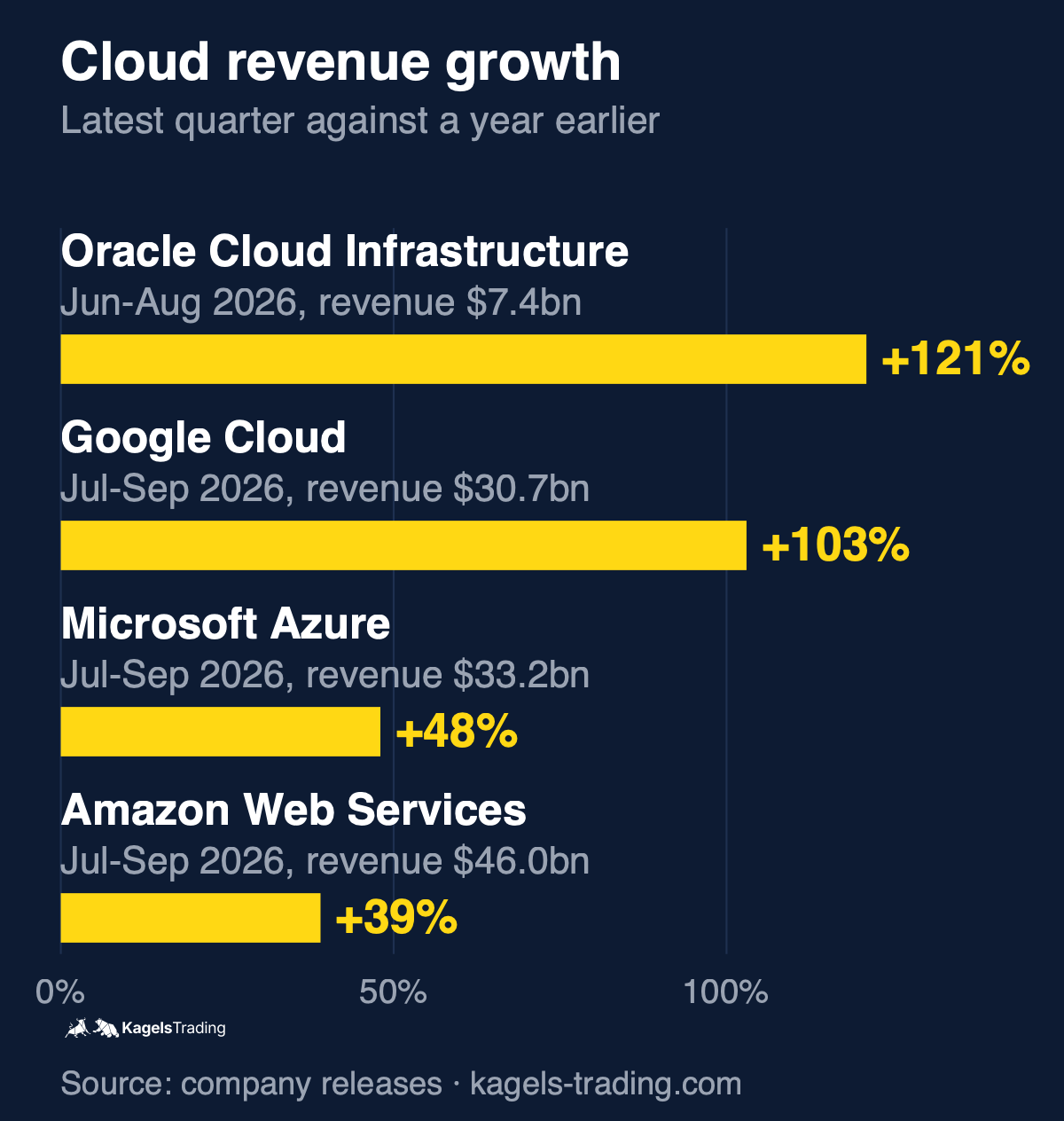
- Cloud providers report strong growth in businesses exposed to AI demand. Google Cloud grew 103 percent and Oracle’s cloud infrastructure 121 percent in their latest quarters; Microsoft Azure grew 48 percent and AWS 39 percent.
- They also spend the most. Amazon expects about $220 billion of capital spending in 2026, Microsoft about $170 billion in calendar 2026 and Meta $135 to 145 billion.
- Few companies disclose AI revenue in dollars. Dell recognised $16.4 billion of AI server revenue in one quarter and Broadcom $16.7 billion of AI semiconductor revenue. Salesforce reports an annualised figure instead: Agentforce ARR above $1.5 billion.
- The best-known AI companies are not listed. OpenAI is private; Anthropic filed its public prospectus on 26 October 2026 but did not trade by 31 October.
- Concentration is the main risk. The ten largest holdings of the S&P 500 ETF SPY made up 37.4 percent of the fund on 29 October 2026, most of them AI-related.
What are AI stocks?
AI stocks are shares of listed companies whose revenue or growth depends to a large part on artificial intelligence. The term is not an official category. No index provider or regulator decides which company counts, so every AI stock list is someone’s selection.
That is why I sort AI stocks by the evidence in their reports. There are four levels, from strongest to weakest. A company can disclose AI revenue recognised in the quarter; it can report an annualised AI metric such as recurring revenue; it can report an AI-exposed segment such as cloud infrastructure that grows with AI demand; or it can only give growth rates and targets. The last level is expectation, not revenue.
| Level | What the company reports | Examples (latest quarter) |
|---|---|---|
| Disclosed AI revenue | revenue recognised in the quarter and labelled as AI | Dell AI servers $16.4 bn, Broadcom AI semiconductors $16.7 bn |
| Annualised AI metric | annual recurring revenue (ARR), a run rate of contracts, not revenue of the quarter | Salesforce Agentforce ARR above $1.5 bn |
| AI-exposed segment | a segment that grows with AI but also sells other things | Google Cloud $30.7 bn, AWS $46.0 bn, Oracle cloud infrastructure $7.4 bn |
| Growth rates or targets only | AI growth without a dollar base, or a target | Adobe AI-first ARR “more than 150 percent”, ServiceNow AI net new ACV target $1.7 bn |
From each company’s latest results release before 31 October 2026. ARR = annual recurring revenue, an annualised value of current contracts; ACV = annual contract value. Neither is revenue recognised in the quarter.
The four layers of the AI business
AI money flows through four layers, and each layer earns at a different point in time. Chips and infrastructure are paid first, when data centers are built. Cloud providers earn when customers rent that capacity. Software companies earn last, when businesses pay for AI features in their daily work.
| Layer | How it earns from AI | Listed examples |
|---|---|---|
| Cloud and hyperscalers | rents computing power and AI models | Microsoft, Alphabet, Amazon, Oracle, CoreWeave |
| Software and applications | sells AI features and agents | Palantir, ServiceNow, Salesforce, Adobe |
| Infrastructure | builds servers, networks, power and cooling | Dell, Super Micro, Arista, Vertiv |
| Chips | designs and makes AI processors and memory | Nvidia, Broadcom, AMD, TSMC, Micron |
Meta stands outside this grid. It does not sell AI to other companies; it uses AI to sell advertising. Revenue rose 26 percent to $64.6 billion in the third quarter of 2026, and Meta says its AI investments already deliver “substantial incremental advertising revenue”, without a figure. For investors that makes Meta an AI user with a large AI budget, not an AI supplier.
Cloud: the hyperscalers
 Click to enlarge
Source: Alphabet release (Amazon, Microsoft and Oracle under Sources).
The cloud businesses of the largest companies report strong growth that AI demand helps to drive. In the third quarter of 2026, Google Cloud grew 103 percent to $30.7 billion with an operating income of $11.1 billion. AWS grew 39 percent to $46.0 billion and earned $17.8 billion. Microsoft’s Azure grew 48 percent; Microsoft now reports a segment called “Agents and Infra” with $76.8 billion of revenue instead of the former Intelligent Cloud.
Backlogs show contracted future revenue, but not how much of it is AI. Google Cloud reported $560.8 billion of remaining performance obligations, Microsoft $677 billion of commercial obligations across its business customers, and Oracle $664 billion for the whole company after its quarter to 31 August 2026. None of them says how much of this is AI, and the three totals have different scopes. Oracle’s cloud infrastructure grew 121 percent to $7.4 billion, and Oracle said AI demand “continues to grow faster than supply”. Backlogs are contracts, not yet revenue.
The price of this growth is a record investment bill. Amazon expects cash capital spending of about $220 billion in 2026, Microsoft about $170 billion in calendar 2026 and Meta $135 to 145 billion. Alphabet spent $51.4 billion in the third quarter alone. None of these companies discloses AI revenue as a dollar figure, so the return on this spending is the big open question.
CoreWeave is the pure play among the cloud providers. The company rents out GPU capacity only and trades on Nasdaq as CRWV. In the second quarter of 2026 revenue rose to $2.58 billion with a backlog of about $104 billion, but it still made a net loss of $626 million. On 30 October 2026 it was worth about $30 billion, a fraction of the hyperscalers.
Software: where AI shows up as a product
Software companies are the first to put a price tag on AI features. Salesforce reported Agentforce annual recurring revenue of more than $1.5 billion in its quarter to July 2026, up more than 240 percent, and about $3.9 billion together with Data 360. ARR is an annualised contract value, not revenue booked in the quarter, and since that quarter the Agentforce figure also includes Slackbot and Headless 360, so the growth rate compares a wider scope. ServiceNow raised its 2026 target for AI net new annual contract value to $1.7 billion, a measure of new contracts, not of revenue.
Palantir’s AI story shows up in its US commercial business. In the second quarter of 2026 Palantir’s revenue rose 93 percent to $1.94 billion, and US commercial revenue rose 149 percent to $764 million. Palantir does not report an AI line; its AI platform drives this segment. Adobe reported that its “AI-first” annual recurring revenue grew more than 150 percent, but without a dollar amount.
For software stocks, AI is both an opportunity and a threat. If AI agents do the work, customers may need fewer user licenses, which is how many software companies charge; whether that happens is open. On 30 October 2026, ServiceNow, Salesforce and Adobe were worth $109 billion, $189 billion and $97 billion, far less than the cloud providers.
Infrastructure: servers, networks and power
Infrastructure companies earn when data centers are built, before any AI software is sold. Dell reported record AI server revenue of $16.4 billion in its quarter to July 2026, orders of $60.9 billion and a backlog of $95 billion; for the full fiscal year it expects $74 billion of AI server revenue. Super Micro expects $18.5 to 19.5 billion of revenue for its quarter to September 2026, a preliminary figure with a gross margin of only 12.0 to 12.5 percent.
Power and networks are the newer bottleneck. Vertiv, which builds power and cooling systems for data centers, grew third-quarter sales 61 percent to $4.31 billion, and its orders more than doubled. Arista Networks reported revenue of $3.04 billion in the second quarter of 2026 and guided about $3.3 billion for the third. Its third-quarter report was not yet out on 31 October 2026.
Chips: the first layer, covered in detail elsewhere
Chips are the most direct link to AI spending. Nvidia reported $89.0 billion of data center revenue in its quarter to July 2026, up 117 percent; that is a business category, not an AI-only figure. Broadcom reported $16.7 billion of AI semiconductor revenue, up 221 percent. Memory makers and TSMC earn on every AI accelerator too. Our semiconductor stocks guide compares the chip designers, foundries, memory and equipment makers in detail, so I do not repeat them here.
AI stocks by market value
The largest AI stocks are also the largest companies in the world. The table shows the market value at the close on 30 October 2026 and the AI evidence in each company’s latest report. Market value says how much investors already expect, not how much AI money the company earns today.
| Company | Layer | Market value | AI evidence in the latest report |
|---|---|---|---|
| Nvidia (NVDA) | chips | $4.94 trn | data center revenue $89.0 bn |
| Microsoft (MSFT) | cloud, software | $3.88 trn | Azure +48% |
| Alphabet (GOOGL) | cloud, models, ads | $3.44 trn | Google Cloud $30.7 bn, +103% |
| Amazon (AMZN) | cloud | $2.60 trn | AWS $46.0 bn, +39% |
| Meta (META) | AI user (ads) | $1.57 trn | no AI revenue figure |
| Broadcom (AVGO) | chips | $1.56 trn | AI semiconductors $16.7 bn |
| Palantir (PLTR) | software | $442 bn | US commercial $764 m, +149% |
| Oracle (ORCL) | cloud | $396 bn | cloud infrastructure $7.4 bn, +121% |
| Dell (DELL) | infrastructure | $270 bn | AI servers $16.4 bn |
| Arista (ANET) | infrastructure | $213 bn | revenue $3.04 bn (Q2) |
| Salesforce (CRM) | software | $189 bn | Agentforce ARR above $1.5 bn |
| Vertiv (VRT) | infrastructure | $90 bn | sales +61% |
| CoreWeave (CRWV) | cloud | $30 bn | revenue $2.58 bn (Q2) |
Market values at the close on 30 October 2026 per stockanalysis.com; Oracle checked against companiesmarketcap.com. AI evidence from each company’s latest results release before 31 October 2026.
OpenAI, Anthropic and xAI: the AI leaders you cannot buy directly
The companies most people associate with AI are mostly not listed. OpenAI is still private; according to press reports it filed a confidential draft registration in June 2026, and no public prospectus was on EDGAR by 31 October 2026. Our OpenAI stock guide shows how much OpenAI you hold indirectly through Microsoft or SoftBank.
Anthropic is closest to a listing. The company filed its public registration statement with the SEC on 26 October 2026, which names Nasdaq and the ticker ANT; by 31 October no shares had been priced or traded. Our Anthropic stock guide follows the IPO and the prospectus figures. Elon Musk’s xAI is part of SpaceX, which trades on Nasdaq as SPCX; see our SpaceX stock guide.
AI ETFs
An AI ETF spreads the company risk, but each fund defines AI differently. The three funds below all carry “AI” in their name and hold very different portfolios. Check the top holdings before you buy, not the name.
| ETF (ticker) | Expense ratio | Holdings | Largest weights |
|---|---|---|---|
| Global X Artificial Intelligence & Technology (AIQ) | 0.68% | 88 | Palantir 4.34%, Microsoft 3.98%, Tesla 3.64% |
| Global X Robotics & Artificial Intelligence (BOTZ) | 0.68% | 81 | Intuitive Surgical 9.91%, Keyence 8.62%, FANUC 8.56% |
| iShares Future AI & Tech (ARTY) | 0.47% | 50 | AMD 5.60%, Marvell 4.59%, Broadcom 4.58% |
Issuer pages, holdings as of 29 or 30 October 2026.
The names hide three different bets. AIQ is a broad technology fund led by software and platforms, BOTZ is mostly robotics and factory automation, and ARTY leans on chips and infrastructure, including CoreWeave and Super Micro. If you already own an S&P 500 fund, much of the AI exposure is in your portfolio anyway.
Risks of AI stocks
The biggest risk is that the spending runs ahead of the revenue. The hyperscalers spend hundreds of billions of dollars on data centers, while only a fraction of their revenue is labelled as AI. If AI revenue grows more slowly than expected, capital spending could fall, and chips and infrastructure suppliers would feel it first.
- Concentration: the ten largest holdings of the S&P 500 ETF SPY made up 37.4 percent of the fund on 29 October 2026 (our sum of the issuer’s list), led by Nvidia, Apple and Microsoft. An index investor already has a large AI bet.
- Valuation: market values of several trillion dollars price in years of growth, so a weaker outlook can reset a price quickly.
- Margins: Super Micro’s gross margin of about 12 percent shows that selling AI hardware is not always a high-margin business.
- Regulation: AI and export rules differ by country and can change; check the risk section of each company’s annual report.
How to check an AI stock yourself
Four questions sort a real AI business from a story. I use them before I trade any company that calls itself an AI stock, and I answer each from the latest results release, not from headlines.
- Results releaseRevenueDoes the company report a dollar figure for AI, or only growth rates and plans?
- Results releaseSegmentWhich segment grows with AI, and how fast against last year?
- Cash flow statementSpendingHow much does it invest, and does revenue grow faster than the spending?
- Market dataPriceWhat is the market value against that revenue, and how far is the stock from its high?
A "no" to the first two questions does not exclude a stock, but then you are buying an expectation, not AI revenue.
Conclusion: assess the business behind the AI label
AI is real money for a growing number of listed companies, but not for all that use the word. The cloud providers and chip and server suppliers report billions in revenue from businesses that grow with AI; software companies are starting to; many others only have a story. The difference shows in the results release, not in the name.
Look at the layer, the evidence and the price before you decide. A cloud provider with a large contract backlog is a different bet from a server maker with a 12 percent margin or a software company whose licenses AI might replace. For the chip side, see the semiconductor guide linked above; for the market as a whole, our Nasdaq 100 forecast shows the index levels I watch.
Frequently asked questions about AI stocks
What are AI stocks?
AI stocks are shares of listed companies whose revenue or growth depends largely on artificial intelligence. They include cloud providers, AI software companies, server and network suppliers and chipmakers. There is no official list, so each selection is someone’s judgement.
Which companies have the largest AI-exposed businesses?
Chipmakers and cloud providers have the largest businesses that grow with AI, but most do not report an AI-only figure. Nvidia reported $89.0 billion of data center revenue in its quarter to July 2026. Google Cloud grew to $30.7 billion and AWS to $46.0 billion in the third quarter, without splitting out the AI share.
Can I buy OpenAI or Anthropic stock?
Not on the stock market yet. OpenAI is private; according to press reports it has filed only confidentially. Anthropic filed its public prospectus on 26 October 2026 but had not started trading by 31 October. Until then you get exposure only through investors such as Microsoft, Amazon or Alphabet.
Are AI stocks a bubble?
No one can say that in advance, but the risk of a sharp correction is real. The largest companies spend far more on data centers than they report as AI revenue, and a few stocks dominate the indices. Single stocks can fall a quarter in one day, so size your positions for that.
Is an AI ETF better than single AI stocks?
An AI ETF spreads the company risk, but not the sector risk. Funds such as AIQ, BOTZ and ARTY define AI very differently, from software to robotics to chips. Compare the top holdings and the costs before you choose one.
Sources
Company figures come from the companies’ own results releases and filings, checked on 31 October 2026. Market values are from stockanalysis.com at the close on 30 October 2026, ETF data from the issuers, and the SPY sum is our own calculation. Several companies report again in November, so check the latest release before you act.
- Cloud: Microsoft fiscal 2027 first quarter, Microsoft earnings call (capital spending), Alphabet third quarter 2026, Alphabet 10-Q (backlog), Amazon third quarter 2026, Meta third quarter 2026, Oracle fiscal 2027 first quarter, CoreWeave second quarter 2026.
- Software: Palantir second quarter 2026, ServiceNow third quarter 2026, Salesforce fiscal 2027 second quarter, Adobe fiscal 2026 third quarter.
- Infrastructure and chips: Dell fiscal 2027 second quarter, Super Micro preliminary first quarter, Vertiv third quarter 2026, Arista second quarter 2026, Nvidia second quarter fiscal 2027, Broadcom third quarter fiscal 2026.
- Private companies, ETFs, concentration: Anthropic filings on EDGAR, AIQ, BOTZ, ARTY, SPY holdings.
This article is market information, not investment advice. Prices and company figures change quickly; check them before you act.
This English edition is based on our German edition on kagels-trading.de and has been adapted for international readers.
More Markets and Brokers guides
- Choose a broker
Interactive Brokers Review 2026: Fees and Platforms
Fees, platforms, investor protection and real futures commissions from a client since 1996.
- Check an offshore broker
PU Prime Review 2026: FCA Warning, Licences and Costs
Which PU Prime company you contract with, what the FCA warning means, and what 1:1000 leverage and the deposit bonus do to your account.
- Understand your price
Market Makers: Who Sets Your Price and How They Profit
How market makers earn on the spread, who sets prices at German trading venues and what the EU ban on payment for order flow changed.
- Read bond market stress
MOVE Index: The VIX of the Bond Market, Explained
What the MOVE index measures, which readings signal stress, how it differs from the VIX and where its limits are.
- Size an index future
Micro Futures: MES vs MNQ, Tick Values and Risk
MES and MNQ tick values, a worked sizing example from the stop with costs and slippage, and why margin is not your risk.
- Read the futures curve
Contango vs Backwardation: Futures Curves Explained
What contango and backwardation mean, what rolling does to a position in each case, and real gold, oil and gas curves from 28 October 2026.
- Choose a silver future
Silver Futures: SI vs Micro Silver vs 100-oz SIC
SI, Micro Silver and the 100-ounce SIC compared by tick value, risk per contract, margin and December 2026 deadlines.
- Read the chip sector
SOX Index: Holdings, Weighting and How to Use It
What the SOX holds, how Nasdaq caps the weights, its largest declines since 2004 against the Nasdaq-100 and which ETFs really track it.
- Read the biotech sector
Nasdaq Biotechnology Index: Holdings, Weighting and Risks
What the NBI holds, how Nasdaq caps the weights, its long declines since 2003 against the Nasdaq-100 and which ETFs really track it.
- Research stocks
InvestingPro Review: Screener, ProPicks AI and WarrenAI
What the InvestingPro screener, ProPicks AI and WarrenAI do, what Pro and Pro+ cost and who needs which plan.
- Use the free news portal
Investing.com Review: Free Tools, Data and Limitations
What the free Investing.com portal does well, where the quote prices come from and when InvestingPro is worth paying for.
- Follow an IPO
Anthropic Stock: IPO Date, Valuation and How to Invest
Where the Anthropic IPO stands, how the valuation compares with revenue and how to get exposure before and after the listing.
- Invest in OpenAI before the IPO
OpenAI Stock: Can You Buy It, and Who Owns OpenAI?
Why there is no OpenAI stock yet, who owns OpenAI, where the IPO stands and how much OpenAI you get through Microsoft or SoftBank.
- Understand a stock split
Stock Splits Explained: Forward and Reverse Splits
What forward and reverse splits change and what they do not, the dates that matter, what happens to options and the $1 listing rule.
- Value a new listing
SpaceX Stock (SPCX): Valuation, Risks and How to Buy
How to buy SpaceX stock, what the company is worth after the IPO and which risks the lock-up calendar brings.