
Spot Market Explained: Definition and Settlement Times


Contents
- The spot market in 30 seconds
- What is a spot market?
- Spot market and cash market: one thing, several names
- What is a spot contract?
- How long does settlement take on the spot market?
- What is the futures market?
- Pros and cons of spot trading
- What trades on the spot market?
- Where are spot markets?
- Who trades on the spot market?
- Conclusion: the spot market is the market you already trade
- Frequently asked questions about the spot market
- About the author
If you have ever bought a stock, you have traded on the spot market, even if you never heard the term. The spot market is the normal form of exchange trading: price and quantity are fixed at once, and settlement follows a day or two later. Its counterpart is the futures market, where the trade and the delivery are deliberately separated in time.
I bought my first shares in 1980, and I keep seeing the same mistake about this term. Almost every explainer says a spot trade must always be settled within two days. The EU definition is wider than that, and the two days are on their way out anyway: the United States settles stocks one day after the trade since 2024, the EU follows on 11 October 2027. I checked every legal reference in this guide against the original texts on 12 November 2026. This article follows our editorial policy and is for education, not investment advice.
The spot market in 30 seconds
- Definition: on the spot market, the trade and its fulfilment belong together. Common names are spot market, cash market and physical market.
- Two days is not a fixed limit: under Article 7(2) of Delegated Regulation (EU) 2017/565, delivery of a spot contract must be scheduled within the longer of two trading days or the standard delivery period of that market. For physical commodities that can be weeks.
- T+2 is ending: US and Canadian stocks settle at T+1 since May 2024, the EU, the UK and Switzerland move on 11 October 2027.
- What trades spot: stocks, bonds, currencies, precious and industrial metals, farm products and electricity.
- The opposite: on the futures market, the trade and the delivery are separated on purpose. The price gap between the two markets is called contango or backwardation.
What is a spot market?
A spot market is a market where purchases and sales take effect immediately and delivery follows promptly.
Buyer and seller agree on price and quantity, and both deliver within the usual period of that market. The seller hands over the asset, the buyer pays the price. The name comes from the spot contract, a deal settled “on the spot”. In English the terms spot market and cash market mean the same thing, and traders of physical goods also speak of the physical market.
What counts is not the asset but the timing of delivery. Whether you buy a share, a barrel of crude oil or dollars makes no difference. The only question is whether the trade and its fulfilment go together or are deliberately pulled apart. If they go together, it is a spot trade. If they are separated, it is a forward or futures trade. The venue can even be the same.
A spot market does not need an exchange. Many spot trades run through regulated exchanges, but far from all of them. Currencies, for example, trade almost entirely over the counter (OTC), directly between banks and dealers.
Where spot trading comes from
Spot trading is the older of the two forms of trade. As long as merchants stood on the same market square with their goods, immediate settlement was a matter of course: goods for money, hand to hand.
Forward contracts appeared when goods and traders were no longer in the same place. With long-distance trade by sea, months could pass between the deal and the delivery. Anyone who bought in advance needed a contract that covered exactly that gap. Futures trading grew out of this practical need, not out of a taste for speculation.
Spot market and cash market: one thing, several names
The difference between “spot market” and “cash market” is a matter of usage, not of substance. Securities traders tend to say cash market, commodity traders say spot market. Both describe the same mechanism: delivery now, at today’s price. The price paid there is the spot price or cash price.
In commodities, “spot” almost always means physical goods for short-term delivery. Think of crude oil, electricity, natural gas or metals. How far the spot price and the futures curve can drift apart in US natural gas is something we follow in our natural gas price forecast.
Electricity is the most short-term spot market of all. Power trades for the next day, called day-ahead, and in intraday trading even for the coming hours. The reason is physics: electricity can hardly be stored, so generation and consumption must match at every second.
For crude oil, the grade is part of the price. The two benchmark grades are WTI (West Texas Intermediate, a light sweet crude) and Brent. Oil is priced per barrel, about 159 litres. Precious metals are priced per troy ounce, about 31.1 grams.
One point surprises beginners: physical spot markets have minimum sizes. Nobody buys half a barrel or a single kilowatt hour there. For private traders, the physical spot market is therefore practically closed. They trade derivatives on the same underlying instead.
What is a spot contract?
A spot contract is a single deal made on a spot market. It obliges the seller to deliver and the buyer to pay, within the standard period of that market.
Every spot trade has five parts. The counterparties, the underlying asset, the amount, the due date and the settlement, meaning the technical transfer. If one is missing, the trade cannot be settled. You will find all five on every trade confirmation your broker sends you.
The EU definition is precise and often quoted wrongly. Article 7 of Delegated Regulation (EU) 2017/565 separates spot contracts from derivatives under MiFID II, mainly for commodities. Its paragraph 2 defines a spot contract as a sale where delivery is scheduled “within the longer of” two periods: 2 trading days, or “the period generally accepted in the market for that commodity, asset or right as the standard delivery period”.
This makes the popular two-day rule too narrow. Delivery must happen within the window, so earlier delivery is always fine. But the window is not always two days: if a market usually needs longer, for example because grain has to be loaded or metal released from a warehouse, the deal is still a spot contract. The same article adds one condition: if the parties have an understanding that delivery will be postponed beyond that window, the contract is not a spot contract, whatever its written terms say.
Spot trades serve three typical purposes. Arbitrage, meaning profiting from price gaps between two venues; speculation on rising or falling prices; and hedging, the protection of an existing position.
What is the spot price?
The spot price is the price at which an asset trades on the spot market right now. Its counterpart on the futures market is the futures price, which applies to delivery at a later date. The gap between the two is called the basis.
A spot price always belongs to a place and a time. That sounds academic but has practical effects: crude oil delivered in Rotterdam does not cost the same as crude oil in Cushing, Oklahoma, because transport and storage are part of the price. For stocks the effect is small. For physical commodities it can decide between profit and loss.
In currencies, the spot rate consists of three numbers. The lower bid, at which the dealer buys, the higher ask, at which it sells, and the mid price in between. The gap between bid and ask is the spread, and it is your real trading cost. Our guide to the bid-ask spread shows how to measure it.
How long does settlement take on the spot market?
On the spot market, the trade and its settlement are one or two business days apart. In the EU, stocks currently settle at T+2, the second business day after the trade date. The United States switched to T+1 on 28 May 2024, Canada a day earlier, and the EU, the UK and Switzerland follow on 11 October 2027.
There is more between your click and the change of ownership than most people think. The trade itself takes milliseconds. Then settlement begins: the securities move from one account to another, the cash moves the other way, and a central securities depository matches both sides. The technical term for this period is the settlement cycle.
The number after the T counts business days after the trade date. T+2 means: you buy on Monday and become the owner on Wednesday. T+1 means Tuesday. T+0 would be settlement on the same day, which so far happens only in niches. For you as an investor, the key point is that you can sell shares you have just bought straight away, because the exchange keeps the trade and the settlement apart.
The United States went first. The SEC adopted the shorter cycle on 15 February 2023 and set the compliance date to 28 May 2024. In its press release 2023-29 it names the goal: to reduce the credit, market and liquidity risks that market participants face. Canada moved on 27 May 2024, one day earlier, because 27 May was a US holiday.
The EU follows in 2027, and the date is fixed in law. Regulation (EU) 2025/2075 of 8 October 2025 amends Article 5(2) of the Central Securities Depositories Regulation. For transferable securities executed on a trading venue, the intended settlement date must then be “no later than on the first business day after the trading takes place”, with some listed exceptions. The regulation applies from 11 October 2027. The graphic below compares the main markets.
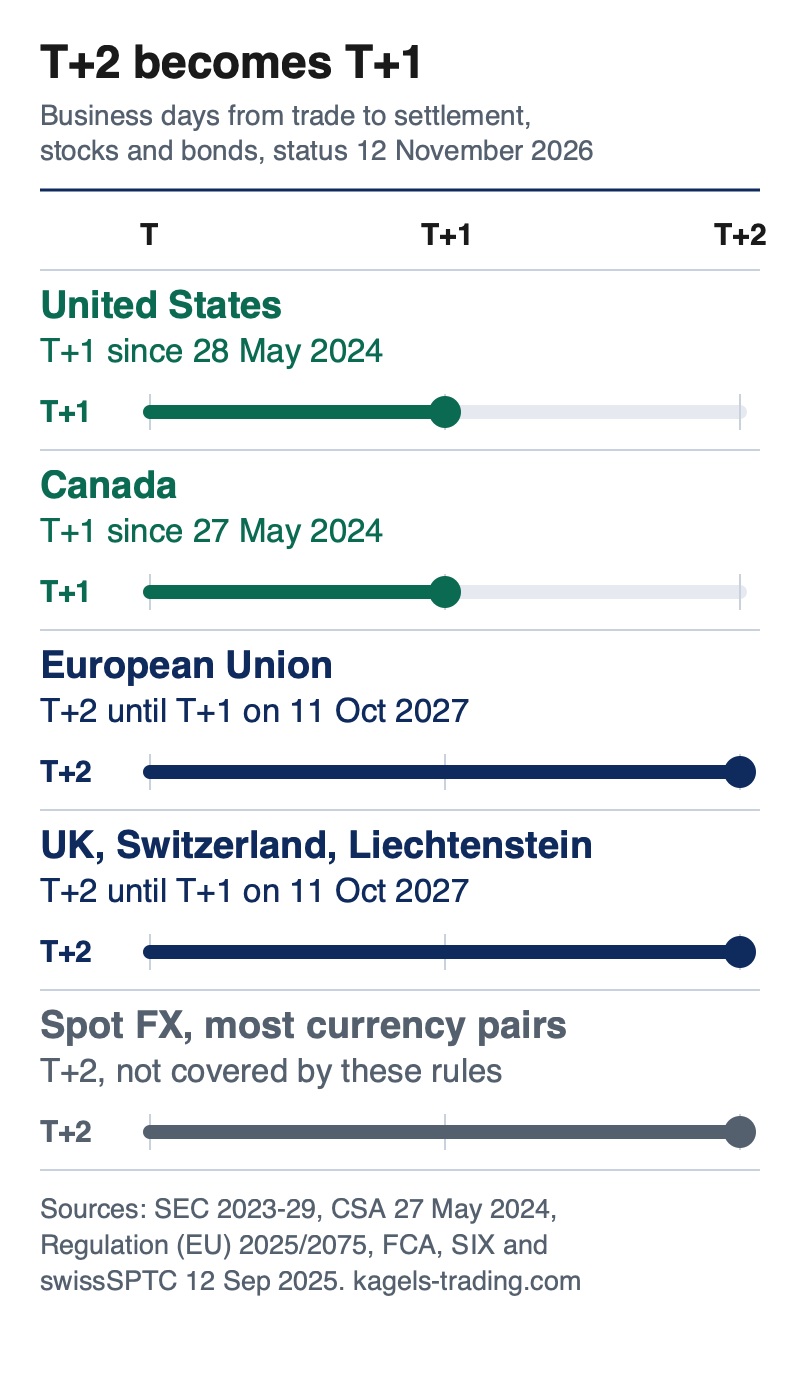 Click to enlarge
Source: Regulation (EU) 2025/2075.
Europe will switch on one single day. The UK plans the same date, as the FCA explains on its T+1 information page; the UK statutory instrument was still a draft when we checked. Switzerland and Liechtenstein follow on 11 October 2027 as well, according to SIX and the Swiss Securities Post-Trade Council. The reason is practical: two different cycles inside Europe would create a gap on every cross-border trade that someone would have to finance.
Until then, the cycles run apart. If you buy a US stock through a European broker, you move in two systems at once. That matters mainly for funds and currency hedges, because most spot FX trades still settle after two days. For your own account, little changes in daily practice.
What is the futures market?
The futures market is the counterpart to the spot market. Deals there are made today and fulfilled on purpose at a later date. Price and quantity are fixed when the trade is made, and the contract ends on the agreed date with physical delivery or a cash settlement. Until then, gains and losses are settled in cash every day through variation margin.
The best-known form of forward trade is the future. A futures contract is standardised: quantity, quality and delivery date are set by the exchange, and only the price is negotiated. Well-known examples are the E-mini S&P 500 future on the US index and the DAX future in Germany; both are settled in cash, not by delivering shares. When these contracts trade during the day and night is covered in our guide to futures market hours.
The futures price is not a forecast of the spot price. It is today’s agreed price for a later date and follows from the spot price, interest rates, storage costs and availability. Where the spot price actually stands on the delivery day does not change a contract that has already been made.
The gap between the two prices has its own names. If the futures price is above the spot price, traders call it contango. That is normal for commodities that can be stored, because storage and financing cost money. If the futures price is below the spot price, it is called backwardation, and it usually points to a current shortage. Our guide to contango and backwardation shows both with real futures curves.
Spot market vs futures market at a glance
The difference fits into one sentence. On the spot market you buy the asset, on the futures market you buy a promise. Everything else follows from that:
| Feature | Spot market | Futures market |
|---|---|---|
| Delivery | Prompt, one or two days for stocks | On the agreed date, physical or in cash |
| Price | Spot price, cash price | Futures price |
| Capital | Full value, or a margin loan | Margin as collateral, daily settlement |
| Main use | Investing, buying the goods | Hedging, leverage |
On the spot market the deal runs through in one go; on the futures market it is split into the trade and a later delivery. That split is what makes leverage possible. Instead of paying the full value, you post margin as collateral. It is not a down payment: if the price moves against you, you have to add cash every day, long before expiry.
Borderline cases: CFDs, short sales and electricity
Day trading with CFDs is not a spot trade, even though everything happens on the same day. A CFD trader does not want to own the stock, only to earn the price difference. Under EU law, “financial contracts for differences” are listed as financial instruments in Annex I, Section C(9) of the MiFID II directive, next to options and futures, and are treated as derivatives. For the basics of intraday trading, see our day trading guide.
A short sale of shares can still be a spot trade. In a short sale, someone sells shares they do not own. The sale itself is an ordinary trade on the cash market and settles in the normal cycle. To deliver, the seller borrows the shares, and that loan stays open until they buy the shares back. Our guide to short selling explains the mechanics and the costs.
Electricity is the borderline case that is often misread. Power bought for physical delivery the next day is a typical spot trade. A contract that only pays the difference in the power price in cash, without a single kilowatt hour ever flowing, is a derivative. The commodity is the same; the contract terms and the rules that apply to them make the difference.
Pros and cons of spot trading
The spot market is not the better market, it is the simpler one. If you know both sides, you can decide more consciously whether to buy an asset directly or to replicate it through a futures contract. Here is the balance from my own practice. It assumes a fully paid purchase without borrowed money.
Advantages of spot trading
- No expiry: a share or an ounce of gold you bought does not expire. You can hold the position as long as you like, without rolling it.
- No roll cost: on the futures market, switching into the next contract in contango costs real money. On the spot market this effect does not exist.
- Full ownership: you receive voting rights, dividends and interest. A derivative on the same asset gives you none of that.
- No margin calls if fully paid: if you pay the full value, no margin call can come and the maximum loss on a long position is your stake. If you buy on a margin loan, you pay interest and your broker can sell your position when the account falls too low.
Disadvantages of spot trading
- Full capital required: if you want to hold $50,000 in stocks without borrowing, you need $50,000. On the futures market a fraction is enough as margin.
- Falling prices are hard to use: going short requires borrowing the shares, which many private investors cannot easily do.
- Physical commodities are out of reach: minimum sizes, storage and transport keep private traders away from the real spot market.
- Hedging is more awkward: if you want to protect a portfolio against a setback, you will usually need a futures or options position after all.
What trades on the spot market?
Practically anything that can be delivered. The range runs from securities to the kilowatt hour. Traders usually sort it into two large groups, securities and commodities, with currencies as a world of their own.
Securities: stocks, bonds and currencies
Stocks are the standard case of the spot market. A share is a part of a company, with a claim to a share of the profit and a vote. If you buy one through your broker, you make a spot trade without the word ever coming up.
Bonds follow the same pattern but mean the opposite. A bond is a debt: you lend money to a government or a company and receive interest. Bonds also change hands on the spot market, and the price at the moment of the trade is what counts.
The currency market is the largest spot market in the world. Foreign exchange means balances in another currency. Trading runs almost entirely over the counter between banks, around the clock on five days a week. How we read the most traded pair on the chart is shown in our EUR/USD forecast.
Commodities: metals, energy and farm products
The industry sorts commodities into five groups. The grouping is not a formality. It decides how well a commodity can be stored, how long delivery takes and therefore how far apart spot and futures prices can be:
- Agricultural products: grains, corn, coffee, sugar and cotton, often called soft commodities. They depend on the season and can be stored only for a limited time.
- Livestock: live cattle and lean hogs. Storage is practically impossible, which makes the spot market especially important.
- Industrial metals: copper, aluminium, zinc, nickel and lead. They store well and are mostly delivered through warehouses.
- Precious metals: gold, silver, platinum and palladium. Spot and futures prices are usually close, as our forecasts for palladium and platinum show.
- Energy: crude oil, natural gas, coal and electricity. Here the spot market is the most short-term and the most volatile.
Electricity shows why the timing differs so much. What flows through the grid has to be produced and used in the same second. That is why power has a day-ahead market for the next day and an intraday market for the coming hours, while weeks may pass between the trade and delivery for grain.
Where are spot markets?
Spot markets sit wherever buyers and sellers meet for prompt delivery. They exist on stock exchanges, at energy exchanges and between banks. Three examples show the range.
Stock exchanges: Frankfurt and Xetra as an example
Every major stock exchange runs a spot market. In Germany, Deutsche Börse operates the Frankfurt Stock Exchange with its electronic trading system Xetra. The group keeps its spot and futures markets under one roof but apart: the cash market covers Xetra and floor trading in Frankfurt, while futures and options run through Eurex. US stocks trade the same way on exchanges such as the NYSE and Nasdaq; their opening hours are listed in our guide to stock exchange hours.
Power exchanges: EPEX SPOT
Europe’s short-term power trading runs largely through EPEX SPOT. According to its own description, it operates physical electricity markets with day-ahead and intraday trading across Central Western Europe, the UK, Switzerland, the Nordic and Baltic countries and Poland. EPEX SPOT is part of EEX Group, which belongs to Deutsche Börse Group. Its members are utilities, large industrial users and traders, not private households.
Farm products: regional cash prices
For farm products there is often no single central spot market. Prices form regionally, as cash prices paid by grain buyers and local trading points. That is why “spot price” in agriculture usually means something specific: the price a farmer receives today for immediate delivery at a given place.
Who trades on the spot market?
Three groups share the market, with very different aims. If you want to understand why a spot price moves, you need to know which buyers are active and what they want.
Professional traders and producers
Market makers earn mainly from the spread, not from the direction. Market makers continuously quote buy and sell prices and earn on the spread in between; brokers pass client orders to the market and charge commissions. Ideally a market maker does not care whether the price rises or falls. How that business works is explained in our guide to the market maker.
Producers use both markets at the same time. A farmer sells the harvest physically on the spot market and locks in the price in parallel with futures contracts. This combination is the original purpose of futures trading.
Institutional investors
Institutions move the largest volumes. Pension funds, insurers, banks and sovereign wealth funds trade on behalf of others and are bound by supervisory rules. How much one order moves the price depends on its size compared with the liquidity available at that moment.
Private traders
For most private investors, the spot market is the entry point. A trader acts on their own account and carries their own risk. Buying shares with your own money works without leverage and without margin calls, which makes it the simplest place to start.
Conclusion: the spot market is the market you already trade
The spot market is not a special field but the normal case. Every stock purchase, every fund unit and every currency exchange runs through it. Most people who read the term for the first time have used the thing for years. Its mark is that the trade and the delivery belong together instead of being pulled apart.
The popular two-day rule is the most common error on this topic. The EU definition sets the window at two trading days or the market’s standard delivery period, whichever is longer. And the two days are temporary anyway: from 11 October 2027, stocks in the EU, the UK and Switzerland settle on the next business day.
In practice, what counts is the distinction. On the spot market you buy the asset itself, normally with full capital and no expiry date. On the futures market you buy a promise, with leverage, daily settlement and a deadline. Both have their place, and choosing the wrong one costs more money than a wrong view on the market.
Frequently asked questions about the spot market
What is a spot market?
A spot market is a market where purchases and sales take effect immediately and delivery follows promptly. Stocks, bonds, currencies, precious metals and electricity all trade there. Other names are cash market and physical market.
What is the difference between the spot market and the futures market?
On the spot market the trade and the delivery go together; on the futures market they are separated on purpose. The practical result: on the spot market you normally pay the full value and own the asset, on the futures market you post margin, settle gains and losses daily and hold a contract with an expiry date.
Does a spot trade really have to settle within two days?
Not always: two days is only part of the rule. Article 7(2) of Delegated Regulation (EU) 2017/565 requires delivery within the longer of two periods: two trading days or the market’s standard delivery period. EU stocks currently settle on the second business day; for physical commodities the window can be weeks.
When does the EU move to T+1?
The EU switches on 11 October 2027. The legal basis is Regulation (EU) 2025/2075 of 8 October 2025, which shortens the settlement cycle in the Central Securities Depositories Regulation from two business days to one. The UK, Switzerland and Liechtenstein plan the same date; the United States made the switch on 28 May 2024.
What does spot price mean?
The spot price, also called cash price, is the price for immediate delivery of an asset. It always applies to a specific place and a specific time, because transport and storage are part of the price of physical goods.
Is a spot market always an exchange?
No, many spot trades happen off exchange. Many spot trades run through exchanges, but the largest spot market in the world trades off exchange: currency dealing between banks. In commodities, too, a large share is agreed directly between the parties.
Why is day trading with CFDs not a spot trade?
Because a CFD never delivers the asset. A CFD trader does not want to own the underlying asset, only to earn the price difference. EU law lists contracts for differences among the financial instruments in MiFID II, Annex I, Section C(9), next to options and futures, so they count as derivatives.
This English edition is based on our German edition on kagels-trading.de and has been adapted for international readers.
More Markets and Brokers guides
- Open your first account
What Is a Brokerage Account? A US Beginner's Guide
How to open and fund a US brokerage account, cash vs margin, what it costs and what SIPC and FDIC really cover.
- Know what trading really costs
Trading Costs: Every Fee You Pay and How to Cut It
Spread, commissions, SEC and FINRA fees, market data, margin interest and tax, with yearly totals for three trading styles.
- Choose a broker
Interactive Brokers Review 2026: Fees and Platforms
Fees, platforms, investor protection and real futures commissions from a client since 1996.
- Check an offshore broker
PU Prime Review 2026: FCA Warning, Licences and Costs
Which PU Prime company you contract with, what the FCA warning means, and what 1:1000 leverage and the deposit bonus do to your account.
- Check an EU CFD broker
Tradeview Review 2026: Tradeview Europe, MFSA and Costs
What the Malta licence of Tradeview Europe covers, how it differs from the Cayman company, and what the three MetaTrader 5 accounts cost.
- Check CopyX
CopyX Review 2026: Is TAG Markets Copy Trading Legit?
Who runs the TAG Markets copy trading platform, which regulators warn about it, why US residents are excluded and how fast the 12x Amplify account eats your deposit.
- Choose a US forex broker
OANDA Review 2026: Fees, TradingView and US Rules
OANDA from its own pages and NFA records: spreads and fees, TradingView and the demo, FIFO and three penalties.
- Understand your price
Market Makers: Who Sets Your Price and How They Profit
How market makers earn on the spread, who sets prices at German trading venues and what the EU ban on payment for order flow changed.
- Size up a bull market
Bull Market: How Long It Lasts and How to Spot the End
When a rise becomes a bull market, how long the 27 completed S&P 500 bull markets since 1928 lasted and gained, and where the current one stands.
- Read bond market stress
MOVE Index: The VIX of the Bond Market, Explained
What the MOVE index measures, which readings signal stress, how it differs from the VIX and where its limits are.
- Read stock market fear
VIX Index: What the Fear Gauge Measures and Normal Levels
What the VIX measures, which levels have been normal since 1990, how closely it tracks the S&P 500 and how VIX futures, options and ETPs work.
- Read the risk mood
Risk-On vs Risk-Off: Meaning, Assets and Indicators
What risk-on and risk-off mean, which assets rise and fall in each mode, five market shocks since 2008 and the VIX, DXY and AUD/JPY signals.
- Read market sentiment
Fear and Greed Index: How It Works, Tested Since 2021
How CNN builds its Fear and Greed Index from seven measures, what the zones mean and how the S&P 500 moved after readings below 20.
- Size up a bear market
Bear Market: How Long It Lasts and How to Spot One
When a decline becomes a bear market, how long the 27 S&P 500 bear markets since 1928 lasted, how long the recovery took and why Bitcoin had three since 2025.
- Trade an index CFD
Index CFDs at Interactive Brokers: Symbols, Costs and Trading
All 13 IBKR index CFDs, margin, stop and close-out worked through for IBDE40, financing, UK hours and the TradingView limit.
- Size an index future
Micro Futures: MES vs MNQ, Tick Values and Risk
MES and MNQ tick values, a worked sizing example from the stop with costs and slippage, and why margin is not your risk.
- Choose between futures and CFDs
Futures vs CFDs: Regulation, Order Execution and Costs
Who your counterparty is, EU, UK and US rules, how stops are triggered on CME and at CFD providers, and booked costs in a DAX example.
- Read the futures curve
Contango vs Backwardation: Futures Curves Explained
What contango and backwardation mean, what rolling does to a position in each case, and real gold, oil and gas curves from 28 October 2026.
- Choose a silver future
Silver Futures: SI vs Micro Silver vs 100-oz SIC
SI, Micro Silver and the 100-ounce SIC compared by tick value, risk per contract, margin and December 2026 deadlines.
- Read the chip sector
SOX Index: Holdings, Weighting and How to Use It
What the SOX holds, how Nasdaq caps the weights, its largest declines since 2004 against the Nasdaq-100 and which ETFs really track it.
- Read the biotech sector
Nasdaq Biotechnology Index: Holdings, Weighting and Risks
What the NBI holds, how Nasdaq caps the weights, its long declines since 2003 against the Nasdaq-100 and which ETFs really track it.
- Read the transport sector
Dow Jones Transportation Average: Stocks and Dow Theory
The 20 stocks in the Dow transport index, why the share price sets their weight, declines since 1992 and what Dow Theory can and cannot tell you.
- Read the French market
CAC 40 Index Explained: All 40 Stocks, Weights and Trading Hours
All 40 CAC 40 stocks, how Euronext caps the weights at 15 percent, trading hours in Eastern Time and how it differs from the DAX.
- Research stocks
InvestingPro Review: Screener, ProPicks AI and WarrenAI
What the InvestingPro screener, ProPicks AI and WarrenAI do, what Pro and Pro+ cost and who needs which plan.
- Judge a stock-picking newsletter
Motley Fool Stock Advisor Review: Cost and Track Record
What Motley Fool Stock Advisor costs after the first year, how the advertised return is calculated, refund and renewal terms, and who it suits.
- Use the free news portal
Investing.com Review: Free Tools, Data and Limitations
What the free Investing.com portal does well, where the quote prices come from and when InvestingPro is worth paying for.
- Find real AI revenue
AI Stocks 2026: How Listed Companies Earn From AI
Which listed companies earn from AI in cloud, software, infrastructure and chips, disclosed AI revenue against hope, plus AI ETFs and risks.
- Compare AI data center suppliers
AI Infrastructure Stocks: 10 Data Center Suppliers Compared
Ten suppliers for power, cooling, servers and optics compared on free cash flow, customer concentration and next dates, with filters and a two-stock comparison.
- Follow an IPO
Anthropic Stock: IPO Date, Valuation and How to Invest
Where the Anthropic IPO stands, how the valuation compares with revenue and how to get exposure before and after the listing.
- Invest in OpenAI before the IPO
OpenAI Stock: Can You Buy It, and Who Owns OpenAI?
Why there is no OpenAI stock yet, who owns OpenAI, where the IPO stands and how much OpenAI you get through Microsoft or SoftBank.
- Understand a stock split
Stock Splits Explained: Forward and Reverse Splits
What forward and reverse splits change and what they do not, the dates that matter, what happens to options and the $1 listing rule.
- Analyze a company
Fundamental Analysis: 12 Ratios, a Worked Example, 5 Steps
Twelve ratios with formulas and rules of thumb, worked through Microsoft's 2026 annual report, a five-step process and the fundamentals of forex, commodities and crypto.
- Value a stock
Value Investing: Intrinsic Value, Margin of Safety, Traps
Intrinsic value against price, a worked DCF with a sensitivity table, Coca-Cola as a real example, the value premium since 1926 and value traps.
- Value a new listing
SpaceX Stock (SPCX): Valuation, Risks and How to Buy
How to buy SpaceX stock, what the company is worth after the IPO and which risks the lock-up calendar brings.