
Anthropic Stock: IPO Date, Valuation and How to Invest


Contents
- Anthropic stock in 30 seconds
- What is Anthropic?
- Is there an Anthropic stock yet?
- Anthropic IPO: where things stand
- How much is Anthropic worth?
- How can you invest before the IPO?
- Subscribing to Anthropic stock: how an IPO works
- Where can you buy Anthropic stock once it is listed?
- Opportunities and risks of Anthropic stock
- What the SpaceX IPO teaches about Anthropic
- The most common mistakes in an IPO
- Conclusion: an interesting company, now with a price range
- Frequently asked questions about Anthropic stock
- About the author
Anthropic is heading for the largest IPO the AI industry has ever seen. The company behind Claude offers 825 million shares at $70 to $78 each, according to its amended prospectus of 10 November 2026. That values it at about $0.92 to $1.02 trillion on the shares outstanding. Only one thing does not exist yet: an Anthropic stock that you could buy, because trading is only expected to start on 19 November.
That is why searches for Anthropic stock end on empty quote pages showing “0.00”. This article clears that up. You get the confirmed state of the IPO, the realistic ways to take part in the company’s growth today, and an honest look at the valuation. In June I followed the SpaceX IPO from the first minute and saw how quickly euphoria turned into a loss. That experience is part of this article. The valuation itself is calculated and updated in our Anthropic stock forecast.
Anthropic stock in 30 seconds
- No stock can be traded yet. Anthropic is still a private company. It has applied to list on Nasdaq under the ticker ANT, and the prospectus does not name an ISIN. Until the listing, the quote pages of the finance portals are placeholders.
- Price range $70 to $78 since 10 November. According to CNBC sources, the roadshow started the same day, the price is to be set on 18 November and trading to start on 19 November. Anthropic itself names no date.
- Valuation about $968 billion at the midpoint. That is the value of the about 13.1 billion shares after the IPO at $74, almost exactly the $965 billion of the last funding round in May 2026. On a fully diluted basis the top of the range comes to about $1.4 trillion.
- Indirect exposure is possible today. Alphabet holds about 14 percent of Anthropic, and Amazon holds a stake in the mid to high teens.
What is Anthropic?
Anthropic is a US artificial intelligence company based in San Francisco that develops the Claude family of language models and was valued at $965 billion in May 2026.
The company was founded in 2021 by former OpenAI executives, among them the siblings Dario and Daniela Amodei. The trigger was a dispute about how to handle the risks of powerful AI systems. Since then Anthropic has positioned itself as the safety-focused alternative in the race for the strongest artificial intelligence.
You probably know the product: Claude. The assistant competes directly with ChatGPT, but it has established itself above all with business customers. Programmers, law firms and large corporations use the models through interfaces in their own applications. This business with companies is the reason for the rapid revenue growth that we come to further below.
For investors one thing matters most: Anthropic is no longer a small challenger. The company has overtaken OpenAI in valuation and raises capital on a scale usually reserved for states. In the funding round of May 2026, $65 billion came in at once.
Is there an Anthropic stock yet?
No. There is no Anthropic stock, because the company is not listed. Its shares are held only by founders, employees and large investors.
Even so, almost every finance portal already has a quote page. On TradingView there is an entry for Anthropic on Nasdaq marked as an upcoming IPO. All of these pages show a price of 0.00, because there is simply nothing to quote.
These placeholders are not errors, they are preparation. The portals create the data records so that everything is in place on the first trading day. For you they are still worthless. Anyone who clicks “buy” there ends up in an empty order screen at their broker.
Since 26 October the ticker is clear. According to the prospectus, Anthropic has applied to list under ANT. The symbol ANTP that went around in forums and that Investing.com listed is therefore out of date. The prospectus does not name an ISIN. If someone offers you listed Anthropic shares today, be very careful: nothing is listed yet.
Anthropic IPO: where things stand
The process is under way, and it is moving fast. On 1 June 2026 Anthropic confirmed that it had submitted a confidential draft registration statement to the US Securities and Exchange Commission (SEC). That is the official start of the process, as stated in Anthropic’s announcement.
A confidential S-1 is the non-public draft of the IPO prospectus that a company submits to the SEC to prepare its listing without disclosing figures yet.
The advantage for the company is obvious: the regulator reviews, and competitors read nothing. Only when the prospectus becomes public will you see audited revenue and losses, and later the number of shares. That step came on 26 October 2026: Anthropic published the S-1 in the EDGAR register and announced the filing. It had been expected as early as early September, after the Labor Day holiday. On 2 November a first amendment added the third-quarter figures. On 10 November Amendment No. 2 filled in the price range: 825 million Class A shares at $70 to $78, about 801 million of them new shares and about 24 million from existing holders.
The SEC rule explains the roadshow date. A company that files confidentially must, under an SEC rule, make its prospectus public at least 15 days before the roadshow. Anthropic filed on Monday, 26 October, so Tuesday, 10 November was the earliest possible start, and that is when the roadshow began, according to CNBC. The core figures that Reuters had reported from confidential drafts at the end of September and on 20 October are in the prospectus as reported.
These milestones are confirmed so far:
| Milestone | Date |
|---|---|
| Funding round of $65 billion, valuation $965 billion | May 2026 |
| Confidential S-1 submitted to the SEC | 1 June 2026 |
| Goldman Sachs, Morgan Stanley and JPMorgan hired as lead banks | June 2026 |
| Banks arrange first investor meetings | 15 July 2026 |
| AMD commits to invest up to $5 billion | 22 July 2026 |
| First listing moved to November | 18 Sept 2026 |
| Reuters quotes the draft prospectus | 28 Sept 2026 |
| Investor day, third-quarter revenue $16.8 billion | 14 Oct 2026 |
| Reuters: first-half loss in a newer draft | 20 Oct 2026 |
| Public S-1, ticker ANT applied for on Nasdaq | 26 Oct 2026 |
| Amendment No. 1 with third-quarter figures | 2 Nov 2026 |
| Amendment No. 2: price range $70 to $78, 825 million shares; roadshow starts (CNBC) | 10 Nov 2026 |
The investor day has taken place. On 14 October Anthropic hosted selected institutional investors at its headquarters in San Francisco, according to Bloomberg, and according to Reuters it named $16.8 billion of third-quarter revenue there; the prospectus now shows $16.96 billion. First talks with investors have been running since July, as CNBC reported. The formal roadshow, the marketing on the basis of the public prospectus before the price is set, started on 10 November, according to CNBC.
The reports now name 19 November as the first trading day. October was planned at first. According to a Wall Street Journal report of 18 September, Anthropic postponed the start so that it could show its third-quarter figures first. According to CNBC, citing people familiar with the plans, the price is to be set on 18 November and trading to start on 19 November, a week before Thanksgiving. CNBC also reports that Anthropic is aiming for a retail share of about 20 percent. The prospectus names no date. Treat 19 November as a well-founded expectation, not a fixed date. IPOs slip when markets turn.
One detail shows the scale. Its rival OpenAI, whose stock is not listed either, does not expect its own listing before 2027. That makes Anthropic the first of the two large AI labs to go public.
How much is Anthropic worth?
Since the price range you can calculate it per share. After the IPO and a parallel private placement, about 13.1 billion shares will be outstanding, according to the prospectus. At $70 that is a market value of about $917 billion, at the $74 midpoint about $968 billion and at $78 about $1.02 trillion. The midpoint is almost exactly the $965 billion post-money of the funding round in May 2026, with which Anthropic overtook OpenAI.
| Price per share | Market value (shares outstanding) |
|---|---|
| $70 (bottom of range) | about $917 billion |
| $74 (midpoint) | about $968 billion |
| $78 (top of range) | about $1.02 trillion |
Calculated on the shares outstanding after the IPO and the private placement, without the banks’ extra shares.
The $1.4 trillion in the headlines counts more shares. TechCrunch and CNBC name up to about $1.4 trillion on a fully diluted basis. The prospectus’s own fully diluted count of about 18.0 billion shares, calculated at the $74 midpoint, gives roughly the same figure when multiplied by $78, as an approximation: besides employee options and stock awards it includes shares from convertible notes, shares reserved for the donation-matching program and a planned public-benefit issuance. Both figures are correct; for comparisons with listed companies I use the shares outstanding. The $2 trillion that investors had named in the autumn is no longer in play. Even before the price range, according to CNBC, some investors called $1.5 trillion a stretch.
Seven partners buy at the IPO price. AMD, Broadcom, Google, Micron, Microsoft, Nvidia and TSMC have agreed to buy $26 billion of non-voting shares at the issue price in a private placement, according to the prospectus. Together with the IPO, Anthropic expects net proceeds of about $84.6 billion at the midpoint.
To judge whether that is expensive, you need revenue. This is where it gets interesting, because almost all finance portals work with a figure that is easily misunderstood: the run-rate.
The revenue run-rate is a projection: recent revenue scaled up to a year. According to the prospectus, Anthropic takes its usage-based revenue of the last 28 days times 13 and its monthly subscription revenue times twelve. It is not an audited annual revenue and says nothing about profits.
On this basis the development looks like this:
| Point in time | Run-rate |
|---|---|
| End of 2025 | about $9 billion |
| March 2026 | just under $20 billion |
| April 2026 | over $30 billion |
| May 2026 | about $47 billion |
| End of July 2026 | over $65 billion |
| 30 September 2026 (prospectus) | about $71 billion |
| 31 October 2026 (prospectus) | about $81 billion |
| End of 2026 (expected) | $100 to $120 billion |
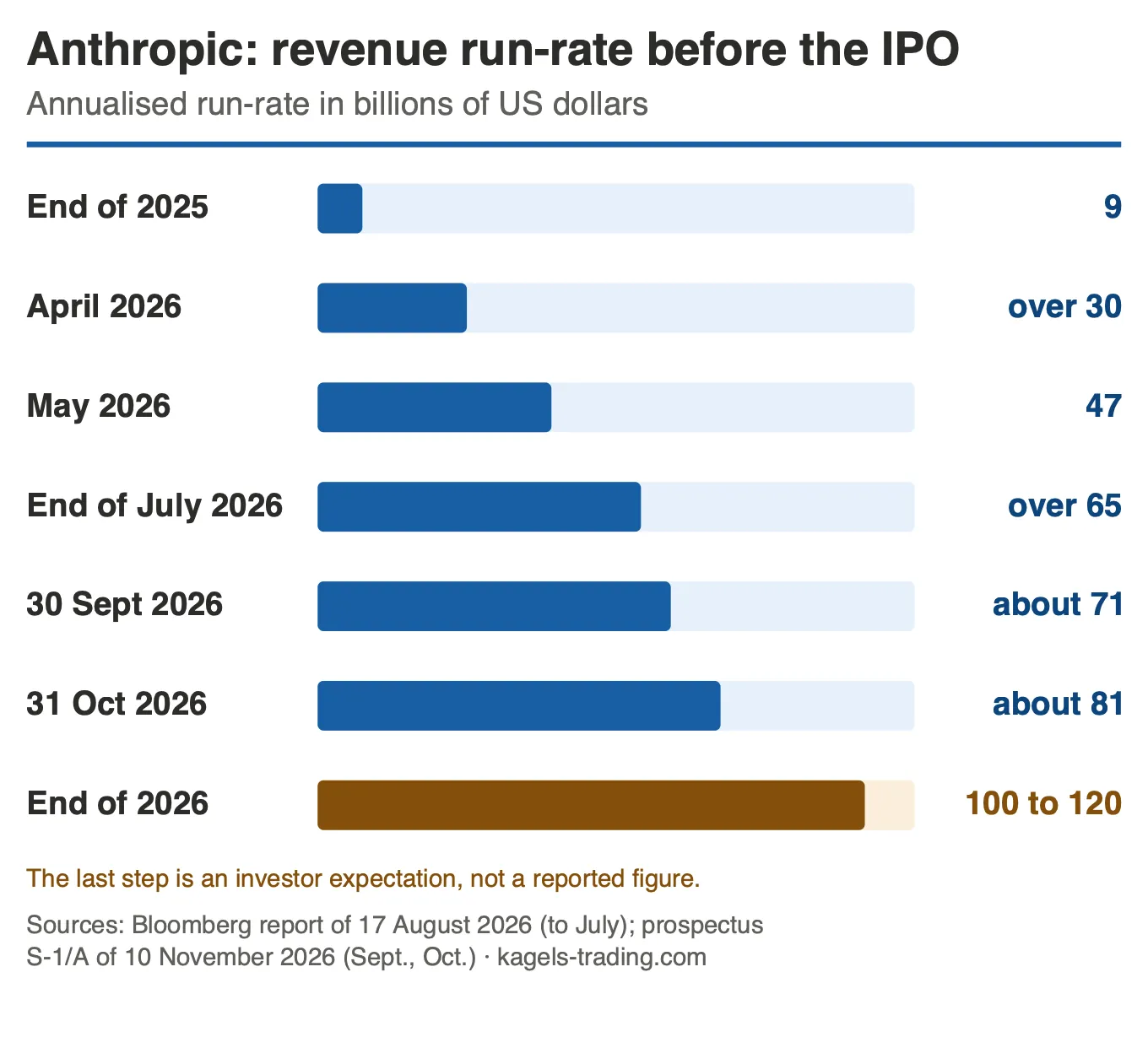 Anthropic revenue run-rate in billions of US dollars. Each bar is recent revenue scaled up to a year; the last bar is an investor expectation, not a reported figure. Data: Bloomberg report of 17 August 2026 (to July) and the amended prospectus of 10 November 2026 (September and October); graphic as of 10 November 2026 (Kagels Trading).
That is growth you rarely see. It explains why investors are talking about a trillion-dollar valuation at all. According to the prospectus, revenue in the third quarter of 2026 was $16.96 billion, 47 percent more than the $11.56 billion of the second quarter and about twelve times the same quarter a year earlier. From the first to the second quarter it had more than doubled, so the pace is slowing, but from a much higher level.
The profit picture has become mixed. In the second quarter Anthropic made its first operating profit under US accounting rules, $974 million. In the third quarter it was back to an operating loss of $567 million. The prospectus names $5.0 billion for expensive short-term computing power and $2.0 billion of non-cash charges for a program that matches employee donations with shares. Without stock-based compensation and these donation charges, the adjusted operating income rose to $2.5 billion. None of this is a net profit.
Now the decisive calculation, on the same revenue basis. Third-quarter revenue times four comes to about $68 billion. At the $74 midpoint the price-to-sales ratio is about 14, at the top of the range about 15, and on the fully diluted $1.4 trillion about 21. Against the run-rate of about $81 billion at the end of October, the midpoint is about 12. Before the price range, the reported $2 trillion meant about 30 times third-quarter revenue times four.
| Valuation | Revenue basis | Price-to-sales ratio |
|---|---|---|
| $968 billion (midpoint $74) | third quarter 2026 times four (about $68 billion) | about 14 |
| $1.02 trillion (top $78) | third quarter 2026 times four | about 15 |
| about $1.4 trillion (top $78, fully diluted) | third quarter 2026 times four | about 21 |
| $968 billion (midpoint $74) | run-rate of about $81 billion (31 October) | about 12 |
| SpaceX at its close on 9 November ($1.93 trillion) | third quarter 2026 times four (about $58 billion) | about 33 |
As a practitioner, I compare this with the last mega IPO. SpaceX closed at $142.07 on 9 November, a market value of about $1.93 trillion, or about 33 times its third-quarter revenue times four. On the same basis Anthropic at the midpoint would be about 14 times. This does not say which stock is cheaper: SpaceX has a market price, Anthropic only a price range, and Anthropic grows much faster but has far larger commitments for computing power. What the comparison does show is that the price range is much less demanding than the targets of a few weeks ago.
We keep this calculation up to date. How the valuation compares with revenue, which scenarios follow from that and what the SpaceX start says about the first weeks is in our Anthropic stock forecast linked above, which works with valuation marks instead of price levels until the first listing.
Two caveats belong here. First, the run-rate is a snapshot, not an annual result. If a large customer drops away, the projection drops with it. Second, in the prospectus only the full-year figures to 2025 are audited. The 2026 figures are unaudited, and the prospectus is still a preliminary version.
The look at the books is official. According to the prospectus, revenue in 2025 rose to $4.59 billion, almost twelve times the year before. Reuters had reported the order of magnitude from the draft on 28 September. In the same year Anthropic made an operating loss of $8.06 billion. In the first nine months of 2026 revenue was $33.24 billion and the net loss $104.0 billion. $94.3 billion of that is an accounting entry without any cash leaving the company: the financing instruments that can later be converted into shares became more valuable with the valuation. From operations, $6.6 billion of cash flowed in over the nine months.
How can you invest before the IPO?
Ordinary investors cannot buy Anthropic on a stock exchange, because there is nothing listed yet.
Private transactions exist, but access is narrow. Existing shares change hands on specialised platforms and through funds. Depending on the offer and the country, eligibility rules apply, in the US often the status of an accredited investor, and Anthropic usually has to approve a transfer. Availability, fees and minimum amounts differ widely. The SEC’s investor alert on pre-IPO offerings explains that legitimate offers stand next to scams.
One route still works, and it is surprisingly direct. The two largest shareholders are themselves listed companies:
- Alphabet: holds about 14 percent of Anthropic, worth about $135 billion at the current valuation. The group has committed to invest up to a further $40 billion.
- Amazon: holds a stake in the mid to high teens, estimated at $135 to $160 billion. So far $13 billion has gone in, and a further $20 billion is tied to milestones.
- AMD: committed on 22 July 2026 to an equity investment of up to $5 billion “in the future”, without naming a date. In the same deal AMD supplies graphics chips for up to two gigawatts of computing power, the first gigawatt from the first half of 2027.
If you hold Alphabet or Amazon, you already take part in Anthropic today. With the IPO these stakes would become visible at a market price for the first time. That can lift both stocks. Both companies are also among the largest weights in the Nasdaq 100, which our Nasdaq forecast follows.
You have to be honest about dilution. Alphabet is a group with a market value of over $2 trillion. Even an Anthropic stake of $135 billion moves its price only to a limited degree. You are not buying a pure Anthropic investment, but a group with a very valuable holding.
Finally, a warning that is unfortunately necessary. Unverified offers for supposed pre-IPO shares in Anthropic are circulating online. Check who is selling, what exactly you would own and whether the company has approved the transfer. An unsolicited offer through online ads or messages is a classic warning sign, and no Anthropic share trades on an exchange before the IPO.
Subscribing to Anthropic stock: how an IPO works
Subscribing to a stock means ordering it at the issue price before the first trading day. In large IPOs this is mostly reserved for institutional investors.
The process is similar for every large IPO, and you can follow it live with Anthropic. The first two steps are done, two are still to come:
- Public prospectus (since 26 October): the S-1 is visible, with audited full-year figures for the first time. The amendment of 10 November added the price range of $70 to $78 and the share count.
- Roadshow (since 10 November, according to CNBC): management courts large investors for capital. Demand in this phase determines the price.
- Pricing: the issue price is fixed shortly before the start, according to CNBC sources on 18 November.
- First listing: the first trading day, according to CNBC sources on 19 November. From then on you buy the stock through your broker like any other stock.
Whether private investors can subscribe at all is decided in the roadshow phase. According to CNBC, Anthropic is aiming for a retail share of about 20 percent; the prospectus only speaks of a possible allocation of a minority of shares to retail investors. Whether you get any depends on the banks and on your broker, and the answer differs from country to country. At the SpaceX IPO some brokers offered retail subscriptions, but with heavy scaling back: many subscribers received far fewer shares than they ordered, and some received none.
My advice from practice: subscribing is not a sure thing. Anyone who gets an allocation often has only a few shares in the account. And anyone who gets nothing buys on the first trading day at a price that has nothing to do with the issue price any more.
Where can you buy Anthropic stock once it is listed?
Once the first listing is done, you need no special routes. You then buy the stock like any other US stock through your broker, at the current market price.
What you need is a brokerage account with access to the US market. On Nasdaq you trade in US dollars. If your account is in another currency, your broker converts it, and the currency conversion costs something. Which international broker we use ourselves, and what it charges for US stocks, is in our Interactive Brokers review.
Clarify two points beforehand. First, the order fees for US stocks, which differ widely between brokers. Second, whether your broker makes the stock tradable on the first trading day at all. At SpaceX there were delays of several hours at some brokers while the price was already moving. On the first day of an IPO, the opening trade on Nasdaq also often comes only hours after the regular open at 9:30 a.m. Eastern Time; our guide to stock exchange hours has the session times.
A practical tip: use limit orders, not market orders, for new issues. In the first trading hours prices swing by double-digit percentages. Otherwise a market order may be filled at a price you would never have accepted.
Opportunities and risks of Anthropic stock
Before you get involved in an IPO, both sides should be on the table. Let us start with the opportunities, then come the risks.
- Growth on a rare scale: from about $9 billion of run-rate at the end of 2025 to about $81 billion on 31 October 2026, according to the prospectus. This momentum carries a large part of the valuation.
- Strong business with companies: Claude is firmly established with companies and developers. Such customers switch less often than private users.
- Investors with deep pockets: seven chip and cloud partners buy $26 billion of shares at the IPO price, and Alphabet and Amazon stand behind the company as major investors. A funding shortage is not a near-term threat.
- Valuation well below SpaceX: with third-quarter revenue times four, the $74 midpoint is about 14 times revenue, against about 33 times for SpaceX at its close on 9 November. Anthropic also grows much faster.
- Adjusted in the black, cash coming in: the second quarter of 2026 brought a first operating profit of $974 million under US accounting rules. In the third quarter the adjusted operating income was $2.5 billion, and over nine months $6.6 billion of cash flowed in from operations. It is not a net profit, and the 2026 figures are unaudited.
Against this stand risks that you should not explain away. Most of them are set out in the prospectus itself, in its long risk section.
- Losses are back at the operating level: according to the prospectus, Anthropic made an audited operating loss of $8.06 billion in 2025 and, after an operating profit in the second quarter, an operating loss of $567 million in the third quarter of 2026. In the first nine months the net loss was $104.0 billion, $94.3 billion of it an accounting entry with no cash outflow. The 2026 figures are unaudited.
- Dependence on a few customers: according to the prospectus, almost a quarter of revenue in 2025 came from just two customers with 12 percent each. In the first nine months of 2026 the five largest together made up about 25 percent. Many large customers have no long-term contracts and can cut their spending at any time.
- Concentration among the major shareholders: Alphabet and Amazon together hold roughly 30 percent and are at the same time major customers and infrastructure partners. This entanglement cuts both ways.
- Little say for shareholders: according to the prospectus, the seven co-founders get 50.1 percent of the voting power through a special class of stock, and an independent trust, the Long-Term Benefit Trust, elects the majority of the board. Anyone who buys the stock has one vote per share, but hardly any influence.
- Ongoing lawsuits: several cases are pending against Anthropic, among them on trademark rights. Investors have to price that in.
- Enormous capital needs: according to the amended prospectus, Anthropic has commitments of about $900.9 billion for computing power and data centres, about $451.6 billion of it before the end of 2030 and most of the rest by 2045. These costs arise before the revenue does.
- Valuation risk on day one: even at about $1 trillion, a lot of the future is already paid for. If the first price runs far above the issue price, as at SpaceX, little room is left for disappointment.
What the SpaceX IPO teaches about Anthropic
A look at the last mega IPO helps, and I followed it day by day. The SpaceX listing was instructive for every new issue that follows.
SpaceX listed on Nasdaq on 12 June 2026. The issue price was $135, the stock opened at $150 and closed the first day at $160.95, a gain of just over 19 percent. Four days later it marked its all-time high at $225.64. Then the market turned. In mid-July the price fell below the issue price, and the low was $104.83. On 9 November it closed at $142.07, a little above the issue price.
I take three lessons from this, and all three apply to Anthropic. They concern the first price, the free float and the valuation.
- The first price is not the fair value: SpaceX opened at $150, closed the first day at $160.95, marked its all-time high four days later and was below the issue price about five weeks after that. The first days say little about where the price settles.
- A small free float amplifies both directions: only about five percent of SpaceX shares were freely tradable. First, little supply drove the price up. The fall below the issue price came in mid-July, before the first lock-up release on 6 August; from then on, the releases added supply.
- The valuation catches up with everyone: at its IPO SpaceX was valued at about 95 times its reported 2025 revenue, which left no room for disappointment. That is a historical figure on a different revenue basis, not a comparison with Anthropic, but the mechanism stays the same.
The most important difference: Anthropic already has more revenue than SpaceX, $16.96 billion against $14.58 billion in the third quarter of 2026. That makes the valuation easier to argue, but it does not protect against the usual exaggeration in the first trading days.
The most common mistakes in an IPO
With large new issues I see the same patterns again and again. These five mistakes cost private investors money most often.
- Buying the open blindly: the first price comes from euphoria and scarce supply. SpaceX opened at $150 and was below its $135 issue price about five weeks later.
- Using the issue price as an anchor: this price is the result of a roadshow, not a fair value. It works neither as a buy signal nor as a floor.
- Not doing the valuation maths: anyone who hears $965 billion and does not put it in relation to revenue is buying a feeling, not a number.
- Ignoring position size: new issues swing extremely in the first weeks. A position that keeps you awake at night is too large. How to size a position is in our guide to risk management.
- Betting on the wrong ticker: Anthropic has applied for ANT. Anyone searching for ANTP or a supposed identifier today can easily end up with dubious offers.
The most expensive mistake is haste. An IPO is a one-off event, but the stock stays tradable afterwards. There is no reason to have to be there on the first day.
Conclusion: an interesting company, now with a price range
Anthropic is the most convincing candidate among the AI IPOs. The growth is exceptional, the business with companies carries the revenue, and the company brings in cash from operations. Anyone who wants to take part in this technology has the most solid route so far here.
The price range has made the IPO less demanding. At $70 to $78 Anthropic would be worth about $0.92 to $1.02 trillion on the shares outstanding, about 14 times third-quarter revenue times four at the midpoint. A few weeks ago $2 trillion was being reported. At the same time the third quarter shows an operating loss of $567 million under US accounting rules and commitments of about $900 billion for computing power. That is the other side of the growth.
My approach is therefore simple. I read the amended prospectus, wait for the final price and watch the first trading days from a distance. At SpaceX patience paid off: four weeks after the first listing the stock was clearly cheaper than on the first day. As soon as Anthropic is listed, our Anthropic stock forecast switches to a chart analysis with price levels.
This article is market analysis and education, not investment advice.
Frequently asked questions about Anthropic stock
Is Anthropic on the stock market?
No, Anthropic is not listed yet. On 26 October 2026 the company filed its public prospectus with the SEC, and on 10 November it set a price range of $70 to $78. It has applied to list on Nasdaq under the ticker ANT. According to CNBC sources, trading is to start on 19 November 2026. Anthropic has not confirmed this date.
Can you buy Anthropic shares?
Not on a stock exchange, because there are no listed Anthropic shares. The quote pages of the finance portals are placeholders, and private transactions are usually limited to eligible investors and need the company’s approval. You have indirect exposure through Alphabet and Amazon, which together hold roughly 30 percent of Anthropic.
What is the ticker symbol for Anthropic stock?
Anthropic has applied for the ticker ANT. That is what the prospectus says, with Class A shares to be traded on Nasdaq. The symbol ANTP that circulated in forums is out of date. The prospectus does not name an ISIN.
When is the Anthropic IPO?
According to press reports, on 19 November 2026. Anthropic filed the public prospectus on 26 October and set the price range of $70 to $78 on 10 November. According to CNBC, citing people familiar with the plans, the roadshow started the same day, the price is to be set on 18 November and trading to start on 19 November. Anthropic itself names no date, and IPO timetables can still slip.
How much is Anthropic worth?
At the price range, about $917 billion to $1.02 trillion. That is the value of the about 13.1 billion shares outstanding after the IPO at $70 and $78; at the $74 midpoint it is about $968 billion. On a fully diluted basis, which also counts options, stock awards, convertible notes and reserved shares, the top of the range comes to about $1.4 trillion. In the funding round of May 2026 Anthropic was valued at $965 billion, ahead of OpenAI.
Which banks are handling the Anthropic IPO?
Goldman Sachs and Morgan Stanley lead the syndicate. They come first on the cover of the prospectus, followed by JPMorgan and 19 other banks. The lead banks manage the pricing and the approach to institutional investors.
This English edition is based on our German edition on kagels-trading.de and has been adapted for international readers.
More Markets and Brokers guides
- Open your first account
What Is a Brokerage Account? A US Beginner's Guide
How to open and fund a US brokerage account, cash vs margin, what it costs and what SIPC and FDIC really cover.
- Know what trading really costs
Trading Costs: Every Fee You Pay and How to Cut It
Spread, commissions, SEC and FINRA fees, market data, margin interest and tax, with yearly totals for three trading styles.
- Choose a broker
Interactive Brokers Review 2026: Fees and Platforms
Fees, platforms, investor protection and real futures commissions from a client since 1996.
- Choose an options broker
tastytrade Review 2026: Options Fees, Margin and Safety
tastytrade from an options trader's own account and its October 2026 fee schedule: fees, the 6.75% margin rate, safety and FINRA fines.
- Check an offshore broker
PU Prime Review 2026: FCA Warning, Licences and Costs
Which PU Prime company you contract with, what the FCA warning means, and what 1:1000 leverage and the deposit bonus do to your account.
- Check an EU CFD broker
Tradeview Review 2026: Tradeview Europe, MFSA and Costs
What the Malta licence of Tradeview Europe covers, how it differs from the Cayman company, and what the three MetaTrader 5 accounts cost.
- Check ZuluTrade
ZuluTrade Review 2026: Costs, Regulation and US Status
Who runs the copy trading platform, what it costs through your broker, why the US was missing from its sign-up form and what the CFTC fined its US company for.
- Check CopyX
CopyX Review 2026: Is TAG Markets Copy Trading Legit?
Who runs the TAG Markets copy trading platform, which regulators warn about it, why US residents are excluded and how fast the 12x Amplify account eats your deposit.
- Choose a US forex broker
OANDA Review 2026: Fees, TradingView and US Rules
OANDA from its own pages and NFA records: spreads and fees, TradingView and the demo, FIFO and three penalties.
- Check a commission-free app broker
Webull Review 2026: Fees, Margin Rates and Safety
Webull from its own fee schedule and FINRA records: what is free, margin rates and Premium, overnight trading, crypto and three fines.
- Understand your price
Market Makers: Who Sets Your Price and How They Profit
How market makers earn on the spread, who sets prices at German trading venues and what the EU ban on payment for order flow changed.
- Size up a bull market
Bull Market: How Long It Lasts and How to Spot the End
When a rise becomes a bull market, how long the 27 completed S&P 500 bull markets since 1928 lasted and gained, and where the current one stands.
- Read bond market stress
MOVE Index: The VIX of the Bond Market, Explained
What the MOVE index measures, which readings signal stress, how it differs from the VIX and where its limits are.
- Read stock market fear
VIX Index: What the Fear Gauge Measures and Normal Levels
What the VIX measures, which levels have been normal since 1990, how closely it tracks the S&P 500 and how VIX futures, options and ETPs work.
- Read the risk mood
Risk-On vs Risk-Off: Meaning, Assets and Indicators
What risk-on and risk-off mean, which assets rise and fall in each mode, five market shocks since 2008 and the VIX, DXY and AUD/JPY signals.
- Read market sentiment
Fear and Greed Index: How It Works, Tested Since 2021
How CNN builds its Fear and Greed Index from seven measures, what the zones mean and how the S&P 500 moved after readings below 20.
- Size up a bear market
Bear Market: How Long It Lasts and How to Spot One
When a decline becomes a bear market, how long the 27 S&P 500 bear markets since 1928 lasted, how long the recovery took and why Bitcoin had three since 2025.
- Trade an index CFD
Index CFDs at Interactive Brokers: Symbols, Costs and Trading
All 13 IBKR index CFDs, margin, stop and close-out worked through for IBDE40, financing, UK hours and the TradingView limit.
- Size an index future
Micro Futures: MES vs MNQ, Tick Values and Risk
MES and MNQ tick values, a worked sizing example from the stop with costs and slippage, and why margin is not your risk.
- Choose between futures and CFDs
Futures vs CFDs: Regulation, Order Execution and Costs
Who your counterparty is, EU, UK and US rules, how stops are triggered on CME and at CFD providers, and booked costs in a DAX example.
- Understand the IBKR Exposure Fee
IBKR Exposure Fee: What It Is and How to Reduce It
Why Interactive Brokers charges a daily fee on high-risk accounts, why weekends count, where to find it and how to reduce it, with a real 1.12 euro notice.
- Read the futures curve
Contango vs Backwardation: Futures Curves Explained
What contango and backwardation mean, what rolling does to a position in each case, and real gold, oil and gas curves from 28 October 2026.
- Understand the spot market
Spot Market Explained: Definition and Settlement Times
What a spot market is, why two days is a minimum and not a limit, and when stocks settle at T+1 in the US, EU, UK and Switzerland.
- Choose a silver future
Silver Futures: SI vs Micro Silver vs 100-oz SIC
SI, Micro Silver and the 100-ounce SIC compared by tick value, risk per contract, margin and December 2026 deadlines.
- Read the chip sector
SOX Index: Holdings, Weighting and How to Use It
What the SOX holds, how Nasdaq caps the weights, its largest declines since 2004 against the Nasdaq-100 and which ETFs really track it.
- Read the biotech sector
Nasdaq Biotechnology Index: Holdings, Weighting and Risks
What the NBI holds, how Nasdaq caps the weights, its long declines since 2003 against the Nasdaq-100 and which ETFs really track it.
- Read the transport sector
Dow Jones Transportation Average: Stocks and Dow Theory
The 20 stocks in the Dow transport index, why the share price sets their weight, declines since 1992 and what Dow Theory can and cannot tell you.
- Read the French market
CAC 40 Index Explained: All 40 Stocks, Weights and Trading Hours
All 40 CAC 40 stocks, how Euronext caps the weights at 15 percent, trading hours in Eastern Time and how it differs from the DAX.
- Research stocks
InvestingPro Review: Screener, ProPicks AI and WarrenAI
What the InvestingPro screener, ProPicks AI and WarrenAI do, what Pro and Pro+ cost and who needs which plan.
- Judge a stock-picking newsletter
Motley Fool Stock Advisor Review: Cost and Track Record
What Motley Fool Stock Advisor costs after the first year, how the advertised return is calculated, refund and renewal terms, and who it suits.
- Use the free news portal
Investing.com Review: Free Tools, Data and Limitations
What the free Investing.com portal does well, where the quote prices come from and when InvestingPro is worth paying for.
- Use Forex Factory
Forex Factory: Calendar, Forums and Tools Explained
How to read and set up the Forex Factory calendar, and what its forums, trades feed, news, broker guide and Trade Explorer offer.
- Find real AI revenue
AI Stocks 2026: How Listed Companies Earn From AI
Which listed companies earn from AI in cloud, software, infrastructure and chips, disclosed AI revenue against hope, plus AI ETFs and risks.
- Compare AI data center suppliers
AI Infrastructure Stocks: 10 Data Center Suppliers Compared
Ten suppliers for power, cooling, servers and optics compared on free cash flow, customer concentration and next dates, with filters and a two-stock comparison.
- Invest in OpenAI before the IPO
OpenAI Stock: Can You Buy It, and Who Owns OpenAI?
Why there is no OpenAI stock yet, who owns OpenAI, where the IPO stands and how much OpenAI you get through Microsoft or SoftBank.
- Understand a stock split
Stock Splits Explained: Forward and Reverse Splits
What forward and reverse splits change and what they do not, the dates that matter, what happens to options and the $1 listing rule.
- Analyze a company
Fundamental Analysis: 12 Ratios, a Worked Example, 5 Steps
Twelve ratios with formulas and rules of thumb, worked through Microsoft's 2026 annual report, a five-step process and the fundamentals of forex, commodities and crypto.
- Value a stock
Value Investing: Intrinsic Value, Margin of Safety, Traps
Intrinsic value against price, a worked DCF with a sensitivity table, Coca-Cola as a real example, the value premium since 1926 and value traps.
- Value a new listing
SpaceX Stock (SPCX): Valuation, Risks and How to Buy
How to buy SpaceX stock, what the company is worth after the IPO and which risks the lock-up calendar brings.