
CAC 40 Index Explained: All 40 Stocks, Weights and Trading Hours


Contents
- CAC 40 in 30 seconds
- What is the CAC 40?
- Which stocks are in the CAC 40?
- How is the CAC 40 selected and weighted?
- How has the CAC 40 performed?
- CAC 40 vs DAX: what is the difference?
- When does the CAC 40 trade?
- How can you trade the CAC 40? Ways and costs
- Pros and cons of the CAC 40
- CAC 40 outlook: the levels that matter
- Conclusion: what the CAC 40 means for traders
- Frequently asked questions about the CAC 40
- About the author
Since the end of 1987 the CAC 40 has grown a little more than eightfold, while the DAX grew more than 25 times. Yet with dividends included, the two come out close over these 39 years. Most of the gap lies in how the indices are calculated.
This guide shows which 40 stocks are in France’s main index, how Euronext selects them and when the index trades. You also get a chart since 1990, a fair comparison with the DAX and the ways to trade the CAC 40. This article follows our editorial policy and is for education, not investment advice. We may earn a commission if you buy through the TradingView links in this guide.
CAC 40 in 30 seconds
- The main index of the Paris stock exchange. It holds the 40 largest and most actively traded stocks on Euronext Paris, weighted by free-float market value.
- A 15 percent cap. No stock may weigh more at the annual rebalance. On 30 September 2026 Schneider Electric led with 9.55 percent and TotalEnergies followed with 8.79 percent.
- A price index without dividends. Unlike the DAX. With dividends the CAC 40 returned 8.82 percent a year since the end of 1987, according to Euronext, similar to the DAX over the same period.
- Continuous trading from 3:00 to 11:30 a.m. Eastern Time for most of the year. That is 9:00 to 17:30 Paris time. The CAC 40 future trades from 2:00 a.m. to 4:00 p.m. ET for most of the year.
- A highest close of 8,726 points. It came on 10 August 2026, the highest daily close in our data since 1990. You can follow the current level on the CAC 40 chart on TradingViewAffiliate link: we may earn a commission if you buy..
What is the CAC 40?
The CAC 40 is the most important stock index in France. It tracks the price of the 40 largest and most actively traded companies on the Euronext Paris exchange and is weighted by free-float market value.
The name stands for “Cotation Assistée en Continu”, which means continuous quotation. That is how Euronext explains it. The base is 1,000 points on 31 December 1987, and the index has been published since 15 June 1988.
The standard CAC 40 is a price index. It only tracks share prices, so dividends paid out are not included. Euronext also calculates versions with reinvested dividends, such as the CAC 40 GR under the symbol PX1GR.
The index is quoted in euros and recalculated every 15 seconds from 9:00 a.m. Paris time. That is set out in the Euronext rule book. The official symbol is PX1, the ISIN FR0003500008, and Yahoo lists it as ^FCHI.
On TradingView you find the index as EURONEXT:PX1. How it has moved over the decades shows best on a monthly chart, such as the CAC 40 monthly chart on TradingViewAffiliate link: we may earn a commission if you buy..
Which stocks are in the CAC 40?
According to Euronext, the ten largest stocks make up 62 percent of the index. Schneider Electric, TotalEnergies and Airbus alone account for almost 25 percent. The weights come from the Euronext factsheet.
| Company | Symbol | Weight |
|---|---|---|
| Schneider Electric | SU | 9.55% |
| TotalEnergies | TTE | 8.79% |
| Airbus | AIR | 6.41% |
| Air Liquide | AI | 6.17% |
| Safran | SAF | 5.93% |
| BNP Paribas | BNP | 5.62% |
| LVMH | MC | 5.45% |
| L’Oréal | OR | 5.14% |
| Sanofi | SAN | 4.71% |
| AXA | CS | 4.28% |
The ten largest stocks in the CAC 40 according to the Euronext factsheet, as of 30 September 2026. Between rebalances the weights change every day with prices.
Luxury is strongly represented. LVMH, L’Oréal, Hermès and Kering are all in the index. Aerospace adds Airbus, Safran and Thales, alongside large banks and insurers.
TradingView shows prices, daily change and market value of the members as a sortable list. The list of CAC 40 stocks on TradingViewAffiliate link: we may earn a commission if you buy. can be sorted by the day’s winners and losers. On 11 November 2026 it did not show ArcelorMittal, which according to Euronext is still in the index.
| Company | Symbol |
|---|---|
| Accor | AC |
| Air Liquide | AI |
| Airbus | AIR |
| ArcelorMittal | MT |
| AXA | CS |
| BNP Paribas | BNP |
| Bouygues | EN |
| Bureau Veritas | BVI |
| Capgemini | CAP |
| Carrefour | CA |
| Crédit Agricole | ACA |
| Danone | BN |
| Dassault Systèmes | DSY |
| Eiffage | FGR |
| Engie | ENGI |
| EssilorLuxottica | EL |
| Eurofins Scientific | ERF |
| Euronext | ENX |
| Hermès | RMS |
| Kering | KER |
| Legrand | LR |
| L’Oréal | OR |
| LVMH | MC |
| Michelin | ML |
| Orange | ORA |
| Pernod Ricard | RI |
| Publicis | PUB |
| Renault | RNO |
| Safran | SAF |
| Saint-Gobain | SGO |
| Sanofi | SAN |
| Schneider Electric | SU |
| Société Générale | GLE |
| Stellantis | STLAP |
| STMicroelectronics | STMPA |
| Thales | HO |
| TotalEnergies | TTE |
| Unibail-Rodamco-Westfield | URW |
| Veolia | VIE |
| Vinci | DG |
All 40 members in alphabetical order, symbols on Euronext Paris. Composition according to Euronext on 11 November 2026. Euronext made no change at the reviews in March, June and September 2026.
Not every member is a French company. Airbus has a Dutch ISIN according to Euronext, ArcelorMittal one from Luxembourg. Stellantis, STMicroelectronics and Euronext itself use the Dutch legal form N.V. Under the rule book, Paris must in principle be the stock’s main market. Current members may stay with another main market, for example if they have a large presence in France or active derivatives trading in Paris.
How is the CAC 40 selected and weighted?
A free-float weighted index only counts the shares that actually trade on the market. Stakes held by large shareholders are left out of the weighting.
Selection is based on two rankings. Euronext ranks all eligible stocks by the monetary value traded over the previous twelve months and by their free-float market value. Both ranks together give the order.
The 35 highest-ranked companies are in. For the last five places there is a buffer zone from rank 36 to 45, where current members take priority over newcomers. That stops stocks from moving in and out because of small shifts in rank.
Weights are capped at 15 percent. No company may weigh more at the annual review in September. Between review dates the weights move freely with prices.
A stock must also trade actively. At the annual review it must have turned over at least 20 percent of its free-float shares in twelve months. Additions are decided by the Conseil Scientifique, a committee at Euronext, on a proposal from the index team.
| Step | Rule | Next date |
|---|---|---|
| Cut-off | after the close on the second-to-last Friday of February, May, August and November | 20 Nov 2026 |
| Announcement | committee meeting in March, June, September and December | 10 Dec 2026 |
| Effective | after the close on the third Friday of March, June, September and December | from 21 Dec 2026 |
Review dates according to the CAC family rule book (version 25-03, valid from 1 October 2025). Meeting date of 10 December 2026 according to the Euronext notice of 10 September 2026, the other dates are derived from the calendar.
How has the CAC 40 performed?
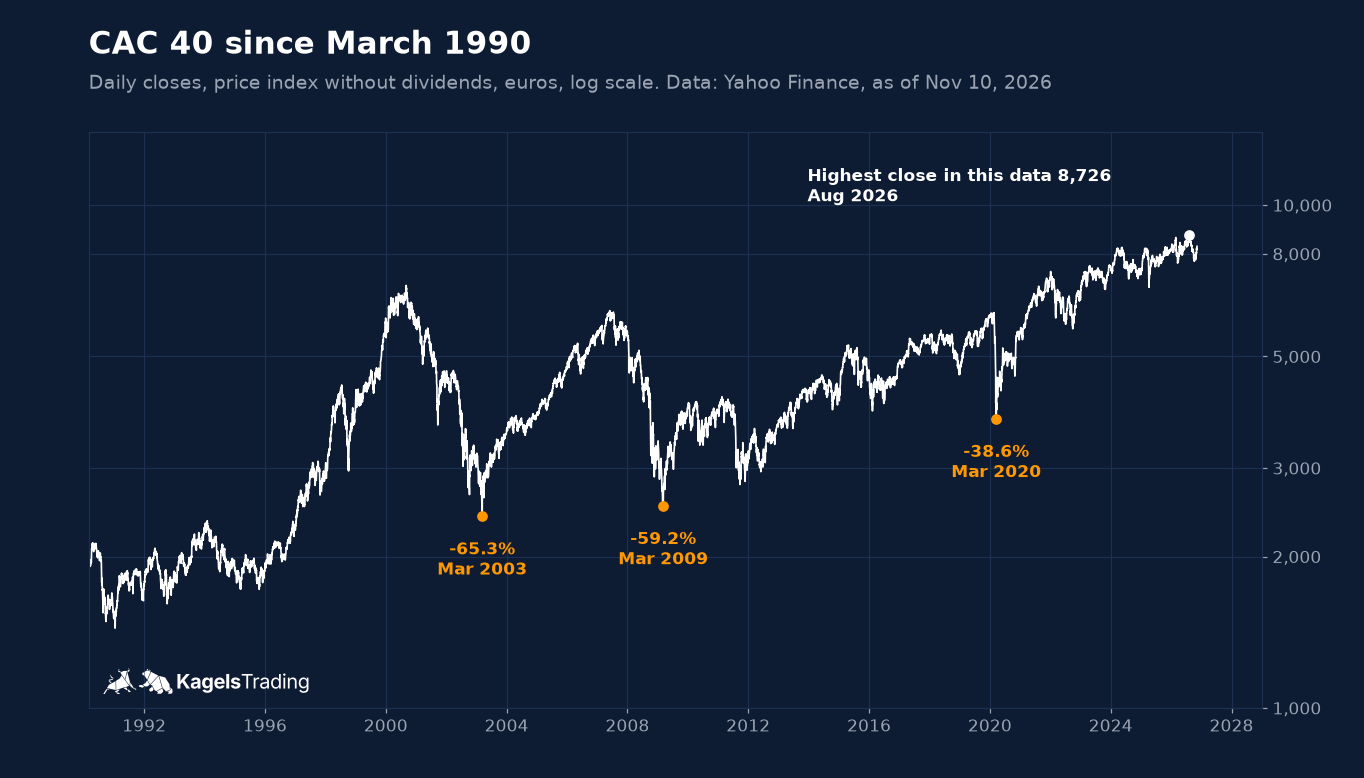
On 10 November 2026 the CAC 40 closed at 8,278.59 points. That is a gain of 1.6 percent since the start of the year. The highest daily close in our data since 1990, on 10 August 2026, is 5.4 percent higher.
 Click to enlarge
The index fell sharply three times. From the high in September 2000 it lost 65 percent by March 2003, and in the financial crisis from June 2007 to March 2009 it lost 59 percent. In the Covid crash of 2020 it dropped 39 percent within a month.
The price index only passed its 2000 high again in November 2021, a good 21 years later. If you only look at the price index, you underestimate the return, because the dividends are missing.
| Year | Change |
|---|---|
| 2021 | +28.9% |
| 2022 | −9.5% |
| 2023 | +16.5% |
| 2024 | −2.2% |
| 2025 | +10.4% |
| 2026 to 10 Nov | +1.6% |
Yearly change of the CAC 40 price index, own calculation from daily closes. The figures for 2023 to 2025 match the Euronext factsheet.
CAC 40 vs DAX: what is the difference?
The key difference is how they are calculated. The DAX is a performance index, so dividends are reinvested in the calculation. The CAC 40 is a price index, so dividends paid out drop out of the calculation.
| Feature | CAC 40 | DAX |
|---|---|---|
| Provider | Euronext | STOXX |
| Index type | Price index | Performance index |
| Members | 40 | 40 |
| Maximum weight | 15% | 15% |
| Calculated since | 15 June 1988 | 1 July 1988 |
| Exchange | Euronext Paris | Xetra |
CAC 40 according to the Euronext rule book, DAX according to the STOXX index page, a subsidiary of Deutsche Börse Group. The DAX cap has been 15 percent since 18 March 2024, before that it was 10 percent.
With dividends included for both, they come out close over this period. According to Euronext, the CAC 40 with dividends returned 8.82 percent a year on average from 31 December 1987 to 30 September 2026. Our own calculation gives the DAX about 8.7 percent over the same period. TradingView lists the dividend version as EURONEXT:PX1GR, and on the CAC 40 GR chartAffiliate link: we may earn a commission if you buy. you can check the comparison yourself.
Without dividends the CAC 40 returned only 5.50 percent a year. This gap of three percentage points a year is why the DAX pulls so far ahead on a chart. If you put both indices side by side, always compare the same index type.
That does not make the two markets equally good. Both index calculations reinvest gross dividends and ignore costs and taxes. Their paths, sectors and risks differ clearly. Our DAX forecast shows where the German index stands now.
French companies make up 32.0 percent of the Euro Stoxx 50, more than any other country. That is according to STOXX. All 16 members listed in Paris come from the CAC 40. More in the Euro Stoxx 50 forecast.
When does the CAC 40 trade?
The stocks in the CAC 40 trade continuously on Euronext Paris from 3:00 to 11:30 a.m. Eastern Time. That is 9:00 to 17:30 Paris time. For a few weeks in March and in October and November, when Europe and the US change their clocks on different dates, cash trading runs from 4:00 a.m. to 12:30 p.m. ET.
After 17:30 Paris time the closing auction follows. The index is calculated until it ends, and its closing level comes from the auction prices.
Other exchanges keep different hours. The NYSE and Nasdaq open later, and all sessions are in our guide to stock exchange hours.
You can trade longer through the future. According to the Euronext contract specification, the CAC 40 future trades from 8:00 to 22:00 Paris time, which is 2:00 a.m. to 4:00 p.m. ET for most of the year and 3:00 a.m. to 5:00 p.m. ET in the clock-change weeks. Details are in the next section.
| Date | Euronext Paris | Occasion |
|---|---|---|
| 24 Dec 2026 | half trading day | Christmas Eve |
| 25 Dec 2026 | closed | Christmas |
| 31 Dec 2026 | half trading day | New Year’s Eve |
| 1 Jan 2027 | closed | New Year’s Day |
| 26 Mar 2027 | closed | Good Friday |
| 29 Mar 2027 | closed | Easter Monday |
According to the Euronext trading calendar. Euronext publishes the exact hours of the half trading days separately.
Paris trades normally on US holidays such as Thanksgiving. The futures hours of other markets, from CME to Eurex, are in our guide to futures market hours.
How can you trade the CAC 40? Ways and costs
You cannot buy the index itself, you need a product that tracks it. The three main routes are ETFs, futures and CFDs, and not all of them are open to US traders.
CAC 40 ETFs
According to justETF, three funds track the CAC 40, all with full replication. They are UCITS ETFs listed in Europe, aimed at European investors. US retail investors usually cannot buy them, and justETF lists them for the German market.
| ETF | ISIN | Cost per year |
|---|---|---|
| Amundi CAC 40 UCITS ETF Dist (distributing) | FR0007052782 | 0.25% |
| Amundi CAC 40 UCITS ETF Acc (accumulating) | FR0013380607 | 0.25% |
| Xtrackers CAC 40 UCITS ETF 1D (distributing) | LU0322250985 | 0.20% |
Ongoing charges (TER) according to justETF, as of 10 November 2026. Read the provider’s key information document before buying.
Unlike the price index, each of these ETFs gives you the dividends. Distributing funds pay them out, accumulating funds reinvest them in the fund. The funds use different dividend versions of the index as their benchmark. According to the Amundi key information document, both Amundi funds track the CAC 40 Gross Total Return index with gross dividends. According to DWS, the Xtrackers fund tracks the CAC 40 Total Return Net, where withholding taxes on dividends are deducted.
We found no US-listed ETF that tracks the CAC 40. The closest US fund is the iShares MSCI France ETF (EWQ), which follows the MSCI France index instead, with an expense ratio of 0.50 percent according to BlackRock. Its holdings and weights differ from the CAC 40.
CAC 40 futures
One point in the CAC 40 future is worth 10 euros. At an index level of 8,300 points, one contract therefore moves about 83,000 euros. The minimum price move is 0.5 points, which is 5 euros. On TradingView the contract has the symbol FCE1!, where you find the CAC 40 futures chartAffiliate link: we may earn a commission if you buy..
The future is cash-settled. The last trading day is the third Friday of the delivery month at 16:00 Paris time, and settlement uses the average of index values between 15:40 and 16:00. Whether your US broker offers Euronext futures is something to check before you plan a trade.
CAC 40 as a CFD (FRA40)
At CFD brokers the CAC 40 carries names that depend on the broker and platform, such as FRA40 or France 40. A CFD tracks the price move with leverage, without owning the index, a future or the shares. That allows small positions, but it also multiplies losses.
CFDs are not available to retail traders in the United States. Outside the US, costs come from the spread and, for positions held overnight, from financing charges. How that works at a large broker is shown in our guide to index CFDs at Interactive Brokers.
Pros and cons of the CAC 40
The CAC 40 is a broad view of large French companies, but it has its quirks. The two lists sum up what speaks for the index and where it reaches its limits.
What speaks for the CAC 40
- It spreads across luxury, industry, aerospace, energy and banks.
- Its rules are public. Selection and capping are set out in the Euronext rule book.
- With dividends its yearly return since the end of 1987 was similar to the DAX.
- It is easy to trade through ETFs, futures and CFDs in Europe.
Where the CAC 40 reaches its limits
- As a price index it understates the return because dividends are missing.
- The ten largest stocks make up 62 percent of the weight.
- It took a good 21 years to regain its 2000 high.
- It depends on one country, so political risk in France hits it directly.
CAC 40 outlook: the levels that matter
We deliberately give no forecast with a price target here. For traders, a few levels that come from the closing prices matter most.
| Level | Points | Meaning |
|---|---|---|
| Highest close | 8,726 | 10 Aug 2026, highest daily close in our data since 1990 |
| 200-day average | 8,205 | average of the last 200 closes |
| 50-day average | 8,024 | average of the last 50 closes |
| Round number | 8,000 | psychological level |
| 52-week low | 7,666 | lowest close, 20 Mar 2026 |
Own calculation from daily closes to 10 November 2026 (close 8,278.59 points).
The index trades above its 200-day average, but more than five percent below its highest close. Our reading: as long as it holds above that average, the picture points up. If it falls below, the 50-day average and the round number of 8,000 points come into view.
What moving averages and oscillators signal right now is summed up in the CAC 40 technical analysis on TradingViewAffiliate link: we may earn a commission if you buy.. Key dates are the next index review on 10 December and the expiry of the December futures on 18 December 2026.
Levels are a guide, not a guarantee. A stop and a fixed position size protect you better than any forecast.
Conclusion: what the CAC 40 means for traders
The CAC 40 bundles the 40 most important stocks on Euronext Paris. It is weighted by free-float market value and capped at 15 percent. Ten companies such as Schneider Electric, TotalEnergies and Airbus make up almost two thirds of the index.
If you compare it with the DAX, check the index type. As a price index it leaves out dividends, and with them its yearly return since 1987 is similar to the German index. My assessment: much of the apparent lag comes from the calculation, not from a weak market.
For most of the year its stocks trade continuously from 3:00 to 11:30 a.m. ET, and the future until 4:00 p.m. ET. For a quick overview use the CAC 40 daily chart on TradingViewAffiliate link: we may earn a commission if you buy., and for the individual stocks the list of all 40 members above.
Frequently asked questions about the CAC 40
What does CAC stand for?
According to Euronext, CAC stands for “Cotation Assistée en Continu”, which means continuous quotation. The number 40 is the number of members. Euronext has calculated the index since 1988.
Which companies are in the CAC 40?
The index holds 40 companies, including LVMH, TotalEnergies, Airbus, Sanofi and BNP Paribas. On 30 September 2026 the largest weights were Schneider Electric, TotalEnergies and Airbus. The full list is in the table above.
What are the CAC 40 trading hours in Eastern Time?
For most of the year the stocks in the index trade continuously from 3:00 to 11:30 a.m. ET, which is 9:00 to 17:30 Paris time, followed by the closing auction. In the weeks when Europe and the US change clocks on different dates it is 4:00 a.m. to 12:30 p.m. ET. The CAC 40 future on Euronext trades from 2:00 a.m. to 4:00 p.m. ET for most of the year. The exchange is closed on days such as Christmas, New Year’s Day, Good Friday and Easter Monday.
Is the CAC 40 a price index or a total return index?
The CAC 40 is a price index, so dividends are not included. Euronext also calculates the CAC 40 GR with reinvested dividends. The DAX, by contrast, is a performance index.
What is the difference between the CAC 40 and FRA40?
FRA40 is one name CFD brokers use for the CAC 40, depending on broker and platform. It refers to the same index. The CFD tracks the price move with leverage, and it is not available to retail traders in the US.
Is there a US ETF on the CAC 40?
We found no US-listed ETF that tracks the CAC 40. Three UCITS ETFs from Amundi and Xtrackers track it in Europe, at 0.20 to 0.25 percent a year. The iShares MSCI France ETF (EWQ) follows a different French index.
How often is the CAC 40 rebalanced?
Euronext reviews the composition every quarter, effective after the third Friday of March, June, September and December. There has been no change so far in 2026. The next decision comes on 10 December 2026.
This English edition is based on our German edition on kagels-trading.de and has been adapted for international readers.
More Markets and Brokers guides
- Open your first account
What Is a Brokerage Account? A US Beginner's Guide
How to open and fund a US brokerage account, cash vs margin, what it costs and what SIPC and FDIC really cover.
- Choose a broker
Interactive Brokers Review 2026: Fees and Platforms
Fees, platforms, investor protection and real futures commissions from a client since 1996.
- Check an offshore broker
PU Prime Review 2026: FCA Warning, Licences and Costs
Which PU Prime company you contract with, what the FCA warning means, and what 1:1000 leverage and the deposit bonus do to your account.
- Check CopyX
CopyX Review 2026: Is TAG Markets Copy Trading Legit?
Who runs the TAG Markets copy trading platform, which regulators warn about it, why US residents are excluded and how fast the 12x Amplify account eats your deposit.
- Understand your price
Market Makers: Who Sets Your Price and How They Profit
How market makers earn on the spread, who sets prices at German trading venues and what the EU ban on payment for order flow changed.
- Read bond market stress
MOVE Index: The VIX of the Bond Market, Explained
What the MOVE index measures, which readings signal stress, how it differs from the VIX and where its limits are.
- Read market sentiment
Fear and Greed Index: How It Works, Tested Since 2021
How CNN builds its Fear and Greed Index from seven measures, what the zones mean and how the S&P 500 moved after readings below 20.
- Trade an index CFD
Index CFDs at Interactive Brokers: Symbols, Costs and Trading
All 13 IBKR index CFDs, margin, stop and close-out worked through for IBDE40, financing, UK hours and the TradingView limit.
- Size an index future
Micro Futures: MES vs MNQ, Tick Values and Risk
MES and MNQ tick values, a worked sizing example from the stop with costs and slippage, and why margin is not your risk.
- Read the futures curve
Contango vs Backwardation: Futures Curves Explained
What contango and backwardation mean, what rolling does to a position in each case, and real gold, oil and gas curves from 28 October 2026.
- Choose a silver future
Silver Futures: SI vs Micro Silver vs 100-oz SIC
SI, Micro Silver and the 100-ounce SIC compared by tick value, risk per contract, margin and December 2026 deadlines.
- Read the chip sector
SOX Index: Holdings, Weighting and How to Use It
What the SOX holds, how Nasdaq caps the weights, its largest declines since 2004 against the Nasdaq-100 and which ETFs really track it.
- Read the biotech sector
Nasdaq Biotechnology Index: Holdings, Weighting and Risks
What the NBI holds, how Nasdaq caps the weights, its long declines since 2003 against the Nasdaq-100 and which ETFs really track it.
- Read the transport sector
Dow Jones Transportation Average: Stocks and Dow Theory
The 20 stocks in the Dow transport index, why the share price sets their weight, declines since 1992 and what Dow Theory can and cannot tell you.
- Research stocks
InvestingPro Review: Screener, ProPicks AI and WarrenAI
What the InvestingPro screener, ProPicks AI and WarrenAI do, what Pro and Pro+ cost and who needs which plan.
- Judge a stock-picking newsletter
Motley Fool Stock Advisor Review: Cost and Track Record
What Motley Fool Stock Advisor costs after the first year, how the advertised return is calculated, refund and renewal terms, and who it suits.
- Use the free news portal
Investing.com Review: Free Tools, Data and Limitations
What the free Investing.com portal does well, where the quote prices come from and when InvestingPro is worth paying for.
- Find real AI revenue
AI Stocks 2026: How Listed Companies Earn From AI
Which listed companies earn from AI in cloud, software, infrastructure and chips, disclosed AI revenue against hope, plus AI ETFs and risks.
- Compare AI data center suppliers
AI Infrastructure Stocks: 10 Data Center Suppliers Compared
Ten suppliers for power, cooling, servers and optics compared on free cash flow, customer concentration and next dates, with filters and a two-stock comparison.
- Follow an IPO
Anthropic Stock: IPO Date, Valuation and How to Invest
Where the Anthropic IPO stands, how the valuation compares with revenue and how to get exposure before and after the listing.
- Invest in OpenAI before the IPO
OpenAI Stock: Can You Buy It, and Who Owns OpenAI?
Why there is no OpenAI stock yet, who owns OpenAI, where the IPO stands and how much OpenAI you get through Microsoft or SoftBank.
- Understand a stock split
Stock Splits Explained: Forward and Reverse Splits
What forward and reverse splits change and what they do not, the dates that matter, what happens to options and the $1 listing rule.
- Value a stock
Value Investing: Intrinsic Value, Margin of Safety, Traps
Intrinsic value against price, a worked DCF with a sensitivity table, Coca-Cola as a real example, the value premium since 1926 and value traps.
- Value a new listing
SpaceX Stock (SPCX): Valuation, Risks and How to Buy
How to buy SpaceX stock, what the company is worth after the IPO and which risks the lock-up calendar brings.