
Index CFDs at Interactive Brokers: Symbols, Costs and Trading


Contents
- Index CFDs at Interactive Brokers in 30 seconds
- What is an index CFD at Interactive Brokers?
- Which index CFDs does Interactive Brokers offer?
- How to find IBDE40 in Trader Workstation
- Worked example: what one IBDE40 contract moves
- What do index CFDs cost at Interactive Brokers?
- Trading hours of index CFDs at Interactive Brokers
- Index CFDs and TradingView: analysis yes, orders no
- Index CFD or micro future?
- Who index CFDs at Interactive Brokers suit
- Index CFDs at Interactive Brokers: my conclusion
- Frequently asked questions about index CFDs at Interactive Brokers
- About the author
One IBDE40 at Interactive Brokers moves by exactly one euro for every DAX point, and as a retail client you deposit at least 5 percent of the position value for it. At 5 percent the margin is only a twentieth of what you actually move. If you forget that, it is easy to confuse the deposit with your risk of loss. This guide works through both, step by step.
I have been an Interactive Brokers client since 1996 and trade mainly futures there, plus its forex CFDs. For this guide I read the broker’s price, financing and help pages on 10 November 2026, together with the contract details from Eurex and CME. I did not place an index CFD order with real money for it; all examples are calculated. The rules described are the retail terms of IB (UK) and Interactive Brokers Ireland; if you live elsewhere, check which IBKR company issues your CFDs and which rules apply. This article follows our editorial policy and is for education, not investment advice.
Index CFDs at Interactive Brokers in 30 seconds
- 13 equity indices as CFDs: from IBUS500 and IBDE40 to IBAU200, each with one unit of the index currency per point and from one contract.
- Costs shown separately: 0.005 to 0.01 percent commission of the trade value with a minimum per order (for example €1 or $1), plus spread and overnight financing.
- Retail margin: 5 percent on major indices such as the DAX, FTSE 100 and Nasdaq 100, 10 percent on IBES35, IBNL25, IBCH20 and IBHK50.
- Close-out at 50 percent at the latest: if your CFD equity falls below half of the initial margin of all CFD positions, Interactive Brokers must close. Because of its own house margins this can happen earlier.
- No orders from TradingView: Interactive Brokers excludes CFDs from its TradingView integration. Analyse there, place the order in Trader Workstation.
What is an index CFD at Interactive Brokers?
An index CFD at Interactive Brokers is an over-the-counter contract for difference between you and Interactive Brokers that pays the price change of an equity index in the index currency and follows the related index future.
You do not buy an index, you buy a contract on the price difference. If the price rises after you buy, Interactive Brokers pays you the difference; if it falls, you pay. That is how the broker describes it in its index CFD FAQ. The trade is over the counter: your counterparty is the Interactive Brokers company that holds your account, IB (UK) for UK residents and Interactive Brokers Ireland for residents of the European Economic Area.
The price comes from the future, not from the cash index. Interactive Brokers takes the price of the index future, removes the interest and adds the expected dividends. A future is an exchange-traded contract with a fixed expiry date. The result is close to the cash index, the level you see in the news, but it can differ by a few points. The CFD takes the bid-ask spread of the future and adds a spread from the liquidity provider.
An index CFD differs from a share CFD in three ways. A share CFD tracks a single stock and requires 20 percent margin from retail clients; index CFDs need 5 or 10 percent. A short index CFD is also not bought in because shares are recalled, as no stock loan stands behind it. A close-out for lack of margin or for other contractual reasons remains possible.
| Feature | Index CFD at IBKR |
|---|---|
| Counterparty, UK residents | Interactive Brokers (U.K.) Limited, FCA no. 208159 |
| Counterparty, EEA residents | Interactive Brokers Ireland Limited, Central Bank of Ireland C423427 |
| Price basis | index future, adjusted for fair value |
| Smallest size | 1 contract = 1 x index level |
| Expiry | none, no roll needed |
| Market data | free, but a subscription is required |
| Not available to | residents of the USA, Canada, Hong Kong, New Zealand, Israel; Spain only with conditions |
Which index CFDs does Interactive Brokers offer?
On 10 November 2026 Interactive Brokers offers thirteen equity index CFDs: three on US indices, seven on European indices and three on indices from Asia and Australia, each with a multiplier of 1 in the index currency.
A multiplier of 1 means one point of movement is one unit of profit or loss. One IBDE40 moves by one euro per DAX point, one IBGB100 by one pound per FTSE point and one IBUST100 by one dollar per Nasdaq point. You cannot trade less than one contract, according to the CFD product page. The margin column shows the retail minimum under the FCA and Central Bank of Ireland rules; Interactive Brokers can ask for more.
| Symbol | Index, currency | Retail margin |
|---|---|---|
| IBUS500 | US 500 (S&P 500), USD | 5% |
| IBUS30 | US 30 (Dow Jones), USD | 5% |
| IBUST100 | US Tech 100 (Nasdaq 100), USD | 5% |
| IBGB100 | UK 100 (FTSE 100), GBP | 5% |
| IBEU50 | EURO 50 (Euro Stoxx 50), EUR | 5% |
| IBDE40 | GERMANY 40 (DAX), EUR | 5% |
| IBFR40 | FRANCE 40 (CAC 40), EUR | 5% |
| IBES35 | SPAIN 35 (IBEX 35), EUR | 10% |
| IBNL25 | NETHERLANDS 25 (AEX), EUR | 10% |
| IBCH20 | SWITZERLAND 20 (SMI), CHF | 10% |
| IBJP225 | JAPAN 225 (Nikkei 225), JPY | 5% |
| IBHK50 | HONG KONG 50 (Hang Seng), HKD | 10% |
| IBAU200 | AUSTRALIA 200 (ASX 200), AUD | 5% |
Older comparisons still mention the symbol IBDE30. It dates from the time when the DAX had 30 members and still appears in the worked example on Interactive Brokers’ own price page. The tradable contract today is IBDE40. Oil and precious metal CFDs sit in separate lists and do not belong in this table.
How to find IBDE40 in Trader Workstation
To trade an index CFD in Trader Workstation you need the CFD trading permission, the free index CFD market data subscription and the right product: symbol IBDE40, type CFD, currency EUR.
Without the permission you will not see a tradable price. The steps are in the broker’s index CFD FAQ. Here they are in the order you meet them in practice:
- Request the permission: in the Client Portal, add CFDs to your trading permissions and accept the risk disclosures. UK clients get a separate F segment for CFDs; at the Irish company no extra segment is needed.
- Activate market data: index CFD prices are free but need a one-time subscription, either in the Client Portal user settings or via the button in the TWS quote line.
- Enter the product: type IBDE40 in Trader Workstation and choose the type CFD from the list, not the index and not the future.
- Check the contract details: currency EUR, multiplier 1 and the trading hours, before the first order goes out.
- Preview the order: open the order preview before sending. It shows the margin effect and estimated commission for exactly this position.
The most common mistake is the wrong product. If you search for IBDE40 and pick the DAX future or the cash index by accident, you get a different contract size or no tradable price at all. The DAX future on Eurex moves by €25 per point, the CFD by one euro. How order types and attached stops work is explained in our guide to order types.
Worked example: what one IBDE40 contract moves
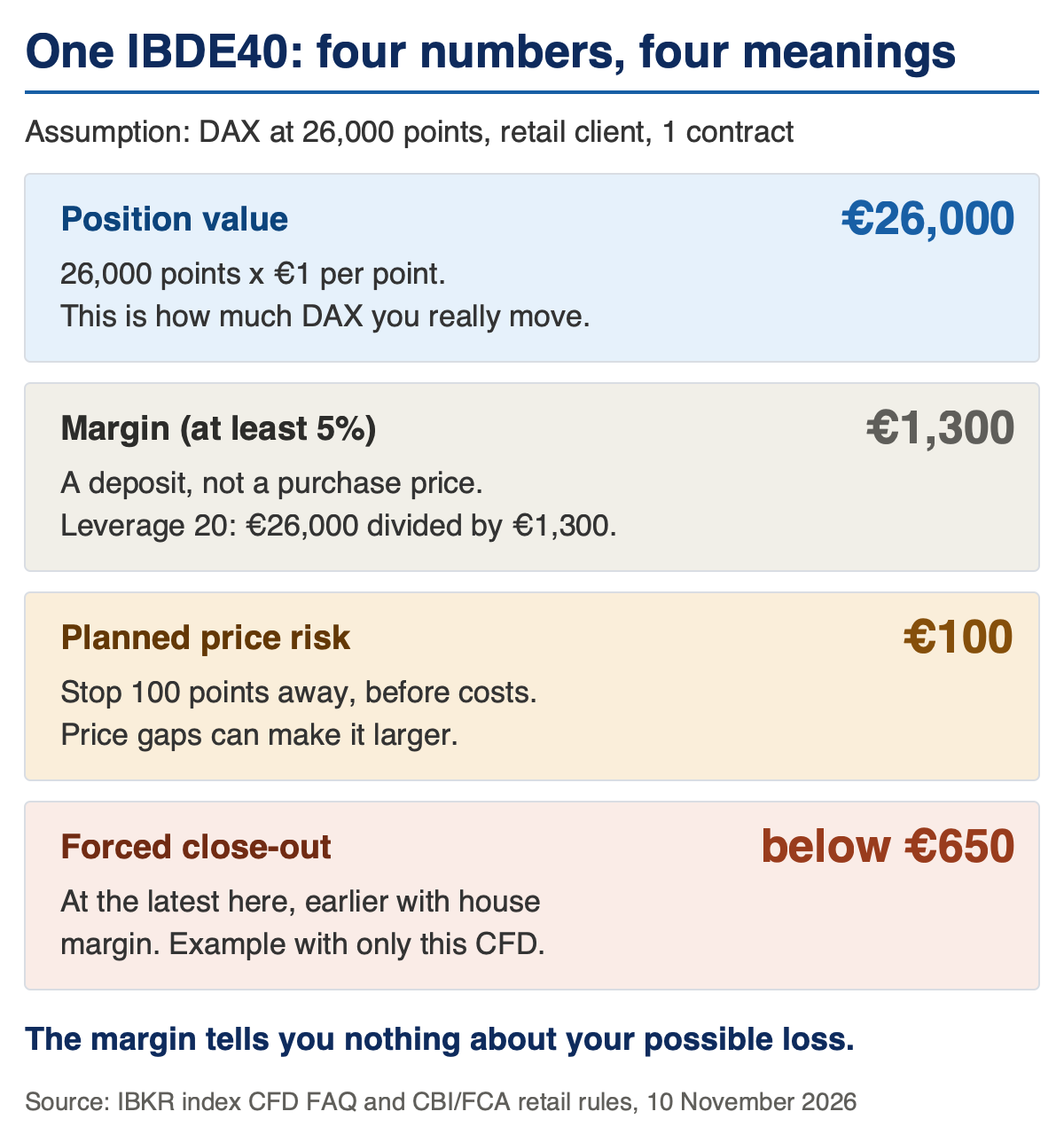
For an index CFD with a multiplier of 1, the position value is the index level times the number of contracts, the margin is a percentage of that, and the planned price risk is the stop distance in points times the number of contracts, before costs and if the stop fills at its price.
Let’s assume a DAX level of 26,000 points and you buy one IBDE40. The numbers are an example, not a forecast. On 10 November 2026 the DAX stood at around 26,475 points, as our DAX forecast shows. The round number keeps the arithmetic simple.
| Item | Calculation | Result |
|---|---|---|
| Position value | 26,000 points x €1 | €26,000 |
| Retail margin | 5% of €26,000 | €1,300 |
| Leverage | €26,000 / €1,300 | 20 |
| Stop 100 points below entry | 100 points x €1 | €100 before costs |
| Close-out at the latest | CFD equity below 50% of €1,300 | below €650 |
 Click to enlarge
Source: Rules from the IBKR index CFD FAQ, graphic by Kagels Trading.
The margin is neither a purchase price nor a loss limit. The €1,300 is a deposit that Interactive Brokers blocks while the position is open. Your planned risk is set by the stop: a distance of 100 points means a €100 price loss if it fills at the planned level, plus commission and spread. In fast markets and with overnight price gaps the fill can be worse.
Without a stop, the close-out decides. The FCA and the Central Bank of Ireland require Interactive Brokers to close CFD positions at the latest when your CFD equity falls below 50 percent of the initial margin of all open CFD positions. According to the index CFD key information document, CFD equity means CFD cash plus the unrealised profit and loss of all CFDs. If the IBDE40 is your only CFD position and exactly €1,300 of CFD cash stands behind it, that point lies at roughly 650 points of loss before costs. Interactive Brokers can close earlier because of higher house margins, and the €650 is not a guaranteed amount left over. How to size the position to your account is shown in our guide to position sizing.
UK clients have one extra trap: the F segment is not topped up for maintenance margin. IB (UK) moves cash from your main account into the CFD segment to open positions, but not to keep them open. According to its FCA rules FAQ, a liquidation can happen even if your main account holds plenty of cash. If you want to avoid that, you have to transfer money into the F segment yourself.
Counter-example: a short in IBUST100
A short in IBUST100 runs in US dollars, so a pound or euro account carries currency risk. Let’s assume a Nasdaq 100 level of 28,000 points. The position value is $28,000, the minimum margin of 5 percent $1,400. A stop 50 points above entry limits the price risk to about $50, again only if it fills at the stop price.
Profit and loss arise in dollars. If your account is in pounds or euros, the exchange rate changes the result as well. Because a future, not borrowed stock, stands behind the index CFD, there is no buy-in because shares are recalled, unlike with share CFDs. A lack of margin can still lead to a close-out. As the Nasdaq 100 is a price index, a short position pays a dividend adjustment.
When Interactive Brokers closes your position
For retail clients, the FCA and the Central Bank of Ireland set four protective rules for CFDs. Both have applied them since 1 August 2019; the Irish central bank announced its measure on 12 June 2019. How Interactive Brokers implements them is explained in its FAQ on the CBI rules and in a matching FAQ for IB (UK). Professional clients are not covered, so they also lose this protection.
- Initial margin from cash only: unrealised profits do not count. At the Irish company, a margin loan from share purchases leaves no cash for new CFD positions.
- The initial margin stays fixed: the close-out level depends on the margin at opening, not on the current position value. Interactive Brokers may close earlier if its own risk view is stricter.
- No FIFO when closing: Interactive Brokers closes the position with the highest initial margin first, even if it is not the oldest.
- Negative balance protection: your CFD loss is limited to the money dedicated to CFD trading. Shares or futures in the same account are not sold to cover a CFD deficit.
These rules protect you and can catch you out. If you hold a lot of CFD cash and open a small position, you are not closed out early. But you can also lose more than the €1,300 margin, at most the money you dedicated to CFDs. Our guide to risk management shows how to set limits before that happens.
What do index CFDs cost at Interactive Brokers?
Index CFDs at Interactive Brokers cost a commission of 0.005 to 0.01 percent of the trade value with a minimum per order, plus the spread of the future with the liquidity provider’s mark-up, overnight financing and, for price indices, the dividend adjustment.
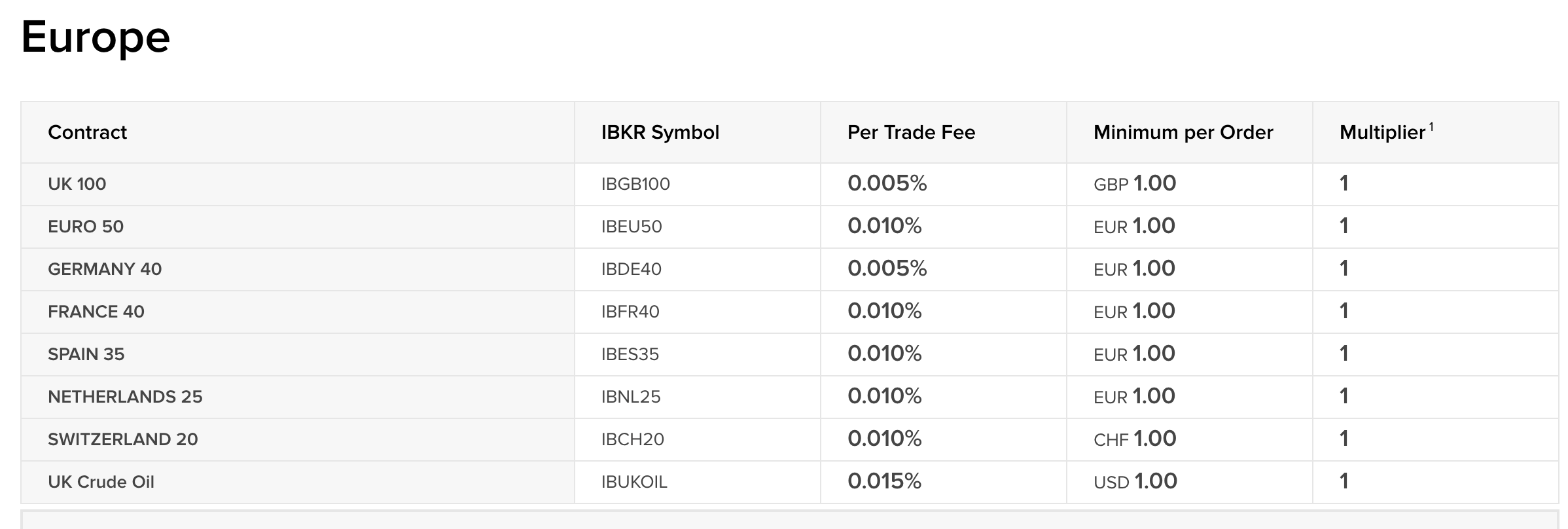
Interactive Brokers earns its money from the commission, not from a wider spread. That is how the product page describes it. You still pay a spread: the CFD takes the bid-ask spread of the future, and the liquidity provider adds its own mark-up. Interactive Brokers does not say how large it is. The commissions are in the UK price list for index CFDs; the Irish list shows the same rates.
| Symbol | Commission | Minimum per order |
|---|---|---|
| IBUS500, IBUS30 | 0.005% | USD 1.00 |
| IBUST100 | 0.010% | USD 1.00 |
| IBGB100 | 0.005% | GBP 1.00 |
| IBDE40 | 0.005% | EUR 1.00 |
| IBEU50, IBFR40, IBES35, IBNL25 | 0.010% | EUR 1.00 |
| IBCH20 | 0.010% | CHF 1.00 |
| IBJP225 | 0.010% | JPY 40 |
| IBHK50 | 0.010% | HKD 10 |
| IBAU200 | 0.010% | AUD 1.00 |
 Click to enlarge
For our IBDE40 at 26,000 points each order costs €1.30. Buying and selling at an unchanged price comes to €2.60. The minimum of one euro per order does not matter here. It does at lower index levels: one IBGB100 at an assumed 10,000 points would cost £0.50, so you pay the minimum of one pound.
For the Nasdaq 100, the micro future had the lower commission in my own statements. Two IBUST100, the same size as one MNQ, cost $5.60 per order at 28,000 points. My Interactive Brokers statements from September 2026 show $0.61 commission per MNQ contract and order. That compares commissions only: spreads, slippage, market data fees and your account’s pricing also affect the total, so do this arithmetic for your own account.
Overnight financing
If you hold a long position past the session close, you pay interest. Interactive Brokers charges it daily on the position value at the closing price, using the formula rate x position value x days / 360, or / 365 for pounds. For index CFDs the rate is benchmark plus or minus 1.5 percentage points. Retail clients pay one more percentage point because of the negative balance protection, as the financing page shows. The benchmark changes all the time; the table shows the rates when we checked.
| Case (checked 10 Nov 2026, 22:49 CET) | Rate per year | IBDE40 at 26,000 points |
|---|---|---|
| Long, retail client | 4.958% | €3.58 per night |
| Long, professional client | 3.958% | €2.86 per night |
| Short, retail client | −0.042% | €0.03 charge per night |
A week long in IBDE40 therefore costs about €25 in interest. That weekly cost is roughly ten times the commission for getting in and out. On the short side the retail rate was just below zero on that day, which can turn at any time with the benchmark. For swing trades over several days financing is the largest cost; for day trades it does not matter. A retail short in IBUST100 earned a small credit on the same day: at $28,000 and 1.38 percent that is about $1.07 per night. For pound positions in IBGB100 the retail long rate was 6.499 percent.
Dividends and currency
IBDE40 has no dividend adjustment; the other twelve index CFDs do. The DAX is a total return index that already includes dividends. All other indices in the list are price indices, so Interactive Brokers adjusts for the ordinary dividends of their members on the ex-date. Long positions receive the adjustment, short positions pay it.
Index CFDs in a foreign currency add the cost of conversion. Profit and loss on an IBUS500 arise in US dollars. You decide in your account whether and when to convert them, and conversion has its own costs. How CFD gains are taxed depends on where you live; ask a tax adviser if you are unsure.
Trading hours of index CFDs at Interactive Brokers
Each index CFD at Interactive Brokers has its own trading hours: long total hours, which for IBDE40 run from 1:15 to 21:00 UK time in winter, and shorter liquid hours, in which a lower intraday margin can apply to professional clients.
The hours follow the future, not the cash market. That is why IBDE40 can be traded from 1:15 UK time, long before Xetra opens. The table shows the hours from the index CFD FAQ for the most traded symbols, converted to UK time (GMT). It applies since US daylight saving time ended on 1 November 2026. IBKR states the European hours in CET and does not say how they shift in summer, so check the contract details in TWS then.
| Symbol | Liquid hours (UK, GMT) | Total hours (UK, GMT) |
|---|---|---|
| IBDE40 | 8:00 to 21:00 | 1:15 to 21:00 |
| IBEU50 | 8:00 to 21:00 | 1:15 to 21:00 |
| IBGB100 | 8:00 to 16:30 | 7:00 to 21:00 |
| IBUS500 | 14:30 to 21:00 | 23:00 (previous day) to 22:00 |
| IBUST100 | 14:30 to 21:00 | 23:00 (previous day) to 22:00 |
In very volatile markets Interactive Brokers can restrict trading to the liquid hours. The FAQ says so explicitly, so do not count on closing an IBDE40 at three in the morning. For IBUS30 the FAQ table gives no hours; it lists IBUS500 twice. Here too, only the contract details in TWS help. When the related futures trade is shown in our overview of futures market hours.
Index CFDs and TradingView: analysis yes, orders no
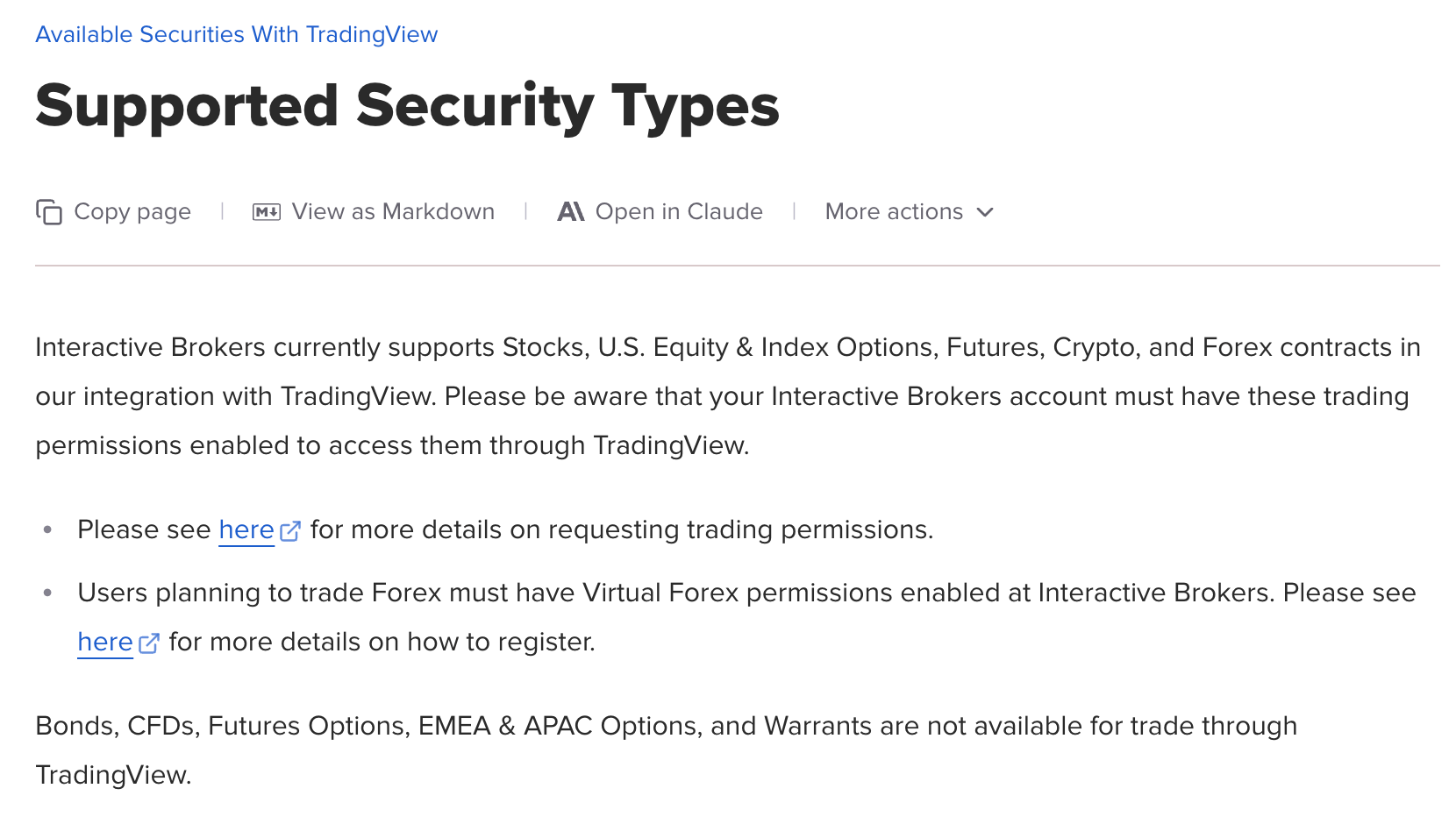
Index CFDs from Interactive Brokers cannot be traded through the TradingView integration, because Interactive Brokers explicitly excludes CFDs from it.
Enabling CFDs in your account does not change that. On its documentation page for TradingView Interactive Brokers lists stocks, US options, futures, crypto and forex as tradable. Bonds, CFDs, futures options and options outside the US cannot be traded through TradingView. Checked on 10 November 2026.
 Click to enlarge
Source: Interactive Brokers documentation.
The chart in TradingView shows a different price from your CFD. If you analyse the cash DAX, the DAX future or another provider’s CFD there, you see a different price series from IBDE40. The gap can be several points and changes with interest and expected dividends. So always move a level from the chart onto the current IBDE40 price in TWS before you set a stop or limit.
- TradingViewAnalysisChart, drawings and alerts on the cash index or the future, a different price series from IBDE40.
- YouAdjust the levelsMeasure the gap between chart and IBDE40 in points and shift entry, stop and target by it.
- Trader WorkstationOrderProduct IBDE40, type CFD, currency EUR. Check the order preview and attach the stop.
A dark line marks the hand-over. TradingView cannot send this order, because Interactive Brokers excludes CFDs from the integration.
TradingView still wins on tools. Drawing, alerts and custom indicators are more convenient there than in TWS. Which brokers do support orders from the chart is covered in our overview of TradingView brokers. If you want to trade from TradingView at Interactive Brokers, you have to use futures.
Index CFD or micro future?
A micro future is a small exchange-traded index future with a fixed expiry date, which Interactive Brokers routes to the exchange instead of acting as your counterparty, and to which the retail CFD rules do not apply.
The Micro-DAX future is exactly the size of one IBDE40. According to Eurex the FDXS moves by €1 per DAX point. For the Nasdaq 100, one MNQ micro future equals $2 per point according to CME, so two IBUST100. I trade the MNQ myself at Interactive Brokers; its commission compared with two IBUST100 is in the cost section above.
| Feature | Index CFD | Micro future |
|---|---|---|
| Venue | with IBKR | Eurex, CME |
| Expiry | none | quarterly |
| Per point | €1 or $1 | FDXS €1, MNQ $2 |
| Margin | min. 5% or 10% | exchange, broker |
| Holding cost | interest per night | in the futures price |
| Negative balance protection | yes, retail | no CFD rules |
| Order from TradingView | no | yes |
Futures are not automatically the better choice. The retail CFD protection does not apply to them, so a futures loss can exceed the money in the position. Germany is a special case: there, Interactive Brokers Ireland’s customer agreement excludes an additional payment obligation for retail futures trades, and the same agreement says clients outside Germany may face one. Rolling at each quarterly expiry takes time and fees. For a position over a few days, the CFD is simpler and finer: one IBUST100 is half an MNQ. If you hold for weeks, the CFD costs a lot of financing. Tick values and sizing for MES and MNQ are explained in our guide to micro futures.
Who index CFDs at Interactive Brokers suit
Index CFDs at Interactive Brokers suit traders who already have an account there, want to trade indices short term in small sizes and prefer a transparent commission to a supposedly free spread.
Their strength is transparency. If you know other CFD brokers, you will see commission, financing rate and price source shown separately here, perhaps for the first time. Their weakness is usability: TWS is not a beginner’s platform, and there is no TradingView order connection for CFDs.
What speaks for index CFDs at Interactive Brokers
- Open costs: commission shown separately, and Interactive Brokers does not widen the spread on top
- Traceable price: it follows the future, not an in-house price
- Small sizes: one IBDE40 is one euro per point
- No expiry: no roll, no contract change
- Negative balance protection: for retail clients, shares and futures in the account stay untouched
What speaks against them
- No TradingView orders: the integration excludes CFDs
- Expensive nights: retail clients pay one percentage point more financing
- Unquantified mark-up: the broker does not state the liquidity provider’s share of the spread
- Hard to use: Trader Workstation is not a beginner’s platform
- Residency limits: no trading for residents of the USA, Canada, Hong Kong, New Zealand or Israel, and only with conditions in Spain
According to Interactive Brokers, 58.9 percent of retail investor accounts lose money when trading CFDs with IBKR. On 10 November 2026 this figure appears as a mandatory warning on every CFD page of the broker. It covers all CFDs together and shows that low costs alone do not make you profitable. Without a firm stop and a position size that fits your account, the cheapest commission will not help you.
Disclosure: Kagels Trading sells its own CFD signal service. This article does not recommend it, and it contains no affiliate link to Interactive Brokers. Our general verdict on the broker is in the Interactive Brokers review.
Index CFDs at Interactive Brokers: my conclusion
Index CFDs at Interactive Brokers are a clean tool for short index trades, but not for long positions. Their advantage is small sizes and openly stated costs. The commission on IBDE40 is low; the financing over several nights is not. If you hold longer or trade very often, compare the micro future; for the Nasdaq 100 the MNQ commission was clearly lower in my September 2026 statements, before spreads, slippage and data costs.
The most important point is to separate margin from risk. The margin says nothing about how much you can lose. You plan that with the stop, before costs and if it fills at its price. Without a stop the close-out decides, at 50 percent of the margin at the latest and earlier with higher house margins. If you work with TradingView, analyse there and place the order in TWS, always at the IBDE40 price and not the cash index chart. My assessment after three decades with this broker: for a short DAX trade in small size the IBDE40 is convenient; for anything that runs longer than a few days I compare it with the future.
Frequently asked questions about index CFDs at Interactive Brokers
Which index CFDs does Interactive Brokers offer?
Interactive Brokers offers 13 equity index CFDs. They are IBUS500, IBUS30, IBUST100, IBGB100, IBEU50, IBDE40, IBFR40, IBES35, IBNL25, IBCH20, IBJP225, IBHK50 and IBAU200. You trade the DAX with the symbol IBDE40; the older IBDE30 no longer exists.
What is the smallest index CFD trade at Interactive Brokers?
The smallest trade is one contract, which is one times the index level in the index currency. One IBDE40 at 26,000 points has a position value of €26,000 and moves by €1 per point.
How much do index CFDs cost at Interactive Brokers?
The commission is 0.005 or 0.01 percent of the trade value, depending on the index. The minimum per order is 1 euro, dollar, pound or franc, 40 yen for IBJP225 and 10 Hong Kong dollars for IBHK50. On top come the spread, overnight interest of benchmark plus 1.5 percentage points on long positions, plus one more point for retail clients, and the dividend adjustment on price indices.
Can I trade Interactive Brokers index CFDs through TradingView?
No, Interactive Brokers explicitly excludes CFDs from its TradingView integration. You can analyse in TradingView, but you place the order directly with Interactive Brokers, for example in Trader Workstation.
How much margin do I need for one IBDE40?
Retail clients deposit at least 5 percent of the position value, so €1,300 at 26,000 points. Interactive Brokers can ask for more; the order preview in TWS shows the exact amount. The margin is not a loss limit.
Who can trade index CFDs at Interactive Brokers?
It depends on where you live and which IBKR company issues the CFDs. According to IBKR’s eligibility notice, residents of the USA, Canada, Hong Kong, New Zealand and Israel cannot trade IBKR-issued CFDs. Residents of Spain can only if they are MiFID professionals or clients of a Spanish introducing broker or professional financial adviser. Australian and Japanese residents trade CFDs issued by local IBKR companies. UK residents trade through IB (UK) under FCA rules, other residents of the European Economic Area through Interactive Brokers Ireland; you also need the CFD trading permission.
This English edition is based on our German edition on kagels-trading.de and has been adapted for international readers.
More Markets and Brokers guides
- Open your first account
What Is a Brokerage Account? A US Beginner's Guide
How to open and fund a US brokerage account, cash vs margin, what it costs and what SIPC and FDIC really cover.
- Choose a broker
Interactive Brokers Review 2026: Fees and Platforms
Fees, platforms, investor protection and real futures commissions from a client since 1996.
- Check an offshore broker
PU Prime Review 2026: FCA Warning, Licences and Costs
Which PU Prime company you contract with, what the FCA warning means, and what 1:1000 leverage and the deposit bonus do to your account.
- Check CopyX
CopyX Review 2026: Is TAG Markets Copy Trading Legit?
Who runs the TAG Markets copy trading platform, which regulators warn about it, why US residents are excluded and how fast the 12x Amplify account eats your deposit.
- Understand your price
Market Makers: Who Sets Your Price and How They Profit
How market makers earn on the spread, who sets prices at German trading venues and what the EU ban on payment for order flow changed.
- Read bond market stress
MOVE Index: The VIX of the Bond Market, Explained
What the MOVE index measures, which readings signal stress, how it differs from the VIX and where its limits are.
- Read market sentiment
Fear and Greed Index: How It Works, Tested Since 2021
How CNN builds its Fear and Greed Index from seven measures, what the zones mean and how the S&P 500 moved after readings below 20.
- Size an index future
Micro Futures: MES vs MNQ, Tick Values and Risk
MES and MNQ tick values, a worked sizing example from the stop with costs and slippage, and why margin is not your risk.
- Read the futures curve
Contango vs Backwardation: Futures Curves Explained
What contango and backwardation mean, what rolling does to a position in each case, and real gold, oil and gas curves from 28 October 2026.
- Choose a silver future
Silver Futures: SI vs Micro Silver vs 100-oz SIC
SI, Micro Silver and the 100-ounce SIC compared by tick value, risk per contract, margin and December 2026 deadlines.
- Read the chip sector
SOX Index: Holdings, Weighting and How to Use It
What the SOX holds, how Nasdaq caps the weights, its largest declines since 2004 against the Nasdaq-100 and which ETFs really track it.
- Read the biotech sector
Nasdaq Biotechnology Index: Holdings, Weighting and Risks
What the NBI holds, how Nasdaq caps the weights, its long declines since 2003 against the Nasdaq-100 and which ETFs really track it.
- Read the transport sector
Dow Jones Transportation Average: Stocks and Dow Theory
The 20 stocks in the Dow transport index, why the share price sets their weight, declines since 1992 and what Dow Theory can and cannot tell you.
- Research stocks
InvestingPro Review: Screener, ProPicks AI and WarrenAI
What the InvestingPro screener, ProPicks AI and WarrenAI do, what Pro and Pro+ cost and who needs which plan.
- Use the free news portal
Investing.com Review: Free Tools, Data and Limitations
What the free Investing.com portal does well, where the quote prices come from and when InvestingPro is worth paying for.
- Find real AI revenue
AI Stocks 2026: How Listed Companies Earn From AI
Which listed companies earn from AI in cloud, software, infrastructure and chips, disclosed AI revenue against hope, plus AI ETFs and risks.
- Compare AI data center suppliers
AI Infrastructure Stocks: 10 Data Center Suppliers Compared
Ten suppliers for power, cooling, servers and optics compared on free cash flow, customer concentration and next dates, with filters and a two-stock comparison.
- Follow an IPO
Anthropic Stock: IPO Date, Valuation and How to Invest
Where the Anthropic IPO stands, how the valuation compares with revenue and how to get exposure before and after the listing.
- Invest in OpenAI before the IPO
OpenAI Stock: Can You Buy It, and Who Owns OpenAI?
Why there is no OpenAI stock yet, who owns OpenAI, where the IPO stands and how much OpenAI you get through Microsoft or SoftBank.
- Understand a stock split
Stock Splits Explained: Forward and Reverse Splits
What forward and reverse splits change and what they do not, the dates that matter, what happens to options and the $1 listing rule.
- Value a stock
Value Investing: Intrinsic Value, Margin of Safety, Traps
Intrinsic value against price, a worked DCF with a sensitivity table, Coca-Cola as a real example, the value premium since 1926 and value traps.
- Value a new listing
SpaceX Stock (SPCX): Valuation, Risks and How to Buy
How to buy SpaceX stock, what the company is worth after the IPO and which risks the lock-up calendar brings.