
Tradeview Review 2026: Tradeview Europe, MFSA and Costs


Contents
- Tradeview review in 30 seconds
- What is Tradeview?
- Tradeview or TradingView?
- Which Tradeview company would you contract with?
- What does Tradeview Europe’s licence cover?
- How safe is your money at Tradeview Europe?
- Tradeview account types and costs
- What does EU leverage mean at Tradeview?
- Platform: MetaTrader 5 only
- How do Tradeview withdrawals work?
- Tradeview reviews and complaints
- Pros and cons of Tradeview Europe
- How to check a broker before you open an account
- Conclusion: who Tradeview Europe suits
- Frequently asked questions about Tradeview
- About the author
Tradeview is a forex and CFD broker, not the charting platform TradingView. The names differ by two letters, and most people who search for “tradeview” are looking for TradingView. This review is about the broker: its European company Tradeview Europe Ltd in Malta, its three MetaTrader 5 accounts and the group companies outside the EU.
For this review I read Tradeview’s website, an older public client agreement and the registers of the European regulators myself. We did not open an account and made no deposit. You will learn which company you would sign with, what its licence covers, what trading costs and which questions you should ask before you send money. Tradeview does not accept US residents, so this review is written for readers in Europe and other countries. This article follows our editorial policy.
Risk warning: CFDs are complex instruments, and leverage can make you lose money fast. According to Tradeview Europe, 80% of its retail investor accounts lose money when trading CFDs. This review is not investment advice.
Tradeview review in 30 seconds
- EU investment firm in Malta: Tradeview Europe Ltd is supervised by the Malta Financial Services Authority (MFSA) and may offer its services in other EU and EEA countries, among them Germany, France and Italy.
- A narrow register entry: The European register entries we checked list one investment service, the reception and transmission of orders. An older public client agreement also calls Tradeview the principal for forex trades on MetaTrader, so ask who your counterparty is.
- Three accounts on MT5: EDGE with raw spreads from €2.00 commission per lot and side, Classic ILC with €2.50 per lot and side, and XLev without commission. Real US shares cost $0.01 per share.
- EU retail protection: ESMA leverage limits, negative balance protection, a close-out when equity falls to half the required margin and the Malta investor compensation scheme of up to €20,000.
- Several companies, different rules: Outside the 16 target countries, another group company such as Tradeview Ltd on the Cayman Islands may hold your account. The complaints that a broker rating site collected in 2025 name that company’s website.
What is Tradeview?
Tradeview is a broker group founded in 2004 that offers forex, CFDs and stocks through several companies under one brand.
The founder is Timothy Furey, and the group started inside a US futures broker. According to Tradeview’s own history, it began as part of Rosenthal Collins Group, became independent in 2009 and opened a company on the Cayman Islands in 2012. The European company in Malta followed in 2021. Your contracting party is always the company named in your client agreement, not the brand.
Tradeview Europe offers mostly CFDs, plus real US shares. On its website it lists more than 1,000 instruments: currency pairs, metals, energy, indices and crypto CFDs, and on the stock side all US-listed shares and ETFs on NYSE, Nasdaq and AMEX. Everything runs on MetaTrader 5. The group’s other platforms, such as MetaTrader 4 and cTrader, are not on the European website.
| Topic | Tradeview Europe at a glance |
|---|---|
| Company | Tradeview Europe Ltd, Malta, registration number C93990 |
| Regulator | MFSA, authorisation ID TRDV |
| Licence scope in the EU registers | Reception and transmission of orders |
| Target countries | 16 EU and EEA countries, including Germany, France, Italy, Spain, Poland and Norway |
| Accounts | EDGE, Classic ILC, XLev, plus a stock account |
| Platform | MetaTrader 5 (desktop, web, mobile) |
| Investor compensation | Malta Investor Compensation Scheme, up to €20,000 |
| US residents | Not accepted |
Tradeview or TradingView?
Tradeview and TradingView are two unrelated companies. TradingView is a charting and analysis platform that many brokers connect to. Tradeview is a broker that runs its own accounts on MetaTrader 5. When we searched Google for “tradeview” from Germany on 12 November 2026, all nine organic results on the first page were about TradingView.
If you are looking for charts, you want TradingView. Our TradingView review explains its plans and features, and our guide to brokers you can trade from TradingView shows which accounts connect to it. Tradeview Europe is not one of the brokers we found there.
Which Tradeview company would you contract with?
It depends on where you live and on what the onboarding offers you. Tradeview’s regulation page names several companies that “independently” trade under the brand. For readers in the EU and EEA, the website tradeview.eu belongs to Tradeview Europe Ltd. For the Americas and international clients, the same page names Tradeview Ltd and its website tvmarkets.com; other regions have their own companies. The only reliable answer is the company named in your agreement.
Tradeview Europe Ltd: an MFSA investment firm
The European company is licensed under Malta’s Investment Services Act. Its website and client agreement give the authorisation ID TRDV and the registration number C93990. The ESMA register of investment firms lists Tradeview Europe Limited as active since 22 December 2020, with the LEI 213800CJHS2WZDN8MT41.
Tradeview Europe also notified the German regulator that it serves clients in Germany. The BaFin company database lists it as a cross-border service provider since 13 April 2021. As with every EU passport, the home regulator in Malta supervises the firm, not BaFin. Tradeview’s footer names 16 target countries: Austria, Cyprus, the Czech Republic, Estonia, Finland, France, Germany, Hungary, Italy, Latvia, the Netherlands, Poland, Portugal, Slovenia, Spain and Norway.
Tradeview Ltd: the Cayman Islands company
For the Americas and international clients, the group names a company in the Cayman Islands. According to Tradeview’s regulation page, Tradeview Ltd holds a securities broker-dealer licence from the Cayman Islands Monetary Authority (CIMA), number 585163. It runs tvmarkets.com and tradeviewmarkets.com, with MetaTrader 4, cTrader, futures and options. Its client agreement and its rules are not the EU rules for retail CFD clients.
The regulation page names three more companies. They are Tradeview Financial Markets S.A.C, TVM Global Ltd and iLC Brokers Ltd, and we did not check them in their local registers. For a reader in Europe, only one question matters: does your contract say Tradeview Europe Ltd, Malta? If it names another company, the protection described below does not apply.
What does Tradeview Europe’s licence cover?
The register entries we checked list a single investment service for Tradeview Europe: the reception and transmission of orders. That is service A1 under the EU’s MiFID II rules. The firm takes your order and passes it on. The BaFin entry, which records the firm’s passport notification for Germany, shows the same service, plus foreign exchange services linked to it, for shares, derivatives and CFDs. Neither entry lists the execution of orders, dealing on own account or the safekeeping of securities. The full current permissions are set by the MFSA, whose register we could not open.
An older client agreement describes the same service in its words. The agreement is a PDF on Tradeview’s European document server, created in June 2022; we could not confirm that new clients sign this version today. It says the licence conditions permit Tradeview to “receive and transmit Client orders”, and it names “liquidity providers, prime brokers, counterparties, market makers” and other service providers that it works with. According to this version, client money can move from Tradeview’s client custody account to omnibus accounts at these service providers for trading.
The same agreement also describes Tradeview as principal. Clause 4.6 says Tradeview acts “only as your agent” when it receives and transmits orders. Clause 15 says all over-the-counter contracts are entered into “by Tradeview as Principal”, and the order table for MetaTrader 4 and 5 states that “Tradeview Europe Ltd. acts a Principal” for forex. A principal is your counterparty. How these clauses fit the register entry, and whether they still apply, we could not clarify from the public documents.
Ask Tradeview two questions in writing before you deposit. Which client agreement applies to a new account today, and which company is your counterparty for CFDs? For shares, ask which firm holds your US shares and in whose name. Keep the answers.
How safe is your money at Tradeview Europe?
As a retail client of Tradeview Europe you get the EU’s standard CFD protection. EU rules require negative balance protection: your losses cannot exceed the money in your CFD account. They also require a margin close-out for the whole account: when your equity falls below 50% of the total initial margin for your open CFDs, the broker must close one or more positions.
The older client agreement adds its own rules. It says Tradeview does not make margin calls, so watching your account is your job, and it describes an automatic liquidation that starts with the largest losing position. Whether this order still applies, we could not confirm. How equity, margin and the close-out level are calculated is explained in our guide to account equity.
If the firm fails, Malta’s investor compensation scheme can step in. Tradeview Europe Limited is on the list of participants of the Investor Compensation Scheme in Malta. For eligible claims that the scheme accepts, it pays 90% of the net loss, up to a maximum of €20,000, if an investment firm cannot return your money or securities. It does not pay for trading losses.
Segregated client money has limits. Tradeview says client money is kept apart from its own funds. The older agreement names segregated accounts at banks in the EU or EEA or in a third country, and it says Tradeview is not liable if a bank, agent or broker that holds your money defaults. Because your money can sit with service providers, the €20,000 limit is worth knowing before you deposit a larger amount.
Complaints go to Tradeview first, then to a public body in Malta. Tradeview’s complaints procedure promises a reply within 15 working days. If you are not satisfied, you can turn to the Arbiter for Financial Services in Malta, a public body for complaints against firms licensed by the MFSA; see the Arbiter’s website.
| Retail CFD client | Tradeview Europe Ltd (Malta) | Tradeview Ltd (Cayman) |
|---|---|---|
| Regulator | MFSA, EU rules | CIMA |
| Leverage, major pairs | At most 30:1 | EU limit does not apply |
| Account below zero | Loss limited to the account | EU rule does not apply |
| Compensation if the firm fails | Malta scheme, up to €20,000 | Malta scheme does not apply |
| Disputes | Arbiter for Financial Services, Malta | Malta Arbiter not responsible |
Tradeview account types and costs
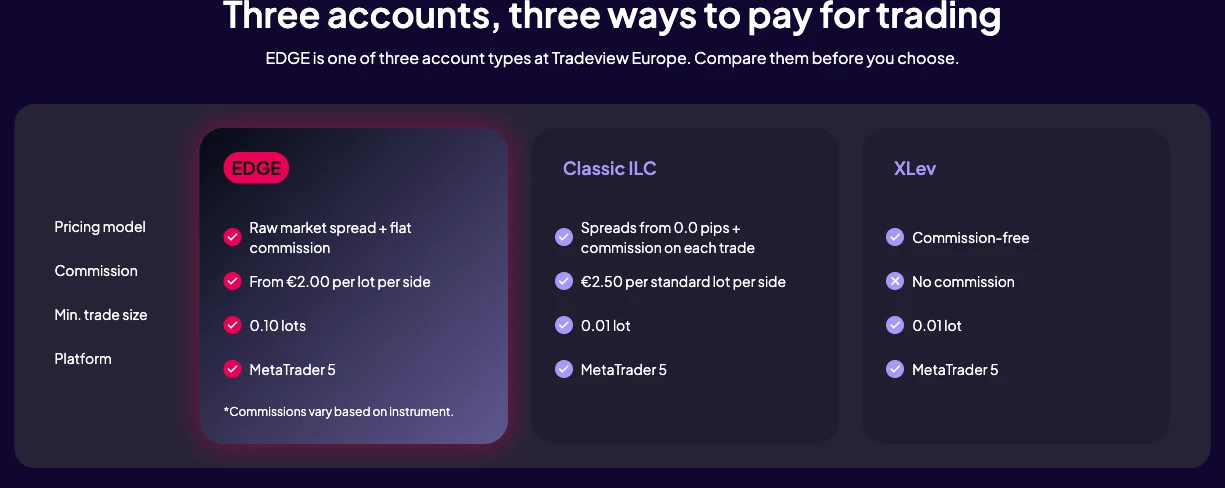
Tradeview Europe offers three forex and CFD accounts that differ in how you pay. In XLev the cost sits in the spread. In Classic ILC and EDGE you pay a raw spread plus a commission per lot. The figures come from the accounts page and the home page of tradeview.eu on 12 November 2026.
| Account | Spread and commission | Minimum trade size | Minimum deposit |
|---|---|---|---|
| EDGE | Raw market spread, from €2.00 per lot and side | 0.10 lot | Not stated |
| Classic ILC | From 0.0 pips, €2.50 per lot and side | 0.01 lot | €1,000 (accounts page) |
| XLev | Spread only, no commission | 0.01 lot | None |
| US stocks | $0.01 per share | Not stated |
 Click to enlarge
The commission is easy to work out. One standard lot is 100,000 units of the base currency. In Classic ILC you pay €2.50 when you open and €2.50 when you close, so €5 per lot for the round turn, plus the spread. In EDGE the round turn starts at €4 per lot and varies by instrument; trades start at 0.10 lot, so the account is not for very small positions.
The minimum deposit is stated in two different ways. The accounts page lists €1,000 for Classic ILC and no minimum for XLev. Another page of the same website says “No minimum deposit” next to the ILC commission. Check the figure in the registration form before you rely on it.
For EDGE, the website promises no markup. The home page says EDGE adds “no markup” to the market price and passes positive slippage on to you. The older client agreement from 2022 has a general clause that Tradeview is paid through “a commission and a markup of the raw spread”. That clause predates EDGE and does not prove a markup on EDGE; ask which pricing terms apply to your account. Symbols traded on EDGE end in .edge in MetaTrader 5.
Overnight positions cost or earn a swap. Tradeview publishes rollover rates on its website and books them at about 21:00 GMT. Tradeview may also charge you the bank fees it pays for wire transfers. We found no inactivity fee in the documents we read.
What does EU leverage mean at Tradeview?
Tradeview Europe says it applies the ESMA leverage limits for retail clients. These limits go back to the ESMA decision of 2018 and are now set by the national regulators, in Tradeview’s case the MFSA. A retail client may open a position with at most:
- 30:1 for major currency pairs: a €100,000 position on EUR/USD needs at least €3,333 margin.
- 20:1 for other pairs, gold and major indices: 5% margin.
- 10:1 for other commodities and minor indices: 10% margin.
- 5:1 for single shares and 2:1 for crypto: 20% and 50% margin.
Professional clients can get more leverage, but they lose protections. The client agreement allows a classification as professional client. Then the leverage limits, the 50% close-out and the negative balance protection for retail clients no longer apply in the same way. Before you agree to such a classification, ask in writing which protections you would give up.
Platform: MetaTrader 5 only
Tradeview Europe runs all its accounts on MetaTrader 5. You get the desktop, web and mobile versions, more than 80 built-in indicators and support for automated trading. Tradeview also offers FIX API access, but only above a minimum trading volume and deposit.
There is no TradingView connection, no cTrader and no copy trading on the European website. These products appear on the group’s other websites. If you want to place orders from TradingView charts, the list of TradingView brokers linked above is the better place to start.
How do Tradeview withdrawals work?
Money goes back the way it came, and profits go to a bank account. Tradeview’s withdrawal FAQ and its withdrawal policy say that the method must match the deposit method. After a card or e-wallet deposit, you can only send back up to the amount you paid in that way. Anything above that, your profit, goes by bank transfer.
All accounts must be in your own name. Tradeview accepts no third-party payments and pays out only to accounts in the name of the trading account holder. Deposit methods are bank wire, debit and credit cards, Skrill and Neteller. Tradeview says it usually processes withdrawals within 24 hours; bank transfers can take up to three days.
Withdrawals in another currency cost you money. Withdrawals must be made in the account currency, or you pay the conversion. This matters if you deposit in euros and choose a dollar account for US shares.
Tradeview reviews and complaints
The complaints we found in 2025 concern Tradeview’s international brand, not the Malta company. WikiFX, a broker rating site, reported on 22 December 2025 that it had received complaints about “Tradeview Markets” between July and November 2025. Users described balances that were cleared as a “negative balance recapture”, stalled withdrawals and requests to sign a waiver.
These are unverified user reports, and they do not name Tradeview Europe. The article links to tvmarkets.com and Tradeview Ltd on the Cayman Islands and does not mention the MFSA. We could not check the reports ourselves.
On Trustpilot, only the international brand has reviews. Our first attempt to open Trustpilot on 12 November 2026 was blocked. When we opened the pages in a browser at 21:28 CET the same day, the profile Tradeview Markets for tvmarkets.com showed a TrustScore of 4.4 from 434 reviews. Trustpilot marks the profile as claimed, with a paid subscription, and says the company invites its customers to write reviews. The profile for tradeviewmarkets.com had no reviews, and there was no profile for tradeview.eu.
A rating of the international brand says nothing about the Malta company. The profile collects reviews of the international brand, which several Tradeview companies serve. For Tradeview Europe we found no public rating at all.
Pros and cons of Tradeview Europe
Tradeview Europe suits experienced traders who want MetaTrader 5, low commissions and an EU contract. The table sums up the strengths and the open questions from this review.
| Pros | Cons |
|---|---|
| EU investment firm, MFSA, passport for 16 countries | Register entries list order transmission only, while the older agreement calls Tradeview principal |
| Negative balance protection and €20,000 investor compensation | Current client agreement not public; the 2022 version has a general markup clause |
| Low commissions: from €4 (EDGE) or €5 (ILC) per lot round turn | Minimum deposit stated in two different ways |
| Real US shares at $0.01 per share | Custodian of the shares not named in public documents |
| No deposit bonus or trading promotions on the website | MetaTrader 5 only, no TradingView connection |
How to check a broker before you open an account
Five checks protect you from the most common surprises. They work for Tradeview and for any other CFD broker, and you need nothing but the contract and the public registers.
- Find the company name in the contract: It must match the regulator’s register entry. For Tradeview in Europe that is Tradeview Europe Ltd, C93990.
- Look up the licence scope: The ESMA register shows which investment services an EU firm may offer and which regulator supervises it.
- Ask who your counterparty is: For CFDs, ask who holds the other side; for shares, ask which custodian holds them and in whose name.
- Compare the addresses: Tradeview’s website, its documents and the ESMA register give three different addresses in Malta. Ask which one is current.
- Test with a demo first: Check the real spread and commission on the symbols you trade before you deposit.
The checks do not replace your own risk rules. Stops and position size are covered in our guide to risk management, and how a broker earns from your price is explained in our guide to the market maker.
Conclusion: who Tradeview Europe suits
Tradeview Europe is a small EU broker with clear commissions and open questions about its contract. If you live in one of its target countries, trade forex or US shares on MetaTrader 5 and value a low commission per lot, it is worth a look. You get the EU retail protection that applies to a firm supervised in the EU.
Before you deposit, get the answers in writing. Ask which client agreement applies today, who your counterparty is for CFDs and who holds your US shares. Ask which document defines the EDGE pricing. If you live outside the 16 target countries, check which company your agreement names; our assessment of the European firm then does not apply to you. For a broker with a much larger range and its own clearing, see our Interactive Brokers review.
Frequently asked questions about Tradeview
Is Tradeview regulated?
Tradeview Europe Ltd is regulated by the Malta Financial Services Authority. Its authorisation ID is TRDV and the company number is C93990. The group’s Cayman company, Tradeview Ltd, is licensed by CIMA, which is not an EU regulator.
Is Tradeview the same as TradingView?
No, they are different companies. TradingView is a charting platform, and Tradeview is a forex and CFD broker that uses MetaTrader 5.
Can US residents open a Tradeview account?
No, Tradeview does not accept US residents. Both the European and the international websites say their services are not offered in the United States or to US persons.
What is the minimum deposit at Tradeview?
The accounts page lists €1,000 for the Classic ILC account and no minimum for XLev. Another page of the website says “No minimum deposit” next to the ILC commission, so check the amount in the registration form.
Is my money protected at Tradeview Europe?
Retail clients get negative balance protection and segregated client money. If the firm fails, the Investor Compensation Scheme in Malta pays 90% of the net loss on eligible accepted claims, up to €20,000. Trading losses are not covered.
How long does a Tradeview withdrawal take?
Tradeview says it usually processes withdrawals within 24 hours. Bank transfers can take up to three days, and profits above a card deposit go back by bank wire.
Is Tradeview a market maker?
The answer is not clear from the public documents. The register entries we checked list only the reception and transmission of orders. The older 2022 client agreement, however, says Tradeview Europe acts as principal for forex orders on MetaTrader. Ask Tradeview which agreement applies today and who your counterparty is before you trade.
More Markets and Brokers guides
- Open your first account
What Is a Brokerage Account? A US Beginner's Guide
How to open and fund a US brokerage account, cash vs margin, what it costs and what SIPC and FDIC really cover.
- Know what trading really costs
Trading Costs: Every Fee You Pay and How to Cut It
Spread, commissions, SEC and FINRA fees, market data, margin interest and tax, with yearly totals for three trading styles.
- Choose a broker
Interactive Brokers Review 2026: Fees and Platforms
Fees, platforms, investor protection and real futures commissions from a client since 1996.
- Check an offshore broker
PU Prime Review 2026: FCA Warning, Licences and Costs
Which PU Prime company you contract with, what the FCA warning means, and what 1:1000 leverage and the deposit bonus do to your account.
- Check ZuluTrade
ZuluTrade Review 2026: Costs, Regulation and US Status
Who runs the copy trading platform, what it costs through your broker, why the US was missing from its sign-up form and what the CFTC fined its US company for.
- Check CopyX
CopyX Review 2026: Is TAG Markets Copy Trading Legit?
Who runs the TAG Markets copy trading platform, which regulators warn about it, why US residents are excluded and how fast the 12x Amplify account eats your deposit.
- Choose a US forex broker
OANDA Review 2026: Fees, TradingView and US Rules
OANDA from its own pages and NFA records: spreads and fees, TradingView and the demo, FIFO and three penalties.
- Check a commission-free app broker
Webull Review 2026: Fees, Margin Rates and Safety
Webull from its own fee schedule and FINRA records: what is free, margin rates and Premium, overnight trading, crypto and three fines.
- Understand your price
Market Makers: Who Sets Your Price and How They Profit
How market makers earn on the spread, who sets prices at German trading venues and what the EU ban on payment for order flow changed.
- Size up a bull market
Bull Market: How Long It Lasts and How to Spot the End
When a rise becomes a bull market, how long the 27 completed S&P 500 bull markets since 1928 lasted and gained, and where the current one stands.
- Read bond market stress
MOVE Index: The VIX of the Bond Market, Explained
What the MOVE index measures, which readings signal stress, how it differs from the VIX and where its limits are.
- Read stock market fear
VIX Index: What the Fear Gauge Measures and Normal Levels
What the VIX measures, which levels have been normal since 1990, how closely it tracks the S&P 500 and how VIX futures, options and ETPs work.
- Read the risk mood
Risk-On vs Risk-Off: Meaning, Assets and Indicators
What risk-on and risk-off mean, which assets rise and fall in each mode, five market shocks since 2008 and the VIX, DXY and AUD/JPY signals.
- Read market sentiment
Fear and Greed Index: How It Works, Tested Since 2021
How CNN builds its Fear and Greed Index from seven measures, what the zones mean and how the S&P 500 moved after readings below 20.
- Size up a bear market
Bear Market: How Long It Lasts and How to Spot One
When a decline becomes a bear market, how long the 27 S&P 500 bear markets since 1928 lasted, how long the recovery took and why Bitcoin had three since 2025.
- Trade an index CFD
Index CFDs at Interactive Brokers: Symbols, Costs and Trading
All 13 IBKR index CFDs, margin, stop and close-out worked through for IBDE40, financing, UK hours and the TradingView limit.
- Size an index future
Micro Futures: MES vs MNQ, Tick Values and Risk
MES and MNQ tick values, a worked sizing example from the stop with costs and slippage, and why margin is not your risk.
- Choose between futures and CFDs
Futures vs CFDs: Regulation, Order Execution and Costs
Who your counterparty is, EU, UK and US rules, how stops are triggered on CME and at CFD providers, and booked costs in a DAX example.
- Read the futures curve
Contango vs Backwardation: Futures Curves Explained
What contango and backwardation mean, what rolling does to a position in each case, and real gold, oil and gas curves from 28 October 2026.
- Understand the spot market
Spot Market Explained: Definition and Settlement Times
What a spot market is, why two days is a minimum and not a limit, and when stocks settle at T+1 in the US, EU, UK and Switzerland.
- Choose a silver future
Silver Futures: SI vs Micro Silver vs 100-oz SIC
SI, Micro Silver and the 100-ounce SIC compared by tick value, risk per contract, margin and December 2026 deadlines.
- Read the chip sector
SOX Index: Holdings, Weighting and How to Use It
What the SOX holds, how Nasdaq caps the weights, its largest declines since 2004 against the Nasdaq-100 and which ETFs really track it.
- Read the biotech sector
Nasdaq Biotechnology Index: Holdings, Weighting and Risks
What the NBI holds, how Nasdaq caps the weights, its long declines since 2003 against the Nasdaq-100 and which ETFs really track it.
- Read the transport sector
Dow Jones Transportation Average: Stocks and Dow Theory
The 20 stocks in the Dow transport index, why the share price sets their weight, declines since 1992 and what Dow Theory can and cannot tell you.
- Read the French market
CAC 40 Index Explained: All 40 Stocks, Weights and Trading Hours
All 40 CAC 40 stocks, how Euronext caps the weights at 15 percent, trading hours in Eastern Time and how it differs from the DAX.
- Research stocks
InvestingPro Review: Screener, ProPicks AI and WarrenAI
What the InvestingPro screener, ProPicks AI and WarrenAI do, what Pro and Pro+ cost and who needs which plan.
- Judge a stock-picking newsletter
Motley Fool Stock Advisor Review: Cost and Track Record
What Motley Fool Stock Advisor costs after the first year, how the advertised return is calculated, refund and renewal terms, and who it suits.
- Use the free news portal
Investing.com Review: Free Tools, Data and Limitations
What the free Investing.com portal does well, where the quote prices come from and when InvestingPro is worth paying for.
- Find real AI revenue
AI Stocks 2026: How Listed Companies Earn From AI
Which listed companies earn from AI in cloud, software, infrastructure and chips, disclosed AI revenue against hope, plus AI ETFs and risks.
- Compare AI data center suppliers
AI Infrastructure Stocks: 10 Data Center Suppliers Compared
Ten suppliers for power, cooling, servers and optics compared on free cash flow, customer concentration and next dates, with filters and a two-stock comparison.
- Follow an IPO
Anthropic Stock: IPO Date, Valuation and How to Invest
Where the Anthropic IPO stands, how the valuation compares with revenue and how to get exposure before and after the listing.
- Invest in OpenAI before the IPO
OpenAI Stock: Can You Buy It, and Who Owns OpenAI?
Why there is no OpenAI stock yet, who owns OpenAI, where the IPO stands and how much OpenAI you get through Microsoft or SoftBank.
- Understand a stock split
Stock Splits Explained: Forward and Reverse Splits
What forward and reverse splits change and what they do not, the dates that matter, what happens to options and the $1 listing rule.
- Analyze a company
Fundamental Analysis: 12 Ratios, a Worked Example, 5 Steps
Twelve ratios with formulas and rules of thumb, worked through Microsoft's 2026 annual report, a five-step process and the fundamentals of forex, commodities and crypto.
- Value a stock
Value Investing: Intrinsic Value, Margin of Safety, Traps
Intrinsic value against price, a worked DCF with a sensitivity table, Coca-Cola as a real example, the value premium since 1926 and value traps.
- Value a new listing
SpaceX Stock (SPCX): Valuation, Risks and How to Buy
How to buy SpaceX stock, what the company is worth after the IPO and which risks the lock-up calendar brings.