
Futures Market Hours: CME Trading Times for ES, Oil and Gold


Contents
- Futures market hours in 30 seconds
- What are futures market hours?
- CME futures hours by contract
- The daily break: what happens between 5:00 and 6:00 p.m. ET
- Regular trading hours versus overnight hours
- Grains, livestock and bitcoin: the exceptions
- Futures holidays: when CME closes or opens late
- Daylight saving time: the trap for traders outside the US
- Practical checklist for your trading day
- Frequently asked questions about futures market hours
- About the author
Most CME futures trade almost around the clock, from Sunday evening to Friday afternoon, with a one-hour break every day. That is the short answer. The details matter, though: grains and livestock keep shorter hours, bitcoin futures now trade seven days a week, and the clocks in New York and London change on different dates. I have been a client of Interactive Brokers since 1996 and trade futures there, so these hours set my own working day.
This guide lists the hours of the most traded CME contracts in three time zones and explains what happens in the gaps. All times come from the contract specifications and product pages on the CME Group website, checked on 7 October 2026. CME states its hours in Central Time (CT); we add Eastern Time (ET) and London time. This article follows our editorial policy.
Futures market hours in 30 seconds
- Weekly schedule: most CME futures open Sunday at 6:00 p.m. ET (5:00 p.m. CT) and close Friday at 5:00 p.m. ET (4:00 p.m. CT).
- Daily break: from Monday to Thursday, trading stops for one hour at 5:00 p.m. ET (4:00 p.m. CT) and restarts at 6:00 p.m. ET.
- Same plan for the big contracts: E-mini S&P 500 (ES), crude oil (CL), gold (GC), 10-year Treasury notes (ZN) and euro FX (6E) all follow this nearly 23-hour schedule.
- Exceptions: corn trades in two blocks with a pause in the morning, live cattle only from 8:30 a.m. to 1:05 p.m. CT, and bitcoin futures trade 24/7 with short maintenance windows.
- Holidays: CME publishes special hours for each US holiday and usually finalizes them about two weeks before the date.
- Time zone trap: the US and the UK switch to and from daylight saving time on different dates. For a few weeks a year, the London times in this article move one hour earlier.
What are futures market hours?
Futures market hours are the times when a futures exchange matches buy and sell orders for a contract on its electronic platform. At CME Group this platform is called CME Globex. It covers the exchanges CME, CBOT, NYMEX and COMEX, so equity index, interest rate, energy, metal and grain futures all run through the same system.
Unlike the stock market, the futures market does not close every evening for the night. A trading day on Globex starts in the evening of the day before. If you buy an ES contract at 7:00 p.m. ET on a Tuesday, the trade already belongs to Wednesday’s trading day. That is why the daily break at 5:00 p.m. ET is the real boundary between two futures trading days, not midnight.
CME futures hours by contract
The table shows the regular weekly hours of the most traded CME futures in Eastern Time, taken from CME’s contract specifications and product pages. CME itself states the hours in Central Time, one hour earlier. The second table converts the key times to London time.
| Contract (symbol) | Hours in ET | Daily break (ET) |
|---|---|---|
| E-mini S&P 500 (ES) | Sun 6:00 p.m. to Fri 5:00 p.m. | 5:00 to 6:00 p.m. |
| Crude oil, WTI (CL) | Sun 6:00 p.m. to Fri 5:00 p.m. | 5:00 to 6:00 p.m. |
| Gold (GC) | Sun 6:00 p.m. to Fri 5:00 p.m. | 5:00 to 6:00 p.m. |
| 10-year T-note (ZN) | Sun 6:00 p.m. to Fri 5:00 p.m. | 5:00 to 6:00 p.m. |
| Euro FX (6E) | Sun 6:00 p.m. to Fri 5:00 p.m. | 5:00 to 6:00 p.m. |
| Corn (ZC) | Sun to Thu evening 8:00 p.m. to 8:45 a.m. next morning; Mon to Fri 9:30 a.m. to 2:20 p.m. | 8:45 to 9:30 a.m.; 2:20 to 8:00 p.m. (Mon to Thu) |
| Live cattle (LE) | Mon to Fri 9:30 a.m. to 2:05 p.m. | day session only |
| Bitcoin (BTC) | 24/7 | Sat 3:00 to 5:00 a.m., weekdays 5:00 to 5:02 p.m. |
Sources: CME Group pages for ES, NQ, MES, CL, GC, ZN, 6E, ZC, LE and BTC, read on 7 October 2026.
For most contracts, four times are all you need to remember. The table converts them with the usual five-hour gap between New York and London. For central Europe, add one hour to London time, so the Sunday open falls on Monday at midnight there.
| Time | CT | ET | London |
|---|---|---|---|
| Sun open | 17:00 | 18:00 | 23:00 |
| Break | 16:00 | 17:00 | 22:00 |
| Reopen | 17:00 | 18:00 | 23:00 |
| Fri close | 16:00 | 17:00 | 22:00 |
The E-mini Nasdaq-100 (NQ) and the Micro E-mini S&P 500 (MES) follow the same schedule as ES. Check the contract specs of the exact contract you trade before you rely on it, because CME can change hours with a notice to market participants. How MES and the Micro E-mini Nasdaq-100 (MNQ) differ in tick value and size is in our guide to micro futures.
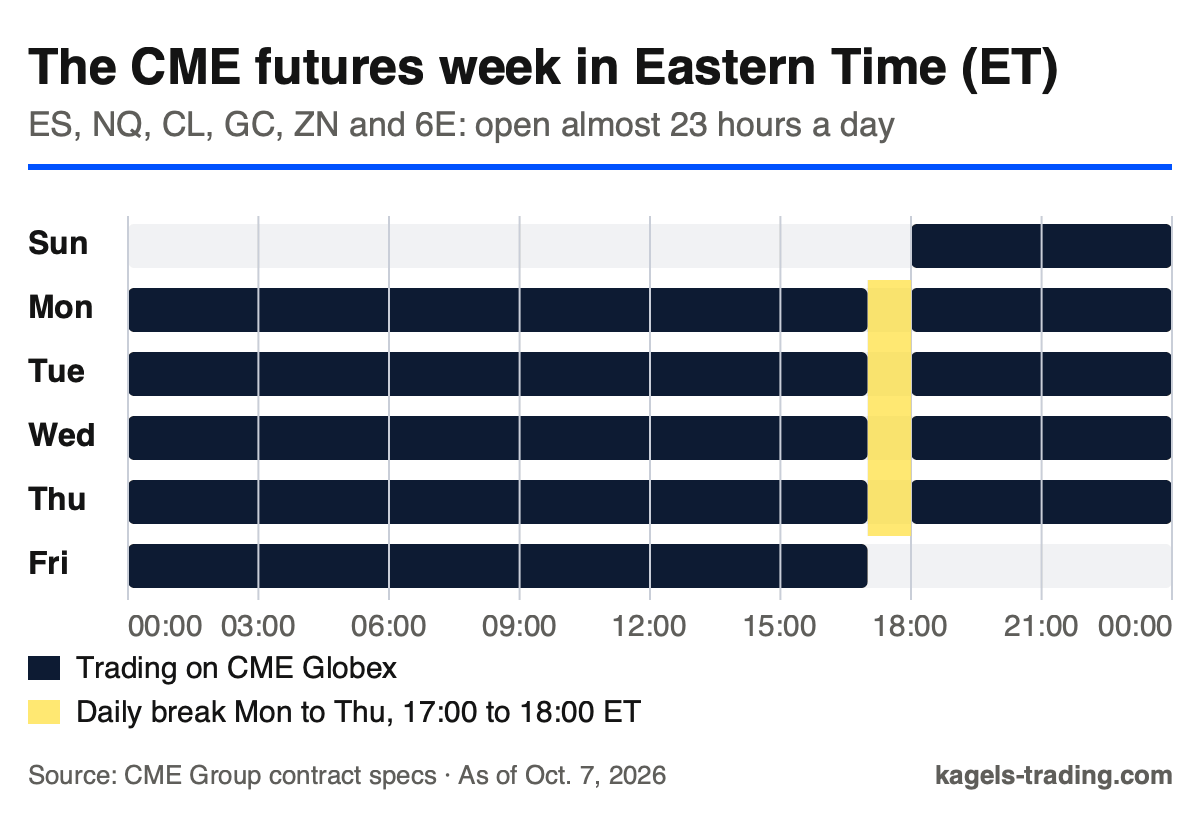 Click to enlarge
Source: CME Group contract specifications, as of 7 October 2026.
The daily break: what happens between 5:00 and 6:00 p.m. ET
During the one-hour break, Globex does not match any orders, and the trading day ends. CME uses fixed market states for this. In the closed state, day orders and orders valid only for the current trading day are cancelled. Before the next open comes a pre-open phase, in which you can enter, change and cancel orders, but nothing is executed.
For your orders this has two practical effects. A day order that did not fill before 5:00 p.m. ET is gone and must be entered again. An order marked good till cancelled can survive the daily close, but it can only be triggered once trading resumes. What happens then depends on the order type and on how your broker handles it: a stop can be filled at a worse price than the stop level, filled only in part, or, as a stop-limit order or with price protection, not filled at all. CME describes these order types in its Globex reference guide.
For charts, the break explains the small gap you see in a 24-hour futures chart every afternoon in New York. It marks the end of one futures trading day and the start of the next, so the last bar before the gap and the first bar after it belong to different days in the exchange’s records.
Regular trading hours versus overnight hours
For equity index futures like ES and NQ, many traders focus on the hours when the US stock market is open, 9:30 a.m. to 4:00 p.m. ET. The futures trade far longer, and volume and liquidity are usually highest while the stock exchanges are open. Charting software uses its own definitions: TradingView, for example, shows CME futures in regular trading hours (RTH) from 8:30 a.m. to 3:15 p.m. CT, which is 9:30 a.m. to 4:15 p.m. ET, and calls the full session electronic trading hours (ETH), according to its help page on CME sessions.
Moves in the overnight hours are real trades, but they usually rest on thinner volume. A breakout at 3:00 a.m. ET is worth checking again after the cash open, when far more orders arrive. How to switch your chart between the full session and the regular session, and why that changes the gaps you see, is explained in our guide to trading sessions. For gap strategies on stocks, see gap trading.
The Nasdaq stock market plans to add an overnight session for stocks from 9:00 p.m. to 4:00 a.m. ET. As of 7 October 2026, Nasdaq expects the start on Sunday, 6 December 2026, pending readiness of the securities information processors and any required rule changes. This concerns stocks traded on the Nasdaq Stock Market, not the futures hours in this article; see our guide to pre-market and after-hours trading.
Grains, livestock and bitcoin: the exceptions
Agricultural futures keep shorter hours than the financial contracts. Corn (ZC) trades in two blocks: an evening and night block that opens at 7:00 p.m. CT from Sunday to Thursday and runs to 7:45 a.m. CT the next morning, and a day block from 8:30 a.m. to 1:20 p.m. CT, Monday to Friday. In between there is a 45-minute pause. Live cattle (LE) trades only during the day, from 8:30 a.m. to 1:05 p.m. CT.
Bitcoin futures at CME are the opposite case: they now trade seven days a week, like CME’s other cryptocurrency futures. The contract specification lists 24/7 trading with two maintenance windows: Saturday from 2:00 to 4:00 a.m. CT and a two-minute pause on weekdays from 4:00 to 4:02 p.m. CT. That brings the futures closer to the crypto spot market, which never closes.
Futures holidays: when CME closes or opens late
CME follows the US holiday calendar, but on many holidays Globex trades a shortened schedule instead of closing completely. Trading can stop early, and the next session can open in the evening of the holiday. The exact hours differ by product group, so equity, interest rate, energy and grain futures can have different times on the same holiday.
CME publishes a holiday schedule for each date and notes that the hours are usually finalized about two weeks in advance. The remaining US holidays of 2026 on the CME Globex schedule are:
| Holiday | Date |
|---|---|
| Thanksgiving | Thursday, 26 November 2026 |
| Christmas | Friday, 25 December 2026 |
| New Year’s Day | Friday, 1 January 2027 |
We do not copy holiday times for single products here, because they can still change. Check the official CME Group holiday and trading hours page in the week before the holiday, and check your broker’s notice as well. The stock exchange closures are a separate calendar; on those days the cash market is shut even if some futures trade. The regular hours of the major exchanges are in our guide to stock exchange hours.
Daylight saving time: the trap for traders outside the US
CME keeps its hours in Central Time, so the open and close move with US daylight saving time. In 2026, US daylight saving time ran from 8 March to 1 November. The UK and the European Union switch on the last Sunday of March and of October, in 2026 on 29 March and 25 October.
In the weeks between those dates, London is only four hours ahead of New York instead of five. From 25 October until the US clock change on 1 November 2026, the daily break therefore starts at 21:00 London time, not 22:00. On Sunday, 25 October, ES opens at 22:00 London time; on Sunday, 1 November, it is back at 23:00. In central Europe the gap shrinks from six to five hours in the same weeks. If you trade from Europe, set a reminder for these two windows every year.
Practical checklist for your trading day
Three checks save most of the trouble with futures hours. First, read the contract specs of the exact contract, including micro contracts, once a year. Second, check the holiday schedule in the week before any US holiday. Third, make sure your charting software and your broker platform show the same time zone, or convert all times to ET. Equity index futures also expire four times a year; the dates and settlement times are in our guide to triple witching.
If you trade with Interactive Brokers, the platform shows the trading hours of each contract in its contract details. Our Interactive Brokers review covers commissions, platforms and the futures account in more detail.
Frequently asked questions about futures market hours
What time do futures open on Sunday?
Most CME futures open on Sunday at 6:00 p.m. ET, which is 5:00 p.m. CT. This applies to E-mini S&P 500, crude oil, gold, Treasury and currency futures. Corn opens later, at 7:00 p.m. CT, and live cattle does not trade on Sunday at all.
Do futures trade 24 hours a day?
Most CME futures trade nearly 23 hours a day, five days a week. They pause for one hour every day from 5:00 to 6:00 p.m. ET. Of the contracts in this guide, only bitcoin futures trade 24/7, apart from short maintenance windows.
What are the trading hours of ES futures?
ES futures trade from Sunday 6:00 p.m. to Friday 5:00 p.m. ET, with a daily break from 5:00 to 6:00 p.m. ET. In Central Time that is 5:00 p.m. to 4:00 p.m. with the break from 4:00 to 5:00 p.m. CT. Many traders focus on 9:30 a.m. to 4:00 p.m. ET, when the stock market is open; TradingView’s RTH view of CME futures runs to 4:15 p.m. ET.
Are futures markets open on US holidays?
On many US holidays CME runs a shortened schedule instead of closing completely. The exact hours depend on the product group and are usually finalized about two weeks before the holiday on the CME holiday page.
Why do futures hours change for traders in Europe?
CME sets its hours in US Central Time, and the US changes its clocks on different dates than Europe. For a few weeks in March and in October and November, the gap between New York and London is four hours instead of five, so every futures time arrives one hour earlier in Europe.
This article is market education, not investment advice. Futures are leveraged, and losses can exceed the money in your account.
A German edition of this article is available on kagels-trading.de.
More Market Hours guides
- Time your trades
Trading Sessions: Asian, London and New York Hours in ET
The Asian, London and New York sessions in ET, London and India time, their overlap, RTH and ETH, and how to set up your chart.
- Plan around expiry
Triple Witching 2026 and 2027: Dates and What Happens
Triple witching dates for 2026 and 2027, settlement times, and what 25 years of SPY data show about volume and the week after.
- Trade before the open
Pre-Market and After-Hours Trading: Hours, Risks, Brokers
Pre-market, after-hours and overnight hours at the exchanges and at Schwab and Interactive Brokers, the risks, and what SPY data show about the overnight move.
- Check exchange hours
Stock Exchange Hours Worldwide: Opening Times in ET
Opening and closing times of the major exchanges in the Americas, Europe and Asia-Pacific, in local and New York time, with lunch breaks.
- Trade the opening range
Opening Range Breakout: Rules, Charts and Common Mistakes
How 5, 15 and 30-minute opening windows differ, with a worked SPY example at a 15-minute window, entry at the next bar’s open and a 2R target.