
Futures vs CFDs: Regulation, Order Execution and Costs


Contents
- Futures vs CFDs in 30 seconds
- What is the difference between futures and CFDs?
- The legal side: exchange contract vs contract with your broker
- Order execution: central order book vs dealer price
- What do futures and CFDs cost?
- Pros and cons of futures and CFDs
- Who should use futures and who should use CFDs?
- Conclusion: futures and CFDs differ above all in the contract
- Frequently asked questions about futures vs CFDs
- About the author
With a future you trade against a market on an exchange, with a CFD you trade against your broker. Almost everything else follows from this one difference: who sets your price, when your stop is triggered and who is liable if the broker fails. On a chart both look the same; in the contract and in the execution they do not.
I have traded since 1980 and have been an Interactive Brokers client since 1996, mainly in futures and, for forex, also in CFDs. From now on I trade futures only. That is my personal decision, not a recommendation for you. This article follows our editorial policy and is for education, not investment advice.
Futures vs CFDs in 30 seconds
- The core: a future is a standardised exchange contract with a fixed expiry; a CFD is an over-the-counter contract with your broker and usually has no fixed expiry.
- Counterparty: with futures, the exchange’s clearing house stands between buyer and seller. With CFDs, the broker itself is your counterparty.
- Pricing: futures trade in the exchange’s central order book. The CFD price is set by the provider, usually derived from the future or the cash market plus its own mark-up.
- Stop trigger: a stop held natively on CME fires only after a real trade at or through the stop price. With many CFD providers the quoted bid or ask is enough.
- Retail rules: in the EU and the UK, CFDs come with leverage limits, a 50 percent margin close-out and negative balance protection. In the US, retail traders cannot trade CFDs at all.
What is the difference between futures and CFDs?
A future is a standardised contract traded on a futures exchange with a fixed expiry date and backed by a clearing house; a CFD is an over-the-counter contract for difference with a broker that pays the price change of an underlying, in its usual form without a fixed expiry.
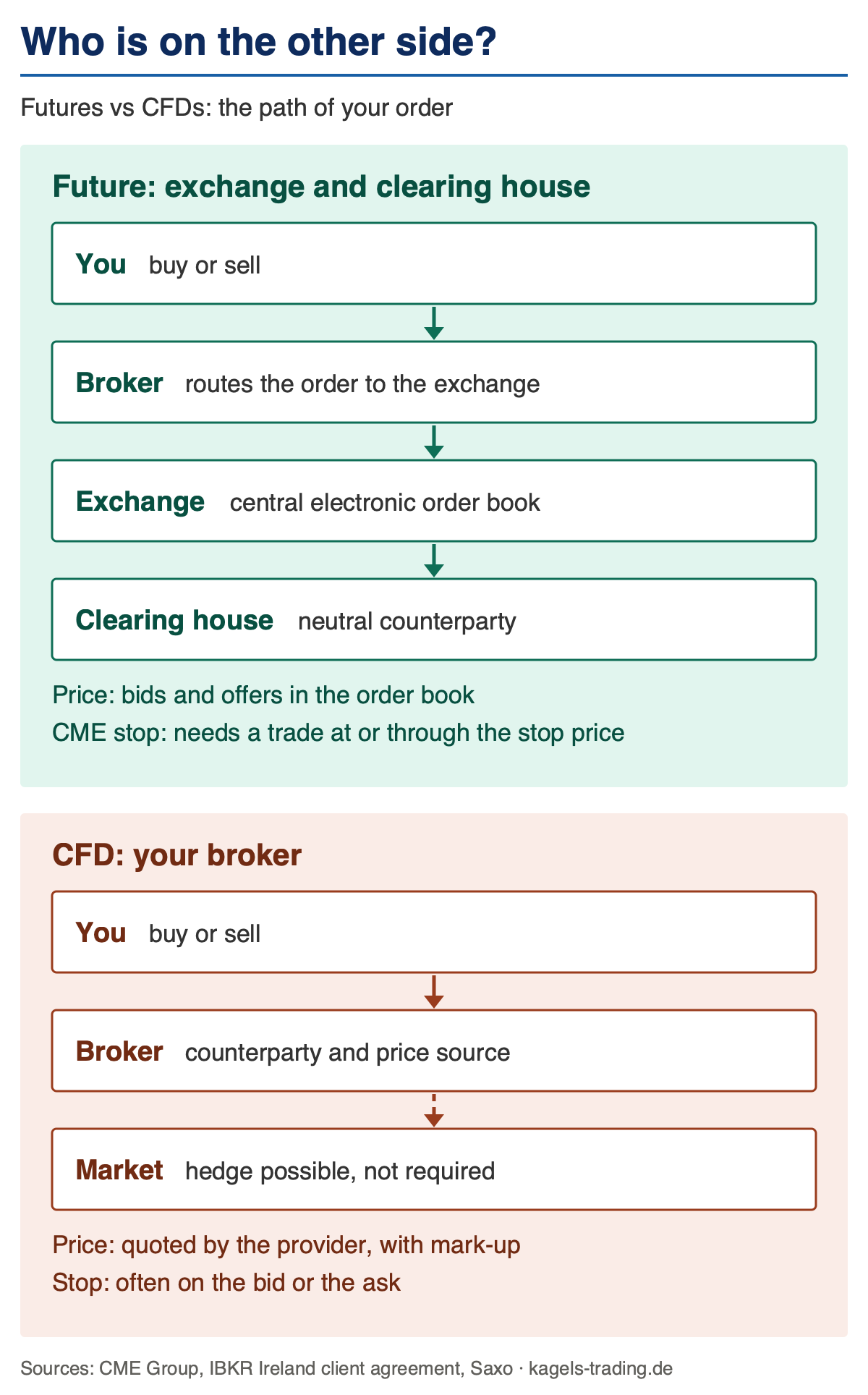
Both instruments give you leveraged exposure without owning the underlying. That is where the similarity ends. A future is an exchange product with fixed rules for size, expiry and settlement. A CFD is a private contract whose terms your broker sets in its client agreement. This guide compares futures with the usual rolling CFD without an expiry; some providers also offer CFDs that expire quarterly like a future. The building blocks of small futures contracts are explained in our guide to micro futures. The graphic below shows the path of your order for both instruments.
 Click to enlarge
| Feature | Future | CFD |
|---|---|---|
| Venue | exchange (CME, Eurex) | your broker |
| Counterparty | clearing house | your broker |
| Price | central order book | quoted by the provider |
| Expiry | fixed, roll needed | usually none |
| Size | fixed contracts, micro from €1 per point | flexible, often from one unit |
| Holding cost | built into the price | interest every night |
The legal side: exchange contract vs contract with your broker
Legally, a future is an exchange-traded derivative with the clearing house as central counterparty, while a CFD is a bilateral over-the-counter contract in which the broker itself is the counterparty.
Who is on the other side?
With a future you do not know your counterparty, and you do not need to. After each trade the clearing house steps in. CME describes CME Clearing as the neutral counterparty to every futures trade. If a single market participant fails, the other trader does not carry that risk; the exchange’s safeguards do.
With a CFD it is different, and the contracts say so. The client agreement of Interactive Brokers Ireland states that OTC transactions are executed against the company itself, which may hold a long or short position, may profit or lose and may hedge. The same principle applies to every CFD provider; only the hedging practice differs.
In practice you depend on the solvency and the rules of a single company. That is not an accusation against reputable providers. It is simply how the product is built, and it matters most when markets move fast.
CFD rules for retail clients in the EU and the UK
Since 2018, retail CFDs in Europe come with five fixed conditions. ESMA introduced them as a temporary measure, and national regulators made them permanent. Germany’s BaFin did so with its general administrative act of 23 July 2019; in the UK the FCA applies the same limits under policy statement PS19/18 since 1 August 2019.
| Underlying | Minimum margin | Max leverage |
|---|---|---|
| major currency pairs | 3.33% | 30:1 |
| major indices, gold, minor FX | 5% | 20:1 |
| other commodities and indices | 10% | 10:1 |
| single shares | 20% | 5:1 |
| crypto (EU only) | 50% | 2:1 |
In the UK, crypto CFDs are not allowed for retail clients at all. The FCA has banned crypto derivatives for retail consumers since 6 January 2021, so the last row of the table applies to the EU only.
Four protective rules come on top of the leverage limits. If your account falls below 50 percent of the initial margin, the provider must close positions. Negative balance protection caps your loss at the money in the CFD account, and bonuses are banned.
Every provider must also publish its own loss rate. It shows the share of retail accounts that lost money with CFDs over the last twelve months. On 12 November 2026 Interactive Brokers showed 58.9 percent on its CFD product page.
Futures for retail clients: a German special rule
Germany has its own rule for futures. Since 1 January 2023, investment firms may sell futures to retail clients domiciled in Germany only if they contractually exclude an additional payment obligation after a forced close-out, so losses stay within the funds deposited for futures, or if the client confirms each trade as a hedge. Closing old positions opened before 2023 is also exempt; ordinary margin requirements remain. That is set out in BaFin’s general administrative act on futures of 30 September 2022.
Outside Germany this protection does not apply. The Interactive Brokers Ireland agreement says it plainly: clients who are not retail clients domiciled in Germany may face an additional payment obligation on futures. In other words, with futures you can lose more than your deposit in most countries, which is a real argument for the CFD’s negative balance protection.
Why US traders cannot trade CFDs
In the United States, retail traders do not have access to the usual over-the-counter CFDs. Depending on the underlying, a CFD counts as a swap under CFTC rules or, on a single stock, as a security-based swap under SEC rules. For swaps, the Commodity Exchange Act, 7 U.S.C. § 2(e), makes it unlawful for anyone other than an eligible contract participant to trade off a designated contract market, and in an enforcement case the SEC treated single-stock CFDs as security-based swaps that must be registered and traded on a registered national exchange. Brokers such as Interactive Brokers therefore exclude US residents, and US traders use futures or options instead.
What protects you if the broker fails?
Investor compensation in Germany and Ireland pays 90 percent of your loss, up to €20,000. That is the limit under section 4 of the German Investor Compensation Act and under the Irish ICCL scheme, which covers clients of Irish investment firms. For CFDs this limit matters more, because your open profits are a claim against that very broker.
Futures are not free of risk here either. The clearing house guarantees the trade, not your account at the broker. If your broker becomes insolvent, your money depends on the segregation of client funds and on investor compensation, so the size and supervision of the broker matter for both instruments.
How futures and CFDs are taxed
Tax rules depend on where you live, so check your own country before you trade. In Germany, for example, futures and CFDs are treated the same way: both are forward transactions under section 20 of the Income Tax Act, and the former €20,000 cap on loss offsetting no longer exists. Other countries treat the two instruments differently, which can matter more than any commission.
Order execution: central order book vs dealer price
With futures, the price comes from the bids and offers of all participants in the exchange’s central order book; with a CFD, the provider quotes its own bid and ask, derived from a reference market.
How a CFD price is made
A CFD has no market of its own; it borrows its price. Saxo writes in its CFD trading conditions that commodity CFDs follow the underlying future, with a somewhat wider spread. Interactive Brokers also derives its index CFDs from the future and adds a liquidity provider’s mark-up, as shown in our guide to index CFDs at Interactive Brokers.
What you see on a CFD chart is your provider’s price. Another broker shows a different bid and ask in the same minute. Exchange volume, the number of contracts actually traded, is something a CFD cannot show you.
What you see with futures: order book, time and sales, volume
With futures you see what the market actually does. Regular trading in a contract runs through one central electronic order book; at CME the system is called Globex. Only a few exceptions, such as privately negotiated block trades, happen outside it. You see the depth of the book, every trade with price and size in time and sales, and real volume. How to read these data is explained in our guide to order flow trading.
For me, this is the most important difference in practice. When my stop is filled, I can check in time and sales whether anyone actually traded at that price. With a CFD I only have the provider’s price list.
When a stop is triggered
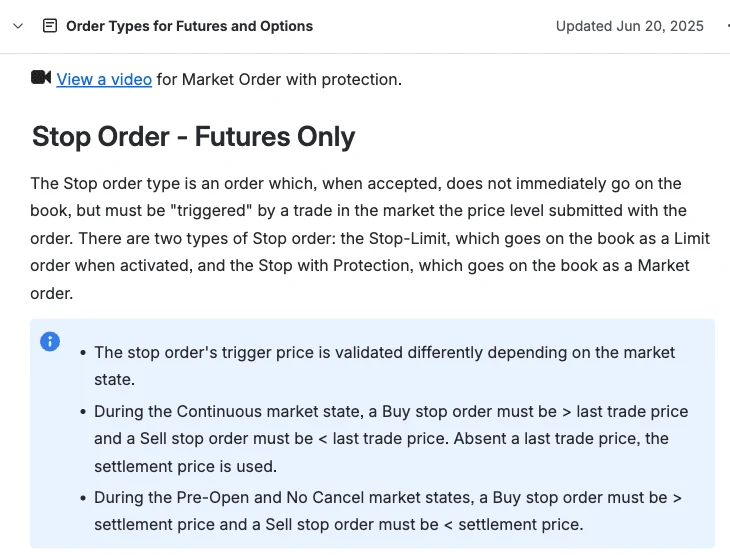
A stop held natively on CME Globex is triggered only when a trade takes place at or through the stop price. CME’s technical documentation says a stop order must be “triggered” by a trade in the market. A bid or offer alone is not enough, as the screenshot shows. After that it is filled only within its limit or protection band, as explained below. If your broker simulates the futures stop instead, its own trigger rules apply.
 Click to enlarge
Source: CME Group Client Systems Wiki.
With a CFD, the provider decides what triggers your stop. Saxo, for example, triggers a sell stop at the bid and a buy stop at the ask. If the provider widens its spread, the quoted bid can reach your stop even though nobody traded that low in the reference market.
Some brokers let you choose the trigger method for simulated stops. Which methods are allowed depends on the product: for index CFDs, Interactive Brokers’ trigger methods accept only bid/ask based methods, not the last price. An incompatible setting can mean the stop never triggers.
The critical hour: daily break and rollover
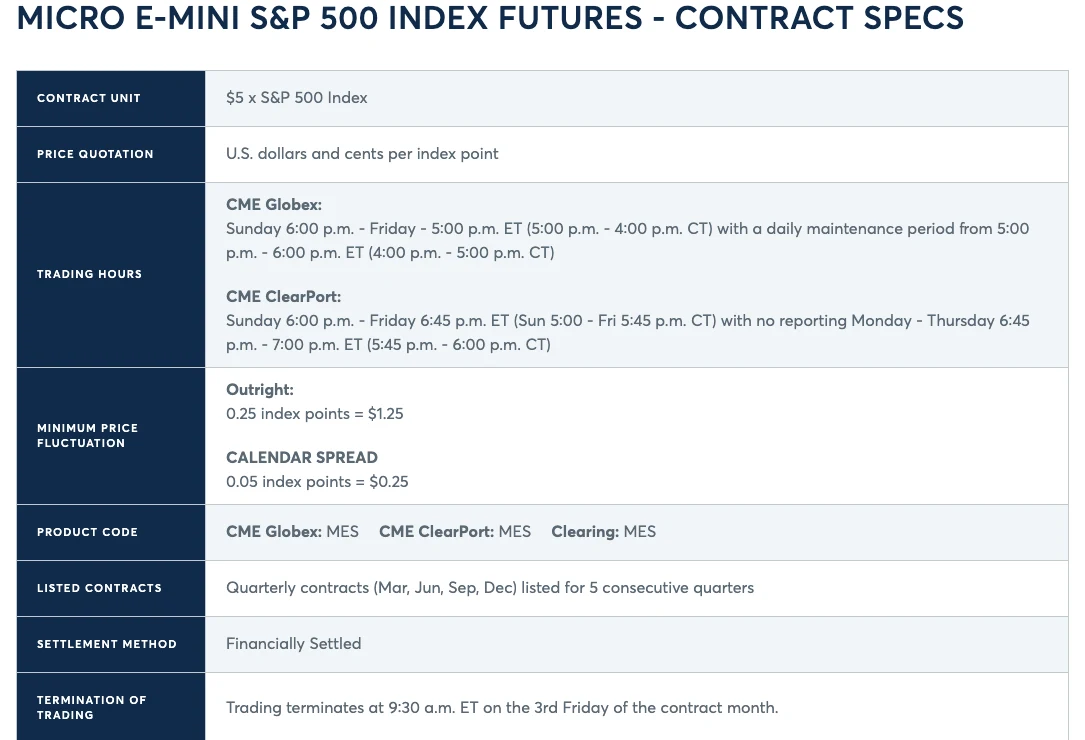
CME pauses its equity index futures every day from 5 to 6 p.m. New York time. In central Europe that is usually 11 p.m. to midnight, one hour earlier in the weeks when the US and Europe change their clocks on different dates. The image shows the maintenance period in the contract data of the Micro E-mini S&P 500, and our guide to futures market hours lists the breaks for other contracts.
 Click to enlarge
Source: CME Group contract specifications.
At the same time the forex market rolls to the next trading day. Many CFD providers book their overnight financing then; CMC Markets names 5 p.m. New York time explicitly. When the future behind a CFD is paused, there is no running reference market, and the provider quotes from another market or not at all.
During the break itself, the future does not trade at all. When trading reopens, prices can jump, so a tight stop left open around the break is at particular risk with both instruments.
Futures slip too: gaps and thin markets
A future does not protect you from bad fills. After it is triggered, a stop becomes a market order or a limit order. CME caps stops with protection at a price band; whatever cannot be filled inside it rests in the book as a limit order, so your position may be only partly closed.
A stop-limit order may not be filled at all if the market gaps past its limit. If the market opens far below your stop on Sunday evening, your order is filled at the next available prices as far as the protection band or limit allows, and the rest stays in the book. This difference is called slippage, and it hits both instruments. With futures you can at least check it against the exchange’s trade record.
An advantage for CFDs: the guaranteed stop
Only CFD providers can offer a guaranteed stop. CMC Markets, for example, sells a guaranteed stop-loss for a premium; it closes at the set price regardless of gaps and refunds the premium if it is not triggered. An exchange cannot offer that, because every fill needs a real buyer or seller.
What do futures and CFDs cost?
A CFD costs spread, commission and daily financing; a future costs commission, exchange fees and the roll before expiry, while the interest is already built into the futures price.
| Cost | Future | CFD |
|---|---|---|
| Commission | per contract | percentage or in the spread |
| Spread | from the order book | with provider mark-up |
| Exchange fee | per contract | none |
| Overnight | no interest booking | interest every night |
| Expiry | roll before expiry | none |
Worked example: the DAX as a micro future and as a CFD
A Micro-DAX future and one unit of a DAX CFD move the same: one euro per point. At an assumed DAX level of 26,000 points, both positions are worth €26,000. I use the Interactive Brokers Ireland price lists, because the same broker offers both instruments.
| Item | Micro-DAX (FDXS) | DAX CFD (IBDE40) |
|---|---|---|
| Value per point | €1 | €1 |
| Buy and sell | €0.76 | €2.60 |
| Interest booking per night (long) | none | €3.61 |
| Booked costs, 5 nights | €0.76 | €20.66 |
The commission is lower on the future, but financing makes the big difference. In the tiered model, the futures price list shows €0.38 per contract and side for the Micro-DAX, including exchange fees. IBDE40 costs 0.005 percent of the trade value, so €1.30 per side.
The night costs retail clients 5.001 percent a year on the CFD. That is the long rate on the financing page on 12 November 2026 plus the 1 percentage point retail surcharge, calculated on 360 days. The spread is not included in either column, and the table compares booked charges only: the financing built into the futures price is missing.
Holding a future is not free either. The futures price contains the interest for the remaining term, so it usually sits above the index; for price indices such as the S&P 500 expected dividends are deducted, for the DAX as a total return index they are not. You do not pay this as a booking, it is in the price, and to hold past expiry you roll into the next contract with commission and spread.
Margin: exchange requirement vs regulatory minimum
With futures the exchange sets the minimum margin, with CFDs the regulator does. On 12 November 2026 CME required a maintenance margin of $2,667 for one Micro E-mini S&P 500 (December 2026, long). At about 7,600 points that controls $38,000, so roughly 7 percent; brokers usually ask for a little more to open.
For a retail S&P 500 CFD, regulators set a minimum of 5 percent, about $1,900 for the same size. That is a floor, and brokers may ask for more, so compare the actual margins your broker charges for both instruments. Our guide to position sizing shows how to size a trade from the stop instead of the margin.
Contract sizes: micro futures as a bridge
For a long time the CFD was the only choice for small accounts. A classic DAX future moves €25 per point, too big for many private accounts. Micro contracts changed that: the Micro-DAX moves €1 and the Micro E-mini S&P 500 $5 per point.
The CFD is still easier to size precisely. If you want to match your position size to your risk almost to the euro, a CFD from one unit or in fractions gives you more room.
Pros and cons of futures and CFDs
No instrument wins on every point. The two lists below sum up the advantages and disadvantages of each one.
Futures: advantages
- Neutral counterparty: the exchange’s clearing house stands between you and the market, not your broker.
- Verifiable fills: order book, time and sales and real volume show whether anyone traded at your price.
- Stops need a real trade: a quoted price alone does not trigger a stop held natively on CME.
- No nightly interest booking: holding costs sit in the futures price instead of a daily interest charge.
Futures: disadvantages
- Fixed contract sizes: even micro contracts cannot be split.
- Rolling: longer positions cost time, commission and spread at each roll.
- Slippage too: gaps and thin markets hit futures as well, and there is no guaranteed stop.
- Loss beyond the deposit: outside Germany a margin call can exceed the money in your account.
CFDs: advantages
- Fine sizing: positions from one unit, at many providers in fractions.
- No expiry: with the usual rolling CFD there is nothing to roll.
- Negative balance protection: in the EU and UK, retail clients cannot lose more than the CFD account.
- Guaranteed stop: available at some providers for a premium.
CFDs: disadvantages
- Broker as counterparty: your profit is a claim against one company.
- Quoted prices: no central order book, no exchange volume, stops on the provider’s bid or ask.
- Expensive nights: daily financing eats the cost advantage on longer positions.
- High loss rates: providers must publish them, and they are often above half of retail accounts.
Who should use futures and who should use CFDs?
Futures suit traders who want verifiable fills, exchange rules and lower booked holding costs over several days; CFDs suit small accounts that need very fine position sizes, short holding periods and, as EU or UK retail clients, a legally capped loss.
Small accounts and very short trades lean towards the CFD. If you trade a few thousand euros, want an exotic currency pair or are out again within the hour, a regulated CFD broker has the right tool. For EU and UK retail clients it is a legitimate choice with negative balance protection; elsewhere that protection depends on the country and the provider.
Overnight positions and larger accounts lean towards futures. There is no nightly interest booking, and the fill can be checked at the exchange. You need a broker with exchange access, for example Interactive Brokers.
Why I now trade futures only
This is my opinion, not advice for you. After more than four decades in the markets I want to check every fill against what actually happened on the exchange. With futures I can, with CFDs I cannot. I also want a neutral institution between me and the market, not a company that earns or loses on my trade.
For that I accept fixed contract sizes and the roll. If you trade differently, need smaller sizes or value negative balance protection, a reputable CFD provider can serve you well.
Conclusion: futures and CFDs differ above all in the contract
If you compare futures and CFDs only on costs, you miss the most important point: who is on the other side. With futures it is the exchange and its clearing house, with CFDs your broker. That decides your price, your stop trigger and your risk when something goes wrong.
For short trades in a small account, the CFD remains a legitimate tool, for EU and UK retail clients with a legal loss cap. On booked charges the future wins clearly in the overnight example, but a full comparison also needs the financing built into the futures price and the spread; on transparency of execution the future is ahead. I have chosen futures; check for yourself which rules matter more to you.
Frequently asked questions about futures vs CFDs
Which is better, futures or CFDs?
It depends on your account size and holding period. Futures offer a neutral counterparty, verifiable fills and no nightly interest booking. CFDs offer finer sizes, no expiry and, for EU and UK retail clients, negative balance protection.
Can I lose more than my account with futures?
In most countries, yes. A futures loss can exceed your deposit, and the broker can demand a margin call. Germany is an exception: since 1 January 2023 brokers must contractually exclude an additional payment after a forced close-out for German retail clients, except for confirmed hedges and old positions, or they may not sell them futures.
Can US traders trade CFDs?
No, the usual OTC CFDs are not available to US retail traders. Depending on the underlying they count as swaps (CFTC) or security-based swaps (SEC), which retail traders cannot trade off-exchange, and brokers exclude US residents from CFDs. US traders use futures or options instead.
Why was my CFD stop triggered although the market never reached that price?
Because a CFD stop usually reacts to your provider’s quoted price, not to an exchange trade. A sell stop often triggers at the bid. If the provider widens its spread, for example around the daily break at 5 p.m. New York time, the bid can reach your stop although nobody traded that low in the reference market.
Which futures can replace index CFDs?
The micro contracts. The Micro-DAX moves €1 per point, the same as one unit of a DAX CFD. The Micro E-mini S&P 500 moves $5 per point and the Micro E-mini Nasdaq-100 $2 per point.
How much does a future cost compared with a CFD?
At Interactive Brokers Ireland, a Micro-DAX costs €0.38 per contract and side in the tiered model, a DAX CFD 0.005 percent of the trade value. At 26,000 points that is €1.30 per side for the CFD. The bigger difference is financing: the CFD charges interest every night, while the future has it built into its price.
This English edition is based on our German edition on kagels-trading.de and has been adapted for international readers.
More Markets and Brokers guides
- Open your first account
What Is a Brokerage Account? A US Beginner's Guide
How to open and fund a US brokerage account, cash vs margin, what it costs and what SIPC and FDIC really cover.
- Know what trading really costs
Trading Costs: Every Fee You Pay and How to Cut It
Spread, commissions, SEC and FINRA fees, market data, margin interest and tax, with yearly totals for three trading styles.
- Choose a broker
Interactive Brokers Review 2026: Fees and Platforms
Fees, platforms, investor protection and real futures commissions from a client since 1996.
- Check an offshore broker
PU Prime Review 2026: FCA Warning, Licences and Costs
Which PU Prime company you contract with, what the FCA warning means, and what 1:1000 leverage and the deposit bonus do to your account.
- Check an EU CFD broker
Tradeview Review 2026: Tradeview Europe, MFSA and Costs
What the Malta licence of Tradeview Europe covers, how it differs from the Cayman company, and what the three MetaTrader 5 accounts cost.
- Check ZuluTrade
ZuluTrade Review 2026: Costs, Regulation and US Status
Who runs the copy trading platform, what it costs through your broker, why the US was missing from its sign-up form and what the CFTC fined its US company for.
- Check CopyX
CopyX Review 2026: Is TAG Markets Copy Trading Legit?
Who runs the TAG Markets copy trading platform, which regulators warn about it, why US residents are excluded and how fast the 12x Amplify account eats your deposit.
- Choose a US forex broker
OANDA Review 2026: Fees, TradingView and US Rules
OANDA from its own pages and NFA records: spreads and fees, TradingView and the demo, FIFO and three penalties.
- Check a commission-free app broker
Webull Review 2026: Fees, Margin Rates and Safety
Webull from its own fee schedule and FINRA records: what is free, margin rates and Premium, overnight trading, crypto and three fines.
- Understand your price
Market Makers: Who Sets Your Price and How They Profit
How market makers earn on the spread, who sets prices at German trading venues and what the EU ban on payment for order flow changed.
- Size up a bull market
Bull Market: How Long It Lasts and How to Spot the End
When a rise becomes a bull market, how long the 27 completed S&P 500 bull markets since 1928 lasted and gained, and where the current one stands.
- Read bond market stress
MOVE Index: The VIX of the Bond Market, Explained
What the MOVE index measures, which readings signal stress, how it differs from the VIX and where its limits are.
- Read stock market fear
VIX Index: What the Fear Gauge Measures and Normal Levels
What the VIX measures, which levels have been normal since 1990, how closely it tracks the S&P 500 and how VIX futures, options and ETPs work.
- Read the risk mood
Risk-On vs Risk-Off: Meaning, Assets and Indicators
What risk-on and risk-off mean, which assets rise and fall in each mode, five market shocks since 2008 and the VIX, DXY and AUD/JPY signals.
- Read market sentiment
Fear and Greed Index: How It Works, Tested Since 2021
How CNN builds its Fear and Greed Index from seven measures, what the zones mean and how the S&P 500 moved after readings below 20.
- Size up a bear market
Bear Market: How Long It Lasts and How to Spot One
When a decline becomes a bear market, how long the 27 S&P 500 bear markets since 1928 lasted, how long the recovery took and why Bitcoin had three since 2025.
- Trade an index CFD
Index CFDs at Interactive Brokers: Symbols, Costs and Trading
All 13 IBKR index CFDs, margin, stop and close-out worked through for IBDE40, financing, UK hours and the TradingView limit.
- Size an index future
Micro Futures: MES vs MNQ, Tick Values and Risk
MES and MNQ tick values, a worked sizing example from the stop with costs and slippage, and why margin is not your risk.
- Read the futures curve
Contango vs Backwardation: Futures Curves Explained
What contango and backwardation mean, what rolling does to a position in each case, and real gold, oil and gas curves from 28 October 2026.
- Understand the spot market
Spot Market Explained: Definition and Settlement Times
What a spot market is, why two days is a minimum and not a limit, and when stocks settle at T+1 in the US, EU, UK and Switzerland.
- Choose a silver future
Silver Futures: SI vs Micro Silver vs 100-oz SIC
SI, Micro Silver and the 100-ounce SIC compared by tick value, risk per contract, margin and December 2026 deadlines.
- Read the chip sector
SOX Index: Holdings, Weighting and How to Use It
What the SOX holds, how Nasdaq caps the weights, its largest declines since 2004 against the Nasdaq-100 and which ETFs really track it.
- Read the biotech sector
Nasdaq Biotechnology Index: Holdings, Weighting and Risks
What the NBI holds, how Nasdaq caps the weights, its long declines since 2003 against the Nasdaq-100 and which ETFs really track it.
- Read the transport sector
Dow Jones Transportation Average: Stocks and Dow Theory
The 20 stocks in the Dow transport index, why the share price sets their weight, declines since 1992 and what Dow Theory can and cannot tell you.
- Read the French market
CAC 40 Index Explained: All 40 Stocks, Weights and Trading Hours
All 40 CAC 40 stocks, how Euronext caps the weights at 15 percent, trading hours in Eastern Time and how it differs from the DAX.
- Research stocks
InvestingPro Review: Screener, ProPicks AI and WarrenAI
What the InvestingPro screener, ProPicks AI and WarrenAI do, what Pro and Pro+ cost and who needs which plan.
- Judge a stock-picking newsletter
Motley Fool Stock Advisor Review: Cost and Track Record
What Motley Fool Stock Advisor costs after the first year, how the advertised return is calculated, refund and renewal terms, and who it suits.
- Use the free news portal
Investing.com Review: Free Tools, Data and Limitations
What the free Investing.com portal does well, where the quote prices come from and when InvestingPro is worth paying for.
- Find real AI revenue
AI Stocks 2026: How Listed Companies Earn From AI
Which listed companies earn from AI in cloud, software, infrastructure and chips, disclosed AI revenue against hope, plus AI ETFs and risks.
- Compare AI data center suppliers
AI Infrastructure Stocks: 10 Data Center Suppliers Compared
Ten suppliers for power, cooling, servers and optics compared on free cash flow, customer concentration and next dates, with filters and a two-stock comparison.
- Follow an IPO
Anthropic Stock: IPO Date, Valuation and How to Invest
Where the Anthropic IPO stands, how the valuation compares with revenue and how to get exposure before and after the listing.
- Invest in OpenAI before the IPO
OpenAI Stock: Can You Buy It, and Who Owns OpenAI?
Why there is no OpenAI stock yet, who owns OpenAI, where the IPO stands and how much OpenAI you get through Microsoft or SoftBank.
- Understand a stock split
Stock Splits Explained: Forward and Reverse Splits
What forward and reverse splits change and what they do not, the dates that matter, what happens to options and the $1 listing rule.
- Analyze a company
Fundamental Analysis: 12 Ratios, a Worked Example, 5 Steps
Twelve ratios with formulas and rules of thumb, worked through Microsoft's 2026 annual report, a five-step process and the fundamentals of forex, commodities and crypto.
- Value a stock
Value Investing: Intrinsic Value, Margin of Safety, Traps
Intrinsic value against price, a worked DCF with a sensitivity table, Coca-Cola as a real example, the value premium since 1926 and value traps.
- Value a new listing
SpaceX Stock (SPCX): Valuation, Risks and How to Buy
How to buy SpaceX stock, what the company is worth after the IPO and which risks the lock-up calendar brings.