
Webull Review 2026: Fees, Margin Rates and Safety


Contents
- Webull in 30 seconds
- What is Webull?
- What you can trade at Webull
- Webull fees: what is free and what costs money
- Margin rates and Webull Premium
- Trading hours: pre-market, after-hours and overnight
- Platforms, TradingView and paper trading
- Is Webull safe? Protection, clearing and fines
- Who can open a Webull account?
- Pros and cons of Webull
- Conclusion: who should use Webull?
- Frequently asked questions about Webull
- About the author
Webull is a US online broker that charges no commission on US stocks, ETFs and options. You can also trade futures, crypto and event contracts in the same app, and selected stocks almost around the clock with overnight trading. Webull earns its money elsewhere: with margin interest, interest on cash, stock lending and payment for order flow.
We did not open a Webull account for this review, and we placed no orders. Everything below comes from Webull’s fee schedule, its help center and FINRA’s records, all checked on November 12, 2026. Where we could not confirm a claim, we leave it out or say so. How the app feels in daily use and how fast customer service answers are not part of this review. This article follows our editorial policy.
Risk warning: trading involves risk. Options, futures and margin can cost you more than your deposit.
Webull in 30 seconds
- Who it is for: US residents who want commission-free stocks, ETFs and options, plus futures and crypto in one app.
- Costs: $0 commission on US stocks, ETFs and options; $0.50 per contract on index options such as SPX, plus the exchange fee; futures from $0.13 to $1.00 per contract and side.
- Margin: 8.74 percent a year on every loan size without Premium; 5.45 to 4.15 percent with Premium.
- Premium: $3.99 a month or $40 a year, mainly worth it if you borrow on margin.
- Watch out for: a 1 percent crypto spread, $75 to transfer your account out and seven regulatory actions on BrokerCheck, the largest a $4.2 million FINRA fine in November 2026.
- Our rating: no score, because we did not test Webull with an account.
What is Webull?
Webull Financial LLC is a US broker-dealer registered with the SEC and a member of FINRA and SIPC. You can check it on FINRA BrokerCheck under CRD 289063. Its pricing page names Apex Clearing as the clearing firm for transfers and regulatory fees. The parent company, Webull Corporation, has been listed on Nasdaq under the ticker BULL since April 2025, after a merger with a SPAC (a listed shell company).
Webull runs different products through different companies. Futures and event contracts belong to Webull Futures LLC, which is registered with the CFTC and a member of the NFA. Crypto runs through Webull Pay LLC, and the robo-advisor through Webull Advisors LLC. This matters for your protection, because SIPC covers only the securities account (see below).
Outside the US, Webull works through separate companies with different offers. This review covers only Webull in the US. If you live in another country, the products, fees and investor protection of your local Webull company can be quite different; our German edition reviews the European offer.
What you can trade at Webull
| Market | What Webull offers in the US (as of November 12, 2026) |
|---|---|
| US stocks and ETFs | Yes, $0 commission; selected stocks and ETFs also overnight |
| Options | Equity, ETF and index options; $0 commission, index options $0.50 per contract plus exchange fee |
| Futures | Yes, through Webull Futures LLC; regular, mini, micro and crypto futures |
| Crypto | Yes, through Webull Pay LLC; 1.00% spread per buy and per sell, none on stablecoins |
| Event contracts | Yes, prediction markets through Kalshi; $0.02 per contract per side |
| Other | OTC stocks, bonds, mutual funds, money market funds, IRAs, robo-advisor |
| Not offered | CFDs, spot forex |
Crypto at Webull means buying the coins themselves, not crypto ETFs only. Webull’s crypto page says the service is offered by Webull Pay LLC, and that clients in New York, Guam and the Northern Mariana Islands hold their account at Bakkt. Crypto is not a security, so it is neither SIPC nor FDIC insured. We could not confirm on Webull’s pages whether you can send coins to your own wallet, so ask before you buy if that matters to you.
Event contracts are yes-or-no trades on real-world outcomes. Webull connects to Kalshi, a CFTC-regulated exchange. According to Webull’s event contract fees, you pay a $0.01 commission plus a $0.01 exchange fee per contract when you open a position, and the same again if you sell before expiration; holding to settlement costs nothing extra. Which contracts you see can depend on your US state. Our Kalshi review and the guide to prediction markets explain how these contracts work and what can go wrong.
Webull fees: what is free and what costs money
Webull charges no commission on US stocks, ETFs and equity options, but some fees remain. The pricing page lists regulatory fees that Webull passes on, for example the SEC fee of $0.0000206 times the sale amount on stock sales. Options carry small per-contract fees on every trade: $0.025 OCC clearing and a $0.02 options regulatory fee, which Apex Clearing charges since July 1, 2026 and which Webull says is not a pass-through fee. For the FINRA fee on option sales, the table shows $0 while the note below it names $0.00279 per contract, so check the fee estimate on the order ticket. Large option orders of 500 contracts or more cost an extra $0.10 per contract, or $0.04 if routed through the algo route; index options are exempt from this charge.
| Item (as of November 12, 2026) | Webull fee |
|---|---|
| US stocks and ETFs | $0 commission plus regulatory fees |
| Equity and ETF options | $0 commission plus a few cents in fees per contract; extra fee on orders of 500+ contracts (not on index options) |
| Index options (for example SPX, VIX, XSP) | $0.50 per contract plus the exchange’s own fee (SPX $0.57 to $0.66) |
| Futures, per contract and side (standard pricing) | Nano crypto $0.13, micro $0.25, crypto $0.50, mini $0.60, standard $1.00, plus exchange, clearing and NFA fees |
| Crypto | 1.00% spread on buys and sells (not on stablecoins) |
| Event contracts | $0.01 commission plus $0.01 exchange fee per contract and side |
| Margin interest | 8.74% a year (Premium 5.45% to 4.15%) |
| Transfer to Webull | $0 |
| Transfer out (ACAT) | $75 |
| Wire transfer | $8 in, $25 out (US); $12.50 in, $45 out (international) |
| ACH deposit and withdrawal | $0 |
Index options cost more than equity options at Webull. For SPX options, you pay Webull’s $0.50 per contract plus the exchange’s proprietary fee, which Webull lists at $0.57 for prices under $1 and $0.66 from $1. That makes about $1.07 to $1.16 per contract before the small regulatory fees. With Premium, the Webull fee falls to $0.40 for the next 4,000 contracts after the first 1,000 in a month and to $0.30 above 5,000.
Futures fees apply when you open and again when you close a position. Webull’s futures fee page names four parts: the commission, a clearing fee, the exchange fee and the NFA fee. The commissions in the table above are Webull’s part only, so a round trip in one micro contract costs at least $0.50 in commission before the other fees.
The account fees matter more than the trading fees for most people. Moving your whole account to another broker costs $75, an outgoing domestic wire $25 and a debit card withdrawal 1.75 percent of the amount. ACH transfers are free. The fee schedule names no inactivity fee and no minimum deposit. Paper statements cost $5 a month, and if Webull cannot deliver your statement by email, it switches you to paper automatically until you turn e-delivery back on.
Margin rates and Webull Premium
Without Premium, Webull charges 8.74 percent a year on margin loans of any size. With Premium, the rate starts at 5.45 percent for loans up to $25,000 and falls to 4.15 percent above $25 million. Interest is calculated daily on a 360-day year and charged monthly, and Webull can change the rates without notice. A margin account needs at least $2,000.
| Margin loan (pricing page, November 12, 2026) | Premium | Standard |
|---|---|---|
| $25,000 or less | 5.45% | 8.74% |
| Over $25,000, up to $100,000 | 5.25% | 8.74% |
| Over $100,000, up to $500,000 | 4.70% | 8.74% |
| Over $500,000, up to $1 million | 4.65% | 8.74% |
| Over $1 million, up to $10 million | 4.45% | 8.74% |
| Over $10 million, up to $25 million | 4.40% | 8.74% |
| Over $25 million | 4.15% | 8.74% |
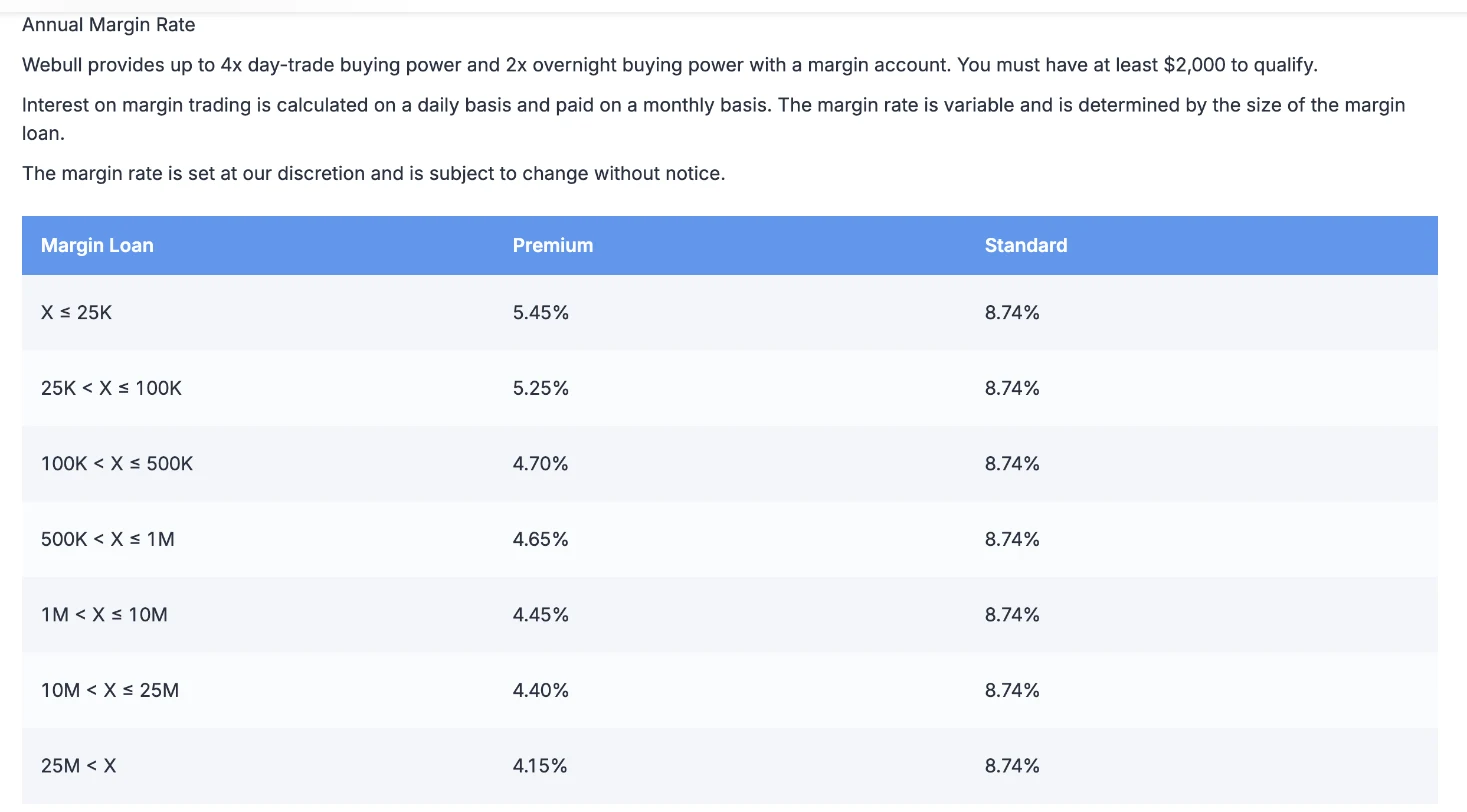 Click to enlarge
Margin gives you up to four times your equity for day trades and twice your equity for positions you hold overnight. This buying power applies in the regular and extended sessions. It does not apply in the separate overnight session from 8:00 PM to 4:00 AM ET, where Webull allows no margin at all (see trading hours below).
Premium costs $3.99 a month or $40 a year. Besides the lower margin rates, Premium adds a higher interest rate on uninvested cash in eligible cash accounts; the rate is variable, Webull shows the current figure in the app, and margin accounts and IRAs do not get it. Premium also raises the IRA match: 3.5 percent instead of 1 percent on new contributions, and a limited-time 1 percent on IRA transfers up to a $2,500 match. According to Webull’s Premium terms, you must keep Premium for a full year and leave the money in the IRA for at least five years to keep the match.
For a margin borrower, Premium pays for itself at an average loan of about $1,200 over a year. The difference between 8.74 and 5.45 percent is 3.29 percentage points. Because Webull counts interest on a 360-day year, a loan of $10,000 held for 365 days at unchanged rates saves about $334 in interest against the $40 annual fee. If you do not use margin, the cash rate and the IRA match are the main reasons left to pay for Premium, and they only help if you meet their conditions. Our guide to margin calls explains what happens when a margin position falls.
Trading hours: pre-market, after-hours and overnight
Webull lets you trade selected stocks and ETFs 24 hours a day, five days a week. Its overnight trading help page describes a session from 8:00 PM to 4:00 AM ET, Sunday to Thursday nights, on overnight alternative trading systems. Together with the extended session from 4:00 AM to 8:00 PM ET, this covers the whole trading week.
The overnight session has strict limits. You can only use limit orders for whole shares, the orders expire at 4:00 AM ET, and short selling is not allowed. Margin is not available: an order must fit your cash buying power, and if your account holds any short position, including covered options, your overnight buying power is zero. Options and bonds do not trade overnight. Prices at night can jump and the spread is often wider; our guide to pre-market and after-hours trading explains the risks of thin markets.
Platforms, TradingView and paper trading
Webull offers a mobile app, a desktop app and a web platform. Its website also lists paperTrade, a simulated account for practice, an Open API for developers and an AI assistant called Vega. We did not test any of them, so we cannot say how well they work in practice.
You can also trade your Webull account from TradingView charts. Webull’s TradingView page says trades placed there are commission-free on the same terms, with $0.50 per contract for index options and no minimum deposit. Our list of TradingView brokers compares Webull with other brokers you can connect there.
Is Webull safe? Protection, clearing and fines
Your securities at Webull are protected by SIPC up to $500,000, including $250,000 in cash. SIPC steps in when a broker fails and customer assets are missing; it does not protect you against trading losses. Webull’s pricing page adds excess SIPC coverage. For accounts cleared through its omnibus arrangement with Apex, a policy at Lloyd’s of London covers up to $1.9 million in cash per customer within an aggregate limit of $100 million; other accounts fall under a separate Apex policy with other limits. Futures, event contracts and crypto are not covered by SIPC.
Webull’s BrokerCheck report lists seven final regulatory actions. The largest came on November 5, 2026, when FINRA fined Webull $4.2 million. According to FINRA, Webull opened more than 120,000 accounts between January 2020 and September 2023 without a reasonable belief that it knew the customers’ true identities, did not detect and report 473 unauthorized ACH transfers of more than $1.5 million, and did not review execution quality properly between February 2020 and May 2025.
| Date | Regulator and fine | Topic |
|---|---|---|
| Nov 5, 2026 | FINRA, $4.2 million | Identity checks, money laundering controls, best execution |
| Aug 17, 2026 | FINRA, $115,000 | Wrong origin codes on about 180,000 options contracts |
| May 8, 2025 | FINRA, $1.6 million | Paid influencer posts on social media |
| Nov 22, 2024 | SEC, $125,000 | Incomplete suspicious activity reports |
| Nov 9, 2023 | Massachusetts, $500,000 | Compliance staff and supervision |
| Mar 9, 2023 | FINRA, $3 million | Options approvals and customer complaints |
| Mar 16, 2022 | California DFPI, $4,000 | State consent order |
The other cases show a pattern of compliance gaps rather than one single event. In March 2023, FINRA fined Webull $3 million because its automated system approved options accounts for customers who did not meet its own criteria, among them more than 2,500 customers under 21 for options spreads. In all four FINRA cases, Webull accepted the findings without admitting or denying them. All cases are on the BrokerCheck report, where you can check the current state yourself.
Webull earns money from payment for order flow. Its fee schedule names stock loans, interest on cash, margin interest and payment for order flow as its main revenue, and links to its SEC Rule 606 report. Payment for order flow is legal and common at commission-free brokers in the US, but it means the broker earns more when you trade more. The 2026 FINRA findings on best execution show why it is worth watching the fill prices you get.
Who can open a Webull account?
Webull’s US brokerage is for people who live in the United States. According to its help center, you must be at least 18 years old, have a Social Security number or ITIN and a US home address, and be a permanent resident or hold an accepted visa. Foreign IDs are not accepted. A futures account requires US residence and an existing individual Webull account.
There is no minimum deposit for a cash account. You need $2,000 for margin, and options need a separate approval. If you are new to brokers, our guide to opening a brokerage account explains cash and margin accounts and what SIPC and FDIC cover.
Pros and cons of Webull
| Pros | Cons |
|---|---|
| $0 commission on US stocks, ETFs and equity options | Margin at 8.74% without Premium |
| Stocks, options, futures, crypto and event contracts in one app | 1% spread on crypto |
| Overnight trading in selected stocks and ETFs | $75 to transfer out, $25 outgoing wire |
| No minimum deposit, no inactivity fee listed | Index options $0.50 per contract plus exchange fee |
| SIPC plus excess SIPC coverage | Seven regulatory actions, $4.2 million FINRA fine in 2026 |
| Trading from TradingView charts | Payment for order flow; US residents only |
Webull is not the best fit for everyone. If you need global markets or trade from outside the US, Interactive Brokers covers far more countries and exchanges. If you trade options through your own code, Tradier and Alpaca are built around their APIs. Webull’s strength is the US trader who wants many asset classes in one commission-free app.
Conclusion: who should use Webull?
Webull fits US traders who want commission-free stocks and options plus futures and crypto in one place. Overnight trading, TradingView access and the absence of a minimum deposit add to that. The costs that matter sit in margin interest, the crypto spread and the account transfer fee.
Before you open an account, check three things. First, if you use margin, compare 8.74 percent with the Premium rates and do the math for your loan size. Second, if you trade SPX or other index options, add Webull’s $0.50 to the exchange fee. Third, read the BrokerCheck report with its seven regulatory actions. Trade only with money you can afford to lose. Website: webull.com.
Frequently asked questions about Webull
Is Webull safe?
Webull Financial LLC is a registered US broker-dealer and a member of FINRA and SIPC. Your securities are protected by SIPC up to $500,000 including $250,000 in cash, plus excess coverage that depends on how your account is cleared. SIPC does not cover trading losses, crypto or futures. BrokerCheck lists seven regulatory actions, among them a $4.2 million FINRA fine in November 2026 for identity checks and best execution reviews.
Is Webull really free?
Webull charges no commission on US stocks, ETFs and equity options. You still pay small regulatory fees, $0.50 per contract on index options, futures commissions on each side and a 1 percent spread on crypto. Webull earns money from margin interest, interest on cash, stock lending and payment for order flow.
What does Webull Premium cost?
Webull Premium costs $3.99 a month or $40 a year (November 12, 2026). It lowers the margin rate from 8.74 percent to between 5.45 and 4.15 percent, raises the cash rate for eligible cash accounts and increases the IRA match if you meet its holding conditions. It pays off mainly if you borrow on margin.
What are Webull’s margin rates?
Without Premium, Webull charges 8.74 percent a year on any margin loan (November 12, 2026). With Premium, the rate is 5.45 percent up to $25,000, 5.25 percent up to $100,000 and lower above that. You need at least $2,000 for a margin account.
Can you trade at night on Webull?
Yes, Webull offers overnight trading in selected stocks and ETFs. The session runs from 8:00 PM to 4:00 AM ET, Sunday to Thursday nights. Only limit orders for whole shares are allowed, margin cannot be used and options do not trade overnight.
Can I open a Webull account outside the US?
Webull’s US brokerage requires a US home address and a Social Security number or ITIN. Non-US residents cannot open this account. Webull runs separate companies in other regions, for example in Europe, with different products and fees, so check the Webull site for your country.
More Markets and Brokers guides
- Open your first account
What Is a Brokerage Account? A US Beginner's Guide
How to open and fund a US brokerage account, cash vs margin, what it costs and what SIPC and FDIC really cover.
- Know what trading really costs
Trading Costs: Every Fee You Pay and How to Cut It
Spread, commissions, SEC and FINRA fees, market data, margin interest and tax, with yearly totals for three trading styles.
- Choose a broker
Interactive Brokers Review 2026: Fees and Platforms
Fees, platforms, investor protection and real futures commissions from a client since 1996.
- Check an offshore broker
PU Prime Review 2026: FCA Warning, Licences and Costs
Which PU Prime company you contract with, what the FCA warning means, and what 1:1000 leverage and the deposit bonus do to your account.
- Check an EU CFD broker
Tradeview Review 2026: Tradeview Europe, MFSA and Costs
What the Malta licence of Tradeview Europe covers, how it differs from the Cayman company, and what the three MetaTrader 5 accounts cost.
- Check ZuluTrade
ZuluTrade Review 2026: Costs, Regulation and US Status
Who runs the copy trading platform, what it costs through your broker, why the US was missing from its sign-up form and what the CFTC fined its US company for.
- Check CopyX
CopyX Review 2026: Is TAG Markets Copy Trading Legit?
Who runs the TAG Markets copy trading platform, which regulators warn about it, why US residents are excluded and how fast the 12x Amplify account eats your deposit.
- Choose a US forex broker
OANDA Review 2026: Fees, TradingView and US Rules
OANDA from its own pages and NFA records: spreads and fees, TradingView and the demo, FIFO and three penalties.
- Understand your price
Market Makers: Who Sets Your Price and How They Profit
How market makers earn on the spread, who sets prices at German trading venues and what the EU ban on payment for order flow changed.
- Size up a bull market
Bull Market: How Long It Lasts and How to Spot the End
When a rise becomes a bull market, how long the 27 completed S&P 500 bull markets since 1928 lasted and gained, and where the current one stands.
- Read bond market stress
MOVE Index: The VIX of the Bond Market, Explained
What the MOVE index measures, which readings signal stress, how it differs from the VIX and where its limits are.
- Read stock market fear
VIX Index: What the Fear Gauge Measures and Normal Levels
What the VIX measures, which levels have been normal since 1990, how closely it tracks the S&P 500 and how VIX futures, options and ETPs work.
- Read the risk mood
Risk-On vs Risk-Off: Meaning, Assets and Indicators
What risk-on and risk-off mean, which assets rise and fall in each mode, five market shocks since 2008 and the VIX, DXY and AUD/JPY signals.
- Read market sentiment
Fear and Greed Index: How It Works, Tested Since 2021
How CNN builds its Fear and Greed Index from seven measures, what the zones mean and how the S&P 500 moved after readings below 20.
- Size up a bear market
Bear Market: How Long It Lasts and How to Spot One
When a decline becomes a bear market, how long the 27 S&P 500 bear markets since 1928 lasted, how long the recovery took and why Bitcoin had three since 2025.
- Trade an index CFD
Index CFDs at Interactive Brokers: Symbols, Costs and Trading
All 13 IBKR index CFDs, margin, stop and close-out worked through for IBDE40, financing, UK hours and the TradingView limit.
- Size an index future
Micro Futures: MES vs MNQ, Tick Values and Risk
MES and MNQ tick values, a worked sizing example from the stop with costs and slippage, and why margin is not your risk.
- Choose between futures and CFDs
Futures vs CFDs: Regulation, Order Execution and Costs
Who your counterparty is, EU, UK and US rules, how stops are triggered on CME and at CFD providers, and booked costs in a DAX example.
- Read the futures curve
Contango vs Backwardation: Futures Curves Explained
What contango and backwardation mean, what rolling does to a position in each case, and real gold, oil and gas curves from 28 October 2026.
- Understand the spot market
Spot Market Explained: Definition and Settlement Times
What a spot market is, why two days is a minimum and not a limit, and when stocks settle at T+1 in the US, EU, UK and Switzerland.
- Choose a silver future
Silver Futures: SI vs Micro Silver vs 100-oz SIC
SI, Micro Silver and the 100-ounce SIC compared by tick value, risk per contract, margin and December 2026 deadlines.
- Read the chip sector
SOX Index: Holdings, Weighting and How to Use It
What the SOX holds, how Nasdaq caps the weights, its largest declines since 2004 against the Nasdaq-100 and which ETFs really track it.
- Read the biotech sector
Nasdaq Biotechnology Index: Holdings, Weighting and Risks
What the NBI holds, how Nasdaq caps the weights, its long declines since 2003 against the Nasdaq-100 and which ETFs really track it.
- Read the transport sector
Dow Jones Transportation Average: Stocks and Dow Theory
The 20 stocks in the Dow transport index, why the share price sets their weight, declines since 1992 and what Dow Theory can and cannot tell you.
- Read the French market
CAC 40 Index Explained: All 40 Stocks, Weights and Trading Hours
All 40 CAC 40 stocks, how Euronext caps the weights at 15 percent, trading hours in Eastern Time and how it differs from the DAX.
- Research stocks
InvestingPro Review: Screener, ProPicks AI and WarrenAI
What the InvestingPro screener, ProPicks AI and WarrenAI do, what Pro and Pro+ cost and who needs which plan.
- Judge a stock-picking newsletter
Motley Fool Stock Advisor Review: Cost and Track Record
What Motley Fool Stock Advisor costs after the first year, how the advertised return is calculated, refund and renewal terms, and who it suits.
- Use the free news portal
Investing.com Review: Free Tools, Data and Limitations
What the free Investing.com portal does well, where the quote prices come from and when InvestingPro is worth paying for.
- Find real AI revenue
AI Stocks 2026: How Listed Companies Earn From AI
Which listed companies earn from AI in cloud, software, infrastructure and chips, disclosed AI revenue against hope, plus AI ETFs and risks.
- Compare AI data center suppliers
AI Infrastructure Stocks: 10 Data Center Suppliers Compared
Ten suppliers for power, cooling, servers and optics compared on free cash flow, customer concentration and next dates, with filters and a two-stock comparison.
- Follow an IPO
Anthropic Stock: IPO Date, Valuation and How to Invest
Where the Anthropic IPO stands, how the valuation compares with revenue and how to get exposure before and after the listing.
- Invest in OpenAI before the IPO
OpenAI Stock: Can You Buy It, and Who Owns OpenAI?
Why there is no OpenAI stock yet, who owns OpenAI, where the IPO stands and how much OpenAI you get through Microsoft or SoftBank.
- Understand a stock split
Stock Splits Explained: Forward and Reverse Splits
What forward and reverse splits change and what they do not, the dates that matter, what happens to options and the $1 listing rule.
- Analyze a company
Fundamental Analysis: 12 Ratios, a Worked Example, 5 Steps
Twelve ratios with formulas and rules of thumb, worked through Microsoft's 2026 annual report, a five-step process and the fundamentals of forex, commodities and crypto.
- Value a stock
Value Investing: Intrinsic Value, Margin of Safety, Traps
Intrinsic value against price, a worked DCF with a sensitivity table, Coca-Cola as a real example, the value premium since 1926 and value traps.
- Value a new listing
SpaceX Stock (SPCX): Valuation, Risks and How to Buy
How to buy SpaceX stock, what the company is worth after the IPO and which risks the lock-up calendar brings.