
Options Trading for Beginners: How Calls and Puts Work


Contents
- Options trading for beginners in 30 seconds
- What are options? A right for the buyer, an obligation for the seller
- What is a call option? Paying for the right to buy
- What is a put option? Paying for the right to sell
- In, at or out of the money: where the strike sits
- Premium explained: intrinsic value and time value
- Worked example: one call from purchase to exit
- Exercise and assignment: what happens to the shares
- Selling options: why the premium is not free money
- The four basic positions at a glance
- The main risks of options trading
- Options approval at a US broker: what to expect
- What options trading costs, and how it is taxed
- A first path for beginners: from learning to one small trade
- Conclusion: start with the rights, the risks and one contract
- Frequently asked questions about options trading for beginners
- Sources
- About the author
Options trading for beginners starts with one idea: a contract gives the buyer a right and the seller an obligation. A call is the right to buy a stock at a fixed price, a put is the right to sell it, and most US stock options cover 100 shares. This guide shows how that works in dollars, what can go wrong, what your broker checks before you may trade, and a sensible first path.
Risk warning: options carry a high level of risk and are not suitable for all investors. This guide is education, not investment or tax advice. All examples are hypothetical and exclude fees and taxes unless stated otherwise.
Options trading for beginners in 30 seconds
- Right or obligation: The buyer has a right and pays a premium. The seller collects that premium and must deliver or buy the shares if assigned.
- Contract size: Most stock options cover 100 shares, so a quote of $3.00 costs $300 per contract.
- Buyers’ risk: You can lose the whole premium, often quickly. You must be right about direction and timing.
- Sellers’ risk: The most you can earn is the premium. An uncovered call has no upper limit on the loss.
- Exit: Most buyers do not have to exercise. You can usually sell the option before expiry.
- Access: Your broker must approve your account for a specific level of options trading.
What are options? A right for the buyer, an obligation for the seller
An option is a contract that gives its buyer the right, but not the obligation, to buy or sell an underlying asset at a fixed price until or on a set date.
Listed options trade on exchanges and have standardized terms. The underlying can be a stock, an ETF, an index or another product. You trade them through a brokerage account, and the other side of your trade may be another investor or a market maker, a firm that quotes buy and sell prices. Our guide to market makers explains what those firms do.
You do not depend on one particular seller to honor your option. The Options Clearing Corporation (OCC) runs the system behind listed options, backed by its member firms, their collateral and clearing funds. This reduces the risk of the person on the other side, but it does not protect you from losing money on the trade itself.
Reading an option quote: five terms
A quote such as “XYZ December 105 Call $3.00” contains everything you need to start. XYZ is a made-up stock here. The strike and the premium are two different numbers: one fixes the share price, the other is what the option costs.
| Term | Meaning | In this quote |
|---|---|---|
| Underlying | What the contract refers to | XYZ stock |
| Expiry | The last day the contract is valid | December |
| Strike | The fixed price for buying or selling | $105 a share |
| Type | Call (right to buy) or put (right to sell) | Call |
| Premium | The price of the option, quoted per share | $3.00 a share, so $300 per contract |
Expiry dates follow a fixed calendar. Standard monthly options use the third Friday of the month, and many products also list weekly options. Some products also have expiries on other weekdays, such as options on the SPX index and the SPY ETF. Check the exact date in your broker’s option chain, the table of all available strikes and expiries.
Exercise style decides when the right can be used. All standardized stock options are American-style, so the holder can exercise on any trading day before expiry. Most index options are European-style, which means exercise only at the end, though you can still sell them earlier in the market.
What is a call option? Paying for the right to buy
A used car shows the logic of a call without any market jargon. You find a car for sale at $23,000, and you know your neighbor would pay $25,000 for it. You pay the owner $200 to hold that price for three days. If your neighbor buys, you make $25,000 minus $23,000 minus $200, which is $1,800. If not, you walk away and lose only the $200.
In this picture, the car is the underlying and the $200 is the premium. The $23,000 is the strike, three days are the time to expiry, and $25,000 is the current market value. Real options differ because they are standardized and tradable, so you can also resell the right to someone else.
A call buyer expects the price to rise above the strike by more than the premium. The seller of that call takes the opposite side: the seller keeps the premium and must sell 100 shares at the strike if assigned. This obligation is why selling options deserves its own section below.
What is a put option? Paying for the right to sell
A put works like insurance on a stock: you pay a premium to fix a selling price for a limited time. The buyer can sell 100 shares at the strike until expiry. The seller must buy them at that strike if assigned, even when the market price is far lower.
A rounded example shows what this protection costs. You own 100 shares at $250, worth $25,000, and buy a put with a $220 strike at $19.85, about 240 days from expiry. The premium is $1,985 per contract. Until expiry you can sell the shares for $22,000, which leaves $20,015 after the premium, however far the stock falls.
That protection has a clear price and an end date. Your worst case in this example is a loss of $4,985, and the put expires worthless if the stock stays above $220. You can also sell the put instead of exercising it and keep the shares. Then the protection ends, and a new put costs a new premium.
In, at or out of the money: where the strike sits
Moneyness describes how the strike relates to the current stock price. It tells you whether exercising would have value right now. The same strike can be in the money for a call and out of the money for a put.
| State | Call | Put | Stock at $100 |
|---|---|---|---|
| In the money | Stock above strike | Stock below strike | 95 call, 105 put |
| At the money | Stock equals strike | Stock equals strike | 100 call, 100 put |
| Out of the money | Stock below strike | Stock above strike | 105 call, 95 put |
Strictly, at the money means the stock price and the strike are the same. In daily use, traders often apply the term to the nearest strike. With a stock at $100.12, for example, they would call the $100 strike at the money.
Premium explained: intrinsic value and time value
Every option premium has two parts: intrinsic value and time value. Intrinsic value is what the option would be worth if exercised now. Time value is everything you pay on top of that.
- Call intrinsic value: stock price minus strike, never below zero.
- Put intrinsic value: strike minus stock price, never below zero.
- Time value: premium minus intrinsic value.
A quick calculation makes the split visible. With a stock at $110, a 105 call quoted at $7.50 has $5.00 of intrinsic value and $2.50 of time value. A 115 call on the same stock would have no intrinsic value, so its whole premium would be time value.
Time value usually shrinks as expiry approaches, and the decline tends to speed up near the end. The OCC calls an option a wasting asset, because it becomes worthless if it is not sold or exercised before it expires. Your position can therefore lose money even if the stock stands still.
The premium also depends on how much the stock is expected to move. The SEC names three main factors: the stock price relative to the strike, the time to expiry and the stock’s volatility. Models such as Black-Scholes estimate a fair value, but the quote you pay is set by buyers and sellers in the market.
Worked example: one call from purchase to exit
Suppose XYZ trades at $100 and you expect a rise over the next few weeks. You buy one 105 call for $3.00 with 45 days to expiry. You pay $300, and the option is out of the money, so the whole premium is time value. Buying 100 shares instead would cost $10,000.
At expiry, the result depends only on where the stock closes relative to $105 and your $108 break-even. The break-even is the strike plus the premium. Below the strike the option is worthless, and your loss cannot exceed the premium you paid.
| XYZ at expiry | Intrinsic value per share | Profit or loss per contract |
|---|---|---|
| $95 | $0 | Loss of $300 |
| $105 | $0 | Loss of $300 |
| $108 | $3 | $0 |
| $115 | $10 | Profit of $700 |
Most buyers do not need to wait for expiry. Say XYZ reaches $110 two weeks later and the call is quoted at $7.50. If you sell to close, you receive $750 and keep a profit of $450. If you exercise instead, you pay $10,500 for shares worth $11,000, which is a $500 gain minus your $300 premium, so $200. Exercising throws away the $250 of remaining time value.
The same example shows why options cut both ways. A rise from $100 to $110 is 10% for the stock, while the call gains 150% in that scenario. If the stock simply stays at $100 until expiry, a shareholder has no loss, but the call buyer loses 100% of the premium.
Exercise and assignment: what happens to the shares
Exercise means the holder uses the right to buy or sell at the strike. One exercised stock call means you pay for 100 shares at the strike, and one exercised put means you deliver 100 shares. In the example above, that is $10,500 of cash for just one contract, which many beginners do not plan for.
Expiring stock options can be exercised without you doing anything. Under OCC’s exercise by exception procedure, an expiring stock option that is at least $0.01 in the money is exercised unless instructions say otherwise. Your broker may use its own threshold. On a normal expiration trading day, FINRA rules stop firms from accepting customer exercise instructions after 5:30 p.m. ET, and many brokers set an earlier cut-off. Holidays or shortened sessions can change these deadlines, so check your broker’s deadline for the exact product.
Do not rely on your broker to rescue a position you cannot pay for. Robinhood, for example, says it may try to sell the contract in the last 30 minutes of trading if you lack the buying power to exercise. Such a step is a firm’s own procedure, and it can differ between brokers. The clean way out is to close the position before the last trading day, unless you really want the shares.
Assignment is the seller’s side of an exercise. The OCC assigns exercises to its clearing firms at random, and each firm then allocates them to its customers by a fixed method, such as random selection or first in, first out. An assigned call seller must deliver shares at the strike, and an assigned put seller must buy them.
A seller of an American-style option can be assigned on any trading day. An option that is in the money is more likely to be exercised, especially as expiry approaches, and short calls carry extra risk just before an ex-dividend date. The notice can arrive a day or more later. Once you are assigned, you can no longer close that position with a closing trade.
Many index options work differently. They are cash-settled, so exercise pays the difference in cash instead of moving shares. The OCC’s booklet explains these details, and European-style index options cannot be exercised before their exercise date.
Selling options: why the premium is not free money
A seller receives cash today and accepts a risk that can be much larger. The premium is the maximum profit, and the seller has no say in whether the option is exercised. Some positions also require margin, the collateral your broker holds against the obligation.
A covered call means you sell a call against 100 shares you already own. You collect the premium and give up any gain above the strike. You still carry the full risk of a falling stock, reduced only by the premium. In the OCC’s example, a $50 stock rises to $58 after a $50 call was sold for $4, and the seller ends up with $54, not $58.
A cash-secured put means you sell a put and keep enough cash to buy the shares. Selling a 95 put for $2.50 brings in $250 and ties up $9,500. If the stock falls to zero, you lose $9,250 before fees. The OCC calls the risk of writing puts substantial, so a “cash-secured” label limits borrowing, not the loss from a falling stock.
An uncovered call is the position beginners should stay away from. You sell a call without owning the shares, and the stock price has no ceiling. The OCC calls this an extremely risky position with unlimited potential loss. A takeover bid can make the stock jump overnight, and your broker can demand more margin at short notice.
The four basic positions at a glance
Every single option trade is one of four positions: buy or sell, call or put. Buying to open makes you long, and selling to open makes you short. To exit, you place the opposite order: sell to close a bought option or buy to close a sold one.
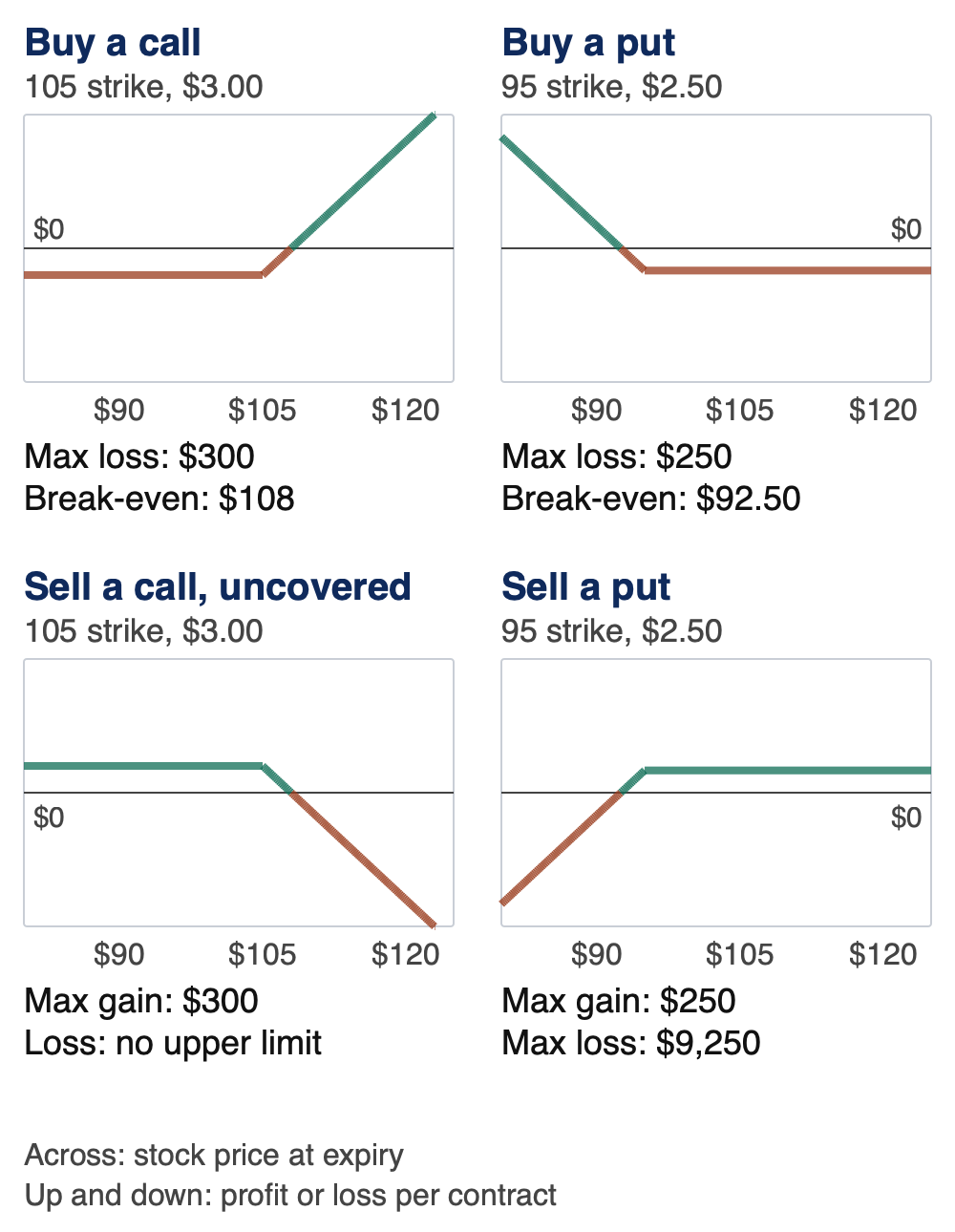 Click to enlarge
Source: Kagels Trading, own diagram.
The table below is per standard 100-share contract, at expiry and before fees. Option quotes are per share, so the formulas multiply by the 100 shares a standard contract covers.
| Position | Most you can make | Most you can lose |
|---|---|---|
| Buy a call (rising stock) | No fixed upper limit | Total premium paid |
| Buy a put (falling stock) | (Strike minus premium per share) × 100 | Total premium paid |
| Sell a call, uncovered (flat or falling stock) | Total premium received | No upper limit |
| Sell a put (flat or rising stock) | Total premium received | (Strike minus premium per share) × 100 |
The strike-based figures apply if the stock falls all the way to zero. In the diagram’s put examples, that is ($95 minus $2.50) × 100, or $9,250 per contract. The table shows the result at expiry, not the position’s value along the way, and the premium is the total for the contract.
The main risks of options trading
The SEC warns that you can lose all of your initial investment, and sometimes more. Which of these two applies depends on your position. These are the risks that matter most for a beginner, based mainly on Chapter X of the OCC’s booklet.
- Total loss of premium: A buyer can lose the entire amount paid in a relatively short time.
- Direction and timing: The stock must move far enough and soon enough. A correct view that comes true after expiry still loses.
- Leverage: One contract moves with 100 shares, so a small account can lose a large share of its money quickly. In the OCC’s example, ten calls lose 100% when the stock stays flat at the strike.
- Assignment: A seller can have to deliver or buy shares at a bad moment, and may hear about it only later.
- Margin calls: Uncovered sellers may have to add substantial collateral when the market moves against them.
- Costs: Fees and the gap between bid and ask weigh more on a small premium than on a stock trade.
- Market access: You can only close a position if there is a market for that contract. Trading can halt, and thin contracts can have poor prices.
Risk management decides how long you can keep learning. Decide your maximum loss before you enter, and size the trade so that a total loss of the premium does not hurt your account. Our guide to risk management in trading covers position sizing and loss limits in general.
Options approval at a US broker: what to expect
You need a brokerage account first, and then a separate approval for options. Our guide to US brokerage accounts explains opening and funding an account, and the difference between cash and margin. FINRA says your firm must approve your account for a specific level of options trading before you can trade.
The options application asks about your goals, experience and money. According to the SEC, you usually provide this personal information:
- Investment objectives, such as capital preservation, income, growth or speculation.
- Trading experience, including years of trading, trades per year and average size.
- Personal finances, including liquid net worth, total net worth, income and employment.
- The options you want to trade.
Answer these questions honestly, because the approval level determines which options strategies you may trade. The firm decides whether options are suitable for you and which trades it permits. It can also refuse. There is no point in overstating your experience to reach a level whose risks you cannot yet carry. Approval does not cap your losses: even bought options can lose one premium after another.
Levels differ from broker to broker. The SEC says firms generally offer five levels, but the number and content vary. Fidelity, for example, describes three tiers on its FAQ page, checked on November 6, 2026:
| Fidelity tier | What it includes |
|---|---|
| Tier 1 | Buying calls and puts, long straddles and strangles, covered calls, cash-covered puts |
| Tier 2 | Tier 1, plus spreads and short-stock-secured puts |
| Tier 3 | Tier 2, plus uncovered calls and puts and short straddles |
The rules also set out what your broker must do. Under FINRA Rule 2360, the firm must give you the OCC’s booklet Characteristics and Risks of Standardized Options before it approves the account or accepts an order. A qualified principal approves the account in writing, and you sign an options agreement within 15 days of approval. For uncovered selling, the firm needs extra procedures, including minimum net equity requirements and a special written risk statement.
What options trading costs, and how it is taxed
Commissions look small, but they are charged per contract and per side. These are published rates for online US stock and ETF options, checked on November 6, 2026. Regulatory fees come on top, and index options can cost more.
| Broker | Online fee per contract | Exercise or assignment |
|---|---|---|
| Charles Schwab | $0.65 | $0 commission |
| Fidelity | $0.65 | $0 commission, no contract fee |
| Robinhood | $0, plus a $0.04 listed fee | Not listed |
This table is no recommendation, and it does not cover platform quality or execution. Fidelity’s full fee schedule waives its fee on online buy-to-close orders for options priced at $0.65 or less. Robinhood’s $0.04 is its listed OCC and options regulatory fee, and its schedule shows no exercise or assignment fee line. Some brokers sell flat plans instead: our Tradier review shows $0.35 per contract on its free plan as of November 1, 2026. Always check the current fee schedule of your own broker before you trade.
The spread can cost more than the commission. In a hypothetical trade where both sides are charged $0.65, buying and selling one contract costs $1.30. If the same option is quoted $2.90 bid and $3.10 ask, and you buy at the ask and sell at the bid, you lose another $20. Against a $0.20 option, which costs $20 in total, that $1.30 fee alone is 6.5%, so cheap options are not automatically cheap to trade.
US tax treatment depends on how the position ends. In IRS Publication 550 (2025), a bought option that you sell or that expires creates a capital gain or loss, based on your holding period. If you exercise a call, its cost adds to the basis of the shares. A seller whose option expires has a short-term capital gain.
Options directly on broad-based indexes follow special rules. Options on the S&P 500 index and similar indexes fall under Section 1256, with gains and losses split 60% long-term and 40% short-term. Contracts you still hold at year-end are generally treated as sold at fair market value, so unrealized gains and losses count for that year. Do not assume this treatment for options on an ETF that tracks such an index, such as SPY.
Puts on shares you already own can also affect your taxes. Buying a put on shares you have held for a year or less can change your holding period. Ask a tax professional about your own situation, because this guide cannot replace tax advice.
A first path for beginners: from learning to one small trade
This order is our editorial suggestion, not a rule, and you can stop at any step. It moves from low-cost learning to a single trade whose maximum loss you know in advance. Nothing here says that options suit you, and it is fine to stay with stocks and ETFs.
- YouLearn the termsCalculate the break-even and maximum loss of a call and a put by hand.
- YouRead the bookletRead the OCC booklet, at least the chapter on principal risks.
- SimulatorPractice on paperFollow trades through to expiry, including time decay.
- BrokerGet approvedApply for the lowest level that allows buying calls and puts.
- YouPlace one small tradeBuy one contract with a limit order and a written exit plan.
Move on only when you can explain the current step in your own words. Editorial suggestion.
A simulator teaches the mechanics, but it does not teach you how a real loss feels. Check that it really covers options: our guide to paper trading on TradingView explains its limits there and names other simulators. Simulated fills can also look better than real fills.
For a first real trade, keep the position simple and its loss limited. Buy a single call or put, not a spread or a sold option, on a heavily traded stock or ETF with a narrow gap between bid and ask. Choose a premium you could lose completely. Use a limit order, which sets the highest price you will pay, instead of a market order.
Write down your exit before you buy. Note the stock price or date at which you will close, in either direction, and do it before the last trading day. Afterward, compare what happened with your plan. Avoid uncovered selling and options that expire within days until you have far more experience.
Later, the wider options market becomes easier to read. Our guide to gamma exposure shows how the hedging of market makers can affect prices. Triple witching explains the quarterly expiry dates. Our guide to options flow shows what large trades on the tape can and cannot tell you, and our options strategies guide compares spreads, straddles and iron condors by maximum gain and loss. All four build on the terms in this guide.
Conclusion: start with the rights, the risks and one contract
Options are a tool with clear rules, not a shortcut to income. A buyer risks the premium and needs the right direction at the right time. A seller earns at most the premium and carries the larger risk, and no options strategy guarantees an income.
Start by working through the numbers, not by placing a trade. Once you can name the break-even, the maximum loss and the assignment risk of a position without looking them up, you are ready to apply for approval. Then keep the first trade small, with a defined risk.
Frequently asked questions about options trading for beginners
How does options trading work?
You buy or sell contracts that fix a price for a stock or other asset until a set date. The buyer pays a premium for the right to buy (call) or sell (put). The seller collects it and takes on the obligation. Most positions can be closed in the market before expiry.
Is options trading good for beginners?
It can be learned, but it is harder and riskier than buying stocks or ETFs. Options lose time value, can expire worthless and use leverage. If you still want to try, start with paper trading, then one small bought option. Selling uncovered options is not a beginner’s trade.
How much money do I need to start trading options?
No single dollar figure applies, because the cost depends on the option and your broker. A bought option costs the premium times 100, plus fees, so a $3.00 option costs $300. Your firm decides on approval and its own account requirements. Use only money you can afford to lose completely, and check the broker’s rules for margin and uncovered positions.
Can you lose more money than you invest with options?
As a buyer, no: your loss on the option itself is limited to the premium and fees. As a seller, yes: an uncovered call has no upper limit on the loss, and a sold put can lose up to (strike minus premium per share) × 100, which is $9,250 in this guide’s example. If an exercise leaves you with shares, you also take on the stock’s risk.
Is one option always 100 shares?
No, but 100 shares is the unit of trading for most stock options. Contract terms can change after events such as certain stock splits or mergers, and index options use a multiplier for a cash amount instead of shares. Check the contract details in your broker’s option chain.
What are the four basic types of option trades?
They are buying a call, buying a put, selling a call and selling a put. Buying a call profits from a rising stock, and buying a put from a falling stock. Sellers collect the premium and take on the obligation, so a sold call gains when the stock stays flat or falls, and a sold put gains when it stays flat or rises.
Do I have to hold an option until it expires?
No: you can usually close it at any time by placing the opposite order. You sell to close a bought option and buy to close a sold one, as long as there is a market for it. Many holders do this because exercising would give up the remaining time value.
Should I buy options or stocks?
That depends on your goal, your experience and how much time you can give it. Stocks have no expiry date, so you can wait out a bad period. Options need less money up front and can hedge a position, but they lose time value and can become worthless on a set date. Learning with stocks first is the simpler route.
Sources
- OCC: Characteristics and Risks of Standardized Options, June 2024, especially Chapters II, VIII, IX and X.
- Options Industry Council (OCC): Options exercise, Options assignment, Weekly options.
- FINRA: Options, Buying and selling options, Rule 2360, including (b)(16) and (b)(23).
- Cboe: DataShop FAQ, symbol information, for non-Friday SPX and SPY expiries.
- SEC, Investor.gov: An Introduction to Options, Opening an Options Account, both updated July 16, 2026.
- IRS: Publication 550 (2025), Investment Income and Expenses.
- Brokers, checked November 6, 2026: Fidelity options FAQ, Robinhood on expiration, exercise and assignment, plus the fee pages linked in the cost table.
This US edition is based on our German edition on kagels-trading.de and has been adapted for US readers.
More Options Trading guides
- Read gamma exposure
Gamma Exposure (GEX): How Dealer Hedging Can Move Prices
What GEX measures, the formula with a worked example, gamma flip, call wall and put wall, data sources with prices, and the limits of the model.
- Read options flow
Options Flow Explained: Sweeps, Blocks and Dark Pool Prints
The OPRA tape, premium, sweeps and blocks, volume against open interest, dark pool prints, a worked example, scanner prices, and what a print cannot tell you.
- Choose a strategy
Options Strategies: How to Choose, With Payoffs and Risks
19 strategies compared by market view, maximum gain, maximum loss and break-even, with worked examples, assignment risk and options approval.