
Margin Call: What It Is, How It Happens and How to Avoid It


Contents
- Margin call in 30 seconds
- What is a margin call?
- How a margin call happens: an example with numbers
- Can you get a margin call on a profitable trade?
- What happens in a margin call?
- Margin calls in a US stock margin account
- Can you owe money after a margin call?
- How to avoid a margin call
- Conclusion: a margin call is a warning sign, not fate
- Frequently asked questions about margin calls
- Sources
- About the author
A margin call almost always comes at the worst moment. It arrives as an email from your broker or a red warning in your platform: your account no longer covers your open positions. For many traders it is the first time an abstract risk turns into a very concrete problem.
Yet a margin call is not a bolt from the blue. It builds up step by step, it follows fixed rules, and good risk management prevents it in almost every case. I have traded since 1980 and have seen margin pressure live in every crash since then. This guide explains how a margin call happens, what your broker does next, whether you can owe money afterwards, and the four rules I use for my own futures positions.
Margin call in 30 seconds
- Margin call: your broker asks you to add money or close positions, because the equity in your account has fallen below the required minimum, the maintenance margin.
- Liquidation: if you do not act, or if the broker does not wait, it closes your positions itself. For retail CFD clients in the EU and UK this must happen at the latest when equity falls to 50 percent of the initial margin.
- Losing more than you deposited: retail CFD clients in the EU and UK have negative balance protection. In a US margin account, and with many brokers outside these rules, you can owe money.
- Avoiding it: small positions, a stop on every trade and low margin use reduce the risk a lot. Gaps and higher margin requirements can still trigger a liquidation.
What is a margin call?
A margin call is a broker’s demand that you deposit more money or close positions, because the equity in your trading account has fallen below the required minimum margin.
The name comes from a time when the broker really picked up the phone. Today the “call” is an email, a push message or a red line in the platform. Many brokers do not send a warning at all: their system starts to liquidate positions as soon as the account breaks the limit.
To understand the mechanism you only need one term: margin. Margin is the collateral you deposit when you trade with leverage, so you move more money than you have in your account. It is not a fee and not your maximum loss. This guide is only about the moment when that collateral is no longer enough; our account equity guide explains margin, free margin and margin level in detail.
The maintenance margin is the minimum equity you must keep in the account to hold an open position.
Who sets that minimum depends on the product. For exchange-traded futures, the clearing house sets the minimum margins; CME calculates them with its SPAN methodology and is rolling out SPAN 2 in phases. For over-the-counter products such as CFDs, the broker sets the margin itself. Either way, your broker can ask for more than the minimum at any time to cover its own risk, and it often does so before elections, central bank meetings or in a crash.
How a margin call happens: an example with numbers
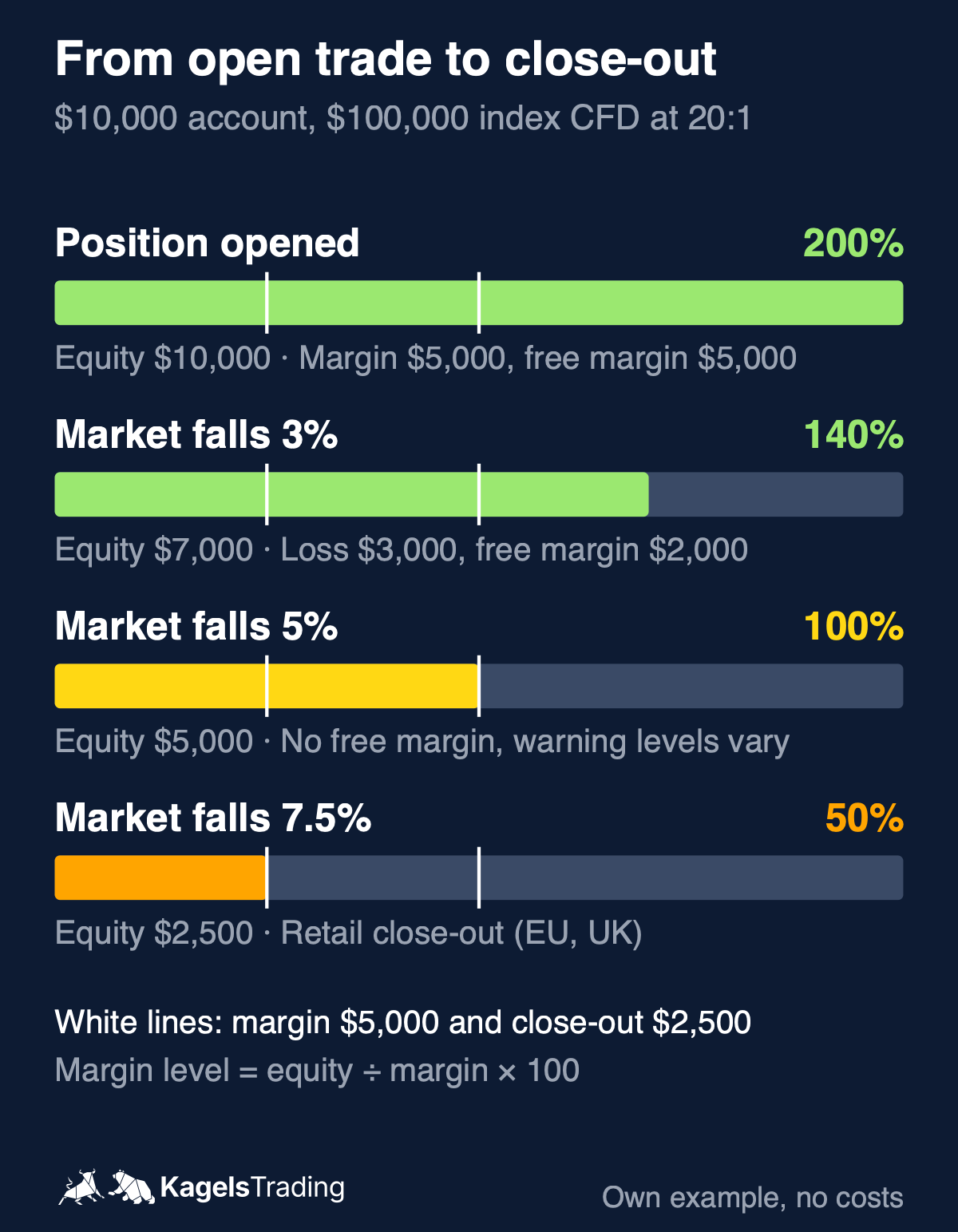
One number shows whether your account is in danger: the margin level. The formula is simple: equity divided by used margin, times 100. The initial margin is the collateral you must deposit to open a leveraged position; the margin level shows how much room is left above it.
 Click to enlarge
Source: ESMA press release of 27 March 2018.
Let us work through a realistic case. You have $10,000 in your account and buy an index CFD worth $100,000 with leverage of 20:1, the maximum for major indices for retail clients in the EU and UK. The broker blocks 5 percent of the position, $5,000, as initial margin. The other $5,000 is free margin.
| Move | Equity | Level | Status |
|---|---|---|---|
| 0% | $10,000 | 200% | healthy |
| −3% | $7,000 | 140% | buffer melts |
| −5% | $5,000 | 100% | no free margin |
| −7.5% | $2,500 | 50% | close-out |
Own example without commission, financing or price gaps. The level at which a broker warns is set by each broker; the 50 percent close-out is the regulatory floor for retail CFD clients in the EU and UK.
Stop for a moment at this result: a 7.5 percent fall in the index has wiped out 75 percent of the account. That is the other side of leverage, and it is the real reason margin calls exist. On top of that, the broker closes at the next available price, so in a fast market or after a gap the remaining equity can be lower than $2,500.
Some positions carry this risk without any leverage ratio on the screen. A typical trigger is an uncovered short option, such as the short call with its theoretically unlimited risk; our options strategies guide explains why brokers ask for high margin on it.
Can you get a margin call on a profitable trade?
Yes, and it confuses many traders. A margin call looks at your whole account, not at a single position. Three typical triggers:
- Other positions pull the account down: your gold trade is in profit, but two losing positions eat up the equity. The margin level does not know single trades.
- The broker raises the margin requirement: in volatile phases margins often rise overnight. Your position is still in profit but suddenly needs more collateral.
- Open profits are not booked profits: a weekend gap or a fast reversal can turn an open profit into a loss within minutes, before you can react.
The same applies to your free margin. Every new position blocks more collateral, so the buffer for all your other trades gets smaller, even if each trade looks fine on its own. That is why I always read the equity of the whole account first.
What happens in a margin call?
The process can run through three stages, but you cannot count on all of them. Warnings and margin calls are not guaranteed; some brokers go straight to liquidation.
- YouWarningThe margin level nears the broker's limit. The platform marks the account and may send a message. You can still add money or reduce positions.
- You and your brokerMargin callThe limit is reached. The clock is running, often for less time than you think: some brokers give hours, many none.
- Your brokerLiquidationThe broker closes positions until the margin is covered again. Its system decides which position goes first, not you.
A dark line marks the point where the decision passes from you to your broker. Many brokers skip the first two stages and liquidate straight away.
A liquidation is the automatic closing of open positions by the broker once the margin in the account is no longer sufficient.
One point is in almost every broker agreement and is still overlooked all the time: your broker does not have to warn you. Interactive Brokers, for example, says in the customer agreement of its US company that it generally will not issue margin calls and can liquidate positions without contacting you when an account breaks its margin requirement. Watching your own account is 100 percent your responsibility; our Interactive Brokers review describes its account types.
Futures add one more feature: positions are settled every day. This is called mark to market. Losses leave your account every evening as variation margin, not only when you close the position. So a margin call can hit you even if you wanted to sit out the move; our micro futures guide shows how smaller contracts keep this risk in proportion.
The Flash Crash of 6 May 2010 showed how fast it can get serious. According to the joint report of the SEC and the CFTC, the major US equity indices, already down more than 4 percent on the day, fell another 5 to 6 percent within minutes and then recovered almost as quickly. Anyone trading with a heavily used margin that afternoon risked being closed out near the low, and the recovery happened without them. Our stock market crash guide puts the large crashes in context.
Margin calls in a US stock margin account
In a US margin account the margin call follows rules set by the Federal Reserve and FINRA. Under Regulation T you may borrow up to 50 percent of the purchase price of margin securities. FINRA Rule 4210 then requires equity of at least 25 percent of the market value, and many brokers ask for more.
A short example shows where the line is. You put in $10,000 and borrow $10,000 to buy stocks worth $20,000. Your loan stays $10,000, so at a market value of about $13,333 your equity of $3,333 is exactly 25 percent. Below that your broker asks for money or sells. Our brokerage accounts guide explains the difference between a cash account and a margin account.
The SEC’s investor site is very clear about the broker’s rights. Your broker can sell your securities without contacting you first, it can choose which ones to sell, and you are not entitled to an extension of time on a margin call. You remain responsible for repaying the loan, so with margin you can lose more than 100 percent of your money.
Can you owe money after a margin call?
For retail CFD clients in the EU and UK the answer is no, thanks to negative balance protection. Since 2018 in the EU and permanently since August 2019 in the UK, three rules protect retail clients:
- Negative balance protection: you cannot lose more than the money in your CFD account. If a price gap pushes the account below zero, the broker carries the difference.
- 50 percent close-out: once your equity falls to half of the initial margin of your open positions, the broker must close one or more of them.
- Leverage limits: the maximum leverage depends on the underlying, so the margin spiral cannot get out of control as easily.
| Underlying | Limit | Margin |
|---|---|---|
| Major currency pairs | 30:1 | 3.33% |
| Other currency pairs, gold, major indices | 20:1 | 5% |
| Other commodities, other indices | 10:1 | 10% |
| Individual shares, other values | 5:1 | 20% |
| Cryptocurrencies | 2:1 | 50% |
Retail limits under ESMA’s 2018 measures, now applied through national rules such as BaFin’s in Germany. The UK applies the same tiers in COBS 22.5.11R, with a higher limit for CFDs on certain government bonds, and has banned the sale of crypto derivatives to retail clients since 6 January 2021.
Germany went further than the EU, in two steps. BaFin banned CFDs with an obligation to make additional payments for retail clients with a general administrative act of 8 May 2017 and made the EU close-out and leverage rules permanent with its act of 23 July 2019, in force from 1 August 2019. Since 1 January 2023 a firm may only sell futures to retail clients in Germany if it contractually excludes additional payments; exceptions apply to hedging and to closing positions opened before that date.
One gap remains: these rules only protect retail clients of regulated brokers. If you opt to be treated as a professional client or trade with an offshore broker, you can lose the whole protection, including negative balance protection. Under the client agreement of PU Prime LLC, for example, a negative balance may be credited only at the company’s discretion, and PU Prime publishes a stop-out at a 20 percent margin level for the accounts in our review (terms checked in October 2026); our PU Prime review shows what that means for your account.
Copy trading accounts with extra leverage are a sharp example. On a 12x account from a broker outside the EU, a fall of about 8.3 percent in the copied strategy is enough to use up an amount equal to your deposit. We recalculated this with the Amplify account in our CopyX review.
In a US margin account there is no such protection. If the broker sells your securities after a gap and the proceeds do not repay the loan, you still have to repay the rest. That is why the margin loan is the riskiest part of a stock margin account.
How to avoid a margin call
In more than 45 years in the markets I have never had a margin call. That is not talent but the result of four boring rules I do not negotiate on. They reduce the risk; they cannot rule it out.
- Position size before anything else: risk only 1 to 2 percent of your account per trade, measured from entry to stop. That limits the loss per trade, but not the margin a large position blocks, so check both numbers. Our position sizing guide has the formulas and a calculator.
- Every position has a stop: a stop-loss order limits the loss before the margin comes into play. The honest limit: in a price gap the stop can be filled worse than set. It is a seat belt, not an airbag. Our ATR indicator guide shows how to set the stop by the market’s normal range.
- Keep margin use low: keep the total used margin of all open positions at no more than 30 to 50 percent of your account equity and leave the rest as a buffer. Free margin is not wasted return but your reserve for the day the market goes crazy.
- Take volatile phases seriously: before central bank meetings, elections and over the weekend, margin requirements often jump. Reducing positions beforehand is cheaper than watching your broker liquidate them afterwards.
The common thread is consistent money management. You steer your risk actively instead of letting the broker decide as the last resort. At its core, a margin call is exactly that: handing your risk management to someone who does not care about your account. Our risk management guide covers the rest of the plan.
Conclusion: a margin call is a warning sign, not fate
A margin call is the last stage of a problem that started much earlier: positions that are too big for too little capital. The mechanism is transparent, the thresholds are known, and in the EU and UK the retail rules take the worst case, a debt beyond your deposit, off your CFD account.
What no rule takes away is the forced close at the worst possible moment. That is why the best answer to a margin call is never to let it happen: small positions, fixed stops, low margin use. These habits reduce the risk a lot, but gaps and higher margin requirements can still trigger a liquidation, so keep watching your account.
Frequently asked questions about margin calls
What happens in a margin call?
Your broker asks you to add money or close positions. If you do not act in time, it closes positions itself until the required margin is covered again. Many brokers do not have to warn you first and liquidate automatically.
Does a margin call mean I owe money?
Usually not, if you are a retail CFD client in the EU or UK. Negative balance protection means you cannot lose more than the money in your CFD account. In a US margin account, as a professional client or with an offshore broker, a negative balance can become a real debt.
Can I get a margin call on a profitable trade?
Yes, because a margin call looks at the whole account, not the single trade. Losses on other positions, a higher margin requirement from your broker or a weekend gap can push the margin level below the limit even while one position is in profit.
At what margin level does a margin call happen?
Each broker sets its own warning level, often around 100 percent. For retail CFD clients in the EU and UK the close-out is fixed by regulation: it must happen at the latest when equity falls to 50 percent of the initial margin. Some offshore brokers close only at a lower level, for example 20 percent.
Can you get a margin call on stocks?
Not if you buy stocks with your own money; then you can lose at most what you paid. A margin call is possible once you buy stocks on credit in a margin account, where FINRA requires equity of at least 25 percent, or trade them with leverage through derivatives such as CFDs.
How do I calculate the margin level?
Divide your equity by the used margin and multiply by 100. With equity of $7,000 and used margin of $5,000 your margin level is 140 percent. The higher the number, the larger your buffer; at 100 percent your free margin is zero, and at 50 percent retail CFD brokers in the EU and UK must close positions.
Sources
All rules were checked against primary sources on 12 November 2026. The worked examples are our own and leave out commission, financing and gaps. Check your broker’s terms for its own margin levels.
- Retail CFD rules: ESMA press release of 27 March 2018, FCA permanent CFD restrictions of 1 July 2019, BaFin general administrative act on CFDs (2019).
- US margin accounts: Investor.gov: Understanding Margin Accounts, FINRA Rule 4210.
- Germany: BaFin general administrative act on CFDs (2017), BaFin general administrative act on futures (2022, German).
- UK: FCA policy statement PS19/18, FCA ban on crypto derivatives for retail clients.
- Futures and brokers: CME Group: mark to market, CME Group: SPAN methodology, Interactive Brokers customer agreement (US), Interactive Brokers glossary: margin warning.
- Flash Crash: SEC and CFTC report on the market events of May 6, 2010.
This article is educational information, not investment advice. Leveraged products can lose money quickly.
This English edition is based on our German edition on kagels-trading.de and has been adapted for international readers.
More Risk Management guides
- Manage your trading risk
Risk Management in Trading: Rules, Math, Psychology
The 1% rule, stops, risk/reward, daily loss limits, leverage caps and the psychology of losing streaks, with the math behind each rule.
- Understand a stock market crash
Stock Market Crash: Causes, Patterns and Lessons
What caused 1929, 1987, 2000, 2008 and 2020, how deep the S&P 500 fell, how long recovery took, and the lessons for your own risk.
- Calculate your position size
Position Sizing in Trading: Formula, Calculator, Examples
The formula, a free calculator, the 1% rule explained correctly, and examples for stocks, forex and futures.
- Read your account equity
Account Equity vs Balance: Margin and Free Margin Explained
Equity against balance, margin, free margin and margin level, with a worked example and the close-out rules for cash, US margin and CFD accounts.
- Size your risk per trade
Kelly Criterion for Traders: Formula, Calculator, Risks
The Kelly formula for traders with a calculator, and a simulation of why full Kelly is far too much.
- Check a profit factor
Profit Factor in Trading: Formula, Calculator, Good Values
The formula, a free calculator, what a good value is, and why 61 trades showed 2.22 while 356 trades showed 1.37.
- Check if you have an edge
Trading Edge: How to Calculate, Test and Keep One
The expectancy formula, the win rate each reward-to-risk ratio needs, and the tests that separate a real edge from luck.
- Avoid costly mistakes
Trading Mistakes: 13 Costly Errors and How to Avoid Them
The 13 mistakes that cost accounts the most, the biases behind them, overtrading and revenge trading, and a checklist for your next trade.
- Keep a trading journal
Trading Journal: How to Record and Review Your Trades
What to write before and after each trade, a completed example with a win and a loss, a weekly review and a template to copy.
- Choose a journal
Best Trading Journal Software 2026: 6 Tools Compared
Six journals compared on price, free plans, refunds, automatic broker sync, costs and export, with a decision guide.
- Check TradeZella
TradeZella Review 2026: Pricing, Features and Limitations
The three plans since July 2026, what Essential leaves out, the no-refund terms, imports, export and what users report.
- Check TraderSync
TraderSync Review 2026: Pricing, Broker Sync and Limits
Plans and dated prices, broker imports and autosync, Market Replay, Cypher and the no-refund policy.
- Check Tradervue
Tradervue Review 2026: Imports, Reports and Costs
Silver or Gold, why net P&L needs Gold, few automatic imports, US-only stocks, the no-refund sign-up terms and how to cancel.
- Check Edgewonk
Edgewonk Review 2026: Features, Costs and Limitations
One feature set billed monthly or yearly, the refund period, MetaTrader auto sync, the psychology tools and our own test journal.
- Check TradesViz
TradesViz Review 2026: Pricing, Broker Sync, Terms
The free stock plan, Pro and Platinum prices checked November 10, 2026, which US brokers sync automatically, the no-refund terms and user reviews.