
Day Trading for Beginners: Markets, Risk and Practice


Contents
- Day trading in 30 seconds
- What is day trading?
- Day trading vs swing trading vs scalping
- Which markets suit day trading?
- A day trading session from start to finish
- Costs, execution and how much capital you need
- US account rules: what changed in 2026
- What the studies say about day trading results
- How to start: simulation, plan and journal
- Choosing a first day trading strategy
- Frequently asked questions about day trading
- About the author
Day trading means opening and closing a position within the same trading session. A day trader holds stocks, ETFs, futures or currencies for minutes or hours and ends the day flat, without an open position overnight. This guide explains the markets, the session, the costs, the current US account rules and what research says about results, and it ends with a practice path that costs nothing. It is educational, not investment advice, and follows our editorial policy.
Day trading in 30 seconds
- Same-day round trips: you open and close within one session, so there is no overnight gap risk, but you need to be at the screen while you trade.
- Costs and speed decide more than in slower styles: spread, commission and slippage take a bigger share of a small intraday move.
- US rules changed in 2026: FINRA replaced the pattern day trader rule and its $25,000 minimum with intraday margin standards on June 4, 2026; brokers may phase them in until October 20, 2027.
- Most day traders in large studies lost money: the samples come from Taiwan, Brazil and European CFD accounts, each with its own period and limits.
- Practise first: a simulated account, a written plan and a trading journal come before any real money.
What is day trading?
Day trading is the buying and selling of the same instrument within one trading session, with every position closed before the session ends.
The holding period is what separates it from other styles. A day trader wants to profit from intraday price moves and accepts that each move is small. Because nothing stays open overnight, a surprise after the close cannot hit the position; the price for that is screen time during the session and many more decisions per week.
A trade is not a day trade because it is short. It is a day trade because entry and exit fall on the same trading day. A position bought at 3:50 p.m. and sold the next morning is an overnight trade, even if it lasted only a few hours.
Day trading vs swing trading vs scalping
The three styles differ in holding time, chart timeframe and the time you need. Pick the one that fits your daily schedule first; a style you have no time for produces mistakes.
| Style | Typical holding time | Typical charts | Screen time | Main risk |
|---|---|---|---|---|
| Scalping | Seconds to a few minutes | Tick, 1-minute | Constant during trading | Costs and execution speed |
| Day trading | Minutes to hours, closed the same day | 1 to 15-minute | Fixed blocks during the session | Costs, overtrading |
| Swing trading | Days to a few weeks | Hourly, daily | Short daily check | Overnight and weekend gaps |
Scalping is day trading at the shortest end. Scalpers aim for very small moves many times a day, so the spread and commission per trade weigh even more. Most beginners who want a short-term style but have a job are closer to swing trading, which needs a short daily check rather than hours at the screen.
Which markets suit day trading?
Liquid markets with tight spreads and clear session times suit day trading best. The instrument also decides the account type, the leverage and which rules apply to you.
| Market | Session (US view) | Leverage | US retail notes |
|---|---|---|---|
| Stocks and ETFs | 9:30 a.m. to 4:00 p.m. ET, plus extended hours | Margin account only | FINRA margin rules apply; cash accounts settle T+1 |
| Index futures (e.g. MES, ES) | Almost 24 hours, Sunday to Friday | Built in, set by exchange and broker | CFTC/NFA regulated futures account, not FINRA securities margin |
| Forex (spot) | 24 hours, five days a week | Built in | Offered by regulated retail forex dealers |
| CFDs | Broker hours | Built in | Generally not available to US retail traders |
Stocks and ETFs are the easiest to read, but price per share matters. A large ETF such as SPY trades with a very tight spread in the regular session. The US cash session runs from 9:30 a.m. to 4:00 p.m. ET, as listed on the NYSE hours and calendars page. Trading before and after those hours has thinner liquidity, explained in our guide to pre-market and after-hours trading.
Futures give you leverage in one contract and nearly round-the-clock hours. The smaller micro contracts let you size more finely: one point of the Micro E-mini S&P 500 (MES) is worth $5, and our guide to micro futures does the tick math. The exact contract hours, including the daily break, are in futures market hours.
Forex has no single opening bell, and CFDs are an offshore question for Americans. Currency volume moves with the Asian, London and New York sessions, mapped in our guide to trading sessions. CFDs are widely offered to retail traders in Europe and elsewhere; in the United States, a CFD on a single stock is a security-based swap, and federal law limits those for retail clients to registered exchanges, where none is listed (15 U.S.C. 78f(l)).
A day trading session from start to finish
 Click to enlarge
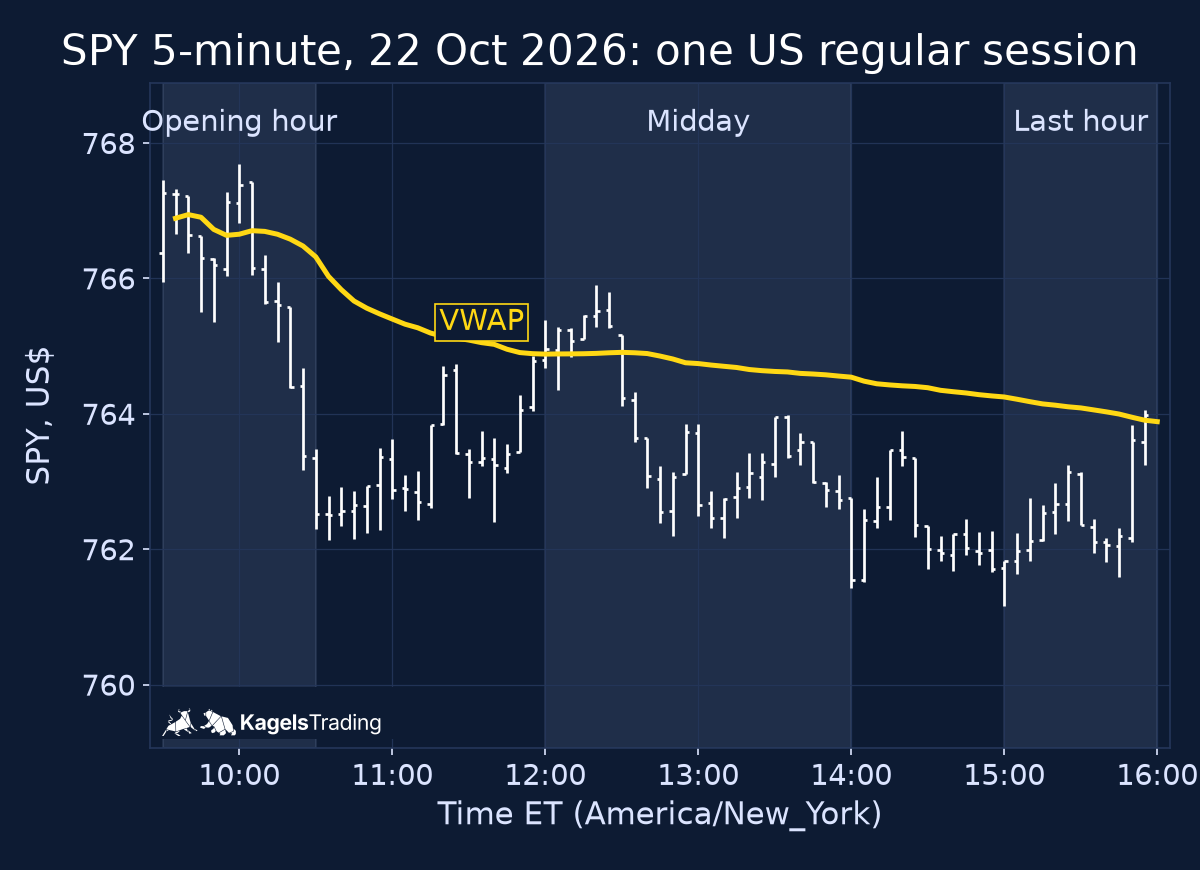
A trading day has phases, and each phase behaves differently. The chart shows one historical SPY session with three labels. They are not rules; they help you plan when you trade and when you only watch.
- Before the open: check the economic calendar, overnight news and your levels. Decide which instrument and which setup you will trade today, and your daily loss limit.
- Opening hour (9:30 to 10:30 a.m. ET): volume and volatility are usually highest, ranges form and spreads can widen in the first minutes. Many intraday methods, such as the opening range breakout, are built around this phase.
- Midday: volume often thins and moves can turn choppy. Many day traders reduce activity or stop.
- Last hour: volume tends to pick up again into the closing auction. Every open position must be closed before the session ends.
- After the close: record every trade in your journal, including the trades you skipped.
The yellow line is the session VWAP. VWAP is the volume-weighted average price since the open; many intraday traders use it as a reference for who is in control. How it is calculated and set up is in our guide to the VWAP indicator.
Costs, execution and how much capital you need
There is no single minimum that makes day trading safe; the number comes from your position size, costs and a buffer. Work it out from the risk per trade, not from a headline figure.
Start with the risk you accept on one trade. Many traders cap it at a small share of the account, for example 0.5%. On a $10,000 account that is $50. With a stop $0.50 below the entry, the size is 100 shares, before costs. Our guide to position sizing has the formula and a calculator.
Then check what that size costs in buying power. At a share price near $765, which is where SPY traded in late October 2026, 100 shares are worth about $76,500. That is far more than a $10,000 account holds, so the trade would need margin or a smaller size. In a cash account, the same $10,000 buys only 13 shares, and the risk at the $0.50 stop shrinks to $6.50. Price per unit, stop distance and account type together decide what is possible.
Costs come off every round trip. Commission, the bid-ask spread and slippage at the stop are small per share but large compared with a small target. A useful habit is to write down the expected cost before each trade and compare it with the planned risk. Our guide to risk management adds daily loss limits and the maths of losing streaks.
US account rules: what changed in 2026
This section applies to US brokerage accounts; rules in other countries differ. It describes the rules as of 29 October 2026 and is not legal advice. Check your own broker’s current terms.
The pattern day trader rule has been replaced by intraday margin standards. With Regulatory Notice 26-10, published on April 20, 2026, FINRA replaced the old day trading margin requirements, including the day-trade count, the pattern day trader label and the $25,000 minimum equity. The SEC approved the rule change in Release No. 34-105226. The new standards took effect on June 4, 2026.
Your broker may still use the old rule for a while. Firms that need more time may phase in the change until October 20, 2027. FINRA’s investor page on the new intraday margin requirements says your firm might continue under the old requirements during the transition. Ask your broker which framework applies to your account.
What the new standard measures. Firms now check whether your margin account’s equity covers your positions during the day, not only at the close. If a trade creates an intraday margin deficit, it must be met as promptly as possible. A customer who repeatedly fails to meet deficits by the fifth business day can face a 90-day restriction on trading with borrowed money, according to the notice.
Margin still has a floor, and firms can ask for more. You need at least $2,000 in equity to trade on margin, and firms can set higher house requirements, as FINRA explains in Frequent Intraday Trading: Understanding the Basics.
Cash accounts have their own limits. In a cash account you pay in full; buying and selling before paying is free-riding. If you buy with proceeds that have not yet settled and sell that position before those proceeds settle, it is a good faith violation. US stock trades settle one business day after the trade (T+1).
Futures accounts follow a different framework. FINRA’s securities margin rule does not set the margin for a futures account; the exchange sets minimum margins and your futures broker may ask for more. Do not mix the rules of cash, margin and futures accounts when you plan.
This guide does not explain workarounds. It does not show how to avoid account rules. They exist because intraday leverage can create losses larger than the cash you put in.
What the studies say about day trading results
Large studies found that most day traders lost money, but each covers one market and period. Read the sample before you read the percentage.
| Study | Market and period | Sample | Main finding |
|---|---|---|---|
| Barber, Lee, Liu, Odean (2004 working paper) | Taiwan Stock Exchange, 1995 to 1999 | All day trading records | In a typical six-month period, more than eight out of ten day traders lost money |
| Barber, Lee, Liu, Odean (2011 version, later in the Journal of Financial Markets) | Taiwan, 1992 to 2006 | Day traders ranked by past returns | The 500 top-ranked traders earned 28.1 basis points per day after fees the next year; the bottom-ranked lost 34.2 |
| Chague, De-Losso, Giovannetti (revised June 2020) | Brazilian equity index futures, starters 2013 to 2015 | 19,646 new day traders; 1,551 traded on more than 300 days | 97% of those 1,551 lost money; 0.5% earned more than a bank teller’s starting pay |
| ESMA (2018) | EU retail CFD accounts | Provider data | 74 to 89% of retail accounts typically lost money |
The studies point in the same direction, with limits. The Taiwan working paper covers one exchange in the late 1990s. The skill study shows that a small group did better persistently, so losses are common but not universal. The Brazilian paper, Day trading for a living?, studies one futures market in a difficult period; an earlier working-paper version reported 0.4% instead of 0.5%. The ESMA figure is about leveraged CFDs, not stocks.
None of these numbers is today’s loss rate for all traders. They do show that costs, leverage and frequent decisions make intraday trading demanding. A plan that assumes you will be in the profitable minority needs evidence from your own journal, not hope.
How to start: simulation, plan and journal
Start without money at risk and move on only when you meet the conditions of each step. There is no fixed number of weeks; judge by rule discipline and records.
- No money at riskUnderstandLearn the session, order types, spreads and the account rules that apply to you.
- No money at riskChoose an approachOne market, one timeframe, one written setup with entry, stop, exit and no-trade rules.
- Simulated moneyPractiseTrade the plan in a paper account during the session. Record every trade and every skipped setup.
- Simulated, then small real sizeLimit riskFixed risk per trade, a daily loss limit and a stop on every position.
- All stagesReviewWeekly review: did you follow the rules, what did costs take, what changes, if anything.
A dark line marks where the kind of money changes. Paper results leave out real fills and real emotions, so a small live test comes before any larger size.
A paper account lets you practise the routine at no cost. Our guide to TradingView paper trading shows how to set one up and where simulated fills differ from real ones. Use it in the same hours and with the same position size you would use with real money.
A written plan and a journal turn practice into evidence. Write down the setup, the entry, the stop, the exit and the conditions under which you skip a trade. Then log each trade with our trading journal routine. Test the same rules on historical charts with the checks in our guide to backtesting. The general learning order for any style, not only day trading, is in our guide to learning to trade.
Choosing a first day trading strategy
Choose one approach that fits the market phase you can recognise and the hours you can trade. Three families cover most beginner questions: the opening range breakout, the trend pullback and range trading, often with VWAP as a filter.
Our comparison guide puts them side by side. Day trading strategies compares their entry, stop, exit and no-trade conditions and applies all three to the same five SPY sessions, with a win, a loss and a skipped trade. Start with one of them, not all three.
Frequently asked questions about day trading
What is day trading in simple terms?
Day trading means buying and selling within the same trading day. You close every position before the session ends, so you hold nothing overnight.
Do I still need $25,000 to day trade in the US?
Not under FINRA’s new rule, but check your broker. The $25,000 pattern day trader minimum was replaced on June 4, 2026. Brokers may keep the old rule during the phase-in until October 20, 2027, and margin trading still needs at least $2,000 in equity.
Can I day trade in a cash account?
Yes, but only with settled money. Selling a position bought with unsettled funds before those funds settle is a good faith violation, and buying and selling before paying is free-riding. US stock trades settle on T+1.
Is day trading better than swing trading for beginners?
For most beginners with a job, no. Day trading needs screen time during the session and costs weigh more on small moves. Swing trading fits a short daily check, but it carries overnight gaps.
How much money do day traders make?
There is no typical income, and large studies found that most lost money. Results depend on costs, risk and discipline; a small group did better persistently in the Taiwan data. Treat any income claim without audited records with caution.
What is the best time to day trade?
Many day traders focus on the opening hour. In US stocks, volume and volatility are usually highest after 9:30 a.m. ET and pick up again in the last hour. Midday often turns quieter.