
Stock Exchange Hours Worldwide: Opening Times in ET


Contents
- Stock exchange hours in 30 seconds
- The global trading day in New York time
- Stock exchange hours in the Americas
- Stock exchange hours in Europe
- Stock exchange hours in Asia-Pacific
- Daylight saving time: why the hours seem to move
- Exchange holidays and special days
- Conclusion: know the hours of the market you trade
- Frequently asked questions about stock exchange hours
- About the author
Stock exchange hours are the times when an exchange runs its regular trading session for shares and other listed securities. They differ by exchange and time zone, from the New York Stock Exchange to London, Frankfurt, Tokyo and Hong Kong. Orders are normally executed only in these hours, so anyone who trades internationally needs to know them.
This guide lists the regular hours of the major stock exchanges by region, in local time and in New York time. We checked every session against the exchange’s own website on 7 October 2026. I have traded on international markets since 1980, and the timing of these sessions shapes my working day. This article follows our editorial policy.
Stock exchange hours in 30 seconds
- New York: NYSE and Nasdaq trade from 9:30 a.m. to 4:00 p.m. ET, Monday to Friday. Toronto keeps the same hours.
- Europe: London trades from 8:00 a.m. to 4:30 p.m. local time; Euronext, Xetra and SIX from 9:00 a.m. to 5:30 p.m. central European time. In New York time, all of them run from 3:00 to 11:30 a.m. ET for most of the year.
- Asia: Tokyo trades from 9:00 a.m. to 3:30 p.m., Hong Kong from 9:30 a.m. to 4:00 p.m. local time, both with a lunch break. Seen from New York, Asia trades in the evening and at night.
- First and last: of the nine markets in our chart, Sydney opens first (6:00 p.m. ET the evening before, in US winter) and New York closes last.
- Daylight saving: Asian exchanges do not change their clocks, so their hours move by one hour in New York time when the US switches. Europe and North America shift together, apart from a few weeks in March and October.
The global trading day in New York time
The trading day moves around the globe from east to west. Sydney and Tokyo start the evening before in New York, Hong Kong, Shanghai and Singapore follow, India bridges into the European morning, and London and Frankfurt hand over to New York at 9:30 a.m. ET.
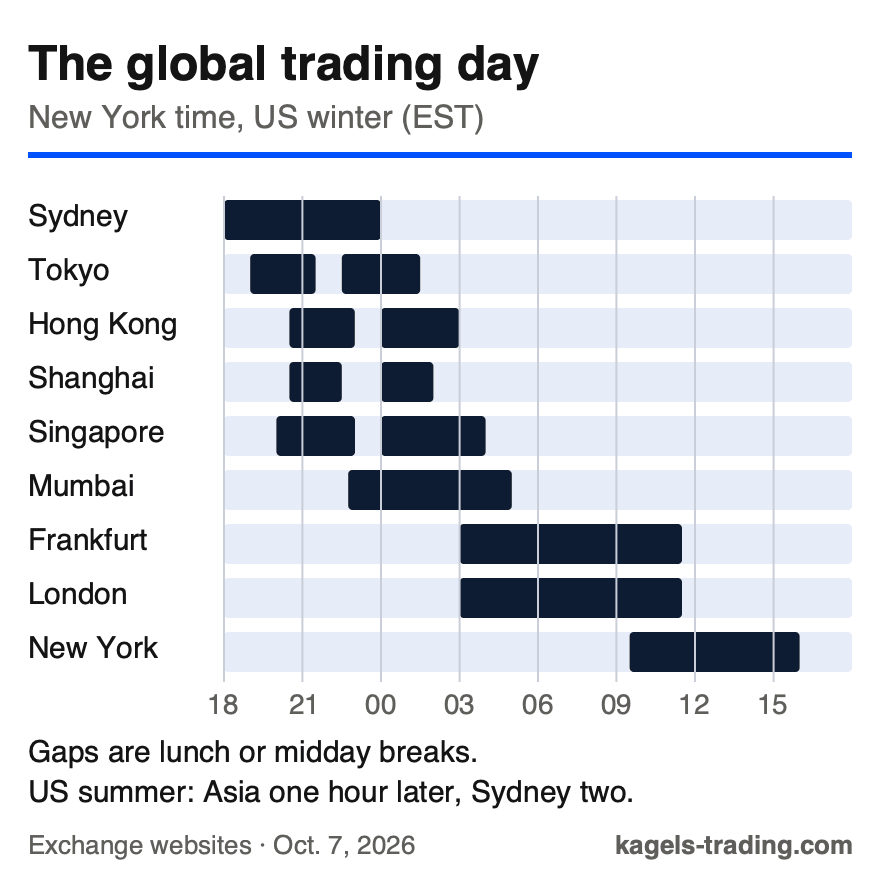 Click to enlarge
Source: Kagels Trading, from the exchanges' own websites, as of 7 October 2026.
The table converts the regular hours into New York time for both halves of the year. US winter (EST) runs from early November to early March, US summer (EDT) from early March to early November. For each Asian trading date, the session opens on the previous evening in New York and closes after midnight.
| Exchange | ET, US winter | ET, US summer |
|---|---|---|
| NYSE, Nasdaq | 9:30–16:00 | 9:30–16:00 |
| Toronto (TSX) | 9:30–16:00 | 9:30–16:00 |
| London (LSE) | 3:00–11:30 | 3:00–11:30 |
| Euronext, Xetra, SIX | 3:00–11:30 | 3:00–11:30 |
| Tokyo, Korea | 19:00–1:30 | 20:00–2:30 |
| Hong Kong | 20:30–3:00 | 21:30–4:00 |
| Shanghai, Shenzhen | 20:30–2:00 | 21:30–3:00 |
| Singapore | 20:00–4:00 | 21:00–5:00 |
| Taiwan | 20:00–0:30 | 21:00–1:30 |
| India (NSE) | 22:45–5:00 | 23:45–6:00 |
| Sydney (ASX) | 18:00–0:00 | 20:00–2:00 |
Two exceptions apply in the weeks when only one side has changed its clocks. Between the US switch on 8 March 2026 and Europe’s on 29 March, and between 25 October and 1 November 2026, European exchanges run from 4:00 a.m. to 12:30 p.m. ET. The ASX runs from 7:00 p.m. to 1:00 a.m. ET from the US switch in March until Australia’s on the first Sunday of April, and from the first Sunday of October until the US switch in November.
Sydney is the special case, because Australia changes its clocks in the opposite direction. When it is summer in Australia, it is winter in New York, so the two shifts add up to two hours. In the transition weeks described above, the ASX runs from 7:00 p.m. to 1:00 a.m. ET.
Stock exchange hours in the Americas
The major North American exchanges trade from 9:30 a.m. to 4:00 p.m. Eastern Time without a lunch break. The tables show the core session of each exchange; some closing times include a closing auction.
| Exchange | Local hours | Lunch break |
|---|---|---|
| NYSE (New York) | 9:30–16:00 ET | none |
| Nasdaq (New York) | 9:30–16:00 ET | none |
| TSX (Toronto) | 9:30–16:00 ET | none |
| B3 (São Paulo) | 10:00–16:55 | none |
The NYSE ends its day with a closing auction at 4:00 p.m. ET. From 3:50 p.m. the exchange publishes the imbalance between buy and sell orders for the close, according to the NYSE’s hours and calendars page. Nasdaq and NYSE Arca also run pre-market and after-hours sessions; those hours and their risks are in our guide to pre-market and after-hours trading.
The TSX in Toronto keeps the same core hours as New York. Its trading hours page adds a pre-open phase from 7:00 a.m. and an extended trading session from 4:15 to 5:00 p.m. at the last sale price.
Brazil’s B3 trades shares from 10:00 a.m. to 4:55 p.m. in São Paulo, followed by a closing call until 5:00 p.m. That is what the B3 trading hours page shows as of 7 October 2026. In New York time, B3 currently closes at 3:55 p.m. ET, shortly before Wall Street. Brazil does not use daylight saving time. Whether B3 changes its hours after the US clock change on 1 November was not stated on the page; check it before you rely on these times. That is also why B3 is missing from the New York time table.
Stock exchange hours in Europe
The major European exchanges trade continuously from morning to late afternoon, without a lunch break. Most of them end the day with a closing auction, and their core sessions line up across the time zones.
| Exchange | Local hours | Lunch break |
|---|---|---|
| London (LSE) | 8:00–16:30 | none |
| Euronext (Paris, Amsterdam) | 9:00–17:30 | none |
| Xetra (Frankfurt) | 9:00–17:30 | none |
| SIX Swiss Exchange | 9:00–17:30 | none |
The London Stock Exchange runs regular trading from 8:00 a.m. to 4:30 p.m. London time. An opening auction runs from 7:50 a.m., and a closing auction from 4:30 p.m., according to the LSE’s trading parameters (version 10.0, July 2026). In New York time, London opens at 3:00 a.m. ET for most of the year.
Euronext, Xetra and SIX all trade from 9:00 a.m. to 5:30 p.m. central European time. London is one hour behind, so the headline session windows of the four markets are aligned. At SIX, shares enter the closing auction at 5:20 p.m., according to its trading hours. Xetra has also run a retail service with early trading from 8:00 a.m. and late trading until 10:00 p.m. since 1 December 2025, according to a Deutsche Börse circular; the main session remains 9:00 a.m. to 5:30 p.m.
Europe and New York overlap from 9:30 to 11:30 a.m. ET for most of the year. In the transition weeks the overlap lasts until 12:30 p.m. ET. How the forex sessions in London and New York overlap is explained in our guide to trading sessions.
Stock exchange hours in Asia-Pacific
Many Asian exchanges split the day into a morning and an afternoon session with a lunch break in between. None of the Asian markets here uses daylight saving time, and the ASX opening time is approximate because of a randomised start.
| Exchange | Local hours | Lunch break |
|---|---|---|
| Tokyo (TSE) | 9:00–15:30 | 11:30–12:30 |
| Hong Kong (HKEX) | 9:30–16:00 | 12:00–13:00 |
| Shanghai, Shenzhen | 9:30–15:00 | 11:30–13:00 |
| Singapore (SGX) | 9:00–17:00 | 12:00–13:00 |
| Korea (KRX) | 9:00–15:30 | none |
| Taiwan (TWSE) | 9:00–13:30 | none |
| India (NSE) | 9:15–15:30 | none |
| Sydney (ASX) | about 10:00–16:00 | none |
Tokyo extended its afternoon session by 30 minutes in November 2024 and now closes at 3:30 p.m. The Japan Exchange Group lists a morning session from 9:00 to 11:30 a.m. and an afternoon session from 12:30 to 3:30 p.m. Continuous trading ends at 3:25 p.m.; the last five minutes collect orders for the closing auction at 3:30 p.m., according to JPX’s trading methods.
Shanghai and Shenzhen run continuous trading until 2:57 p.m. and end with a closing call auction until 3:00 p.m. The morning session runs from 9:30 to 11:30 a.m., the afternoon session from 1:00 p.m., according to the Shanghai Stock Exchange and the Shenzhen Stock Exchange. With 3 hours and 57 minutes of continuous trading, they have the shortest sessions of the major markets in this guide.
Hong Kong and Singapore pause continuous trading from noon to 1:00 p.m. For ordinary shares, Hong Kong trades from 9:30 a.m. to 4:00 p.m., followed by a closing auction, according to HKEX. The Singapore Exchange trades from 9:00 a.m. to 5:00 p.m. During its midday break, orders can still be entered for an auction that opens the afternoon, under its rulebook.
Korea, Taiwan and India trade without a lunch break. The Korea Exchange runs from 9:00 a.m. to 3:30 p.m., according to its trading guide, Taiwan from 9:00 a.m. to 1:30 p.m., with a closing auction from 1:25 p.m., according to the TWSE. India’s NSE runs its normal market from 9:15 a.m. to 3:30 p.m. India Standard Time, according to its market timings, and reaches into the European morning.
The ASX in Sydney trades from 10:00 a.m. to 4:00 p.m. Sydney time. Normal trading starts at a randomised moment around 9:59:45 a.m. after the opening auction, according to the ASX. Australia uses daylight saving time in the southern summer, the opposite season to Europe and North America.
Daylight saving time: why the hours seem to move
Clock changes usually alter the gap between the time zones rather than an exchange’s local session. Exchanges can still change their schedules, as the B3 example shows. Three groups of countries need to be kept apart by their clock rules:
- Same direction, same season: the US, Canada, the UK and the European Union all change their clocks in March and in October or November. Their hours stay aligned in New York time, apart from a few transition weeks.
- No daylight saving: Japan, Korea, China, Hong Kong, Singapore, Taiwan, India and Brazil keep the same clock all year. In New York time their hours move by one hour twice a year.
- Opposite season: Australia changes its clocks in October and April. In New York time the ASX moves by up to two hours over the year.
The transition weeks catch many traders out. In 2026, the US switched to summer time on 8 March and back on 1 November, Europe on 29 March and 25 October. In those weeks, London and Frankfurt open at 4:00 a.m. ET instead of 3:00 a.m. and close at 12:30 p.m. ET; the forex session tables for these weeks are in our trading sessions guide.
Exchange holidays and special days
Each exchange follows its own holiday calendar, and the dates differ from country to country. A US holiday such as Thanksgiving is a normal trading day in London, while on Christmas Eve 2026 the NYSE closes early at 1:00 p.m. ET. Check the calendar of the exchange you trade; the NYSE lists its holidays for three years on the same hours and calendars page.
Index futures and options follow their own calendar on expiry days. The quarterly dates and settlement times are in our guide to triple witching, and the near round-the-clock hours of index futures are in our guide to futures market hours.
Conclusion: know the hours of the market you trade
Every exchange has a rhythm, and the global day follows the sun from Sydney to New York. For traders, the regular session of the home market is where liquidity and tight spreads are. Outside those hours, prices still move, but on thinner volume.
In my experience on international markets, the best time to trade an instrument is when its home market is open. If you trade from another time zone, write the hours of your markets down in your own local time and check them twice a year, when the clocks change.
Frequently asked questions about stock exchange hours
What time does the London Stock Exchange open?
The London Stock Exchange opens at 8:00 a.m. London time and closes at 4:30 p.m. In New York time that is 3:00 a.m. to 11:30 a.m. ET for most of the year. An opening auction runs from 7:50 a.m. and a closing auction from 4:30 p.m.
What time does the Tokyo Stock Exchange open?
The Tokyo Stock Exchange trades from 9:00 to 11:30 a.m. and from 12:30 to 3:30 p.m. Japan time. In New York time, it opens at 7:00 p.m. ET the evening before in US winter and at 8:00 p.m. ET in US summer, because Japan does not use daylight saving time.
What are the Hong Kong Stock Exchange hours?
Hong Kong trades from 9:30 a.m. to noon and from 1:00 to 4:00 p.m. Hong Kong time, followed by a closing auction. In New York time, it opens at 8:30 p.m. ET in US winter and 9:30 p.m. ET in US summer.
What are the ASX trading hours?
The ASX trades from 10:00 a.m. to 4:00 p.m. Sydney time. In New York time, it opens at 6:00 p.m. ET in US winter and at 8:00 p.m. ET in US summer; in the transition weeks of October and of late March and early April, at 7:00 p.m. ET.
Which stock exchange opens first?
Among the major exchanges in this guide, the ASX in Sydney opens first. In US winter it starts at 6:00 p.m. ET, followed by Tokyo and Korea at 7:00 p.m. ET.
Do Asian stock exchanges have lunch breaks?
Several do: Tokyo, Hong Kong, Shanghai, Shenzhen and Singapore pause around midday. Tokyo pauses from 11:30 a.m. to 12:30 p.m., Shanghai and Shenzhen from 11:30 a.m. to 1:00 p.m., Hong Kong and Singapore pause continuous trading from noon to 1:00 p.m. Korea, Taiwan, India and Australia trade without a break.
This article is market education, not investment advice. Exchanges can change their hours; check the exchange’s own page before you trade.
This English edition is based on our German edition on kagels-trading.de and has been adapted for international readers.
More Market Hours guides
- Check futures hours
Futures Market Hours: CME Trading Times for ES, Oil and Gold
Weekly and daily hours of ES, crude oil, gold, Treasuries, grains and bitcoin futures in ET, CT and London time.
- Time your trades
Trading Sessions: Asian, London and New York Hours in ET
The Asian, London and New York sessions in ET, London and India time, their overlap, RTH and ETH, and how to set up your chart.
- Plan around expiry
Triple Witching 2026 and 2027: Dates and What Happens
Triple witching dates for 2026 and 2027, settlement times, and what 25 years of SPY data show about volume and the week after.
- Trade before the open
Pre-Market and After-Hours Trading: Hours, Risks, Brokers
Pre-market, after-hours and overnight hours at the exchanges and at Schwab and Interactive Brokers, the risks, and what SPY data show about the overnight move.
- Trade the opening range
Opening Range Breakout: Rules, Charts and Common Mistakes
How 5, 15 and 30-minute opening windows differ, with a worked SPY example at a 15-minute window, entry at the next bar’s open and a 2R target.