
Short Selling: How to Go Short and What It Really Costs


Contents
- Short selling in 30 seconds
- What is a short position?
- How to go short: five ways compared
- Which brokers let you short?
- What a short position costs
- Pros and cons of short positions
- Risks that only short sellers face
- Short selling rules and data: US and EU
- GameStop 2021: what really happened
- How long do you hold a short position?
- Conclusion: going short is not a mirrored purchase
- Frequently asked questions about short selling
- About the author
Betting on falling prices sounds like the mirror image of buying a stock, but it is not, and the difference costs money. If you buy a stock, you own it. If you short it, you sell something that is not yours and owe it to someone. That debt brings borrow fees, a loss without an upper limit and the risk that your position is closed although your idea is still right.
The second surprise comes after you open an account: many brokers do not let you short at all. In the US you need a margin account. Popular European apps such as Trade Republic and Scalable Capital offer no short selling, only derivatives that follow other rules than the short sale most guides describe.
This guide shows what a short position really is and the five ways to go short. You get what each way costs, the risks that only short sellers face and the rules in the US and the EU. The cost examples come from my own account statements. This article follows our editorial policy.
Short selling in 30 seconds
- Definition: In a short position you sell something you do not own and buy it back later. If the price falls in between, the difference is your profit.
- Five ways: a real short sale with borrowed shares, CFDs, knock-out certificates, put options and inverse ETFs. Only the first is short selling in the strict sense.
- Not at every broker: A real short sale needs a margin account. Where that is missing, you can only buy products that gain when prices fall.
- Borrow fee: LYNX, an Interactive Brokers introducing broker, names 1 to 2% per year as the usual range. For scarce stocks it is much higher.
- Open loss: When you buy, you can lose at most what you paid. In a real short sale the loss grows with the price, and a price has no ceiling.
- US margin: For an ordinary stock short in a standard margin account, Regulation T asks for 150% of the short sale’s value at the start, the proceeds plus 50% of your own money.
- EU leverage: ESMA limits CFDs on single stocks for retail clients to 5:1. The 30:1 you often read applies only to major currency pairs. Negative balance protection caps a retail client’s loss at the money in the CFD account.
- Recall: If the lender wants the shares back, your broker can close the short at short notice, even when it is in profit.
What is a short position?
A short position is a sale without prior ownership: you sell an asset you borrowed or replicated with a derivative, and buy it back later. Your profit is the difference between the higher selling price and the lower buyback price. If the price rises instead, the same difference is your loss.
In terms of order, it is the trade turned around. Normally you buy first and sell later. In a short you sell first and buy later. Everything else follows from that: because you do not have the asset at the start, you have to get it, and because you must give it back, you carry an obligation whatever the price does.
This is where the most common mistake sits. In a short you do not borrow money to buy something. You borrow the shares themselves, sell them and receive cash in your account. That matters because it explains the fee: you pay for securities lending, not for a loan.
Long and short: the difference in one sentence
Long is a bet on rising prices, short a bet on falling prices. If you are long, you own the asset and gain when it gets more expensive. If you are short, you owe the asset and gain when it gets cheaper. Both sides depend on the same price, but their risk profile is not symmetrical.
You can see the asymmetry in one calculation. Buy a stock at $50 and the most you can lose is $50 per share, because no price falls below zero. Short the same stock at $50 and your maximum profit is also $50, but your loss is open. If the stock rises to $200, you have lost $150 per share, and the calculation does not end there.
How you can sell what you do not own
In a real short sale, your broker arranges the securities lending in the background. Large holders such as funds and insurers lend their shares for a fee because they hold them for the long term anyway. Your broker draws on this lending pool, books the shares to your account and sells them in your name.
That is why a short sale is not always possible. If no lender can be found, the trade does not happen. For small and thinly traded stocks this is common, and these are often the stocks where a short idea looks most obvious. The market does not let you go short everywhere you would like to, and a hard-to-borrow stock can become unavailable from one day to the next.
For an ordinary retail short, the shares must be locatable before the sale and delivered on time. In the US, the SEC’s Regulation SHO requires your broker to have reasonable grounds to believe the shares can be borrowed before it executes the order (the locate), and failures to deliver must be closed out quickly. In the EU, uncovered short sales of shares are banned under the Short Selling Regulation, Regulation (EU) No 236/2012. Both rules have exceptions, mainly for market makers.
How to go short: five ways compared
Most explanations only describe the classic short sale, but private traders use five different instruments. They differ in access, in running costs and above all in whether your loss is limited or not. Two of them, CFDs and knock-out certificates, are common in Europe but not offered to US retail traders by US brokers.
Real short sale with borrowed shares
This is the way the definition describes: you borrow real shares and sell them. You need a margin account. In return you trade the original without an issuer in between, and there is no expiry that ends the trade early.
The price is the borrow fee and the collateral you tie up. On top comes a risk the other four ways do not have: the lender can recall the shares, and your broker then has to buy them back for you.
CFDs (Europe and other non-US markets)
A contract for difference pays the price change without any security changing hands. You enter a contract with your broker and receive the difference between the opening and closing price. Access is the easiest of all, because no lending pool is needed and almost every CFD broker offers each liquid market in both directions.
You pay through the spread and the overnight financing. Leverage is regulated and lower than many expect: under the ESMA rules, retail clients get 5:1 on single stocks. A CFD short can lose more than the margin you put up for it. For retail clients in the EU, negative balance protection caps the loss at the money in your CFD account, so you cannot end up owing the broker more. Within that account the risk is still open, and the whole balance can be at stake. US brokers do not offer CFDs to US retail clients. How index CFDs work in practice is shown in our guide to index CFDs at Interactive Brokers.
Knock-out certificates (Europe)
Knock-out certificates are a common way to go short at European brokers. You buy a security that rises when the underlying falls. Your loss is limited to the purchase price, because you do not owe anything, you own something. That is exactly what makes them attractive to beginners.
The catch is in the name. If the underlying reaches the knock-out level, the certificate expires, usually worthless, at once and with no chance of recovery. You swap the unlimited loss risk for a total loss at a fixed level. On top comes issuer risk: if the issuing bank fails, the certificate is only a claim against it.
Put options
When you buy a put option, you get the right to sell at a fixed price later. Your maximum loss is the premium you paid, and you know it from the start. So you can put an exact number on your risk before the trade runs. The basics are explained in our guide to options trading for beginners.
In return, time works against you. The time value of the option melts until expiration, even if the price stands still. So you have to be right on the direction and on the timing. If you bet on a falling price and your timing is off, you can lose here even if you are right in the end.
Inverse ETFs
An inverse ETF aims for the opposite of an index’s daily performance. You can buy it in most normal brokerage accounts, without margin and without a knock-out level, although some brokers ask you to confirm that you understand the product. That makes it the simplest access of all, and for many investors one that works without switching brokers.
The price is the daily reset. Because the fund realigns with each day’s result, its return over longer periods can differ clearly from the inverse of the index. The SEC and FINRA have warned about this for leveraged and inverse ETFs. In sideways phases with big swings it can lose even if the index ends at the same level. Built for short periods, not for long ones.
| Way | Loss limited? | Main costs |
|---|---|---|
| Short sale | no | borrow fee, interest |
| CFD (not US) | to the account (EU retail) | spread, financing |
| Knock-out (not US) | to the price paid | spread, premium |
| Put option | to the premium | premium, time decay |
| Inverse ETF | to the price paid | fees, daily reset |
The second column is the most important one. In a real short sale you can lose more than your stake, and with a CFD more than the margin of the position, up to the funds in the account. With the last three you cannot lose more than you paid. That is not a detail for advanced traders but the basic decision that comes before you pick the market.
Which brokers let you short?
This question decides more in practice than any strategy. A guide is of little use if your own broker does not offer the trade it describes, and with several of the most popular apps that is exactly the case.
In the United States
A real short sale in the US always runs through a margin account. Your broker has to approve margin, and for options you need a separate options approval. Before the order, a good platform shows you whether shares are available to borrow and what the borrow rate is. Some app brokers have not offered short selling, or only to accounts above a minimum balance, so check your own broker’s help pages before you plan a short.
In Europe
Popular European neo-brokers such as Trade Republic and Scalable Capital offer no real short sales. There you can buy derivatives instead, such as short knock-out certificates, factor certificates and warrants; the exact range differs by broker. You buy a product that gains from falling prices instead of opening a sell position yourself. You trade a product of an issuer, with its spread, its premium and its default risk.
One common route to real short sales in Europe is the infrastructure of Interactive Brokers. That means IBKR itself or introducing brokers such as LYNX and CapTrader. The margin rules differ: LYNX states that clients of the Irish entity get risk-based margin on the whole portfolio, while UK accounts follow Regulation T with 150% of the short position’s value. More on the platform itself is in our Interactive Brokers review.
What a short position costs
When you buy a stock with your own cash, you pay the order fee and usually nothing while you hold, but a short position costs money every day it is open. That changes the calculation: a trade that needs three weeks to work has a different break-even than the same trade in three days. The running holding costs belong in your plan, not in your review afterwards.
Borrow fee
The borrow fee is the cost that only a real short sale has. LYNX names 1 to 2% per year as the usual range for securities lending, but says clearly that rates can be much higher. The rates are updated daily, and you pay for each day the position is open.
The rate is not guaranteed in advance. It follows supply and demand. If many traders want to short the same stock, the borrow becomes scarce and expensive, exactly when the idea is most popular. For heavily shorted stocks double-digit annual rates are possible, and they eat any price gain if the trade takes too long.
Margin and interest
A short sale only works in a margin account, and your broker checks all the time whether your collateral is still enough. For an ordinary, unhedged stock short in a standard US margin account, Regulation T sets the initial requirement at 150% of the short’s market value (12 CFR 220.12): the sale proceeds plus 50% of your own money. After that, FINRA Rule 4210 requires equity of at least the greater of $5 per share or 30% of the market value for stocks at $5 or more, and the greater of $2.50 per share or 100% below $5. This is equity you must keep in the account, not a fee. Portfolio margin accounts follow other rules, and many brokers ask for more.
If the price rises, the required margin rises with it. When your equity no longer covers it, you get a margin call: you must add money or close the position. Because a short loses as the price climbs, the call often comes at the worst moment, and your broker may close the trade without asking if you do not act. A rule of thumb from US guides does not travel: EU clients of Interactive Brokers do not face the 150% rule but risk-based margin, which also depends on your other positions.
Swap and overnight fees
For CFDs and in forex, the running cost is called swap, rollover or overnight financing. In forex it comes from the interest rate difference of the two currencies plus a markup of the broker. For a stock CFD the broker charges or credits a financing rate based on a benchmark rate, and how a short is treated depends on its price list. A short can earn a positive swap in some cases, but often enough it does not.
What counts is not the number of days but one moment: the rollover at the end of the trading day. In forex this is usually 5 pm New York time. If your position is open over that moment, you pay a full night’s swap, even if it ran for only a few hours. Over weekends and holidays one rollover can be charged for several days; your broker’s price list says when. A trade during the day costs no swap; a trade from late evening into the night does.
Dividends and corporate actions
If the borrowed stock pays a dividend, it belongs to the lender, and you have to pay it. You pay the dividend to the lender, not to the company. The same idea applies to stock splits, spin-offs and rights issues: the lender should end up as if the shares had never been lent.
This is where short trades become predictably expensive. If you are short over the ex-dividend date, you pay the full payout from your own pocket. The stock usually opens lower by about the dividend on that day, which helps your short, but the payment is a fixed cash outflow and the price drop is not guaranteed. Most US stocks pay quarterly, so a 4% yield means about 1% per payment, roughly what a whole year of a normal borrow fee costs. Many German companies pay once a year: then one date at a 4% yield costs more than the borrow fee for a full year.
What I paid myself
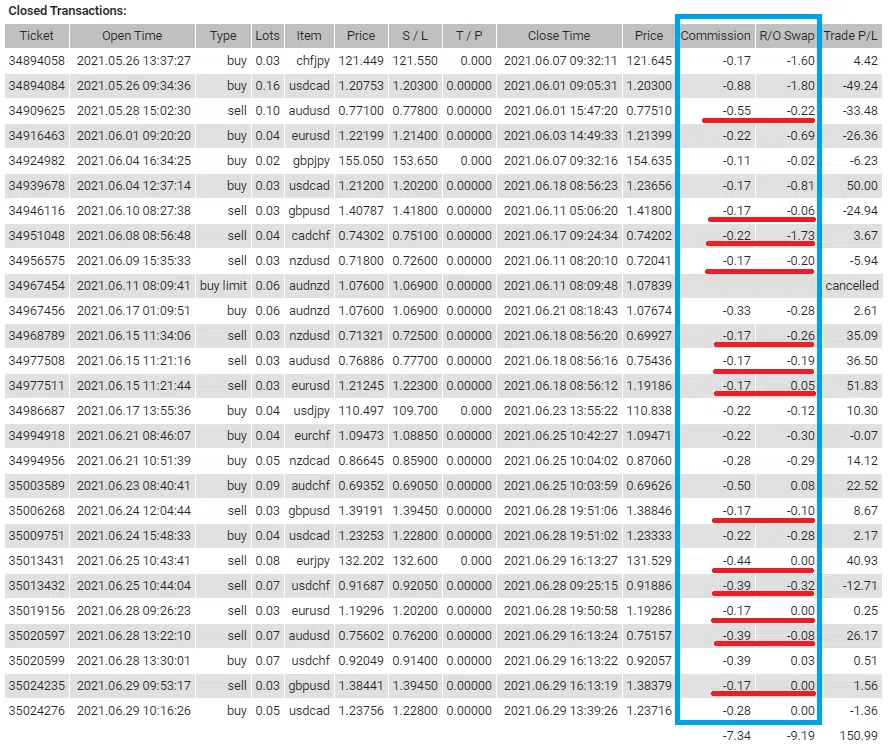
Numbers from guides help only so far, so here are two real statements from my own accounts. The first shows a month of 25 completed forex trades, mostly held for a short time. It is a forex account, so the costs are commission and swap, not a borrow fee.
 Click to enlarge
Over the whole month, commission added up to 7.34 and rollover swap to 9.19, on a trading result of 150.99. Most short positions cost only cents in swap because they ran one to four days. One stands out: the CAD/CHF short from 8 to 17 June was open for nine days and cost 1.73 in swap against 0.22 commission, about eight times as much.
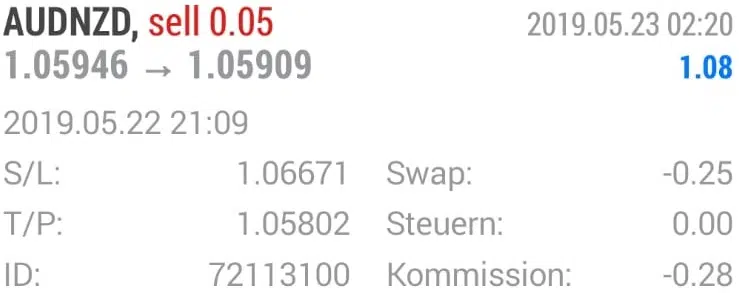
That is the lesson: the holding period, not the order fee, decides what a short costs. The second record shows the same principle in a single trade, this time a currency short in MetaTrader.
 Click to enlarge
Source: Karsten Kagels, own trade record.
This trade ran only about five hours, from 21:09 to 02:20 on the platform’s clock, and still paid swap. It was open over the rollover. Together, swap and commission took 0.53 of the 1.08 gross profit, almost half, leaving 0.55. Note the sign as well: the swap was negative, although this was a short. The common rule of thumb that “a short earns interest” is not reliable.
Pros and cons of short positions
Short positions are not a better or worse tool than buying, just a different one. They open a direction that a pure buyer cannot use, and they bring risks that buying does not have.
Advantages of short positions
- Profits in falling markets: You do not depend on rising prices. In a downtrend the market direction works for you.
- Hedging a portfolio: A short against an index can soften paper losses in your stocks without selling your long-term positions.
- Falling prices often move faster: Declines are often driven by fear and forced selling and can run in less time than similar rallies.
- Choice of risk profile: With puts, inverse ETFs or (in Europe) knock-out certificates you can trade the same view with a limited loss.
Disadvantages of short positions
- No upper limit on the loss: In a real short sale the loss can exceed your stake, because a price has no ceiling. A CFD short can cost more than its margin, in the EU up to the money in the account.
- Running costs: Borrow fee, interest, swap and dividends add up every day and make each extra week more expensive.
- Markets drift upward: Stock markets have risen over long periods. A short on the broad market trades against that tendency.
- Someone else can end your trade: A recall of the shares, a margin call or a knock-out level can close the position before your analysis works out.
- Limited access: Not every broker and not every stock allows a short. For illiquid stocks there is often no lender.
Risks that only short sellers face
The general trading risks apply in both directions, but four risks exist only on the short side. They are the reason why clean risk management is not an extra here but the precondition.
The loss has no upper limit
This is the structural difference, and you cannot argue it away. When you buy, your loss is limited to your stake. When you short, it is not. If the price doubles, you have lost your stake; if it triples, twice your stake. That is why a stop-loss order is not a matter of style for a short.
Short squeeze
A short squeeze happens when many short sellers have to buy back at the same time. Because covering means buying, it pushes the price higher and forces the next short seller to buy. The selling side turns into the buying side and drives the price up itself. A warning sign is a high short interest relative to the shares that are freely tradable.
Recall and forced buy-in
Many traders do not know this risk, and it has nothing to do with the price. The lender can ask for the shares back. LYNX says clearly that short positions can then be closed at short notice. Your trade ends although your analysis is right and the price moves your way.
Overnight gaps
News often comes out after the close, and the price then opens far away from the last trade. A stop does not protect you in such a price gap: it triggers, but at the next tradable price, which can be far away. For shorts this is especially unpleasant, because takeover offers and strong earnings tend to lift prices sharply.
And one misunderstanding
You often read that shorting is less risky in forex because currencies cannot rise without limit. That is misleading. In a currency pair every position is long one currency and short the other, so there is no separate short risk. And the idea that exchange rates do not jump was disproved by the Swiss franc shock of 15 January 2015, when the Swiss National Bank dropped the minimum exchange rate against the euro. Today’s policy is covered in our guide to the SNB interest rate decision.
Short selling rules and data: US and EU
Short selling is legal in the US and the EU, but it is regulated and partly transparent. For you as a private trader the rules are mainly a data source: they show where professional short sellers are positioned.
In the US, exchanges and FINRA publish short interest twice a month. Broker-dealers report the short positions in their customers’ and their own accounts under FINRA Rule 4560, and the totals per stock appear on FINRA and the exchanges. Reported short shares divided by the average daily volume gives the days to cover, a common measure of squeeze risk.
In the EU, the Short Selling Regulation sets two thresholds for net short positions in shares. According to ESMA, a position must be reported to the national regulator from 0.1% of the issued share capital and made public from 0.5%, with further steps of 0.1 percentage points. The 0.1% level applies permanently since 31 January 2022 (Delegated Regulation (EU) 2022/27); before that the rule said 0.2%, with a temporary 0.1% from 2020. In Germany the public positions appear in the Bundesanzeiger.
A very high short interest cuts both ways. It shows that funds expect a falling price, and at the same time it is the warning sign for a short squeeze. The same number can be read as confirmation and as danger.
GameStop 2021: what really happened
Few examples are told so often and so often told wrong. The retail traders who gathered on Reddit’s WallStreetBets did not go short, they bought. Many of them openly wanted to squeeze the short sellers who had bet on the decline of the retailer; others believed in the company. Their motives cannot be measured.
The starting position made a squeeze possible. According to the SEC staff report of October 2021, GameStop’s short interest reached 122.97% of the freely tradable shares in January 2021. That is possible because the same share can be lent again by each new buyer and then counts as sold short twice. The stock rose from about $17 at the start of January 2021 to an intraday high of $483 on 28 January (prices before the 2022 split).
Short covering was part of the story, but not the main driver. The SEC staff saw periods in which large short sellers bought back and pushed the price up. Over the whole run, though, this buying to cover was a small fraction of all buy volume, and the staff concluded that positive sentiment, not covering, kept the rally going for weeks.
The short sellers still paid a high bill. The hedge fund Melvin Capital lost 53% on its whole portfolio in January 2021, according to Fox Business, and ended the month with just over $8 billion after starting with about $12.5 billion, helped by $2.75 billion from Citadel and Point72. The data firm S3 Partners estimated that GameStop short sellers had lost $19.75 billion in January by the 29th, as reported by Fortune.
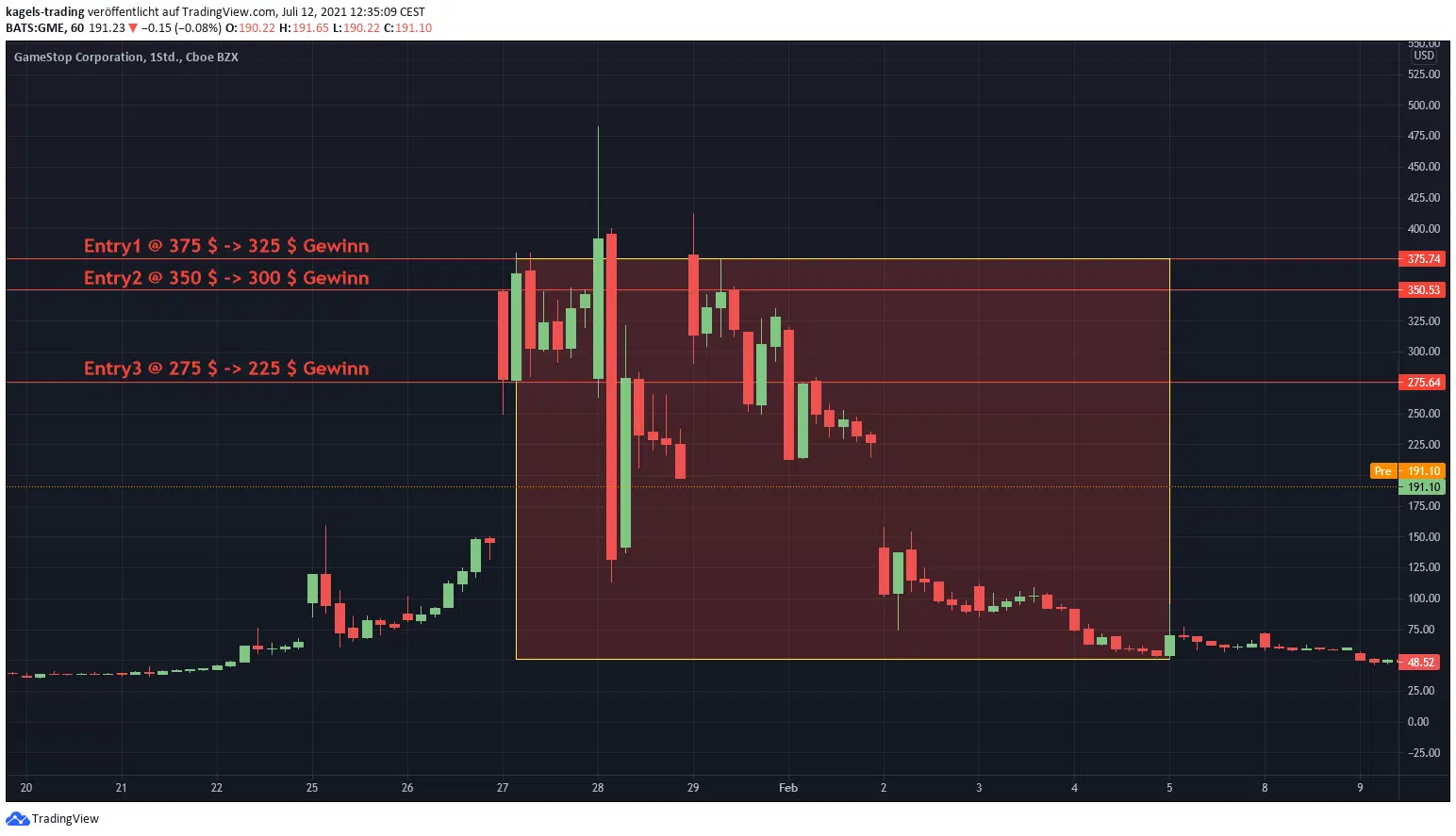
For short traders the case has a second half that is rarely told: after the high, the price fell fast. The chart shows how quickly the overshoot reversed and what a short entry after the high would have been worth.
 Click to enlarge
Source: Karsten Kagels on TradingView.
That is the real lesson, and it is uncomfortable. The falling price came in the end and was still a loss for everyone who went short too early and could not hold through the rise. A saying often credited to Keynes puts it well, although Quote Investigator found no evidence that he said it: the market can stay irrational longer than you can stay solvent.
How long do you hold a short position?
There is no fixed holding period. Short positions are used in day trading, in swing trading and in position trading. The costs point in one direction, though: shorter is cheaper, and for a short this is truer than for any long position.
The second reason to stay short-term is the drift of the market. The broad stock market has risen over long periods. If you short the market, you trade against that tendency and pay for it every day. That is why short ideas are usually trades with a defined reason, not investments.
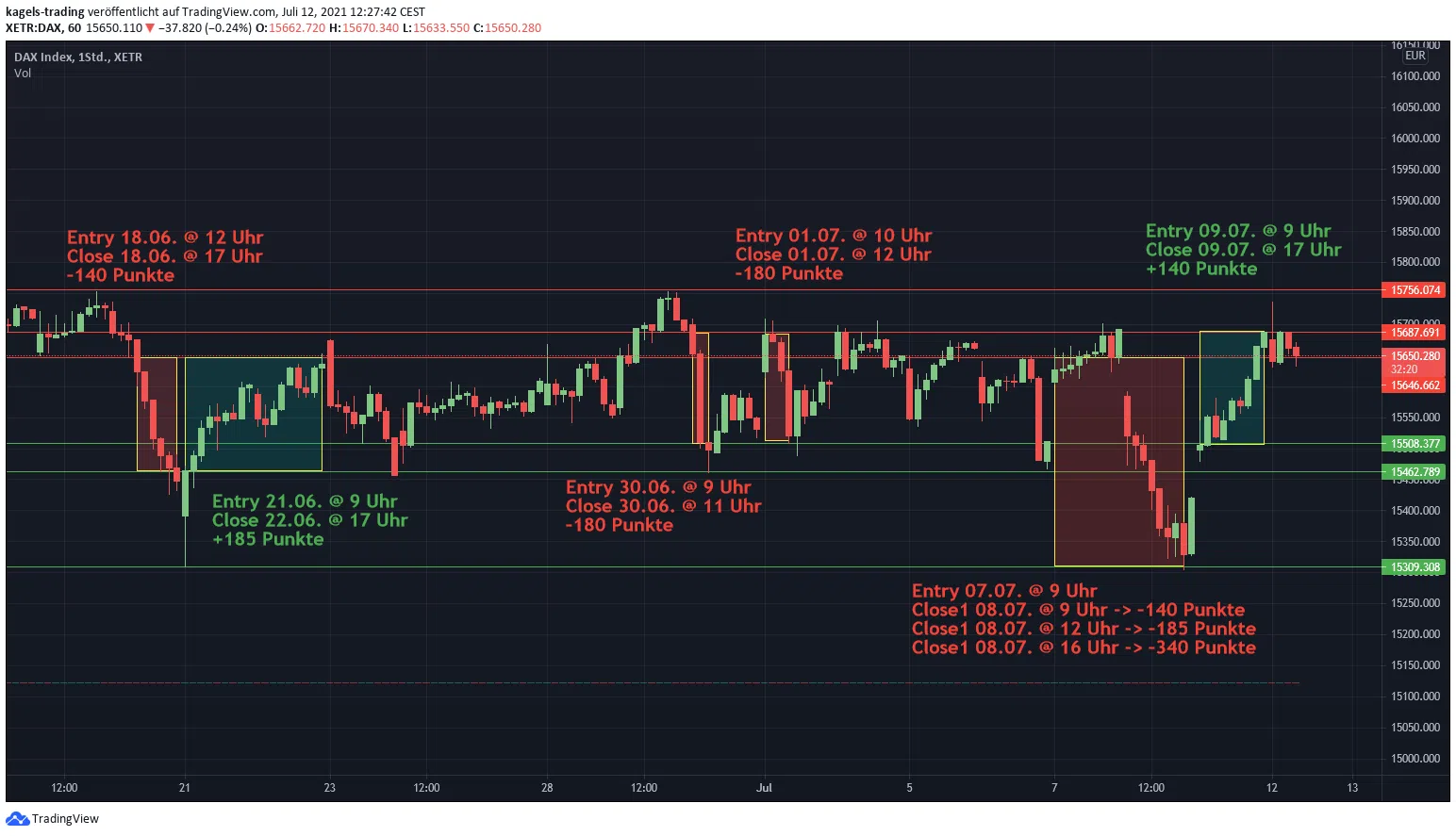
A chart from my own observation of the DAX shows how this looks. The red boxes mark short moves, the green ones the counter moves. You find the current picture of the index in our DAX forecast.
 Click to enlarge
Source: Karsten Kagels on TradingView.
Three of the four short moves ran within a single trading day, with moves of 140 to 180 points. Only the short from 7 July was held overnight, and it was also the largest, with up to 340 points by the afternoon of 8 July. That one trade carried the gap risk the other three did not have, a good yardstick for when overnight risk is worth it and when it is not.
Conclusion: going short is not a mirrored purchase
When you go short, you do not just turn the direction around. You swap a limited loss risk for an open one and a one-time cost for running costs. Together this makes the holding period your most important setting: what is patience in a long position is a cost in a short.
The second practical point is access. With several popular brokers and apps a real short sale is not possible. If you bet on falling prices with a derivative, you trade a product with its own rules, such as a knock-out level, time decay or a daily reset. That is not worse, but it is different, and you should know the difference before your first order.
For a start, a limited risk is the sensible choice. A bought put option or an inverse ETF costs at most what you paid. A real short sale makes sense once position size, stop and holding period are fixed in advance, and not only when the price is already running against you.
Frequently asked questions about short selling
Can private traders short stocks?
Yes, but not with every broker. A real short sale needs a margin account; in the US the broker must approve margin, and in Europe one route is Interactive Brokers or brokers that use its platform. Without that, you can bet on falling prices with put options, inverse ETFs or, in Europe, knock-out certificates.
Is short selling legal?
Yes, short selling is legal in the US and the EU, within rules. In the US, Regulation SHO requires a locate before an ordinary short sale and limits short sales in stocks that have fallen sharply (Rule 201). In the EU, uncovered short sales of shares are banned under Regulation (EU) No 236/2012. Market manipulation is illegal in both, whether long or short.
What does it cost to short a stock?
Besides the order fee, the main cost is the borrow fee. LYNX names 1 to 2% per year as the usual range, with much higher rates for scarce stocks. On top come margin interest where it applies and the dividends if your position is open over an ex-dividend date.
How risky is short selling?
In a real short sale the loss is in theory unlimited, because a price has no ceiling. A CFD short can cost more than its margin; for EU retail clients the loss is capped at the money in the CFD account. With options, knock-out certificates and inverse ETFs the loss is limited to the amount you paid. This distinction is the most important one before your first short.
Do I have to pay dividends when I am short?
Yes, you pay the dividend to the lender of the shares. In the US most stocks pay quarterly, so a 4% yield means about 1% per date. Where companies pay once a year, as many in Germany do, a single date can cost more than a year of borrow fees.
Where can I see which stocks are heavily shorted?
In the US, short interest is published twice a month by FINRA and the exchanges. In the EU, net short positions from 0.5% of the share capital are public, and from 0.1% they go to the regulator. A very high short interest is also a warning sign for a short squeeze.
Risk note: This article explains how short positions work. It is not investment advice. Short selling and derivatives can lead to losses beyond your stake.
This English edition is based on our German edition on kagels-trading.de and has been adapted for international readers.
More Trade Execution guides
- Choose the right order type
Order Types Explained: Market, Limit, Stop and Stop-Limit
Market, limit, stop, stop-limit and trailing stop orders for US stocks, what each one gives up, and who actually holds your stop.
- Link a target and a stop
OCO and Bracket Orders: Link a Target and a Stop
OCO, OTO and bracket orders, partial fills at Fidelity, Alpaca and Interactive Brokers, and why both sides can still fill.
- Set a stop loss
Stop-Loss Order: How to Set a Stop Loss on the Chart
Place the stop from the chart, size the trade from it, and know what a stop costs and what to check after a partial fill.
- Take profits at a target
Take-Profit Order: How to Set a Profit Target
Enter a profit target as a limit order, know why reaching it does not guarantee a fill, and take profits in steps without a wrong-sized stop.