
TradeStation Review 2026: Pricing Tiers, Fees and Platform


Contents
- TradeStation in 30 seconds (as of November 21, 2026)
- What is TradeStation?
- Regulation and protection
- What does TradeStation cost?
- The platform
- What do users say about TradeStation?
- TradeStation compared with other brokers
- Pros and cons of TradeStation
- Conclusion: who is TradeStation for?
- Frequently asked questions about TradeStation
- About the author
TradeStation is a broker and a trading platform built for active traders who test and automate their own rules. It offers US stocks, ETFs, options and futures, a desktop platform with backtesting and its own programming language, EasyLanguage. It is less suited to occasional investors, because its strengths are in technical analysis and automation. Karsten used TradeStation for some time years ago to evaluate trading systems; this review is based on TradeStation’s current pages.
All prices and rules here are as of November 21, 2026. We read TradeStation’s pricing page for US clients and for clients outside the US, its service fee schedule, its legal disclosures and the UK regulator’s register. We did not open an account and have no business relationship with TradeStation. How we work is on our editorial policy page. You can lose more than you invest in options and futures.
TradeStation in 30 seconds (as of November 21, 2026)
- Who: TradeStation Securities, Inc., an SEC-registered broker-dealer and CFTC-registered futures commission merchant; part of TradeStation Group, which belongs to Japan’s Monex Group.
- Pricing: fees fall as your monthly volume rises, in four tiers per asset class.
- US clients: $0 stock commission plus small per-share fees; options from $0 to $0.80 per contract and side; futures $0.50 to $1.75 per contract and side.
- Outside the US: a $5 ticket charge per stock or option trade on top; TradeStation Europe has its own price list.
- Watch out: a $10 monthly inactivity fee unless the account meets minimum activity.
What is TradeStation?
TradeStation is a trading platform with a connected broker, designed for technical analysis, backtesting and automated trading. With a normal broker you place an order; with TradeStation you can build the tool that places it. The platform brings charting, scanners, EasyLanguage and a strategy testing environment that runs ideas against historical prices.
TradeStation is not one company. TradeStation Securities serves US clients and, through TradeStation International Ltd in the UK, international clients; TradeStation Europe B.V. serves the European Economic Area; TradeStation Technologies develops the software. All belong to TradeStation Group, Inc., which a March 2026 company press release describes as a fully owned subsidiary of Monex Group. When you open an account, check which company your contract is with.
Regulation and protection
TradeStation Securities is regulated by the SEC, CFTC, FINRA and NFA, according to its own disclosures. It is a member of SIPC, which protects securities customers up to $500,000, including $250,000 for cash claims. SIPC covers securities accounts only; futures accounts are protected by the CFTC’s segregation rules, which keep client money apart from the firm’s own. Neither protects you against trading losses.
Outside the US, two more entities matter. TradeStation International Ltd is authorised by the UK’s Financial Conduct Authority since February 21, 2006 (firm reference 445531), according to the FCA register. TradeStation Europe B.V. in Amsterdam, launched on June 10, 2026, is a MiFID investment firm supervised by the Dutch regulator AFM for clients in the European Economic Area. Which investor compensation applies depends on the entity; ask before you deposit. TradeStation Europe also has its own price list: on November 21, 2026, it showed $0.005 per share and $0.60 per option contract, each with a $2.00 minimum, and no ticket charge.
One regulatory case concerns the former crypto business. In February 2024, TradeStation Crypto settled charges over an unregistered crypto lending product with a $1.5 million penalty to the SEC and the same amount to state regulators, without admitting or denying the findings, according to SEC press release 2024-16. TradeStation Crypto ended all trading on February 22, 2024, so there is no spot crypto trading anymore; the brokerage business of TradeStation Securities was not affected.
What does TradeStation cost?
TradeStation prices by monthly volume, in four tiers for each asset class. Tier 1 is the lowest volume, Tier 4 the highest. If you pass a threshold during the month, the lower rate applies from the next trading session for the rest of that month and for the following month; activity in one asset class does not count for another.
| US clients, Tier 1 | Fee | Notes |
|---|---|---|
| Stocks and ETFs | $0 commission | $0.003 per share clearing fee up to 100,000 shares a month |
| Equity options, single leg | $0.80 per contract and side | multi-leg $0.40, index option fee $1.00 extra, clearing $0.025 |
| Futures | $1.75 per contract and side | micros $0.50, clearing $0.10 |
| Futures options | $0.85 per contract and side | traded through FuturesPlus, outside the tiers |
Source: TradeStation pricing, U.S. Clients tab, read November 21, 2026. Exchange and regulatory fees not included; all option and futures fees are per side, not round trip. At Tier 4 (more than 10,000 contracts or 10 million shares a month), most of these fees fall to $0 or near it.
The tiers cover standard trades only. According to TradeStation’s pricing disclosures, FuturesPlus trades, sub-dollar and most OTC trades, and third-party, direct-routed, delegated or externally executed trades are excluded from the tiers and can cost more. Trades placed through non-TradeStation applications, such as a TradingView connection, may be subject to custom pricing, so check the price for the route you plan to use.
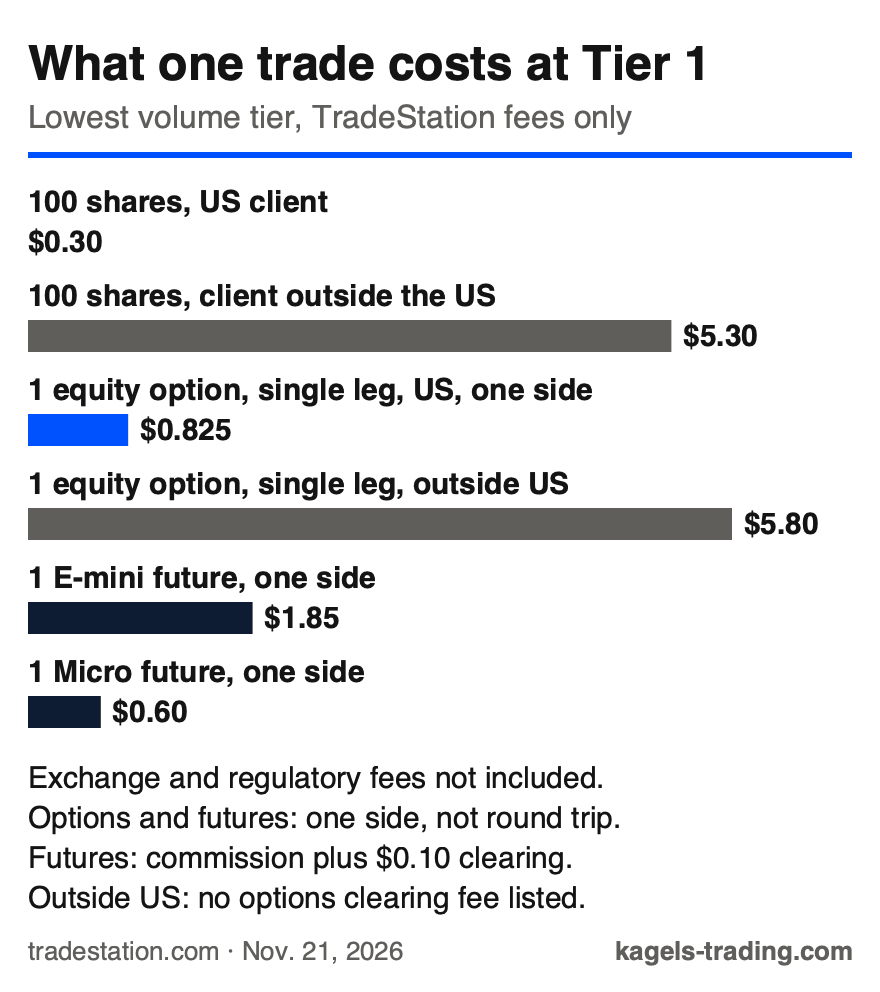
Clients outside the US pay a ticket charge. On the “Clients Outside the U.S.” tab, every stock or option trade costs $5.00 per ticket, plus per-share or per-contract fees. Up to Tier 3 these match the US rates; at Tier 4, single-leg options cost $0.10 and multi-leg $0.05 per contract instead of $0, and the tab lists no separate options clearing fee. Futures prices are the same as for US clients. For small trades, the ticket charge is by far the largest cost.
 Click to enlarge
Source: Kagels Trading, own calculation from the TradeStation pricing page.
Fees that are easy to miss
- Inactivity fee: $10 a month, free “if account meets minimum activity”. The fee page does not define minimum activity; ask support.
- Liquidations: $75 for an options liquidation and for a margin or risk liquidation.
- Transfers: $25 for an outgoing wire ($35 for clients outside the US), $125 for an outgoing account transfer.
- Software only: without a brokerage account, the platform with RadarScreen costs $99.99 a month for non-professionals.
Basic market data is free for non-professionals. According to the pricing page, certain basic market data is available at no charge to non-professional subscribers; additional markets can cost extra. Margin interest runs from 12.00 percent for balances under $50,000 down to 4.50 percent from $2 million.
The platform
TradeStation runs as desktop software, in the browser and as a mobile app. The desktop platform is the full tool for charting, scanning, backtesting and automation; the web and mobile versions cover charting and order entry. The software also connects to TradingView; our guide to TradingView brokers explains how.
RadarScreen scans many symbols in real time. It shows indicators and signals for a long list of symbols in one table, so you can watch many markets without opening a chart for each.
EasyLanguage is TradeStation’s own programming language. Its syntax reads close to plain English, so a trading rule can be written in an almost readable form. You can open the code of existing indicators and strategies and change it. Our guide to algo trading compares it with Pine Script, MQL5 and Python.
Backtesting is where TradeStation is strongest. You can test a strategy on years of historical data, optimize its parameters and then run it automatically. A good-looking test is not a promise; our guide to backtesting explains how to avoid overfitting and the dividend trap.
OptionStation Pro is the options tool. It shows option chains, strategy payoff charts and the Greeks. If options are new to you, start with our guide to options trading for beginners before you use multi-leg strategies.
What do users say about TradeStation?
On Trustpilot, TradeStation had 4.5 stars from 1,484 reviews on November 21, 2026. The profile has been claimed since August 2023, and Trustpilot marks it as a company with a paid subscription. Trustpilot says it does not fact-check reviews.
TradeStation compared with other brokers
TradeStation competes with brokers that serve active traders. Interactive Brokers offers more international markets. tastytrade focuses on options with simple pricing. For futures only, specialist futures brokers can be cheaper on micro contracts. TradeStation’s edge is the combination of a broker and a strategy testing platform.
Pros and cons of TradeStation
Pros
- Strategy tools: EasyLanguage, backtesting, optimization and automation in one platform.
- Volume discounts: fees fall with your monthly volume per asset class.
- Broad US offer: stocks, ETFs, options, futures and futures options.
- Regulated: SEC, CFTC, FINRA and NFA, with SIPC for securities.
Cons
- Ticket charge abroad: $5 per trade for stocks and options for TradeStation Securities clients outside the US.
- Inactivity fee: $10 a month if the account does not meet minimum activity.
- Learning curve: the platform rewards effort but is complex for beginners.
- Software fee without an account: $99.99 a month for platform access alone.
Conclusion: who is TradeStation for?
TradeStation suits active traders who want to build, test and automate their own strategies on US markets. The platform and EasyLanguage are its core; the tiered pricing rewards high volume. US clients pay little per trade at low volume, as long as the account stays active.
For occasional investors and small trades from abroad, it is expensive. The $5 ticket charge and the inactivity fee weigh more than any commission saving. If you mainly buy and hold, a simpler broker fits better; if you mainly trade futures, compare the all-in cost per contract with a futures specialist.
Frequently asked questions about TradeStation
Is TradeStation a good broker?
For active traders who use its testing and automation tools, yes; for occasional investors, less so. TradeStation Securities is regulated by the SEC, CFTC, FINRA and NFA and is a SIPC member. Trustpilot shows 4.5 stars from 1,484 reviews.
How much does TradeStation charge per trade?
It depends on your tier and where you live. US clients at Tier 1 pay $0 commission on stocks plus a $0.003 per-share clearing fee, $0.80 per single-leg option contract and side and $1.75 per futures contract and side. Clients outside the US pay a $5 ticket charge per stock or option trade on top.
Does TradeStation charge an inactivity fee?
Yes, $10 a month unless the account meets minimum activity. TradeStation’s fee page does not define the threshold, so ask support. The fee applies per month.
Can I use TradeStation from the UK or the EU?
Yes, through different TradeStation companies. TradeStation International Ltd is authorised by the UK’s FCA and introduces international clients to TradeStation Securities. Since June 2026, TradeStation Europe B.V. serves clients in the European Economic Area under Dutch supervision.
What is EasyLanguage?
EasyLanguage is TradeStation’s own programming language for indicators and strategies. Its syntax is close to plain English, and you can open and change the code of existing indicators. It runs only inside the TradeStation platform.
Can I trade crypto at TradeStation?
Not spot crypto. TradeStation Crypto ended all spot crypto trading on February 22, 2024, around the time of the settlement over its crypto lending product. TradeStation Securities, the brokerage, was not affected.
This English edition is based on our German edition on kagels-trading.de and has been adapted for international readers.
More Markets and Brokers guides
- Open your first account
What Is a Brokerage Account? A US Beginner's Guide
How to open and fund a US brokerage account, cash vs margin, what it costs and what SIPC and FDIC really cover.
- Know what trading really costs
Trading Costs: Every Fee You Pay and How to Cut It
Spread, commissions, SEC and FINRA fees, market data, margin interest and tax, with yearly totals for three trading styles.
- Choose a broker
Interactive Brokers Review 2026: Fees and Platforms
Fees, platforms, investor protection and real futures commissions from a client since 1996.
- Choose an options broker
tastytrade Review 2026: Options Fees, Margin and Safety
tastytrade from an options trader's own account and its October 2026 fee schedule: fees, the 6.75% margin rate, safety and FINRA fines.
- Check Tradovate
Tradovate Review 2026: Fees, Margins and Who Holds Your Money
The futures broker in many prop firm contracts: all-in costs per plan checked 21 November 2026, the $35 inactivity fee, margins and the clearing firm behind it.
- Check an offshore broker
PU Prime Review 2026: FCA Warning, Licences and Costs
Which PU Prime company you contract with, what the FCA warning means, and what 1:1000 leverage and the deposit bonus do to your account.
- Check an EU CFD broker
Tradeview Review 2026: Tradeview Europe, MFSA and Costs
What the Malta licence of Tradeview Europe covers, how it differs from the Cayman company, and what the three MetaTrader 5 accounts cost.
- Check ZuluTrade
ZuluTrade Review 2026: Costs, Regulation and US Status
Who runs the copy trading platform, what it costs through your broker, why the US was missing from its sign-up form and what the CFTC fined its US company for.
- Check CopyX
CopyX Review 2026: Is TAG Markets Copy Trading Legit?
Who runs the TAG Markets copy trading platform, which regulators warn about it, why US residents are excluded and how fast the 12x Amplify account eats your deposit.
- Choose a US forex broker
OANDA Review 2026: Fees, TradingView and US Rules
OANDA from its own pages and NFA records: spreads and fees, TradingView and the demo, FIFO and three penalties.
- Check a commission-free app broker
Webull Review 2026: Fees, Margin Rates and Safety
Webull from its own fee schedule and FINRA records: what is free, margin rates and Premium, overnight trading, crypto and three fines.
- Understand your price
Market Makers: Who Sets Your Price and How They Profit
How market makers earn on the spread, who sets prices at German trading venues and what the EU ban on payment for order flow changed.
- Trade an index CFD
Index CFDs at Interactive Brokers: Symbols, Costs and Trading
All 13 IBKR index CFDs, margin, stop and close-out worked through for IBDE40, financing, UK hours and the TradingView limit.
- Size an index future
Micro Futures: MES vs MNQ, Tick Values and Risk
MES and MNQ tick values, a worked sizing example from the stop with costs and slippage, and why margin is not your risk.
- Choose between futures and CFDs
Futures vs CFDs: Regulation, Order Execution and Costs
Who your counterparty is, EU, UK and US rules, how stops are triggered on CME and at CFD providers, and booked costs in a DAX example.
- Understand the IBKR Exposure Fee
IBKR Exposure Fee: What It Is and How to Reduce It
Why Interactive Brokers charges a daily fee on high-risk accounts, why weekends count, where to find it and how to reduce it, with a real 1.12 euro notice.
- Read the futures curve
Contango vs Backwardation: Futures Curves Explained
What contango and backwardation mean, what rolling does to a position in each case, and real gold, oil and gas curves from 28 October 2026.
- Understand the spot market
Spot Market Explained: Definition and Settlement Times
What a spot market is, why two days is a minimum and not a limit, and when stocks settle at T+1 in the US, EU, UK and Switzerland.
- Choose a silver future
Silver Futures: SI vs Micro Silver vs 100-oz SIC
SI, Micro Silver and the 100-ounce SIC compared by tick value, risk per contract, margin and December 2026 deadlines.
- Trade soybean futures
Soybean Futures: Contract Specs, Hours and Price Drivers
CBOT soybean contract specs, Mini and Micro, trading hours, daily price limits, WASDE and China, and a seasonal test over 4,784 trading days.
- Understand your taxes
Trading Taxes in the US: How Traders Are Taxed in 2026
US federal rules for 2026: short and long term rates, the $3,000 loss limit, wash sales, the 60/40 rule for futures and trader tax status.