
AMP Futures Review 2026: Margins, Fees, Platforms and Safety


Contents
- AMP Futures in 30 seconds
- What is AMP Futures?
- Which markets can you trade at AMP?
- Fees: what does trading at AMP cost?
- How high are the margins at AMP?
- Trading platforms: more than 50 to choose from
- Opening an account, deposits and withdrawals
- Safety and regulation: is AMP Futures legit?
- Taxes on futures in the US
- Pros and cons of AMP Futures
- Alternatives to AMP Futures
- Conclusion: a low-cost tool for self-directed traders
- Frequently asked questions about AMP Futures
- About the author
AMP Futures is a Chicago futures broker known for low costs, a huge choice of platforms and a minimum deposit of just $100. That is why active day traders with small accounts have used it for years. Its most famous selling point, extremely low day-trade margins, needs a closer look, because AMP raises them for US index futures around major US data releases, and on the day we checked its margin table showed far higher values than its homepage.
This review is based on AMP’s official pages, read on 23 November 2026, and on regulatory sources. You learn who stands behind AMP, what trading really costs, which margins apply, which platforms you can use and how safe your money is. This article follows our editorial policy and contains no affiliate links.
AMP Futures in 30 seconds
- Who: AMP Global Clearing LLC, a futures commission merchant (FCM) in Chicago, regulated by the CFTC and the NFA.
- Small accounts welcome: the minimum to keep a live data connection is $100; to trade, you need the margin of the contract.
- Margins: the homepage advertises $40 for the Micro E-mini S&P 500; AMP’s margin table showed $715 on 23 November 2026, during a temporary restriction around US releases.
- Fees: a public Exact Cost Calculator shows all-in costs, AMP will beat or match written quotes, and account fees are in a public table.
- Platforms: more than 50, several free, including Quantower and a MultiCharts edition; NinjaTrader only for existing connections.
What is AMP Futures?
AMP Futures is the brand of AMP Global Clearing LLC, a Chicago futures commission merchant that clears its customers’ trades at the CME Group exchanges and is regulated by the CFTC and the NFA.
A futures commission merchant is a firm registered with the CFTC that accepts futures orders from customers, executes them and holds the customer money behind them. AMP describes itself as a CME Group clearing member and FCM of CME, CBOT, COMEX and NYMEX. Clearing its own trades shortens the chain between you and the exchange; our guide to futures trading explains clearing and margin.
AMP focuses on one business: futures and options on futures. Stocks, ETFs and CFDs are not offered. That focus explains part of the low costs, because AMP does not need a stock custody business or a CFD market maker.
| Item | Details |
|---|---|
| Firm | AMP Global Clearing LLC |
| Headquarters | 221 N. LaSalle Street, Chicago |
| Regulation | CFTC, NFA (licence no. 0412490 per AMP) |
| Products | futures and options on futures |
| Minimum balance | $100 for a live data connection |
| Data feeds | CQG, Rithmic, TT, Teton |
| Platforms | 50+ (AMP’s own count) |
Source: ampfutures.com, read November 23, 2026.
What happened to AMP Global Europe?
AMP’s European arm in Cyprus has stopped its licensed investment business. AMP Global Ltd voluntarily renounced its CySEC licence 360/18 in 2024, stopped taking clients and closed its existing accounts, as Finance Magnates reported; CySEC withdrew the licence and removed the firm from the Cypriot compensation fund. AMP says it has customers in more than 100 countries, but whether it accepts an account from your country is AMP’s decision, so check before you apply.
Which markets can you trade at AMP?
At AMP you trade futures and options on futures on the major exchanges. Its margin table lists contracts from the CME Group exchanges (CME, CBOT, COMEX, NYMEX) and from Eurex, among others, including the DAX and Euro Stoxx 50 futures. Beginners with small accounts usually start with micro contracts; our guide to micro futures shows how to size a position.
The data feed decides which platforms you can use. AMP offers four: CQG, Rithmic, TT and Teton. Each comes with its own data fees, so choose the feed together with the platform.
Fees: what does trading at AMP cost?
AMP shows its prices through a public cost calculator. The Exact Cost Calculator combines commission, exchange, NFA, platform and routing fees into one all-in cost per trade once you pick data feed, platform and contract. Separately, AMP promises to beat or match any written commission quote from another broker, which can lower that price, or offers 20 commission-free trades to new clients, while exchange, clearing and data fees still apply.
A round turn is the full cycle of buying and selling one contract, and futures brokers quote commissions per round turn or per side.
The account fees, on the other hand, are public. According to AMP’s account fee table, incoming wires, checks and ACH deposits are free, and ACH withdrawals are free for domestic clients. A wire withdrawal costs $30, and $30 for currency conversions made to meet margin calls or at the customer’s request; a liquidation for a margin or daily loss limit breach costs $25 per contract.
On top of the commission come exchange, clearing and NFA fees and market data. For active traders, these items often add up to more than the commission itself. Compare the calculator’s total per round turn, not the commission alone, before you choose a broker.
How high are the margins at AMP?
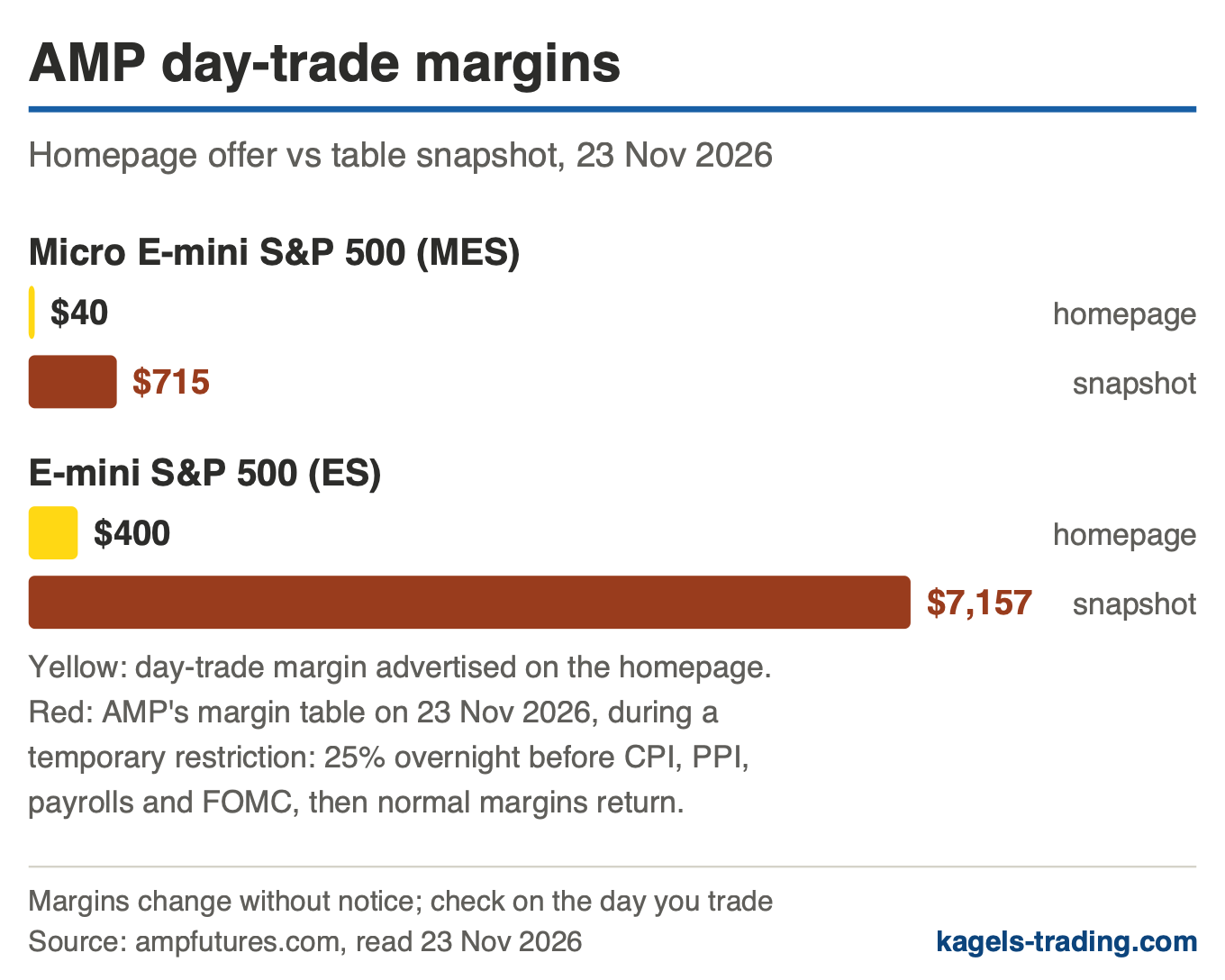
Low margins have long been AMP’s strongest selling point. The homepage advertises $40 for the Micro E-mini S&P 500 and $400 for the E-mini S&P 500. The snapshot of AMP’s margin table below, taken on 23 November 2026, showed much higher day-trade values for US index futures.
The day-trade margin is the deposit a broker requires for a futures position that you close on the same trading day; it lies below the overnight margin set by the exchange.
| Contract | Day-trade margin | Overnight (maintenance) |
|---|---|---|
| Micro E-mini S&P 500 (MES) | $715 | $2,817 |
| Micro E-mini Nasdaq-100 (MNQ) | $1,161 | $4,360 |
| E-mini S&P 500 (ES) | $7,157 | $28,171 |
| E-mini Nasdaq-100 (NQ) | $11,616 | $43,602 |
| Micro-DAX (FDXS) | $100 | $2,170 |
| Mini-DAX (FDXM) | $500 | $10,841 |
| DAX (FDAX) | $2,500 | $54,206 |
Source: AMP margin table, snapshot of November 23, 2026, taken while AMP’s temporary restriction for US index futures applied. Margins change without notice.
 Click to enlarge
Source: AMP Futures, margin table.
Three rules explain the gap. According to its notice on news releases, AMP sets US equity index margins to 25% in the overnight session from 5 p.m. Chicago time until shortly after the CPI, PPI, payrolls and FOMC releases, and then restores the normal day-trading margins. Day-trade margins double for account balances above $100,000. And AMP notes that US regulators classify retail traders as a “heightened risk profile”, with an exchange margin 10% higher than the rates the CME publishes.
What this means for you: the low advertised margins are not available at every moment. Check the margin table, AMP’s release schedule and your platform’s margin display on the day you trade. A low margin is a leverage tool, not a safety net: with one ES contract you control the S&P 500 index times $50, and losses can exceed your margin, as our guide to the margin call explains for a margin deficit.
Trading platforms: more than 50 to choose from
The platform choice is AMP’s second big strength. AMP lists more than 50 platforms, several of them free for its customers, among them Quantower and a MultiCharts edition. Most popular charting and order flow names are available:
- Quantower: modern multi-asset platform, free at AMP; see our Quantower review for its DOM and charting.
- Sierra Chart: fast classic for order flow and charting; see our Sierra Chart review.
- ATAS and Bookmap: specialised order flow and liquidity heatmap tools.
- MetaTrader 5: now available at AMP’s US company.
- Jigsaw Trading and MotiveWave: established professional tools.
NinjaTrader is no longer available for new setups at AMP. According to AMP’s existing-user policy, NinjaTrader stopped AMP from enabling it on new trader setups from 10 April 2026; live AMP/CQG traders enabled before that date keep their access if they meet the grandfathered criteria. New users need a NinjaTrader brokerage account; our NinjaTrader review covers that setup.
TradingView appears in AMP’s platform list. You can then analyse and place orders in the browser while AMP handles the execution in the background. Our overview of TradingView brokers compares the connections and their costs.
Opening an account, deposits and withdrawals
You open the account online through AMP’s client portal. You need the usual identity documents, then you choose platform and data feed. AMP also offers a free demo, so you can test order entry and the platform with simulated money first.
Funding works by wire, ACH or check. According to AMP’s funding instructions, US clients can use ACH and checks, and wires are accepted in several currencies, including euro and pound transfers to an AMP account at Barclays in the UK. AMP runs multi-currency accounts: the currency you deposit becomes your base currency, and profits or losses stay in the currency of the exchange. AMP converts only to cover negative currency balances, usually once a month, and when you withdraw; its fee table lists $30 for conversions made to meet margin calls or at your request.
Safety and regulation: is AMP Futures legit?
AMP is registered as an FCM and states its NFA licence number as 0412490. You can look the firm up yourself in the NFA’s BASIC register, which shows its registration history and any disciplinary actions. AMP also publishes the financial data the CFTC requires under its Rule 1.55 page, so you can check its capital.
Futures accounts at US brokers have no deposit insurance. SIPC protection for securities accounts does not cover futures. Instead, CFTC rules require customer money to be held separately from the firm’s own money, called segregation, and that is the protection you rely on if a broker fails.
Taxes on futures in the US
In the US, regulated futures contracts are generally Section 1256 contracts. Gains and losses are usually treated as 60% long-term and 40% short-term, whatever the holding period, and reported on IRS Form 6781. Rules differ outside the US, so for larger amounts, talk to a tax adviser.
Pros and cons of AMP Futures
AMP’s profile is clear: low entry costs and a huge choice, with more self-reliance required. Here are the main strengths and weaknesses.
Pros of AMP Futures
- Low entry: a $100 minimum balance for a live data connection.
- Huge platform choice: more than 50 platforms, several free.
- Many markets: CME Group exchanges and Eurex from one account.
- Public account fees: wires, currency conversions and liquidations are listed with prices.
Cons of AMP Futures
- Temporary margin restrictions: around US releases, day-trade margins rise; the snapshot showed $715 for MES.
- Prices need the calculator: there is no simple commission list; costs depend on feed and platform.
- No deposit insurance: only segregation under CFTC rules.
- No NinjaTrader for new users: only existing CQG connections from before 10 April 2026 continue.
Alternatives to AMP Futures
No broker fits everyone. These alternatives suit traders who want flat-fee pricing, a multi-asset account or a broker’s own platform:
- Tradovate: flat-fee plans and a browser platform; see our Tradovate review.
- Interactive Brokers: futures, stocks and options in one account; see our Interactive Brokers review.
- TradeStation: its own platform for futures and stocks; see our TradeStation review.
Conclusion: a low-cost tool for self-directed traders
AMP Futures is a specialist for self-directed futures traders. It offers a tiny entry hurdle, a platform choice few rivals match and public account fees. Its famous low day-trade margins, however, do not apply at every moment: around major US releases, AMP raises them for US index futures.
Karsten’s view after more than four decades of trading futures: AMP remains a legitimate choice for cost-aware traders who pick their own platform, but check the current margins and the all-in cost in the calculator before you fund the account. Size every position from your stop, not from the lowest margin the broker allows.
Frequently asked questions about AMP Futures
Is AMP Futures legit?
AMP Global Clearing is a CFTC-registered futures commission merchant and an NFA member, licence no. 0412490 according to AMP. You can check its record in the NFA’s BASIC register. Futures accounts have no deposit insurance; customer money is protected by segregation.
What is the minimum deposit at AMP Futures?
AMP requires a $100 balance to keep a live data connection. To place a trade, you also need the margin of the contract. The homepage advertises $40 for a Micro E-mini S&P 500 day trade, but during AMP’s temporary restriction around US releases, the table showed $715 on 23 November 2026.
How much are AMP Futures commissions?
AMP’s public Exact Cost Calculator shows the all-in cost per trade for your data feed, platform and contract. On top of that, the broker promises to beat or match any written quote from another broker. The calculator total already includes exchange, NFA, platform and routing fees.
Does AMP Futures support NinjaTrader?
Not for new users: since 10 April 2026, AMP can no longer enable NinjaTrader on new setups. Existing live connections enabled before that date continue under the grandfathered rules. AMP offers more than 50 other platforms, including Quantower for free.
Can I use TradingView with AMP Futures?
Yes, TradingView is on AMP’s platform list. You place orders in the browser, and AMP executes them. Check the data fees for the feed you need.
This English edition is based on our German edition on kagels-trading.de and has been adapted for international readers.
More Markets and Brokers guides
- Open your first account
What Is a Brokerage Account? A US Beginner's Guide
How to open and fund a US brokerage account, cash vs margin, what it costs and what SIPC and FDIC really cover.
- Know what trading really costs
Trading Costs: Every Fee You Pay and How to Cut It
Spread, commissions, SEC and FINRA fees, market data, margin interest and tax, with yearly totals for three trading styles.
- Choose a broker
Interactive Brokers Review 2026: Fees and Platforms
Fees, platforms, investor protection and real futures commissions from a client since 1996.
- Check TradeStation
TradeStation Review 2026: Pricing Tiers, Fees and Platform
Broker and strategy platform: volume tiers for stocks, options and futures checked 21 November 2026, the $5 ticket charge outside the US, fees and EasyLanguage.
- Choose an options broker
tastytrade Review 2026: Options Fees, Margin and Safety
tastytrade from an options trader's own account and its October 2026 fee schedule: fees, the 6.75% margin rate, safety and FINRA fines.
- Check Tradovate
Tradovate Review 2026: Fees, Margins and Who Holds Your Money
The futures broker in many prop firm contracts: all-in costs per plan checked 21 November 2026, the $35 inactivity fee, margins and the clearing firm behind it.
- Check an offshore broker
PU Prime Review 2026: FCA Warning, Licences and Costs
Which PU Prime company you contract with, what the FCA warning means, and what 1:1000 leverage and the deposit bonus do to your account.
- Check an EU CFD broker
Tradeview Review 2026: Tradeview Europe, MFSA and Costs
What the Malta licence of Tradeview Europe covers, how it differs from the Cayman company, and what the three MetaTrader 5 accounts cost.
- Check ZuluTrade
ZuluTrade Review 2026: Costs, Regulation and US Status
Who runs the copy trading platform, what it costs through your broker, why the US was missing from its sign-up form and what the CFTC fined its US company for.
- Check CopyX
CopyX Review 2026: Is TAG Markets Copy Trading Legit?
Who runs the TAG Markets copy trading platform, which regulators warn about it, why US residents are excluded and how fast the 12x Amplify account eats your deposit.
- Choose a US forex broker
OANDA Review 2026: Fees, TradingView and US Rules
OANDA from its own pages and NFA records: spreads and fees, TradingView and the demo, FIFO and three penalties.
- Check a commission-free app broker
Webull Review 2026: Fees, Margin Rates and Safety
Webull from its own fee schedule and FINRA records: what is free, margin rates and Premium, overnight trading, crypto and three fines.
- Check Robinhood
Robinhood Review 2026: Fees, Gold, Margin, Options and Safety
Robinhood from its US fee schedule: what commission-free leaves out, Gold for $5 a month, margin tiers, options and futures, and the SEC and FINRA settlements.
- Understand your price
Market Makers: Who Sets Your Price and How They Profit
How market makers earn on the spread, who sets prices at German trading venues and what the EU ban on payment for order flow changed.
- Trade an index CFD
Index CFDs at Interactive Brokers: Symbols, Costs and Trading
All 13 IBKR index CFDs, margin, stop and close-out worked through for IBDE40, financing, UK hours and the TradingView limit.
- Learn how futures work
Futures Trading Explained: Contracts, Margin, Rolling and Risk
Contract specs and month codes, margin, settlement and rolling, US regulation, a COT swing approach and spread trading.
- Size an index future
Micro Futures: MES vs MNQ, Tick Values and Risk
MES and MNQ tick values, a worked sizing example from the stop with costs and slippage, and why margin is not your risk.
- Choose between futures and CFDs
Futures vs CFDs: Regulation, Order Execution and Costs
Who your counterparty is, EU, UK and US rules, how stops are triggered on CME and at CFD providers, and booked costs in a DAX example.
- Understand the IBKR Exposure Fee
IBKR Exposure Fee: What It Is and How to Reduce It
Why Interactive Brokers charges a daily fee on high-risk accounts, why weekends count, where to find it and how to reduce it, with a real 1.12 euro notice.
- Read the futures curve
Contango vs Backwardation: Futures Curves Explained
What contango and backwardation mean, what rolling does to a position in each case, and real gold, oil and gas curves from 28 October 2026.
- Understand the spot market
Spot Market Explained: Definition and Settlement Times
What a spot market is, why two days is a minimum and not a limit, and when stocks settle at T+1 in the US, EU, UK and Switzerland.
- Choose a silver future
Silver Futures: SI vs Micro Silver vs 100-oz SIC
SI, Micro Silver and the 100-ounce SIC compared by tick value, risk per contract, margin and December 2026 deadlines.
- Trade soybean futures
Soybean Futures: Contract Specs, Hours and Price Drivers
CBOT soybean contract specs, Mini and Micro, trading hours, daily price limits, WASDE and China, and a seasonal test over 4,784 trading days.
- Trade soybean meal futures
Soybean Meal Futures: Contract Specs, Crush and Price Drivers
CBOT soybean meal contract specs, the Micro, trading hours, price limits, the crush spread with beans and oil, Argentina and a seasonal test.
- Trade soybean oil futures
Soybean Oil Futures: Contract Specs, Biofuels and the Crush
CBOT soybean oil contract specs, the Micro, trading hours, daily price limits, biofuel demand and EPA rules, WASDE and the soybean crush.
- Trade corn futures
Corn Futures: Contract Specs, Hours and Price Drivers
CBOT corn contract specs, the Micro, trading hours in CT, daily price limits, WASDE, ethanol and exports, and a seasonal test over 4,784 trading days.
- Trade wheat futures
Wheat Futures: Chicago, Kansas City and What Moves Prices
Chicago SRW and Kansas City HRW wheat specs, the Micro, linked price limits, the KC-Chicago spread, the Black Sea and a seasonal test.
- Compare grain futures
Grain Futures: Corn, Wheat and Soybeans at CBOT
Corn, wheat, soybeans, soybean oil and meal at CBOT: contract sizes, tick values, shared hours and reports, and how the five markets are linked.
- Understand your taxes
Trading Taxes in the US: How Traders Are Taxed in 2026
US federal rules for 2026: short and long term rates, the $3,000 loss limit, wash sales, the 60/40 rule for futures and trader tax status.