
Robinhood Review 2026: Fees, Gold, Margin, Options and Safety


Contents
- Robinhood in 30 seconds
- What is Robinhood?
- Robinhood fees: what “commission-free” leaves out
- Robinhood Gold: is it worth $5 a month?
- Margin at Robinhood
- Trading options, futures and crypto at Robinhood
- Is Robinhood safe?
- Pros and cons of Robinhood
- Alternatives to Robinhood
- Conclusion: a good app, with costs in the fine print
- Frequently asked questions about Robinhood
- About the author
Robinhood made commission-free stock trading the industry standard. Almost every large US broker followed its lead, and its app remains a common first account for new investors. Free trades do not mean free trading, though: the money comes from somewhere, and you should know the revenue model before you open an account.
This review looks at Robinhood’s US brokerage from a trader’s point of view. You learn what the fee schedule really charges, what Robinhood Gold costs and brings, how margin, options and futures work there, and what the regulatory record says. It follows our editorial policy and contains no affiliate links.
Robinhood in 30 seconds
- Commission-free: US stocks, ETFs and equity options trade without commission; regulatory fees still apply.
- Fees to know: $100 for an outgoing account transfer (ACATS), $25 for an outgoing wire, $0.50 per index option contract.
- Robinhood Gold: $5 a month for 3.6% APY on eligible cash, a 3% IRA match, cheaper index options and $1,000 of margin without interest.
- Margin: 5.25% a year for up to $50,000 borrowed, falling in tiers for larger balances.
- Track record: SEC settlements of $65 million (2020) and $45 million (2025) and a $57 million FINRA fine (2021).
What is Robinhood?
Robinhood Markets is a US financial company whose subsidiaries offer commission-free trading in stocks, options, futures and crypto through an app and a desktop platform, earning mainly from interest, subscriptions and payment for order flow.
Behind the app stand several separate companies, and that matters for your protection. Brokerage runs through Robinhood Financial LLC and clearing through Robinhood Securities LLC, both registered broker-dealers and SIPC members. Futures go through Robinhood Derivatives, a CFTC-registered futures commission merchant, and crypto through Robinhood Crypto, which is licensed in New York and not SIPC protected.
| Business | Company | Protection |
|---|---|---|
| Stocks, ETFs, options | Robinhood Financial LLC | SIPC member |
| Futures | Robinhood Derivatives, LLC | CFTC/NFA, no SIPC |
| Crypto | Robinhood Crypto, LLC | no SIPC, no FDIC |
| Gold membership | Robinhood Gold, LLC | subscription |
Source: entity disclosures on robinhood.com, read November 23, 2026.
Robinhood fees: what “commission-free” leaves out
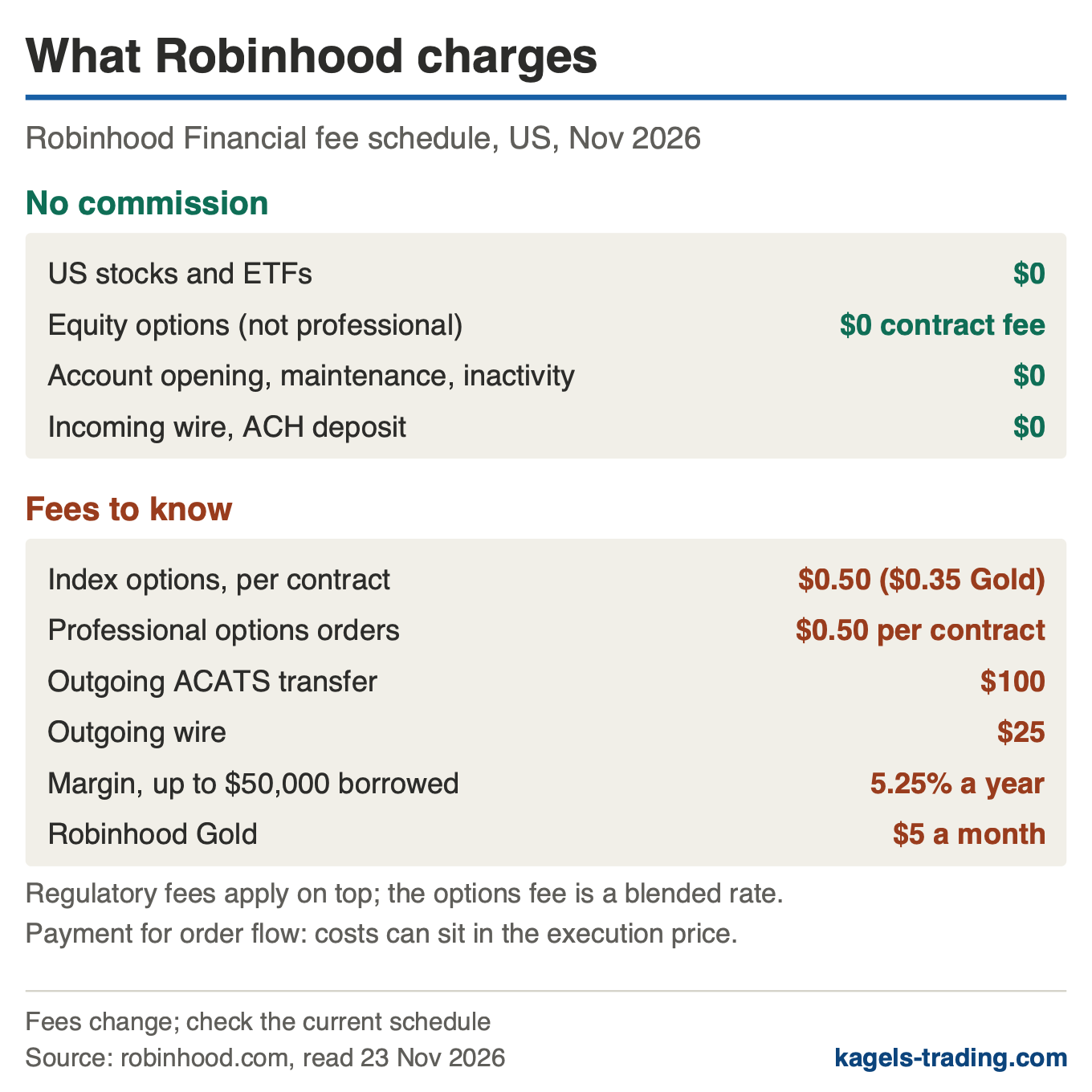
Robinhood charges no commission for US-listed stocks, ETFs and their options in self-directed accounts. There are also no fees for opening or keeping an account, no inactivity fee, and incoming wires and ACH deposits are free. The fees sit in transfers and extras, as the overview shows.
 Click to enlarge
Source: Robinhood Financial, fee schedule.
Moving money and accounts out costs more than moving it in. According to the fee schedule, an outgoing ACATS transfer costs $100 and an outgoing wire $25. Instant withdrawals to a debit card cost up to 1.75%, with a $1 minimum.
Index options carry a contract fee. Robinhood charges $0.50 per index option contract, or $0.35 with Gold, plus exchange and regulatory fees. Equity options have no contract fee, with one exception: from 15 October 2026, professional orders cost $0.50 per options contract, professional meaning more than 390 listed-options orders a day on average in the previous calendar month. Regulatory options fees still apply on every trade.
Regulatory fees apply to every account. They include the SEC fee on sales, the FINRA trading activity fee and fees on options contracts, and they are small per trade, but part of your real trading cost. They are not always exact pass-throughs: for the options regulatory fee, Robinhood charges a blended rate that, according to its fee schedule, may differ from or exceed what it actually pays.
Payment for order flow
Payment for order flow means that a broker routes customer orders to trading firms that pay for them. For a commission-free broker, it is one of the main revenue sources. The cost does not disappear; it can show up as a slightly worse execution price, which you never see on a fee schedule.
This is not a theoretical point at Robinhood. In 2020 the SEC found that Robinhood had misled customers about this revenue source and had not satisfied its best execution duty; we cover the SEC settlement below. Our explainer on the market maker shows how such firms earn on the spread.
Robinhood Gold: is it worth $5 a month?
Robinhood Gold is a subscription that costs $5 a month. According to the Gold page, it brings 3.6% APY on eligible brokerage cash, a 3% match on new IRA contributions, larger instant deposits and the lower index options fee of $0.35.
Gold also includes the first $1,000 of margin without interest. Above that, the normal margin rates apply. If you keep a few thousand dollars in uninvested cash at Robinhood, the interest alone can cover the subscription; if you hold little cash, the value depends on whether you use the other Gold features.
Read the IRA match terms before you count on it. The fee schedule lists a variable IRA match removal fee, the “Gold Cancellation IRA Match Removal Fee”, and according to the Gold page, you must stay subscribed to Gold for one year and keep the assets in the IRA for five years to keep the full 3% match. Cancelling Gold early and removing the assets from the IRA early are two separate ways to lose part of the IRA match.
Margin at Robinhood
Margin interest at Robinhood falls in tiers with the amount you borrow. According to its margin rates page, the rate applies to the full settled margin balance and is calculated daily on a 360-day basis.
| Settled margin balance | Interest rate |
|---|---|
| up to $50,000 | 5.25% |
| $50,000 to $100,000 | 5.05% |
| $100,000 to $1 million | 4.75% |
| $1 million to $10 million | 4.50% |
| $10 million to $50 million | 4.45% |
| over $50 million | 4.20% |
Source: Robinhood margin rates page and fee schedule, read November 23, 2026.
Margin multiplies both gains and losses. If your account falls below the maintenance requirement, a broker can sell positions to cover the shortfall; our guide to the margin call shows how a forced liquidation works. Borrow only what you can afford to lose in a price gap.
Trading options, futures and crypto at Robinhood
Options are a core product for active traders at Robinhood. Equity options trade without a contract fee except for professional orders, and index options cost $0.50 per contract. Options can lose their full value quickly; our guide to options trading for beginners explains calls and puts.
Futures run through Robinhood Derivatives. The futures page lists E-mini, Micro and Nano contracts on the S&P 500, Nasdaq-100, Dow and Russell 2000, among others, with Level 2 futures data at no extra cost; exchange, NFA and subscription fees come on top of the commission. Our guide to futures trading explains margin and rolling.
Crypto runs through Robinhood Crypto. Crypto held there is not SIPC or FDIC protected, so treat it as a separate custody risk from your brokerage account. Our article on crypto exchange hacks shows why custody matters.
Robinhood Legend for active traders
Robinhood Legend is the free desktop platform for more active traders. It offers trading from the chart, technical indicators, drawing tools and custom layouts. There is no extra charge for Legend, though the normal account fees apply.
Is Robinhood safe?
Robinhood is a listed, regulated company, and it also has a record of regulatory settlements you should know. Its brokerage arm is a member of SIPC, which protects securities and cash in a failed broker up to set limits, but not against market losses. You can check its history in FINRA’s BrokerCheck.
Three settlements stand out. The record is public on BrokerCheck and the SEC site, and each case touched customer protection:
- SEC, December 2020: Robinhood Financial agreed to pay $65 million; the SEC found misleading statements about payment for order flow from 2015 to late 2018 and a failure to seek best execution.
- FINRA, June 2021: a $57 million fine plus about $12.6 million in restitution, over misleading information, options approvals and the outages of March 2020, according to FINRA’s settlement document.
- SEC, January 2025: Robinhood Securities and Robinhood Financial agreed to pay $45 million in combined penalties, according to the SEC.
Karsten’s view: Robinhood is not a dubious broker, but it has been sanctioned repeatedly for falling short. Both facts belong in your decision. The structure is regulated and SIPC-protected for securities; the regulatory record asks you to read the fine print carefully.
Pros and cons of Robinhood
Robinhood is easy to start with, and some of its costs only show later. Here are the main strengths and weaknesses.
Pros of Robinhood
- No commissions: US stocks, ETFs and equity options without commission.
- No account fees: no opening, maintenance or inactivity fees.
- Gold value: 3.6% APY on eligible cash and a 3% IRA match for $5 a month.
- Broad product range: stocks, options, futures and crypto in one app.
Cons of Robinhood
- Costly exits: $100 to transfer your account out, $25 per outgoing wire.
- Payment for order flow: part of the cost can sit in the execution price.
- Regulatory record: SEC and FINRA settlements in 2020, 2021 and 2025.
- Crypto outside SIPC: crypto holdings have no SIPC or FDIC protection.
Alternatives to Robinhood
Which broker fits depends on how you trade. These alternatives suit options traders, multi-market traders and app investors:
- Webull: another app broker for stocks and options; see our Webull review.
- tastytrade: built for active options traders; see our tastytrade review.
- Interactive Brokers: many markets and professional tools; see our Interactive Brokers review.
Conclusion: a good app, with costs in the fine print
Robinhood is a solid choice for investors and option traders who want a simple app and no commissions. The free basics, Robinhood Gold’s cash interest and the Legend desktop make it attractive. The costs sit in transfers, index options, margin and the execution price behind payment for order flow.
Karsten’s view after more than four decades of trading: use Robinhood if the app suits you, but read the fee schedule before you fund the account and keep the $100 transfer fee in mind if you might move later. Our overview of brokerage accounts helps you compare it with other account types.
Frequently asked questions about Robinhood
Is Robinhood really free?
Robinhood charges no commission on US stocks, ETFs and equity options. Other costs remain: regulatory fees, $100 for an outgoing ACATS transfer, $25 for an outgoing wire, index option fees and margin interest. Payment for order flow can also affect your execution price.
How much does Robinhood Gold cost?
Robinhood Gold costs $5 a month. It brings 3.6% APY on eligible brokerage cash, a 3% IRA match, $1,000 of margin without interest and a lower index option fee, subject to Robinhood’s Gold terms.
Is my money safe at Robinhood?
Robinhood Financial is a registered broker-dealer and a member of SIPC. SIPC protects securities and cash up to set limits if the broker fails, but not against market losses. Crypto and futures are not SIPC protected.
What did the SEC fine Robinhood for?
In December 2020, Robinhood Financial agreed to pay $65 million to the SEC. The SEC found that it had misled customers about payment for order flow and had not sought the best execution for their orders. In January 2025, two Robinhood broker-dealers agreed to pay another $45 million.
What is the Robinhood margin rate?
Robinhood charges 5.25% a year for up to $50,000 of settled margin, according to its margin rates page. The rate falls for larger balances, down to 4.20% above $50 million. Gold members get the first $1,000 of margin without interest.
This US edition is based on our German edition on kagels-trading.de and has been adapted for US readers.
More Markets and Brokers guides
- Open your first account
What Is a Brokerage Account? A US Beginner's Guide
How to open and fund a US brokerage account, cash vs margin, what it costs and what SIPC and FDIC really cover.
- Know what trading really costs
Trading Costs: Every Fee You Pay and How to Cut It
Spread, commissions, SEC and FINRA fees, market data, margin interest and tax, with yearly totals for three trading styles.
- Choose a broker
Interactive Brokers Review 2026: Fees and Platforms
Fees, platforms, investor protection and real futures commissions from a client since 1996.
- Check TradeStation
TradeStation Review 2026: Pricing Tiers, Fees and Platform
Broker and strategy platform: volume tiers for stocks, options and futures checked 21 November 2026, the $5 ticket charge outside the US, fees and EasyLanguage.
- Choose an options broker
tastytrade Review 2026: Options Fees, Margin and Safety
tastytrade from an options trader's own account and its October 2026 fee schedule: fees, the 6.75% margin rate, safety and FINRA fines.
- Check Tradovate
Tradovate Review 2026: Fees, Margins and Who Holds Your Money
The futures broker in many prop firm contracts: all-in costs per plan checked 21 November 2026, the $35 inactivity fee, margins and the clearing firm behind it.
- Check AMP Futures
AMP Futures Review 2026: Margins, Fees, Platforms and Safety
The Chicago futures broker with 50+ platforms: day-trade margins and their temporary news-release restrictions, the cost calculator and fee table, regulation and who it suits.
- Check an offshore broker
PU Prime Review 2026: FCA Warning, Licences and Costs
Which PU Prime company you contract with, what the FCA warning means, and what 1:1000 leverage and the deposit bonus do to your account.
- Check an EU CFD broker
Tradeview Review 2026: Tradeview Europe, MFSA and Costs
What the Malta licence of Tradeview Europe covers, how it differs from the Cayman company, and what the three MetaTrader 5 accounts cost.
- Check ZuluTrade
ZuluTrade Review 2026: Costs, Regulation and US Status
Who runs the copy trading platform, what it costs through your broker, why the US was missing from its sign-up form and what the CFTC fined its US company for.
- Check CopyX
CopyX Review 2026: Is TAG Markets Copy Trading Legit?
Who runs the TAG Markets copy trading platform, which regulators warn about it, why US residents are excluded and how fast the 12x Amplify account eats your deposit.
- Choose a US forex broker
OANDA Review 2026: Fees, TradingView and US Rules
OANDA from its own pages and NFA records: spreads and fees, TradingView and the demo, FIFO and three penalties.
- Check a commission-free app broker
Webull Review 2026: Fees, Margin Rates and Safety
Webull from its own fee schedule and FINRA records: what is free, margin rates and Premium, overnight trading, crypto and three fines.
- Understand your price
Market Makers: Who Sets Your Price and How They Profit
How market makers earn on the spread, who sets prices at German trading venues and what the EU ban on payment for order flow changed.
- Trade an index CFD
Index CFDs at Interactive Brokers: Symbols, Costs and Trading
All 13 IBKR index CFDs, margin, stop and close-out worked through for IBDE40, financing, UK hours and the TradingView limit.
- Learn how futures work
Futures Trading Explained: Contracts, Margin, Rolling and Risk
Contract specs and month codes, margin, settlement and rolling, US regulation, a COT swing approach and spread trading.
- Size an index future
Micro Futures: MES vs MNQ, Tick Values and Risk
MES and MNQ tick values, a worked sizing example from the stop with costs and slippage, and why margin is not your risk.
- Choose between futures and CFDs
Futures vs CFDs: Regulation, Order Execution and Costs
Who your counterparty is, EU, UK and US rules, how stops are triggered on CME and at CFD providers, and booked costs in a DAX example.
- Understand the IBKR Exposure Fee
IBKR Exposure Fee: What It Is and How to Reduce It
Why Interactive Brokers charges a daily fee on high-risk accounts, why weekends count, where to find it and how to reduce it, with a real 1.12 euro notice.
- Read the futures curve
Contango vs Backwardation: Futures Curves Explained
What contango and backwardation mean, what rolling does to a position in each case, and real gold, oil and gas curves from 28 October 2026.
- Understand the spot market
Spot Market Explained: Definition and Settlement Times
What a spot market is, why two days is a minimum and not a limit, and when stocks settle at T+1 in the US, EU, UK and Switzerland.
- Choose a silver future
Silver Futures: SI vs Micro Silver vs 100-oz SIC
SI, Micro Silver and the 100-ounce SIC compared by tick value, risk per contract, margin and December 2026 deadlines.
- Trade soybean futures
Soybean Futures: Contract Specs, Hours and Price Drivers
CBOT soybean contract specs, Mini and Micro, trading hours, daily price limits, WASDE and China, and a seasonal test over 4,784 trading days.
- Trade soybean meal futures
Soybean Meal Futures: Contract Specs, Crush and Price Drivers
CBOT soybean meal contract specs, the Micro, trading hours, price limits, the crush spread with beans and oil, Argentina and a seasonal test.
- Trade soybean oil futures
Soybean Oil Futures: Contract Specs, Biofuels and the Crush
CBOT soybean oil contract specs, the Micro, trading hours, daily price limits, biofuel demand and EPA rules, WASDE and the soybean crush.
- Trade corn futures
Corn Futures: Contract Specs, Hours and Price Drivers
CBOT corn contract specs, the Micro, trading hours in CT, daily price limits, WASDE, ethanol and exports, and a seasonal test over 4,784 trading days.
- Trade wheat futures
Wheat Futures: Chicago, Kansas City and What Moves Prices
Chicago SRW and Kansas City HRW wheat specs, the Micro, linked price limits, the KC-Chicago spread, the Black Sea and a seasonal test.
- Compare grain futures
Grain Futures: Corn, Wheat and Soybeans at CBOT
Corn, wheat, soybeans, soybean oil and meal at CBOT: contract sizes, tick values, shared hours and reports, and how the five markets are linked.
- Understand your taxes
Trading Taxes in the US: How Traders Are Taxed in 2026
US federal rules for 2026: short and long term rates, the $3,000 loss limit, wash sales, the 60/40 rule for futures and trader tax status.