
Grain Futures: Corn, Wheat and Soybeans at CBOT


Contents
Five contracts in Chicago cover most of what traders mean by grain futures. Corn, wheat, soybeans and the two soybean products, oil and meal, trade at the same times, react to the same reports and influence each other.
This page shows the markets at a glance, with contract size and tick value, the shared dates and the links between them. Each market has its own guide that goes into detail. This article follows our editorial policy and is for education, not investment advice.
Grain futures in 30 seconds
- The markets: corn (ZC), wheat (ZW and KE), soybeans (ZS), soybean oil (ZL) and soybean meal (ZM) at CBOT.
- Same hours: all five trade from 7:00 p.m. to 7:45 a.m. and from 8:30 a.m. to 1:20 p.m. CT.
- Same reports: the monthly WASDE report of the US Department of Agriculture moves all five markets at once.
- Small contracts: Micro futures with one tenth of the size exist for corn, wheat and all three soybean markets.
What are grain futures?
Grain futures are exchange-traded futures contracts on grains such as corn and wheat and on oilseeds such as soybeans, in which quantity, quality and contract month are fixed and only the price is traded.
Strictly speaking, the soybean is not a grain but an oilseed. The exchange still lists it in the same group, because it grows on the same fields and appears in the same reports. Our guide to futures market hours lists the grain markets together for the same reason.
The grain futures at a glance
The table shows the five CBOT contracts with their code, size and the value of the smallest price step. Each name links to the detailed guide for that market.
| Market (code) | Contract | Tick value |
|---|---|---|
| Corn (ZC) | 5,000 bushels | $12.50 |
| Wheat (ZW, KE) | 5,000 bushels | $12.50 |
| Soybeans (ZS) | 5,000 bushels | $12.50 |
| Soybean oil (ZL) | 60,000 pounds | $6 |
| Soybean meal (ZM) | 100 short tons | $10 |
Source: CBOT rulebook chapters 10 to 14H, read November 22, 2026.
Corn
Corn is the largest of the five markets. According to the CFTC, almost 1.95 million corn contracts were open on 17 November 2026, nearly twice as many as in soybeans with about 1.0 million. The corn guide covers the contract, the Micro, ethanol and exports.
Wheat
Wheat has two US contracts: soft red winter wheat in Chicago and hard red winter wheat in Kansas City. Both cover 5,000 bushels and share a linked price limit. The wheat guide explains the difference, the KC-Chicago spread and why Kansas City currently trades above Chicago.
Soybeans, soybean oil and soybean meal
The soybean and its two products form the soybean complex. The bean depends strongly on China as the largest buyer, the oil on US energy policy and the meal on demand for animal feed. Each of the three markets has its own guide, linked in the table.
A side note: grains in Paris
Euronext in Paris lists milling wheat and corn in euros per metric ton, each on 50 tons. These contracts set the European price, but their volume is far smaller than in Chicago and their trading hours are shorter.
What all grain futures have in common
The five CBOT markets share their exchange, their hours and their main reports. That is why a weather scare or a WASDE surprise often moves several of them at the same time.
Trading hours
All five CBOT markets trade on CME Globex in two sessions. The overnight session runs from 7:00 p.m. to 7:45 a.m. CT (8:00 p.m. to 8:45 a.m. ET), the day session from 8:30 a.m. to 1:20 p.m. CT (9:30 a.m. to 2:20 p.m. ET). Outside the US, the gap to Chicago changes twice a year; in 2027, the gaps are 14 to 27 March and 31 October to 6 November.
Price limits
Each market has a daily price limit that the exchange resets twice a year. In wheat, Chicago and Kansas City are linked; in the soybean complex, beans, oil and meal are linked. The current values are on CME’s overview, and the rules are explained in each guide.
Reports and dates
The WASDE report (World Agricultural Supply and Demand Estimates) is the monthly USDA estimate of supply, use and stocks for the main agricultural commodities worldwide.
It is released at 12 noon ET, during the CBOT day session. The next dates according to the USDA are 10 December 2026, 12 January 2027 and 10 February 2027.
During the season, the USDA’s Crop Progress report follows every Monday, and the CFTC positioning data usually every Friday. Our guide to the COT report explains how to read the positions, and our economic calendar guide shows how to keep track of all release dates.
How the grain markets are linked
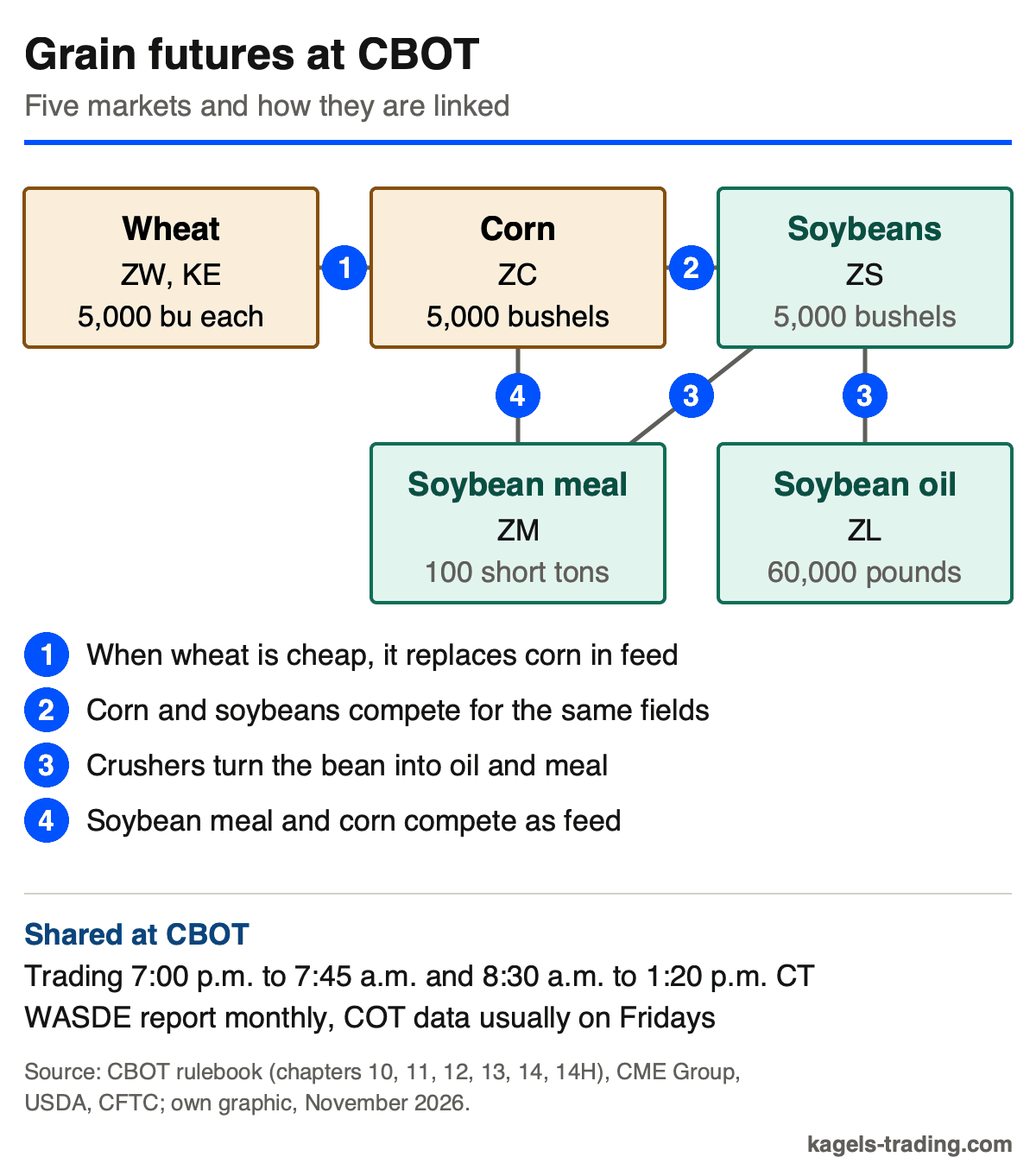
The graphic shows the five markets with code and contract size and the four main links between them.
 Click to enlarge
Source: CME Group, agricultural futures.
Corn and soybeans compete for the same fields in the US Midwest. What farmers plant in spring depends partly on the price ratio of the two, and that ratio then moves both markets.
Crushers turn the soybean into oil and meal. The margin of this processing is called the crush spread and links the three soybean markets; in the feed trough, soybean meal in turn competes with corn.
Wheat is mainly a food grain, but part of it ends up in feed. When it becomes cheap relative to corn, it replaces some of the corn there. Links like these explain why a weather problem in one market often moves the others too.
Later contract months can be priced above or below the front month. What this futures curve means for rolling a position is explained in our guide to contango and backwardation, and it applies to all five markets.
Which grain market suits you?
Account size and liquidity matter most for getting started. Corn is the market with the most open contracts. At the same size of 5,000 bushels, a corn contract is worth much less than a soybean contract, because a bushel of corn costs less.
With a small account, the route is the Micro futures. They cover one tenth of the size and settle in cash, so there is no delivery risk. How to size them from your stop is explained in our guide to micro futures.
Whichever market you choose, set your stop and position size before every trade. How to do this is shown in our guide to risk management, and the stop always comes before the number of contracts.
Conclusion: one cluster, five markets
Grain futures share their exchange, hours and report dates, but differ in their price drivers. Corn depends on ethanol and feed, wheat on crops around the Black Sea and in Europe, and the soybean markets on China, energy policy and the crush.
If you trade one of these markets, you should know the others. The five guides linked in the table above take you into each of them in detail.
Frequently asked questions about grain futures
Which grain futures are there?
The main grain futures are corn, wheat and soybeans with soybean oil and soybean meal at the Chicago Board of Trade. Euronext in Paris also lists milling wheat and corn for the European market.
When do grain futures trade?
CBOT grain futures trade Sunday to Friday from 7:00 p.m. to 7:45 a.m. CT and Monday to Friday from 8:30 a.m. to 1:20 p.m. CT. In Eastern Time, that is 8:00 p.m. to 8:45 a.m. and 9:30 a.m. to 2:20 p.m.
Is the soybean a grain?
No, the soybean is an oilseed, but the exchange lists it together with grains. It grows on the same fields as corn and appears in the same USDA reports.
Which grain futures suit a small account?
Micro futures with one tenth of the standard size suit small accounts best. They exist for corn, wheat, soybeans, soybean oil and soybean meal, and they settle in cash.
What moves grain prices?
Grain prices depend mainly on crops, weather, demand and the monthly WASDE report of the US Department of Agriculture. The dollar, exports and links between the markets, such as the competition for acreage, matter too.
This English edition is based on our German edition on kagels-trading.de and has been adapted for international readers.
More Markets and Brokers guides
- Open your first account
What Is a Brokerage Account? A US Beginner's Guide
How to open and fund a US brokerage account, cash vs margin, what it costs and what SIPC and FDIC really cover.
- Know what trading really costs
Trading Costs: Every Fee You Pay and How to Cut It
Spread, commissions, SEC and FINRA fees, market data, margin interest and tax, with yearly totals for three trading styles.
- Choose a broker
Interactive Brokers Review 2026: Fees and Platforms
Fees, platforms, investor protection and real futures commissions from a client since 1996.
- Check TradeStation
TradeStation Review 2026: Pricing Tiers, Fees and Platform
Broker and strategy platform: volume tiers for stocks, options and futures checked 21 November 2026, the $5 ticket charge outside the US, fees and EasyLanguage.
- Choose an options broker
tastytrade Review 2026: Options Fees, Margin and Safety
tastytrade from an options trader's own account and its October 2026 fee schedule: fees, the 6.75% margin rate, safety and FINRA fines.
- Check Tradovate
Tradovate Review 2026: Fees, Margins and Who Holds Your Money
The futures broker in many prop firm contracts: all-in costs per plan checked 21 November 2026, the $35 inactivity fee, margins and the clearing firm behind it.
- Check an offshore broker
PU Prime Review 2026: FCA Warning, Licences and Costs
Which PU Prime company you contract with, what the FCA warning means, and what 1:1000 leverage and the deposit bonus do to your account.
- Check an EU CFD broker
Tradeview Review 2026: Tradeview Europe, MFSA and Costs
What the Malta licence of Tradeview Europe covers, how it differs from the Cayman company, and what the three MetaTrader 5 accounts cost.
- Check ZuluTrade
ZuluTrade Review 2026: Costs, Regulation and US Status
Who runs the copy trading platform, what it costs through your broker, why the US was missing from its sign-up form and what the CFTC fined its US company for.
- Check CopyX
CopyX Review 2026: Is TAG Markets Copy Trading Legit?
Who runs the TAG Markets copy trading platform, which regulators warn about it, why US residents are excluded and how fast the 12x Amplify account eats your deposit.
- Choose a US forex broker
OANDA Review 2026: Fees, TradingView and US Rules
OANDA from its own pages and NFA records: spreads and fees, TradingView and the demo, FIFO and three penalties.
- Check a commission-free app broker
Webull Review 2026: Fees, Margin Rates and Safety
Webull from its own fee schedule and FINRA records: what is free, margin rates and Premium, overnight trading, crypto and three fines.
- Understand your price
Market Makers: Who Sets Your Price and How They Profit
How market makers earn on the spread, who sets prices at German trading venues and what the EU ban on payment for order flow changed.
- Trade an index CFD
Index CFDs at Interactive Brokers: Symbols, Costs and Trading
All 13 IBKR index CFDs, margin, stop and close-out worked through for IBDE40, financing, UK hours and the TradingView limit.
- Size an index future
Micro Futures: MES vs MNQ, Tick Values and Risk
MES and MNQ tick values, a worked sizing example from the stop with costs and slippage, and why margin is not your risk.
- Choose between futures and CFDs
Futures vs CFDs: Regulation, Order Execution and Costs
Who your counterparty is, EU, UK and US rules, how stops are triggered on CME and at CFD providers, and booked costs in a DAX example.
- Understand the IBKR Exposure Fee
IBKR Exposure Fee: What It Is and How to Reduce It
Why Interactive Brokers charges a daily fee on high-risk accounts, why weekends count, where to find it and how to reduce it, with a real 1.12 euro notice.
- Read the futures curve
Contango vs Backwardation: Futures Curves Explained
What contango and backwardation mean, what rolling does to a position in each case, and real gold, oil and gas curves from 28 October 2026.
- Understand the spot market
Spot Market Explained: Definition and Settlement Times
What a spot market is, why two days is a minimum and not a limit, and when stocks settle at T+1 in the US, EU, UK and Switzerland.
- Choose a silver future
Silver Futures: SI vs Micro Silver vs 100-oz SIC
SI, Micro Silver and the 100-ounce SIC compared by tick value, risk per contract, margin and December 2026 deadlines.
- Trade soybean futures
Soybean Futures: Contract Specs, Hours and Price Drivers
CBOT soybean contract specs, Mini and Micro, trading hours, daily price limits, WASDE and China, and a seasonal test over 4,784 trading days.
- Trade soybean meal futures
Soybean Meal Futures: Contract Specs, Crush and Price Drivers
CBOT soybean meal contract specs, the Micro, trading hours, price limits, the crush spread with beans and oil, Argentina and a seasonal test.
- Trade soybean oil futures
Soybean Oil Futures: Contract Specs, Biofuels and the Crush
CBOT soybean oil contract specs, the Micro, trading hours, daily price limits, biofuel demand and EPA rules, WASDE and the soybean crush.
- Trade corn futures
Corn Futures: Contract Specs, Hours and Price Drivers
CBOT corn contract specs, the Micro, trading hours in CT, daily price limits, WASDE, ethanol and exports, and a seasonal test over 4,784 trading days.
- Trade wheat futures
Wheat Futures: Chicago, Kansas City and What Moves Prices
Chicago SRW and Kansas City HRW wheat specs, the Micro, linked price limits, the KC-Chicago spread, the Black Sea and a seasonal test.
- Understand your taxes
Trading Taxes in the US: How Traders Are Taxed in 2026
US federal rules for 2026: short and long term rates, the $3,000 loss limit, wash sales, the 60/40 rule for futures and trader tax status.