
Tradovate Review 2026: Fees, Margins and Who Holds Your Money


Contents
- Tradovate in 30 seconds (as of November 21, 2026)
- What is Tradovate?
- Who owns Tradovate, and who holds your money?
- What does Tradovate cost?
- Which margins apply?
- Market data: what you pay for live prices
- Platform, app and connections
- Can traders outside the US open an account?
- What do users say about Tradovate?
- Pros and cons of Tradovate
- Conclusion: who is Tradovate for?
- Frequently asked questions about Tradovate
- About the author
Tradovate is a futures broker with its own browser-based platform, and many traders first meet it through a prop firm. Several funded trading programs run their accounts on Tradovate, so the name shows up in the contract before you have chosen it yourself. Our Tradeify review is one example. This review answers three questions: what a trade really costs, who holds your money and which fees surprise new clients.
All prices, margins and rules here are as of November 21, 2026. We read Tradovate’s pricing and commission pages, its margin table, its support articles and the register of the National Futures Association (NFA). We did not open an account and have no business relationship with Tradovate. How we work is on our editorial policy page. Futures are leveraged, and you can lose more than you deposit.
This review covers personal brokerage accounts at Tradovate. If you trade a prop firm evaluation or funded account on the Tradovate platform, the prop firm’s terms apply to fees, data and rules, according to Tradovate’s prop account guidance. The platform name alone does not mean the brokerage terms below apply to you.
Tradovate in 30 seconds (as of November 21, 2026)
- What it is: a futures broker with its own cloud platform; it offers exchange-traded futures, not stocks or CFDs.
- Who holds your money: NinjaTrader Clearing, LLC, which does business as Tradovate. It is a CFTC-registered futures commission merchant and NFA member, and part of the NinjaTrader Group that Kraken bought in 2025.
- Plans: Free ($0), Monthly ($99) or Lifetime ($1,499). A round turn in the E-mini S&P 500 costs $4.34 to $5.74 all-in.
- Watch out: a $35 inactivity fee on the Free plan if you place no live trade within 30 days.
- Margins: day trading from $50 for the Micro E-mini S&P 500, but $2,817 if you hold it overnight.
What is Tradovate?
Tradovate is a US futures broker that runs its own cloud trading platform and offers only exchange-traded futures and options on futures. You get the platform and the brokerage account from one company. The platform runs in the browser, so your layouts and settings live on the server and follow you to any computer.
The offer is deliberately narrow. Tradovate lists equity index, interest rate, energy, metal, agricultural, currency and crypto futures, plus small nano contracts and event contracts. Every order goes to an exchange such as the CME, so Tradovate does not trade against you the way many CFD brokers do. For smaller accounts, the micro futures matter most: the Micro E-mini S&P 500 moves $5 per index point instead of $50.
Who owns Tradovate, and who holds your money?
Tradovate is now a trade name of NinjaTrader Clearing, LLC. The NFA register lists that firm as a CFTC-registered futures commission merchant (FCM) and NFA member under NFA ID 0309379, doing business as Tradovate, NinjaTrader and Kraken Derivatives US. The FCM holds your margin and clears your trades.
The old Tradovate, LLC is no longer registered. According to the NFA register, Tradovate, LLC withdrew its NFA membership in January 2025 and its introducing broker registration in March 2025. Older reviews that list Tradovate, LLC as an introducing broker are out of date.
The group belongs to Kraken. Kraken announced the purchase of NinjaTrader for $1.5 billion in March 2025 and completed it on May 1, 2025, according to its announcements. NinjaTrader continues as a separate platform, and every Tradovate plan now includes the NinjaTrader platforms for desktop, web and mobile.
The regulatory record
The register shows several actions against the clearing firm, and you should know them before you deposit. In September 2024, the CFTC ordered NinjaTrader Clearing to pay a $750,000 penalty and about $233,000 in restitution for failing to supervise the handling of accounts linked to a fraud case, according to CFTC release 8973-24. In an NFA decision filed on May 29, 2025, a hearing panel ordered the firm to pay a $250,000 fine over anti-money-laundering and supervision failures; the firm settled without admitting or denying the allegations. The register also lists a $2,500 CME recordkeeping fine in November 2026.
None of this says your money is unsafe, but it is part of the picture. US futures accounts are protected by the CFTC’s segregation rules, which keep client money apart from the firm’s own. That is not deposit insurance, and it does not protect you against trading losses.
What does Tradovate cost?
Tradovate has three plans that differ in the monthly fee and the commission per contract. All prices are per side; a round turn, the buy and the sell, costs twice as much. Which plan is cheaper depends on how many contracts you trade.
| Plan | Fee | Commission per side (standard / micro) |
|---|---|---|
| Free | $0 | $1.29 / $0.39 |
| Monthly | $99 a month | $0.99 / $0.29 |
| Lifetime | $1,499 once, or 4 payments of $499 | $0.59 / $0.09 |
Source: tradovate.com/pricing, read November 21, 2026. Nano and event contracts cost $0.20, $0.15 and $0.05 per side.
The commission is only part of the bill. Exchange, NFA and clearing fees come on top, and on micro contracts they are larger than the commission. For the E-mini S&P 500, exchange and NFA fees are $1.39 and clearing is $0.19 per side. Tradovate charges only when an order fills; cancelled orders cost nothing.
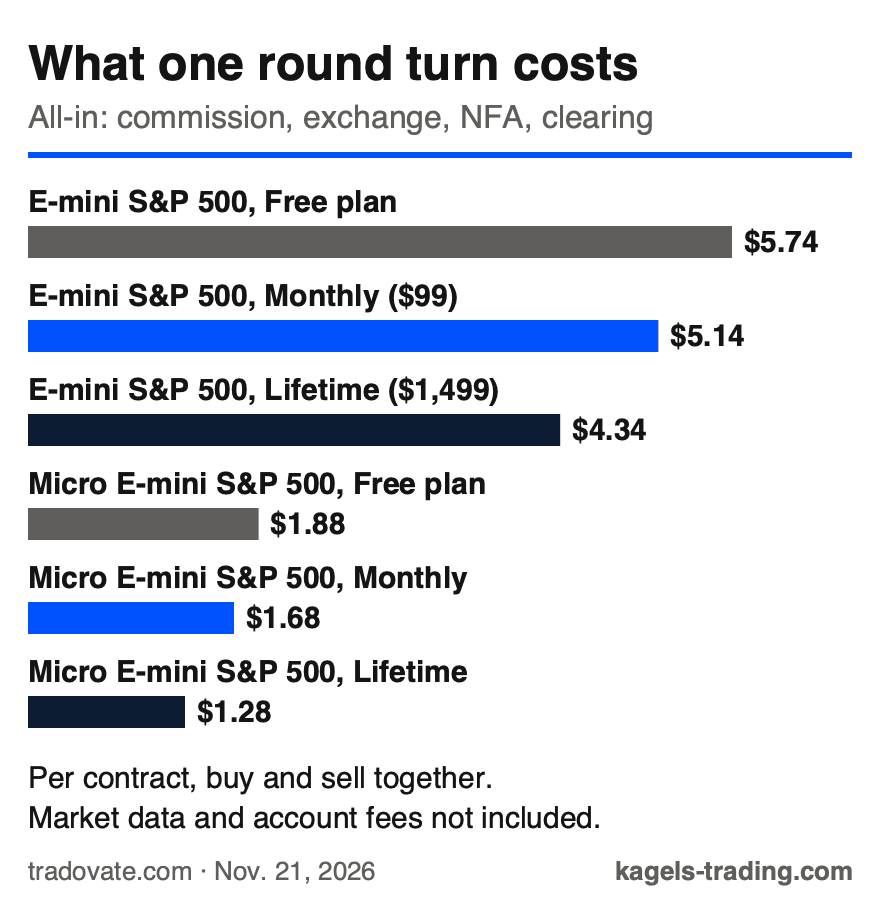 Click to enlarge
Source: Kagels Trading, own graphic from Tradovate's commission table.
The monthly plan pays off only at high volume. On the E-mini S&P 500, Monthly saves $0.60 per round turn against Free, so the $99 needs about 165 round turns a month. On the Micro E-mini, the saving is $0.20, and the break-even is about 495 round turns. The Lifetime plan saves $1.40 per E-mini round turn and needs about 1,071 round turns to pay back its price. For most new traders, Free is the right start.
Fees that are easy to miss
- Inactivity fee: $35 for Free plan holders who place no live trade within 30 days. Simulated trades do not count; Monthly and Lifetime plans are exempt.
- Withdrawals: ACH is free; a domestic wire costs $30, an international wire 30 units of the original currency.
- Currency conversion: 1 percent, at least 10 units, if you deposit euros, pounds or other currencies.
- Margin call and liquidation: $50 for a margin call; $25 for a first margin liquidation, $50 after that.
Source: Tradovate support article “Account & Exchange Fees”, updated September 2, 2026.
Which margins apply?
Day margin is the reduced deposit for intraday positions; from 15 minutes before the session close, the full exchange margin applies. If your account cannot meet the initial margin by then, the position can be liquidated, according to Tradovate’s margin policy. The gap between the two margins is large, and that gap is the risk. Margins change with the market, so check the table before each session.
| Contract | Day margin | Overnight (initial) margin |
|---|---|---|
| Micro E-mini S&P 500 (MES) | $50 | $2,817.05 |
| Micro E-mini Nasdaq-100 (MNQ) | $100 | $4,360.16 |
| E-mini S&P 500 (ES) | $500 | $28,170.47 |
| E-mini Nasdaq-100 (NQ) | $1,000 | $43,601.56 |
Source: Tradovate margin table, read November 21, 2026.
A low day margin means high leverage. In the E-mini S&P 500, one index point is $50; ten points against you would equal the full $500 day margin, and the position can be liquidated before that. If you start with a small account, stay with the micro contracts and size your positions with a stop; our guide to position sizing shows how, and our margin call guide explains what happens when the money runs out.
Market data: what you pay for live prices
Without a subscription, Tradovate shows prices with a ten-minute delay, which is useless for trading. The support article on non-professional data rates lists $12 a month for top of book data on the CME Group bundle (CME, CBOT, COMEX and NYMEX) and $48 for full market depth. Single exchanges cost $4 and $16. Market depth is needed for the DOM ladder.
There is a conflict in Tradovate’s own pages. The pricing page lists “Top of Book Market Data” with an approved and funded account among the tools all plans include, while the fee articles list monthly prices. The Eurex price also differs between two articles ($14 and $23). Confirm in your account which data fee applies before you subscribe.
Platform, app and connections
The web platform includes charts, the DOM, an order ticket, simulated trading and Market Replay. Market Replay plays back historical tick data so you can practice on past sessions. A simulated account is included in every plan, and the mobile app for Android and iOS covers the essentials: positions, orders and stops.
Tradovate connects to TradingView and other tools. You can trade your Tradovate account from TradingView charts; our guide to TradingView brokers explains how the connection works. If you use a third-party platform with a different broker, that broker’s fees apply instead. Tradovate does not let you plug in an outside data feed; for that, see our guide to Rithmic.
Can traders outside the US open an account?
Tradovate accepts deposits in US dollars, euros, British pounds, Australian dollars and Canadian dollars. Everything is converted to US dollars for trading, at 1 percent. Whether you can open an account depends on your country of residence, which Tradovate checks in the application.
As a non-US client, your account is held and regulated in the US. Your money sits with a US clearing firm, so do not assume that your home country’s deposit or investor compensation scheme covers this futures account. International wire withdrawals cost 30 units of the original currency, which makes small transfers expensive; other withdrawal methods have their own fees.
What do users say about Tradovate?
On Trustpilot, Tradovate had 1.5 stars from 1,913 reviews on November 21, 2026. The profile has been claimed since February 2018, and Trustpilot marks it as a company with a paid subscription. Trustpilot’s AI summary of recent reviews mentions platform crashes, freezing and downtime. Trustpilot says it does not fact-check reviews, so read the complaints as topics to check, not as proof.
Pros and cons of Tradovate
Pros
- Low entry: day margin from $50 for the Micro E-mini S&P 500.
- No platform fee: the Free plan costs $0 a month, and NinjaTrader platforms are included.
- Exchange-traded: orders go to the exchange; no CFD counterparty.
- Clear cost tables: all-in rates per contract are published.
Cons
- Inactivity fee: $35 on the Free plan after 30 days without a live trade.
- Fees on top: exchange, NFA and clearing fees add to the advertised commission.
- Regulatory record: a CFTC order and an NFA fine against the clearing firm in 2024 and 2025.
- Weak reviews: 1.5 stars on Trustpilot, with complaints about stability.
Conclusion: who is Tradovate for?
Tradovate suits futures traders who want low costs on small contracts and a platform that runs in the browser. A Micro E-mini round turn costs $1.88 all-in on the Free plan, and the day margin starts at $50. If you trade often enough, the Monthly or Lifetime plan lowers the cost per trade.
Check three things before you open an account. First, the inactivity fee if you trade rarely. Second, the full cost including market data and, if you live outside the US, currency conversion. Third, the regulatory record of the clearing firm and the complaints about platform stability. If you mainly need a stock or ETF account, a multi-asset broker fits better.
Frequently asked questions about Tradovate
Is Tradovate legit?
Tradovate is a trade name of NinjaTrader Clearing, LLC, a CFTC-registered futures commission merchant and NFA member. The clearing firm was ordered to pay a CFTC penalty in 2024 and an NFA fine in 2025. Trustpilot shows 1.5 stars, with complaints about stability and support.
Who owns Tradovate?
Tradovate belongs to the NinjaTrader Group, which Kraken bought for $1.5 billion. Kraken announced the deal in March 2025 and completed it on May 1, 2025. The brokerage runs through NinjaTrader Clearing, LLC.
How much does Tradovate cost per month?
The Free plan costs $0, Monthly $99 a month and Lifetime $1,499 once, as of November 21, 2026. On top come the commission and exchange, NFA and clearing fees per contract. A round turn in the E-mini S&P 500 costs $4.34 to $5.74.
Does Tradovate charge an inactivity fee?
Yes, $35 for Free plan holders who place no live trade within 30 days. Simulated trades do not count. Monthly and Lifetime plans are exempt, and the fee does not apply to a $0 balance.
What is the day trading margin at Tradovate?
$50 for the Micro E-mini S&P 500, $500 for the E-mini S&P 500 and $1,000 for the E-mini Nasdaq-100, as of November 21, 2026. From 15 minutes before the session close, the full exchange margin applies: about $28,170 for one E-mini S&P 500. Margins change with the market.
Can I use Tradovate with TradingView?
Yes, you can connect your Tradovate account to TradingView and trade from its charts. You need active live data access; whether it costs extra depends on your account’s entitlement, and Tradovate’s own pages differ on the top of book price. Each plan also includes the NinjaTrader platforms.
This English edition is based on our German edition on kagels-trading.de and has been adapted for international readers.
More Markets and Brokers guides
- Open your first account
What Is a Brokerage Account? A US Beginner's Guide
How to open and fund a US brokerage account, cash vs margin, what it costs and what SIPC and FDIC really cover.
- Know what trading really costs
Trading Costs: Every Fee You Pay and How to Cut It
Spread, commissions, SEC and FINRA fees, market data, margin interest and tax, with yearly totals for three trading styles.
- Choose a broker
Interactive Brokers Review 2026: Fees and Platforms
Fees, platforms, investor protection and real futures commissions from a client since 1996.
- Check TradeStation
TradeStation Review 2026: Pricing Tiers, Fees and Platform
Broker and strategy platform: volume tiers for stocks, options and futures checked 21 November 2026, the $5 ticket charge outside the US, fees and EasyLanguage.
- Choose an options broker
tastytrade Review 2026: Options Fees, Margin and Safety
tastytrade from an options trader's own account and its October 2026 fee schedule: fees, the 6.75% margin rate, safety and FINRA fines.
- Check an offshore broker
PU Prime Review 2026: FCA Warning, Licences and Costs
Which PU Prime company you contract with, what the FCA warning means, and what 1:1000 leverage and the deposit bonus do to your account.
- Check an EU CFD broker
Tradeview Review 2026: Tradeview Europe, MFSA and Costs
What the Malta licence of Tradeview Europe covers, how it differs from the Cayman company, and what the three MetaTrader 5 accounts cost.
- Check ZuluTrade
ZuluTrade Review 2026: Costs, Regulation and US Status
Who runs the copy trading platform, what it costs through your broker, why the US was missing from its sign-up form and what the CFTC fined its US company for.
- Check CopyX
CopyX Review 2026: Is TAG Markets Copy Trading Legit?
Who runs the TAG Markets copy trading platform, which regulators warn about it, why US residents are excluded and how fast the 12x Amplify account eats your deposit.
- Choose a US forex broker
OANDA Review 2026: Fees, TradingView and US Rules
OANDA from its own pages and NFA records: spreads and fees, TradingView and the demo, FIFO and three penalties.
- Check a commission-free app broker
Webull Review 2026: Fees, Margin Rates and Safety
Webull from its own fee schedule and FINRA records: what is free, margin rates and Premium, overnight trading, crypto and three fines.
- Understand your price
Market Makers: Who Sets Your Price and How They Profit
How market makers earn on the spread, who sets prices at German trading venues and what the EU ban on payment for order flow changed.
- Trade an index CFD
Index CFDs at Interactive Brokers: Symbols, Costs and Trading
All 13 IBKR index CFDs, margin, stop and close-out worked through for IBDE40, financing, UK hours and the TradingView limit.
- Size an index future
Micro Futures: MES vs MNQ, Tick Values and Risk
MES and MNQ tick values, a worked sizing example from the stop with costs and slippage, and why margin is not your risk.
- Choose between futures and CFDs
Futures vs CFDs: Regulation, Order Execution and Costs
Who your counterparty is, EU, UK and US rules, how stops are triggered on CME and at CFD providers, and booked costs in a DAX example.
- Understand the IBKR Exposure Fee
IBKR Exposure Fee: What It Is and How to Reduce It
Why Interactive Brokers charges a daily fee on high-risk accounts, why weekends count, where to find it and how to reduce it, with a real 1.12 euro notice.
- Read the futures curve
Contango vs Backwardation: Futures Curves Explained
What contango and backwardation mean, what rolling does to a position in each case, and real gold, oil and gas curves from 28 October 2026.
- Understand the spot market
Spot Market Explained: Definition and Settlement Times
What a spot market is, why two days is a minimum and not a limit, and when stocks settle at T+1 in the US, EU, UK and Switzerland.
- Choose a silver future
Silver Futures: SI vs Micro Silver vs 100-oz SIC
SI, Micro Silver and the 100-ounce SIC compared by tick value, risk per contract, margin and December 2026 deadlines.
- Trade soybean futures
Soybean Futures: Contract Specs, Hours and Price Drivers
CBOT soybean contract specs, Mini and Micro, trading hours, daily price limits, WASDE and China, and a seasonal test over 4,784 trading days.
- Understand your taxes
Trading Taxes in the US: How Traders Are Taxed in 2026
US federal rules for 2026: short and long term rates, the $3,000 loss limit, wash sales, the 60/40 rule for futures and trader tax status.