
Bid-Ask Spread Explained: Formula, Examples and Costs


Contents
- Bid-ask spread in 30 seconds
- What is the bid-ask spread?
- How to calculate the bid-ask spread: formula and examples
- What affects the bid-ask spread
- Fixed and variable spreads
- What is a normal bid-ask spread?
- How to lower your spread costs
- Conclusion: understand the spread before you trade
- Frequently asked questions about the bid-ask spread
- About the author
The bid-ask spread is the quietest fee in trading. It never shows up on a trade confirmation, yet you pay it whenever you buy or sell at once at the quoted price. I have paid this spread since 1980, in stocks, futures and forex. Once you understand it, you see at once why a position bought with a market order starts slightly in the red.
This guide shows what the bid and the ask really are and how to calculate the spread. You will see examples in dollars, percent and pips, what makes a spread wider, and four practical ways to keep your spread costs low. It is educational, not investment advice, and follows our editorial policy.
Bid-ask spread in 30 seconds
- Bid and ask: The bid is the highest price a buyer offers right now, the ask the lowest price a seller accepts. If you trade at once, you buy at the ask and sell at the bid.
- Definition: The bid-ask spread is the difference between the ask and the bid. It works like a hidden transaction cost whenever you trade at once at the quoted price.
- Calculation: Ask minus bid gives the spread in dollars. The spread in percent of the ask lets you compare different stocks and products.
- What drives it: Liquidity, trading volume, volatility and the time of day decide how tight or wide the spread is.
- How to pay less: Trade liquid markets in their main hours, use limit orders and compare brokers and venues.
What is the bid-ask spread?
The bid-ask spread is the difference between the ask, the price at which you can buy a security right now, and the bid, the price at which you can sell it right now.
Every market shows two prices for the same security at the same time. One belongs to the buyers, the other to the sellers. The single price your broker app shows is often the last trade or the midpoint between the two. The SEC’s investor site defines the ask price in the same plain way, as the lowest price a seller will accept.
What do bid and ask mean?
The bid is the highest price a buyer is currently willing to pay for a security.
The ask, also called the offer, is the lowest price at which a seller currently offers it.
Bid and ask are not two opinions about the value, they are two roles. Whoever wants to buy posts a bid, whoever wants to sell posts an ask. Both stand in the market at the same time, and a trade only happens when one side accepts the other side’s price.
For you as a trader, the rule is simple: if you trade at once, you normally buy at the ask and sell at the bid. Assuming enough shares are available at the quoted prices, unchanged quotes and no price improvement: if you buy a position and sell it again at once, you lose the full spread: half of it against the midpoint on the way in, half on the way out. That is why a position bought with a market order starts with a small paper loss. An easy way to remember it: buyers bid, sellers ask, and an order that trades at once takes the price that is worse for you. A limit order resting at the bid can buy at the bid, and some orders get a better price than the quote.
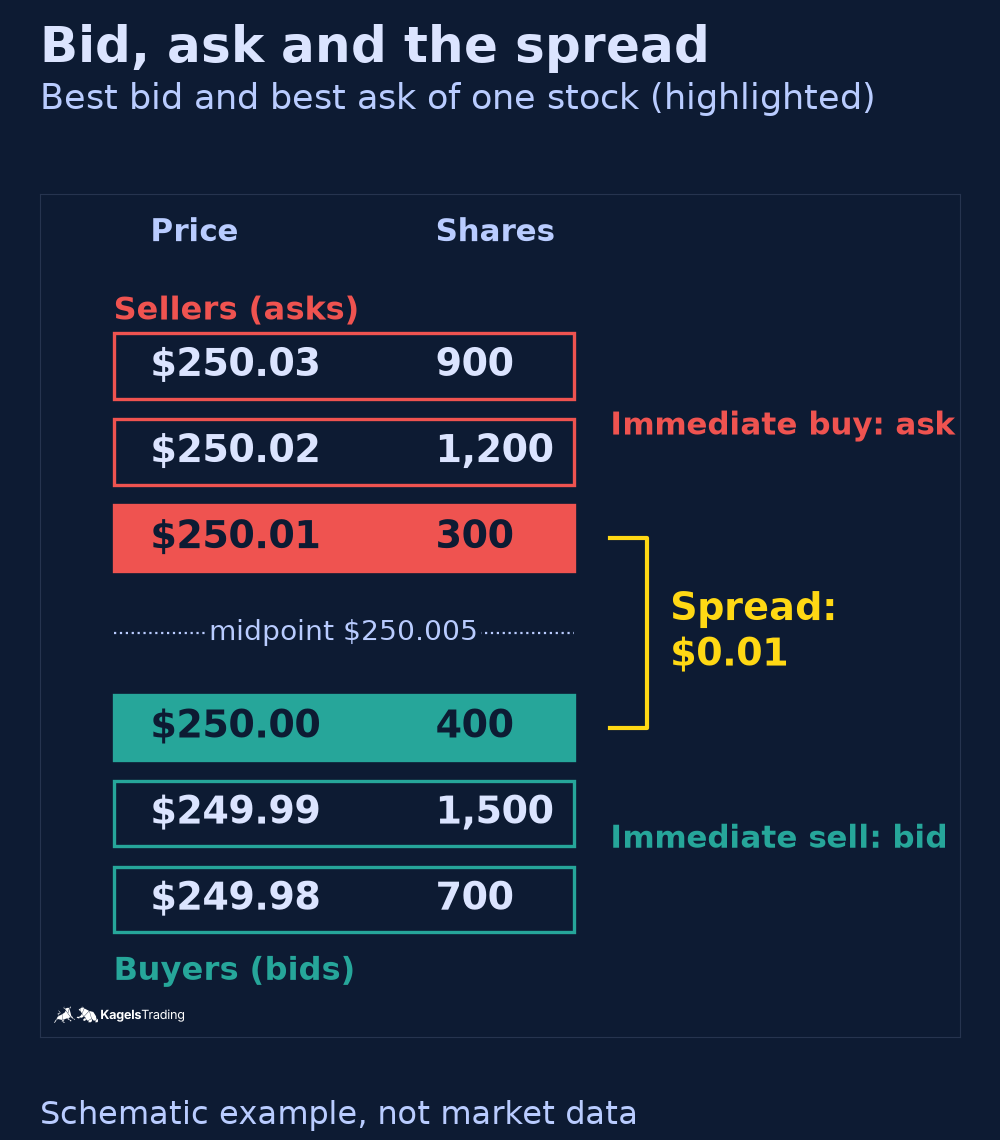
The graphic below shows how the quotes stack up in the order book. The asks are above, the bids below, and the gap between the best ask and the best bid is the spread. In US stocks, the best bid and ask across all exchanges together are called the National Best Bid and Offer, or NBBO.
 Click to enlarge
Source: Kagels Trading, own learning graphic.
Who sets the spread? The role of the market maker
A market maker is a market participant that continuously quotes buy and sell prices and earns money from the spread.
The market maker keeps trading possible even when no other buyer or seller is there at that moment. It is paid for this risk through the spread: it buys at the lower bid and sells at the higher ask. The harder a security is to trade, the wider the market maker sets its quotes. The spread is not a rip-off but the price of immediacy. Our guide to the market maker explains how these firms earn money and which inventory risk they carry.
In US stocks, quotes move in fixed steps called the tick size. Under Rule 612 of Regulation NMS, quotes and orders in US stocks priced at $1.00 or more may not be priced in steps smaller than one cent, with some exemptions. The SEC adopted a half-cent step for the most actively traded stocks in 2024, but its order of June 11, 2026 (Release 34-105656) delays compliance until the first business day of November 2027. So as of November 2026, one cent is the normal smallest quoted spread in a stock above $1. Trades can still happen inside it, for example at the midpoint or with price improvement; the SEC explains the difference in its Rule 612 FAQ.
How to calculate the bid-ask spread: formula and examples
All you need for the calculation are the two prices. The bid and the ask go into two simple formulas:
- Spread in dollars: ask minus bid
- Spread in percent: (spread in dollars divided by the ask) times 100
Some data providers divide by the midpoint instead of the ask. For liquid stocks the result is almost the same, so pick one method and use it for every comparison.
Example: a large-cap stock and a small-cap stock
A busy large-cap stock and a thinly traded small cap can have very different spreads. Take a large-cap stock quoted at a bid of $250.00 and an ask of $250.01. The spread is $0.01, or $0.01 divided by $250.01 times 100, about 0.004%. If you buy 100 shares and sell them again at once, the spread alone costs you $1, before any commission.
Now take a small cap quoted at a bid of $4.95 and an ask of $5.05. The spread is $0.10, or $0.10 divided by $5.05 times 100, about 1.98%. The same 100-share round trip costs you $10 on a position worth only $505. In percent, that is almost 500 times the spread of the large cap.
The percentage is the number that matters. Only the percentage lets you compare a $5 stock fairly with a $250 stock or with an ETF. A useful test before each trade: put the spread next to your profit target. If you aim for a 4% move in the small cap above, the spread already takes half of it.
Example in forex: the spread in pips
A pip is the smallest standard price step of a currency pair, for most pairs the fourth decimal place (0.0001).
In the currency market, the spread is quoted in pips. Say EUR/USD is quoted at a bid of 1.0850 and an ask of 1.0851. The difference is 0.0001, exactly 1 pip. In a mini lot of 10,000 euros, one pip is worth $1, so this entry costs you $1 in spread. With three mini lots it is $3. For pairs quoted against the Japanese yen, a pip is the second decimal place (0.01).
What affects the bid-ask spread
How tight or wide the spread is depends mainly on three market factors. All three point the same way: the easier it is for the market maker to judge its risk, the tighter it quotes.
Liquidity describes how quickly a security can be bought or sold without moving its price.
- Liquidity: The more buyers and sellers are active, the tighter the spread. In illiquid securities you wait longer for the other side and pay a wider spread for it.
- Trading volume: High volume means many small profits for the market maker. It can quote a tight spread and earn through volume. A look at volume before a larger order pays off; our guide to volume analysis shows how to read it.
- Volatility: When the market swings hard, the market maker’s risk rises, and it widens the spread to make up for it. You see this most clearly around major events in the economic calendar and in panic phases.
Time of day matters as well. Outside the regular session of the home exchange, the reference market is missing. US stocks trade most actively from 9:30 a.m. to 4:00 p.m. Eastern Time; in pre-market and after-hours trading, fewer participants are active and spreads are usually wider, even when nothing has happened to the company.
The spread is not your only trading cost. Brokers that advertise zero spreads in forex usually charge a commission per trade instead, and many combine both. Compare the total cost of a round trip, not one line of the price list.
Fixed and variable spreads
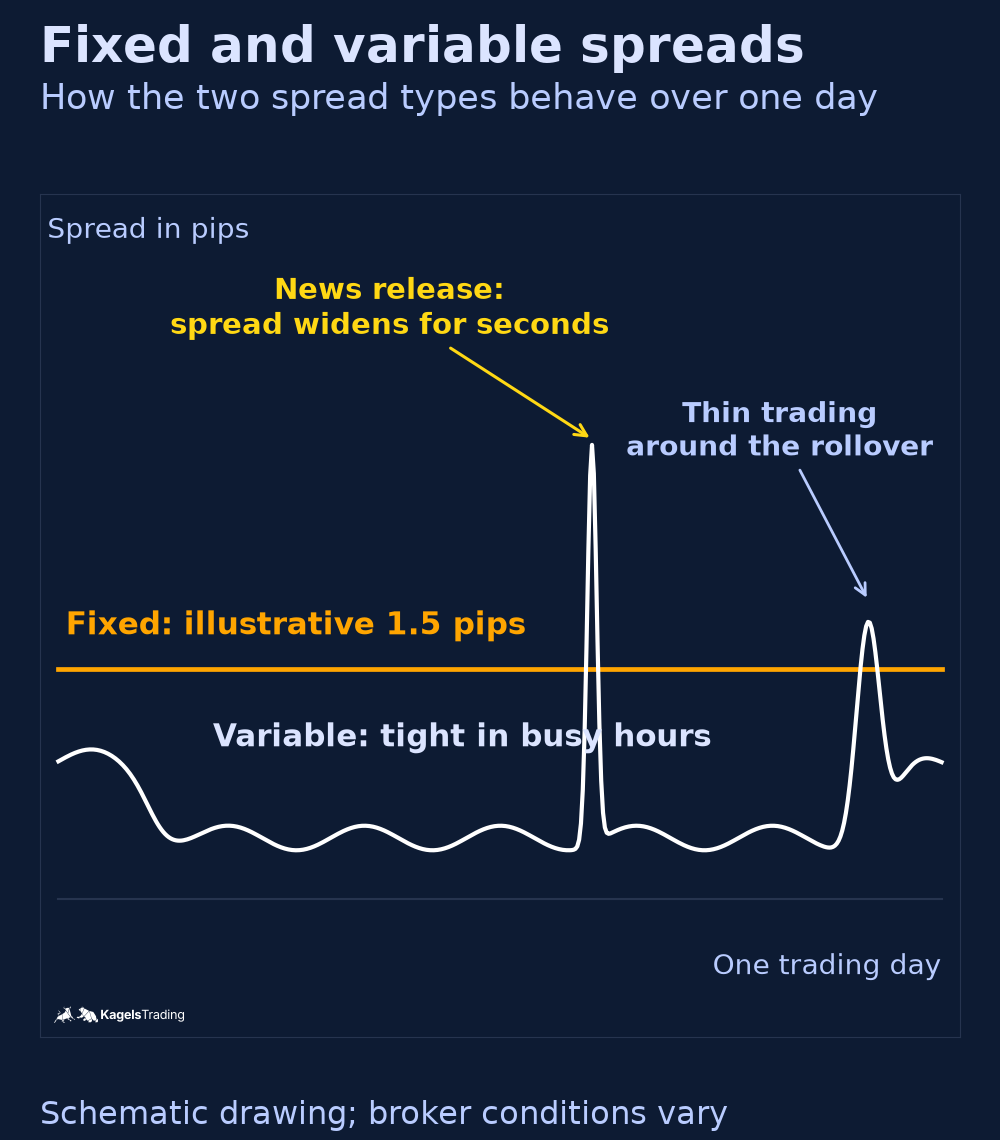
Brokers, mainly in forex and CFDs, quote the spread in one of two ways. The graphic below compares fixed and variable spreads over one trading day.
 Click to enlarge
Source: Kagels Trading, own learning graphic.
Fixed spreads are normally held constant under the broker’s stated conditions. They typically come from dealing desk brokers that act as the counterparty to your trades. The advantage: you know your transaction costs in advance, but check the exceptions in the broker’s execution terms. The drawback: in hectic moments the broker often cannot hold the quoted price, and you get a requote, a new and usually worse price, or slippage.
Slippage is the difference between the price you expected and the price at which your order was actually filled.
Variable spreads, also called floating spreads, move with the market. The broker passes on the prices of its liquidity providers, so in quiet, busy hours you often get very tight spreads. In return, the spread widens exactly when things turn turbulent. You see it most around economic releases, when the spread can blow out for a few seconds.
Which type suits you depends on your trading style. If you trade rarely with a small account, fixed spreads are easier to plan. Active traders with larger accounts tend to gain from variable spreads in the main hours. In scalping and day trading, every sudden widening eats directly into profit, so tight and stable spreads are a must. In swing trading, with holding periods of days to weeks, the spread matters far less.
What is a normal bid-ask spread?
There is no fixed upper limit; competition between quoting firms sets the spread. As a rough guide, these orders of magnitude hold:
- Large-cap US stocks and big ETFs: In normal hours the spread is often just the one-cent minimum, a few thousandths of a percent of the price.
- Major currency pairs: EUR/USD and other majors are among the cheapest markets to trade; what you pay depends on your broker’s account model and the time of day.
- Options, leveraged products and CFDs: Here the spread is often the largest cost item. Compare products with the same underlying and similar terms before you buy, the differences are often bigger than you think.
- Small caps and exotic pairs: In thinly traded stocks, exotic currency pairs or at night, the spread can reach several percent. Rule of thumb: the more exotic the market, the wider the spread.
A warning sign to remember: the spread is unusually wide for this instrument. If the spread is far wider than the normal spread of this stock or pair, or too wide for your planned trade, check the quote timestamp, the venue, the available size and the current news before you trade, or wait.
Bid size and ask size: how many shares does the price cover?
Bid size and ask size tell you how many shares the displayed bid and ask are actually good for.
The two prices never apply to unlimited size. In the quote ladder above, the best ask of $250.01 covers 300 shares. A market order for 1,000 shares would take those 300 shares and then 700 shares at $250.02, an average of $250.017. Large orders move their own price this way. That is why experienced traders read the market depth before they enter; our guide to order flow trading explains the order book and its levels.
Other meanings of “spread”
The word spread has other meanings in markets too. A credit spread is the yield gap between a riskier bond and a safer one. In futures, a spread position means being long and short related contracts at the same time, and in options a spread combines several contracts, as in our guide to options strategies. All of these share only the name with the bid-ask spread in this guide.
How to lower your spread costs
You cannot abolish the spread, but you can keep it small. These four steps help most in practice:
- Trade at the right time: Trade during the regular hours of the home exchange, for US stocks from 9:30 a.m. to 4:00 p.m. Eastern Time. In the evening and at night you pay the market maker’s safety margin.
- Use limit orders: A limit order sets the highest price you will pay. If the spread is wider than one tick, as in the $4.95 to $5.05 example, you can bid inside it, say at $5.00, instead of paying the ask. A fill is not guaranteed, but you never pay more than planned. In a stock with a one-cent spread you cannot set a half-cent limit price; a limit at the bid waits in line, although the market can still fill some orders at the midpoint. Our guide to order types explains both.
- Prefer liquid markets: Large caps, major currency pairs and high-volume products have structurally tighter spreads than exotic ones. Check volume and market depth before you enter.
- Compare brokers and venues: The same trade can cost a different spread depending on how your broker routes the order. Some orders fill between bid and ask, which brokers call price improvement. For active traders, small differences add up over hundreds of trades; our overview of brokerage accounts helps with the choice.
An honest limit: none of these steps protects you from news spikes. If you trade in the seconds after a rate decision or a jobs report, you almost always pay a widened spread, however good your broker is.
Conclusion: understand the spread before you trade
The bid-ask spread is one of the most underrated costs in trading. It is on no invoice and still adds up: every time you trade at once, you cross part of the gap between the ask and the bid, whether in a $5 small cap or a large cap. If you convert the spread into percent, compare products and trade in liquid hours, you save a real part of your transaction costs over a year. For day traders and scalpers the spread is a central number in every plan, for long-term investors a side issue. In both cases: know the spread before you click the buy button.
Frequently asked questions about the bid-ask spread
What is a good bid-ask spread?
The basic rule is: the tighter, the better. For liquid large-cap US stocks, the one-cent minimum is normal in regular hours. What counts is the comparison within the same product class, and the spread measured against your profit target: a fair spread on an option is wider than a fair spread on a large-cap stock.
Do I buy at the bid or the ask?
An order that trades at once normally buys at the ask and sells at the bid. It can also receive price improvement. The ask is the higher of the two prices. That is why a position bought with a market order starts with a small paper loss, about half the spread against the midpoint and the full spread against the bid.
Why is the ask always higher than the bid?
The gap is what the quoting firm earns. The market maker buys at the lower bid and sells at the higher ask. That pays for its risk of having to trade at any time, even when no other buyer or seller is in the market.
What do bid size and ask size mean?
The size is the number of shares the price applies to. An ask size of 300 means you get at most 300 shares at the displayed ask. Larger orders fill at worse prices, which raises your effective spread.
Can an order be filled inside the spread?
Orders can fill inside the spread. If the spread is wider than one tick, you can place a buy limit between the bid and the ask; if a seller accepts it, you trade better than the quoted ask, but a fill is not guaranteed. Orders can also be filled there through price improvement, for example at the midpoint.
How do I remember bid and ask?
Buyers bid, sellers ask. The bid is what buyers offer, the ask is what sellers demand. With a market order, you normally trade at the price that is worse for you.
This US edition is based on our German edition on kagels-trading.de and has been adapted for US readers.
More Trade Execution guides
- Choose the right order type
Order Types Explained: Market, Limit, Stop and Stop-Limit
Market, limit, stop, stop-limit and trailing stop orders for US stocks, what each one gives up, and who actually holds your stop.
- Link a target and a stop
OCO and Bracket Orders: Link a Target and a Stop
OCO, OTO and bracket orders, partial fills at Fidelity, Alpaca and Interactive Brokers, and why both sides can still fill.
- Set a stop loss
Stop-Loss Order: How to Set a Stop Loss on the Chart
Place the stop from the chart, size the trade from it, and know what a stop costs and what to check after a partial fill.
- Take profits at a target
Take-Profit Order: How to Set a Profit Target
Enter a profit target as a limit order, know why reaching it does not guarantee a fill, and take profits in steps without a wrong-sized stop.
- Go short on falling prices
Short Selling: How to Go Short and What It Really Costs
Five ways to go short, what borrow fees, margin, swaps and dividends cost, and the risks only short sellers face.
- Understand a short squeeze
Short Squeeze: How It Works and Famous Examples
Why short sellers who buy back push the price higher, the warning signs in short interest data, and what Volkswagen 2008 and GameStop 2021 show.