
Futures Trading Explained: Contracts, Margin, Rolling and Risk


Contents
- Futures trading in 30 seconds
- What are futures?
- How a futures contract is specified
- Expiration, settlement and rolling
- How futures prices are formed
- Margin: the performance bond
- Who regulates futures in the US?
- The main futures markets
- Pros and cons of futures trading
- Which trading approach fits futures?
- Conclusion: powerful tools that need a plan
- Frequently asked questions about futures trading
- About the author
Futures are the most direct way for active traders to reach the big commodity, index, rate and currency markets. A futures contract is a standardized, exchange-traded agreement to buy or sell an underlying asset at a price fixed today, on a set date in the future. You can go long or short, you post margin instead of the full value, and you have to deal with expiration.
This guide explains futures from the point of view of an active trader. You learn how a contract is specified, how margin, settlement and rolling work, which US markets matter, who regulates them and two ways to trade them: a COT-based swing approach and spread trading. Karsten Kagels has traded since 1980, and this article follows our editorial policy; it is for education, not investment advice.
Futures trading in 30 seconds
- The contract: an exchange-traded agreement to buy or sell an asset at a fixed price on a set future date.
- Two sides: every contract has a long and a short side, and you can trade either without extra cost or borrowing.
- Leverage: you post margin, a performance bond, instead of the full contract value; losses can exceed it.
- Expiration: every contract has a last trading day, so you close or roll before delivery.
- Smaller sizes: Micro futures cut the size of many contracts to one tenth, which helps with position sizing.
What are futures?
A futures contract is a standardized, exchange-traded agreement that obliges the buyer and the seller to exchange a set amount of an underlying asset at a price fixed today, on a fixed date in the future.
Let’s take the definition apart. Futures are derivatives: each one is based on an underlying asset, either a commodity such as corn or crude oil, or a financial asset such as a stock index, a bond or a currency. Every contract has two sides, the buyer (long) and the seller (short). The price is locked in when the trade is made, so if the price rises later, the buyer gains and the seller loses, and the other way round.
Futures differ from options in one key point. A futures contract is an unconditional obligation for both sides. An option gives the buyer a right, not an obligation, and costs a premium; a future has no premium and no time decay.
Futures started as a hedging tool. Farmers and grain merchants used forward agreements to fix prices before the harvest. The Chicago Board of Trade, founded in 1848, turned these into standardized contracts traded only on the exchange. Livestock futures followed at the Chicago Mercantile Exchange in the 1960s and financial futures in the 1970s; in 1982 the CME launched futures on the S&P 500.
How a futures contract is specified
The exchange sets every detail of a contract in its contract specifications. They define the size, the price quotation, the smallest price step (the tick), the contract months, the trading hours and whether the contract is settled by delivery or in cash. These specs are binding for everyone, which is what makes futures interchangeable.
Reading a futures symbol
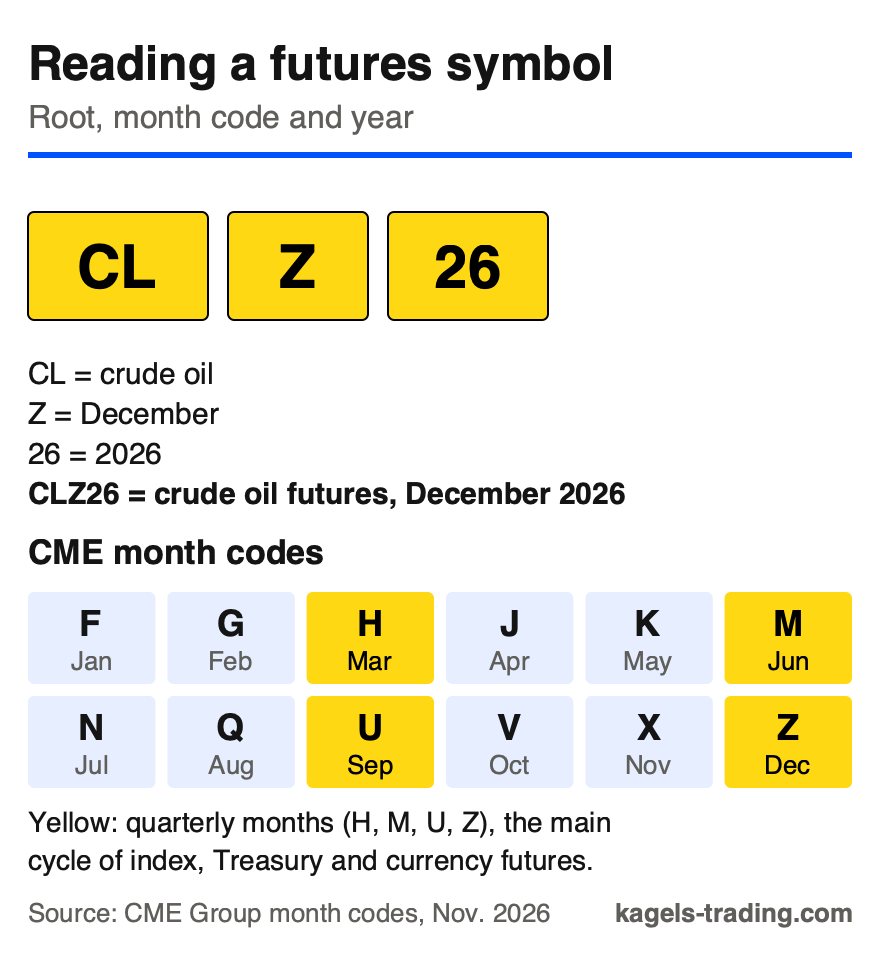
A futures symbol combines a root, a month code and a year. CLZ26, for example, means crude oil (CL), December (Z), 2026. The month codes are the same for all CME Group markets and do not follow the alphabet in an obvious order.
 Click to enlarge
Source: CME Group, contract month codes.
Contract specs of the main US futures
The table shows the contract size and the dollar value of one tick for some of the most traded US futures. The figures come from CME Group’s contract pages, read on 23 November 2026; our guide to micro futures covers the equity index micros in more detail.
| Contract (code) | Size | One tick is worth |
|---|---|---|
| E-mini S&P 500 (ES) | $50 x the index | 0.25 points = $12.50 |
| Micro E-mini S&P 500 (MES) | $5 x the index | 0.25 points = $1.25 |
| E-mini Nasdaq-100 (NQ) | $20 x the index | 0.25 points = $5.00 |
| Crude oil (CL) | 1,000 barrels | $0.01 per barrel = $10.00 |
| Gold (GC) | 100 troy ounces | $0.10 per ounce = $10.00 |
| 10-Year T-Note (ZN) | $100,000 face value | 1/2 of 1/32 of a point = $15.625 |
| Euro FX (6E) | 125,000 euros | 0.00005 per euro = $6.25 |
| Corn (ZC) | 5,000 bushels | ¼ cent per bushel = $12.50 |
Sources: CME Group contract specifications for ES, CL, GC, ZN and 6E, read November 23, 2026; MES and NQ as on our micro futures page; corn as in our corn futures guide.
Contract size times price gives the contract value. With the S&P 500 future at 7,672.25, as on CME’s page on 25 October 2026, one ES contract controlled about $383,600 and one MES about $38,360. That is why the choice of contract size matters as much as the trade idea.
Volume and open interest
Open interest is the number of contracts that are still open at the end of a trading day. Each contract has one long and one short side, so open interest equals all long positions or all short positions. It rises when a new buyer and a new seller open a contract and falls when positions are closed.
Volume is something else. Volume counts every contract traded during the day; open interest is reported once a day. Traders use both to judge liquidity and whether money is flowing into or out of a market.
Expiration, settlement and rolling
Every futures contract has a limited life. That is the main difference from stocks. For each market, several contract months trade at the same time. The front month is the nearest contract month, but it is not always the most active one: around rolls and in seasonal grain markets, volume often moves to a later month early. Corn, for example, lists March, May, July, September and December; crude oil lists every month.
Physical delivery or cash settlement
Contracts end either with delivery or with a cash settlement. According to CME’s specs, crude oil, gold, the 10-Year T-Note and Euro FX are deliverable, while the E-mini S&P 500 is financially settled in cash. In practice, only a small share of contracts ends in delivery; most traders close or roll well before.
For deliverable contracts, the delivery dates differ from market to market. In some contracts, the first notice day comes before the last trading day; in crude oil, delivery notices follow the end of trading. Check the first notice day, the last trading day and your broker’s own earlier cutoff for each contract you trade, because many brokers close retail positions days before.
Rolling a position
Rolling means closing the expiring contract and opening the same position in a later one. If you are long three May soybean contracts, you sell those three and buy three July contracts at the same time. You do not have to roll into the next month: roll into the contract with the best liquidity, which volume and open interest show.
A roll does not turn the price difference into a profit or a loss by itself. Closing the old contract realizes the gain or loss of that position, and opening the new one sets a new entry price. The two months only trade at different prices, and that gap tells you how the market prices carry.
The shape of the curve matters over time. When later months are more expensive, the market is in contango; when they are cheaper, it is in backwardation. If the curve keeps its shape and the spot price stays flat, a long position in contango tends to lose value as its contract moves toward the spot price, and a long in backwardation tends to gain; for a short, it is the other way round. These are assumptions, not rules, and our guide to contango and backwardation explains why the curve takes each shape.
Continuous charts handle rolls in two ways. An unadjusted chart shows the real prices of each contract, with gaps at every roll. A back-adjusted chart shifts older prices to close those gaps, which is better for long-term analysis but shows real prices only for the current contract.
How futures prices are formed
A futures price is based on the spot price of the underlying plus the cost of carry. For a commodity, that cost includes storage, insurance and financing until delivery; for financial futures, it is mainly the interest rate against any income from the asset.
Behind the spot price lie supply and demand. Weather, harvests, production costs, inventories and geopolitics move the supply of commodities; economic growth, energy policy and seasons move demand. For grains, the monthly WASDE report of the US Department of Agriculture is the key date; our overview of grain futures shows how corn, wheat and the soybean complex are linked.
Margin: the performance bond
Margin in futures is not a down payment, but collateral. You do not buy anything when you open a futures position; you enter an agreement. The exchange’s clearing house sets a minimum margin, and your broker blocks it in your account as a good-faith deposit. If the trade makes money, the margin is released plus the gain.
There are two levels. The initial margin is what you need to open a position. The maintenance margin is the minimum your account may fall to while the position is open. Many brokers also set a lower day-trade margin for positions closed the same day and a higher one for positions held overnight.
If your account falls below the maintenance level, you get a margin call. You must add money or reduce the position, or the broker closes it. Our guide to the margin call shows the steps. Margin is collateral, not a loss limit: gaps, fast markets and price limits can make the actual loss larger than the margin, and you are liable for the difference.
Margins change with volatility. Exchanges raise margins when markets become more volatile and lower them in calm phases. Check the current figures on CME’s margin pages and with your broker before every trade.
Who regulates futures in the US?
US futures markets are regulated by the Commodity Futures Trading Commission (CFTC). Brokers that hold customer money for futures trading are futures commission merchants (FCMs). According to the National Futures Association, all registered FCMs must be NFA members.
Futures trade only on regulated exchanges and are cleared centrally. The clearing house stands between buyer and seller, so you do not carry the credit risk of the other trader. That is a key difference from CFDs, which are traded with a provider as counterparty and are not allowed for retail traders in the US; our comparison of futures vs. CFDs covers the details.
The main futures markets
US futures cover six large groups of markets. Most of them trade on CME Group’s exchanges, CME, CBOT, NYMEX and COMEX, on the electronic Globex platform. Our overview of futures market hours lists the sessions in CT and ET.
- Equity index futures: E-mini and Micro contracts on the S&P 500, Nasdaq-100, Dow and Russell 2000, all cash-settled.
- Interest rate futures: Treasury futures from 2-year notes to bonds and SOFR futures; the CME FedWatch tool derives rate expectations from fed funds futures.
- Metals: gold, silver, copper and platinum at COMEX and NYMEX; our guide to silver futures compares the silver contracts.
- Currencies: Euro FX, yen, pound and others at CME, quoted in US dollars per unit of foreign currency.
- Energy: crude oil, natural gas, gasoline and heating oil at NYMEX; our crude oil price forecast covers the oil market.
- Agriculture: grains, oilseeds and livestock; see our guides to corn futures, wheat futures and soybean futures.
Related markets move together, and that matters for risk. Soybeans, soybean meal and soybean oil are linked through processing; crude oil, gasoline and heating oil through refining; gold and silver tend to move together and often against the US dollar. Holding large positions in several correlated markets at once concentrates risk instead of spreading it.
Pros and cons of futures trading
Futures offer direct access to large markets, but leverage cuts both ways. Here are the main points on each side, before you put real money at risk.
Pros of futures trading
- Regulated and centrally cleared: trading runs on exchanges under CFTC rules, with no counterparty risk to the other trader.
- Long and short: you can sell as easily as you buy, with no borrowing of the asset.
- High liquidity: the main contracts trade nearly 24 hours a day on five days a week.
- Capital efficiency: margin is a fraction of the contract value, so capital stays free.
Cons of futures trading
- Leverage: a small move against you can cost more than the margin you posted.
- Expiration: you must manage rolls and delivery dates.
- Contract size: standard contracts are large, so micros are often the better start.
- Gaps and limits: news can make prices jump, and stops may be filled far from the planned level.
Which trading approach fits futures?
Futures are less suited to buy-and-hold investing. Each roll costs fees and can add roll losses, so a long-term position pays for the calendar again and again. Most futures traders are day traders or swing traders.
Day traders use the deep liquidity and the long trading hours. Costs per trade matter more for them, so check commissions and exchange fees first; our guide to day trading strategies shows three approaches on SPY sessions.
Swing traders hold positions for a few days to a few weeks. They work with daily charts and end-of-day prices, which suits traders with a job. One approach combines the Commitments of Traders report with a simple chart trigger.
A COT-based swing approach
The idea is to follow the commercials, the producers and processors who hedge their business in futures. The CFTC’s weekly COT report shows their long and short positions. A commercial index puts their net position in relation to the last 26 or 52 weeks: near 100 means an unusually long position, near 0 an unusually short one.
In the German version, Karsten describes a three-step rule set. First, a reading above 75 or below 25 on the weekly chart gives a signal, which stays valid for about six weeks. Second, on the daily chart, two full bars above or below an 18-day moving average give the entry, with the stop at the bar three days back and a target of one times the risk. Third, the position size follows from the stop.
His example in Chicago wheat in 2022 shows both sides. Eight signals led to six trades; some hit the target within days, others were stopped out quickly. Before fees, the year would have made about $12,600 with his discretion and about $7,525 when every signal was traded mechanically, per standard contract. One market and one year are a sample, not proof, and a single trade risked up to $7,250, which needs a large account or a smaller contract.
Spread trading
A spread trade buys one futures contract and sells a related one at the same time. You do not bet on the direction of the market, but on the difference between two prices. If that difference widens or narrows as you expect, you profit even if both prices move against a single position.
Intramarket spreads use two months of the same market. Buying the near month and selling a later one is a bull spread; the reverse is a bear spread. These calendar spreads often follow seasonal patterns in commodities.
Intermarket spreads use two related markets. Classic examples are gold against silver, corn against wheat, the crack spread between crude oil and its products, and the crush spread between soybeans and soybean meal and oil. Exchanges often charge lower margins for recognized spreads, because they are usually less risky than an outright position; they can still move against you.
Conclusion: powerful tools that need a plan
Futures give you direct, regulated access to the world’s largest markets, with long and short trading and low capital requirements. The same leverage that makes them efficient can also wipe out an account quickly, so risk control comes first.
Karsten’s view after more than four decades of trading: know the contract specs before the first trade, start with micros if your account is small, keep the delivery dates in your calendar, and size every position from the stop. Our guide to position sizing shows the math.
Frequently asked questions about futures trading
What does futures trading cost?
You pay a commission per contract to your broker, plus exchange, clearing and NFA fees. Some brokers lower commissions with higher monthly volume, and data subscriptions for real-time prices come on top.
How many futures contracts exist on one asset?
There is no fixed number. Unlike shares, futures are not issued in a set quantity. A new contract is created whenever a new buyer and a new seller trade, which shows up as rising open interest.
Is margin a down payment on the futures price?
No, margin is collateral, a performance bond. It is blocked in your account while the position is open and released when you close it. If losses push the account below the maintenance margin, you get a margin call.
Is the margin a fixed amount?
No, margins change over time. Exchanges set margins based on recent volatility and change them when markets become calmer or more turbulent. Brokers can ask for more than the exchange minimum.
What is the difference between volume and open interest?
Volume counts the contracts traded during a day; open interest counts the contracts still open at its end. Volume updates continuously, while open interest is reported once a day.
Is futures trading legal in the US?
Yes, futures trading is legal. Futures trade on exchanges regulated by the CFTC, and brokers that hold customer money must be registered futures commission merchants and NFA members.
What is the difference between futures and options?
A future obliges both sides to trade at the agreed price; an option gives the buyer a right, not an obligation. The option buyer pays a premium that loses value over time; a future has no premium and no time decay.
This English edition is based on our German edition on kagels-trading.de and has been adapted for international readers.
More Markets and Brokers guides
- Open your first account
What Is a Brokerage Account? A US Beginner's Guide
How to open and fund a US brokerage account, cash vs margin, what it costs and what SIPC and FDIC really cover.
- Know what trading really costs
Trading Costs: Every Fee You Pay and How to Cut It
Spread, commissions, SEC and FINRA fees, market data, margin interest and tax, with yearly totals for three trading styles.
- Choose a broker
Interactive Brokers Review 2026: Fees and Platforms
Fees, platforms, investor protection and real futures commissions from a client since 1996.
- Check TradeStation
TradeStation Review 2026: Pricing Tiers, Fees and Platform
Broker and strategy platform: volume tiers for stocks, options and futures checked 21 November 2026, the $5 ticket charge outside the US, fees and EasyLanguage.
- Choose an options broker
tastytrade Review 2026: Options Fees, Margin and Safety
tastytrade from an options trader's own account and its October 2026 fee schedule: fees, the 6.75% margin rate, safety and FINRA fines.
- Check Tradovate
Tradovate Review 2026: Fees, Margins and Who Holds Your Money
The futures broker in many prop firm contracts: all-in costs per plan checked 21 November 2026, the $35 inactivity fee, margins and the clearing firm behind it.
- Check AMP Futures
AMP Futures Review 2026: Margins, Fees, Platforms and Safety
The Chicago futures broker with 50+ platforms: day-trade margins and their temporary news-release restrictions, the cost calculator and fee table, regulation and who it suits.
- Check an offshore broker
PU Prime Review 2026: FCA Warning, Licences and Costs
Which PU Prime company you contract with, what the FCA warning means, and what 1:1000 leverage and the deposit bonus do to your account.
- Check an EU CFD broker
Tradeview Review 2026: Tradeview Europe, MFSA and Costs
What the Malta licence of Tradeview Europe covers, how it differs from the Cayman company, and what the three MetaTrader 5 accounts cost.
- Check ZuluTrade
ZuluTrade Review 2026: Costs, Regulation and US Status
Who runs the copy trading platform, what it costs through your broker, why the US was missing from its sign-up form and what the CFTC fined its US company for.
- Check CopyX
CopyX Review 2026: Is TAG Markets Copy Trading Legit?
Who runs the TAG Markets copy trading platform, which regulators warn about it, why US residents are excluded and how fast the 12x Amplify account eats your deposit.
- Choose a US forex broker
OANDA Review 2026: Fees, TradingView and US Rules
OANDA from its own pages and NFA records: spreads and fees, TradingView and the demo, FIFO and three penalties.
- Check a commission-free app broker
Webull Review 2026: Fees, Margin Rates and Safety
Webull from its own fee schedule and FINRA records: what is free, margin rates and Premium, overnight trading, crypto and three fines.
- Check Robinhood
Robinhood Review 2026: Fees, Gold, Margin, Options and Safety
Robinhood from its US fee schedule: what commission-free leaves out, Gold for $5 a month, margin tiers, options and futures, and the SEC and FINRA settlements.
- Understand your price
Market Makers: Who Sets Your Price and How They Profit
How market makers earn on the spread, who sets prices at German trading venues and what the EU ban on payment for order flow changed.
- Trade an index CFD
Index CFDs at Interactive Brokers: Symbols, Costs and Trading
All 13 IBKR index CFDs, margin, stop and close-out worked through for IBDE40, financing, UK hours and the TradingView limit.
- Size an index future
Micro Futures: MES vs MNQ, Tick Values and Risk
MES and MNQ tick values, a worked sizing example from the stop with costs and slippage, and why margin is not your risk.
- Choose between futures and CFDs
Futures vs CFDs: Regulation, Order Execution and Costs
Who your counterparty is, EU, UK and US rules, how stops are triggered on CME and at CFD providers, and booked costs in a DAX example.
- Understand the IBKR Exposure Fee
IBKR Exposure Fee: What It Is and How to Reduce It
Why Interactive Brokers charges a daily fee on high-risk accounts, why weekends count, where to find it and how to reduce it, with a real 1.12 euro notice.
- Read the futures curve
Contango vs Backwardation: Futures Curves Explained
What contango and backwardation mean, what rolling does to a position in each case, and real gold, oil and gas curves from 28 October 2026.
- Understand the spot market
Spot Market Explained: Definition and Settlement Times
What a spot market is, why two days is a minimum and not a limit, and when stocks settle at T+1 in the US, EU, UK and Switzerland.
- Choose a silver future
Silver Futures: SI vs Micro Silver vs 100-oz SIC
SI, Micro Silver and the 100-ounce SIC compared by tick value, risk per contract, margin and December 2026 deadlines.
- Trade soybean futures
Soybean Futures: Contract Specs, Hours and Price Drivers
CBOT soybean contract specs, Mini and Micro, trading hours, daily price limits, WASDE and China, and a seasonal test over 4,784 trading days.
- Trade soybean meal futures
Soybean Meal Futures: Contract Specs, Crush and Price Drivers
CBOT soybean meal contract specs, the Micro, trading hours, price limits, the crush spread with beans and oil, Argentina and a seasonal test.
- Trade soybean oil futures
Soybean Oil Futures: Contract Specs, Biofuels and the Crush
CBOT soybean oil contract specs, the Micro, trading hours, daily price limits, biofuel demand and EPA rules, WASDE and the soybean crush.
- Trade corn futures
Corn Futures: Contract Specs, Hours and Price Drivers
CBOT corn contract specs, the Micro, trading hours in CT, daily price limits, WASDE, ethanol and exports, and a seasonal test over 4,784 trading days.
- Trade wheat futures
Wheat Futures: Chicago, Kansas City and What Moves Prices
Chicago SRW and Kansas City HRW wheat specs, the Micro, linked price limits, the KC-Chicago spread, the Black Sea and a seasonal test.
- Compare grain futures
Grain Futures: Corn, Wheat and Soybeans at CBOT
Corn, wheat, soybeans, soybean oil and meal at CBOT: contract sizes, tick values, shared hours and reports, and how the five markets are linked.
- Understand your taxes
Trading Taxes in the US: How Traders Are Taxed in 2026
US federal rules for 2026: short and long term rates, the $3,000 loss limit, wash sales, the 60/40 rule for futures and trader tax status.