
Risk Management in Trading: Rules, Math, Psychology


Contents
- Risk management in 30 seconds
- What is risk management in trading?
- The three areas of trading risk
- The core rules for limiting losses
- Risk management in day trading and forex
- The five most expensive risk management mistakes
- Psychological risk management: protecting yourself from yourself
- Books on risk management
- Six principles from top traders
- Conclusion: risk management decides your trading career
- Frequently asked questions about risk management in trading
- About the author
Most trading accounts are not destroyed by bad entries but by one trade that was too large. I have watched this since I started trading in 1980, first in currencies, later in stock indices, commodities and interest rate markets. Many traders who gave up after two or three years had a usable edge. They just did not survive long enough for it to pay off.
The broker statistics show how common this is. In Europe, CFD brokers must publish the share of retail accounts that lose money. When we checked five brokers on 7 October 2026, it was between 72 and 89 percent. The numbers count losing accounts, not causes. In my experience, though, the causes are almost always the same: positions that are too big, stops that are too tight, too little capital and emotions nobody controls. This guide shows how to handle all four. It follows our editorial policy.
Risk management in 30 seconds
- Main goal: keep losses small enough that your strategy gets the time to show its edge. Surviving beats winning.
- The 1% rule: plan to lose at most 1 percent of your account per trade if the stop-loss fills at its price. On $10,000 that is a planned loss of $100, not a $100 position. Gaps can make the real loss larger.
- Stop-loss: take it from the chart before you enter, place it as a real order at once and never widen it to save a trade.
- Position size: risk amount divided by the distance to the stop. Not your gut feeling and not your account size.
- Reward-to-risk: aim for at least 2:1. Then you break even at a 33.3 percent win rate and make money from 34 percent, before costs.
- Daily loss limit: day traders add a limit of 2 to 3 percent per day. Once it is hit, the day is over.
- Psychology: overtrading, revenge trading and moved stops destroy more accounts than wrong market calls.
What is risk management in trading?
Risk management in trading is the set of rules a trader uses to limit the loss per position, the total risk of all open trades and their own emotional mistakes, so that they stay in the market long enough for their edge to pay off.
In short: surviving beats winning. Every profitable edge needs a phase in which it proves itself over many trades. You only get through that phase if the loss per trade, your total position and your own reactions are under control.
Risk management is not the same as position sizing, but the two are closely linked. Position sizing, often called money management, decides how much capital goes into each trade. Risk management decides how you protect that capital from being wiped out. They meet at the stop: its distance from the entry sets the size. The formula and a calculator are in the guide to position sizing.
Leverage is where risk management matters most. Leverage makes gains and losses larger by the same factor. A position worth $30,000 on $1,000 of margin does not mean you can earn 30 times more. It means that a move of 3.3 percent against you wipes out the margin, and that is a normal daily move in many markets.
Why losses hurt more than gains help
Losses and gains are not symmetrical, and the math is unforgiving. An account that loses 10 percent needs an 11.1 percent gain to get back to where it was. After a 50 percent loss it needs 100 percent. After 90 percent, which is realistic for a leveraged account without discipline, it would need 900 percent. Almost nobody does that.
| Loss | Gain needed to recover |
|---|---|
| 10% | 11.1% |
| 20% | 25.0% |
| 30% | 42.9% |
| 50% | 100% |
| 75% | 300% |
| 90% | 900% |
That is why the losing trade decides your career, not the winning one. Before every trade, ask one question: what happens if this fails? If you cannot answer it with a number, you are trading blind. A trader with an average strategy and good risk management lasts longer than one with a brilliant strategy and poor risk control.
The three areas of trading risk
Risk in trading comes from three directions, and most traders badly underestimate at least one of them. There is the financial risk to your capital, the psychological risk to your judgment and the operational risk to your execution.
Financial risk: protecting your capital
Financial risk has two levels. The inner level is your trading account: position size, stop-loss, leverage, how closely your positions move together, and your total exposure. The outer level is your personal finances: living costs, savings and other income. If you need this month’s trading profit to pay the rent, you will make worse decisions under pressure. My advice to everyone who asks: keep 12 to 24 months of expenses outside the trading account. That is not a comfort zone, it is a condition for trading professionally.
Psychological risk: protecting your judgment
Your account can be fine on paper while your judgment is already broken. After a losing streak, discipline and confidence can collapse, and you start trading against your own plan. Typical signs: revenge trades, trading out of boredom, moving a stop to save a trade, or taking profits early out of fear. The section on psychology below covers this in detail.
Copying other people’s trades does not move the risk away from you. If you follow signals from a chat group without your own rules, you hand over the decision but keep the loss.
Operational risk: protecting your execution
Operational risk is overlooked most often, because it sounds boring. It covers an internet outage at the wrong moment, a platform that freezes during a news spike, the wrong ticker or a misplaced decimal in the order size. The order type matters too: a market order in a thin market can fill at prices you never expected. Choosing the right order type is part of risk management, not just a technical detail.
The core rules for limiting losses
The rules in this section only work together. If you follow the 1% rule but use no stop, your account is still at risk. If your stop is clean but your position is too large, you break the 1% rule. And even with both in place, the win rate alone does not tell you whether the strategy makes money: that depends on the average win, the average loss and the costs.
The 1% rule: your protection against ruin
The 1% rule in trading says that you plan to lose at most 1 percent of your trading capital on any single position, measured from the entry to the stop-loss price.
On a $10,000 account, the planned loss per trade is at most $100. That assumes the stop fills at its price, before costs; a gap or fast market can fill it worse. On $50,000 it is $500. On $2,000, which I consider undercapitalized, it would be $20, and here the problem with small accounts shows: realistic stop distances and minimum trade sizes often do not fit 1 percent. Experienced traders with a proven record sometimes go to 2 percent. Anything above that is not a rule but a hope. In a prop firm test with a $2,000 loss buffer the same rule weighs much more, as the prop firm drawdown math shows.
At 1 percent risk, it takes 69 losses in a row to cut your account in half. Even a weak strategy rarely produces a streak like that. At 5 percent risk, 14 losses are enough. The difference feels small, but it decides your career. The chart and the table show how many losses an account can take at each level.
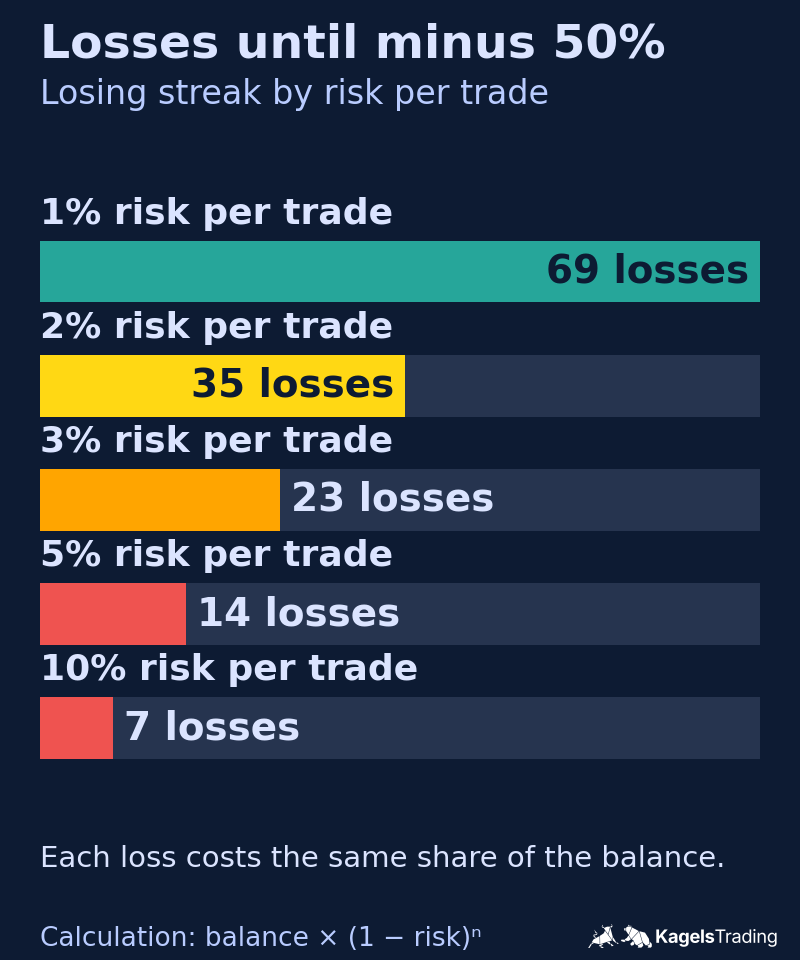 Click to enlarge
Source: Kagels Trading, own calculation.
| Risk per trade | Losses in a row to minus 50% | Losses in a row to minus 70% |
|---|---|---|
| 1% | 69 | 120 |
| 2% | 35 | 60 |
| 3% | 23 | 40 |
| 5% | 14 | 24 |
| 10% | 7 | 12 |
The table assumes a fixed share of the current balance per loss. The formula is balance = start × (1 − risk)ⁿ. Minus 70 percent means that 30 percent of the account is left. At 10 percent risk per trade, seven losses already take more than half of the account.
Setting the stop-loss
A stop-loss is an order placed in advance that closes your position once a set price is reached; it limits the planned loss, but the fill can be worse than the stop price.
The biggest mistake is to set the stop by your pain threshold instead of by the market. If you think “I want to lose $200 at most, so the stop goes 20 cents below my entry”, the stop is arbitrary. A sound stop comes from the chart: below a swing low, beyond support and resistance levels or outside normal volatility. The guide to support and resistance shows how to find those levels.
In volatile markets and for swing trades, I prefer a stop based on volatility. The ATR (Average True Range) measures how far a market typically moves, and a stop at a multiple of it adapts to calm and busy phases. That way you do not stand too far away in quiet markets or too close in fast markets. How this works in practice is part of the guide to swing trading.
Three things are not negotiable for any stop: it is set before the entry, it is never widened, and it goes into the market as an order at once. A stop you only keep in your head is not a stop. It is a hope, and hope is not a plan.
Calculating the position size
The position size equals your risk amount divided by the distance from entry to stop, not your gut feeling and not your account size.
Here is the short version with numbers. You have $20,000, you risk 1 percent, so $200. The stock trades at $50, and your stop from the chart is at $48. The distance is $2, so $200 divided by $2 gives 100 shares. You buy shares worth $5,000 and lose $200 if the stop fills at $48, before costs.
The classic beginner mistake is to pick a round number of shares first and set the stop afterwards. If you buy 200 shares for $10,000 with the same stop, you suddenly risk $400 without knowing it. The order is fixed: first the stop from the chart, then the size from the risk amount. The full method, a calculator and examples for forex and futures are in the position sizing guide linked above. How far the Kelly criterion would push the risk per trade, and why that is far too much, has its own article.
Reward-to-risk: no edge without it
The reward-to-risk ratio, often loosely called risk/reward, compares the possible gain of a trade with its planned loss, and together with the win rate and costs it decides whether a strategy makes money over time.
Entry $50, stop $48 and target $56 means $6 of chance against $2 of risk, so reward-to-risk is 3:1. The break-even win rate follows the formula 1 ÷ (1 + reward/risk). At 2:1 it is 33.3 percent, so you need 34 percent or more to make money. At 3:1 you break even at 25 percent. At 1:1 you need more than 50 percent before costs, and clearly more after commissions and spreads. That is why many scalping systems look great on paper and fail with real money.
| Reward-to-risk | Break-even win rate |
|---|---|
| 1:1 | 50.0% |
| 1.5:1 | 40.0% |
| 2:1 | 33.3% |
| 3:1 | 25.0% |
| 4:1 | 20.0% |
| 5:1 | 16.7% |
Reward-to-risk alone says nothing about the quality of a trade. A 10:1 ratio is worthless if the target lies far away in a sideways market that never makes such a move. The target has to be reachable in your time frame. Before you trust any ratio, test it on past data, as shown in the guide to backtesting.
Several open positions with the same idea behind them act like one big bet. Five long trades on the S&P 500, Nasdaq, Dow Jones, DAX and Euro Stoxx 50 look diversified, but they tend to fall together in a sell-off. The planned total risk stays 5 percent, but it becomes likely that all five stops are hit at once, and gaps can add to that. Diversification is measured by how independent the positions are, not by how many there are.
Risk management in day trading and forex
Day trading and forex bring extra risks that matter little in swing trading. If you ignore them, you can apply the 1% rule correctly and still fail. Leverage, slippage and costs are the main reasons.
Day trading: add a daily loss limit
The 1% rule per trade stays, and day traders add a daily loss limit. Common values are 2 to 3 percent of the account. Once the limit is hit, the trading day ends, however good the next setup looks. That is not giving up. It protects you from the fatigue trap in which good decisions are no longer possible.
Slippage is the silent profit killer in day trading. Around major events such as a Fed meeting, the US jobs report or an ECB decision, stop orders often fill beyond their price. A planned $2 risk per share can become $4 or $5. The clean answer: do not trade into such events, or cut the position size in half beforehand.
Costs eat into reward-to-risk faster than most traders think. At five round trips a day and $4 per trade, you pay $100 a week to your broker. If your average winner makes $20 and your average loser costs $10, and both sides pay $2, your real reward-to-risk drops from 2:1 to 1.5:1. Always build costs into the win rate you need.
Forex: leverage limits and correlation
In forex, leverage reaches levels most stock traders never see, and regulators cap it for retail clients. For CFDs sold to retail clients in the European Union, the ESMA product intervention of 2018 limits it to 30:1 for major currency pairs, 20:1 for other pairs, gold and major indices, 10:1 for other commodities and smaller indices, 5:1 for single stocks and 2:1 for crypto. For retail forex in the United States, the CFTC set a maximum of 50:1 for major currencies and 20:1 for all others in its 2010 retail forex rule, and the NFA explains the matching minimum deposits in its forex regulatory guide; brokers may ask for more. Offshore brokers offer 500:1 and more, and there every pip becomes a question of survival.
Currency pairs that move together give you less diversification than it seems. If you buy EUR/USD and EUR/GBP at the same time, you do not hold two separate trades but one double bet on the euro. If the euro falls broadly, both are likely to lose at the same time. The planned risk is still 2 percent in total, but you get almost no diversification for it. Check the correlation before you open a second position in the same currency.
One shock can jump over every stop. On 15 January 2015, the Swiss National Bank dropped its minimum rate of 1.20 francs per euro. Within minutes, EUR/CHF fell to about 0.85. Stop orders filled far below their level: in one case later heard in an English court, a stop at 1.1791 was filled at around 1.03. Thousands of accounts were emptied or went negative that day.
Whether your rules hold in daily trading only shows up in the review. The maximum drawdown is the most honest number, and a good trading journal calculates it for you. How to set one up is in the guide to the trading journal.
The five most expensive risk management mistakes
Not every mistake costs the same. Some cost 10 percent of the account, others destroy it overnight. I have seen these five again and again over more than 45 years, with beginners, with experienced traders and, in my first years, with myself.
- Widening the stop: the most expensive mistake of all. The trade runs against you, and just before the stop is hit you move it further away to “give it room”. If the price keeps going, 1 percent becomes 3, 5 or 10 percent. Done once, it easily becomes a habit. Hard rule: a stop is never widened.
- Sizing by the account: “I have $10,000, so I buy $10,000 worth of stock.” With a clean stop from the chart, the trader then loses $500 instead of the planned $100. The order is always the same: stop from the chart first, then the size from the risk amount.
- Revenge trading after a losing streak: after three losses, the urge to win it all back with double size is strong. After three losses of 1 percent, a fourth trade at double size risks 2 percent, and if it fails the account is down 5 percent. The disciplined answer is the opposite: trade smaller or take a break.
- Ignoring correlation: five long positions on related stock indices look like diversification, but they tend to fall together in a crash. The planned total risk of 5 percent is then likely to be lost all at once.
- Treating leverage as an invitation: if you size a trade by what the broker allows (“I can trade $30,000”), you misread leverage. It lets you hold a correctly sized position with less margin. It does not let you risk more.
Psychological risk management: protecting yourself from yourself
Financial risk management can be calculated, psychological risk management has to be trained, and that is the harder part. I have seen colleagues with mathematically perfect sizing models fail because they did not know their emotional triggers. Others with an average strategy stayed profitable for decades because they worked with discipline.
Getting through losing streaks
A drawdown is the percentage decline of your account from its last peak to a following low; it only ends when the account rises above the old peak again.
Losing streaks do not mean your strategy is broken, they are unavoidable. Even with a 60 percent win rate, five, six or seven losses in a row happen over a few hundred trades. If you do not know that, you treat every streak as personal failure and start breaking your rules. Prop firms set their own drawdown limits for funded accounts, as the Take Profit Trader review shows.
My routine after three losses in a row has three steps. First, I cut the position size in half at once, out of respect for my own judgment. Second, I go through the last five to ten trades in my journal and check whether they followed the plan. Third, I take one or two days off. With a calm head you see whether the strategy has a problem or is just going through a normal dry spell. Which software makes this review easy is compared in the guide to trading journal software.
Spotting overtrading and revenge trading
Overtrading means opening far more positions than your strategy calls for, out of boredom, nerves or the wish to recover quickly.
Revenge trading is the emotional reaction to losses in which a trader uses larger positions to win back everything in one trade.
Both patterns share one cause: the inability to accept a loss as finished. The brain treats a realized loss like an open bill. Every next trade then comes from the urge to bring the emotional account back to zero, not from a clean analysis.
The warning signs are easy to see once you know them. You trade without a written plan. You click faster than usual. You skip your setup checklist. You raise the size because this trade is “especially clear”. You sit in front of the chart longer than planned and wait for anything. If you notice these signs, you can still stop. If you miss them, you usually see them later in your account statement.
My own brake against overtrading is a maximum number of trades per day. Typically three for swing setups and at most five for shorter-term trading. After that I stop, even if a seemingly perfect sixth setup appears. The limit keeps discipline from slowly turning into randomness.
Patience as an edge
Most traders do not lose because they trade bad setups, but because they trade too often. A clean setup on the daily chart comes once or twice a week, not ten times a day. If you have to trade every day, you will trade situations that do not fit your strategy. Patience is a real advantage: the best professionals I have met over the decades open fewer positions than beginners, not more. They wait for the few setups that really fit.
Build a filter against yourself. Use a setup checklist with clear criteria, write down the reason for each trade before you click, and keep a journal that shows you every impulsive trade. The more friction between impulse and execution, the fewer bad trades you make.
Books on risk management
You do not learn risk management in one evening. These four books shaped me most, each from a different angle. Together they make a compact study plan. More books, sorted by goal, are in my guide to the best trading books.
- Trading in the Zone (Mark Douglas): the standard work on trading psychology. Douglas explains why rational rules break down in live trading and how to accept the result of every single trade.
- Market Wizards (Jack D. Schwager): interviews with Paul Tudor Jones, Richard Dennis, Larry Hite and others. The common thread: not the entry method made them rich, but strict control of losses.
- The Black Swan (Nassim Nicholas Taleb): unlikely events happen more often and change more than we think. For every leveraged trader, this is the key lesson, as the franc shock of 2015 showed.
- Risk Savvy (Gerd Gigerenzer): Gigerenzer separates risk, where the probabilities are known, from uncertainty, where they are not. For traders: a backtest estimates outcomes under historical conditions, but the future still holds uncertainty, such as an event like the SNB decision that was missing from the sample.
Six principles from top traders
The following principles come from traders who stayed in the market for decades. Each one is a rule you can act on, and I still use them as orientation. They also explain why a strategy alone is never enough without loss control.
- Cut losses consistently: William O’Neil calls letting losses run the most common mistake of private investors. The consequence: the stop is set before the entry and never widened.
- Size matters more than the entry: as a young broker, Paul Tudor Jones lost 60 to 70 percent of his clients’ money on a single cotton trade, as he told Jack Schwager. After that he put defense before offense.
- Accept risk, do not fight it: Mark Douglas writes that a trader who truly accepts the risk can be at peace with any outcome. That is the condition for not panicking after every loss.
- Preserve capital until the big trades come: Richard Dennis, the teacher of the famous Turtle traders, stressed that good opportunities are rare. If you burn your account on average trades, you are no longer there when they come.
- Your biggest opponent is yourself: Jesse Livermore saw a trader’s own nature as his greatest enemy. Suppressing emotions does not work; knowing them and planning for them does.
- Risk before return: Larry Hite told Schwager that he does not see markets, he sees risks, rewards and money. First understand the risk, then judge the return, never the other way round.
Conclusion: risk management decides your trading career
After more than 45 years in the markets, I am sure that successful traders differ less in their strategies than in their risk management. You can learn entry methods in weeks. Getting smaller after three losses instead of bigger takes years of honest self-observation.
Three points I give every new trader, and I make no compromise on any of them. The 1% rule is not negotiable: no more than 1 percent of the account planned to the stop, however sure a setup looks. The position size follows from the risk amount and the stop distance, never the other way round. And psychological risk management is not soft: overtrading, revenge trades and widened stops cost more money than any wrong analysis.
My advice for the start: begin small and test your rules first without real money. Keep your risk at 0.5 percent per trade for the first six months and keep a journal from day one. The market does not reward courage, it rewards discipline.
Frequently asked questions about risk management in trading
What does risk management in trading include?
Risk management in trading includes every rule that limits the loss per trade and over a series of trades. That means position size, stop-loss, reward-to-risk, total risk across all open positions and the discipline to follow these rules under stress. The goal is not to avoid losses, which is impossible, but to keep them predictable.
What is the 1% rule in trading?
The 1% rule says that you plan to lose at most 1 percent of your account on a single trade if the stop-loss fills at its price. On a $20,000 account that is a planned loss of $200, however good the setup looks; a gap can make it larger. It limits the loss, not the amount you invest. At 1 percent risk it takes 69 losses in a row to halve the account.
Is it true that 90% of traders lose money?
There is no reliable figure for all traders, so the 90 percent is not proven. European CFD brokers must disclose the share of retail accounts that lose money, and in our check of five brokers on 7 October 2026 it was 72 to 89 percent. The figures count accounts, not people, and they cover leveraged CFDs, not normal stock investing. They say how many accounts lose, not why.
How do I set a stop-loss correctly?
A stop-loss comes from the structure of the chart, not from the amount you would like to lose. For a long trade it goes below a clear swing low, for a short trade above resistance. A distance based on the ATR also protects you from normal market noise. The stop is set before the entry and never widened.
How do I handle a losing streak?
After three losses in a row, cut your position size in half, review your journal and take one or two days off. The smaller size is not a retreat but respect for your own judgment, which suffers during losing streaks. Do not try to win it back with larger trades: that is revenge trading.
What reward-to-risk ratio makes sense?
Aim for at least 2:1, better 3:1, always together with a realistic win rate. At 2:1 you break even at a 33.3 percent win rate, at 3:1 at 25 percent, before costs. The target must be reachable: a 10:1 target in a sideways market looks good on paper and is worthless in practice.
This English edition is based on our German edition on kagels-trading.de and has been adapted for international readers.
More Risk Management guides
- Calculate your position size
Position Sizing in Trading: Formula, Calculator, Examples
The formula, a free calculator, the 1% rule explained correctly, and examples for stocks, forex and futures.
- Size your risk per trade
Kelly Criterion for Traders: Formula, Calculator, Risks
The Kelly formula for traders with a calculator, and a simulation of why full Kelly is far too much.
- Keep a trading journal
Trading Journal: How to Record and Review Your Trades
What to write before and after each trade, a completed example with a win and a loss, a weekly review and a template to copy.
- Choose a journal
Best Trading Journal Software 2026: 6 Tools Compared
Six journals compared on price, free plans, refunds, automatic broker sync, costs and export, with a decision guide.
- Check TradeZella
TradeZella Review 2026: Pricing, Features and Limitations
The three plans since July 2026, what Essential leaves out, the no-refund terms, imports, export and what users report.
- Check TraderSync
TraderSync Review 2026: Pricing, Broker Sync and Limits
Plans and dated prices, broker imports and autosync, Market Replay, Cypher and the no-refund policy.
- Check Tradervue
Tradervue Review 2026: Imports, Reports and Costs
Silver or Gold, why net P&L needs Gold, few automatic imports, US-only stocks, the no-refund sign-up terms and how to cancel.
- Check Edgewonk
Edgewonk Review 2026: Features, Costs and Limitations
One feature set billed monthly or yearly, the refund period, MetaTrader auto sync, the psychology tools and our own test journal.