
SpaceX Stock Forecast: Chart Levels and Scenarios


This analysis is from 4 October 2026. Prices have moved since, so the levels below may no longer apply until the next update.
As of 4 October 2026, with prices up to the weekly close of 2 October: SpaceX stock ended the week at $158.96, 6.9 percent higher and at its best weekly close since early July. Almost the whole gain came on Friday, after three launches in about 13 hours. At that point the next marks were the $167.90 high from 6 July and the share release scheduled for 9 October. Trading after 2 October is not part of this snapshot.
SpaceX forecast in 30 seconds
The situation
Weekly close $158.96, up 6.9 percent on the week before. That is the highest weekly close since early July and the best week since August.
The trigger
Friday, 2 October: +7.4 percent, one day after three launches in about 13 hours, including four astronauts to the ISS.
Levels
The 21 September high at $158.13 is broken on a closing basis. The next level above is the 6 July high at $167.90.
What comes next
The next share release of up to 328 million shares was scheduled for Friday, 9 October. We update this page after the next weekly run.
On this page
- SpaceX forecast in 30 seconds
- SpaceX stock chart: the best week since August
- Monthly chart: the July gap is getting smaller
- SpaceX valuation: what the share price has to carry
- SpaceX forecast: the bull case and the bear case
- Drivers: what moves the SpaceX share price
- SpaceX stock forecast 2030: scenarios instead of price targets
- Conclusion: one day decided the week
- Frequently asked questions about the SpaceX stock forecast
- Please note
SpaceX stock chart: the best week since August
 Click to enlarge
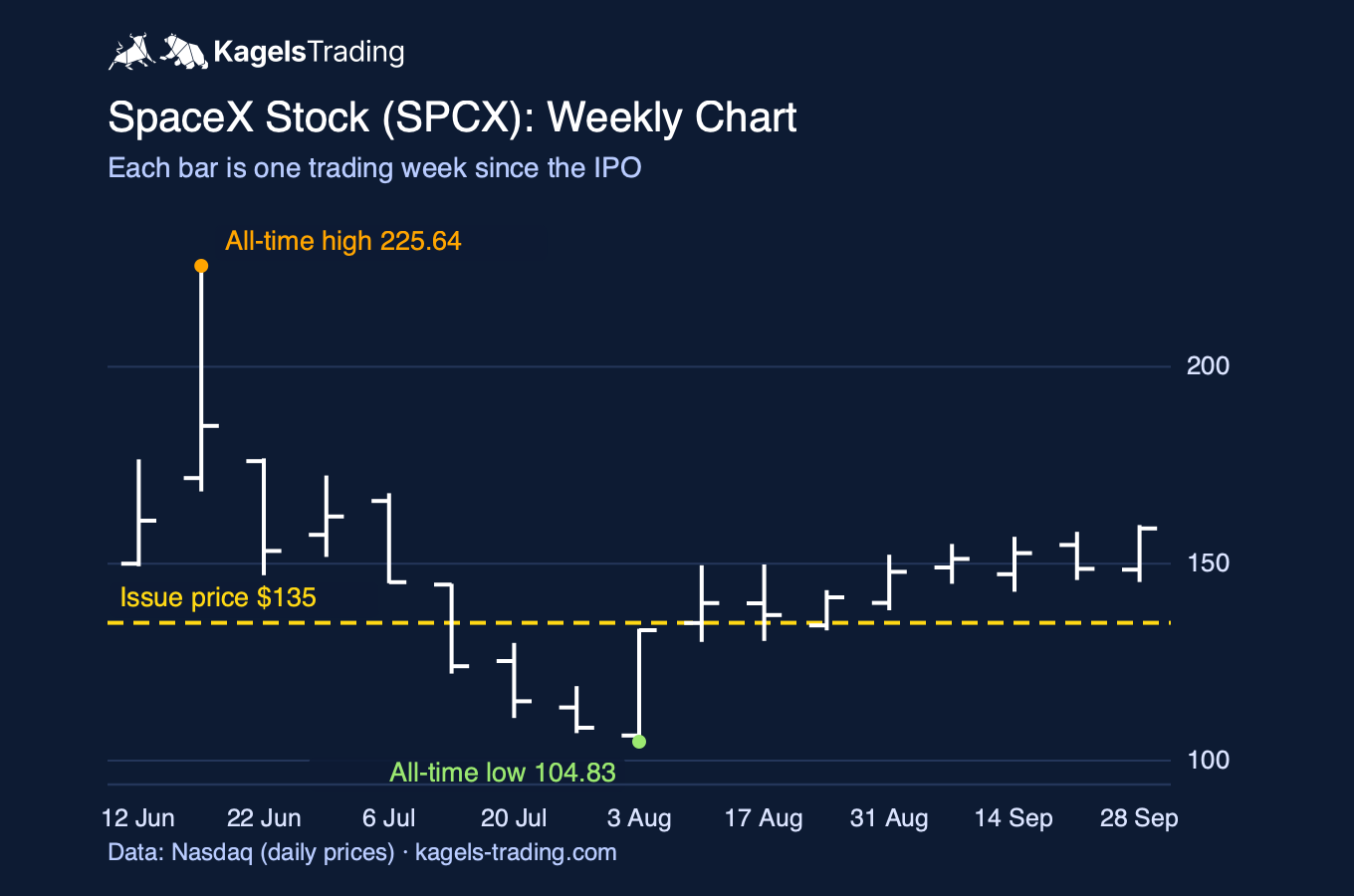
SpaceX stock closed the week to 2 October at $158.96, 6.9 percent above the week before. The weekly range ran from $145.36 to $159.84, and the close sits in the top tenth of it.
Four days of back and forth, then a breakout. From Monday to Thursday every close was between $145.47 and $150.86. Monday ended on its low, although Starship reached orbit for the first time that day. Tuesday and Wednesday made that back, and Thursday lost 1.9 percent. On Friday the stock rose 7.4 percent to $158.96, the biggest daily gain since 12 August.
Friday carried weight. 119.9 million shares changed hands, more than on any day since 18 September. The close sits at 92 percent of the daily range, close to the high at $159.84. The stock last traded this high on 6 July, and the close is also the highest since that day.
A level has fallen, this time to the upside. For a week the $158.13 high of 21 September stood as resistance in the table below. Friday closed 83 cents above it. The round number $150 held on a closing basis only on Wednesday and Friday; it is now the second support below the price.
Two lines, no price targets. To the upside, $167.90 is the next level, and the all-time high of $225.64 is about 42 percent above the price. To the downside $158.13 has to hold first, and below it are $150 and the weekly low at $145.36.
Resistance
- $225.64
- $167.90
Price at analysis$158.96
Support
- $158.13
- $150
- $145.36
Monthly chart: the July gap is getting smaller
 Click to enlarge
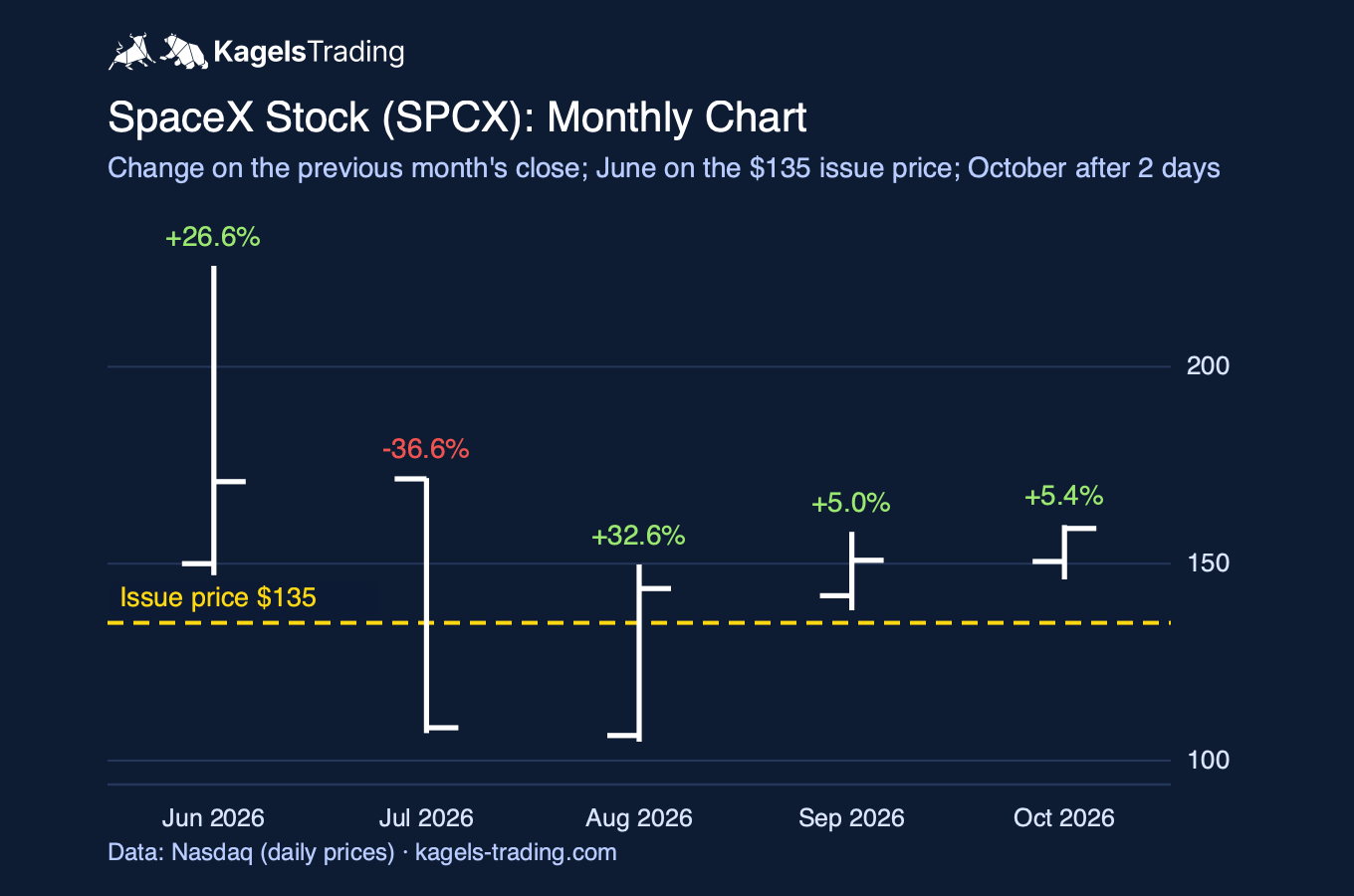
The gap from July is getting smaller. The monthly bars show it: from the June close at $170.86, July cost 36.6 percent, and if you lose 36.6 percent you need a gain of about 58 percent to get back to zero. From the July close at $108.37 to $158.96 it is 46.7 percent. A week earlier it was 37 percent. The gap is not closed yet. September ended at $150.86, up 5.0 percent on the August close.
The launches came on Thursday, the price on Friday. On 1 October SpaceX flew three missions in about 13 hours. Crew-13 took four astronauts to the ISS, Transporter-18 carried about 130 payloads into space, and a Falcon Heavy flew its first mission for the US reconnaissance agency NRO with NROL-97. Two launches came during market hours, the Falcon Heavy lifted off shortly before midnight. Thursday itself closed 1.9 percent lower. Reports put Friday's rise down to exactly these launches, plus a contract that runs at its full rate from October.
The contract is the second reason. According to reports on Friday's rise, Google pays SpaceX about $920 million a month for computing power, over 32 months to June 2029, about $29 billion in total. The full rate applies from October. Together with Anthropic, which has paid about $1.25 billion a month since July, these two customers alone come to almost $2.2 billion a month. One of Thursday's launches also carried a test satellite for Google's project to move data centres into space.
This time the bond market ran the other way. In the week before, the jump in the 10-year Treasury yield had pulled the stock down. This week the yield kept rising, to 5.29 percent on 30 September, a new high for the year, according to the official daily closing values of the US Treasury. The stock rose 6.9 percent in the same week. No source explains why the interest rate did not hit the price this time.
Conclusion: In short: on Monday the market sold the biggest technical success in the company's history, on Friday it bought three routine launches and a contract running at full rate. The stock closed at its highest level since July. The next share release was scheduled for 9 October, after the end of this snapshot.
SpaceX valuation: what the share price has to carry
Everything starts with the price and the share count. At the issue price of $135, SpaceX was worth about $1.77 trillion. Since then the count has grown: 13.18 billion shares on 28 July according to the quarterly report, plus about 391 million new shares for Cursor on 14 August (SEC filing). With about 13.57 billion shares, $158.96 means about $2.16 trillion. Against 2025 revenue of $18.7 billion the price-to-sales ratio is about 116; with second-quarter revenue scaled up to a year it is about 69.
This is where it pays to do the maths. Morgan Stanley calls the stock attractively valued because it costs only about ten times the revenue expected for 2028. Work it back: at a $2.16 trillion valuation, a factor of ten assumes annual revenue of just over $200 billion in 2028. For 2025 the books show about $18.7 billion. That is more than ten times as much in three years. So the stock is only cheap if that calculation works out.
Interest rates hit the core of this valuation. A stock with a price-to-sales ratio of over 100 lives on profits that lie far in the future. When rates rise, the same future billion is worth less today. The 10-year yield reached a new high for the year at 5.29 percent on 30 September. That week it did not slow the price, the week before it did. The next Fed meeting is on 27 and 28 October; our interest rate forecast follows the path.
The data centre contracts add up, but not to the target. The three contracts with Google, Anthropic and a new customer come to about $3.3 billion a month, almost $40 billion a year once all of them run at full rate. Google has been at full rate since October, the third customer starts in December. That is more than the second-quarter run-rate of about $31 billion, but less than half of the $100 billion target. Further contracts, Starlink and the launch business would have to close the gap.
The free float has become a valuation question. For a long time this analysis treated the share releases only as a burden. The index rebalancing of 18 September shows the other side: the more shares are freely tradable, the higher the weight in the index and the more passive funds have to hold. The weight more than doubled without any change in the business. The tranches up to the end of the year therefore work in both directions.
A second figure makes the valuation tangible. The book value per share was about $9.66 on 30 June, so the price is a good 16 times what stands behind one share on paper. The balance sheet itself is solid: about $192.8 billion of assets against $65.5 billion of liabilities, plus about $93.5 billion of cash and liquid assets. If you buy here, you pay for what is expected, not for what exists.
The second $100 billion figure. On the earnings call for the quarterly report, Musk said a revenue run-rate of $100 billion by December was "no question". The second quarter equals a run-rate of about $31 billion, so it would take more than a tripling in five months. The same number came up a second time soon after, this time on the other side: $100 billion for a single launch site, Starbase Louisiana. One sum is a hope, the other a commitment.
It is notable who disagrees on the revenue target. Deutsche Bank, which considers it reachable in principle, itself expects only $45 to $50 billion by the end of the year, less than half. After the Cursor acquisition closed, the same bank raised its profit estimate for the full year by 11 percent but left its price target unchanged at $235.
What stands behind the valuation. In the second quarter revenue rose 92 percent on the year before to $7.81 billion, according to the earnings release. Adjusted EBITDA, a company measure before interest, taxes, depreciation and share-based pay, was $3.54 billion, and the bottom line showed a loss of $541 million. Compared with the first quarter, the AI business grew from $818 million to $2.56 billion, Starlink from $3.25 to $4.29 billion and the classic space business from $619 to $962 million. Against this stand $18.4 billion of capital spending in a single quarter, $15.8 billion of it on AI data centres.
Analysts are split. Morningstar puts fair value at about $780 billion, about 36 percent of the valuation at $158.96. At the other end, Morgan Stanley has a price target of $300 and a best case of even $600. Oppenheimer has been at $280 since 2 September, Pivotal Research at $220 since 8 September, Mizuho at $200. The average price target is about $236. Whether a price-to-sales ratio of this size holds is a question you have to answer for yourself. The company and its IPO are covered in our guide to SpaceX stock.
The next IPO of this size is already lined up. Anthropic is valued at $965 billion. Our Anthropic stock forecast calculates what that valuation means against its revenue, and the OpenAI stock forecast does the same for the rival that has not set a date yet.
SpaceX forecast: the bull case and the bear case
Two scenarios, clearly separated. No price targets, only the logic behind the two paths.
Bull case
The chart has turned up, and the news flow supports it. The week to 2 October brought a gain of 6.9 percent and the highest weekly close since early July. The $158.13 high of 21 September is broken on a closing basis, and Friday came with the highest volume since 18 September. On 1 October SpaceX flew three missions in about 13 hours, including four astronauts to the ISS and the first Falcon Heavy for the NRO. On 28 September Starship reached orbit for the first time. Since October Google pays the full rate of about $920 million a month. The new Nasdaq 100 weight of about 2.8 percent stays. Mizuho names $200, Pivotal Research $220, Oppenheimer $280, Morgan Stanley $300. If $158.13 holds, $167.90 is the next level.
Bear case
One strong day does not make a trend. Almost the whole weekly gain came from a single day. From Monday to Thursday the price swung between $145 and $151. From Friday, 9 October, up to 328 million shares could be sold, and up to as many again from 24 October. The 10-year yield marked a new high for the year at 5.29 percent on 30 September. For a stock with a price-to-sales ratio of about 116, that remains the strongest headwind. The company's president has filed a notice to sell shares worth about $52 million. The book value per share is about $9.66, and the price is a good 16 times that. If $158.13 falls again, $150 is the next level, and below it $145.36.
Conclusion: The figures will decide, not the vision. On the chart you measure the price against three levels: $167.90 to the upside, $158.13 as the first support and $150 below it. No crystal ball needed.
Drivers: what moves the SpaceX share price
Keep these drivers in view as the chart analysis goes on. In my view the interest rate path and the share releases weigh most in the coming weeks, because both act directly on the price.
The rate path is the heaviest macro factor. The Fed raised its target range to 3.75 to 4.00 percent on 16 September, the first increase in about three years. The 10-year yield reached its highest level of the year at 5.29 percent on 30 September. For a stock with a price-to-sales ratio of over 100, this is the strongest headwind.
The launch rate is the hardest currency. On 1 October SpaceX flew three missions in about 13 hours, including Crew-13 and the first Falcon Heavy for the NRO. With 100 orbital missions by 19 August, SpaceX was already about two months ahead of last year's pace in the summer.
Starship after its first orbital flight. On 28 September Starship reached about 170 miles of altitude and deployed all 26 Starlink V3 satellites, despite an engine that shut down early. The question is no longer whether the vehicle flies, but at what cadence.
The release calendar sets the supply. According to the final prospectus, up to 328 million shares could be sold from 9 October and up to as many again from 24 October. Up to 1.3 billion follow two trading days after the third-quarter results in November, and up to 798 million on 8 December, when the 180-day lock-up period ends. These are maximum amounts; how many are actually sold is not known.
The Nasdaq 100 weight stays. Since 21 September SpaceX weighs about 2.8 percent in the index instead of 1.3 percent, according to reports on the rebalancing. About $1.7 trillion is tied to the Nasdaq 100. The forced buying is done, the higher weight remains. Our Nasdaq 100 forecast follows the index.
The build-out of computing power is the figure to watch. At the end of the second quarter 1.4 gigawatts were online, by the end of the year it should be a little over 2, and for 2027 the CFO names 5 to 10 gigawatts. After the change of leadership in this unit, the pace is the key figure.
The revenue from computing power depends on very few customers. Google pays about $920 million a month, at full rate since October, Anthropic about $1.25 billion, and from December an unnamed customer about $1.11 billion.
Starbase Louisiana is the biggest single investment. SpaceX is investing $100 billion in a second Starbase site with five launch complexes of two pads each, its own propellant production and a power plant. Construction starts in 2027, and the first launch is targeted for 2029 to 2030.
SpaceX stock forecast 2030: scenarios instead of price targets
There is no reliable SpaceX forecast for 2030, only scenarios. They depend on whether the billions invested in AI, chips and Starship pay off.
Why no fixed price target? A few months of price history and a single quarterly report do not carry a five-year forecast. The only honest answer is the range of possible developments.
Bull case to 2030
The bull case to 2030 rests on scale. Musk is aiming for $1 trillion of annual revenue, more than 50 times the 2025 figure. The first quarter as a listed company provides arguments: revenue up 92 percent on the year, the AI unit more than tripled on the quarter before, Starlink with twice as many customers. Every new country licence widens this base. Starbase Louisiana adds a site designed for thousands of launches a year. Since 28 September it is also proven that Starship reaches orbit. If own chips from Terafab and regular operation of this vehicle come on top, SpaceX controls its own cost base.
Bear case to 2030
Spending keeps running ahead of returns. On top of about $65 billion of capital spending a year come $100 billion for a launch site that will see its first flight in 2029 at the earliest. The reshuffle in the data centre unit also shows that build-out speed on paper and in reality are two different things. Then there is a concentration risk: revenue from computing power depends on very few large customers, who are also among the biggest shareholders. The technological lead is no longer a given now that China also recovers boosters. Starlink depends in every country on a licence that can be granted and withdrawn. And in 2027 the last lock-ups end, Musk's own shares included.
Conclusion: The anchor for putting this in context. Between Morningstar's fair value of about $57 per share (on 13.57 billion shares) and Morgan Stanley's best case of $600 lies a factor of ten. This range is not a weakness of the analysts but an honest description of the situation: nobody knows today what the billions for data centres, chip plants and launch sites will be worth in five years. If you bet on 2030, you are not buying a cheap valuation but a bet on execution.
Conclusion: one day decided the week
One day decided the week. SpaceX stock closed the week to 2 October at $158.96, 6.9 percent above the week before and at its highest weekly close since early July. Almost the whole gain came on Friday, after three launches in about 13 hours and with the full Google contract behind it.
The honest double message: the chart has brightened, but the valuation has not become cheaper. At $158.96 the stock costs about 116 times its 2025 revenue and a good 16 times its book value of about $9.66. It is only attractively valued if revenue grows more than tenfold by 2028. The next share release was scheduled for 9 October, after this snapshot. We keep this forecast up to date instead of selling you a snapshot, as in our other forecasts.
Frequently asked questions about the SpaceX stock forecast
Why did SpaceX stock rise?
On 2 October 2026 the stock rose 7.4 percent to $158.96, the highest close since 6 July. Reports name two reasons. The day before, SpaceX had flown three missions in about 13 hours, including Crew-13 with four astronauts to the ISS and the first Falcon Heavy for the NRO. And from October the contract with Google runs at its full rate of about $920 million a month. The whole week brought a gain of 6.9 percent, the best week since early August.
Was Starship Flight 14 a success?
Yes, Starship reached a stable orbit for the first time. It launched on Monday, 28 September 2026, at 12:46 UTC from Pad 2 at Starbase, Texas, and reached about 170 miles of altitude. All 13 flights before were deliberately suborbital, and all 26 Starlink V3 satellites were deployed. It did not go smoothly: one engine shut down early, and a company spokesperson first said orbit would not be reached. The stock closed 2.2 percent lower that day at $145.47 and only made that back during the week.
Is SpaceX stock overvalued?
Measured by the fundamentals at this update it remains expensive. The price-to-sales ratio is about 69 based on the second quarter scaled up to a year and about 116 based on 2025. On top comes the book value of about $9.66 per share, which the price exceeds a good 16 times. Morgan Stanley, by contrast, calls the stock attractively valued, but bases that on the revenue expected for 2028. Morningstar puts fair value at about $780 billion, about 36 percent of the $2.16 trillion at $158.96.
What is the price target for SpaceX stock?
Serious targets need chart structure. To the upside the 6 July high at $167.90 counts first. To the downside the 21 September high at $158.13, broken on 2 October, comes first, then the round number $150 and the weekly low at $145.36. Analyst targets range from $60 to $600, with an average of about $236. Morgan Stanley names $300, Oppenheimer $280, Pivotal Research $220, Mizuho $200.
When does the SpaceX lock-up period end?
The release is staggered. According to the prospectus, up to 911.5 million shares could be sold from 6 August, up to 319 million each from 20 August and 9 September, and up to 328 million each from 24 September, 9 October and 24 October. Up to 1.3 billion follow two trading days after the third-quarter results in November, and the rest of the 180-day pool, up to about 798 million, on 8 December with the regular 180-day period. These are the shares allowed to trade, not shares actually sold. Musk’s own 6.42 billion shares stay locked until June 2027.
Should I buy SpaceX stock or not?
That is your decision, not a recommendation. Right after an IPO, buying is considered risky, and the stock is too expensive and too volatile for anything else. Since June more than $120 has separated the all-time high from the all-time low, and in the week to 2 October alone the range was almost $15. Add the rate path after the increase of 16 September and the further share releases scheduled for October. If you buy, plan for the high risk from the start.
Please note
This is market analysis, not investment advice. SpaceX has only been listed since 12 June 2026, and all figures beyond the share price are company reports, analyst estimates or our own calculations. A new issue of this size can move by tens of percent within weeks: keep your position sizes in line with your own risk management.
This forecast is translated from the German edition on kagels-trading.de.
How our forecasts are made and reviewed: How we work.