
Euro Bund Future Forecast: Week, Month and Beyond


This analysis is from 13 September 2026. Prices have moved since, so the levels below may no longer apply until the next update.
Euro Bund Future forecast in 30 seconds
Where it stands
120.497 at the close on 11 September 2026: down 2.50 points on the week, with a new low.
Short term
After the 126 area gave way, the rebound met resistance at the 200-day line.
Next targets
120 is coming into reach, then 118 (2026 to 2027) and 115 by 2030.
Why it matters
Price and yield move in opposite directions: a falling future means the market expects higher euro-area rates.
On this page
- Euro Bund Future forecast in 30 seconds
- Euro Bund future forecast, short term
- Euro Bund future forecast, medium term
- Euro Bund future forecast, long term
- The contract and the current numbers
- What is the Euro Bund future?
- Why the Bund future rises and falls
- Conclusion from the previous update: the downward move reaches 122
- Frequently asked questions
Euro Bund future forecast, short term
 Click to enlarge
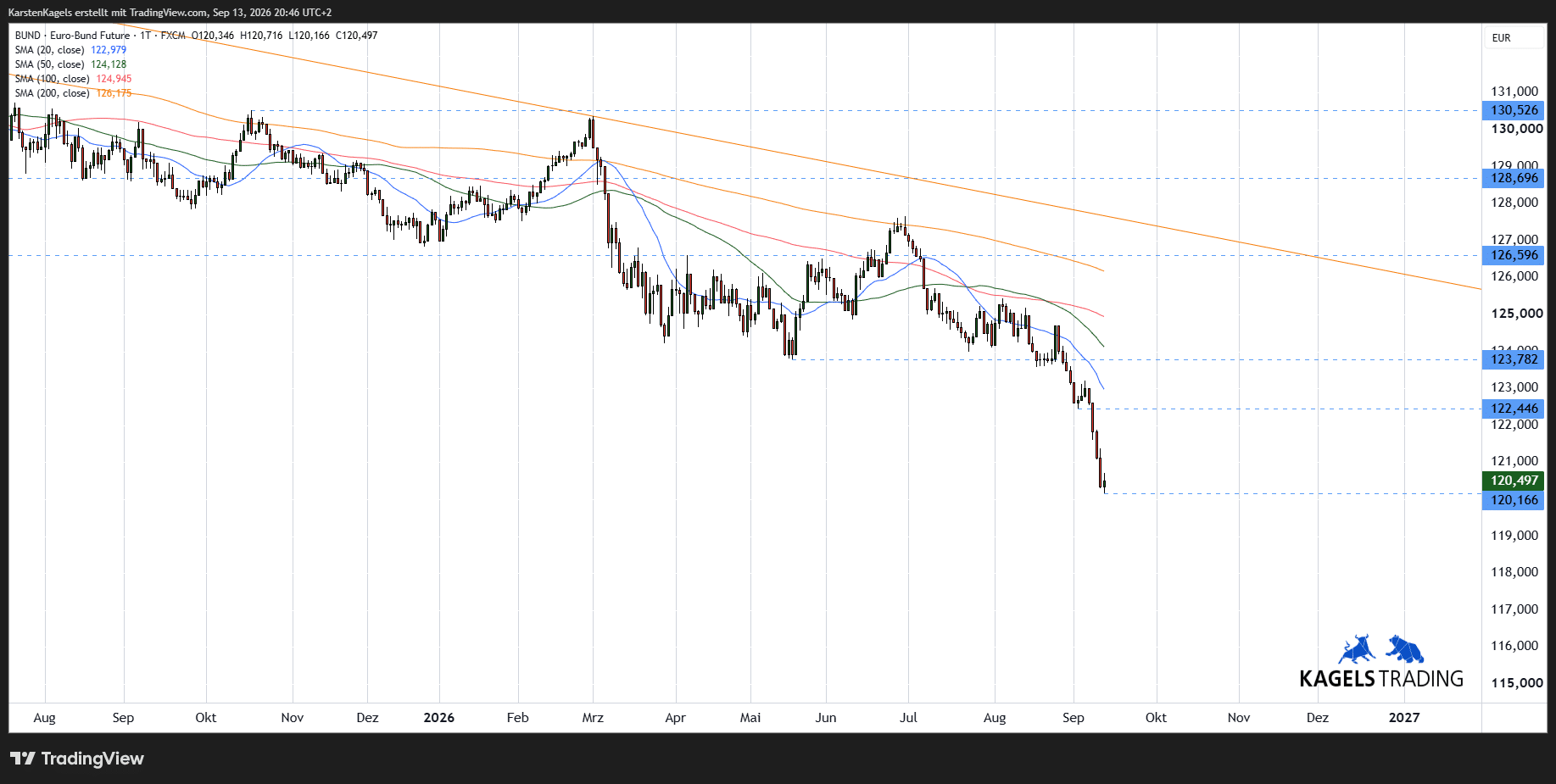
Looking back: the daily chart shows a wide sideways phase between 126 and 132 points, inside which a short-term downtrend formed. Since May 2025 price pushed increasingly toward the 126 mark, and that zone gave way after a failed attempt at recovery.
Outlook: in October 2025 price met stronger resistance at the 200-day moving average (orange). During the February recovery the moving averages were broken to the upside, and price formed a connecting point for the short-term falling trend line. At the local high of 130.50, however, resistance was so clearly in charge that the nearby supports were given up straight away. After the break of the 126 area, the interim recovery was rejected at the 200-day line as well. The selling pressure that set in has now broken the 123 mark and aims at prices below 120 points.
That leaves the forecast standing on two legs. As long as 125 is not won back, a target below 120 points stays active for further selling. If a counter-move upward develops instead, a return above the 50-day line would first allow a test of the 100-day average.
Resistance
- 126.596
- 123.782
- 122.446
Price at analysis120.497
Support
- 120.166
Euro Bund future forecast, medium term
 Click to enlarge
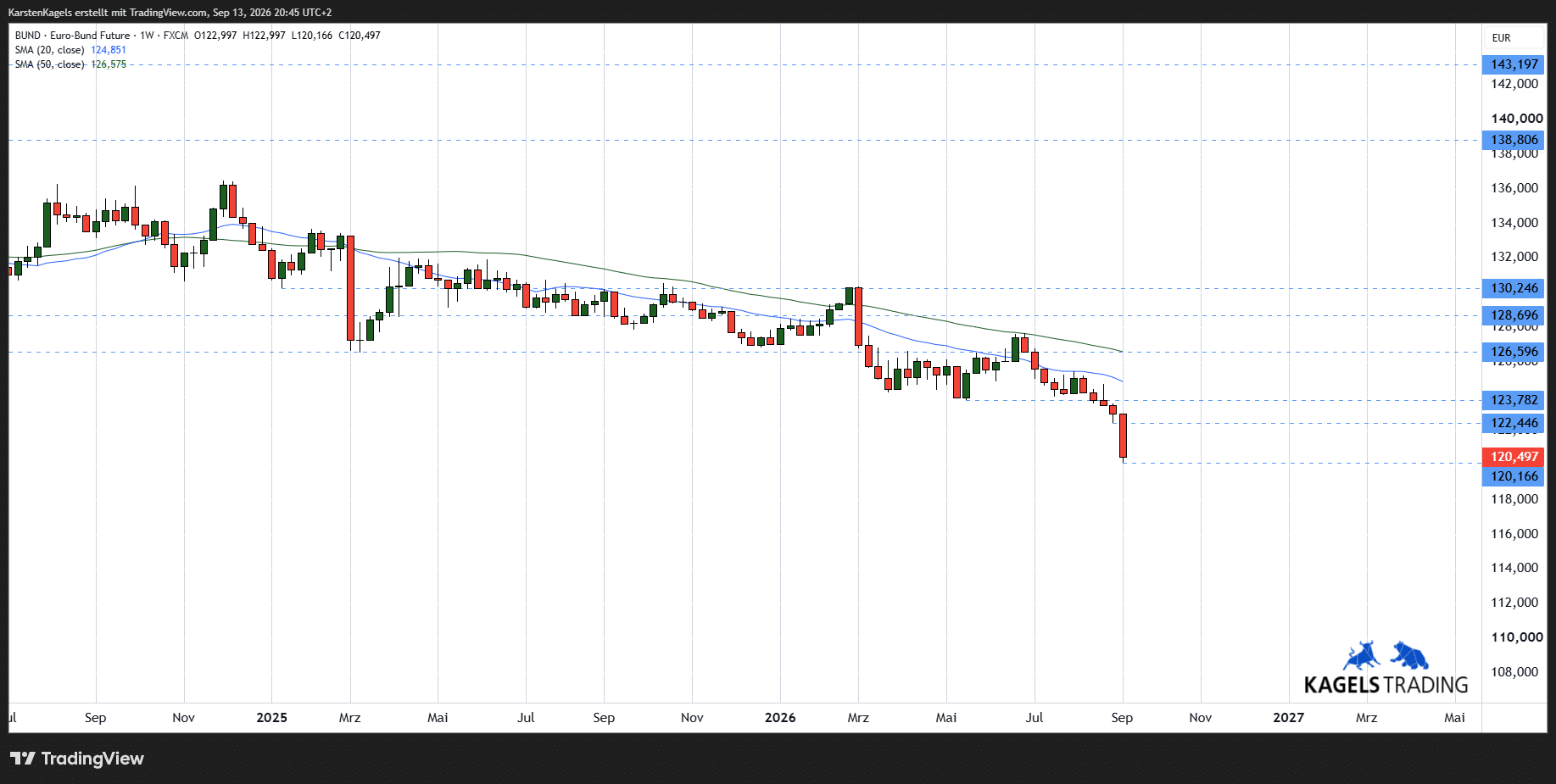
Looking back: the weekly chart covers the move since 2021. After 2022 brought heavier losses, a base started to form from 2023. The lower edge at 126 points stayed under lasting pressure, and it has now given way.
Outlook: the focus in the medium-term picture was on the 2023 yearly low (126.59), which was tested several times. After the failed recovery above the moving averages, the break has released further weakness toward the 120 mark, with the 20-week moving average acting as resistance.
The fundamental tailwind for this view got stronger in 2026. On 11 June 2026 the ECB raised its key rates for the first time in three years and set the deposit rate at 2.25 percent. A pause followed on 23 July. Another rise came in September, so 2.5 percent is on the books now. For a bond future, rising rates mean falling prices.
Resistance
- 128.696
- 126.596
- 123.782
Support
- 120.166
Euro Bund future forecast, long term
 Click to enlarge
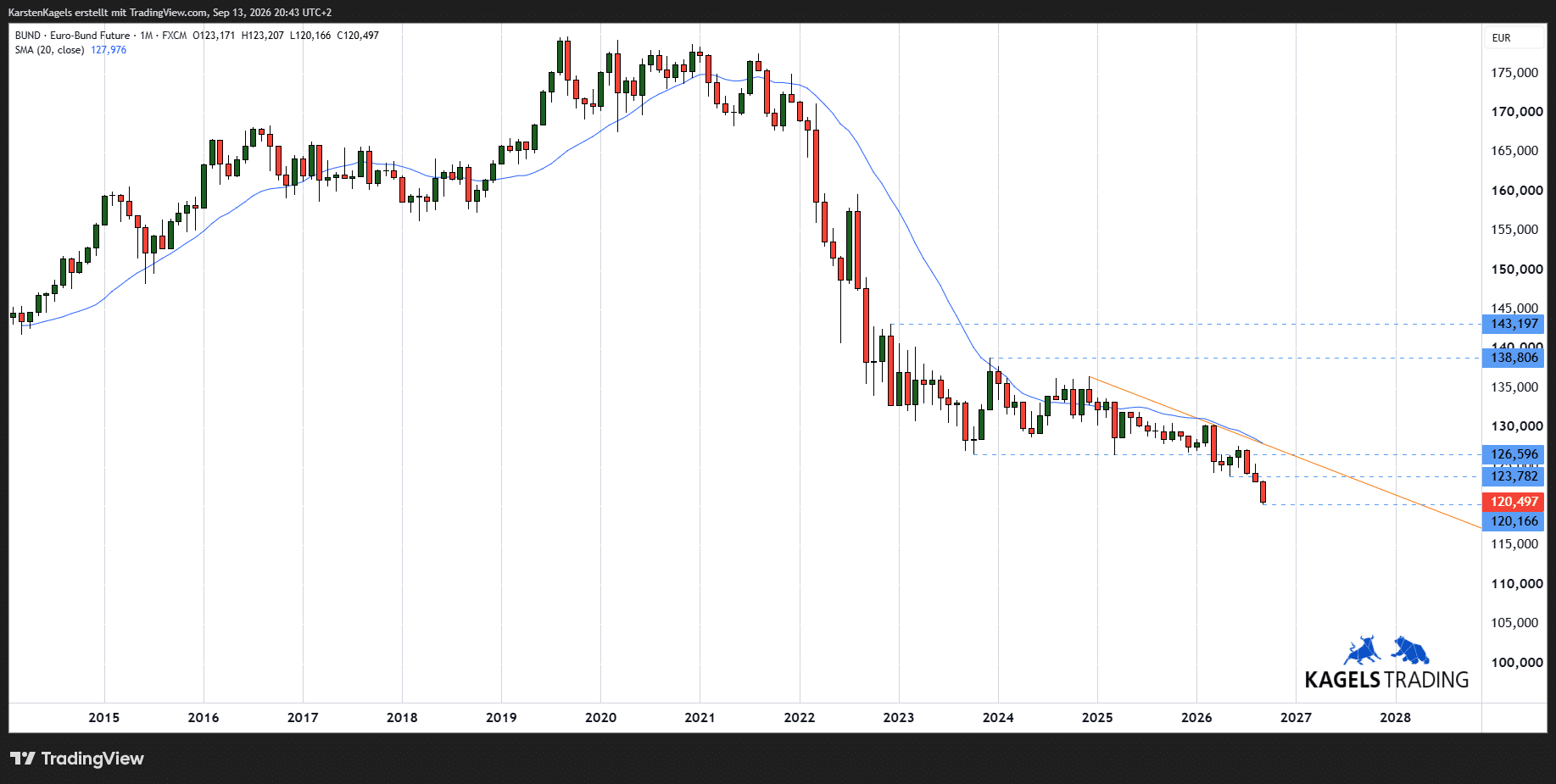
Looking back: the monthly chart shows the move since 2013. The sideways phase established from 2019 to 2022 was broken to the downside when the era of low interest rates ended. Price then contained the clear losses of 2023 at a local low of 126 points. Above that, further downward pressure built up in a drifting phase.
Outlook: the long-term chart shows a clear leg down, which turned into a stabilisation between 126 and 138 points in 2023. After a test of the 20-month line, price put increasing pressure on the lower edge of the trading range at 126 points. The break that has now happened could aim at the 120 area after the pullback.
Two structural factors work against the Bund future over a year. First, the higher financing need for defence and infrastructure increases the supply of German government bonds, which weighs on prices. Second, the ECB turned the rate cycle upward again in 2026. Only when that cycle turns does the long-term picture change fundamentally.
Resistance
- 143.197
- 138.806
- 126.596
Support
- 120.166
The contract and the current numbers
The Bund future has fallen below the narrow trading range of recent weeks. The actively traded contract is December 2026, ticker FGBL, and its last trading day is 8 December 2026. All values below refer to that contract on Eurex. Because Eurex does not trade at the weekend, Friday’s close is the current state.
The Euro Bund future is a futures contract traded on Eurex on a notional German government bond with a 6 percent coupon and a remaining maturity of 8.5 to 10.5 years. It counts as the most important gauge of long-term interest rates in the euro area. Trading it requires a broker with Eurex access; what the contract costs per trade is documented from real statements in our Interactive Brokers review.
| Figure | Value (as of 13 September 2026) |
|---|---|
| Weekly close | 120.497 points |
| Weekly open | 122.997 points |
| Weekly high / low | 122.997 / 120.166 points |
| Change on the week | -2.50 points (-2.03 percent) |
| Previous week, high / low | 123.59 / 122.44 points |
| Last daily volume | 1,652,544 contracts |
| Open interest | 2,155,614 contracts |
| Active contract | FGBL December 2026 |
What stands out after the recent calm is the new directional impulse. Since mid-July 2026 the contract had moved very little on balance: between the high and the low of that phase lay 1.4 points, or about 1.1 percent. For an instrument that usually reacts clearly to rate decisions, that is an unusually narrow band. Lately the downward pressure has increased and led to a break.
One point of price movement equals 1,000 euros per contract. The smallest price change is 0.01 points and is worth 10 euros. Last week’s range of 1.15 points therefore meant 1,150 euros for a single contract. Keeping that size in mind gives a far more realistic view of the risk in a position.
What is the Euro Bund future?
Behind the clumsy name sits a contract on a bond that does not exist in that form. The Euro Bund future does not refer to a single security but to a notional reference bond. Only at maturity is it decided which real German government bonds may be delivered.
The Euro Bund future, or Bund future for short, is a standardised futures contract on Eurex with a notional value of 100,000 euros. It refers to a notional German government bond with a 6 percent coupon and a remaining maturity of 8.5 to 10.5 years.
The price is quoted as a percentage of the notional value. A level of 125.08 points therefore means 125.08 percent of par. The ticker FGBL stands for “federal government bond liability”. On Eurex, trading runs from 2:10 to 22:00 Frankfurt time, which makes the contract interesting outside classic exchange hours as well.
The contract data
Standardisation is the real advantage of a future. Because every contract is built identically, liquidity is high and the spread very tight. The following data comes directly from Eurex.
| Feature | Detail |
|---|---|
| Ticker | FGBL |
| Notional value per contract | 100,000 euros |
| Coupon of the reference bond | 6 percent |
| Remaining maturity of deliverable bonds | 8.5 to 10.5 years |
| Smallest price change | 0.01 points, equal to 10 euros |
| Expiry months | March, June, September, December |
| Last trading day | two exchange days before delivery, close 12:30 |
| Trading hours | 2:10 to 22:00 Frankfurt time |
Only three expiry months are tradable at any time. Trading concentrates almost entirely on the nearest contract. About two weeks before expiry, most market participants roll their positions into the next date. Anyone who wants to hold a position longer has to plan that rollover themselves.
Bund, Bobl, Schatz and Buxl compared
The Bund future is only one of four interest-rate futures on German government bonds. They differ solely in the remaining maturity of the deliverable paper. The longer the maturity, the more strongly the price reacts to a change in rates. The data comes from the German Finance Agency.
| Contract | Remaining maturity | Coupon |
|---|---|---|
| Euro Schatz future | 1.75 to 2.25 years | 6 percent |
| Euro Bobl future | 4.5 to 5.5 years | 6 percent |
| Euro Bund future | 8.5 to 10.5 years | 6 percent |
| Euro Buxl future | 24 to 35 years | 4 percent |
For beginners the maturity is the most important lever. For the same change in rates, the Schatz future moves far less than the Buxl future. Anyone who wants to keep risk small chooses the short maturity. Anyone betting deliberately on a turn in rates finds the greater leverage at the long end.
Advantages and disadvantages
Before you take a position, you should know both sides. The contract is liquid and transparent, but it does not forgive carelessness in risk management.
Advantages
- Very high liquidity: with more than 1.6 million open positions it is one of the most traded interest-rate futures in Europe. Getting in and out works even in size without notable slippage.
- Tight spreads: thanks to standardisation, the difference between bid and ask is usually only one tick, which lowers trading costs noticeably.
- Long trading hours: trading runs from 2:10 to 22:00 Frankfurt time and covers the Asian session as well as US trading.
- Direct access to rate expectations: no other instrument reflects euro area rate expectations so directly, which also makes it suitable for hedging bond portfolios.
Disadvantages
- High capital requirement: one point of movement equals 1,000 euros per contract. Clean risk management needs an account to match.
- Leverage works both ways: the margin posted is only a fraction of the notional value, so losses can exceed it.
- Rollover is compulsory: positions expire with the contract. Holding them means actively moving into the next expiry month, at extra cost.
- Event risk on rate dates: around ECB decisions and important inflation data, spreads widen abruptly. A tight stop is then easily triggered, even when the idea was right.
Why the Bund future rises and falls
The most important rule is also the one that confuses beginners most. Price and yield run in opposite directions. When the Bund future rises, the yield on ten-year German government bonds falls. When it falls, the yield rises. Once that has sunk in, the contract reads immediately as an interest-rate barometer.
The Bund future and the yield on ten-year German government bonds always move in opposite directions. A rising price signals falling rate expectations, a falling price signals rising rate expectations.
The reason lies in the fixed coupon. A bond already issued pays an unchanging rate of interest. If the general level of interest rates rises, that older paper becomes less attractive. Its price then falls until the yield is in line with the market again. The future reflects exactly that move.
What drives the price
- ECB monetary policy: the deposit rate currently stands at 2.5 percent. After the first rise in three years in June 2026 and the pause in July, the rate went up again in September. Attention now turns to 29 October 2026.
- Supply of German government bonds: higher spending on defence and infrastructure means more issuance. More supply weighs on prices if demand does not grow with it.
- Inflation data: surprisingly high readings push rate expectations up and weigh on the contract. Weak readings work the other way.
- Risk appetite: in a crisis investors look for safe havens. German government bonds benefit then, and the future rises even though monetary policy has not changed.
- US interest rates as a pacemaker: the yield on ten-year US Treasuries acts on the European market through the rate spread. A strong rise in the US often drags German yields with it. The US side is covered in the Fed rate decision. How nervous the US rate market is shows in the MOVE index, and where US yields could go in our interest rate forecast.
In practice that means: not every drop is a break in the trend. A fall on an ECB day has a different quality from one on an uneventful trading day. So always check first whether a scheduled event is behind the move, before you reassess the chart.
Conclusion from the previous update: the downward move reaches 122
This conclusion still describes the state of the update before this one, when the contract stood at 122.997. The chart sections above are newer, from 13 September, with a close at 120.497.
The Bund future has left the consolidation between 124 and 125.50 to the downside and so confirmed the bearish case. At a close of 122.997 points the contract trades only just above the next support at 122.446, which means the base that recent counter-moves came from has broken away.
The picture is clearer now than it was weeks ago: all moving averages (SMA 20 at 123.80, SMA 50 at 124.70, SMA 100 at 125.16, SMA 200 at 126.36) are falling and lie above the current price, an intact bearish setup with no counter-signal. In the short term the 122 mark is in focus, and on a break below it, 120 points come into reach as the medium-term target.
The date for a possible acceleration or counter-move comes from the ECB: on 29 October 2026 the Governing Council decides on rates, and the market already prices in expectations of another rise. Until then it is worth looking especially carefully at position size, because one point of movement means 1,000 euros per contract.
Frequently asked questions
What does the Bund future tell us?
It counts as the most important interest-rate barometer in the euro area. It shows what rate expectations the market is pricing in for the coming ten years. A rising price stands for falling rate expectations, a falling price for rising ones. On 11 September 2026 the contract closed at 120 points.
What happens when the Bund future rises?
A rising Bund future means falling yields. Price and yield always move in opposite directions. When the contract climbs, the yield on the ten-year German government bond falls. For savers that means worse terms on deposits, for borrowers tendentially cheaper mortgages.
Why is the Bund future falling?
Answered in an earlier update, when the deposit rate was 2.25 percent. It has been 2.5 percent since 10 September 2026. Falling prices reflect rising rate expectations. Three drivers work together: the ECB raised the deposit rate to 2.25 percent in June 2026, the federal government’s financing needs increase the supply of bonds, and stubborn inflation prevents quick rate cuts.
What is the forecast for 2026?
The technical picture stays bearish and points to new momentum. After the break of the 123 mark, the next target at 122 points is active, and 120 points in the medium term. The condition is that 125 is not won back.
How is the price of the Euro Bund future formed?
The price moves inversely to interest rates. It is quoted as a percentage of the notional value of 100,000 euros. A conversion factor adjusts the bonds that can really be delivered to the notional reference bond with its 6 percent coupon. The daily settlement price reflects market activity.
How can I trade the Euro Bund future?
Trading runs through Eurex and needs a broker with access to the futures exchange. You can bet on rising prices (long) or falling prices (short). What matters is knowing the margin requirement and having a realistic view of the contract size: one point equals 1,000 euros.
What are the risks?
Leverage is the central risk. Because only a fraction of the notional value is posted as margin, losses can exceed the amount invested. On top of that come market risk from rate swings, wide ranges around ECB dates, and the duty to roll positions before expiry.
Which tools and indicators are used in the charts?
For this forecast we stick to proven instruments: moving averages (SMA), nearby supports and resistances, and trend lines.
- Blue line: 20-period moving average
- Green line: 50-period moving average
- Orange line: 200-period moving average
- Black dashed line: supports and resistances from previous highs and lows
- Green dashed line: long-term uptrend line or support
- Red dashed line: long-term downtrend line or resistance
- Grey line: short-term trend line, in temporary use
This forecast is translated from the German edition on kagels-trading.de.
How our forecasts are made and reviewed: How we work.