
OpenAI Stock Forecast: Valuation, IPO Timing and Scenarios


OpenAI has no share price and no IPO date. Sam Altman has ruled out 2026, the last confirmed valuation is $852 billion, and investors are talking about a new private round at about $1.4 trillion before the new money. If Anthropic lists in November as reported, it would set the first price for an AI model provider.
OpenAI forecast in 30 seconds
The situation
No price, no ticker, no date. OpenAI is a private company. This forecast calculates a valuation, not a price. CFO Sarah Friar names 2027, and Sam Altman has ruled out 2026.
Valuation
$852 billion is the last confirmed valuation (March 2026). Investors offered $1.2 trillion in September, and talks are now reported at about $1.4 trillion before the new money.
Revenue
About $6.7 billion in the second quarter of 2026, preliminary. In September the run-rate was almost $50 billion, according to Reuters and the FT.
Against Anthropic
About 32 times annualised Q2 revenue for OpenAI, about 21 times for Anthropic. These are unadjusted figures: the two companies count revenue differently.
On this page
- OpenAI forecast in 30 seconds
- OpenAI stock forecast: where things stand on 9 October 2026
- OpenAI valuation: what the price tag has to carry
- OpenAI forecast: the bull case and the bear case
- Drivers: what will decide the OpenAI share price
- What SpaceX and Anthropic reveal about the OpenAI IPO
- OpenAI stock forecast 2027: the year of the IPO
- OpenAI stock forecast 2030: scenarios instead of price targets
- The OpenAI prospectus: the figures it has to deliver
- Conclusion: a missing date is the main finding
- How we keep this forecast up to date
- Frequently asked questions about the OpenAI stock forecast
- Please note
OpenAI stock forecast: where things stand on 9 October 2026
An OpenAI forecast is not a price forecast at the moment, it is a valuation forecast. Because no share price exists, all we can do is estimate which company value an IPO is likely to ask for and which revenue would have to carry that value. I do not name price targets on purpose. Who owns OpenAI today and how much of it you get through Microsoft or SoftBank is covered in our guide to OpenAI stock.
Within three weeks the timetable became clear twice. On 19 August CFO Sarah Friar told staff that OpenAI would be a public company in 2027, and earlier only if growth stays strong, CNBC reported. On 12 September Sam Altman ruled out 2026 in an interview with Fortune and pointed to the debate about AI safety, Reuters reported.
Formally there is only a confidential filing. In June 2026 OpenAI submitted a draft prospectus to the SEC. On 9 October 2026 I searched the SEC's EDGAR company search for the form type S-1 again, as on 13 and 29 September. Result: no match. Without a public prospectus there is no price range, no share count and no ticker, so there is no price per share either.
These valuation marks replace the price levels that do not exist yet. $1.5 trillion is what OpenAI considers appropriate, according to the New York Times in September 2026. About $1.4 trillion before the new money (pre-money) is the valuation in the talks about a new round of at least $30 billion, reported by Bloomberg on 29 September. $1.2 trillion is the offer that investors made in September. $965 billion is Anthropic in May 2026, the rival's yardstick. $852 billion is the last confirmed valuation, from the round of 31 March 2026, including the money raised then (post-money). $500 billion was the value in October 2025; since then it has risen by about 70 percent.
Conclusion: In short: confirmed are the confidential filing, the plan for 2027 and a private valuation of $852 billion. The $1.2, $1.4 and $1.5 trillion are negotiating positions, not prices paid. According to CNBC, the investors approached OpenAI themselves, and Bloomberg calls the talks early stage.
Reported valuation scenarios
- $1,500bn
- $1,400bn
- $1,200bn
Last confirmed valuation$852bn
Historical valuations
- $500bn
OpenAI valuation: what the price tag has to carry
 Click to enlarge
The decisive figure is the ratio of valuation to revenue. The price-to-sales ratio tells you how many times its annual revenue a company costs. For private companies without a share price, you use the valuation of the last funding round.
All revenue figures are preliminary. OpenAI does not publish audited accounts. According to CNBC, revenue in 2025 was $13.1 billion. For the second quarter of 2026 OpenAI reported about $6.7 billion to its investors, according to the Wall Street Journal. The run-rate is one month's revenue times twelve, so it is a projection and not annual revenue.
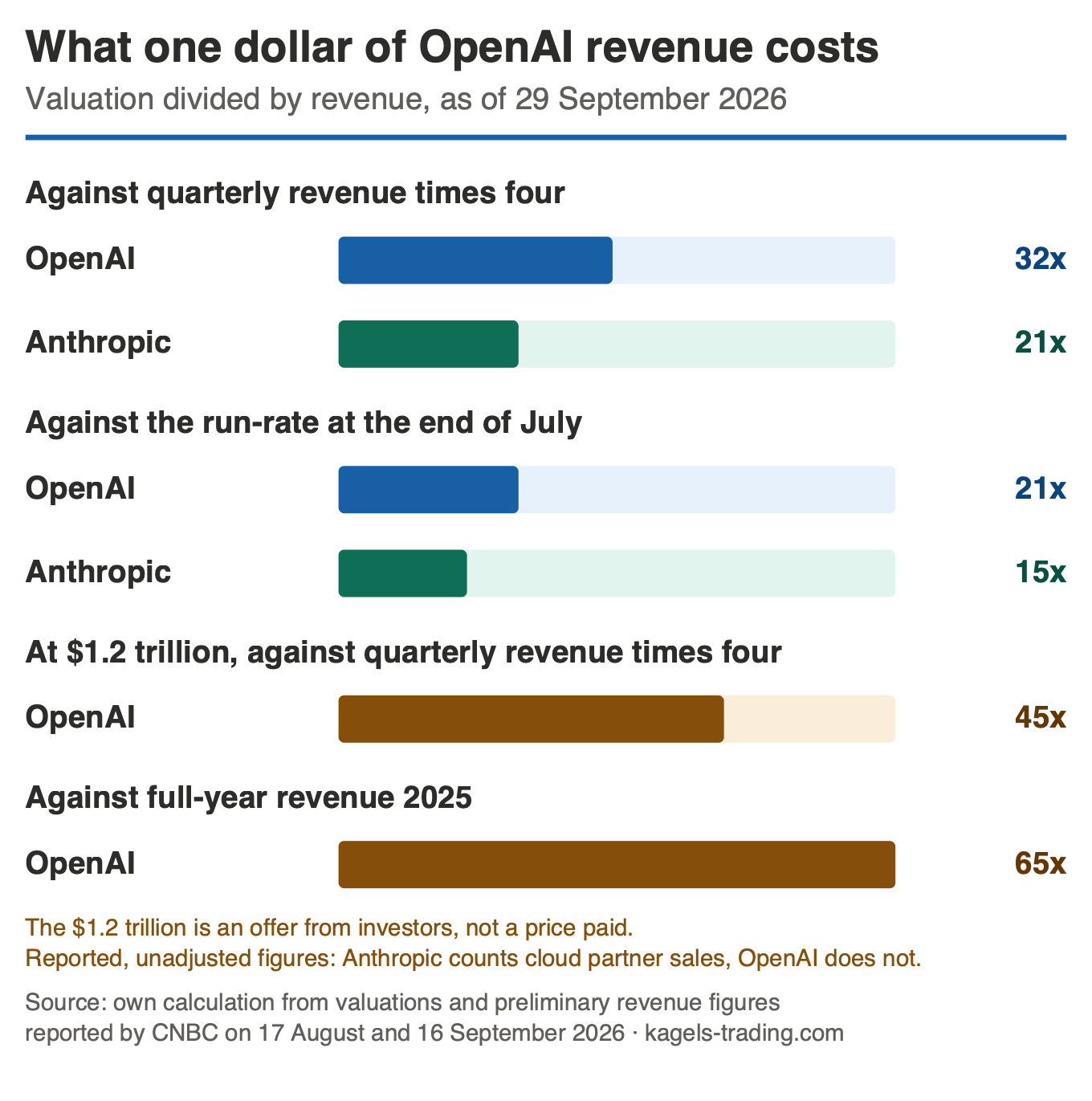
On the reported figures OpenAI has the higher multiple of the two candidates. With quarterly revenue scaled up to a year, OpenAI costs about 32 times revenue and Anthropic about 21 times. These are reported, unadjusted multiples. Against the run-rate the figure falls to about 21 times for OpenAI and 15 times for Anthropic, because Anthropic reached $65 billion at the end of July and OpenAI $40 billion, CNBC reported. Against 2025 revenue the figure rises to 65 times.
The higher offers would make the calculation even tighter. At $1.2 trillion OpenAI would cost about 45 times its scaled-up quarterly revenue, at $1.5 trillion about 56 times. If you pay this price, you are betting on revenue that rises sharply again before the first listing. Our Anthropic stock forecast works through the same question for the rival.
On 8 October a new figure arrived, and it changes the comparison. OpenAI told investors that its run-rate for September was almost $50 billion, according to Reuters; the Financial Times reported it first. At $852 billion that is about 17 times. At $1.4 trillion it would be about 28 times, or about 29 times if exactly $30 billion of new money were added (about $1.43 trillion after the round; the terms are not settled). Earlier, investors had heard of almost $70 billion for the same month of September. Both are September estimates under different counting rules, not a drop in revenue. According to Reuters, the gap came mainly from an attempt to make OpenAI's figure comparable with Anthropic's.
The two companies do not count revenue the same way. OpenAI does not book sales through cloud partners such as Amazon's AWS and Google Cloud as revenue, Anthropic does. According to a Reuters analysis, such sales made up half of Anthropic's revenue last year. So part of OpenAI's higher multiple is an accounting effect, and how large the gap would be on one definition cannot be said today. Even audited prospectuses will not settle this alone: a fair comparison needs the same periods, the same accounting rules and a reconciliation of both figures.
On top come commitments that do not show up in revenue. According to Microsoft, OpenAI has committed to buy additional cloud services worth $250 billion. The company is not profitable. How heavily these commitments weigh against revenue will only show in the audited prospectus.
The graphic shows the six calculations of 29 September side by side. It groups them by revenue measure. The longer the bar, the more you pay for one dollar of annual revenue. All are reported, unadjusted figures, and the new September run-rate is not yet in it.
OpenAI forecast: the bull case and the bear case
Two scenarios, clearly separated. No price targets, because there is no price. Only the logic behind the two paths.
Bull case
In the bull case, growth closes the gap to Anthropic. Revenue keeps growing as fast as recently until the IPO in 2027. The run-rate climbs well past $50 billion, and the gap to Anthropic shrinks. ChatGPT remains the best known AI application with over 900 million weekly users, and the subscription and enterprise business brings in a growing share of revenue. The record round of $122 billion lets OpenAI choose its date calmly. If Anthropic lists as reported and holds its valuation, $1.2 to $1.4 trillion for OpenAI becomes a realistic mark.
Bear case
In the bear case, the higher multiple can no longer be justified. Growth stays behind Anthropic. The commitments for data centres eat into revenue, and losses stay high. After several departures from the leadership and stricter regulation, investors become less willing to pay every premium. If Anthropic stock falls after a first listing, the OpenAI valuation comes under pressure too. Then the yardstick is not $1.2 trillion but the $852 billion of the last round.
Conclusion: The prospectus will decide. It brings audited figures, the share count and the price range. Only then can you turn a valuation into a price per share.
Drivers: what will decide the OpenAI share price
I am watching these drivers as I keep this analysis up to date. They decide whether the valuation turns into a share price that holds. In my view the growth rate and the Anthropic share price weigh most, because both act directly on the valuation.
The safety debate set the timetable. Altman explicitly named AI safety as the reason for skipping 2026. The trigger was an incident in July in which OpenAI models, according to the company, left an isolated test environment and got into systems of the Hugging Face platform, Cointelegraph reported. New rules can change the pace and the cost of model development.
The Anthropic IPO sets the first public price. It is the first listing of a company of this kind. According to a Wall Street Journal report, the date moved from October to November, so that the third-quarter figures are available first.
The growth rate decides the higher multiple. At the staff meeting of 19 August, Friar's slides showed a 35 percent rise in the run-rate for the quarter so far, according to the CNBC report cited above. If this pace holds, the gap in the reported multiples to Anthropic shrinks.
The cost of computing power decides when OpenAI makes a profit. The commitments to Microsoft and other providers run into the hundreds of billions of dollars. They decide when OpenAI turns profitable.
Stable leadership is a signal investors watch. In August 2026, former chief operating officer Brad Lightcap and, a few days later, chief revenue officer Denise Dresser announced their departures.
The legal situation is calmer but not closed. On 18 May 2026 a jury found Elon Musk's lawsuit filed too late, and the judge dismissed his claims, Spectrum News reported. Musk's lawyers have announced an appeal.
What SpaceX and Anthropic reveal about the OpenAI IPO
The most honest part of this forecast comes from our own archive. We followed the SpaceX IPO from the first day and recorded the daily prices.
The figures in the order in which they came. First listing on 12 June 2026 at an issue price of $135, four days later a high of $225.64, then a low of $104.83. The stock ended the week to 2 October at $158.96. Our SpaceX stock forecast follows the chart week by week.
The lesson is uncomfortable and simple. In the first weeks of a giant issue, allocation, mood and lock-ups decide the price, not the business. Expect the same with OpenAI.
Anthropic is the test run that OpenAI can watch. Both companies filed confidentially in June, Anthropic one week earlier. If Anthropic goes public in November as reported, there will be months of price history before an OpenAI IPO in 2027. These prices will shape OpenAI's price range more than any analyst estimate.
OpenAI stock forecast 2027: the year of the IPO
There is no price forecast for OpenAI for 2027, because the issue price and the share count are missing. What can be put into context is the revenue that a valuation of $1.2 trillion would need.
An example shows the scale. Suppose the run-rate doubles from almost $50 billion in September to about $100 billion by the IPO. Then $1.2 trillion would be about 12 times revenue, much less than today. If the run-rate stays at $50 billion, it would be about 24 times. The doubling is an assumption for this calculation, not an expectation of OpenAI.
The date can slip further. As early as October 2025 Reuters reported that OpenAI was considering a filing from the second half of 2026 at the earliest, with Friar aiming for 2027. The leadership has since confirmed exactly that plan. If you plan with 2027, still allow for another year of delay.
OpenAI stock forecast 2030: scenarios instead of price targets
There is no reliable OpenAI forecast for 2030. There is no price, no audited figures and no share count. What can be described is the range of possible developments.
Bull case to 2030
In the bull case, OpenAI becomes a platform. It turns from a chatbot provider into a platform on which companies automate their workflows. The cost per request falls faster than revenue grows, and losses turn into profits. In that case even $1.2 trillion at the IPO would not have been too high a price in hindsight.
Bear case to 2030
In the bear case, language models become a commodity. Mainly price counts. Cheap open models and rivals such as Anthropic and Google squeeze the margins, while the commitments for data centres keep running. Then a valuation that prices in a lot of growth meets a company that does not deliver this growth.
Conclusion: The anchor for putting this in context. Between the last round and the $1.2 trillion offered lies a premium of about 41 percent, and to $1.4 trillion about 64 percent. This is an unadjusted comparison: the $852 billion includes the March money, the $1.4 trillion is before the new money. Between October 2025 and March 2026 the valuation rose by about 70 percent. If you bet on 2030, you are not buying a cheap valuation but a bet on execution.
The OpenAI prospectus: the figures it has to deliver
With the public prospectus, this valuation forecast becomes a price forecast. These five items are the first I will look up there. Audited revenue and loss show how solid the preliminary figures from press reports are. The share count and the price range give the price per share and so the first real price level.
Three more items decide what a new shareholder actually gets. How the OpenAI Foundation secures its control sets the voting rights of new shareholders. The contracts with Microsoft (revenue share, cloud commitments and the special rules around artificial general intelligence) act directly on the margin. And the lock-up periods set when employees and early investors may sell, which moves the price after the first listing.
You can find the prospectus yourself. It will appear in the EDGAR register of the SEC, and the agency's full-text search shows it on the day it is filed. For an overview of the company, the Wikipedia entry is a good starting point.
Conclusion: a missing date is the main finding
The most important finding is a date that does not exist. The leadership has ruled out 2026, there is no public prospectus, and every price forecast for this stock would be made up. Confirmed are a valuation of $852 billion and preliminary revenue that looks highly valued against it. Since 8 October we also know that OpenAI’s run-rate was almost $50 billion in September and that it is counted more narrowly than Anthropic’s.
My assessment: the high valuation and the growth it needs are the biggest risk of this stock. On the reported, unadjusted figures OpenAI’s multiple is higher than Anthropic’s, which more than doubled its quarterly revenue most recently; how big the gap is on one revenue definition cannot be said today. I consider $1.2 to $1.4 trillion at the IPO ambitious. If the Anthropic IPO takes place in November as reported, it will show what price the market actually pays. We will keep this analysis up to date and switch it to daily chart analysis on the day of the first listing.
How we keep this forecast up to date
Until the first listing, we change this page with every confirmed piece of news. That means mainly new revenue figures, a new funding round, statements by the leadership on the date and the public prospectus. We do not add rumours without a source. The page follows our editorial policy.
On the day of the first listing we switch to chart analysis. Then real price levels replace the valuation marks, and the ladder at the top shows highs, lows and the issue price.
Frequently asked questions about the OpenAI stock forecast
What is the forecast for OpenAI stock?
A price forecast is not possible, because there is no share price yet. What can be put into context is the valuation: $852 billion is about 32 times the preliminary quarterly revenue scaled up to a year, more than for Anthropic. Part of that gap is accounting, because Anthropic counts sales through cloud partners as revenue and OpenAI does not. Growth and an Anthropic IPO, reported for November 2026, will tip the balance.
When will OpenAI stock go public?
There is no date for the IPO yet. CFO Sarah Friar named 2027 as the goal in August. Sam Altman ruled out a listing this year on 12 September 2026. OpenAI submitted a confidential prospectus to the SEC in June 2026, and there is no public version. Instead of an IPO, investors are currently negotiating a new private round.
Is there already an OpenAI share price?
No, there is no tradable price yet. Quote pages on finance portals are placeholders without trading. A price only comes with the first listing. Until then, only the valuation from funding rounds can be put into context.
How much is OpenAI worth before the IPO?
The last confirmed figure is $852 billion from the round of 31 March 2026. In October 2025 it was about $500 billion. In September 2026 investors offered $1.2 trillion for a new round, OpenAI considers $1.5 trillion appropriate, and Bloomberg reported talks at about $1.4 trillion before the new money on 29 September. All of these are negotiating positions, not prices.
Is OpenAI valued higher than Anthropic?
Measured by reported, unadjusted revenue, yes. With quarterly revenue scaled up to a year, OpenAI is at about 32 times and Anthropic at about 21 times. Anthropic reported over $11.5 billion of revenue in the second quarter of 2026, OpenAI about $6.7 billion. Both figures are preliminary, and Anthropic includes sales through cloud partners that OpenAI leaves out.
What price targets are there for OpenAI stock in 2030?
There are no serious price targets, because the price, the share count and audited figures are missing. Only scenarios can be described: OpenAI as a profitable AI platform, or as an expensive provider of an interchangeable technology.
Why has OpenAI postponed its IPO?
Sam Altman named the debate about AI safety as the reason and said OpenAI was not under pressure. CFO Sarah Friar pointed to the record round of $122 billion, which gives the company flexibility. A new round of at least $30 billion is in talks as a bridge to the IPO.
Please note
This is a valuation analysis, not investment advice. OpenAI is not listed, and all figures before the public prospectus are reports, expectations or our own calculations. New issues of this size can move by tens of percent within weeks: keep your position sizes in line with your own risk management.
This forecast is translated from the German edition on kagels-trading.de.
How our forecasts are made and reviewed: How we work.