
Anthropic Stock Forecast: Valuation, IPO Timing and Scenarios


Anthropic has no share price yet. On 6 October 2026 there was still no public prospectus at the SEC, the last confirmed valuation is $965 billion, and reports point to a listing before Thanksgiving. If the formal roadshow starts on 9 November, the prospectus has to be public by about 25 October; a later start moves that date.
Anthropic forecast in 30 seconds
The situation
No price, no ticker, no date. Anthropic is a private company, and the quote pages of the finance portals are empty placeholders. This forecast calculates a valuation, not a price.
Timing
No public S-1 on 6 October. According to Bloomberg, marketing starts in the week of 9 November at the earliest, with the first listing before Thanksgiving on 26 November.
Valuation
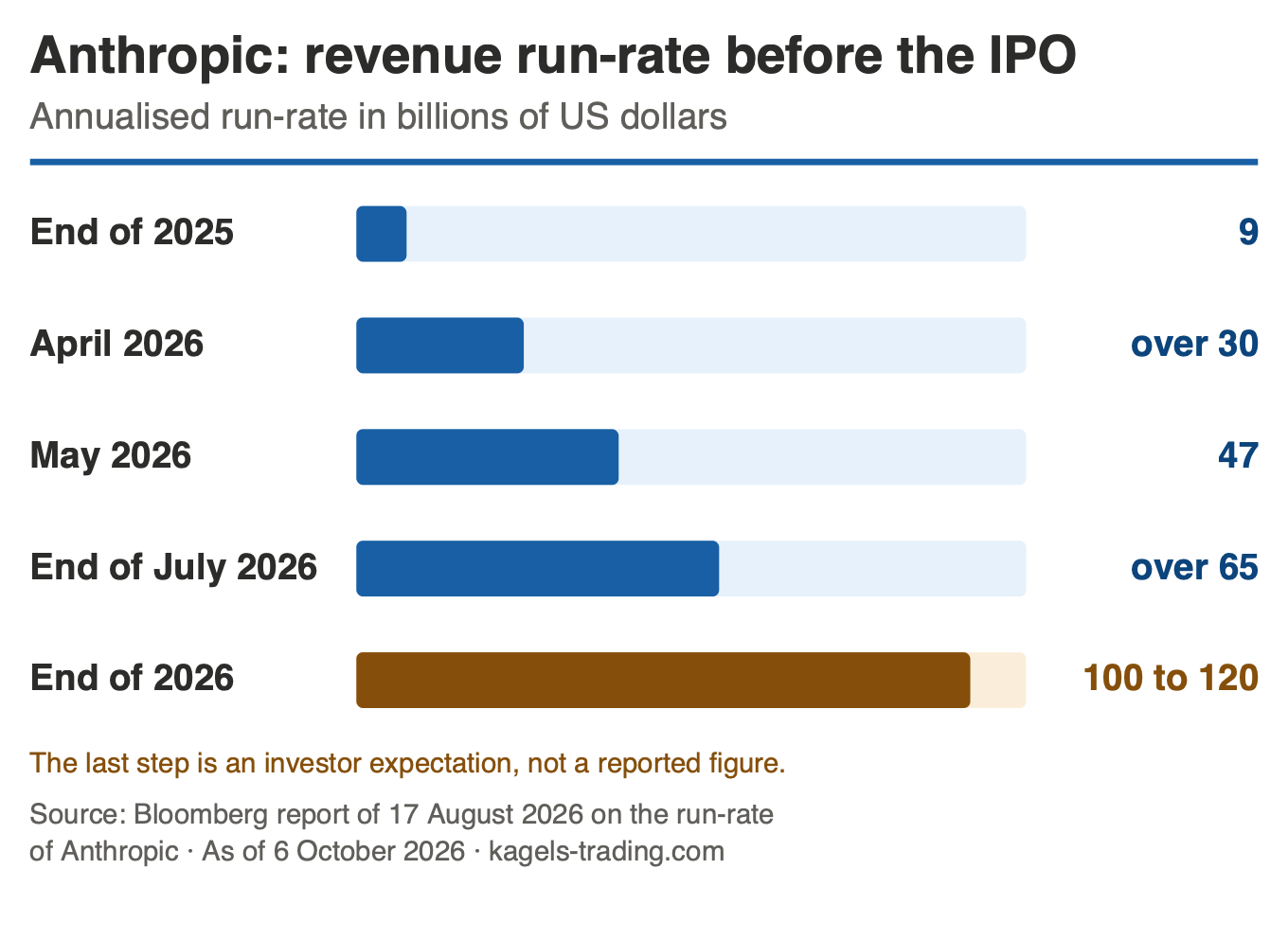
$965 billion is the last confirmed valuation (May 2026). Reports put the IPO at about $2 trillion, against a revenue run-rate of over $65 billion at the end of July.
The SpaceX lesson
$135 issue price, $225.64 at the high, $104.83 at the low, all in less than two months. The first weeks after a giant IPO are decided by allocation and mood.
On this page
- Anthropic forecast in 30 seconds
- Anthropic stock forecast: where things stand on 6 October 2026
- Anthropic valuation: what the IPO price tag has to carry
- Anthropic forecast: the bull case and the bear case
- Drivers: what will decide the Anthropic share price
- The SpaceX IPO: what the first months reveal
- Anthropic stock forecast 2030: scenarios instead of price targets
- Conclusion: valuation instead of price until the prospectus
- How this forecast is made
- Frequently asked questions about the Anthropic stock forecast
- Please note
Anthropic stock forecast: where things stand on 6 October 2026
 Click to enlarge
An Anthropic forecast is not a price forecast at the moment, it is a valuation forecast. Because no share price exists, all we can do is estimate which company value the IPO is likely to ask for and which revenue would have to carry that value.
The timetable is the first question, and it has a hard answer. On 1 June 2026 Anthropic confidentially submitted a draft S-1 to the SEC and announced this itself. Confidential means that the regulator reviews the document and the public sees nothing. Only the public version fixes the number of shares, the price range and the ticker.
That public version still does not exist. On 6 October 2026 I once again searched the SEC's EDGAR company search for the form type S-1. Result: no match, as on 8 and 29 September. Anthropic only appears in the prospectuses of other companies, not as a filer of its own. Anyone who names a date, a price range or a ticker today is passing off a guess as a number.
Someone has read the draft all the same. On 28 September Reuters reported exclusively from the confidential draft prospectus. It contains full-year figures for 2025 for the first time; they follow in the valuation section below. About a third of the document describes risks. Anthropic has not commented on the report, and the SEC is still reviewing the draft.
Since then the timetable has slipped. In early September the expectation was a public prospectus at the end of September and a listing in October. On 18 September the Wall Street Journal reported that Anthropic was now aiming for November, so it can show its third-quarter figures before the roadshow. On 1 October Bloomberg became more specific: marketing could begin in the week of 9 November, which would put the first listing before Thanksgiving on 26 November. Anthropic has confirmed none of these dates.
From this you can work out a date that you can check yourself. A company that files its prospectus confidentially must, under an SEC rule, make it public at least 15 days before the roadshow, or before the requested effective date if there is no roadshow. If the formal roadshow starts on 9 November, the prospectus has to be in the EDGAR register by about 25 October. A later start would move that date, and early investor meetings are not necessarily the roadshow. For comparison: at SpaceX, exactly 23 days passed between the public prospectus on 20 May 2026 and the first listing on 12 June.
The banks have been at work for a long time. Morgan Stanley, Goldman Sachs and JPMorgan lead the syndicate. They have been arranging investor meetings since July, and according to Bloomberg an investor day at the headquarters in San Francisco is set for 14 October. A formal start of the roadshow has not been confirmed, and the date depends on exactly that.
Be careful with the ticker. In forums the symbol ANTP is going around. One data provider lists it, but nobody has confirmed it. Anthropic itself has not published a ticker, a WKN or an ISIN. Until the first listing, every one of these details is unconfirmed. How to get exposure before the IPO and how to buy once the stock is listed is explained in our guide to Anthropic stock.
The revenue run-rate is the only figure that really moves. The graphic above shows its five steps. At the end of 2025 it stood at about $9 billion, in April 2026 at over 30, in May at 47 and at the end of July at over $65 billion. That is more than a sevenfold increase in seven months. The figure for the end of the year, by contrast, is an expectation and not a report.
These valuation marks replace the price levels that do not exist yet. $2 trillion is the reported IPO target and would be the largest IPO in history. $1.5 trillion is the middle of the range reported earlier, about one and a half times the last funding round. $1 trillion is the lower end of that range, just above the private valuation from May. $965 billion is the last confirmed valuation, from the funding round of May 2026, post-money. $183 billion was the valuation of September 2025: in eight months it has more than quintupled.
Conclusion: Confirmed are the filing, the banks and the run-rate. Add a private valuation of $965 billion and the 2025 figures from the draft prospectus. Date, ticker and price range are open. We will add the figures here as soon as the prospectus is public.
Reported valuation scenarios
- $2,000bn
- $1,500bn
- $1,000bn
Last confirmed valuation$965bn
Historical valuations
- $183bn
Anthropic valuation: what the IPO price tag has to carry
Everything starts with a figure that is easy to misread. The run-rate is a projection: the revenue of a single month multiplied by twelve. It is not an audited annual revenue. If the business keeps growing this fast, it understates. If growth slows, it simply stops rising. Only if monthly revenue falls does it fall too, and then it overstates the past peak.
With that caveat, the calculation gets uncomfortable. Measured against the run-rate of $65 billion, the last private valuation of $965 billion equals about 15 times revenue. At a hypothetical $2 trillion offer valuation, it would be about 31 times. Buyers on the exchange could pay a different valuation, as the SpaceX example below shows.
Against the expectation for the end of the year it looks friendlier. Investors expect a run-rate of $100 to $120 billion by the end of the year, and the WSJ most recently named over $110 billion. Taking the middle, the price-to-sales ratio falls to about 9 at a $1 trillion valuation, about 14 at $1.5 trillion and about 18 at $2 trillion. These figures assume that the expectation comes true.
Against the company's own planning it almost looks cheap. Internal documents assume annual revenue of $190 to $200 billion for 2028. Even a $2 trillion valuation would only be about 10 times that. Anyone who considers the stock cheap at this price is also buying a tripling of revenue within two years.
A comparison makes the size easier to grasp, but only roughly. SpaceX was worth about $2.08 trillion on 2 October. Its quarterly revenue scaled up to a year comes to about $31 billion, so the valuation is about 67 times that figure. Anthropic at $2 trillion would be about 31 times its July run-rate. The two figures rest on different revenue bases and periods, so this is an illustration and not a like-for-like result. How to read such a valuation ratio always depends on the growth behind it.
That growth is the real reason for the numbers. In the second quarter of 2026 revenue was over $11.5 billion, after $4.73 billion in the first quarter and $787 million in the same quarter a year earlier. That is about 14 times within a year. On top came an adjusted operating profit of about $559 million, the first quarter in the black on this adjusted measure. It does not show a net profit or a positive cash flow. According to the Financial Times, quoted by CNN, Anthropic has told investors to expect a second quarter in a row with a positive adjusted operating profit this year.
Since 28 September there have been figures for a full financial year for the first time. According to the draft prospectus, revenue in 2025 rose to almost $4.6 billion, about twelve times the year before. In the same year Anthropic made an operating loss of more than $8 billion. The costs for computing power and infrastructure alone tripled to $7.33 billion, more than half of all operating costs of $12.65 billion.
Most of the net loss of almost $42 billion is an accounting entry. About $34 billion of it comes from financing instruments that can later be converted into shares. Because Anthropic has become more valuable, their estimated value rose too, and this rise is booked as an expense. No cash left the company for it. At the end of 2025 Anthropic held $20.28 billion in cash and liquid assets.
Two other figures from the draft weigh more heavily. Anthropic plans $518 billion for cloud, data centres and infrastructure in the coming years. And almost a quarter of revenue in 2025 came from just two customers. According to the risk section, many large customers have no long-term contracts and can cut their spending at any time. Long-term costs therefore meet revenue that can fall away at short notice.
These figures come with a caveat. The quarterly figures for 2026 are preliminary and come from documents that journalists have seen. The 2025 figures are in a draft that the SEC is still reviewing. Anthropic has not commented on any of them. They only become binding with the public prospectus.
Anthropic forecast: the bull case and the bear case
Two scenarios, clearly separated. No price targets, because there is no price. Only the logic behind the two paths.
Bull case
In the bull case, strong figures carry the listing in November. The prospectus appears in October with strong third-quarter figures, and the first listing succeeds in mid-November. Anthropic brings something that is rare for new issues of this size: a quarter with a positive adjusted operating profit. Revenue grew twelvefold in 2025, the run-rate has grown more than sevenfold since the end of 2025, and investors expect $100 to $120 billion by the end of the year. If that comes true, the price-to-sales ratio falls to about 18 even at a $2 trillion valuation, against roughly 67 for SpaceX on a different revenue basis. Amazon and Alphabet stand behind it as major investors, and the enterprise business with Claude brings in the lion's share of revenue.
Bear case
In the bear case, the price tag runs ahead of the business. The date slips further, just as OpenAI does not expect its own listing before 2027. The $2 trillion is an expectation of investors, not a price, and the last confirmed valuation is $965 billion. Anyone who subscribes at the top end pays about 31 times today's run-rate for a company that lost more than $8 billion at the operating level in 2025 and has shown only one quarter with a positive adjusted operating profit. The run-rate is also a projection: if growth slows, it stops rising and no longer supports the expected valuation, and if monthly revenue falls, it falls too. On top come $518 billion of planned infrastructure spending, two customers with almost a quarter of revenue, tight competition with OpenAI and Google, and an interest rate question that hits highly valued growth stocks first. The sharpest counter view comes from the research firm New Constructs: in a report of 6 October it values Anthropic at only $150 billion, less than 8 percent of the $2 trillion target, according to CNBC. By its calculation, $2 trillion would require twice the profit Nvidia earned over the past four quarters. The same firm called WeWork the most ridiculous IPO of 2019, and six weeks later WeWork pulled its listing; it has also been wrong, for example on DoorDash in 2020.
Conclusion: The prospectus will decide. It brings three things that are missing today: audited figures, the number of shares issued and the price range. Only then can a valuation be turned into a price per share. Until then, every price target is an invention.
Drivers: what will decide the Anthropic share price
I am watching these drivers as I keep this analysis up to date. They decide whether the valuation turns into a share price that holds.
The publication of the prospectus is the hard starting signal. Only then are the number of shares, the price range, the ticker and audited figures fixed. For a formal roadshow from 9 November it has to appear by about 25 October; a later start moves that date.
The third-quarter figures are why the date has moved to November. If the adjusted operating profit from the second quarter holds, that supports the price range. If Anthropic falls back into a loss, the $2 trillion calculation becomes hard to defend.
The run-rate in the third quarter shows whether the pace holds. Between May and July it went from $47 billion to over $65 billion. If this pace continues, the reported valuations hold up. If it flattens, they do not.
The cost of computing power can eat the margin in a single quarter. In 2025 it tripled to $7.33 billion. The adjusted operating profit of $559 million is thin compared with over $11.5 billion of revenue, and rising data centre costs can wipe it out.
The interest rate path is the biggest factor outside the business. A valuation that rests on profits far in the future loses the most when interest rates rise. Our US interest rate forecast follows the Fed and Treasury yields.
Competition is both an opportunity and a yardstick. OpenAI does not expect its own listing before 2027, as our OpenAI stock forecast explains. Until then, Anthropic would be the only pure AI model provider on the stock market.
The lock-up periods after the first listing matter early. At SpaceX, hundreds of millions of shares became tradable in tranches from August. How Anthropic staggers its lock-ups is set out in the prospectus, and it is one of the first things I will look up there.
You can check this yourself. The prospectus will be filed in the EDGAR register of the SEC and is free to read there; the agency's full-text search finds it on the day it is filed. Until then, our other forecasts are the better place for tradable markets, because they have charts with levels you can read.
The SpaceX IPO: what the first months reveal
The most honest part of this forecast comes from our own archive. We followed the largest IPO in history so far from the first day and recorded the prices. What happened there is the best available answer to what could happen with Anthropic in the first weeks.
The figures in the order in which they came. The prospectus appeared on 20 May 2026. The first listing was on 12 June at an issue price of $135, and the first close was about $161. Four days later the all-time high stood at $225.64. After that the stock fell as low as $104.83. It ended the week to 2 October at $158.96; our SpaceX stock forecast follows the chart week by week.
Work through it once from a buyer's point of view. Anyone who got the issue price was 67 percent ahead after four days. Anyone who bought on the exchange on the first trading day paid about $161 and saw $104.83 a few weeks later. That is a loss of about 35 percent, at a company whose fundamentals had not changed in those weeks.
The lesson is uncomfortable and simple. With an issue of this size, the first weeks are not decided by the business but by allocation, mood and lock-ups. At SpaceX more than $120 lay between high and low within two months. Anyone who buys without a plan is trading exactly this swing.
For Anthropic this means three things. First, the issue price is not the price a private investor gets. Second, a strong first day says nothing about the following eight weeks. Third, it pays to read the lock-up periods in the prospectus before entering any order at all.
Anthropic stock forecast 2030: scenarios instead of price targets
There is no reliable Anthropic forecast for 2030. There is no price, no audited figures and no share count. What can be described is the range of possible developments.
Why no fixed price target? A price target needs a price and a number of shares. Both are missing. Anyone who names a figure for 2030 today multiplies one guess by a second guess. The only serious approach is to put the valuation into context.
Bull case to 2030
In the bull case, the plan for 2028 comes true. The internal plan with $190 to $200 billion of revenue works out, and growth only slows gradually after that. Anthropic remains the provider to which companies connect their core processes, and it keeps its pricing power. Operating profit grows with revenue, because the model costs per request fall faster than revenue rises. In this case even buying in at a $2 trillion valuation would not have been expensive in hindsight.
Bear case to 2030
In the bear case, the run-rate turns out to be a snapshot. The costs of data centres and top staff outrun revenue, and the thin adjusted operating margin tips back into the red. Language models become an interchangeable commodity where price decides, not the brand. Then a valuation that already prices in two years of growth meets a company that does not deliver this growth.
Conclusion: Between $965 billion and $2 trillion lies a factor of two, and that is the range before the first trading day. This range is not incompetence on anyone's part but an honest description of the situation: nobody knows today what an AI model provider will earn in five years. Anyone betting on 2030 is not buying a cheap valuation but a bet on execution.
Conclusion: valuation instead of price until the prospectus
The most important statement is still a negative finding. On 6 October 2026 the US Securities and Exchange Commission had no public prospectus from Anthropic. So there is no date, no price range and no ticker, and every price forecast for this stock is made up. Confirmed are the confidential filing of 1 June, the three lead banks and a run-rate of over $65 billion. New are the reports of a first listing from mid-November and the first full-year figures from the draft prospectus: revenue up twelvefold with an operating loss of more than $8 billion.
What this means for you. The valuation is the only figure that can be calculated today, and it cuts both ways: expensive measured against today’s run-rate, moderate measured against the company’s own plan for 2028. The SpaceX example also shows how little the first weeks have to do with the fundamentals. We will keep this analysis up to date and switch it to daily chart analysis on the day of the first listing.
How this forecast is made
This page is written for investors, not for day traders. Readers of a stock forecast want to know how the value could develop over months and years, so the page works with valuation, revenue and scenarios instead of daily levels. The page follows our editorial policy.
Before a first listing, Karsten follows a simple rule. What cannot be read from a chart is calculated, and what cannot be calculated stays open. That is why the page names valuation ranges instead of price targets and says which figure is confirmed and which is an expectation. Karsten has been a client of Interactive Brokers since 1996 and has followed several IPOs in which the issue price and the price a private investor actually got were far apart.
Frequently asked questions about the Anthropic stock forecast
When will Anthropic stock go public?
There is no date yet. On 1 June 2026 Anthropic confidentially submitted a draft prospectus to the SEC. A public version did not exist on 6 October 2026, checked in the EDGAR company search. According to Bloomberg, marketing is to begin in the week of 9 November, so the first listing on the Nasdaq would follow from mid-November at the earliest. Anthropic has not confirmed this. The public prospectus has to appear at least 15 days before the roadshow: if the formal roadshow starts on 9 November, by about 25 October. A later start moves that date.
Is there already an Anthropic share price?
No, there is no tradable price yet. What the finance portals show are placeholder pages. On 8 September 2026 one of them showed a price of 0.00, an automatically written sentence about a sideways movement and the figure “nan percent”. Such pages exist because the database already knows the company but receives no prices yet. A tradable price only exists from the first listing.
What is Anthropic’s ticker symbol?
It has not been fixed yet. In forums and at one data provider the symbol ANTP is going around. Anthropic itself has not published a ticker, WKN or ISIN. These details only appear in the public prospectus. Until then, every ticker you see is a guess.
How much is Anthropic worth?
The last confirmed figure is $965 billion. This valuation comes from the funding round of May 2026 and is calculated post-money. In September 2025 it was still $183 billion. For the IPO, the Wall Street Journal names about $2 trillion with up to $100 billion raised; these are investor expectations, not a fixed price.
How reliable is the run-rate of $65 billion?
It is a projection, not annual revenue. The run-rate takes one month’s revenue and multiplies it by twelve. For a company that has grown its quarterly revenue about fourteenfold within a year, it is more likely to understate. If growth slows, the run-rate stops rising and may no longer carry the expected valuation; if monthly revenue falls, the run-rate falls with it. For the end of 2026 investors name $100 to $120 billion, and that too is an expectation.
Is Anthropic profitable?
Not over a full year, but for the first time in one quarter. According to the draft prospectus, Anthropic made an operating loss of more than $8 billion in 2025 and a net loss of almost $42 billion. About $34 billion of the net loss, however, is an accounting entry with no cash outflow. In the second quarter of 2026 there was a positive adjusted operating profit of about $559 million for the first time, and according to the Financial Times a second is to follow. An adjusted figure does not show a net profit or a positive cash flow. These figures are only audited and public with the prospectus.
Should I get in on Anthropic from the start?
That is your decision, not a recommendation. The SpaceX example shows the risk in figures: $135 issue price, $225.64 at the high, $104.83 at the low, all in less than two months. Anyone who bought at about $161 on the first trading day was soon about 35 percent down. If you buy into a new issue of this size, plan for the swings from the start.
Please note
This is a valuation analysis, not investment advice. Anthropic is not listed, and all figures before the public prospectus are reports, expectations or our own calculations. New issues of this size can move by tens of percent within weeks: keep your position sizes in line with your own risk management.
This forecast is translated from the German edition on kagels-trading.de.
How our forecasts are made and reviewed: How we work.