
Trading Mistakes: 13 Costly Errors and How to Avoid Them


Contents
- Trading mistakes in 30 seconds
- What a trading mistake is: and why it gets so expensive
- The 13 worst trading mistakes
- The thinking errors behind trading mistakes
- Overtrading, revenge trading and false signals
- How to take your next trade without mistakes
- Conclusion: avoiding mistakes beats searching for a strategy
- Frequently asked questions about trading mistakes
- About the author
In 2025, Germany’s financial regulator BaFin checked how retail traders really do with leveraged products. The result is uncomfortable: of about 543,000 retail investors, 74.2% lost money. The average loss was EUR 6,358 per person.
The study does not say why these investors lost, but I see the same pattern in my own work. When I go through accounts with traders, a small set of mistakes repeats again and again, and almost all of them can be avoided. I bought my first shares in 1980 and have traded price action actively since 1986, and the mistakes I see in seminar participants have hardly changed in that time. It is not the exotic cases that empty accounts. It is the moved stop, the doubled position and the trade out of boredom.
In this article I go through the 13 most expensive trading mistakes one by one. Then I look at the thinking errors behind them, at false signals and at what the regulator’s data says about overtrading. At the end you get a checklist for your next trade. This article follows our editorial policy.
Trading mistakes in 30 seconds
- Most traders lose, and that is measured: in the BaFin study published in 2025, 74.2% of German retail investors in leveraged turbo certificates lost money, on average EUR 6,358 each.
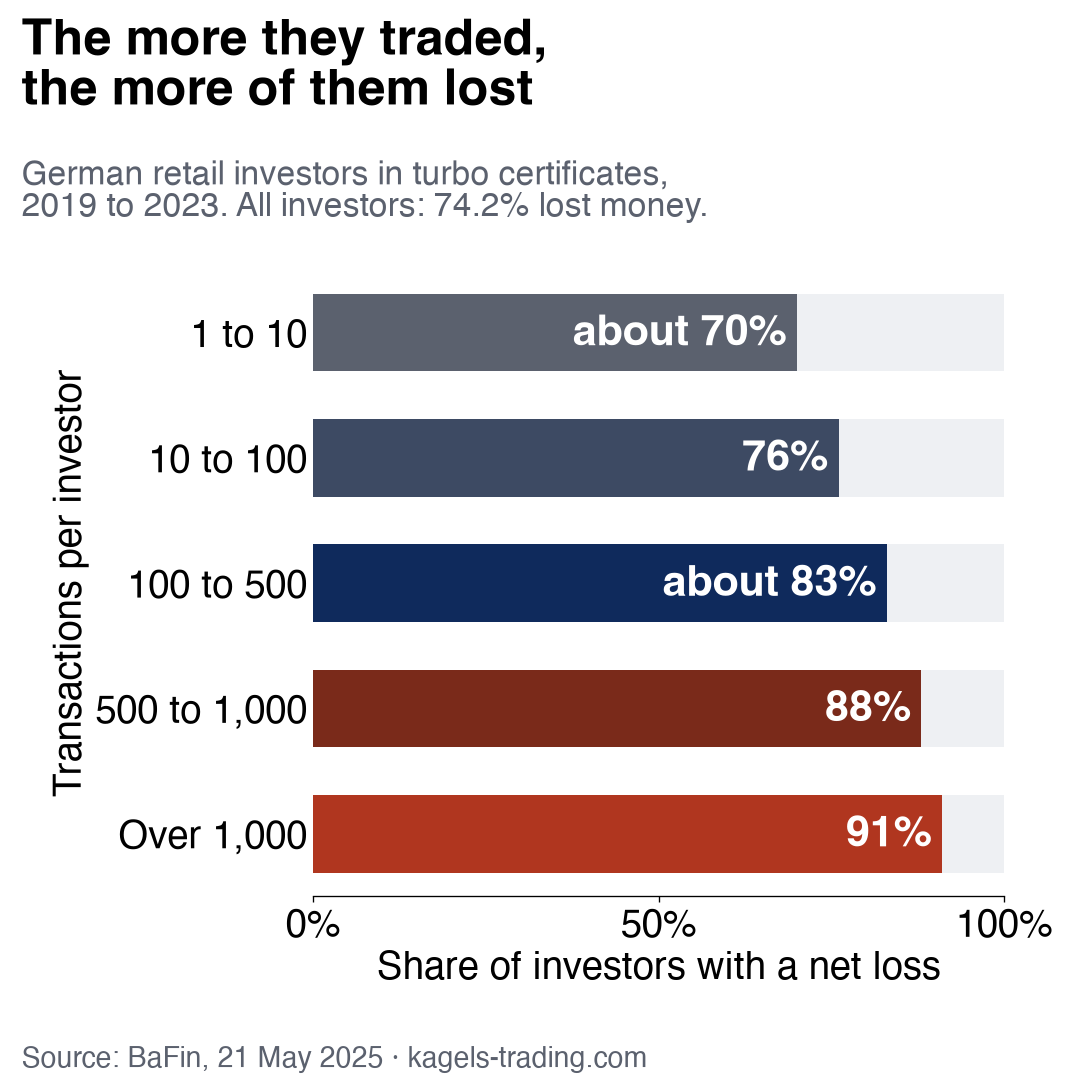
- More trading went with more losers: with 1 to 10 transactions about 70% lost; with more than 1,000 transactions it was 91%. The study measures this link, not its cause.
- A trading mistake is a broken rule, not a loss: a trade that follows the plan and still loses is not a mistake. A winning trade against your own rules is one.
- The most expensive mistakes are in risk management: moving the stop, adding to a loser and trading too large a size ruin accounts faster than any wrong market opinion.
- The causes are psychological, not technical: loss aversion, confirmation bias and revenge trading work even when you know them. Only written rules and a trading journal hold against them.
What a trading mistake is: and why it gets so expensive
Most traders use the word in the wrong way. They call every loss a mistake. That is convenient but useless, because it hides the one thing you really control. The market decides the result of a trade. You decide the execution.
A trading mistake is any action that breaks your own trading plan, set in advance, whether the trade ends in a profit or a loss.
This definition gives you a split that helps every day. A losing trade that follows the plan is a cost of doing business. A winning trade against the rules is the most dangerous case of all, because the account rewards the broken rule and you repeat it next time. Once you separate the two, you stop punishing yourself for market moves and start working on your discipline.
Changing targets after the fact is another systematic mistake. If you raise the profit target of your next trade after a loss, your risk/reward ratio only improves on paper. The market does not reach the more distant target more often because of that.
What the regulator’s data shows
Since 2025 there is solid data for Germany. The BaFin market study on turbo certificates (in German) looked at about 113 million transactions by 543,329 retail investors from 1 January 2019 to 31 December 2023. Turbo certificates are leveraged products with a knock-out level, popular in Germany: if the price touches that level, the product is practically worthless. Across all investors the net losses added up to more than EUR 3.4 billion.
The split by trading frequency is more interesting than the overall rate. It answers a question that is usually only guessed at: how do loss rates differ between investors who trade rarely and those who trade a lot, and does practice go with better results?
| Transactions per investor (2019 to 2023) | Reading | Share with a net loss |
|---|---|---|
| 1 to 10 | occasional trading | about 70% |
| 10 to 100 | regular trading | 76% |
| 100 to 500 | frequent trading | about 83% |
| 500 to 1,000 | very frequent trading | 88% |
| Over 1,000 | heavy trading | 91% |
In this data, more trading did not go with better results. The more transactions an investor made, the higher the share of losers in that group. A second number from the same study fits this: about 70% of the certificates were held for less than 24 hours, while the average holding period was eight days. That is not investing but fast back and forth.
An honest limit belongs here too. The study covers only turbo certificates and cannot be transferred one to one to stocks or futures. It also shows a link, not a cause: it does not tell us whether overtrading or other mistakes produced the losses. As a warning sign for leveraged short-term trading it still works, because the sample is unusually large.
Regulators reacted to leverage years earlier. In the European Union, the ESMA product intervention for CFDs limited the leverage a retail client could get from 1 August 2018: 30:1 on major currency pairs, 20:1 on other currency pairs, gold and major indices, 10:1 on other commodities and non-major indices, 5:1 on single stocks and other assets, and 2:1 on cryptocurrencies. ESMA’s own measure ended on 31 July 2019, after most national regulators had adopted permanent rules that ESMA considered at least as strict.
In the United States, the CFTC set similar limits for retail forex in 2010. Under its final rule on retail foreign exchange, in effect since 18 October 2010, a dealer must collect a security deposit of at least 2% of the position on major currency pairs and 5% on all others. That is a maximum of 50:1 and 20:1 at dealers regulated by the CFTC; the NFA decides which currencies count as major and can require more. Caps like these do not remove the mistakes. At 30:1, a price move of about 1.7% against a full position is enough to lose half the account, and our guide to risk management shows the math behind it.
 Click to enlarge
Source: BaFin market study on turbo certificates (in German), chart by Kagels Trading.
The 13 worst trading mistakes
These are the mistakes I meet most often in seminars and when I go through other traders’ account statements. They follow the order of a trade: first your state before the entry, then entry, exit and review. The original list comes from Galen Woods, who published it on his site as Don’t Make These 13 Common Mistakes With Your Next Trade. I translated it into German years ago and have extended it several times since.
1. You are not in good shape, physically or mentally
Trading needs concentration for hours. If you are ill, overtired or busy with private trouble, you make worse decisions. This is not a question of motivation but of capacity.
In trading you are not paid for being present. Being present without capacity costs you money. I have a hard rule for this: on days when I notice that I am restless, I open no new positions. I manage the existing ones according to plan, nothing more.
The practical test takes ten seconds. Can you say in one sentence why you want to trade today? If the answer is “I just have to”, your daily condition is the real problem, not the chart.
2. You are still thinking about your last trade
The last trade is closed and has no meaning for the current setup. If you brood over a losing trade, you want to win it back. If you think about three winners in a row, you feel unbeatable. Both states lead to the same behavior: the entry rules get softer and the position gets bigger.
A previous win or loss should not decide your next trade. The market does not know that you lost yesterday. Results can be linked through market phases or similar setups, so judge the current trade against your tested rules, not against your last result. That is easy to say and hard to feel, which is why this point is so high on the list.
Only a fixed order in your routine helps. First judge the setup, then decide the position size. Never the other way round, or yesterday’s result decides today’s size.
3. You want to buy something with this trade
Maybe your next trade pays for a new car, and maybe it does not. As soon as you tie a bill or a wish to the result, you set the position size by the price of the wish instead of by your risk.
That distorts the expected outcome of your trades. You hold losers longer because the money is still needed. You close winners too early as soon as the amount fits. Both destroy the statistics your system is built on.
The market does not care what you need. This gap between wish and market reality is one of the most reliable recipes for account damage that I know.
4. You open a trade out of boredom or fear
Calm trading is a good sign. Excitement belongs in a casino, not in a trading account. Still, most people find it hard to watch the market for a whole day without trading.
That is exactly the exercise I give beginners first: watch for a full day and take no position at all. If you can stand that, you have learned a skill that saves a lot of money later. Having no position is also a position.
Two feelings push most traders out of this calm. Boredom, because sitting still feels unproductive. And fear of missing the next big move. You can see how strongly both forces move the whole market in the Fear and Greed Index.
There is a time to go long, a time to go short and a time to go fishing.
5. You do not work out the expected value
Nothing in trading is certain. So all you have is the expectation, the statistical average over many trades. If you never calculate this value, you trade on luck and call the result a strategy.
The expected value of a trade is the win rate times the average win, minus the loss rate times the average loss.
Expected value = (win rate × average win) − (loss rate × average loss)
If the result is positive, you take the trade. If it is negative, you leave it, however convincing the chart looks. The estimates may be rough. Leaving them out completely is the mistake. Our guide to the profit factor shows how to check this over a series of real trades.
A trader without a positive expectation is a gambler with better software. The difference to a real edge in the market is exactly this calculation, not the equipment.
6. You break your trading plan
A trade against your own plan is worthless, even if it wins. Imagine a trade you opened without cover from your trading plan. If it loses, you are annoyed twice: about the money and about the broken rule. Our day trading plan shows what such a plan contains.
If it wins, it is worse. You cannot take credit for the result, because it was pure luck. The learning effect weighs more: your brain links the broken rule with a reward. Next time, breaking it is easier.
So the rule is: trades that break your plan are not worth making. The only winning trade that really counts is the one that followed the plan.
7. You miss the dates of important economic data
Even if you trade purely on charts, you need to know when jobs data, inflation numbers or rate decisions are due. Opening a directional position just before them is gambling with a chart as an excuse. The monthly US jobs report is one example; see our guide to nonfarm payrolls.
The reason is liquidity. Before the number, many market participants step back, the spread between bid and ask gets wider, and your stop is filled at a price you had not planned for.
A calendar is all you need to check. Our economic calendar lists the dates and can be set to your time zone. It also marks the events by importance.
8. You are careless with your stop-loss
There are four ways to ruin a stop-loss order. All four are common, and the last one is the most expensive because it looks like risk management. How to place a stop-loss order correctly is covered in its own guide.
- You set no stop at all: your risk is open to the downside. Every other rule of your system becomes meaningless.
- You move the stop further away: a stop limits a loss. If you move it as soon as the price comes closer, you have removed it and only kept the good feeling.
- You delete the stop: you are no longer trading by plan. My advice is uncomfortable: close all positions and end the trading day.
- You set the stop by the loss you want to accept: the distance comes from the market structure, not from the amount you can live with.
The last point settles an order that many people turn around. First you take the stop from the chart, then you calculate the position size from it. If the stop that makes sense in the market does not fit your risk, the size is wrong, not the stop. The position sizing guide has the formula and a calculator.
9. You have no plan for taking profits
You do not need a fixed price target for every trade, but you need an exit plan. It describes how and when you get out when the trade runs in your direction.
Many traders skip it because they take the advice “let your profits run” literally. Letting profits run does not mean watching without a rule. It means tying the exit to a condition instead of a gut feeling.
Without that plan you stay unsure even when you are in profit. In the end you often give most of it back. The main variants, from partial exits to a trailing stop, are in our guide to the take-profit order.
10. You average down
Buying more is not wrong in itself. It is fine when it was set in advance as part of the strategy. An investor who has worked out a fair value and buys in steps below it follows a plan.
In trading it usually looks different. There, traders buy more because the position is in the red and they do not want to take the loss. You raise the risk in exactly the position that has not proved itself so far.
The effect on your risk is negative twice. The total loss grows, and the point where you should get out moves further away. How quickly a drawdown is still recoverable is pure math: a loss of 50% needs a gain of 100% to get back to the start.
11. You risk too much on one trade
Here the most important rule is ignored: adjusting the position size. It is one half of the craft. The other half is to take only good risks in the first place.
If you put everything on one position, you give up the first half. Single trades work out that way, and that is what makes it so tricky. Over a series of trades, this approach ruins every account.
The common guide is the 1% rule. On each trade at most 1% of the account is at risk. Then you survive a long losing streak without the numbers breaking. Why much larger fractions fail even with an edge is shown in the Kelly criterion guide.
12. You do not record your trades
Every trade holds information, the winners as much as the losers. Without a record, that information is gone after two days.
Speed is what matters. Emotions and discipline problems fade quickly and are polished in hindsight. If you only write on the weekend, you record a cleaned-up version of yourself.
As a rule of thumb, the entry must hold enough detail to rebuild the trade, including your reasons and your state of mind. How to set one up is in our guide to the trading journal, and a comparison of tools in trading journal software. How expensive a single mistake really is shows up in an analysis by mistake type, as offered by TraderSync. Where such software reaches its limits is part of our Tradervue review.
13. You over-analyze the single trade
From a single trade you can learn exactly two things, and neither is about the market. Both are about your behavior and your rules:
- Did you follow your rules?
- Did you keep your emotions under control?
Everything else needs a series. Only over many trades can you see at which time of day your system works or whether your price action reading holds up. A losing trade is not automatically a bad trade.
If you take a single loser apart, you almost always end up with the same question: what would have worked? That is the start of the endless search for the holy grail and leads to constant system changes.
Almost all of these points also appear in Mark Minervini’s trading rules. Mark Minervini explicitly forbids moving the stop and adding to losing positions. Similar patterns run through the interviews that Jack Schwager did with successful traders in the Market Wizards books.
The thinking errors behind trading mistakes
The thirteen points above describe behavior. The question of why smart people repeat this behavior goes one level deeper. Research calls the causes behavioral biases.
A behavioral bias is a systematic thinking error that pushes decisions under uncertainty in a predictable direction.
The word systematic carries the whole meaning. These errors do not happen at random but regularly and in the same direction. That is why you can plan for them but not think them away. I have known the following four for decades and still walk into them now and then. The difference is that I notice it faster today.
Loss aversion
Loss aversion is the tendency to feel a loss much more strongly than a gain of the same size.
A loss of $500 feels heavier than a gain of $500. A trading pattern follows directly from that: losers are held too long, because taking the loss hurts, and winners are closed too early, because the gain should be secured.
That is the exact opposite of what a positive expectation needs. Mistakes 9 and 10 in the list above are both forms of it. The only reliable counter is an exit rule written down in advance.
Confirmation bias
Confirmation bias is the tendency to notice information that supports your own expectation and to play down signs against it.
In trading it shows up when you read charts. You are long and suddenly see buying arguments everywhere. The indicator that says otherwise gets new settings or is hidden. The news is read in the way that fits.
A simple test helps. Before the entry, write down what would have to happen for your idea to be wrong. If you cannot name that condition, you do not have a thesis, you have a hope.
Recency bias
Recency bias is giving recent events more weight than the long-term statistics.
After three winners in a row your appetite for risk goes up, after three losers it goes down, although nothing in the system has changed. This is mistake 2 in the language of psychology. In practice traders adjust their position size to their mood instead of to the account size.
The counter is not romantic: the size comes from a formula. If the number comes out of a calculation, your mood has nothing to attack.
Overconfidence
Overconfidence in trading is the systematic overestimate of your own win rate and of how reliable your forecasts are.
It grows with every success, so it is often stronger in advanced traders than in beginners. It shows in larger positions, less protection and more trading activity.
This matches the BaFin numbers, although the study did not measure confidence. Those who think they are good trade more, and those who traded more than 1,000 times had a loss rate of 91% in the study. The only remedy is your own, honestly kept statistics.
Overtrading, revenge trading and false signals
Three patterns deserve their own section, because they chain the mistakes from the list together. A false signal turns into a loss, the loss turns into a revenge trade, and the revenge trade turns into a trading day that gets out of control.
Overtrading
Overtrading means trading much more often than your own strategy gives valid signals.
It is not a sign of hard work but of poor selection. The BaFin study fits this picture without proving it: the loss rate rose from about 70% at up to ten transactions to 91% at more than a thousand, but the study cannot say how many of those trades lacked a valid signal.
Two mechanisms explain it. First, spreads and fees add up again with every trade. Second, the average signal quality falls when you take more chances than your system delivers.
Overtrading has a next stage. If you no longer trade because there is a signal but because the market is open, you are on the way to a trading habit that controls you. A common driver of extra trades without a signal is the fear of missing a move (FOMO).
The test is simple. Count over one month how many trades fully met your criteria and how many you took on top. The difference is your overtrading.
Revenge trading
Revenge trading is the attempt to win back a loss right away with a new, usually larger trade.
The trigger is not the market but the account balance. The typical sequence: the stop is hit, then comes an immediate re-entry, often with double the size and without a valid setup.
This trade has no positive expectation, because it never came from a signal. The counter must therefore be mechanical: after two stops in a row, end the trading day. No judgment, no exception.
How to read false signals
A false signal is an entry signal that meets every condition of the strategy and still runs into a loss.
It is neither a trader’s mistake nor a defect of the indicator. This distinction is where many trading careers tip over. Whoever takes a false signal for a system error looks for a better system, and after the next false signal looks again.
Every strategy produces false signals. With a win rate of 45%, 55 of 100 signals are losers, and the system can still be profitable. What decides is the ratio of the average win to the average loss. That ratio is not the same as the profit factor, which works with sums, not with averages.
If false signals pile up, there are two sensible explanations. Either the market phase does not fit the strategy, for example a trend-following system in a sideways market. Or the time frame is too small, so market noise passes as a signal.
You check both on a series, not on a single case. Before you drop a strategy in a live account, paper trading is the cheaper way to an answer.
How to take your next trade without mistakes
Avoiding these mistakes does not replace an edge in the market. You still need a system with a positive expectation, or you just lose with discipline. If you avoid them, you are still ahead of most of the field, and with a loss rate of over 70% in the regulator’s data that is worth a lot.
The checklist below shows how to tell a clean trade from a faulty one before you click the order button. Go through it before every entry, not after the exit.
Signs of a clean trade
- Signal before size: the setup meets every condition of your strategy before you think about the size.
- Stop from the chart: the stop distance comes from the market structure, and the position size is calculated from it.
- Exit plan in place: before the entry you know under which condition you take profits.
- Dates checked: no important data release falls into the time window of your trade.
- State clear: you are rested and can say in one sentence why you take this trade.
Warning signs of a faulty trade
- The last trade still works on you: you want to win back a loss, or you feel unbeatable after some winners.
- The size is wrong: the size follows a target amount instead of your risk per trade.
- The stop moves: you move or delete it while the position is open.
- Adding without a plan: you average down a losing position that was not planned that way.
- No reason: you trade out of boredom, fear of missing out, or because the day would otherwise be empty.
Conclusion: avoiding mistakes beats searching for a strategy
When I look at the accounts I have seen in seminars, the strategy was almost never the problem. It was the execution. The same thirteen points in a different order, in beginners as much as in people who have traded for years.
The BaFin numbers from 2025 point the same way from a completely different angle. The more often investors traded, the larger the share that lost: about 70% with few transactions, 91% with very many. That is not an argument against active trading but one for trading less and more selectively.
My advice is plain and still works. Write down your rules, keep a journal, and end the trading day after two stops in a row. These three habits defuse most of the mistakes above, because they take the decision out of the moment.
Everything else comes after that. If you are just starting, our roadmap to learn trading is a better first step than the search for the perfect indicator.
Frequently asked questions about trading mistakes
What are the biggest mistakes in trading?
The most expensive mistakes are in risk management. No stop-loss or a moved one, a position size that is too large and averaging down into losing positions. Then come mistakes in preparation, such as a missing exit plan or missed dates of important economic data.
How many traders really lose money?
In a BaFin study published in 2025, 74.2% of German retail investors in turbo certificates lost money. The study covered about 113 million transactions by about 543,000 investors from 2019 to 2023, with an average loss of EUR 6,358 per person. Turbo certificates are leveraged products, so the rate is not the same for stocks or futures.
Is every losing trade a mistake?
No, a trade that follows the plan and still loses is not a mistake. It is a normal cost of trading. A mistake is when you break your own rules, and that is true even when the trade makes a profit.
What is the 3-5-7 rule in trading?
The 3-5-7 rule is a rule of thumb with no official source, and it is used in different ways. One published reading is 3% risk per trade, 5% total risk across all open positions, and winners at least 7% larger than losers. Other sources define the numbers differently, so it is not a recognized standard; I work with the 1% rule per trade.
Why do I keep making the same trading mistakes?
Because the causes are systematic thinking errors, not gaps in knowledge. Loss aversion, confirmation bias and overconfidence work even when you can name them. Only rules you write down before the trade help, together with a journal that shows your real win rate.
How do I stop overtrading?
Set a fixed daily limit of trades and a hard stop rule, for example quitting after two stops in a row. Also count for one month how many trades fully met your criteria. The difference to the total number is your share of overtrading.
How do I stop revenge trading?
Make the stop mechanical, not a matter of willpower. After two stops in a row, the trading day ends. Before any new trade, check that it came from a signal and not from the wish to win back the last loss.
How do I tell a false signal from a real mistake?
A false signal meets every condition of your strategy and still runs into a loss. That is part of every system and no reason to change the strategy. A real mistake is when you did not wait for the signal or bent your rules at the entry.
Risk note: This article explains common trading mistakes and their causes. It is not investment advice. Leveraged products can lead to quick losses, and past data does not guarantee future results.
This US edition is based on our German edition on kagels-trading.de and has been adapted for US readers.
More Risk Management guides
- Manage your trading risk
Risk Management in Trading: Rules, Math, Psychology
The 1% rule, stops, risk/reward, daily loss limits, leverage caps and the psychology of losing streaks, with the math behind each rule.
- Understand a stock market crash
Stock Market Crash: Causes, Patterns and Lessons
What caused 1929, 1987, 2000, 2008 and 2020, how deep the S&P 500 fell, how long recovery took, and the lessons for your own risk.
- Calculate your position size
Position Sizing in Trading: Formula, Calculator, Examples
The formula, a free calculator, the 1% rule explained correctly, and examples for stocks, forex and futures.
- Read your account equity
Account Equity vs Balance: Margin and Free Margin Explained
Equity against balance, margin, free margin and margin level, with a worked example and the close-out rules for cash, US margin and CFD accounts.
- Avoid a margin call
Margin Call: What It Is, How It Happens and How to Avoid It
When a margin call comes, what your broker does next, whether you can owe money, and four rules that keep your account away from it.
- Size your risk per trade
Kelly Criterion for Traders: Formula, Calculator, Risks
The Kelly formula for traders with a calculator, and a simulation of why full Kelly is far too much.
- Check a profit factor
Profit Factor in Trading: Formula, Calculator, Good Values
The formula, a free calculator, what a good value is, and why 61 trades showed 2.22 while 356 trades showed 1.37.
- Check if you have an edge
Trading Edge: How to Calculate, Test and Keep One
The expectancy formula, the win rate each reward-to-risk ratio needs, and the tests that separate a real edge from luck.
- Keep a trading journal
Trading Journal: How to Record and Review Your Trades
What to write before and after each trade, a completed example with a win and a loss, a weekly review and a template to copy.
- Choose a journal
Best Trading Journal Software 2026: 6 Tools Compared
Six journals compared on price, free plans, refunds, automatic broker sync, costs and export, with a decision guide.
- Check TradeZella
TradeZella Review 2026: Pricing, Features and Limitations
The three plans since July 2026, what Essential leaves out, the no-refund terms, imports, export and what users report.
- Check TraderSync
TraderSync Review 2026: Pricing, Broker Sync and Limits
Plans and dated prices, broker imports and autosync, Market Replay, Cypher and the no-refund policy.
- Check Tradervue
Tradervue Review 2026: Imports, Reports and Costs
Silver or Gold, why net P&L needs Gold, few automatic imports, US-only stocks, the no-refund sign-up terms and how to cancel.
- Check Edgewonk
Edgewonk Review 2026: Features, Costs and Limitations
One feature set billed monthly or yearly, the refund period, MetaTrader auto sync, the psychology tools and our own test journal.
- Check TradesViz
TradesViz Review 2026: Pricing, Broker Sync, Terms
The free stock plan, Pro and Platinum prices checked November 10, 2026, which US brokers sync automatically, the no-refund terms and user reviews.