
Trading Mindset: How to Think Like a Disciplined Trader


Contents
- Trading mindset in 30 seconds
- What is a trading mindset?
- Why execution matters more than the next strategy
- The disposition effect: why traders cut winners and keep losers
- Emotions in trading: notice them, do not switch them off
- Three results of a weak trading mindset
- How to build a better trading mindset: three factors
- Five trading mindset habits for better trades
- Conclusion: the mindset decides whether your strategy works
- Frequently asked questions about trading mindset
- About the author
In my experience, many traders do not struggle because they lack a strategy, but because they do not follow the one they have. A stop is moved, a trade is skipped after three losses, a position is doubled after a win. Each of these decisions feels reasonable in the moment, and together they make it impossible to know whether the strategy ever had an edge.
This is what traders mean by the word mindset. It is the set of thoughts, emotions and habits that decides whether you execute your plan or not. I bought my first shares in 1980 and have traded price action actively since 1986, and in all those years I have seen far more accounts damaged by execution than by a bad method.
The German version of this page is a guest article by Maté Radovcic, a trading psychology coach with a degree in applied psychology. This English article is my own text. I use his three-part model of personality, mindset and strategy check and credit it to him; his coaching site mindset-trader.de is in German. Where I cite research, I link the original study. This article follows our editorial policy.
Trading mindset in 30 seconds
- Mindset means execution: a trading mindset is the way you think and feel about risk, losses and rules. It decides whether you follow your plan when it is uncomfortable.
- The classic error has a name: the disposition effect, selling winners too early and holding losers too long. Terrance Odean measured it in 10,000 brokerage accounts in 1998.
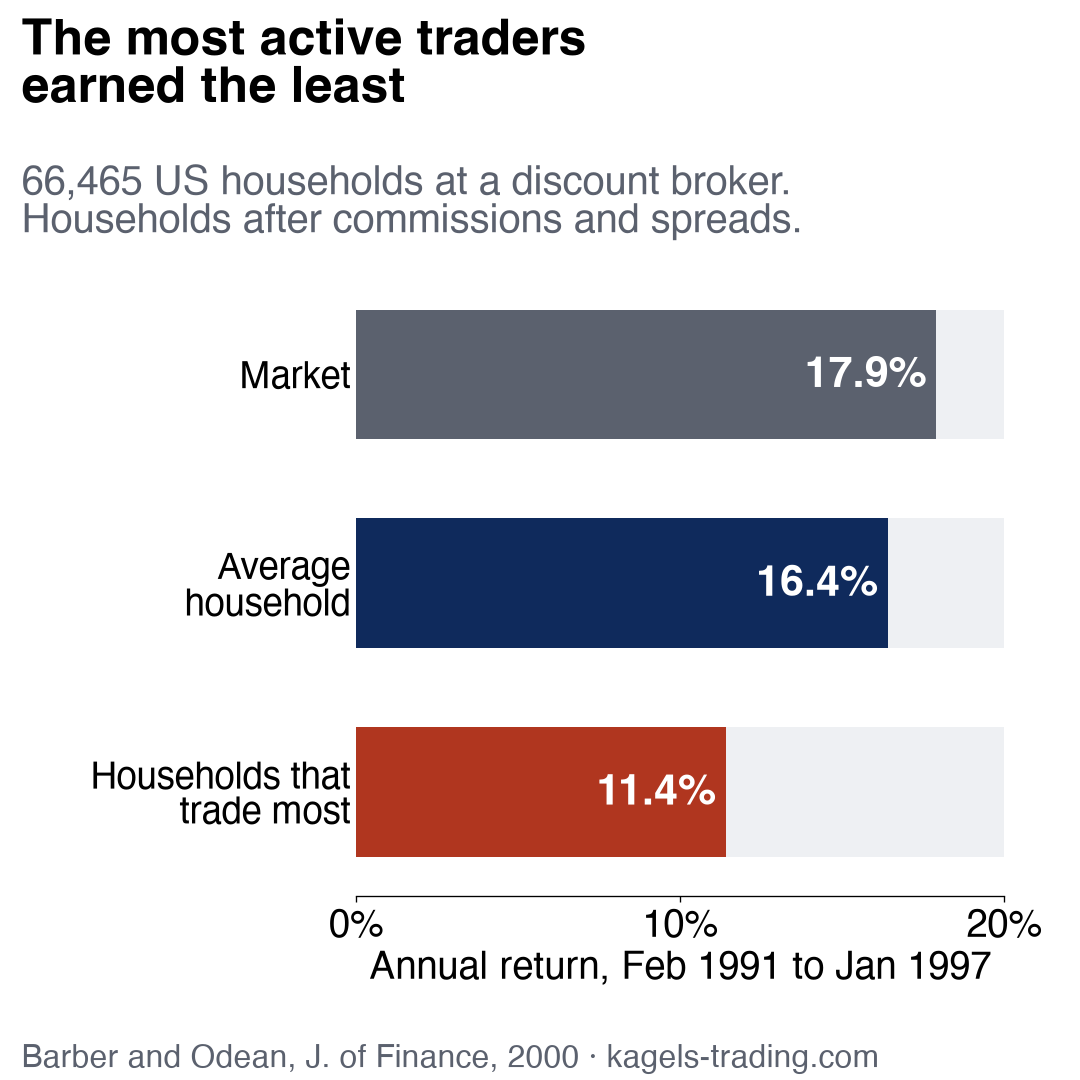
- Trading more often cost money: in Barber and Odean’s study of 66,465 US households, those who traded most earned 11.4% a year after costs from 1991 to early 1997, while a market index returned 17.9%.
- Emotions are not the enemy: the goal is not to feel nothing. The goal is to notice fear and greed and still act on the rules you wrote down in advance.
- Five habits help: work on your mindset on purpose, set clear goals, record your emotions in a journal, size positions so you can sleep, and trade fewer, better setups.
What is a trading mindset?
A trading mindset is the mix of thoughts, emotions and habits that decides how you act when money is at risk.
It has two parts that work together. The first is cognition: what you notice on the chart, how you read news and how you judge a setup. A large part of this runs automatically, without you deciding it step by step. The second part is emotion: fear, regret, anger, greed, joy and euphoria, which are all normal reactions to winning and losing money.
The aim is to make the automatic part visible. Once you know which situations push you into the wrong reaction, you can build rules and routines that catch it. Maté Radovcic describes this as becoming aware of unconscious patterns and retraining them, so that your decisions follow your plan rather than your mood.
Why execution matters more than the next strategy
A strategy may have an edge if testing supports it after realistic costs, and that edge only shows over many trades. A backtest or a set of rules tells you what happened over a long series of trades. If you skip the trade after a losing streak or take an extra one out of boredom, your real results no longer come from that sample: changing the trade selection means the backtest no longer directly describes your results. Consistent execution helps you judge the trading edge you measured, but it does not guarantee that the edge will continue.
This is why I judge my trades by their execution, not by their result. A trade that follows the plan and loses is a normal cost of business. A trade that breaks the plan and wins is the dangerous one, because the account rewards the broken rule. Our article on trading mistakes goes through the most expensive of these broken rules one by one.
The disposition effect: why traders cut winners and keep losers
The most studied error in trader psychology is the disposition effect. Hersh Shefrin and Meir Statman gave it its name in 1985 in the Journal of Finance (original paper): investors tend to sell winning positions too early and ride losing positions too long. They explained it with prospect theory, mental accounting, regret and pride.
Terrance Odean then tested it on real accounts. In his 1998 study of 10,000 accounts at a large US discount broker, investors showed a strong preference for selling winners rather than losers. Odean found that the behavior was not explained by rebalancing or by trading costs, and that it was not justified by how the stocks performed afterwards. In December, investors realized a higher share of their available losses than of their gains, consistent with tax-loss selling before year-end. You can read the abstract of Odean’s study on his Berkeley page.
Maté Radovcic uses a picture from the Stone Age to make the effect easy to remember. A hungry hunter who finds a bush of small berries late in the day takes them, because a sure meal beats the hope of finding an apple tree. A hunter who has found nothing all day keeps walking, because only hope can still help. In trading, the small sure gain is taken too early and the open loss is held in the hope that it comes back. The picture is an illustration, not a scientific explanation, but it shows why the effect feels so natural.
The fix is not willpower but a rule set in advance. Decide your stop and your exit before you enter, and write both down. If you want to change them during the trade, the rule should say when that is allowed, for example only in the direction that reduces risk. Our guide to the stop-loss order covers the order types that put this rule into the market.
Emotions in trading: notice them, do not switch them off
Fear, regret, anger, greed, joy and euphoria are part of every trading day. Fear makes you skip a valid setup. Regret after a missed move pushes you to chase the next one. Anger after a loss leads to revenge trading. Euphoria after a winning streak makes the next position too large.
The goal is not to sit in front of the charts like an ice block. Maté stresses this point, and I agree with him: people are not machines. What helps is to recognize the emotion while it happens and to have a rule that decides for you. A daily loss limit, a pause after two stops in a row and a fixed position size all take the decision out of the emotional moment.
Crowd sentiment works the same way on a larger scale. When many traders feel the same fear or greed at once, it shows up in the market itself. The Fear and Greed Index measures this mood across seven indicators, and it is a useful reminder that your own feelings are often the same as everyone else’s.
Three results of a weak trading mindset
When your habits work against your plan, the damage usually shows up in one of three ways. Maté names them overtrading, lack of discipline and emotion-based trading. They often appear together.
Overtrading
Overtrading means taking far more trades than your strategy calls for. It often starts after a loss that you have not accepted: you want the money back and open position after position, even when the setups no longer fit your rules. The losses grow, and in the worst case the account ends in a margin call.
Research shows what frequent trading costs. Brad Barber and Terrance Odean studied 66,465 US households at a large discount broker, with returns measured from February 1991 to January 1997. After commissions and bid-ask spreads, the households that traded most earned 11.4% a year and the average household earned 16.4%. A value-weighted index of US stocks returned 17.9%. The authors explain the high trading levels mostly with overconfidence.
 Click to enlarge
The study looked at stock investors, not at day traders, but the lesson carries over. Every extra trade adds costs and another chance to break your rules. Our article on trading mistakes also shows newer regulator data from Germany, where the share of losing investors rose with the number of transactions.
Lack of discipline
Discipline means following your trading plan on the bad days, too. The reasons traders break their plan are many. Maté points to three that he sees most often in coaching: self-sabotage, missing trust and unclear goals.
Self-sabotage often grows from a belief you never checked. If you heard as a child that “the stock market only loses you money”, that sentence can turn into “I cannot make money trading”. A trader with that belief may find ways to prove it right: closing good trades too early or taking setups that are not in the plan. Writing such beliefs down is the first step to testing them.
Missing trust shows up in a drawdown. A series of losses tests your faith in yourself and in the strategy. Without that trust, you start to change the rules in the middle of the losing streak, before you know whether it is normal or a sign that the strategy has stopped working. The better way is to decide in advance: set a loss limit and a drawdown level at which you pause and review, and follow it. Our guide to risk management explains how to size positions so that a normal losing streak stays bearable.
Unclear goals invite constant strategy hopping. With so much information online, it is easy to think that another method might work better. Clear, measurable goals keep your focus on the one plan you are testing. A written day trading plan is a good place to put them.
Emotion-based trading
There are two ways to make a decision, and only one fits the markets. A rational decision follows rules you set when you were calm. An emotional decision follows the feeling of the moment. Evolution prepared us well for survival in the wild, Maté argues, but not for probabilities and open positions.
You only become consistent when you keep making rule-based decisions in emotional situations. That does not mean suppressing emotions. It means learning to handle them so that they do not drive the order. A short checklist before every entry is one of the simplest tools for this.
How to build a better trading mindset: three factors
Maté Radovcic builds his coaching on three factors that depend on each other: personality, mindset and a strategy check. I find the order useful, because it starts with you and ends with the method, not the other way round.
Personality
Your personality sets the frame for how you trade. Start by understanding your strengths, your weaknesses and why you want to trade at all. Someone who needs quick feedback will struggle with a strategy that holds positions for weeks. Someone who worries a lot will find tight intraday trading hard.
This is also where you look at beliefs and goals. Negative beliefs, as above, can be written down and tested. Goals become useful when they are specific and measurable, which the habits below explain.
Mindset
The second factor is the mindset itself: your emotional patterns and your mental distance to the market. Find out which situations trigger which reactions. Typical triggers are a losing streak, a missed move or a large open profit. Techniques such as mindfulness training can help you notice the reaction earlier.
Better decisions also need knowledge of your own blind spots. Biases such as loss aversion, confirmation bias and overconfidence work even when you know about them. Our article on trading mistakes explains four of them with examples.
Strategy check
Only now does the strategy come in. With a clear view of your personality and your patterns, choose a strategy that fits your time, your nerves and your life. A strategy you cannot follow is worthless to you, however good its backtest looks.
If you already have a strategy, adjust it to yourself rather than the other way round. A slower time frame, fewer markets or a smaller position size can make the same idea much easier to execute. You can test such changes without risk in a paper trading account.
Five trading mindset habits for better trades
These five habits come from Maté’s article; the wording and the details are mine. None of them needs special software. All of them need consistency.
Habit 1: work on your mindset on purpose. Most traders spend their time on setups and indicators and almost none on how they execute. Set aside time each week to review not only your trades but also your decisions.
Habit 2: set goals that you can check. George T. Doran published the SMART formula in November 1981 in Management Review (original article): goals should be specific, measurable, assignable, realistic and time-related. Many later versions use achievable and relevant instead, and the German version of this page uses a variant with “attractive”. The exact letters matter less than the idea: a goal such as “follow my stop rule on every trade this month” is checkable, “become a better trader” is not. Combine near milestones with goals that are further away.
Habit 3: keep a trading journal with a column for emotions. A journal shows your mistakes in black and white. If you also note how you felt before and after each trade, you start to see patterns, for example that your rule breaks cluster after a loss or after a big win. Our guide on how to keep a trading journal shows what to record and includes a template.
Habit 4: size your positions so that you can sleep. If an open trade keeps you awake at night, it is too large. The right risk per trade protects your account, and it also protects you from emotions you cannot control. Our article on position sizing shows the formula and a free calculator.
Habit 5: trade fewer, better setups. At school we learn that more work brings more results. In trading, less is often more. Focus on the setups your plan describes and accept no compromise. Even when a good setup loses, it teaches you more than many weak trades.
Conclusion: the mindset decides whether your strategy works
A tested strategy can show an edge on paper, and your mindset decides whether you execute it well enough to find out if it is real. Discipline, clear rules for exits, predefined loss limits and an honest look at your own patterns matter more than the next indicator. No mindset can rescue a strategy that has no edge.
Research supports what experienced traders say. Investors tend to sell winners too early and keep losers too long, and the households that traded most in the Barber and Odean study earned clearly less than the market. Neither finding is about intelligence. Both are about behavior that you can change with rules.
Start small, with one rule at a time. Write down your stop and exit rules, add an emotion column to your journal and review it every week. Maté Radovcic, who wrote the German version of this page, sums up his approach as “Trade your mindset”. If you are new to the markets, our roadmap to learn trading shows where mindset fits among the other skills.
This article is general education about trading behavior, not investment advice. Trading leveraged products can lose you more money than you expect, so only risk money you can afford to lose.
Frequently asked questions about trading mindset
What is a trading mindset?
A trading mindset is the way you think and feel about risk, losses and rules while you trade. It includes discipline, patience, objectivity and the ability to handle uncertainty. In practice it decides whether you follow your trading plan when it is uncomfortable.
Why is mindset so important in trading?
Because emotional decisions often turn a good strategy into a losing one. Fear makes you skip valid trades, greed makes positions too large, and regret makes you chase moves. A strategy only delivers its edge if you execute it consistently.
Is mindset more important than strategy?
You need both, and they depend on each other. A good strategy is useless if you cannot follow it, and the best mindset cannot save a strategy without an edge. Start with a tested method and then work on your execution.
Should I switch off my emotions when trading?
No, and you could not do it anyway. The aim is to notice emotions such as fear and greed and to have rules that decide for you in those moments. A daily loss limit and a fixed position size are two simple examples.
What is the disposition effect?
The disposition effect is the tendency to sell winning positions too early and hold losing positions too long. Shefrin and Statman named it in 1985, and Terrance Odean measured it in 10,000 brokerage accounts in 1998. A stop and an exit rule set before the entry are the simplest defense.
How do I deal with losses?
Accept that losses are part of trading and judge each loss by whether you followed your plan. Record it in your journal, check what happened and stay within your loss limits rather than trying to win the money back with extra trades. If losses go beyond the drawdown level you set in advance, pause and review the strategy.
How do I stop overtrading?
Limit your trades by rule, not by mood. Set a maximum number of trades per day or a stop after two losses in a row, and only take setups your plan describes. Barber and Odean found that the households that traded most earned 11.4% a year after costs, against 17.9% for a market index.
How can I keep improving my trading mindset?
Review your decisions every week, not only your profits. Read your journal for patterns, practice techniques that help you stay calm, and talk to other traders about their mistakes. Small changes in routine add up over months.
This English edition is based on our German edition on kagels-trading.de and has been adapted for international readers.
More Risk Management guides
- Manage your trading risk
Risk Management in Trading: Rules, Math, Psychology
The 1% rule, stops, risk/reward, daily loss limits, leverage caps and the psychology of losing streaks, with the math behind each rule.
- Understand a stock market crash
Stock Market Crash: Causes, Patterns and Lessons
What caused 1929, 1987, 2000, 2008 and 2020, how deep the S&P 500 fell, how long recovery took, and the lessons for your own risk.
- Calculate your position size
Position Sizing in Trading: Formula, Calculator, Examples
The formula, a free calculator, the 1% rule explained correctly, and examples for stocks, forex and futures.
- Set a stop from volatility
Volatility Stop Loss: ATR Trailing Stops and 8 Methods
Measure, multiple and anchor, eight methods from the Chandelier Exit to the Parabolic SAR, and an SPY test of intraday against closing triggers.
- Read your account equity
Account Equity vs Balance: Margin and Free Margin Explained
Equity against balance, margin, free margin and margin level, with a worked example and the close-out rules for cash, US margin and CFD accounts.
- Avoid a margin call
Margin Call: What It Is, How It Happens and How to Avoid It
When a margin call comes, what your broker does next, whether you can owe money, and four rules that keep your account away from it.
- Size your risk per trade
Kelly Criterion for Traders: Formula, Calculator, Risks
The Kelly formula for traders with a calculator, and a simulation of why full Kelly is far too much.
- Calculate your risk-reward ratio
Risk-Reward Ratio: Formula, Calculator, Break-Even Win Rate
The formula, a free calculator, why 1:2 and 2:1 can mean the same trade, and the win rate each ratio needs to break even.
- Check a profit factor
Profit Factor in Trading: Formula, Calculator, Good Values
The formula, a free calculator, what a good value is, and why 61 trades showed 2.22 while 356 trades showed 1.37.
- Check if you have an edge
Trading Edge: How to Calculate, Test and Keep One
The expectancy formula, the win rate each reward-to-risk ratio needs, and the tests that separate a real edge from luck.
- Avoid costly mistakes
Trading Mistakes: 13 Costly Errors and How to Avoid Them
The 13 mistakes that cost accounts the most, the biases behind them, overtrading and revenge trading, and a checklist for your next trade.
- Keep a trading journal
Trading Journal: How to Record and Review Your Trades
What to write before and after each trade, a completed example with a win and a loss, a weekly review and a template to copy.
- Choose a journal
Best Trading Journal Software 2026: 6 Tools Compared
Six journals compared on price, free plans, refunds, automatic broker sync, costs and export, with a decision guide.
- Check TradeZella
TradeZella Review 2026: Pricing, Features and Limitations
The three plans since July 2026, what Essential leaves out, the no-refund terms, imports, export and what users report.
- Check TraderSync
TraderSync Review 2026: Pricing, Broker Sync and Limits
Plans and dated prices, broker imports and autosync, Market Replay, Cypher and the no-refund policy.
- Check Tradervue
Tradervue Review 2026: Imports, Reports and Costs
Silver or Gold, why net P&L needs Gold, few automatic imports, US-only stocks, the no-refund sign-up terms and how to cancel.
- Check Edgewonk
Edgewonk Review 2026: Features, Costs and Limitations
One feature set billed monthly or yearly, the refund period, MetaTrader auto sync, the psychology tools and our own test journal.
- Check TradesViz
TradesViz Review 2026: Pricing, Broker Sync, Terms
The free stock plan, Pro and Platinum prices checked November 10, 2026, which US brokers sync automatically, the no-refund terms and user reviews.