
Account Equity vs Balance: Margin and Free Margin Explained


Contents
- Account equity in 30 seconds
- What is account equity?
- Equity vs balance: the difference
- Margin, free margin and margin level
- Worked example: one CFD account, four numbers
- Equity in a cash account
- Equity in a US margin account
- CFD and forex accounts: margin calls and stop-out
- The equity curve
- How I use equity as a trader
- Conclusion: watch equity, not the balance
- Frequently asked questions about account equity
- Sources
- About the author
Account equity is what your trading account is worth right now, including your open trades. Apart from deposits, withdrawals and booked charges, your balance only changes when you close a trade. Your equity moves with every tick of your open positions. The difference between the two is your unrealized profit or loss.
Equity is the number your broker watches, so it is the number you should watch too. Free margin and the margin level are calculated from equity and the required margin, and when equity falls too far your broker can close your positions. This guide explains each term with one worked example and shows how the rules differ between a cash account, a US margin account and a leveraged CFD account.
Account equity in 30 seconds
- Balance is the money in your account from closed trades and deposits. Open positions do not count.
- Equity is the balance plus or minus the profit or loss of your open positions. MetaTrader 5 defines it as balance plus credit, minus commission, plus or minus floating profit or loss.
- Free margin is equity minus the margin your open positions block. It is what you can still use for new trades.
- Margin level is equity divided by margin, times 100. Retail CFD brokers in the EU and UK must close positions once equity falls to 50 percent of the initial margin of the open positions.
- In a US margin account, equity is the value of your securities minus what you owe your broker, and it must stay at least 25 percent of the securities’ value.
What is account equity?
Account equity is the current value of your trading account if you closed all positions at the current prices. It is your balance plus any unrealized profit and minus any unrealized loss of your open trades. MetaTrader 5, the platform many CFD and forex brokers use, calculates it as “Balance + Credit - Commission +/- Floating profit/loss - Blocked”.
The word equity has other meanings that have nothing to do with your account. In English, equities are shares: Investor.gov says that stocks “also are called equities”. So “equity trading” normally means trading stocks, with or without margin. A company’s equity on the balance sheet, home equity and private equity are different things again; this guide is only about the value of a trading account.
Equity vs balance: the difference
Balance shows what you have locked in, equity shows what you have now. As long as you have no open positions, both are the same. Once you open a trade, the balance stays fixed (apart from deposits, withdrawals or booked charges) and the equity moves with the price. When you close the trade, its profit or loss is booked to the balance, and the two match again.
| Situation | Balance | Equity |
|---|---|---|
| No open trade, $10,000 deposited | $10,000 | $10,000 |
| Open trade with a $1,200 loss | $10,000 | $8,800 |
| Same trade with a $900 profit | $10,000 | $10,900 |
| Trade closed with a $1,200 loss | $8,800 | $8,800 |
Without commission, financing or credit. Some brokers include only floating losses or only profits in equity; the MetaTrader 5 help says this depends on the broker’s trading conditions.
The balance can look healthy while the account is in trouble. If you hold a large losing position, the balance still shows the full deposit, but your equity, and with it your free margin, is shrinking. That is why I always look at equity first and treat the balance as history.
Margin, free margin and margin level
Margin is the part of your equity that your open positions block as security. It is not a fee and not your maximum loss. It is the deposit the broker requires to keep your position open. On leveraged products the margin is a fraction of the position’s value; on a stock bought with cash, there is no margin at all.
- Margin is the money required to cover open positions and pending orders.
- Free margin is equity minus margin. It is what you can still use to open new positions or to absorb further losses.
- Margin level is equity divided by margin, times 100. A high value means a large buffer, a low value means the broker is close to acting.
Free margin shrinks from two sides. It falls when you open more positions, because more equity is blocked as margin, and it falls when open trades lose money, because equity drops. When free margin reaches zero you cannot open new trades, and if equity keeps falling the broker sends a margin call or closes positions.
Worked example: one CFD account, four numbers
 Click to enlarge
Source: MetaTrader 5 help.
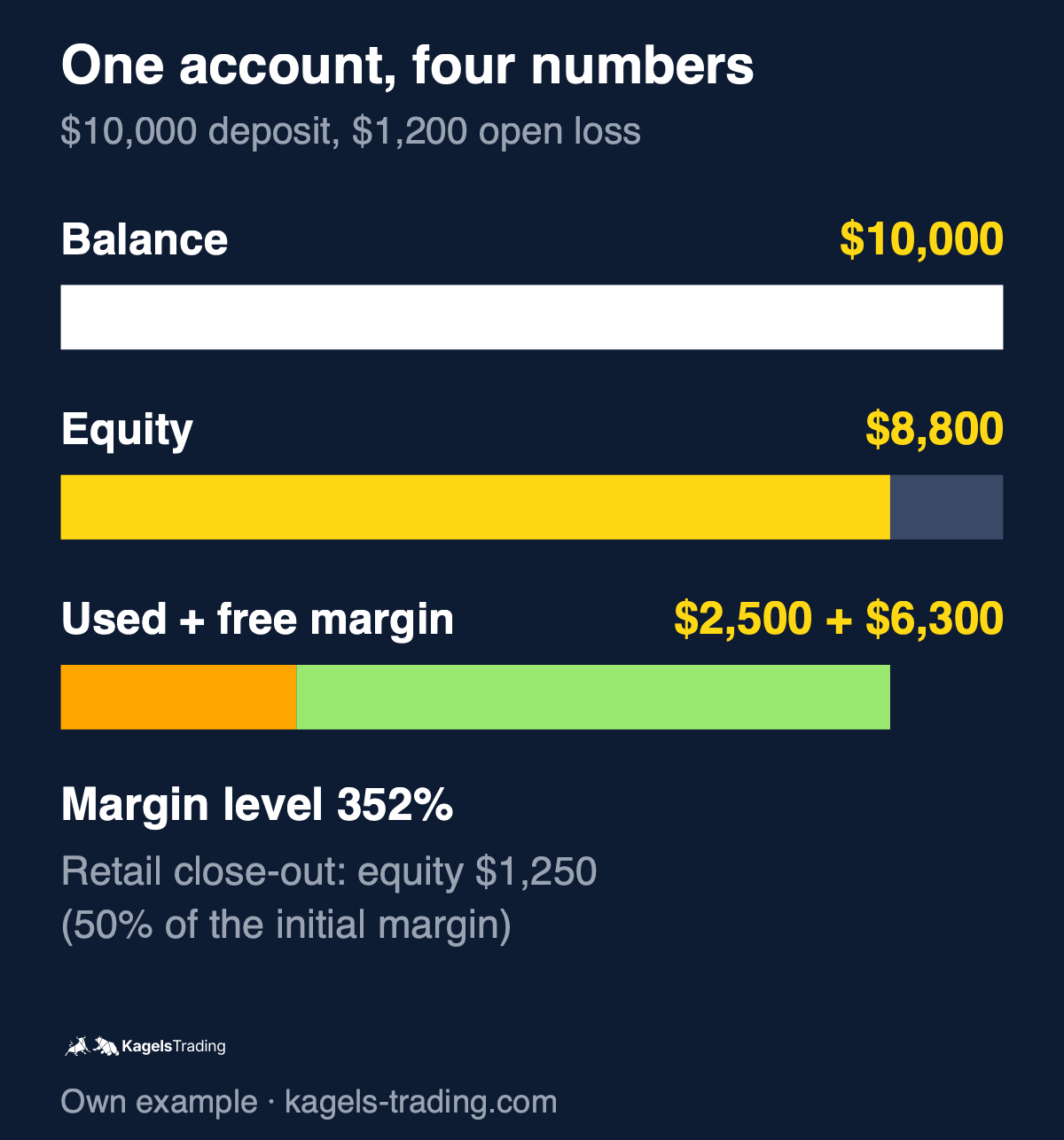
A $1,200 open loss changes three of the four numbers, but not the balance. You deposit $10,000 and buy an index CFD with $50,000 exposure. Under the EU and UK retail rules the maximum leverage on major indices is 20:1, so the broker blocks at least 5 percent, or $2,500, as margin. The price falls and the position shows an open loss of $1,200.
| Number | Calculation | Result |
|---|---|---|
| Balance | deposit, no closed trades | $10,000 |
| Equity | $10,000 − $1,200 open loss | $8,800 |
| Used margin | 5% of $50,000 | $2,500 |
| Free margin | $8,800 − $2,500 | $6,300 |
| Margin level | $8,800 ÷ $2,500 × 100 | 352% |
| Close-out point | equity at 50% of the $2,500 initial margin = $1,250 | loss of about $8,750 |
Own example. The regulatory close-out refers to the initial margin of the open positions, here $2,500. If a broker displays margin as 5 percent of the current position value, the platform would show $2,440 after the loss; that display does not change the initial-margin basis of the rule. No commission, financing or credit included.
The close-out point shows how much room the account really has. Under the 50 percent rule, the broker must close one or more positions, as soon as market conditions allow, once equity falls to half the initial margin, here $1,250. That is a loss of about $8,750, or a 17.5 percent fall of the index; in a fast market the actual closing price can be worse. Long before that point the trade has broken any sensible stop loss. Our position sizing guide shows how to size the trade from the stop instead of from the free margin.
Equity in a cash account
In a cash account, equity is simply your cash plus the market value of your securities. If you deposit $10,000 and buy shares for $8,000, your equity is $10,000. If the shares fall to $6,800, your equity is $8,800, while your cash stays at $2,000. There is no borrowed money, so there is no margin call and no forced sale.
The loss is the same, the risk of being closed out is not. A cash investor can wait out a falling price as long as the company survives. A leveraged trader with the same open loss may be closed out by the broker. That difference matters more than the definitions.
Equity in a US margin account
In a margin account, equity is the value of your securities minus what you owe your broker. That is how the SEC’s investor site Investor.gov defines it. Under the Federal Reserve’s Regulation T you may borrow up to 50 percent of the purchase price, and FINRA Rule 4210 requires equity of at least 25 percent of the securities’ market value as a maintenance minimum.
A worked example shows when the margin call comes. You put in $10,000 and borrow $10,000 to buy stocks worth $20,000. If they fall to $16,000, your equity is $6,000, which is 37.5 percent of the value and still above the 25 percent minimum. At about $13,333 the equity of $3,333 is exactly 25 percent, and below that your broker asks for more money or sells.
Your broker’s requirement is often stricter than the legal minimum. Investor.gov notes that many firms require 30 to 40 percent maintenance, and that a broker may sell your securities without asking you first. At Interactive Brokers, for example, the margin rules work with Equity with Loan Value, which counts cash, stocks, bonds and funds; our Interactive Brokers review explains the account types.
CFD and forex accounts: margin calls and stop-out
On leveraged CFD and forex accounts, the broker watches your margin level all the time. MetaTrader 5 has two settings for this, a margin call level and a stop-out level, and each broker sets its own values. At the margin call level the account enters a warning state, but whether and how you are notified depends on the broker and the platform; at the stop-out level the platform starts to close positions automatically. Do not rely on a warning before liquidation.
For retail clients in the EU and UK, the regulators set a floor. Since 2018 in the EU (now through national rules such as BaFin’s in Germany) and since August 2019 permanently in the UK, brokers must close one or more of a retail client’s CFD positions, as soon as market conditions allow, when the account’s equity falls to 50 percent of the initial margin for the open positions. Leverage is limited to between 30:1 and 2:1, and negative balance protection means you cannot lose more than the money in your CFD account. Professional clients and brokers outside these rules can work with other levels, so read your broker’s terms.
| Account | What equity means | Who closes positions, when |
|---|---|---|
| Cash account | cash + market value of securities | nobody, there is no loan |
| US margin account | securities value − loan | broker, below its maintenance requirement (at least 25%) |
| Retail CFD account (EU, UK) | balance ± open profit or loss | broker, once equity falls to 50% of the initial margin at the latest |
Rules as of 31 October 2026: Regulation T and FINRA Rule 4210 for US margin accounts; ESMA’s 2018 measures and the FCA’s permanent rules of 2019 for retail CFDs. Brokers can set stricter levels.
The equity curve
An equity curve is a chart of your account equity over time. MetaTrader’s strategy tester shows it next to the balance curve: the balance changes only when a position closes, the equity also moves while trades are open. The gap between the two shows how deep your open trades went against you before they closed.
An equity curve shows the result of a period, not the quality of a method. It depends on the time window, the position size, the costs and which trades were taken. A smooth curve can hide large open losses if you only look at the balance, and a short window can make luck look like skill. I use it to measure drawdowns; for testing a method, our backtesting guide explains what else you need.
How I use equity as a trader
I size positions so that my planned stop leaves a large buffer above the broker’s close-out point. Gaps and higher margin requirements can still cause an unexpected liquidation, and a stop order does not guarantee its price. My risk per trade comes from the distance to the stop and a fixed share of equity, not of the balance. With open positions, I recalculate it from the current equity, so a losing streak makes my positions smaller automatically.
Free margin is a limit, not a budget. A large free margin tempts many traders to open more positions. I treat it only as the line the broker draws; my own line is the maximum loss I accept on the account, and that is always far above the broker’s close-out point. If you trade for a prop firm, the same idea applies to its drawdown rules, which our prop firm drawdown guide explains with examples.
Conclusion: watch equity, not the balance
Equity is the true value of your trading account at every moment. The balance only tells you what you have already locked in. Required margin depends on your positions and the broker’s rules; free margin, margin level and the point at which your broker closes your positions depend on equity.
Know which account you have and where its line is. In a cash account there is no forced sale, in a US margin account the maintenance requirement of at least 25 percent applies, and in a retail CFD account the 50 percent close-out rule. Size your trades so that you never reach that line, and read our risk management guide for the rest of the risk plan.
Frequently asked questions about account equity
What is equity in a trading account?
Equity is your balance plus or minus the profit or loss of your open positions. It shows what your account would be worth if you closed everything at the current prices. Your broker calculates free margin and margin level using equity and the required margin.
What is the difference between equity and balance?
Balance records deposits, withdrawals, realized trading results and booked charges; equity also includes open profit or loss. With no open position both are the same. With an open loss your equity is lower than your balance, with an open profit it is higher.
What is free margin?
Free margin is equity minus the margin your open positions block. It is the amount you can still use for new trades or to absorb losses. When it reaches zero you cannot open new positions, and a further fall can lead to a margin call.
What is a good margin level?
There is no fixed good value, but the higher the margin level, the larger your buffer. At a margin level of 100 percent your equity only just covers the margin. Retail CFD brokers in the EU and UK must start closing positions once equity falls to 50 percent of the initial margin; your own risk limit should be far above that.
Does equity trading mean trading with your own money?
No, equity trading means trading equities, which is another word for stocks. You can trade stocks with your own money or on margin in a margin account. The account term equity is a separate meaning of the same word.
Sources
All rules and definitions are checked against primary sources as of 31 October 2026. The worked examples are our own and leave out commission, financing and credit. Check your broker’s terms for its own margin levels.
- Platform definitions: MetaTrader 5 help: trade tab and account state, MQL5 reference: account properties (margin call and stop-out levels), MetaTrader 5 help: strategy tester and equity curve.
- US margin accounts: Investor.gov: Understanding Margin Accounts, SEC: Margin, Borrowing Money to Pay for Stocks, FINRA Rule 4210, IBKR glossary: Equity with Loan Value, IBKR glossary: Net Liquidation Value.
- Retail CFD rules: ESMA press release of 27 March 2018, FCA permanent CFD restrictions of 1 July 2019, FCA policy statement PS19/18, BaFin general administrative act on CFDs (2019).
- Terms: Investor.gov: stocks are also called equities.
This article is educational information, not investment advice. Leveraged products can lose money quickly.
This English edition is based on our German edition on kagels-trading.de and has been adapted for international readers.
More Risk Management guides
- Manage your trading risk
Risk Management in Trading: Rules, Math, Psychology
The 1% rule, stops, risk/reward, daily loss limits, leverage caps and the psychology of losing streaks, with the math behind each rule.
- Calculate your position size
Position Sizing in Trading: Formula, Calculator, Examples
The formula, a free calculator, the 1% rule explained correctly, and examples for stocks, forex and futures.
- Size your risk per trade
Kelly Criterion for Traders: Formula, Calculator, Risks
The Kelly formula for traders with a calculator, and a simulation of why full Kelly is far too much.
- Keep a trading journal
Trading Journal: How to Record and Review Your Trades
What to write before and after each trade, a completed example with a win and a loss, a weekly review and a template to copy.
- Choose a journal
Best Trading Journal Software 2026: 6 Tools Compared
Six journals compared on price, free plans, refunds, automatic broker sync, costs and export, with a decision guide.
- Check TradeZella
TradeZella Review 2026: Pricing, Features and Limitations
The three plans since July 2026, what Essential leaves out, the no-refund terms, imports, export and what users report.
- Check TraderSync
TraderSync Review 2026: Pricing, Broker Sync and Limits
Plans and dated prices, broker imports and autosync, Market Replay, Cypher and the no-refund policy.
- Check Tradervue
Tradervue Review 2026: Imports, Reports and Costs
Silver or Gold, why net P&L needs Gold, few automatic imports, US-only stocks, the no-refund sign-up terms and how to cancel.
- Check Edgewonk
Edgewonk Review 2026: Features, Costs and Limitations
One feature set billed monthly or yearly, the refund period, MetaTrader auto sync, the psychology tools and our own test journal.