
Is Day Trading Gambling? What the Law and the Data Show


Contents
- Is day trading gambling? The answer in 30 seconds
- What US law says: is trading gambling?
- Luck or skill? What the data show
- What skill in day trading actually means
- Why good traders still lose
- When day trading starts to look like gambling
- The dream of fast money
- Conclusion: skill exists, but it is rare and slow to show
- Frequently asked questions about day trading and gambling
- About the author
When you tell people that you trade, many of them answer with the same sentence: isn’t that just gambling? It is a fair question. And it has an answer that does not depend on opinion alone, because US law treats trading differently from betting and because researchers have studied millions of trades to separate luck from skill.
Both answers are clearer than most people expect, and they cut both ways. This article first explains how US law draws the line between trading and gambling. Then it looks at the numbers: how many day traders make money, how you can tell skill from luck, and the point where trading starts to look like betting. This article follows our editorial policy.
Is day trading gambling? The answer in 30 seconds
- Not in the legal sense of the federal internet gambling law: the Unlawful Internet Gambling Enforcement Act excludes ordinary securities transactions and trades on registered futures exchanges from its definition of a bet or wager.
- The odds work differently: a casino game such as roulette has a built-in negative expectancy for the player. In trading, your expectancy is open: it can be positive, but for most traders it is not.
- Skill exists, but it is rare: in 15 years of Taiwan data, about 13% of day traders made a profit after fees in a typical year, and under 1% beat the market consistently.
- Most still lose: in a Brazilian study, 97% of the day traders who kept going for more than 300 days lost money.
- Trading can look like gambling through behavior: trading without a plan, chasing losses and trading for the thrill are warning signs.
What US law says: is trading gambling?
The federal internet gambling law excludes ordinary securities and futures trading from its definition of a bet or wager. The clearest statement is in the Unlawful Internet Gambling Enforcement Act of 2006. For that law, a “bet or wager” means staking something of value on a contest, a sporting event or a game subject to chance. Then it lists what the term does not include.
Two of those exclusions matter for traders. The definition does not include activity governed by the securities laws for the purchase or sale of securities. And it does not include transactions on, or subject to the rules of, an exchange registered under the Commodity Exchange Act, which is where US futures trade.
The reach of this definition is limited, and the law says so itself. The definition applies within that part of the US Code, and the act states that it does not alter, limit or extend other federal or state gambling laws (31 U.S.C. § 5361). In practice, stocks and futures are supervised as financial markets by the SEC and the CFTC, not by gaming regulators.
The difference is also built into the product. When you buy a stock, you buy a share of a company. When you buy a futures contract, you enter a binding contract on a regulated exchange. You decide when to enter, how large the position is and where you plan to exit. At the roulette table, you decide none of that once the ball is rolling.
| Feature | Casino games such as roulette | Trading |
|---|---|---|
| What decides the result | Chance | The market, plus your timing, size and exit |
| Expected value | Negative, built into the game | Open: positive or negative |
| Loss on one decision | Fixed when you bet | Planned through position size and exit; execution can be worse than planned |
| Legal form | Bet or wager | Securities or futures transaction |
The row with the expected value is the one most people skip. In American roulette, the house edge is 5.26% on every spin; the player cannot change it. In trading, nobody builds a loss into the game for you, but costs and mistakes can do it just as reliably. A stop order also does not guarantee its price: in a fast market or after a gap, the fill can be worse. Our guide to the trading edge shows how to calculate your own expectancy.
One contested area is event contracts on sports. Prediction markets such as Kalshi and Polymarket US list event contracts on CFTC-registered exchanges, and several US states treat contracts on sports games as betting. As of November 2026, the federal appeals courts are split on that question, as our prediction markets guide explains.
Luck or skill? What the data show
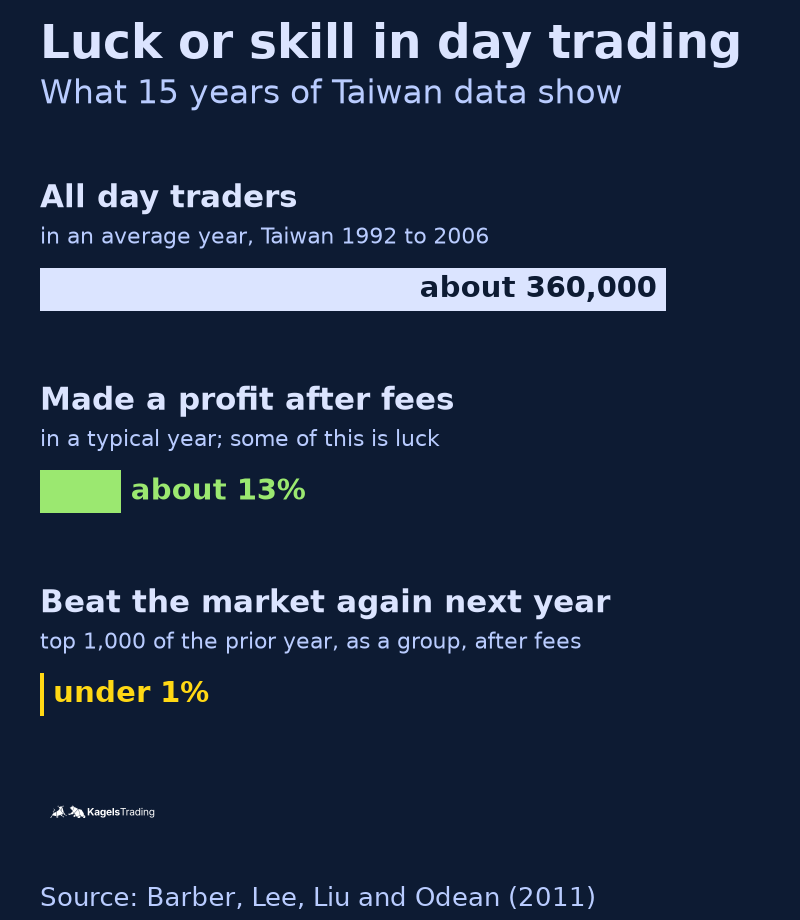
The question of luck or skill has been studied with real account data. The largest study comes from Brad Barber, Yi-Tsung Lee, Yu-Jane Liu and Terrance Odean. They followed day traders on the Taiwan Stock Exchange from 1992 to 2006, about 360,000 people in an average year.
 Click to enlarge
Source: Barber, Lee, Liu and Odean, The Cross-Section of Speculator Skill, May 2011.
The first result is sobering. In a typical year, only about 13% of these day traders made a profit after fees. The authors add that some outperformance would be expected by sheer luck, because in a large group somebody always wins.
The second result answers the question of this article. The researchers ranked the traders by their results in one year and then measured each ranked group in the next year. Only the roughly 1,000 best traders of the prior year, less than 1% of all day traders, earned reliably positive market-adjusted returns on their whole portfolio as a group. The top 500 earned a daily alpha of 28.1 basis points on their day trades after fees; the lowest-ranked traders kept losing.
That persistence is the evidence that skill exists. If trading success were pure luck, last year’s ranking would say nothing about this year’s results, just as a winning streak at roulette says nothing about the next spin. In the Taiwan data, the ranking did predict the next year. The study does not promise that every top trader keeps winning, and it shows how rare that skill is.
A study from Brazil points the same way, with an even harder number. Fernando Chague, Rodrigo De-Losso and Bruno Giovannetti studied 19,646 people who began day trading equity index futures between 2013 and 2015. Of the 1,551 who kept going for more than 300 days, 97% lost money, and only 0.5% earned more than a bank teller’s starting pay (Day trading for a living?, revised June 2020).
Both studies have limits. Each covers one country, one market and one period. Our day trading guide lists the studies side by side. What they share is the pattern: skill appears to exist, losses are the norm, and the gap between the two is wide.
What skill in day trading actually means
Skill in trading does not mean predicting the market. It means separating what you can control from what you cannot. The next price move belongs to the second group. Your entry rules, your position size and your exit belong to the first.
The first skill is knowing your exit before you enter. An experienced trader knows the price at which the trade idea is wrong and roughly what that mistake will cost. A beginner often starts thinking only when the loss is already there. A written day trading plan and a stop-loss turn that decision into a rule.
The second skill is patience. Trading more often than your plan allows adds costs and gives you more chances to break your rules. A trader who acts only when the conditions of the plan are met takes fewer of those chances. It sounds simple, and in practice it is hard, because the urge to trade is often strongest when nothing is happening.
The third skill is controlling the size of your losses. What matters is not only how often you are right, but how much you make when you are right and how much you lose when you are wrong. A win rate below 50% can be profitable, and one above 70% can ruin an account when the losses are large. Our guide to risk management shows the math and the rules behind it.
These skills can be learned, but not quickly. The Taiwan data show that experience alone is not enough: many traders kept going for years while losing money. If you want a structured path, our overview of trading education compares the common ways to learn.
Why good traders still lose
Skill does not protect you from a single loss, and that is not a contradiction. The result of one trade depends heavily on chance. Over a larger number of trades, an edge becomes easier to see, but chance still affects the result, and a plan controls your decisions, not the market. Poker is a useful comparison: one hand says little, and a long record says more, but never everything.
I see it in my own journal. I have traded since 1980, and I published 61 closed trades from four weeks in my article on trading math (in German), with a 54.1% win rate after costs. On one Friday, three overnight positions showed a good profit in the morning. In the afternoon came five stop-outs in a row, with the same strategy and the same rules. In the evening, a scalp added to the result, and the day closed with a net gain.
If you had seen only that afternoon, you would have called the system broken. If you had seen only the morning, you would have called me a genius. Both would have been wrong. With my loss rate, a streak of five losers within 61 trades has a probability of about 49%, assuming independent trades and an unchanged loss rate, so about every second run of such a journal contains one without anything being broken. The Kelly criterion guide uses the same journal numbers.
That leads to an uncomfortable rule. A winning trade does not prove that your decision was good, and a losing trade does not prove that it was bad. What you can judge after every trade is the process: did you follow your rules? A larger record can help you assess an edge, but the evidence still depends on chance and changing market conditions; a trading journal is how you keep the record.
When day trading starts to look like gambling
The law says how trading is classified, not how a person trades. You can trade in a way that looks a lot like gambling. This half of the answer is missing from many articles on the topic, and for your own account it is the more important one.
The difference often lies in the motive. A trader who acts to carry out an analysis makes an economic decision. A trader who acts mainly to feel the thrill is looking for something similar to what a player at a slot machine looks for. The National Council on Problem Gambling now runs a Financial Trader Health and Safety Initiative, which shows that the risk is taken seriously.
A few signs deserve attention. They are not a diagnosis. But if several of them apply to you, they can be warning signs of harmful or compulsive trading:
- No planned exit: there is no price at which you close the position, neither in profit nor in loss.
- Chasing losses: after a loss, the next trade is bigger, to get the money back at once.
- Size follows your mood: your position size depends on how you feel, not on your account.
- More trades than your plan allows: you look for setups instead of waiting for them.
- You cannot stop watching: price checks take over your day, also outside market hours.
- Money you need is at risk: rent, savings or borrowed money are in the account.
If you recognize yourself here, consider pausing and talking to someone. In the US, the National Council on Problem Gambling runs a free, confidential helpline: call or text 1-800-MY-RESET. A new trading method is unlikely to fix this pattern on its own.
Leverage can make the problem bigger. In a US margin account, a fast move or a price gap can leave you owing your broker more than you deposited. Our margin call guide explains when that happens and where negative balance protection applies.
The dream of fast money
Hardly anyone starts trading with the plan to get rich slowly. A common hope is to turn a small account into an income within a few months. That hope can push traders into positions that are too large.
The math rarely works out. A $5,000 account would have to multiply several times to replace a salary. Doing that in a few months needs position sizes at which a handful of losing trades can empty the account. A position that can make 50% in a week can also lose 50% in the same week, and it is easy to see only the first half.
Small positions reach the goal more slowly, but they are more likely to survive a losing streak. And losing streaks come with every method. That is why trading is less spectacular than it looks from the outside. Our list of the most common trading mistakes shows where the money often goes, and our guide to the trading mindset covers the habits that help you stay on plan.
Conclusion: skill exists, but it is rare and slow to show
Day trading is not a bet or wager under the federal internet gambling law. That law excludes ordinary securities transactions and trades on registered futures exchanges from its definition. A trader who fixes entry, size and exit in advance controls the decisions, even though the market still decides each single result.
At the same time, skill is rarer than advertising suggests. About 13% of the Taiwan day traders made a profit after fees in a typical year, and under 1% beat the market consistently. That this small group stood out again in the next year is evidence that a skill exists. That it is so small shows how hard it is to acquire.
For your own trading, this gives you a simple test. Do not judge a single trade; judge whether you followed your rules. And ask yourself honestly whether you trade to carry out an analysis or to feel something. The first is a craft. The second is a game, played with prices instead of cards.
Frequently asked questions about day trading and gambling
Is day trading gambling?
Not in the legal sense of the federal internet gambling law. The Unlawful Internet Gambling Enforcement Act excludes ordinary securities transactions and trades on exchanges registered under the Commodity Exchange Act from its definition of a bet or wager.
Unlike a casino game, trading has no built-in negative expectancy. You decide entry, position size and exit yourself. But a trader without a plan can still behave like a gambler.
Is day trading luck or skill?
Both, and chance never disappears. A single trade depends heavily on chance, because nobody knows the next price move. Over many trades, an edge becomes easier to see, but the record still includes luck.
The Taiwan data show persistence at the group level. The best day traders of one year, as a group, kept earning reliably positive market-adjusted returns in the next year, which pure luck would not be expected to produce. That group was under 1% of all day traders.
How many day traders make money?
In large studies, a minority. In Taiwan from 1992 to 2006, about 13% of day traders made a profit after fees in a typical year, and less than 1% beat the market consistently.
In Brazil, 97% of those who traded on more than 300 days lost money. Both studies cover one market and one period each, so treat them as evidence of a pattern, not as a fixed rate.
Is day trading an addiction?
Day trading itself is not an addiction, but it can become harmful or compulsive. Constant price checks and the urge to win back losses are warning signs that problem gambling counselors also look for, and the National Council on Problem Gambling has an initiative for traders.
Warning signs include trading without an exit, chasing losses and using money you need. In the US, the National Problem Gambling Helpline is free and confidential: call or text 1-800-MY-RESET.
Can you lose more money than you deposit?
In a US margin account, yes. If the market gaps against a leveraged position, your account can fall below zero, and you owe the difference to your broker.
Retail CFD clients in the EU and UK have negative balance protection. That protection does not cover a US margin account, so check the rules of your own account before you use leverage.
Why is day trading so risky?
Because costs, leverage and many fast decisions add up. Trading costs can include commissions, spreads and slippage, while leverage magnifies losses. The large studies of day traders found that most lost money.
In the Taiwan data, fees weighed heavily on the weakest traders. The study measured returns before and after fees, and for the lowest-ranked groups the costs made the losses larger.
This article is for education. It is not investment advice, and trading involves the risk of losing money.
This US edition is based on our German edition on kagels-trading.de and has been adapted for US readers.
More Day Trading guides
- Understand day trading
Day Trading for Beginners: Markets, Risk and Practice
Definition, markets, a session from open to close, costs and capital, the 2026 US account rules, study evidence and a practice path.
- Choose a strategy
Day Trading Strategies: Rules, Examples and When to Skip
Opening range breakout, trend pullback and range fade compared, VWAP as a filter, with a win, a loss and a skipped trade on SPY.
- Practice without risk
Day Trading Simulators: Paper Trading and Replay Compared
Paper trading, market replay and backtests compared, with seven simulators US traders use, their cost, account conditions and fill limits.
- Plan one session
Day Trading Plan: A Session Checklist and Worked Example
What to decide before the open, follow during the session and review after, with a worked SPY example and a free Excel template.
- Build a watchlist
Stock Watchlist: What It Is and How to Build One
What a watchlist is, how to build one from your setups in five steps, how many symbols it should hold and which tools keep it.
- Understand your taxes
Trading Taxes in the US: How Traders Are Taxed in 2026
US federal rules for 2026: short and long term rates, the $3,000 loss limit, wash sales, the 60/40 rule for futures and trader tax status.