
Take-Profit Order: How to Set a Profit Target


Contents
- Take-profit orders in 30 seconds
- What is a take-profit order?
- Take-profit example: a target and a stop
- Does a take-profit order guarantee the price?
- Target and stop together: OCO instead of two separate orders
- Taking profits in steps: two targets, one stop
- How long a take-profit order lives
- Where the target comes from
- Take-profit order or trailing stop?
- Conclusion: plan the exit with a profit as carefully as the stop
- Frequently asked questions about take-profit orders
- About the author
Most traders plan the entry and the stop, and leave the exit with a profit to their mood on the day. A take-profit order fixes that exit in advance. It is a plain limit order, but how it fills, what happens to your stop and how you take profits in steps are details that decide whether the plan works.
This guide covers the mechanics, not a list of exit techniques. You get the definition, a worked example with 200 shares at $45.00, what US regulators and brokers say about limit fills, how to combine a target with a stop, and how to sell in two steps without leaving a wrong-sized stop behind. This article follows our editorial policy.
Take-profit orders in 30 seconds
- What it is: a limit order that closes your position at a price target: for a long position a sell limit above the price, for a short a buy limit below it.
- The price: your limit or better. A take-profit order never sells below its limit.
- The catch: reaching the target does not guarantee a fill, and the order may fill only in part.
- With a stop: link both in an OCO or bracket order, so the second order does not linger after the exit.
- In steps: after a partial sale, check that the stop exists, its status and that it covers the remaining shares.
- Not the prop firm: Take Profit Trader is also the name of a funded trader program, covered in a separate review.
What is a take-profit order?
A take-profit order is a limit order that closes an open position at a planned price target: for a long position a sell at the limit or higher, for a short position a buy at the limit or lower.
A profit target has two steps. First you decide where the target is, which comes from the chart and your reward-to-risk plan. Then you put that target into the market as an order. In the ticket you choose sell, the order type limit, the share count of your position, the target as the limit price, and the time in force.
The name is not an order type of its own at most stock brokers. In the SEC’s overview of order types, a sell limit order “can only be executed at the limit price or higher”, and that is all a take-profit order is. Some platforms show a take profit field next to the stop in the ticket, as our TradingView paper trading guide shows. Our guide to order types puts the limit order next to the other types.
One name clash is worth clearing up. Take Profit Trader is a prop firm that funds futures traders after an evaluation. It has nothing to do with the order in this guide, except the name and the goal.
Take-profit example: a target and a stop
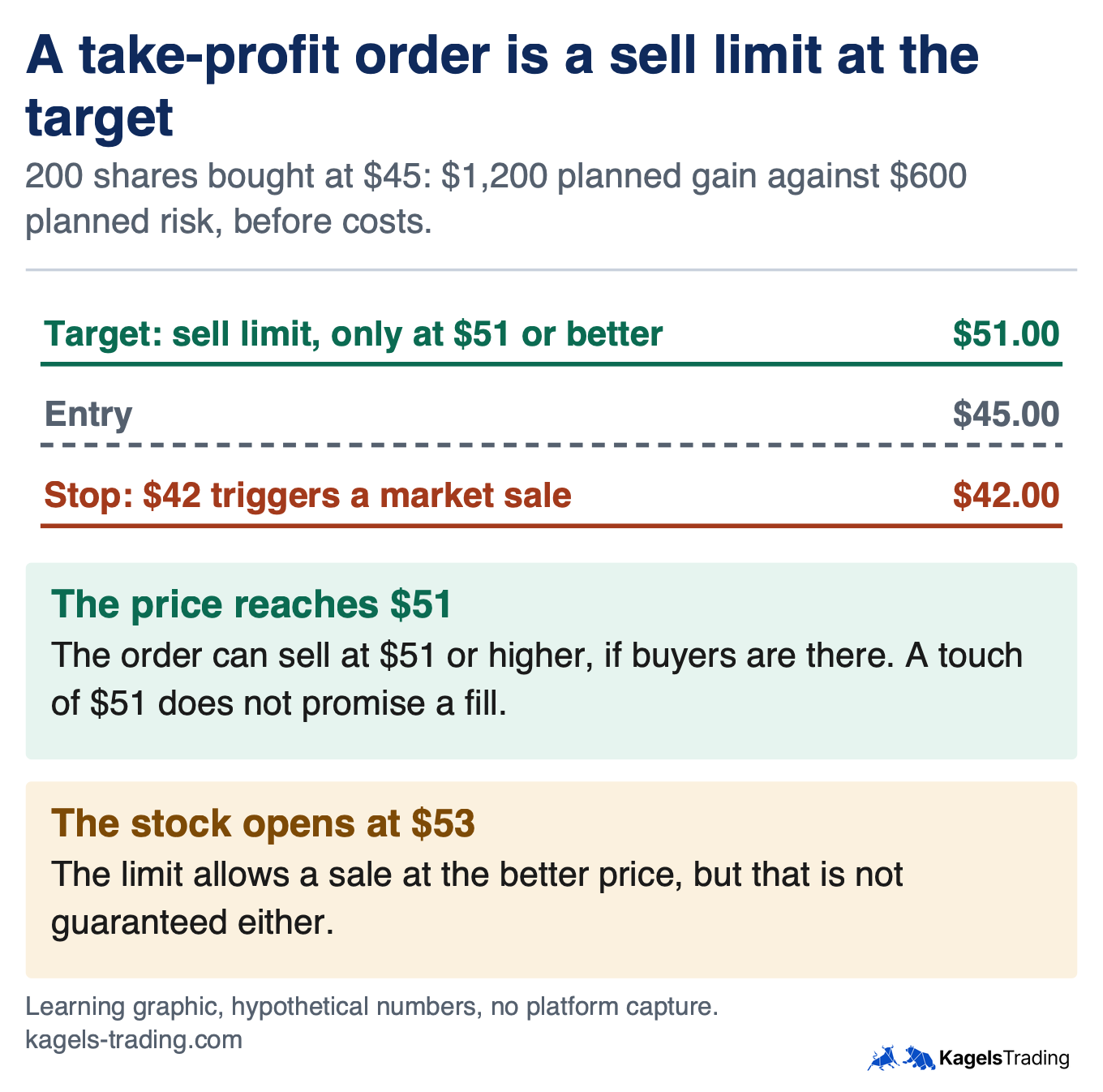
Our example is hypothetical: 200 shares bought at $45.00, a stop at $42.00 and a target at $51.00 from the chart. That plans $600 of risk and $1,200 of gain before costs, a reward-to-risk ratio of 2 to 1. The stop comes from the chart as described in our stop-loss guide.
For the target, you enter a sell limit order for 200 shares at $51.00. It rests in the market above the current price as a sell order, waiting for buyers. If the stock never gets there, it never sells, and your stop stays the only exit.
 Click to enlarge
Source: Kagels Trading, own learning graphic.
Does a take-profit order guarantee the price?
It guarantees the price, not the fill. The SEC states that a limit order “is not guaranteed to execute”. The limit only protects you from selling below $51.00; it does not make anyone buy at that price.
A single trade at $51.00 does not mean your order was filled. Fidelity’s order FAQ says orders at each price level are filled “in a sequence that is determined by the rules of the various market centers”, and that a reached limit “does not guarantee an execution”. Other orders at $51.00 may be ahead of yours, and there may not be enough buyers for all 200 shares.
A gap in your favor can help, but nothing promises that either. If good news makes the stock open at $53.00, a sell limit at $51.00 can execute at the better price, because the limit allows $51.00 or higher. A limit order cannot fill below its limit, so there is no negative slippage past it. The fill still depends on the buyers at that moment.
Partial fills are normal for limit orders. Of your 200 shares, perhaps only 80 sell at $51.00 and 120 stay in the account. Then check that a stop still protects those 120 shares, which the section on taking profits in steps covers.
Target and stop together: OCO instead of two separate orders
A target and a stop are two sell orders for the same 200 shares. If they run separately, one is left over after the exit. Schwab’s guide to advanced orders names the risk: a stop left open after the target fills can inadvertently open a short position.
Some brokers do not even accept two separate closing orders. Alpaca says its system would view one of two conditional closing orders as exceeding the available position, and points to bracket orders, which it treats as a group. Rules differ from broker to broker.
The clean solution is an OCO or bracket order. An OCO links the target and the stop, so that execution of one is meant to cancel the other. A bracket adds both to the entry. How partial fills and cancellations work at Fidelity, Alpaca and Interactive Brokers is in our guide to OCO and bracket orders. After every exit, check that no order is still open.
Taking profits in steps: two targets, one stop
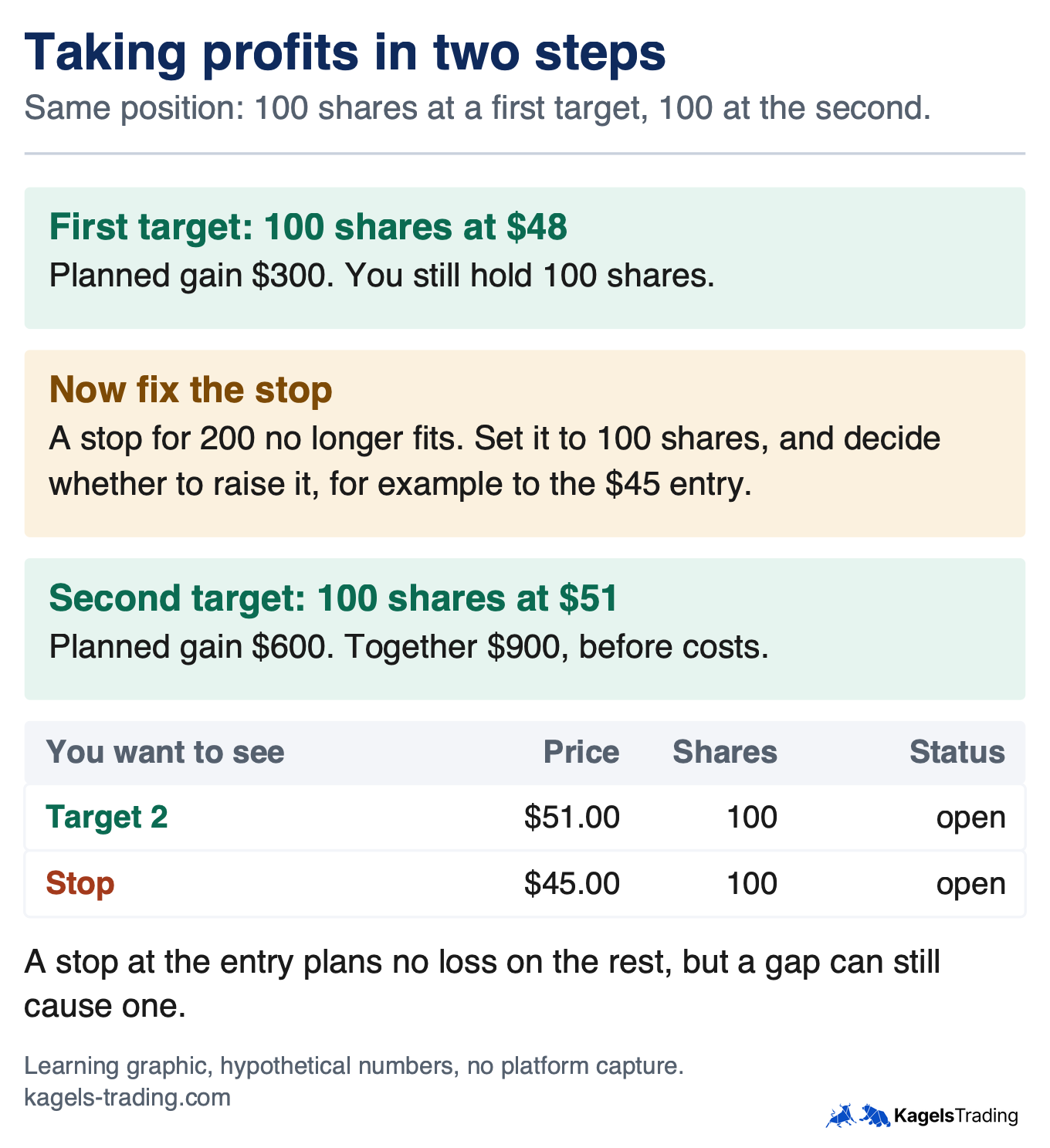
Many traders do not sell everything at the first target. In our example, 100 shares go at $48.00 and 100 at $51.00. That books part of the gain early and keeps the rest of the position for the larger move.
 Click to enlarge
Source: Kagels Trading, own learning graphic.
After the first sale, check the stop before anything else. Brokers handle this differently: Alpaca adjusts the stop of a bracket to the remaining quantity after a partial take-profit fill, while Fidelity’s 2012 disclosure says a partial fill on one side of an OCO triggers an attempt to cancel the other side, so your stop may be gone. A separate stop may still cover 200 shares, 100 more than you hold. So check three things: does the stop exist, what is its status, and how many shares does it cover? Then restore or resize it to the remaining 100 shares, and decide whether to raise it, for example to the $45.00 entry.
The plan then adds up to $900 before costs. That is $300 from the first part and $600 from the second. With the stop at the entry, no loss is planned on the rest, but a gap can still bring one.
Costs depend on your broker and the number of orders. At brokers with $0 online stock commissions, two sales usually cost no commission, but industry fees on sales still apply, as Schwab’s pricing page states. Check your own fee schedule for anything charged per order or per execution.
How long a take-profit order lives
A target often needs days or weeks, so the time in force matters. A day order generally ends at the regular close. A good-til-canceled order lasts until filled or canceled, within your broker’s limit; Fidelity’s FAQ says its GTC orders expire 180 calendar days after they are placed.
An expired target looks exactly like no target. Nothing in your position view tells you that the exit is gone. Note the expiry date of every GTC target, and look at your open orders whenever you review the position.
Where the target comes from
The order is the second step; the level is the first. A target needs a reason on the chart and has to be reachable in your time frame. Three common sources, each with its own guide:
- Past swing highs and resistance: the market has turned there before. See our guide to support and resistance for levels.
- Measured moves of chart patterns: the height of a pattern projected from the breakout point, as shown in our guide to chart patterns.
- Fibonacci extensions: projected levels beyond the last swing, with a calculator in our Fibonacci extension guide.
Check the target against your risk before the entry. If the nearest resistance gives you only $1.50 of gain against $3.00 of risk, the trade does not meet a 2 to 1 plan. Our guide to risk management shows what a reward-to-risk ratio means for the win rate you need.
Take-profit order or trailing stop?
A fixed target caps the gain, and a trailing stop lets it run but gives some back. The take-profit order sells at a planned level, even if the stock keeps rising afterwards. A trailing stop follows the price up and sells only after a pullback by its set distance, at a price that is not guaranteed.
Many traders combine both. They sell part of the position at a fixed target and protect the rest with a stop that they raise or trail. The two-step example above is one version of this, and the stop-loss guide linked above covers trailing stops and their weak points. Which mix fits depends on your strategy and your time frame.
Conclusion: plan the exit with a profit as carefully as the stop
A take-profit order is a simple limit order with three things to watch. It guarantees its price, not its fill. It belongs together with the stop in an OCO or bracket, so no orphaned order stays behind. And after every partial sale, check that a stop still exists and covers the remaining shares.
This guide explains order mechanics and is not investment advice. The numbers are hypothetical and before costs, and we did not test these orders at any broker. We read the SEC, Fidelity, Schwab and Alpaca documents named above on November 8 and 10, 2026; your own firm’s current terms decide.
Frequently asked questions about take-profit orders
What is a take-profit order?
It is a limit order that closes your position at a planned target. For a long position, it is a sell limit above the current price; for a short position, a buy limit below it. It can only fill at the limit or better.
Does a take-profit order always fill when the price reaches my target?
No, reaching the price allows a fill but does not guarantee one. Orders at the same price are filled in a sequence set by market center rules, and there may not be enough buyers. The order can also fill only in part.
What is the difference between a take-profit and a stop-loss order?
A take-profit order sells at a target above the price, a stop-loss sells after a drop to its trigger. The take-profit is a limit order and protects the price. The stop-loss becomes a market order and protects against larger losses, but its fill can be below the stop.
Can I set more than one take-profit level?
Yes, by splitting the position into several sell limit orders. For example, 100 shares at the first target and 100 at the second. After each partial sale, check that the stop still exists and covers the remaining shares.
Should I use a take-profit order and a stop together?
Yes, but link them, ideally in an OCO or bracket order. Two separate sell orders for the same shares can leave one open after the exit, which can open a short position or be rejected by your broker. After every exit, check your order list.
Does a take-profit order cost anything?
At brokers with $0 online stock commissions, a filled target usually pays no commission. Industry fees on sales still apply, and a sale in two steps means two executions. Check your broker’s fee schedule.
This US edition is based on our German edition on kagels-trading.de and has been adapted for US readers.
More Trade Execution guides
- Choose the right order type
Order Types Explained: Market, Limit, Stop and Stop-Limit
Market, limit, stop, stop-limit and trailing stop orders for US stocks, what each one gives up, and who actually holds your stop.
- Link a target and a stop
OCO and Bracket Orders: Link a Target and a Stop
OCO, OTO and bracket orders, partial fills at Fidelity, Alpaca and Interactive Brokers, and why both sides can still fill.
- Set a stop loss
Stop-Loss Order: How to Set a Stop Loss on the Chart
Place the stop from the chart, size the trade from it, and know what a stop costs and what to check after a partial fill.