
Stop-Loss Order: How to Set a Stop Loss on the Chart


Contents
- Stop-loss orders in 30 seconds
- What is a stop-loss order?
- The wrong way: a stop set by the loss you want
- Which stop orders can you use for a stop loss?
- Stop-loss example: one order, step by step
- Where to place a stop loss on the chart
- How much to risk: size the trade from the stop
- Where stop-loss orders work
- Who watches your stop, and when
- After a partial fill: check the stop
- What does a stop-loss order cost?
- Pros and cons of stop-loss orders
- Why you need an initial stop loss
- Conclusion: the stop belongs on the chart, not on your wish
- Frequently asked questions about stop-loss orders
- About the author
Most traders put their stop where the loss would still feel bearable, and that is the wrong order of steps. The market does not know your account. It knows support, resistance and how far the stock usually swings, and a stop that ignores those is often hit before the move even starts.
This guide turns the order around: first the level on the chart, then the position size. You get the stop orders you can use for a stop loss, a worked example with 200 shares at $45.00, how to place the stop, how to size the trade from it, what a stop costs at US brokers, and what to check after a partial fill. This article follows our editorial policy.
Stop-loss orders in 30 seconds
- What it is: an order to sell your shares once the price falls to a stop price you set in advance. The SEC uses stop-loss order as another name for a stop order.
- The hard limit: the stop price is a trigger, not a fill price. After a gap, the sale can come far below it.
- Where it goes: behind the level where your trade idea has failed, for a long position below the last support, with room for normal swings.
- How big the trade is: the distance to the stop sets the share count, not the other way round.
- What it costs: at brokers with $0 online stock commissions, such as Schwab, a filled stop pays no commission, but industry fees on sales still apply.
- The habit that matters: after every fill or partial fill, check that your stop exists, its status and its share count.
What is a stop-loss order?
A stop-loss order is an order to sell a stock once its price reaches a stop price set in advance. It becomes a market order at that point, and it limits the planned loss of a position without you having to watch the screen.
The SEC defines it as another name for a stop order. In its investor bulletin on stop orders, a sell stop sits below the current price and is used to limit a loss or protect a profit on shares you own. A buy stop sits above the price and does the same job for a short position. This guide uses the long side, because that is how most readers use a stop.
A stop does two jobs during a trade. At the start, it is the initial stop: it sets the planned loss before you are in. If the stock then moves your way, you can raise it until it sits above your entry, and it starts to protect a profit. No loss is planned from then on, but none is ruled out either, because a gap can still fill the sale below your entry price, and costs come on top.
A stop never works alone. It belongs together with the position sizing formula, the 1% rule and a reasonable reward-to-risk ratio, as our guide to risk management explains. The stop sets the level, and the other rules decide how much you trade at that level.
The wrong way: a stop set by the loss you want
Two questions sound sensible and still lead to an arbitrary stop. The first is “how much do I want to lose?”, and the second is “where does that put my stop?”. Both are about your account, and neither looks at the chart.
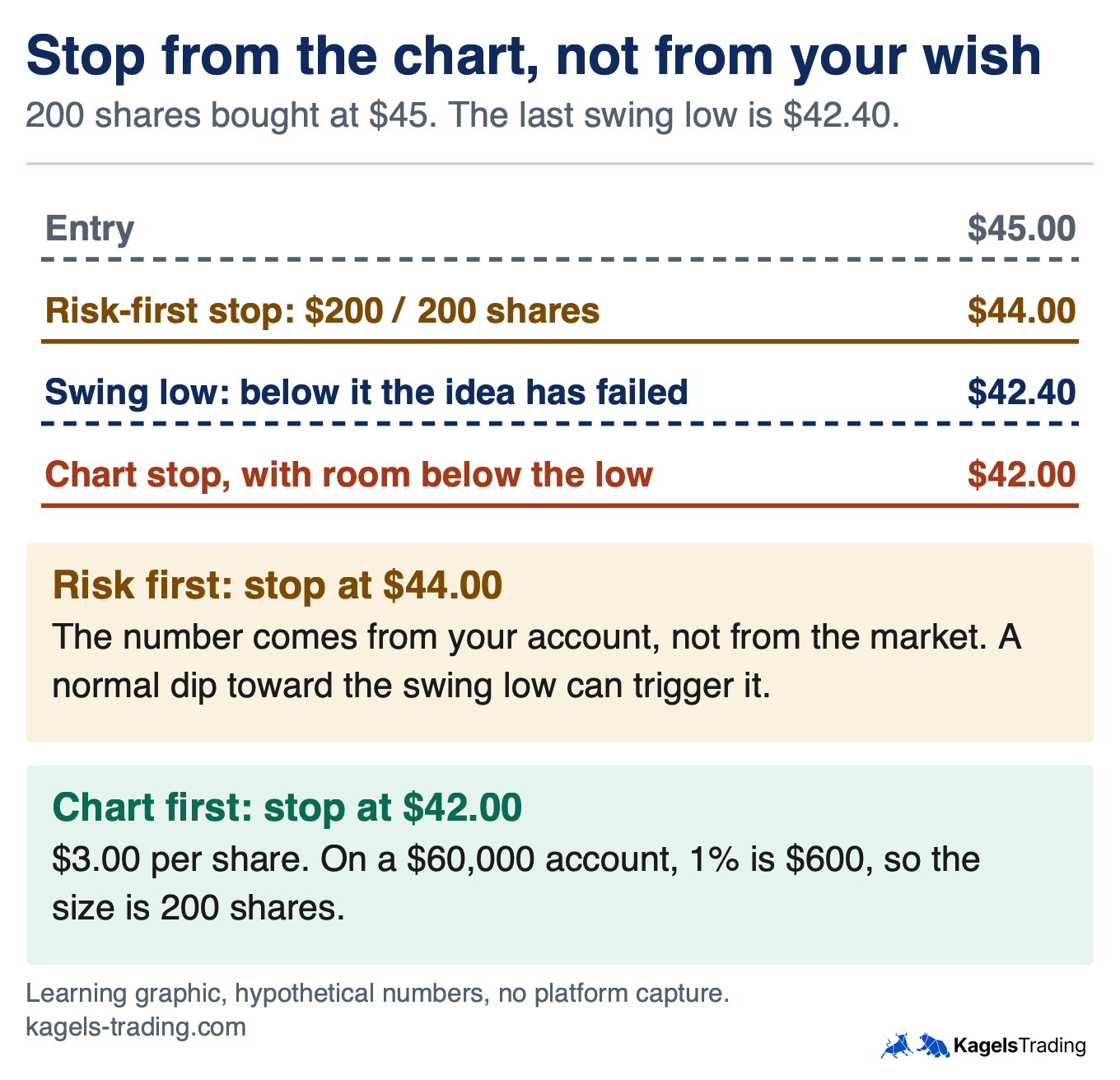
Take the example from the graphic: you buy 200 shares at $45.00 and want to lose no more than $200. The arithmetic gives a stop at $45.00 minus $1.00, so $44.00. But the last swing low, the lowest point of the last pullback, is at $42.40. A normal dip toward that low can trigger your stop at $44.00 even though the trade idea is still intact.
 Click to enlarge
Source: Kagels Trading, own learning graphic.
The link between risk and size is right, only the order of the steps is wrong. First find the level on the chart where the idea has failed, then work out the share count that fits your risk. With a stop at $42.00, $3.00 below the entry, a planned risk of $600 gives exactly 200 shares. That $600 is 1% of a $60,000 account.
Which stop orders can you use for a stop loss?
The type decides what happens after the trigger, and that matters most on a bad day. Our guide to order types compares all of them in detail. Here is the short version for protecting a position, so you know which order type you are placing.
Stop order: the standard stop loss
A stop order becomes a market order once the stop price is reached. That is what most traders mean by a stop loss. It sells in nearly every market, because a market order takes the next available price, and the price you pay for that is slippage: the fill can come below your stop.
The size of that slippage depends on the moment. In a liquid stock in a calm market, it is often a few cents. FINRA’s note on stop orders from March 2025 warns that in a fast market you could receive “significantly less” than your stop price, and that a short-lived price drop can trigger the stop before the stock recovers.
Stop-limit order: a price floor, and the risk of no sale
A stop-limit order becomes a limit order once the stop price is reached. You set two prices: the stop price that wakes the order and a limit price, the lowest price you accept. With a stop at $42.00 and a limit at $41.50, the order can sell at $41.50 or higher after the trigger, and never lower.
The limit is a floor, not a range around the stop. If the stock gaps below $41.50, the order stays open and unfilled, and you still hold a falling stock. A rebound can fill it, but only if buyers are there at that price, and possibly only in part. The SEC bulletin says plainly that a stop-limit order “may not be executed” if the price moves away from the limit.
Trailing stop: a stop that follows the price
A trailing stop moves up with a winning long position and stays put when the price falls. You set the distance in dollars or percent. In the SEC’s example, a $1 trail on a stock that peaks at $24 leaves the stop at $23, and the sale can still fill below that price.
The weak point of a trailing stop is its fixed distance. It does not know the chart. It moves up in a sideways phase just as it does in a trend, and a trail that is too tight is hit by normal swings. The SEC advises choosing the trail carefully for exactly that reason. When a fixed target fits better than a trail is part of our guide to the take-profit order.
Indicator stops: the level moves, the order does not
Some stops come from an indicator that calculates a new level on every bar. The Chandelier Exit is a classic: according to StockCharts’ ChartSchool, Charles Le Beau developed it, and by default it sits 3 times the ATR below the highest high of the last 22 periods. The SuperTrend indicator works with a similar idea.
The practical difference is where the stop lives. An indicator line on your chart is not an order. You have to move your stop order to the new level yourself, or use a tool that does it. A trailing stop held by your broker moves without you, but only by its fixed distance.
Stop-loss example: one order, step by step
Numbers show the difference between stop types faster than any definition. We use one hypothetical trade, one swing low on the chart, and work through both stop types. All amounts are before costs.
- The position: 200 shares bought at $45.00, worth $9,000.
- The level on the chart: the last swing low is at $42.40. Below it, the trade idea has failed.
- The stop: $42.00, a little below the low, so that normal swings do not trigger it.
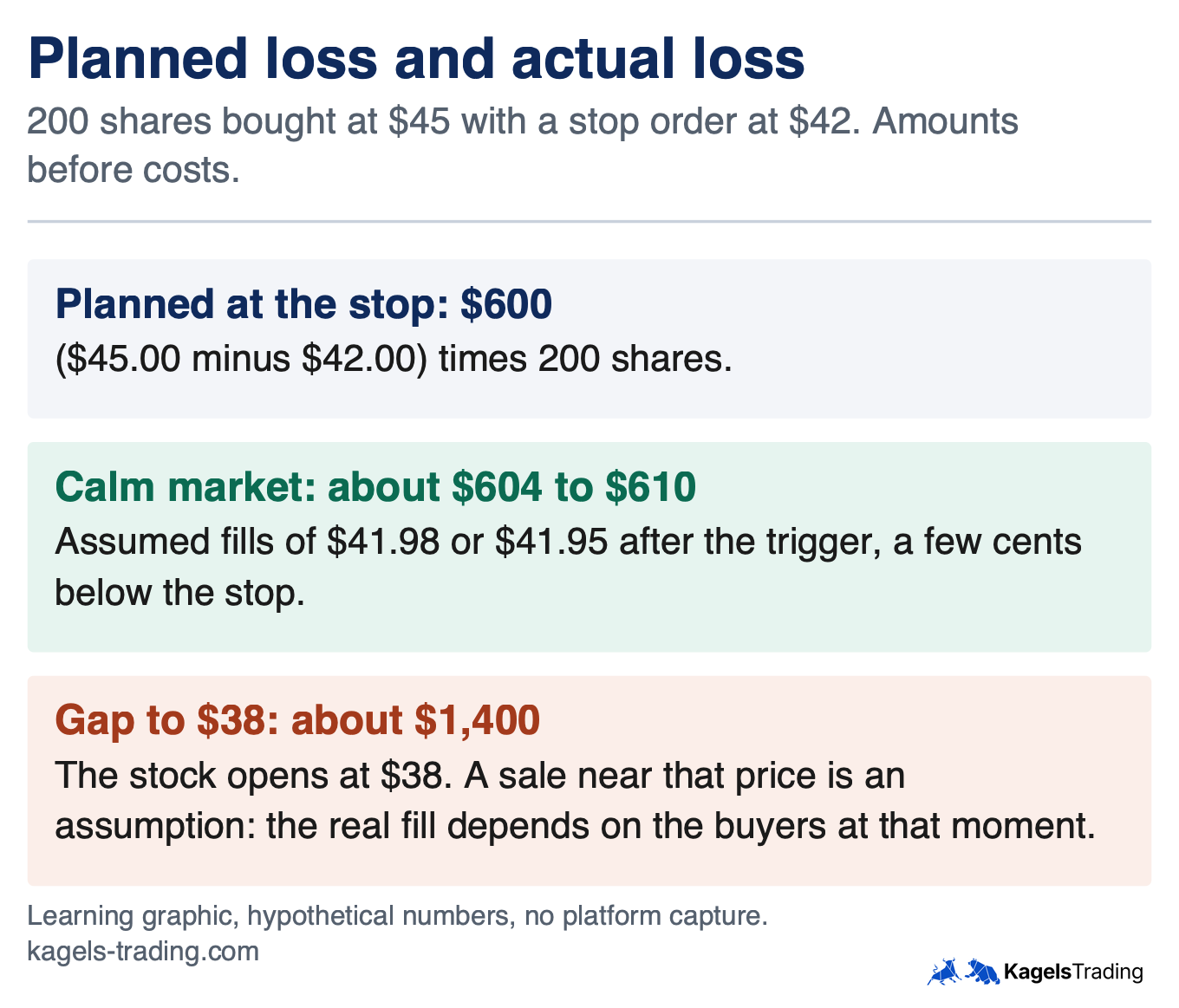
- The risk: ($45.00 minus $42.00) times 200 shares is $600, or 1% of a $60,000 account.
With a stop order, a trade at $42.00 or lower triggers it, and it becomes a market order. In a calm market, assume fills at $41.98 or $41.95. The loss is then about $604 to $610 instead of the planned $600.
A gap changes the picture. Say the company warns on profits and the stock opens at $38.00. The stop order is triggered and sells at the next available prices; if we assume a fill near $38.00, the loss is $1,400, or $800 more than planned. A stop-limit with a $41.50 limit is triggered too, but it does not sell below $41.50. You still hold 200 shares, down $1,400 on paper, and the loss can grow.
 Click to enlarge
Source: Kagels Trading, own learning graphic.
The rule that follows is honest in both directions. Use a stop order if getting out matters most. Use a stop-limit only if a sale at a panic price worries you more than holding a falling stock, and if you have a plan for the case where it does not sell. For limiting losses, which is the job of a stop loss, the stop order is the fitting choice in most cases. Our guide to gap trading explains how gaps form.
Where to place a stop loss on the chart
A logical stop follows the price, not your risk appetite. It sits where the idea behind the trade is proven wrong, which limits the loss and still gives the trade room to work. Two methods lead there: market structure and volatility. The idea of placing the stop from the chart first goes back to two articles by Galen Woods, the price action trader behind Trading Setups Review: The Logical Trader’s Guide to Setting Stop-Losses and Why You Must Have An Initial Stop-Loss.
Below support, above resistance
In the ideal case, the market never reaches your stop. That makes the placement almost automatic: for a long position the stop goes below support, for a short position above resistance. Both are zones where the market has turned before, and our guide to support and resistance shows how to find them.
Many setups bring their own stop level. In a breakout trade, the other side of the range limits the loss. After a pullback entry, the stop goes beyond the extreme of the pullback, as our guide to pullback trading shows. If you trade a candlestick or bar pattern, the stop goes below the low of the pattern, or above its high for a short.
Round numbers and obvious lows attract many stops. Orders cluster just below a visible low, and a quick break below it that turns back at once is called a liquidity sweep or stop hunt. Our guide to the liquidity sweep shows what that looks like. The answer is a little more room, not trading without a stop.
How far away should the stop be?
There is no fixed percentage that fits every trade. Any single number ignores the stock, the time frame and the market phase. A large-cap stock on a daily chart needs a very different distance from a small cap on a five-minute chart.
Fixed rules exist, but they are rules of a method, not of the market. The CAN SLIM method cuts every loss at 7 to 8 percent below the purchase price. The 10% rule often linked to Jesse Livermore is not in his own book, as our Jesse Livermore guide shows; what remains is the principle of small, early losses.
A sound order of steps works for every trade. Find the level where the idea has failed, put the stop a little beyond it, and calculate the share count from that distance. If the result is a position too large for your account, make the position smaller, never the distance tighter.
Using volatility: the ATR stop
Volatility turns the room a stop needs into a number. The ATR indicator, the Average True Range, measures how far a stock typically moves per bar. On a daily chart, a stop inside the average daily range is usually too tight, while on an intraday chart a smaller stop can fit behind a clear level of that time frame.
A common way is a multiple of the ATR behind the level. The stop then widens in busy markets and tightens in calm ones. As the price rises, the same calculation can trail the stop, which is what the Chandelier Exit described above does with 3 ATR below the high.
How much to risk: size the trade from the stop
Only now does the account come in. The chart has given the level, the level gives the amount at risk, and that amount decides the share count, or whether you skip the trade. Here is a second example with a wider stop.
A chart pattern puts the stop at $40.00, the entry is at $50.00, and you plan to buy 100 shares. ($50.00 minus $40.00) times 100 shares is $1,000 of trade risk, known before the order is sent. Whether you can afford it depends on your account.
- Account of $2,000: the $1,000 would be half of it. No setup is good enough for that drawdown. Skip the trade or buy far fewer shares.
- Account of $50,000: the same $1,000 is 2 percent, a loss the account can take. The trade is possible at the planned size, though many traders cap risk at 1%.
This is the core of the method: the market comes first. The careless trader picks a wish loss, sets the stop from it and decides on the trade before checking the risk. The careful trader reads the chart, finds the level, works out the amount and only then decides. The full calculation, with a calculator, is in the position sizing guide linked above.
Where stop-loss orders work
A stop needs a price that trades during the day. That is the case for stocks and ETFs on an exchange, and not for every product you can hold. The question is less whether a stop works technically than which distance a product can live with.
Stocks
For stocks, the usual daily swing decides the distance. If a stock moves 10% on a normal day, a stop inside that range is close to a coin flip. It is hit because the day was loud, not because the idea failed. Use the swing low or an ATR multiple from the sections above.
ETFs and mutual funds
An ETF trades on an exchange during the day, so a stop works as it does for a stock. The SEC’s bulletin on mutual funds and ETFs says retail investors buy and sell ETF shares at market prices. The question is whether a stop makes sense: a broad index ETF held for the long term is not a trade with an exit level, and a stop turns a paper dip into a realized loss.
A mutual fund has no price during the day for a stop to watch. The same SEC bulletin says a fund’s net asset value is typically calculated at the end of each business day, and you buy or sell at that price. For a short-term idea on a sector or a region, an ETF is the tool that a stop can protect.
Margin accounts
In a margin account, a stop matters even more, but it remains your own risk-management choice. Borrowed money enlarges every move, and the loss acts on the full position, not only on your own money. No rule requires a stop order, and a stop does not prevent a margin call or a sale by your broker.
Under FINRA Rule 2264, firms must tell margin customers that they can sell securities without contacting them. The margin disclosure statement also says you are not entitled to choose which securities are sold to meet a margin call. That forced sale is a separate mechanism from your stop: the firm decides when and what to sell, at the prices available then. A stop set from your plan can close a losing position before it gets that far, but it cannot rule out a forced sale.
Who watches your stop, and when
Two details in the order ticket decide whether your stop works when it matters. Neither shows on the chart: what counts as reaching the stop, and in which hours the stop is active. A third, the time in force, decides how long it exists at all.
The trigger depends on the order and your broker. Under FINRA Rule 5350, a stop order becomes a market order when a transaction occurs at or beyond the stop price, and an order that triggers on something else, such as a quote, must not be called a stop order. The SEC bulletin adds that some firms use last-sale prices and others quotation prices, so check your broker’s terms.
Many stops are held by the broker and watched only in certain hours. Fidelity’s conditional order disclosure, dated 2012, says its conditional and trailing stop orders are monitored from 9:30 a.m. to 4:00 p.m. Eastern and held in a separate order file until triggered. Alpaca accepts only limit orders in extended hours. So a stock can move after the close while your stop cannot react; whether it triggers once the regular session opens depends on the prices then, and a fill is still not guaranteed; our guide to pre-market and after-hours trading covers those sessions.
An expired stop looks exactly like no stop. A day order is generally gone after the regular close, and a good-til-canceled order lasts only until your broker’s limit. Note the expiry date of every GTC stop; the order types guide linked above lists the time-in-force rules.
After a partial fill: check the stop
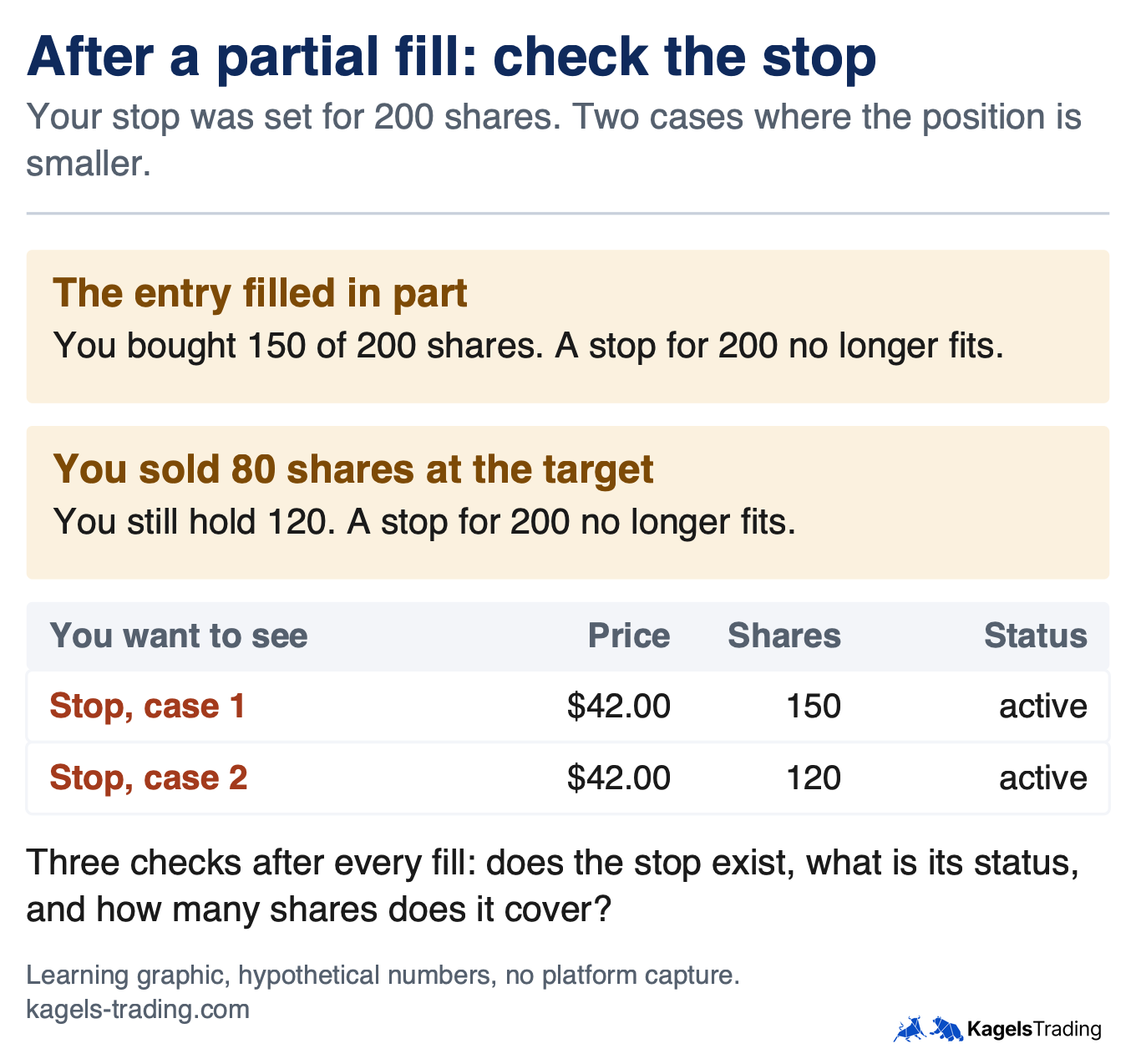
A stop set for 200 shares fits only a position of 200 shares. Two everyday events change the position without changing the stop: an entry that fills only in part, and a target that sells only part of the position. In both cases, the share count of the stop has to follow.
 Click to enlarge
Source: Kagels Trading, own learning graphic.
Brokers handle the second case differently, and some do nothing by themselves. Alpaca says that if the take-profit order of a bracket fills in part, the stop-loss is adjusted to the remaining quantity. Fidelity’s 2012 disclosure says a partial fill on one side of an OCO triggers an attempt to cancel the other side, so your stop may be gone. Our guide to OCO and bracket orders compares these rules.
So after every fill, partial fill and change, check three things. Does the stop still exist? What is its status: open, held, triggered, canceled? And how many shares does it cover? A stop that is too small leaves part of the position unprotected, and a stop that is too large no longer matches your position, so correct it yourself before you do anything else.
What does a stop-loss order cost?
At US brokers with $0 online stock commissions, a stop that fills usually costs no commission. Schwab’s pricing page, read on November 10, 2026, lists $0 online commission for listed stocks and ETFs. Other brokers have other prices, so check your own fee schedule, including whether placing or changing an order costs anything.
Small fees still apply to the sale. The same Schwab page says industry fees still apply, among them the Section 31 fee that the SEC charges on sales of securities and that firms pass on. They are shown on your trade confirmation.
The real cost of a stop is not on the price list. It is the slippage between your stop and the fill. In a liquid stock it is often a cent or two, but in a thin stock or after news before the open it can reach several percent, which costs far more than any fee. That is why the stop distance and the position size belong in one calculation.
Pros and cons of stop-loss orders
A stop solves one problem reliably and creates another. Weigh both sides before you decide how tight you trade and which order type you use.
Advantages:
- The planned loss is known in advance: you know the amount to the stop before you buy, and that makes position sizing possible at all. Gaps and costs can push the actual loss higher.
- It works without a screen: a stop held by your broker works while you are in a meeting, within the hours your broker watches it. A stop in your head does not.
- It takes the decision out of the moment: the exit is set while you are calm, before a falling market tests your nerves.
- It can protect profits: a raised stop turns a loss limit into profit protection, though a gap can still turn it into a loss.
Disadvantages:
- No guaranteed price: a stop order can fill far below its trigger, and a stop-limit may not sell at all.
- It makes the loss final: a paper loss becomes a realized one, and for a long-term holding an automatic exit may not fit the investment plan.
- Tight stops get picked off: orders cluster around obvious lows, and noise reaches them first.
- Limited lifetime: a day order ends at the close and a GTC order at your broker’s time limit.
For larger stock positions, a protective put is a second way to limit the loss. You keep the shares and buy a put option, which gains value if the stock falls, and a gap cannot skip its strike price. The put costs a premium, which you pay whether or not the stock falls; our guide to options strategies explains it.
Why you need an initial stop loss
An initial stop is the loss limit you place together with the opening of the position. It fixes the price at which the trade idea counts as wrong. Some traders go without one, almost always after a painful experience: they were stopped out, and then the market moved the way they had expected. Those moments stick, while the times a stop saved the account are forgotten.
There are three reasons to put the stop into the market as a real order. Each one holds for technical traders, and the last one most of all for day traders.
Every trade idea has a price at which it is wrong
If you trade technically, there is always a level where your reason for the trade is gone. If you buy at $45.00 because a chart pattern points to $50.00, ask yourself why you would still hold the stock at $20.00. The pattern broke long before that. Fundamental investors are a different case, because their thesis does not depend on the price path.
The stop protects you from yourself
Your worst enemy in a losing trade is you, at the moment you do not want to lose. An order in the market makes you accept the loss that you would otherwise keep postponing. Losses are part of the business; trading is about probabilities, not certainty, and a series of stopped trades is usually normal variance, not proof that the method failed.
You will not enter a stop when the market runs
This hits day traders hardest. When the market gets fast and no stop is in place, you are unlikely to enter one in that moment, because looking away is the easier reaction. A mental stop in your head does not survive that situation. A written day trading plan fixes the stop before the session starts.
Three cases are different, and they are worth naming. A buy-and-hold investor needs no stop order; technically, that stop sits at zero. Some option positions have their risk limited by construction to the amount paid. And a trader who knows the conditions that end the edge, but cannot name a price, exits with a market order when those conditions occur.
Conclusion: the stop belongs on the chart, not on your wish
A stop-loss order is a simple tool with one demanding question: not whether you set a stop, but where. If you derive the level from the loss you want, you get exits with no link to the market, and they are hit reliably by normal swings.
The order of steps that works has three parts. First find the level on the chart where the idea has failed. Then work out the amount at risk. Last, decide whether your account can carry it. If it cannot, the position gets smaller, never the distance tighter.
Two limits remain however carefully you work. A stop does not guarantee its price, and it turns every paper loss into a realized one. For a trade with a clear exit level, that is exactly its purpose; for a long-term holding, an automatic exit may conflict with the investment plan.
This guide explains how stop orders work and is not investment advice. The numbers are hypothetical and before costs, and we did not test these orders at any broker. We read the SEC, FINRA and broker documents named above on November 8 and 10, 2026; your own firm’s current terms decide.
Frequently asked questions about stop-loss orders
What is the difference between a stop-loss and a stop-limit order?
A stop-loss becomes a market order after the trigger, a stop-limit becomes a limit order. The stop-loss sells in nearly every market but can fill far below the stop price. The stop-limit never sells below its limit, but after a gap through the limit it stays unfilled, and you still hold the stock.
Does a stop-loss order guarantee my price?
No, the stop price is only a trigger. The SEC says it is not the guaranteed execution price. After a gap or in a fast market, the fill can be well below the stop, which makes the actual loss larger than the planned loss.
How far away should I set my stop loss?
There is no fixed percentage. The distance comes from the level on the chart where your idea has failed, plus some room for the stock’s normal swings, which the ATR measures. On a daily chart, a stop inside the average daily range is usually too tight.
Does a stop-loss order cost anything?
At brokers with $0 online stock commissions, a filled stop usually pays no commission. Schwab lists $0 for online stock trades, but industry fees such as the SEC’s Section 31 fee on sales still apply. Check your broker’s fee schedule for any charge on changes.
Do stop-loss orders work after hours?
Often not, so check your broker’s rules. Fidelity’s disclosure says its conditional and trailing stop orders are watched from 9:30 a.m. to 4:00 p.m. Eastern, and Alpaca accepts only limit orders in extended hours. An overnight move can leave the position unprotected until monitoring resumes, and whether the stop then triggers and fills depends on the prices at that time.
What should I check after a partial fill?
Check that the stop still exists, its status and its share count. After a partial entry or a partial sale at the target, a stop for the original size no longer fits. Some brokers adjust it, others may cancel it, so correct it yourself if needed.
Can I put a stop loss on an ETF or a mutual fund?
On an ETF yes, on a mutual fund generally not. An ETF trades at market prices during the day, while a mutual fund is priced once a day at its net asset value. For a long-term index ETF, ask first whether a stop fits the plan at all.
This US edition is based on our German edition on kagels-trading.de and has been adapted for US readers.
More Trade Execution guides
- Choose the right order type
Order Types Explained: Market, Limit, Stop and Stop-Limit
Market, limit, stop, stop-limit and trailing stop orders for US stocks, what each one gives up, and who actually holds your stop.
- Link a target and a stop
OCO and Bracket Orders: Link a Target and a Stop
OCO, OTO and bracket orders, partial fills at Fidelity, Alpaca and Interactive Brokers, and why both sides can still fill.
- Take profits at a target
Take-Profit Order: How to Set a Profit Target
Enter a profit target as a limit order, know why reaching it does not guarantee a fill, and take profits in steps without a wrong-sized stop.