
Martingale Strategy in Trading: Why Doubling Down Fails


Contents
- Martingale strategy in 30 seconds
- What is the Martingale strategy?
- How does Martingale work in trading?
- A worked example: Martingale in action
- Martingale calculator: how many losses can your account take?
- Our test: Martingale on 27 years of EUR/USD direction data
- Pros and cons of Martingale trading
- Is the Martingale strategy banned?
- Why you should stay away from Martingale
- Anti-Martingale: the reverse logic
- Conclusion: Martingale is a bet against the statistics
- Frequently asked questions about the Martingale strategy
- About the author
If you double your stake after every loss, you win a little almost every time and then lose a lot at once. That is the Martingale strategy: a single win is supposed to recover the whole losing streak before it. On paper it looks like a safe system; in a trading account, one long streak takes back many small wins in a single series.
That is why I did not just explain the method, but ran the numbers. You get an exact calculator for how many losses in a row your stake plan can take, a test on the direction of 27 years of EUR/USD rates from the European Central Bank and the answer to whether brokers and prop firms allow Martingale at all. This article follows our editorial policy.
Martingale strategy in 30 seconds
- The principle: you double the stake after every loss until a single win recovers all previous losses.
- The origin: a betting system from 18th-century France, later applied to roulette.
- The catch: stakes grow exponentially; with a $100 start, five losses cost $3,100, and the sixth trade needs $3,200.
- Our test: on the daily direction of EUR/USD over 27 years, a plan of six stakes hit a six-loss streak after a median of 115 trading days, in 75 percent of cases within a year.
- The math: in a fair, independent, even-money game, the expected value of a Martingale series is zero; costs make it negative, and staking alone creates no edge.
- Is it banned? Not by law, but margin close-out rules and prop firm rules often break the chain first.
What is the Martingale strategy?
The Martingale strategy is a staking system in which you double the stake after every loss, so that a single win recovers all previous losses and brings a profit equal to the first stake.
The idea is older than any stock exchange. According to Wikipedia, Martingale systems come from 18th-century France and were later applied to roulette, where red or black is close to a coin flip.
In trading, position size replaces the roulette stake. Instead of red or black, you bet on rising or falling prices. If the trade loses, the next position is twice as large. The principle stays the same, and so does the risk. The mathematical opposite, in which risk grows with the account and shrinks after losses, is the Kelly criterion.
How does Martingale work in trading?
After every losing trade, you increase the position size so that a later win recovers all previous losses. In the classic version, the stake doubles. Modified versions raise it more slowly, for example by a factor of 1.5, or add to the position at fixed price intervals.
A Martingale series looks like this in practice. You open a position with $100 at risk, and it loses. To recover, you risk $200 on the next trade, and it loses too. Then you risk $400, $800, $1,600 and so on, until one win is supposed to make up for all of it.
It works in theory, but only under two conditions that real trading lacks. You would need unlimited capital to survive any losing streak, and a broker that never limits how far you can raise the position size. Neither is realistic: five or six losses in a row turn a harmless-looking plan into a threat to your account.
A worked example: Martingale in action
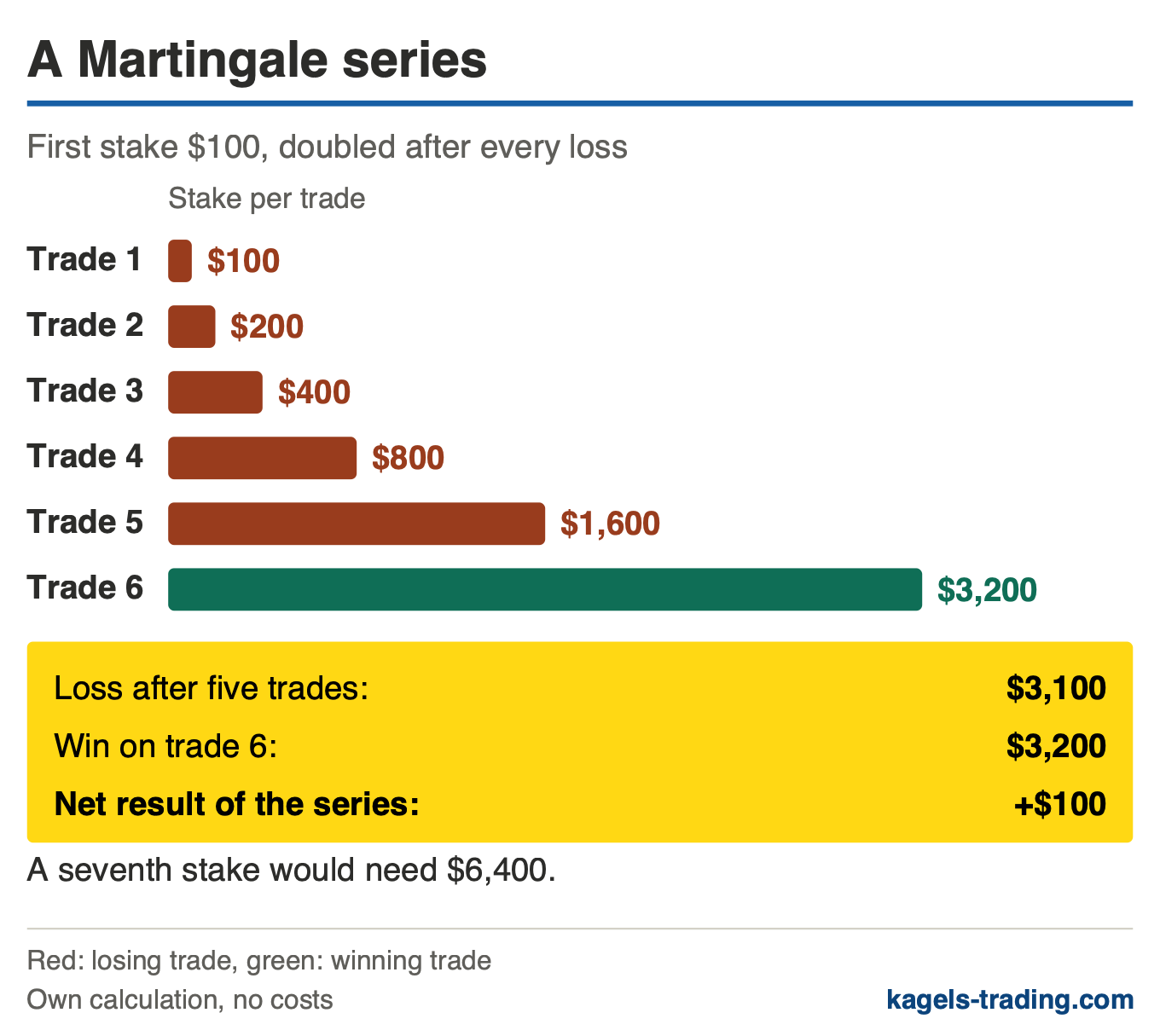
Take a trader who bets on a rising EUR/USD. He starts with a stake of $100, the market runs against him, and following the Martingale rules he doubles on every new trade. The chart and the table show the whole series.
 Click to enlarge
Source: Kagels Trading, own calculation; method as described on Wikipedia.
| Trade | Stake | Loss so far |
|---|---|---|
| 1 | $100 | $100 |
| 2 | $200 | $300 |
| 3 | $400 | $700 |
| 4 | $800 | $1,500 |
| 5 | $1,600 | $3,100 |
| 6 (win) | $3,200 | recovered, plus $100 |
After five losses in a row, the trader is $3,100 in drawdown. His sixth trade finally wins and brings in $3,200. That recovers all losses and leaves him with a profit of just $100.
For those $100, he put a total of $6,300 at risk. If the sixth trade had lost as well, the seventh would have needed a stake of $6,400. Many traders can no longer raise that amount after the losses before it.
The real problem is the ratio of risk to possible gain. Position size grows exponentially, while the profit stays at the first stake. That is exactly why Martingale is so dangerous, and why many grid bots that add at fixed intervals carry the same risk; our guide to grid trading explains that logic.
Martingale calculator: how many losses can your account take?
How long a Martingale chain lasts depends on one number: the stakes in a row your plan can pay. After n losses in a row, you have lost the first stake times 2 to the power of n, minus 1. With a $100 start, that is $6,300 after six losses and already $102,300 after ten.
The table shows how many stakes in a row a starting balance can pay and how likely a streak of that length is. It gives the exact probability that, within 250 trades, at least one losing streak occurs that is as long as the stakes the starting balance covers. It assumes a fair hit rate of 50 percent, a coin flip with equal payouts and no costs. When that streak comes, the plan cannot double again and the whole series is lost: with a 1 percent first stake, that is 63 percent of the starting balance.
| First stake as share of account | Stakes the account can pay | Streak limit hit in 250 trades |
|---|---|---|
| 5% | 4 | practically 100% |
| 2% | 5 | 98.6% |
| 1% | 6 | 86.8% |
| 0.5% | 7 | 62.7% |
| 0.2% | 8 | 38.4% |
| 0.1% | 9 | 21.3% |
Own exact calculation, not a simulation: probability of at least one losing streak as long as the stakes the starting balance can pay, 250 independent trades, 50 percent hit rate, equal payouts, no costs. Profits from earlier series are not added to the plan.
A smaller first stake delays the streak that breaks the plan; it does not prevent it. Even with a 0.1 percent start, the probability reaches 62.4 percent after 1,000 trades. And the profit per finished series shrinks in the same way, because it is never larger than the first stake.
Real trading costs make it worse. If you treat spread and fees as a slightly lower hit rate of 48 instead of 50 percent, the chance of hitting the streak limit at a 1 percent start rises from 86.8 to 91.7 percent within 250 trades.
In a fair game, the expected value is exactly zero. With six stakes and independent even-money bets, you win 63 of 64 series by $100 each and lose one by $6,300; on balance, that is zero, and costs push it below. No staking system can turn a fair game into an edge; it only redistributes wins and losses. Whether a trading strategy has an edge depends on its entries and exits, not on the staking.
Our test: Martingale on 27 years of EUR/USD direction data
Theory is one thing, the real market another. So I ran the method on the daily reference rates of the European Central Bank for EUR/USD from 4 January 1999 to 23 November 2026, a total of 7,142 trading days.
The euro rose on 49.6 percent of the days. That is close to the fair coin flip from the calculator, only with a real sequence of up and down days. The rule bet every day on a rising euro, and every day without a rise counted as a loss. Only the direction counts: each win pays the stake and each loss costs the stake, a hypothetical 1:1 payout, not the size of the real move.
| Key figure | Value | Note |
|---|---|---|
| Longest losing streak | 10 days | Feb 26 to Mar 11, 2015 |
| Streaks of 6 days or more | 52 | about 1.9 per year |
| Streaks of 8 days or more | 9 | enough for a 0.2% start |
| Years with a 6-day streak | 22 of 28 | including 2025 and 2026 |
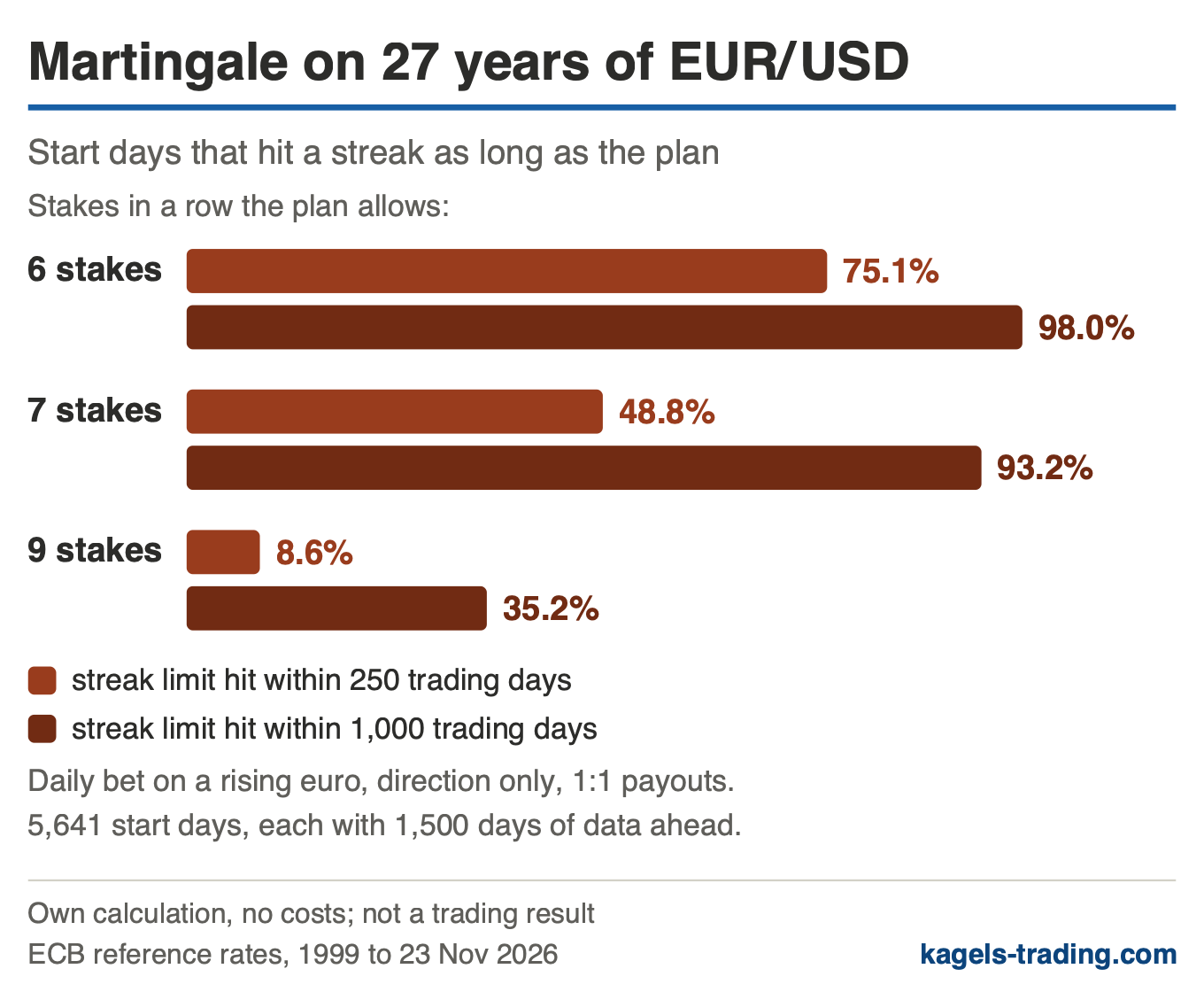
Then I ran every possible start day on its own. I used all 5,641 start days with at least 1,500 trading days of data ahead. The plan: a $100 first stake and at most six stakes in a row, the $6,300 a $10,000 starting balance can pay. A six-loss streak, which loses the full series, came after a median of 115 trading days, in 75 percent of cases within 250 trading days and in 98 percent within 1,000.
 Click to enlarge
Source: European Central Bank, EUR/USD reference rate; own calculation.
Until that streak, the equity curve looks good for a long time. At the median, the system won 56 series in a row, so $5,600. Then came the one series that cost $6,300, and the $10,000 account stood at $9,300, below where it started. This phase makes Martingale so tempting: if you look at the equity curve after three months, the system looks brilliant.
A longer stake plan only moves the date. With seven stakes, the median was 259 trading days. With nine stakes, 27 percent of start days never met a nine-loss streak before the data ended; for the 73 percent that did, the median was 1,042 trading days. No stake plan avoids the breaking streak as long as streaks eventually get long enough, and in 27 years of EUR/USD they did, again and again.
This test has clear limits. It is a historical direction-sequence exercise with equal win and loss payouts, one market, one daily rule and no costs. It does not track the account balance after each series, and the ECB reference rate is an information rate, not a price you could trade at. It shows how losing streaks hit a doubling plan, not a forecast for any strategy.
Pros and cons of Martingale trading
Martingale has two real strengths, and both explain why it attracts so many traders. The weaknesses weigh more, because they hit the whole account, not just single trades.
Pros of Martingale
- Easy to understand: the rule fits into one sentence and needs no analysis.
- High hit rate: most series end with a small win, and the equity curve rises smoothly for a long time.
Cons of Martingale
- Exponential risk: a few losses in a row make the position size explode.
- Capital limit: without unlimited money, a longer streak breaks the chain and costs a whole series, in our test usually within a year.
- Broker limits: leverage, margin close-out and position limits often break the chain before the saving win.
- No edge: staking alone adds nothing; in a fair game the expected value stays at zero, however clever the ladder.
- Psychological pressure: rising stakes lead to impulsive decisions, exactly when calm matters most.
Is the Martingale strategy banned?
No law bans Martingale. No rule tells you how to scale your position sizes. In practice, though, the method runs into limits in three places, and each can break the chain before the saving win arrives.
Forex and CFD brokers: leverage caps and close-out
In the US, retail forex leverage is capped by law. Under CFTC rule 17 CFR 5.9, dealers must collect at least 2 percent of the notional value for major currency pairs and 5 percent for all other pairs, which means at most 50:1 and 20:1. CFDs are not offered to retail traders in the US.
In the UK, CFD rules add a close-out at 50 percent of margin. The FCA’s policy statement PS19/18 limits leverage to between 30:1 and 2:1, requires firms to close out positions when your funds fall to 50 percent of the required margin and protects you from losing more than the money in your account. The EU applies similar rules.
For Martingale, this means the last steps of the chain often never happen. Before you can place the sixth or seventh doubling, the broker closes your open positions, as our guide to the margin call shows. Negative balance protection in the UK and EU at least keeps you from losing more than your deposit.
Prop firms: rarely named, often ruled out
Large prop firms rarely use the word Martingale, but their rules hit it. FTMO’s forbidden trading practices name, among other things, overleveraging, one-sided bets and opening substantially larger positions than in your other trades. A Martingale ladder fits exactly that pattern.
Other firms allow it, with conditions. In its FAQ, Funded Trader Markets allows Martingale and layering per account, but treats running them across several accounts at once as abusive. Even there, the drawdown limit of the challenge stays in place, and a long streak breaks it reliably; our guide to prop firm drawdown explains those limits.
Casinos: table limits
In a casino, the maximum bet stops the chain. Every table has a limit. Once you reach it, you cannot double again, and the loss of the whole series is final. It is the same mechanism as the margin limit at a broker, only under another name; our article on whether day trading is gambling draws the line.
Why you should stay away from Martingale
I admit it: on paper, the strategy sounds logical. In theory, you should at least break even or take a small profit. Maybe you think it could work with small amounts or enough capital.
That is exactly the mistake. No trader has unlimited capital, and with small stakes the profit stays so small that the risk is not worth it. Then comes the psychological strain: the larger the losses, the stronger the pressure to keep going, and many traders underestimate this until they are stuck in a loss spiral.
If you still want to try it, do it only on a demo account or with minimal risk. Do not judge it by the first weeks, but by the longest losing streak your account can survive. Many trading bots use the same doubling logic, and our guide to trading bots shows how to spot it before you pay.
Anti-Martingale: the reverse logic
The opposite is called Anti-Martingale. Here you increase the position after a win and reduce it after a loss. Risk grows only while things go well, and losing phases stay small. In gambling, the same idea is known as the Paroli system.
This does not create an edge either. The reverse ladder changes the expected value just as little as Martingale. It only flips the profile: many small losses, an occasional big win. That fits trend following strategies better, because they live from a few large moves anyway, and it keeps drawdowns under control.
What really protects a trading account is a fixed risk per trade. If you risk the same percentage of your account on every trade and use a stop loss, you survive even ten losses in a row. How to calculate the right size is shown in our guide to position sizing, and the bigger picture is in our guide to risk management for traders.
Conclusion: Martingale is a bet against the statistics
Martingale wins often and loses once, for real. Our test on 27 years of EUR/USD direction data showed that the breaking streak came after a median of only a few months. A longer plan only delays it, and staking alone gives the system no edge.
My personal verdict after these numbers: I would not put real money on Martingale, not even in a bot. If you want to improve your trading, clean risk management with a fixed risk per trade is the better path.
Frequently asked questions about the Martingale strategy
Is the Martingale strategy allowed in trading?
Yes, no law bans Martingale in trading. But UK and EU brokers close out positions once your funds fall to half the required margin, US forex leverage is capped, and many prop firms forbid much larger positions after losses. The chain often breaks before the saving win.
What are the alternatives to Martingale?
The solid alternative is a fixed risk per trade with a stop loss. For example, you risk 1 percent of the account on every trade. Some traders also use Anti-Martingale, where the position grows after wins.
What happens during a long losing streak?
Position size grows exponentially with every loss. After six losses with a $100 start, $6,300 is gone, and the next stake would have to be $6,400. Usually, the chain breaks there through a margin close-out or because the money runs out.
What is the Anti-Martingale strategy?
Anti-Martingale works the other way round: you raise the position after a win and reduce it after a loss. Risk rises only in profitable phases, so drawdowns stay easier to control, but it creates no edge.
How much capital do you need for Martingale?
For n losses in a row, you need the first stake times 2 to the power of n, minus 1. With a $100 start, that is $6,300 for six steps and $102,300 for ten. Even then, a high chance of a breaking streak remains; it only comes later.
Does Martingale work with trading bots?
Technically yes, and many grid and forex bots use Martingale position sizing. The risk does not go away; the bot only executes the doubling faster and without hesitation, so check the position sizing of any bot before you use it.
This English edition is based on our German edition on kagels-trading.de and has been adapted for international readers.
More Risk Management guides
- Manage your trading risk
Risk Management in Trading: Rules, Math, Psychology
The 1% rule, stops, risk/reward, daily loss limits, leverage caps and the psychology of losing streaks, with the math behind each rule.
- Calculate your position size
Position Sizing in Trading: Formula, Calculator, Examples
The formula, a free calculator, the 1% rule explained correctly, and examples for stocks, forex and futures.
- Set a stop from volatility
Volatility Stop Loss: ATR Trailing Stops and 8 Methods
Measure, multiple and anchor, eight methods from the Chandelier Exit to the Parabolic SAR, and an SPY test of intraday against closing triggers.
- Read your account equity
Account Equity vs Balance: Margin and Free Margin Explained
Equity against balance, margin, free margin and margin level, with a worked example and the close-out rules for cash, US margin and CFD accounts.
- Avoid a margin call
Margin Call: What It Is, How It Happens and How to Avoid It
When a margin call comes, what your broker does next, whether you can owe money, and four rules that keep your account away from it.
- Size your risk per trade
Kelly Criterion for Traders: Formula, Calculator, Risks
The Kelly formula for traders with a calculator, and a simulation of why full Kelly is far too much.
- Calculate your risk-reward ratio
Risk-Reward Ratio: Formula, Calculator, Break-Even Win Rate
The formula, a free calculator, why 1:2 and 2:1 can mean the same trade, and the win rate each ratio needs to break even.
- Avoid costly mistakes
Trading Mistakes: 13 Costly Errors and How to Avoid Them
The 13 mistakes that cost accounts the most, the biases behind them, overtrading and revenge trading, and a checklist for your next trade.
- Build a trading mindset
Trading Mindset: How to Think Like a Disciplined Trader
Why traders sell winners too early and hold losers too long, what overtrading costs, and five habits that help you follow your plan.
- Keep a trading journal
Trading Journal: How to Record and Review Your Trades
What to write before and after each trade, a completed example with a win and a loss, a weekly review and a template to copy.
- Choose a journal
Best Trading Journal Software 2026: 6 Tools Compared
Six journals compared on price, free plans, refunds, automatic broker sync, costs and export, with a decision guide.
- Check TradeZella
TradeZella Review 2026: Pricing, Features and Limitations
The three plans since July 2026, what Essential leaves out, the no-refund terms, imports, export and what users report.
- Check TraderSync
TraderSync Review 2026: Pricing, Broker Sync and Limits
Plans and dated prices, broker imports and autosync, Market Replay, Cypher and the no-refund policy.
- Check Tradervue
Tradervue Review 2026: Imports, Reports and Costs
Silver or Gold, why net P&L needs Gold, few automatic imports, US-only stocks, the no-refund sign-up terms and how to cancel.
- Check Edgewonk
Edgewonk Review 2026: Features, Costs and Limitations
One feature set billed monthly or yearly, the refund period, MetaTrader auto sync, the psychology tools and our own test journal.
- Check TradesViz
TradesViz Review 2026: Pricing, Broker Sync, Terms
The free stock plan, Pro and Platinum prices checked November 10, 2026, which US brokers sync automatically, the no-refund terms and user reviews.
- Check a Myfxbook account
Myfxbook Review 2026: Free Tools, Fees and Track Records
What is free and what costs money as of 21 November 2026, the two verification marks, and why Gain and Absolute Gain can tell different stories.