
Slippage in Trading: What It Is and How to Reduce It


Contents
Slippage is the gap between the price you expect and the price you actually get. It never appears as a line on your trade confirmation, yet it comes off every trade that fills worse than planned. I bought my first shares in 1980 and have traded actively since 1986, in stocks, futures and forex, and slippage has been part of every one of those markets.
This guide explains where slippage comes from and how much it can cost. You will see examples for market, stop and limit orders, a simple calculation in dollars, and the ways I keep slippage small. It is educational, not investment advice, and follows our editorial policy.
Slippage in 30 seconds
- Definition: Slippage is the difference between the expected price of a trade and the price at which it is actually filled.
- Both directions: Slippage can be negative (a worse fill) or positive (a better fill).
- Fast markets: It happens most often when prices move quickly, for example around economic data and near the open or close.
- Thin markets: It also happens when your order is larger than the volume available at the best price.
- How to reduce it: Limit orders instead of market orders, liquid markets and calm times. Slippage is part of trading and cannot be avoided completely.
What is slippage?
Slippage is the difference between the expected price of a trade and the price at which the trade is actually filled.
Slippage is one of the hidden execution costs, together with the spread. Like the bid-ask spread, it never shows up as a fee, but it changes your entry price and your exit price. In this article I share my own experience with slippage in order execution.
Where slippage comes from: fast or thin markets
Slippage depends on the order type you use. When you buy at once, your starting point is the price at which sellers currently offer, the ask. A market order fills there or at the next available price. The order types guide explains each order in detail; for slippage, three cases matter:
- A stop order can slip past its stop price. When a trader enters or exits with a stop order without a limit, the fill can differ from the stop price entered in the platform, because the stop becomes a market order once it is triggered.
- A market order can fill away from the quote you saw. When a trader buys with a market order, the fill can differ from the ask on the screen when the order was sent (for a sell, from the bid), because the market moves while the order travels.
- A limit order never fills worse than its limit. With a limit order, any difference can only be in the trader’s favor: the order fills at the limit price or better, or it does not fill at all.
 Click to enlarge
Source: Kagels Trading, own learning graphic.
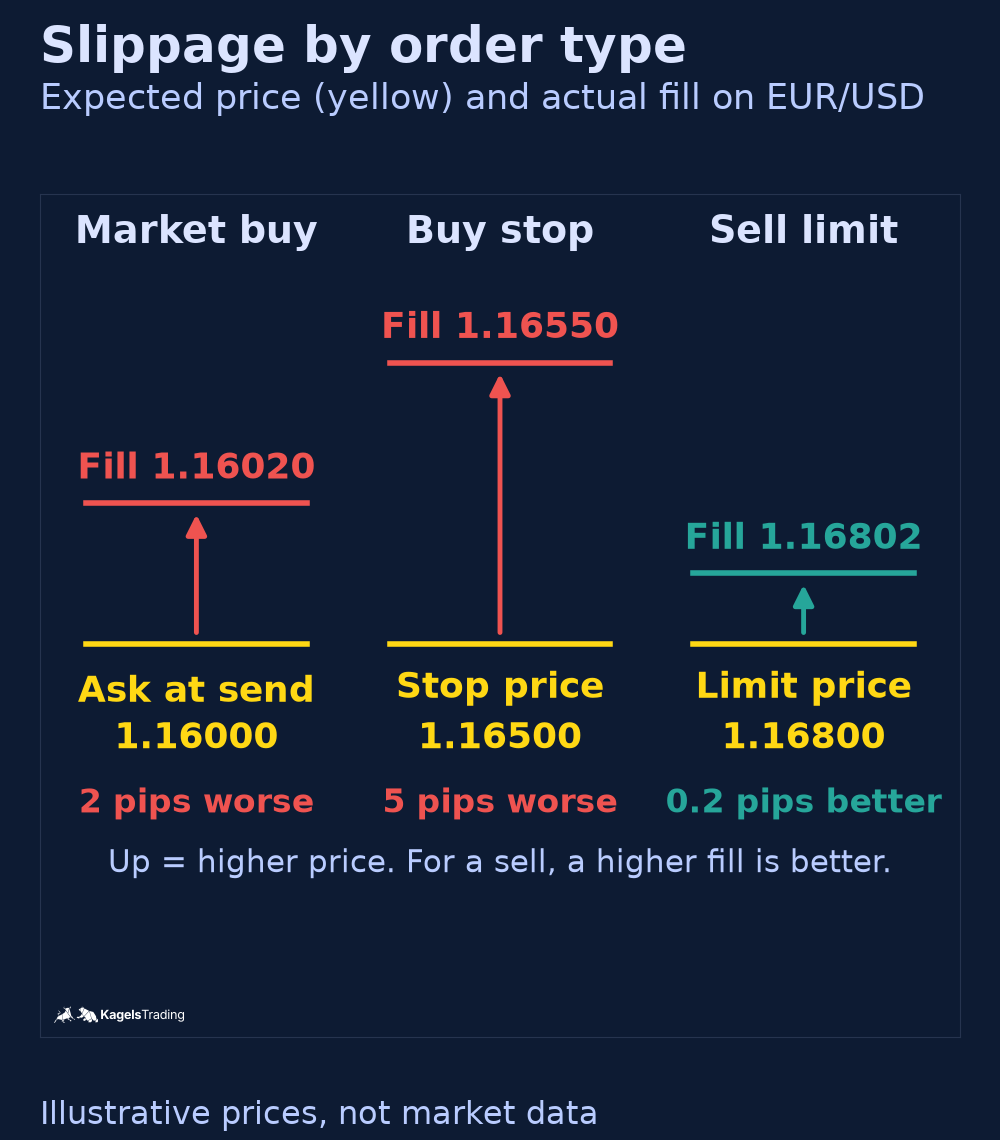
Three examples show how slippage looks in practice. The prices are illustrative and match the graphic above. Each example measures the move beyond the executable quote or order price, so the spread is not counted as slippage:
- A buy stop that slips by 5 pips. A trader places a buy stop on EUR/USD at 1.16500 and is filled at 1.16550. The negative slippage is 5 pips.
- A market order that slips by 2 pips. The ask on EUR/USD is 1.16000 when a trader sends a buy market order and is filled at 1.16020. The negative slippage is 2 pips.
- A sell limit that fills 0.2 pips better. A trader places a sell limit at 1.16800 and is filled at 1.16802. That is positive slippage of 0.2 pips in the trader’s favor.
Positive slippage is not limited to limit orders. In US stocks, a market order can also fill at a better price than the best quote at that moment; brokers call this price improvement. You cannot plan with it, though. What you can plan with is that a limit order caps the price you pay.
Slippage in dollars: a simple calculation
Slippage in dollars is the price difference times your position size. For a buy, subtract the expected price from the fill; for a sell, subtract the fill from the expected price. A positive result is a cost, a negative result a gain. In forex and stocks, multiply by the position size in units or shares. For futures, multiply the price difference by the dollar value per point and the number of contracts, or multiply the number of ticks by the tick value and the number of contracts.
In forex, a pip on one standard lot of EUR/USD is worth $10. A standard lot is 100,000 euros, and one pip is 0.0001, so 0.0001 times 100,000 is $10. The 2 pips from the market order cost $20 per lot, the 5 pips from the buy stop cost $50, and the 0.2 pips from the sell limit gain $2.
In futures, count the ticks and multiply by the tick value. The E-mini S&P 500 moves in steps of 0.25 index points, and each step is worth $12.50 according to CME’s contract specifications. If the best ask is 6,800.00 when you send a buy market order and are filled at 6,801.25, that is 5 ticks of slippage, or $62.50 per contract.
Small amounts add up over many trades. $62.50 sounds small. A day trader who loses that much on both entry and exit, ten round trips a week, pays $1,250 a week before any other cost.
Slippage can become expensive
In fast markets, slippage can be large. When markets move quickly, especially during and shortly after important economic releases, but also just after the open and just before the close, the gap between the expected and the actual fill can be considerable. The economic calendar shows when these moments are due.
US stock exchanges have their own brake against extreme moves. Under the Limit Up-Limit Down plan, a stock may not trade outside a price band around its recent average price; for stocks above $3.00 the usual band is 5% for Tier 1 and 10% for Tier 2, and Tier 1 bands double during the final 25 minutes of the session. If a qualifying Limit State does not clear within 15 seconds, the primary listing exchange declares an initial five-minute trading pause, which can be extended, according to the LULD plan. A stop order that triggers around such a pause can fill at a price far from the stop.
In my experience, even very liquid markets slip in those moments. On GBP/USD, slippage can reach 10 pips or more around major news. For US stocks, FINRA warns that a stop order can be filled at a price significantly below the stop in a fast market (FINRA on stop orders).
Choosing the right stop type helps against slippage. A stop market order sells in almost every case but accepts the slippage. A stop limit order caps the slippage but may not fill at all, and then the position stays open. Which of the two fits your trading style is explained in the guide on the stop loss order.
Every trader has to include slippage in the risk plan. If your stop is 20 pips away, a 10-pip slippage turns a planned loss of 1% into 1.5%. That belongs in your risk management, especially in day trading and around news.
Many backtests leave slippage out or model it too kindly. The result is a large and negative gap between backtest results and live trading. The guide on backtesting shows how much even small costs per trade change a test result, and why a test without costs is only an upper limit.
High slippage is also typical in thin markets. These are stocks with low volume, exotic currency pairs and futures in which few contracts change hands. Your order can be larger than the volume at the best price, so it fills at several worse prices one after the other.
Orange juice futures are a classic example. FCOJ-A futures trade on ICE Futures U.S. and are far less active than the big index futures. If you enter there with a market order at the wrong time, the actual fill can be a nasty surprise.
How to reduce slippage
A trader has to live with slippage. It is a trading cost that goes straight into your profit and loss, just like commission and spread.
Limit orders reduce slippage the most. Use a buy limit or sell limit to enter, and exit with limit orders where your plan allows it, for example at a profit target. For the stop loss, decide consciously between a stop market and a stop limit order.
Avoid market orders in fast and thin markets. Trade liquid markets in their main hours, check the economic calendar before you enter, and split a large order if the volume at the best price is small.
Frequently asked questions about slippage
What is slippage in trading?
Slippage is the difference between the expected price of a trade and the price at which it is actually filled. It affects market orders and stop orders most, because they fill at the next available price.
What causes slippage?
Slippage mostly comes from fast markets. When prices move quickly, for example around economic data, the price changes while your order travels. It also comes from thin markets, when your order is larger than the volume available at the best price.
Is slippage always negative?
No, slippage can be positive or negative. Positive slippage means a fill at a better price than expected, negative slippage a fill at a worse price. Limit orders can only slip in your favor.
How can I reduce slippage?
Limit orders are the most effective tool against slippage. A limit order sets the worst price at which you are willing to trade. Add liquid markets, calm trading hours and smaller order sizes in thin markets.
Can slippage be avoided completely?
No, slippage is a normal part of trading. You can limit it with limit orders and good timing, but a limit order may then not fill at all. That is the trade-off between price and execution.
What does positive slippage mean?
Positive slippage means your order filled at a better price than expected. For example, you place a buy order and get filled at a lower price. In US stocks this is often called price improvement.
What does negative slippage mean?
Negative slippage means your order filled at a worse price than expected. For example, your buy stop triggers and you get filled at a higher price than your stop. This is the slippage that costs money.
Is slippage the same in all markets?
No, the amount of slippage depends on the market. Markets with high liquidity, such as major currency pairs and large index futures, tend to slip less. Markets with low liquidity, such as small stocks and thin futures, tend to slip more.
This US edition is based on our German edition on kagels-trading.de and has been adapted for US readers.
More Trade Execution guides
- Choose the right order type
Order Types Explained: Market, Limit, Stop and Stop-Limit
Market, limit, stop, stop-limit and trailing stop orders for US stocks, what each one gives up, and who actually holds your stop.
- Link a target and a stop
OCO and Bracket Orders: Link a Target and a Stop
OCO, OTO and bracket orders, partial fills at Fidelity, Alpaca and Interactive Brokers, and why both sides can still fill.
- Set a stop loss
Stop-Loss Order: How to Set a Stop Loss on the Chart
Place the stop from the chart, size the trade from it, and know what a stop costs and what to check after a partial fill.
- Take profits at a target
Take-Profit Order: How to Set a Profit Target
Enter a profit target as a limit order, know why reaching it does not guarantee a fill, and take profits in steps without a wrong-sized stop.
- Go short on falling prices
Short Selling: How to Go Short and What It Really Costs
Five ways to go short, what borrow fees, margin, swaps and dividends cost, and the risks only short sellers face.
- Know what the spread costs you
Bid-Ask Spread Explained: Formula, Examples and Costs
Bid, ask and the spread in dollars, percent and pips, why it widens and how limit orders and timing keep the cost low.
- Read a live quote screen
Bid vs Ask: Which Price You Pay and Which You Get
Which price you normally pay and get, why the last price is not your price, and what bid size and ask size show, with real quotes from my platform.
- Understand a short squeeze
Short Squeeze: How It Works and Famous Examples
Why short sellers who buy back push the price higher, the warning signs in short interest data, and what Volkswagen 2008 and GameStop 2021 show.