
Pre-Market and After-Hours Trading: Hours, Risks, Brokers


Contents
- Pre-market and after-hours trading in 30 seconds
- What is pre-market and after-hours trading?
- Extended trading hours at the US exchanges
- Overnight trading: the stock market almost 24 hours a day
- Broker hours: when you can actually trade
- Why prices move before the open and after the close
- What our data shows: the overnight move
- Risks of pre-market and after-hours trading
- Pre-market trading from Europe
- How I use the pre-market
- Frequently asked questions about pre-market and after-hours trading
- About the author
Say a US company reports its quarterly earnings at 7:00 a.m. Eastern Time, two and a half hours before the stock market opens. The stock can move by several percent within minutes. That is pre-market trading: traders react to news long before the opening bell, and the same happens in after-hours trading when results come out after the close.
This guide gives you the exact pre-market and after-hours times, explains how the sessions work and where the risks are. It also covers the new overnight sessions and what 25 years of SPY data show about the move between the close and the next open. This article follows our editorial policy.
Pre-market and after-hours trading in 30 seconds
- Pre-market: at Nasdaq and NYSE Arca from 4:00 to 9:30 a.m. ET; many brokers start later, Schwab for example at 7:00 a.m. ET.
- After-hours: from 4:00 to 8:00 p.m. ET at Nasdaq and NYSE Arca; at Schwab from 4:05 p.m. ET.
- Overnight: some brokers already offer trading through the night, Interactive Brokers from 8:00 p.m. to 3:50 a.m. ET. Nasdaq expects to add its own overnight session on 6 December 2026.
- Risks: lower liquidity, wider spreads, higher volatility and restricted order types; Schwab, for example, accepts only limit orders. FINRA requires its member brokers to warn about these risks.
- What our data shows: from 2001 to 2026, most of SPY’s gain came between the close and the next open. After opening price gaps of 0.5 percent or more, the regular session moved against the gap on 46 percent of days.
What is pre-market and after-hours trading?
Pre-market and after-hours trading, together called extended-hours trading, is the trading of stocks outside the regular session of 9:30 a.m. to 4:00 p.m. Eastern Time.
Trading in these hours runs on electronic systems, not on the trading floor. Exchanges like Nasdaq and NYSE Arca run their own early and late sessions, and electronic communication networks (ECNs) and other trading systems match orders as well. Your broker routes your order to one of these venues, so the hours you can trade depend on your broker, not only on the exchange. The SEC’s Investor.gov glossary notes that the duration of these sessions varies between markets.
Far fewer participants trade outside the regular session. Mostly institutional investors and active traders react to fresh news in these hours. Volume is thin, and prices can move far from the last close.
Extended trading hours at the US exchanges
The exchanges set the outer limits; your broker decides which part of them you can use. The table shows the sessions of the two exchanges with the widest extended hours and of the NYSE itself, according to their own pages, checked on 7 October 2026.
| Exchange | Early session (ET) | Late session (ET) |
|---|---|---|
| Nasdaq | 4:00–9:30 a.m. | 4:00–8:00 p.m. |
| NYSE Arca | 4:00–9:30 a.m. | 4:00–8:00 p.m. |
| NYSE, Tape A (own listings) | none, orders from 6:30 a.m. | none |
A detail few guides mention: NYSE-listed stocks have no early trading session at the NYSE itself. From 6:30 a.m. ET, orders can be entered and are queued until the opening auction at 9:30 a.m., according to the NYSE trading hours. For stocks listed elsewhere (Tapes B and C), the NYSE runs an early session from 7:00 to 9:30 a.m. In practice this hardly matters, because the same stocks trade on NYSE Arca, Nasdaq and other venues from 4:00 a.m. The table shows normal trading days; holiday schedules can shorten the sessions.
Most of the early volume arrives in the last hours before the open. Many companies publish earnings before 9:30 a.m. ET, and major US economic data such as the jobs report and inflation figures is released at 8:30 a.m. ET. For what happens after the bell, see our guide to trading sessions, which also explains RTH and ETH.
Overnight trading: the stock market almost 24 hours a day
Overnight trading fills the gap between the end of after-hours trading at 8:00 p.m. and the start of the pre-market. Until now, it has run on alternative trading systems offered through brokers, such as IBKR Eos ATS, not on the exchanges.
Brokers already offer it for selected stocks and ETFs. Interactive Brokers offers overnight trading from 8:00 p.m. to 3:50 a.m. ET for more than 10,000 US stocks and ETFs, according to its overnight trading page. Charles Schwab offers 24-hour trading five days a week on thinkorswim for all S&P 500, Nasdaq-100 and Dow 30 stocks plus more than 600 ETFs, according to its extended hours page.
Nasdaq plans to bring overnight trading onto the exchange. As of 7 October 2026, Nasdaq expects to add a session from 9:00 p.m. to 4:00 a.m. ET on Sunday, 6 December 2026, pending the readiness of the securities information processors and any required rule changes. Together with the existing sessions, that allows trading 23 hours a day, five days a week, with a one-hour pause from 8:00 to 9:00 p.m. ET.
More hours do not create more liquidity; they spread it more thinly. The busiest windows will most likely stay the open and the close of the regular session. Index futures already trade almost around the clock; their hours are in our guide to futures market hours.
Broker hours: when you can actually trade
The hours that count are your broker’s, and they differ more than most people expect. Two examples from the brokers’ own pages, checked on 7 October 2026; all times ET:
| Session | Schwab | Interactive Brokers |
|---|---|---|
| Pre-market (session) | 7:00–9:25 a.m. | offered |
| After-hours (session) | 4:05–8:00 p.m. | offered |
| Overnight | 24/5, selected stocks and ETFs | 8:00 p.m.–3:50 a.m. |
At Schwab, orders for the pre-market session must be placed between 8:05 p.m. on the previous trading day and 9:25 a.m. ET. Schwab also offers orders that stay active continuously from 7:00 a.m. to 8:00 p.m. ET, with short pauses around the regular session, and 24-hour orders on thinkorswim for the overnight sessions. Check the exact rules of your own broker before your first extended-hours order, including which order types it accepts. Our Interactive Brokers review covers fees and platforms in more detail.
Why prices move before the open and after the close
Most big moves outside the regular session have a concrete trigger.
- Earnings: many US companies report before the open or after the close, so the first reaction to the results runs through the extended hours.
- Economic data: the US jobs report and inflation figures come out at 8:30 a.m. ET, an hour before the open.
- Company news: takeovers, profit warnings, analyst changes and drug approvals often hit the wires early in the morning.
- Overseas markets: what happens in Asia and Europe is priced into US stocks before New York opens; their hours are in our guide to stock exchange hours.
A strong move in the pre-market leads to an opening gap. The stock opens far from the previous close, and the chart shows a visible gap. How gaps behave in the regular session, tested on SPY data, is in our guide to gap trading.
What our data shows: the overnight move
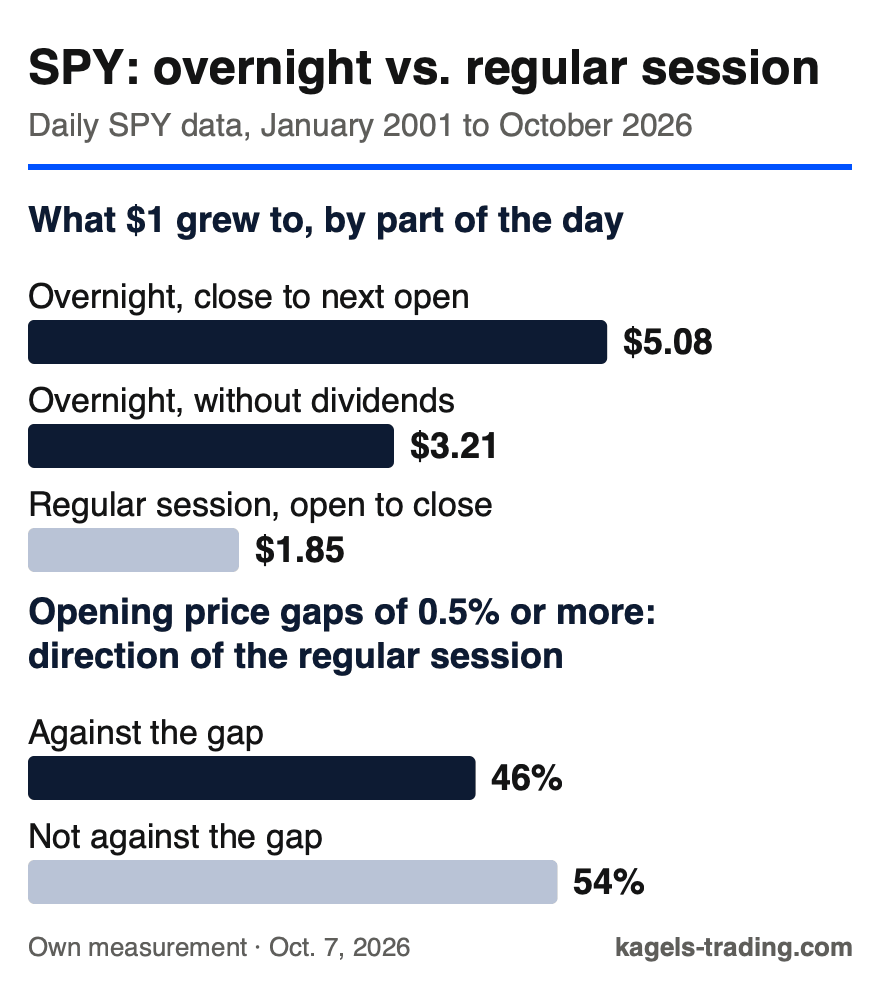
We split every SPY trading day from 2 January 2001 to 6 October 2026 into two parts: the move from the close to the next open, and the move from the open to the close. The overnight part therefore contains after-hours trading, the night and the pre-market. We allocated the dividend to the overnight move of the ex-dividend date, as an accounting choice, and show the result without dividends as well. The data are 6,478 daily prices from Yahoo Finance; yearly figures assume 252 trading days.
 Click to enlarge
Source: Kagels Trading, own measurement of SPY daily data, as of 7 October 2026.
| Measure, SPY 2001 to 2026 | Overnight | Regular session |
|---|---|---|
| $1 grew to | $5.08 ($3.21 without dividends) | $1.85 |
| Per year | 6.5% (4.6% without dividends) | 2.4% |
| Median absolute move per day | 0.29% | 0.44% |
Most of SPY’s gain came while the regular market was closed. One dollar held only from close to open grew to $5.08, one dollar held only from open to close to $1.85. The pattern held in both halves of the period: from 2001 to 2013 the overnight part earned 3.95 percent a year against 0.66 percent, from 2014 to 2026 9.21 percent against 4.25 percent.
The overnight moves were smaller, but they added up. The median absolute overnight move, regardless of direction, was 0.29 percent, against 0.44 percent during the session. The session moves were larger, but they cancelled each other out more often.
After an opening gap, the session went either way. SPY opened at least 0.5 percent away from the previous close on 29 percent of days, measured on the raw opening price. On those days, the regular session moved against the gap 46 percent of the time; for gaps of 1 percent or more, 45 percent of the time. A move against the gap is common, but it is not a rule, and only 18 percent of these days closed back at or beyond the previous close.
These are past figures for one ETF, before trading costs and taxes. Buying at every close and selling at every open would have meant two trades a day, with spreads and fees on each. The opening and closing prices are daily data, not guaranteed fills. The numbers describe where the market moved, not a strategy to copy.
Risks of pre-market and after-hours trading
FINRA requires its member brokers to give customers a risk disclosure before they trade in extended hours. FINRA Rule 2265 names these risks, among others, in its disclosure:
- Lower liquidity: fewer buyers and sellers, so even medium-sized orders can move the price, and an order may be filled only in part or not at all.
- Higher volatility: prices can swing more than in the regular session.
- Changing prices: the price in extended hours can differ from the price at the open or the close.
- Unlinked markets: quotes on one trading system may not match those on another.
- News announcements: news released outside the regular session can move prices sharply.
- Wider spreads: the gap between bid and ask is usually wider, so you pay more on the way in and out of a position.
Order types are restricted in the extended hours. Schwab, for example, accepts only limit orders; other brokers have different rules, and some allow certain stop-limit orders outside the regular session. Check what your broker allows and how it executes before you rely on a stop.
The other side is often better informed. Professional traders and institutions dominate these hours. If you missed a piece of news, it is usually better to trade in the liquid regular session than to rush into a thin market at 7:15 a.m. ET.
Pre-market trading from Europe
Traders in Europe can follow the US pre-market during their working day. In central Europe, the US pre-market from 4:00 a.m. ET starts at 10:00 a.m. local time for most of the year, and the regular session opens at 3:30 p.m. For the weeks when the clocks change on different dates, see our guide to trading sessions.
German trading venues also quote US stocks from early in the morning. LS Exchange, for example, trades Monday to Friday from 7:30 a.m. to 11:00 p.m. local time, according to its website, and other venues such as gettex and Tradegate also offer long hours. Before the US pre-market, these prices come from market makers while the US market is still closed, so the spreads can be wider than during US hours. How market makers set those prices is explained in our guide to the market maker.
How I use the pre-market
My morning routine has been the same for decades: first the US index futures, then the individual stocks in the pre-market. The futures show the overall risk mood, and the pre-market movers show where today’s news is. Futures are separate, leveraged instruments; if you are new to trading, use them to watch, not to trade.
For me, the pre-market is preparation time. It tells me which stocks deserve attention today and where the important levels are. I trade when there is real liquidity in the market. If you invest for the long term with a savings plan, you do not need pre-market access at all.
Frequently asked questions about pre-market and after-hours trading
What time does pre-market trading start?
At Nasdaq and NYSE Arca, the pre-market starts at 4:00 a.m. ET and runs until the open at 9:30 a.m. ET. Many brokers offer a shorter window; at Schwab, for example, the pre-market session runs from 7:00 to 9:25 a.m. ET. Check the hours of your own broker.
What time does after-hours trading end?
After-hours trading at Nasdaq and NYSE Arca runs from 4:00 to 8:00 p.m. ET. Some brokers continue with an overnight session, Interactive Brokers for example from 8:00 p.m. to 3:50 a.m. ET for selected stocks and ETFs.
Can anyone trade in the pre-market?
Most US brokers offer extended-hours trading to their customers, but the hours, the stocks and the order types differ. Under FINRA Rule 2265, a FINRA member broker must give you a risk disclosure first. Order types are restricted; Schwab, for example, accepts only limit orders in these hours.
Is pre-market trading risky?
Yes, the risks are higher than in the regular session. Liquidity is lower, spreads are wider, prices can move sharply on news, and stop orders are often not available. Opening gaps are also no reliable forecast: in our SPY data, the session moved against price gaps of 0.5 percent or more on 46 percent of days.
Will the stock market trade 24 hours a day?
Almost: Nasdaq expects to start trading 23 hours a day, five days a week, on 6 December 2026. The new session will run from 9:00 p.m. to 4:00 a.m. ET, with a one-hour pause from 8:00 to 9:00 p.m. ET. The start depends on the readiness of the market data systems, as of 7 October 2026.
Do pre-market prices predict the open?
Pre-market prices show where the stock will probably open, but not where it will close. After opening price gaps of 0.5 percent or more, SPY’s regular session moved against the gap on 46 percent of days and in the same direction on 54 percent; a handful of days ended unchanged. That is close to a coin toss.
This article is market education, not investment advice. Broker hours and rules can change; check your broker’s current terms before you trade.
This English edition is based on our German edition on kagels-trading.de and has been adapted for international readers.
More Market Hours guides
- Check futures hours
Futures Market Hours: CME Trading Times for ES, Oil and Gold
Weekly and daily hours of ES, crude oil, gold, Treasuries, grains and bitcoin futures in ET, CT and London time.
- Time your trades
Trading Sessions: Asian, London and New York Hours in ET
The Asian, London and New York sessions in ET, London and India time, their overlap, RTH and ETH, and how to set up your chart.
- Plan around expiry
Triple Witching 2026 and 2027: Dates and What Happens
Triple witching dates for 2026 and 2027, settlement times, and what 25 years of SPY data show about volume and the week after.
- Check exchange hours
Stock Exchange Hours Worldwide: Opening Times in ET
Opening and closing times of the major exchanges in the Americas, Europe and Asia-Pacific, in local and New York time, with lunch breaks.
- Trade the opening range
Opening Range Breakout: Rules, Charts and Common Mistakes
How 5, 15 and 30-minute opening windows differ, with a worked SPY example at a 15-minute window, entry at the next bar’s open and a 2R target.