
Short Squeeze: How It Works and Famous Examples


Contents
- Short squeeze in 30 seconds
- What is a short squeeze?
- How a short squeeze starts
- Warning signs: short interest, days to cover and float
- Why squeeze rallies rarely last
- Famous short squeezes
- What a squeeze means for short sellers and buyers
- Conclusion: a squeeze is a flow of orders, not a new valuation
- Frequently asked questions about short squeezes
- About the author
A short squeeze is the moment when betting on a falling price turns against the people who made the bet. The stock rises, the short sellers lose money, and the only way out for them is to buy. That buying pushes the price higher still and puts the next short seller under pressure.
Most explanations stop at that point, but the interesting part comes after. Why can a stock go up fivefold in two days without any change in the business? Which warning signs show up in the data before a squeeze? And why do squeeze rallies so often collapse as fast as they began?
This guide answers these questions with three real cases. You get the mechanics, the US short interest data that measure the risk, and what Volkswagen 2008 and GameStop 2021 really show. If you have never gone short, start with our guide to short selling. This article follows our editorial policy.
Short squeeze in 30 seconds
- Definition: A short squeeze is a fast price rise driven partly by short sellers who must buy back the shares they sold.
- The trigger: good news, strong earnings, a large buyer or simply a rising price that hits the short sellers’ buy stops.
- The loop: Every short seller who closes a position has to buy. That buying lifts the price and forces the next one out.
- Warning signs: high short interest compared with the freely tradable shares, many days to cover, a small float and rising borrow fees.
- The risk for short sellers: a price has no ceiling, so the loss on a short position has no upper limit.
- The end: A squeeze rarely lasts. Once the forced buying is done, the price often falls back sharply.
- Famous cases: Volkswagen in October 2008 and GameStop in January 2021.
What is a short squeeze?
A short squeeze is a rapid rise in a stock’s price that forces short sellers to close their positions by buying the stock back. A short seller borrows shares, sells them and hopes to buy them back cheaper. If the price rises instead, the loss grows with every dollar. At some point the broker, the stop order or the trader’s own nerves end the trade, and ending it means buying.
The word describes exactly what happens. To squeeze is to press something until nothing is left, like a lemon. The short sellers are pressed from two sides: the rising price increases their loss, and their own buy orders push the price further against them.
A squeeze is not an everyday event. It needs many short sellers in one stock, a trigger that lifts the price, and too few sellers on the other side to absorb the buying. When the three come together, a price can move in days what it normally moves in years.
How a short squeeze starts
Covering a short means buying
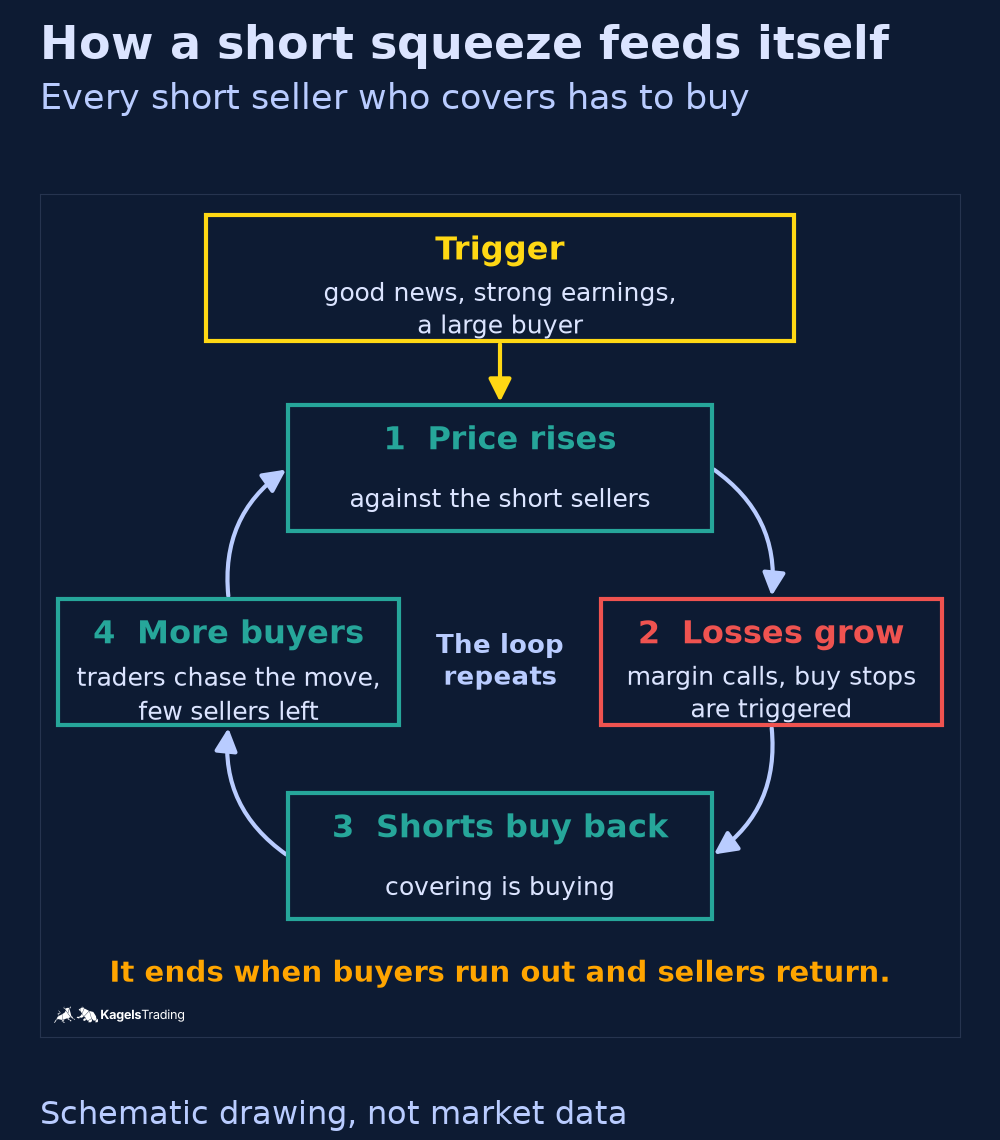
The market does not care why someone buys. A trader who buys because they expect a rise and a short seller who buys to close a position create exactly the same demand. Both orders take shares from the offers in the market. If buyers want more shares than are offered at the current price, they have to pay more, and the price rises.
That is the core of every squeeze. In a normal rise, the higher price attracts sellers who take profits. In a squeeze, part of the buying is forced: short sellers do not buy because the price is attractive, but because they cannot afford to wait. The higher the price, the more of them have to buy.
 Click to enlarge
Source: Kagels Trading, own learning graphic.
Stops and margin calls set off an avalanche
Many short sellers protect themselves with a stop loss, and for a short that stop is a buy order. It sits above the current price and turns into a market order when the price reaches it. Stops of different traders sit at different levels, often just above an obvious resistance. How stop orders work in general is explained in our guide to the stop-loss order.
When the price breaks through, the stops fire one after another. Each filled stop is a buy order that lifts the price to the next group of stops. On top of that, brokers demand more margin when a short position loses money. A trader who cannot pay is closed out by the broker, again with a buy.
Then the ordinary buyers join in. They see a stock break out and want to ride the move. Some short sellers even reverse: a trader short 500 shares buys 1,000, 500 to close the short and 500 to go long. In a small stock with little volume, demand for 50,000 shares can meet an offer of only 25,000. The price then jumps until enough sellers appear.
Futures and other markets
A squeeze is not limited to stocks. In futures nobody borrows anything, but a short position is closed the same way: by buying the contract back. If many traders are short in the same direction and the price runs against them, their buying can drive a sharp rise. The difference to stocks is that there is no lender who can recall the shares. The pressure comes from margin calls and stops.
Warning signs: short interest, days to cover and float
The best known measure of squeeze risk is short interest. It counts the shares that have been sold short and not yet bought back. In the US, broker-dealers report these positions under FINRA Rule 4560, and the totals per stock are published twice a month on FINRA and the exchange websites.
Short interest matters most in relation to the freely tradable shares. Analysts usually divide it by the float, the shares not held by insiders, governments or long-term owners. A stock with a large short interest and a small float has few shares available for short sellers who all want to buy at once.
Days to cover turns the same number into time. You divide the shares sold short by the average daily volume. If 20 million shares are short and 4 million traded on an average day, the ratio is five days. That is a hypothetical figure based on past volume, not a timetable: actual covering can be faster or slower because volume and positions change. The published short interest is also a snapshot from a reporting date and may already be out of date. It is not the same as the daily short-sale volume that some data sites show.
A rising borrow fee is the third signal. When shares become hard to borrow, brokers charge short sellers more and may recall shares. Both increase the pressure to close. None of these signs predicts the timing of a squeeze. A stock can stay heavily shorted for months, and the short sellers can be right in the end.
Why squeeze rallies rarely last
A price driven by forced buying has no lasting support. Once the short sellers have covered, that source of demand is gone. To hold the higher price, new buying would have to keep absorbing every share offered, and that is rarely the case after a squeeze.
Ask a simple question about any squeeze: did the company’s value change? Was Volkswagen in October 2008 suddenly worth five times more than a week earlier? Was GameStop in January 2021 worth almost 28 times its low of 8 January? Expectations may have shifted, but a price surge of that size need not reflect a comparable change in the business. Much of it came from the order flow.
That is why the end of a squeeze is often as violent as the start. Traders who bought late sit on large paper profits and start to sell. Short sellers who waited for the peak sell short again. The price can lose a large part of its gain within days.
Famous short squeezes
Volkswagen 2008: the most valuable company for a day
On Sunday, 26 October 2008, Porsche disclosed its shareholding and economic exposure in Volkswagen. According to Porsche’s press release, it held 42.6% of the ordinary shares plus 31.5% in cash-settled options, a total of 74.1%. Porsche gave a reason for the disclosure: there were “by far more short positions in the market than expected”.
The numbers left almost nothing for the short sellers to buy. The options did not give Porsche the shares themselves, but the banks on the other side held shares to hedge them, and those shares were not for sale either. With the state of Lower Saxony holding about 20%, the effectively available shares were estimated at less than 6%, while around 12% had been sold short, as International Banker summarizes. Many of the short sellers were hedge funds that had bet on a falling price.
What followed is still taught as the textbook squeeze. The ordinary share rose from a close of €210.85 on Friday, 24 October, to more than €1,005 on Tuesday, 28 October. For a short time Volkswagen was the most valuable listed company in the world. A study by Tengulov, Allen, Nowak and Haas, summarized on the Harvard Law School Forum, estimates the short sellers’ losses at more than €20 billion.
The higher value did not last, and neither did Porsche’s plan. The price fell back sharply within days. Porsche’s takeover attempt failed under its own debt, and in the end Volkswagen took over Porsche’s car business, not the other way round.
US bank stocks, July 2008: a rally with several possible drivers
In July 2008 the SEC restricted short selling in large financial stocks. Its emergency order of 15 July 2008 banned naked short sales, sales without first borrowing or arranging to borrow the shares, in Fannie Mae, Freddie Mac and 17 other financial firms. The order took effect on 21 July.
On 16 July 2008 bank stocks jumped. The KBW Bank Index rose 17%, the biggest one-day gain in its 16-year history, according to American Banker. The same day Wells Fargo reported better-than-expected quarterly earnings, so the rally cannot safely be attributed to the short-sale restrictions alone. The sources cited here do not quantify how much of the buying came from short covering.
GameStop 2021: the squeeze that was mostly something else
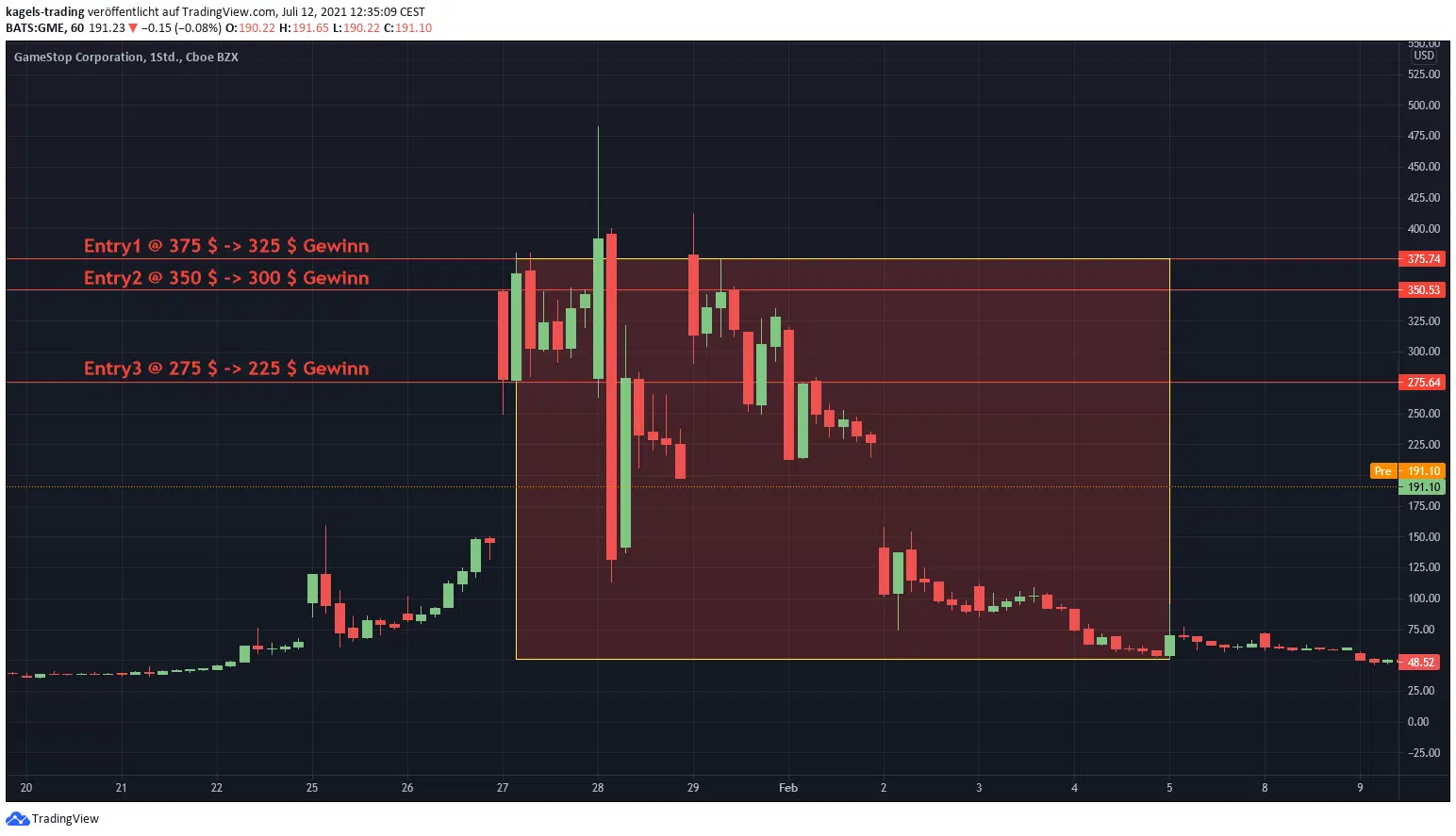
GameStop is the most famous squeeze of recent years, and the SEC looked at it closely. According to the SEC staff report of October 2021, short interest reached 122.97% of the float in January 2021. The intraday price rose about 2,700% from 8 to 28 January and then fell more than 86% by the end of the first week of February.
The report’s key finding surprises many readers. Short sellers who covered did contribute to sharp rises on certain days. But their buying was “a small fraction of overall buy volume”, the staff wrote, and it was the positive sentiment, not the buying-to-cover, that carried the rally for weeks. Retail traders on Reddit bought, partly to squeeze the short sellers, partly because they believed in the company.
GameStop is often called a gamma squeeze as well. For GameStop in January 2021, the SEC staff found no evidence of that either. How this second mechanism through market makers’ hedging works is explained in our article on gamma exposure. The story became the 2023 film Dumb Money.
 Click to enlarge
Source: Karsten Kagels on TradingView.
The chart shows what happened after the peak. It marks three possible short entries on the way down, at $375, $350 and $275, and the price reached about $48 by early February. Those entries came after the end of the squeeze, not from a prediction that it would come. Entering short before the top would have meant facing a price that rose without any visible limit.
What a squeeze means for short sellers and buyers
For short sellers, a squeeze is the risk that turns a correct analysis into a loss. A company can be overvalued and still rise further for weeks. That is why position size, a stop placed before the trade and a look at short interest and days to cover matter more on the short side than on the long side. A crowded short trade is a trade with many future buyers.
For buyers, a squeeze offers a chance and a trap at the same time. Investors who held the stock before the squeeze can make large profits. Traders who buy during the move often pay elevated prices, while earlier holders may already be taking profits. When the forced buying ends, the price can drop faster than any stop is filled.
Conclusion: a squeeze is a flow of orders, not a new valuation
A short squeeze shows how much a price depends on who has to trade, not only on who wants to. Short sellers who buy back create demand that has nothing to do with the company’s value. When they all have to buy at once and few sellers are left, the price can explode.
The same mechanics explain why squeezes rarely last. After the forced buying is done, the price has to stand on ordinary demand. In Volkswagen’s case it fell back within days, and in GameStop’s case the SEC found that sentiment mattered more than covering. Whoever watches short interest, days to cover and float understands the risk before the headlines do.
Frequently asked questions about short squeezes
What is a short squeeze?
A short squeeze is a fast price rise that forces short sellers to buy back the shares they sold. Their buying pushes the price higher and puts more short sellers under pressure. The move feeds itself until the forced buying is done.
What triggers a short squeeze?
Usually a rise in the price that the short sellers did not expect. It can start with good news, strong earnings or a large buyer. Once the price breaks through levels where many buy stops sit, the stops themselves add to the rise.
How can I spot a possible short squeeze?
Look at short interest, days to cover and the float together. A high short interest compared with the freely tradable shares, many days to cover and rising borrow fees show that many short sellers might have to buy at the same time. None of these numbers tells you when it will happen.
How long does a short squeeze last?
There is no fixed duration, and the two best known cases differ a lot. Volkswagen rose about fivefold in two trading days in October 2008. GameStop ran for about three weeks in January 2021, carried mostly by positive sentiment according to the SEC staff.
How much can short sellers lose in a squeeze?
In a real short sale the possible loss has no upper limit. A price can rise without a ceiling, and the short seller has to buy the shares back at whatever the market asks. Brokers may close the position through a margin call before the trader decides to, and gaps can skip any stop.
Can a short squeeze be prevented?
A squeeze does not by itself prove a rule violation, and no one can simply switch it off. Manipulation can nevertheless contribute to one, and regulators such as the SEC can investigate abusive conduct and restrict short selling, as they did for 19 financial firms in July 2008. Short sellers can limit their own risk by avoiding crowded shorts, keeping position size small or closing early; a stop helps but does not guarantee its price.
Risk note: This article explains how short squeezes work. It is not investment advice. Short selling can lead to losses larger than the money you put in.
This US edition is based on our German edition on kagels-trading.de and has been adapted for US readers.
More Trade Execution guides
- Choose the right order type
Order Types Explained: Market, Limit, Stop and Stop-Limit
Market, limit, stop, stop-limit and trailing stop orders for US stocks, what each one gives up, and who actually holds your stop.
- Link a target and a stop
OCO and Bracket Orders: Link a Target and a Stop
OCO, OTO and bracket orders, partial fills at Fidelity, Alpaca and Interactive Brokers, and why both sides can still fill.
- Set a stop loss
Stop-Loss Order: How to Set a Stop Loss on the Chart
Place the stop from the chart, size the trade from it, and know what a stop costs and what to check after a partial fill.
- Take profits at a target
Take-Profit Order: How to Set a Profit Target
Enter a profit target as a limit order, know why reaching it does not guarantee a fill, and take profits in steps without a wrong-sized stop.
- Go short on falling prices
Short Selling: How to Go Short and What It Really Costs
Five ways to go short, what borrow fees, margin, swaps and dividends cost, and the risks only short sellers face.
- Know what the spread costs you
Bid-Ask Spread Explained: Formula, Examples and Costs
Bid, ask and the spread in dollars, percent and pips, why it widens and how limit orders and timing keep the cost low.