
Bid vs Ask: Which Price You Pay and Which You Get


Contents
When you buy a stock, you almost never pay the price on the chart. The chart shows the last trade, which is the past. If you buy at once, you normally pay the ask, the lowest price a seller offers right now. If you sell at once, you normally get the bid, the highest price a buyer offers right now. I have traded since 1980, and beginners still trip over this difference every week.
This guide explains bid vs ask with real quotes from my own trading platform. You will see which price you pay, which you get, what the size next to each price tells you and why a quote can look much wider after the close. The maths of the spread itself has its own guide. This page is educational, not investment advice, and follows our editorial policy.
Bid vs ask in 30 seconds
- Bid: The highest price a buyer offers right now. If you sell at once, you normally get the bid or better.
- Ask: The lowest price a seller accepts right now, also called the offer. If you buy at once, you normally pay the ask or better.
- Why the ask is higher: Buyers want to pay little, sellers want a lot. The gap between them is the bid-ask spread.
- Last price: The price of the last completed trade. It can sit below the bid or above the ask, because the quotes have moved on.
- Size: Next to each price stands a quantity. A larger order may reach worse price levels, because the quote only covers that size.
What are the bid and the ask?
The bid is the highest price a buyer is willing to pay for a security at this moment.
The ask is the lowest price a seller is willing to accept for a security at this moment.
On an exchange, both prices come from the order book. All buy orders with a limit sit there sorted by price, and the highest one is the bid. All sell orders sit on the other side, and the lowest one is the ask. With a CFD or other over-the-counter product, the broker’s own pricing system sets the quote instead. The SEC’s investor site uses the same plain definition of bid and ask.
A trade usually happens when one side gives in. For immediate execution, a buyer normally accepts the ask, or a seller the bid, although some orders get a slightly better price. Until then, the two prices stand apart, and the gap between them is the cost of trading at once.
Bid vs ask: which price do you pay?
For immediate execution, you normally buy at the ask and sell at the bid. A market order asks for speed, not for a price. A buy normally takes the offers that are available, a sell the available bids. Quotes can change before your order arrives, and some orders get price improvement, as the SEC’s investor site explains in its guide to executing an order. As a rule of thumb, the buyer gets the higher price and the seller the lower one.
| Bid | Ask | |
|---|---|---|
| Side of the market | Buyers (demand) | Sellers (supply) |
| You normally get or pay it when you | sell at once | buy at once |
| Size column shows | quantity wanted | quantity offered |
| Other name | bid price | offer |
You do not have to accept either price. A limit order sets the worst price you accept. If your buy limit is below the ask, the order waits in the book and becomes part of the bid. If it is at or above the ask, it can fill at once. Either way, a limit order can stay partly or wholly unfilled. The order types guide explains this trade-off in detail.
Bid and ask in a real trading platform
Here is what bid and ask look like on a live screen. The capture comes from my Trader Workstation at Interactive Brokers on 12 November 2026, just over an hour after the US open. The platform runs in German, so the caption translates each column. Left of the bid stands the bid size, right of the ask the ask size. The table below the picture repeats the quotes in readable form.
 Click to enlarge
Source: Kagels Trading, own screenshot of Interactive Brokers TWS.
| Symbol | Bid size | Bid | Ask | Ask size | Last |
|---|---|---|---|---|---|
| QQQ | 40 | 685.25 | 685.30 | 200 | 685.21 |
| DIA | 400 | 524.19 | 524.24 | 190 | 523.90 |
| PLTR | 100 | 169.47 | 169.66 | 4 | 169.60 |
| ADP | 41 | 309.98 | 310.22 | 5 | 310.15 |
The size column has no fixed unit across platforms. Depending on the platform settings, it can show shares or round lots. What counts here is the comparison between the two sides.
The Nasdaq-100 ETF QQQ shows how tight a liquid market is. The bid stood at $685.25, the ask at $685.30. The spread of five cents is about 0.007% of the price. At those displayed quotes, a small immediate round trip would have cost only the five-cent spread, assuming both fills occurred at those prices.
Palantir (PLTR) shows why the size matters. The bid was $169.47, the ask $169.66, a spread of 19 cents or about 0.11%. More telling were the sizes: 100 on the bid side, only 4 on the ask side. A buy order larger than the quantity shown at the ask could have reached a higher price level.
Why the last price is not your price
On the Dow Jones ETF DIA, the last price was below the bid. The last trade printed at $523.90, while the bid already stood at $524.19. A seller at that moment could have received more than the last price suggested, at least for the quantity the bid covered. The chart lags behind the order book, in both directions.
That is why a fill can differ from the price you saw. If you look at the chart and send a market order, it normally executes against the available offers or bids, not at the last price. Check the quote line before you click, not the chart.
Bid size and ask size
The size next to a price is as important as the price. At ADP the bid side showed 41, the ask side only 5. The spread was 24 cents or about 0.08%, roughly eight times the percentage spread of DIA in the same minute.
A thin ask side means a large buy order may walk up the book. Part of it can fill at the ask and the rest at higher levels, unless new offers arrive. The average price is then worse than the ask you saw. This effect is called slippage, and a limit order caps the price you accept.
Bid and ask in forex
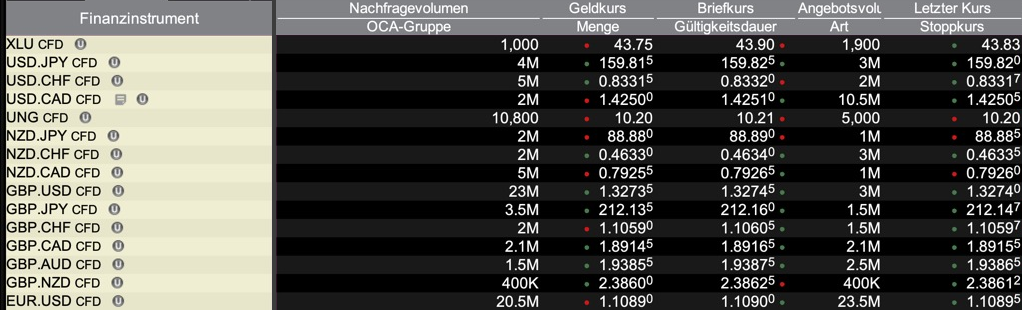
On the major currency pairs, the spread is tiny. My second capture shows currency pair CFDs on the evening of 11 November 2026. The EUR/USD CFD stood at 1.10890 bid and 1.10900 ask. The gap was one pip, which is one unit in the fourth decimal place, or about 0.009%.
 Click to enlarge
Source: Kagels Trading, own screenshot of Interactive Brokers TWS.
At a bank or an exchange bureau, the same logic applies from the bank’s side. The bank buys your foreign currency at its bid and sells it to you at its ask. For cash the gap is much wider than in the screen market, because notes cost money to handle and store.
The well-known reference rate is neither bid nor ask. The European Central Bank publishes its euro reference rates around 4:00 p.m. CET for information only. On 11 November 2026 the rate was 1.1127 dollars per euro. It is a reference rate, not an executable quote. Your bank or broker provides its own bid and ask.
A wide quote after the close
Away from the main session, the same screen can look very different. In my forex list stood a CFD on the US utilities ETF XLU, 43 minutes after the regular US close: bid $43.75, ask $43.90. That displayed spread of about 0.34% was nearly 40 times the EUR/USD CFD spread in the same minute.
One quote proves no general rule, but it shows what to check. When the underlying market is closed, a quote can be much wider than during the session. What drives the spread, how to turn it into a cost in dollars, percent and pips and how to keep it low is covered in the bid-ask spread guide, together with the US tick rules.
Conclusion: look at bid, ask and size before every order
The chart tells you about the past, the bid and the ask tell you about now. If you buy at once, you normally pay the ask, as far as the size at that price reaches. If you sell at once, you normally get the bid. The last price is only a reference.
One habit covers most of it. Before every order, look at the bid, the ask and the size next to them. If the gap is wide or the size is thin, use a limit order instead of a market order. That is what I do on my own screen every day.
Frequently asked questions about bid vs ask
Is the bid the buyer or the seller?
The bid belongs to the buyers. It is the highest price a buyer offers right now. As a seller who wants to trade at once, you normally receive the bid, subject to the available size and changing quotes.
Is the ask the same as the offer?
Yes, ask and offer mean the same price. Both name the lowest price a seller accepts right now. Forex and bond traders say offer more often, stock platforms usually say ask.
Why did I pay more than the last price?
Because a buy at once normally fills at the ask, not at the last price. The last price is a completed trade from a moment ago. If the ask has moved up since then, or your order was bigger than the size at the ask, your fill can be higher.
Which price does a chart show?
A stock chart usually plots completed trades, so it shows the last price. In spot forex there is no single last price. MetaTrader, for example, builds its forex charts from the bid.
Is the ECB reference rate a bid or an ask?
Neither, it is a reference rate published for information only. The ECB itself discourages its use for transactions. Your bank or broker quotes its own bid and ask.
This English edition is based on our German edition on kagels-trading.de and has been adapted for international readers.
More Trade Execution guides
- Choose the right order type
Order Types Explained: Market, Limit, Stop and Stop-Limit
Market, limit, stop, stop-limit and trailing stop orders for US stocks, what each one gives up, and who actually holds your stop.
- Link a target and a stop
OCO and Bracket Orders: Link a Target and a Stop
OCO, OTO and bracket orders, partial fills at Fidelity, Alpaca and Interactive Brokers, and why both sides can still fill.
- Set a stop loss
Stop-Loss Order: How to Set a Stop Loss on the Chart
Place the stop from the chart, size the trade from it, and know what a stop costs and what to check after a partial fill.
- Take profits at a target
Take-Profit Order: How to Set a Profit Target
Enter a profit target as a limit order, know why reaching it does not guarantee a fill, and take profits in steps without a wrong-sized stop.
- Go short on falling prices
Short Selling: How to Go Short and What It Really Costs
Five ways to go short, what borrow fees, margin, swaps and dividends cost, and the risks only short sellers face.
- Know what the spread costs you
Bid-Ask Spread Explained: Formula, Examples and Costs
Bid, ask and the spread in dollars, percent and pips, why it widens and how limit orders and timing keep the cost low.
- Understand a short squeeze
Short Squeeze: How It Works and Famous Examples
Why short sellers who buy back push the price higher, the warning signs in short interest data, and what Volkswagen 2008 and GameStop 2021 show.
- Keep slippage small
Slippage in Trading: What It Is and How to Reduce It
Why market and stop orders fill worse than expected in fast or thin markets, how to calculate slippage in dollars and how limit orders cap it.