
Coinbase Review 2026: Is It Safe? Fees and Licences


Contents
- Coinbase review in 30 seconds
- Is Coinbase right for you? A decision guide
- Pros and cons of Coinbase at a glance
- What is Coinbase?
- Is Coinbase safe? Regulation, custody and insurance
- Coinbase fees: what US and EU customers pay
- What can you trade on Coinbase?
- Alternatives to Coinbase
- Conclusion: is Coinbase worth it?
- Frequently asked questions about Coinbase
- Sources
- About the author
Coinbase is a regulated, US-listed crypto exchange, but regulation does not make your crypto risk-free. In the US, Coinbase, Inc. holds state money transmitter licences and a New York BitLicense; in the EU, Coinbase Luxembourg S.A. holds a licence under MiCA, the EU crypto law. The parent company files annual and quarterly reports with the SEC, and those filings say plainly what can go wrong.
This review answers the question most people ask first: is Coinbase safe? We read Coinbase’s SEC filings, its help center and the registers and notices of the regulators, and we explain custody, insurance, the 2025 data theft and the fines. Then we check the fees, separately for US and EU customers, because they are not the same. This review follows our editorial policy.
Coinbase review in 30 seconds
- Regulation: US customers deal with Coinbase, Inc. (state licences, New York BitLicense); EU customers with Coinbase Luxembourg S.A., licensed by Luxembourg’s CSSF on June 20, 2025.
- Custody: Coinbase says it holds customer crypto 1:1 and aims to keep no more than 2 percent of it in hot wallets, which are connected to the internet.
- Insurance: its crime insurance covers only a portion of the crypto it holds, and not losses from your own stolen password. Crypto has no FDIC or SIPC protection.
- Incidents: in May 2025, bribed support staff stole data of less than 1 percent of monthly users; Coinbase paid $311.2 million in 2025 for reimbursements and legal costs.
- Fees: no fixed public rate for simple trades; the fee shows in the trade preview. In five US states, Coinbase discloses a cap of $10 under $200 and 6 percent from $200.
- Who it suits: beginners who want a large, regulated provider and accept higher costs. Frequent traders look at Coinbase Advanced or a cheaper exchange.
Is Coinbase right for you? A decision guide
What do you want to know first?
- Whether my crypto is safe at CoinbaseSafety, custody and insurance
- What happened in the 2025 data theft and the finesPast incidents
- What a buy costs meFees for US and EU customers
- Whether the subscription saves moneyCoinbase One prices
- Compare Coinbase with other EU exchangesOur exchange comparison
A starting point, not a ranking. Check the fee in the trade preview before every order.
Pros and cons of Coinbase at a glance
These are the points that matter before you open an account; the sections below explain each one. The overview is based on Coinbase’s own help pages, its SEC filings and the notices of regulators, checked on October 8, 2026.
Pros
- Licensed on both sides of the Atlantic: state licences and a BitLicense in the US, a MiCA licence in the EU.
- Public company: Coinbase Global files audited annual reports with the SEC.
- Mostly cold storage: the target is no more than 2 percent of custodied crypto in hot wallets.
- Free euro transfers in the EU: SEPA transfers “have no fees”, according to Coinbase.
- A disclosed fee cap in five US states: at most 6 percent, or $10 on trades under $200.
Cons
- No fixed public fee: you see the price of a simple trade only in the trade preview.
- Spread on top: simple trades include a spread in the price.
- Limited insurance: it covers only part of the crypto Coinbase holds, and not stolen logins.
- A record of incidents: the 2025 data theft, a $50 million NYDFS penalty in 2023 and a £3.5 million FCA fine in 2024.
- Bankruptcy risk not fully tested: Coinbase itself writes that courts have not yet ruled on custodied crypto in such a case.
What is Coinbase?
Coinbase is a US crypto exchange founded in 2012 by Brian Armstrong and Fred Ehrsam. Its parent company, Coinbase Global, Inc., has traded on the Nasdaq under the ticker COIN since April 14, 2021, and joined the S&P 500 on May 19, 2025. According to its quarterly report, it had 7.6 million monthly transacting users in the second quarter of 2026 and held crypto worth $245.9 billion for customers on June 30, 2026.
| US company | Coinbase, Inc. |
| EU company for crypto | Coinbase Luxembourg S.A. |
| EU company for e-money | Coinbase Ireland Limited |
| US licences | state money transmitter licences, New York BitLicense |
| EU licence | MiCA licence from the CSSF, June 20, 2025 |
| US derivatives | Coinbase Derivatives, LLC, registered with the CFTC |
| EU derivatives | Coinbase Financial Services Europe Ltd, CySEC licence |
| US cash | may qualify for FDIC or NCUSIF pass-through cover if held as cash at a bank, up to $250,000 |
| EU cash | e-money from Coinbase Ireland, separate custodial accounts, no deposit insurance named |
| Crypto | no FDIC, SIPC or deposit guarantee anywhere |
Sources: Coinbase Global 10-K for 2025, 10-Q for the second quarter of 2026, Coinbase licences pages for the US and Europe, Coinbase legal notice and help center, CSSF and CySEC registers, checked October 8, 2026.
Coinbase has three ways to trade, and that explains many questions about fees. Simple trades in the app and on the website include a spread and a Coinbase fee. Coinbase Advanced has an order book with maker and taker fees. The Coinbase Wallet app is a separate self-custody product: there, you hold the keys, not Coinbase.
Is Coinbase safe? Regulation, custody and insurance
With an exchange, safety means four things: who supervises it, how it stores your crypto, what happens if it fails, and how you protect your account. This section takes them in that order, first for the US, then for the EU. Everything here comes from Coinbase’s own disclosures, its SEC filings or the regulators.
Is Coinbase regulated in the US?
Yes: Coinbase, Inc. lists state money transmitter licences on its licences page, and the 10-K says it holds them where they are required. On the English page we counted 47 entries on October 8, 2026: 45 states plus the District of Columbia and Puerto Rico. A state missing from the table does not by itself mean that Coinbase is unlicensed or unavailable there. In New York, the Department of Financial Services (NYDFS) granted it a virtual currency licence, known as the BitLicense, and a money transmitter licence in 2017. The 10-K for 2025 adds a Virtual Currency Business License from Louisiana.
Two more US companies of the group are supervised separately. Coinbase Custody Trust Company, LLC is a limited purpose trust company chartered by the NYDFS; the 10-K calls it a fiduciary under New York law and a qualified custodian under the Investment Advisers Act. Coinbase Derivatives, LLC is registered with the CFTC as a designated contract market, a regulated futures exchange.
Being a public company adds another layer of disclosure. Coinbase Global publishes audited annual reports and quarterly reports with the SEC. These reports list risks in detail, and this review quotes several of them, because they are the most reliable source on what Coinbase promises and what it does not.
Is Coinbase regulated in the EU and the UK?
For crypto, EU customers deal with Coinbase Luxembourg S.A., a crypto-asset service provider authorised by the CSSF on June 20, 2025. The CSSF register lists custody, exchange of crypto for money and for other crypto, order execution, reception and transmission of orders, and transfer services. A MiCA licence lets a provider serve the whole EU, and ESMA’s register lists 30 countries for it. Coinbase moved the EU countries to the Luxembourg company in phases between August and October 2025.
Your euro balance is handled by a different company. According to Coinbase’s help page on the MiCA change, e-money services are still provided by Coinbase Ireland Limited, which the Central Bank of Ireland authorises as an electronic money institution. Coinbase’s legal notice also describes the Luxembourg company as an e-money institution for e-money token services; the CSSF entry we checked shows only its MiCA authorisation.
Futures and perpetual contracts in the EU run through a different company. Coinbase Financial Services Europe Ltd in Cyprus holds licence 374/19 from the Cyprus Securities and Exchange Commission (CySEC), granted on April 15, 2019. If you trade with leverage, you contract with this company, not with the Luxembourg one.
UK customers deal with CB Payments Ltd. The FCA register lists it as an authorised electronic money institution (firm reference number 900635) and, since February 3, 2025, as a registered cryptoasset firm under the money laundering rules. That registration is for anti-money-laundering supervision; it is not the same as a full authorisation of its crypto services.
How does Coinbase store your crypto?
Coinbase keeps most customer crypto in cold storage, offline. In its 10-K for 2025, Coinbase writes that it “generally” seeks to hold no more than 2 percent of assets under custody in hot wallets at any given time. The key material for the cold wallets is stored in facilities in the US and abroad, and Coinbase says it does not use third-party sub-custodians.
Coinbase also says it does not lend out your crypto. Its help center states that your assets “never belong to Coinbase”, that it holds customer assets 1:1 and does not lend or use them without your instruction. For signing keys, it uses multiparty computation (MPC), a method in which no single machine ever holds a complete key.
What happens to your crypto if Coinbase goes bankrupt?
Coinbase believes custodied crypto would stay outside its estate, but it says courts have not yet tested this. In its 10-K, Coinbase warns that in a bankruptcy, customer crypto “could be subject to bankruptcy proceedings” and customers “could be treated as our general unsecured creditors”. It relies on Article 8 of the Uniform Commercial Code, under which financial assets it holds are not its property, and it changed its US user agreement in June 2022 to that effect.
For EU customers, the 10-K describes segregated custody. It says the EU company stores client assets in dedicated, segregated custody vaults with separate books and records. MiCA also requires a provider that holds client crypto to keep it legally separate from its own estate, so that its creditors have no recourse to it (Article 75). Neither rule is a guarantee against loss, and there is no deposit insurance for crypto in the EU.
Is Coinbase insured?
 Click to enlarge
Source: Coinbase Help.
Coinbase has crime insurance, but it does not cover all customer crypto and never your own lost password. Its help page says the policy protects a portion of the digital assets it holds against theft, including cyber attacks. It does not cover losses from unauthorized access to your account after a breach or loss of your login details, and “total losses may exceed insurance recoveries”.
The 10-K is even clearer about the size of the gap. Customer assets on the platform are “substantially more” than Coinbase’s corporate assets and available insurance, and the crime policy runs for one year without automatic renewal. So the insurance is a cushion against a hack of Coinbase, not a promise to replace every coin.
Crypto at Coinbase has no FDIC or SIPC protection, in the US or anywhere else. SIPC covers only stocks and cash held through Coinbase Capital Markets in the US. A separate, conditional benefit for paying subscribers can reimburse some account takeovers in a few countries; it is a limited warranty, not insurance, and you find it under Coinbase One below.
Are your US dollars and euros protected?
US dollars of US customers can be covered by pass-through FDIC insurance, but only when they are held as cash at a bank. Coinbase pools them and holds them in investments allowed under state money transmission laws: custodial accounts at banks and credit unions, US Treasuries or money market funds. For the share held at FDIC-insured banks or NCUSIF-insured credit unions, pass-through insurance up to $250,000 per customer may apply if a bank fails, depending on correct records and on the regulator’s decision.
For customers outside the US, Coinbase holds cash in dedicated custodial accounts separate from its own money. In the EU, the euro balance is e-money issued by Coinbase Ireland Limited, not a bank deposit, and the FDIC protection applies only to US customers of Coinbase, Inc. For all customers, Coinbase says it does not use customer funds for its operating expenses. On December 31, 2025, the 10-K showed $5.35 billion in customer custodial funds worldwide.
Past incidents: the 2025 data theft, fines and the SEC case
In May 2025, criminals bribed support contractors and employees outside the US to steal customer data. According to Coinbase’s Form 8-K of May 15, 2025, they collected names, addresses, phone numbers, emails, the last four digits of Social Security numbers, masked bank details, ID images and account balances. Coinbase says this affected data of less than 1 percent of monthly transacting users; passwords, private keys and customer funds were not accessed.
The attackers then posed as Coinbase to trick customers into sending them crypto. Coinbase refused a $20 million ransom and set up a $20 million reward fund. It promised voluntary reimbursement, after review, to retail customers who were tricked into sending funds to the scammers as a direct result of this incident before May 15, 2025. In its 10-K, it reports $311.2 million paid in 2025 for voluntary customer reimbursements and direct legal costs.
Regulators have fined Coinbase companies twice in recent years. In January 2023, the NYDFS imposed a $50 million penalty on Coinbase, Inc. and required another $50 million of compliance spending, after finding serious gaps in its anti-money laundering controls, including a backlog of over 100,000 unreviewed alerts. In July 2024, the FCA fined CB Payments Ltd £3,503,546 for repeatedly offering services to high-risk customers despite a restriction.
The SEC sued Coinbase in June 2023 and dropped the case in February 2025. The SEC had accused Coinbase of operating as an unregistered exchange, broker and clearing agency. On February 27, 2025, it filed to dismiss the case and said the decision did not rest on an assessment of the merits.
How do you protect your Coinbase account?
Account takeovers and impersonation scams are risks Coinbase warns its customers about, and its crime insurance excludes stolen logins. Coinbase turns on two-factor authentication by default and supports hardware security keys; use one if you can. Turn on withdrawal allow-listing, so crypto can only go to addresses you have approved.
Coinbase will never ask for your password, your 2FA codes or a transfer to a “safe” wallet. That is its own warning after the 2025 incident. If someone calls you and claims to be from Coinbase, hang up and lock the account in the app; Coinbase gives security@coinbase.com as the address for such cases.
Coinbase fees: what US and EU customers pay
Coinbase does not publish a fixed fee rate for simple trades. Its help center says the fee depends on payment method, order size, market conditions, location and asset, and is shown on the trade preview screen before you confirm. The price also contains a spread, and Coinbase “may retain any excess spread”. Coinbase states that the fees on that global page do not apply in all regions, so we mark below which rates come from it.
The fee cap Coinbase discloses in five US states
 Click to enlarge
Source: Coinbase licences and disclosures.
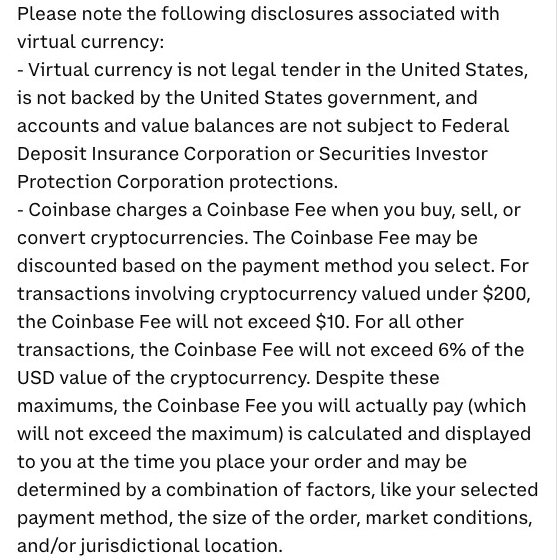
In the consumer disclosures for California, Minnesota, North Dakota, Rhode Island and Washington, Coinbase, Inc. states a maximum fee. On its licences page, Coinbase writes that the Coinbase fee will not exceed $10 for crypto trades under $200, and 6 percent of the US dollar value for all other trades, so from $200 upward. The actual fee is calculated for each order and can be lower. We found the same cap only in these five state disclosures, not as a nationwide rule.
For other US states and for EU customers, we found no published maximum. The fee is shown in the trade preview in the same way. So on both sides, the only reliable number for a simple trade is the one on your own screen before you confirm.
Limit orders: 1 percent on top
According to Coinbase’s global fee page, a simple limit order costs an extra execution fee of 1 percent of the amount, on every limit buy and every limit sell. The same page adds that Coinbase “may also charge” a 1.875 percent Coinbase fee, depending on the payment method. Because Coinbase says the page does not apply in all regions, check both in the fee breakdown of the order preview. Coinbase One does not remove the 1 percent limit order fee.
Coinbase Advanced: no spread, tiered fees
On Coinbase Advanced, there is no spread, because you trade directly in the order book. You pay a maker fee when your order rests in the book and a taker fee when it fills at once. The tier depends on your 30-day volume or your USDC balance. Coinbase shows the tiers only after you sign in, so we cannot quote them here.
Coinbase One: the subscription in the US and the EU
Coinbase One replaces the trading fee on simple trades with a monthly subscription, up to a volume limit. The spread stays, and the benefit does not apply to Coinbase Advanced, DEX fees, derivatives or the 1 percent limit order fee. Prices differ by region: the dollar prices are those of Coinbase, Inc., the euro prices those displayed in Germany.
| Tier | US | Germany (euros) |
|---|---|---|
| Basic | $4.99 a month or $49.99 a year; no trading fee up to $500 a month | 4.99 euros a month or 49.99 euros a year; up to 500 euros a month |
| Preferred | $29.99 a month or $299.99 a year; up to $10,000 a month | 24.99 euros a month or 239.99 euros a year; up to 10,000 euros a month |
| Premium | $299.99 a month or $2,999.99 a year; unlimited | 249.99 euros a month, no annual plan; unlimited |
Sources: Coinbase One page as displayed in Germany on October 8, 2026; US page in the Internet Archive copy of September 22, 2026, because coinbase.com redirects to the German page from here; Coinbase One help article.
Preferred and Premium also give money back on Coinbase Advanced. Members get 25 percent of their Advanced spot fees back in USDC, up to 100 USDC a month in Preferred and without a cap in Premium. In the US, Preferred and Premium also waive Coinbase’s fees for domestic wires.
In the US, Coinbase One includes account protection, a limited warranty against account takeovers, not insurance. The cover is up to $1,000 in Basic, $10,000 in Preferred and $250,000 in Premium per incident; the help article names the US, France and Singapore. You must be enrolled, protect the account with a passkey or security key, file the claim within 45 days with a police report, and transfers you authorised yourself after being deceived are not covered.
Whether the subscription pays off depends on a rate Coinbase does not publish. As long as you do not know your usual fee per trade, you can only compare the subscription price with the fees in your own trade previews. If you buy less than once a month, the subscription is unlikely to help.
Deposits and withdrawals
Cash transfers cost different amounts on each side of the Atlantic. The table lists the routes and the fees Coinbase states in its help center for US and EU customers; where Coinbase names no fee, the trade preview shows it.
| US | EU | |
|---|---|---|
| Bank transfer | ACH: buy, add cash, cash out; 1 to 5 business days | SEPA: buy, sell, add cash, cash out; “no fees”, euros only |
| Wire | add cash, cash out; $10 in, $25 out | not listed for the EU |
| Card | debit card: buy, add cash, cash out | 3D Secure card: buy, cash out; add cash only in NL, IT, ES |
| Other | PayPal: buy, add cash, cash out; Apple Pay, Google Pay, Samsung Pay: buy only | PayPal: buy, cash out; Easy Bank Transfer: add cash in NL, FI, FR, DE, IE; iDEAL; Apple Pay; Google Pay; BLIK in Poland |
Source: Coinbase help center, payment methods for North America and EMEA, checked October 8, 2026. UK customers have their own list there, including Faster Payments.
The name on your bank account must match the name on your Coinbase account. If it does not, Coinbase reviews the payment method by hand, which takes one to three business days. In the EU, Coinbase also rejects deposits from business accounts, shared accounts and pooled accounts such as Wise. If your bank rejects a withdrawal, the refunded amount can be lower because of bank fees.
Other fees: staking, sending and card
Holding crypto and cash at Coinbase is free, but several services carry their own charges. According to its global fee page, Coinbase keeps a standard commission of 35 percent of staking rewards on coins such as ETH and SOL, less for Coinbase One members, and charges 0.2 percent for bitcoin sent over the Lightning Network. When you send crypto off the platform, you pay a network fee. Coinbase says it has no payment for order flow arrangements with market makers.
What can you trade on Coinbase?
The core is buying, selling and converting crypto, with Coinbase Advanced for active traders. On its Coinbase One page, Coinbase speaks of hundreds of cryptocurrencies. Simple trades are filled through the order book or auctions of Coinbase Exchange, the group’s own trading venue, according to its fee disclosures.
Derivatives depend on where you live. In the EU, futures and perpetual contracts run through the Cyprus company, and leverage can lose you money fast. In the US, the group operates its own futures exchange, Coinbase Derivatives, LLC. If you are new to crypto, start with a simple spot purchase; current chart levels for the largest coin are in our Bitcoin forecast.
Alternatives to Coinbase
If fees matter most to you, compare Coinbase with exchanges that publish their rates. Our comparison of crypto exchanges in Europe shows the published charges on a 1,000 euro bitcoin buy at Bitvavo, Bitpanda, Kraken, Coinbase and Bitstamp, all with a MiCA licence.
If you want a public fee table before you sign up, look at Kraken. Our Kraken review covers Kraken Pro, its licences in the US and the EU, and a short comparison with Coinbase; note that Kraken does not serve residents of New York.
If you want crypto and stocks in one EU app, look at Bitpanda. Our Bitpanda review covers its MiCA licences, the fixed fee per coin and Bitpanda Fusion for active traders.
Conclusion: is Coinbase worth it?
Coinbase is one of the most transparent crypto companies about its risks, and one of the least transparent about the price of a simple trade. Its licences, its SEC filings and the mostly offline storage speak for it. Against it stand the missing fixed fee, a spread you have to look up in the preview tooltip, and a record of incidents that its own reports describe in detail.
My assessment after almost five decades of trading: Coinbase is a reasonable place to start, but not a place to stop checking. Read the trade preview before every order, turn on a security key, and keep in mind that the insurance does not cover a stolen login. A fee you only see at checkout should be recalculated, not trusted.
Frequently asked questions about Coinbase
Is Coinbase safe?
Coinbase is licensed in the US and the EU and keeps most customer crypto offline, but your crypto is not insured like a bank deposit. It aims to hold no more than 2 percent of custodied crypto in hot wallets, and its crime insurance covers only part of it. The crime insurance does not cover losses from your own stolen login, so protect your account with a security key.
How much are Coinbase fees?
Coinbase publishes no fixed rate for simple trades; the fee appears in the trade preview. In the disclosures for five US states, Coinbase, Inc. caps its fee at $10 for trades under $200 and 6 percent from $200. Its global fee page lists an extra 1 percent for simple limit orders, and a spread is included in the price.
Is my money at Coinbase FDIC insured?
Only US dollars of US customers, and only the part held as cash at a bank, can be covered by pass-through FDIC insurance up to $250,000. It protects against the failure of the holding bank, not of Coinbase, and depends on the pass-through requirements. Crypto is never covered by the FDIC or SIPC; in the EU, your euro balance is e-money from Coinbase Ireland.
What happens if Coinbase goes bankrupt?
Coinbase believes customer crypto would not be part of its estate, but it warns that courts have not yet decided such a case. In the worst case, its 10-K says customers could be treated as unsecured creditors. In the EU, the company keeps client assets in segregated custody.
Has Coinbase been hacked?
Coinbase’s wallets were not breached in the May 2025 incident, but customer data was stolen through bribed support staff. Criminals used the data to trick customers into sending them crypto. Coinbase promised voluntary reimbursement to retail customers tricked as a direct result, after review, and paid $311.2 million in 2025 for reimbursements and legal costs, according to its 10-K.
Is Coinbase regulated in Europe?
Yes, Coinbase Luxembourg S.A. holds a MiCA licence from Luxembourg’s CSSF, granted on June 20, 2025. It lets Coinbase serve customers across the EU. Derivatives run through a separate company in Cyprus with a CySEC licence.
How much does Coinbase One cost?
Coinbase One starts at $4.99 a month in the US and 4.99 euros a month in the EU. The Basic tier removes the trading fee on simple trades up to $500 or 500 euros a month. Preferred costs $29.99 or 24.99 euros, and Premium costs $299.99 or 249.99 euros a month; euro prices as displayed in Germany.
Sources
Every figure in this review comes from these pages, checked on October 8, 2026, unless a date is given. Fees and products change, so check the current version and the trade preview before you buy.
- SEC filings of Coinbase Global, Inc.: 10-K for 2025, 10-Q for the second quarter of 2026, 8-K of May 15, 2025, prospectus of April 2021.
- Regulators: SEC press release of June 6, 2023, SEC press release of February 27, 2025, NYDFS settlement of January 4, 2023, NYDFS virtual currency businesses, FCA fine of July 25, 2024, FCA register, CSSF register, CySEC register, ESMA interim MiCA register, S&P Dow Jones Indices, May 12, 2025.
- Coinbase pages: pricing and fees, Advanced fees, US licences and disclosures, European licences, MiCA change in the EU, account protection, account protection terms, insurance overview, what Coinbase does with your assets, security, statement on the 2025 incident, legal notice (EU), Coinbase One (Germany), Coinbase One (US, archived September 22, 2026), Coinbase One help, payment methods, North America, funding, North America, payment methods, EMEA, funding, EMEA.
This review was written by Karsten Kagels. It is based on Coinbase’s own pages, the SEC filings of Coinbase Global and the registers and notices of the SEC, NYDFS, FCA, CSSF, CySEC and ESMA, checked on October 8, 2026. We did not open an account for this English edition. Crypto-assets can lose value sharply, and leverage can cost more than you invest. This is not investment advice.
This English edition is based on our German edition on kagels-trading.de and has been adapted for international readers.
More Crypto guides
- Choose an exchange
Crypto Exchanges in Europe: 5 MiCA Platforms Compared
Bitvavo, Bitpanda, Kraken, Coinbase and Bitstamp: licence, fees and the published charges on a 1,000 euro bitcoin buy.
- Check one provider in depth
Bitpanda Review 2026: Fees, MiCA Licences and Who It Suits
Bitpanda: two MiCA licences, the 2026 FMA fine, fees per coin, Fusion, margin costs and who can open an account.
- Check one provider in depth
Kraken Review 2026: Fees and Safety in the US and EU
Kraken for US and EU customers: which company you deal with, Kraken Pro fees from 0.40 percent, the app fee, licences and the SEC history.