
Alpaca Trading Review 2026: API Broker Tested


Contents
- Alpaca in 30 seconds
- What is Alpaca?
- What you can trade at Alpaca
- Alpaca fees and costs
- Market data: free IEX feed or $99 a month
- Alpaca for coders: the API and the AI connector
- Our paper-trading test: three simulated orders
- Is Alpaca safe? Regulation, protection and fines
- Opening an account: US and international traders
- Pros and cons of Alpaca
- Alpaca rating
- Conclusion: who should use Alpaca?
- Frequently asked questions about Alpaca
- About the author
Alpaca is a US online broker built for traders who write code. You can trade US stocks, ETFs, options and crypto through a web dashboard, but the real product is the API: a programming interface through which your own script, a trading bot or an AI assistant receives prices and sends orders. We could not find a current full-featured mobile app, and there is no phone support.
We tested Alpaca with three orders in its paper-trading account on October 21, 2026. Paper trading means simulated orders with virtual money. We placed a crypto order, a limit order we cancelled and a stock order through the API and Alpaca’s official AI connector. We did not fund a live account, so live execution, deposits, withdrawals and support response times are not part of our test. Every fee, limit and rule below was checked against Alpaca’s own fee schedule, its documentation and FINRA’s BrokerCheck on the same day. This article follows our editorial policy.
Risk warning: trading involves risk, and you can lose money. This review is not investment advice.
What do you want to do?
- Run my own trading bot or Python script on US stocksAlpaca
- Let an AI assistant read my account and place ordersAlpaca with MCP
- Test a strategy with fake money and real pricesAlpaca paper account
- Trade futures, forex or markets outside the USAnother broker
- Trade by hand in a mobile app with phone supportAnother broker
- Not sure yetStart with the paper account, it costs nothing
Click a line to jump to the section that explains it.
Alpaca in 30 seconds
- Who it is for: traders who want to automate a strategy in Python or another language, or connect an AI assistant to a broker.
- Costs: $0 commission on US stocks, ETFs and equity options for normal retail orders. Crypto costs 0.15 to 0.25 percent per trade at the start.
- Market data: free with the IEX feed only. Prices from all US exchanges cost $99 a month.
- Practice first: a free paper account with $100,000 in virtual money, open to anyone with an email address.
- Watch out for: two regulatory fines (2024 and 2026), crypto without SIPC protection, and support by form and email only.
- Our rating: 7.3 out of 10. Strong for coders, weak for everyone who wants a classic trading app.
What is Alpaca?
Alpaca Securities LLC is a US broker-dealer that has been registered with the SEC and FINRA since 2018. It clears its trades itself, so your securities are held by Alpaca and not by a third-party bank. The parent company AlpacaDB started in 2015 as a database and machine-learning firm. In January 2026 Alpaca raised $150 million at a valuation of $1.15 billion, according to its own press release.
Crypto runs through a separate company, Alpaca Crypto LLC. It is registered with FinCEN as a money services business and holds money transmitter licences in about 20 US states. It is not a member of FINRA or SIPC, which matters for the protection of your coins (see safety).
Alpaca also sells its brokerage infrastructure to other companies. Through its Broker API, apps and fintechs around the world open accounts on Alpaca’s infrastructure. Alpaca says its partners have opened more than 7 million accounts in over 40 countries. This review is about the self-directed Trading API account for individuals.
What you can trade at Alpaca
| Market | What Alpaca offers |
|---|---|
| US stocks and ETFs | US-listed stocks and ETFs, fractional shares from $1 in over 2,000 names |
| Trading hours | Pre-market, regular, after-hours and overnight (24 hours, 5 days a week) |
| Options | US equity options, levels 1 to 3, multi-leg orders such as spreads |
| Crypto | 20+ coins in 56 pairs, 24/7, no margin, no short selling |
| Margin | Up to 2x overnight, up to 4x intraday from $2,000 equity |
| Short selling | 5,000+ easy-to-borrow stocks without borrow fee |
| Not offered | Futures, forex, CFDs, stocks outside the US |
Alpaca is a US-only stock and crypto broker. If you trade futures on the S&P 500, forex pairs or stocks in Frankfurt or London, you need another broker such as Interactive Brokers. In return, the US offer is broad: overnight trading runs through the Blue Ocean trading venue from 8:00 PM to 4:00 AM Eastern Time, with limit orders only.
Since June 4, 2026 the pattern day trader rule no longer applies at Alpaca. FINRA replaced the old rule, with its $25,000 minimum and the count of four day trades in five days, with a new intraday margin standard (FINRA Regulatory Notice 26-10). Alpaca switched on the first day: 4x intraday buying power now starts at $2,000 equity. Brokers that need to change their systems have until October 20, 2027, the end of FINRA’s transition period.
Alpaca fees and costs
Trading US stocks, ETFs and equity options costs no commission for normal retail orders. Commissions apply to index options, to the optional Elite Smart Router and to traders Alpaca classifies as professional or non-retail. Small regulatory fees apply on top. The table lists what an active trader actually pays, from Alpaca’s brokerage fee schedule revised on October 12, 2026.
| Item | Cost |
|---|---|
| US stocks and ETFs | $0 commission |
| Equity options | $0 commission, plus $0.015 ORF and $0.025 OCC fee per contract, on buys and sells |
| Index options (SPX, VIX and others) | $0.50 per contract plus exchange fees |
| SEC fee on sales | $0.0000206 times the trade value |
| FINRA CAT fee | $0.000003 per share, on buys and sells (100 shares per option contract) |
| Crypto, under $100,000 monthly volume | 0.15% maker, 0.25% taker |
| Margin interest | 6.50% a year (5.00% for Elite 100k accounts) |
| Deposits by ACH | free |
| Wire out | $15 in the US, $35 international |
| Account transfer out (ACATS) | $25 |
| Market data, all US exchanges | $99 a month (optional) |
| Inactivity fee | none |
Alpaca earns money from payment for order flow. Your market orders in US stocks go to large trading firms, in the second quarter of 2026 Citadel Securities, Jane Street, Virtu and GTS, according to Alpaca’s Rule 606 report. They pay Alpaca up to 12 percent of the spread, capped at 5 cents per share. This is legal and common at commission-free brokers, but it means the broker earns more when you trade more. Active traders with $30,000 or more can switch to the Elite Smart Router, which charges a small commission per share instead.
The crypto fee is taken from the coins you buy, not in dollars. If you buy Bitcoin, you receive slightly less Bitcoin; if you sell, you receive slightly fewer dollars. Our test below shows this to the decimal. According to Alpaca’s crypto fee table, fees fall with monthly volume, to 0.10 percent taker above $100 million. Each regulatory fee type is totalled separately for your account each day, then rounded up to the next cent.
One note on margin interest: Alpaca has two versions of its fee schedule online. The version linked from its disclosures page, revised October 12, 2026, shows 6.50 percent. An older copy under another web address still shows 6.25 percent. We use the newer one. Check the current rate before you borrow money.
Market data: free IEX feed or $99 a month
The free plan shows US stock prices from one exchange only, IEX. IEX handles a small share of US trading, so its volume covers only the trades on that one exchange, not the whole US market, and its prices can differ from the best price across all exchanges for a moment. In our test, the free feed showed about 1.24 million SPY shares for October 20, 2026; that is IEX volume, not the consolidated volume of all exchanges. The market data plans compare as follows.
| Basic (free) | Algo Trader Plus ($99 a month) | |
|---|---|---|
| US stock prices | IEX only | All US exchanges (SIP) |
| History | since 2016, not the last 15 minutes | since 2016, no delay |
| Data requests per minute | 200 | 10,000 |
| Live symbols at once | 30 | unlimited |
| Options prices | indicative only | OPRA, the official options feed |
| Crypto prices | included | included |
The free plan is enough to learn the API and test your code, but not always to validate a strategy. IEX-only bars can show different highs, lows and volume than the consolidated market, which changes signals and volume filters. Before you trust a backtest, check which data feed it used and test on the same data your live strategy will see. A paper-only account always gets IEX data, even if you pay.
Alpaca for coders: the API and the AI connector
The Trading API is the heart of Alpaca. It is a REST interface with live streaming, and official libraries exist for Python (alpaca-py), JavaScript, Go and C#. A few lines of code are enough to check your account, pull price bars or send a bracket order with stop-loss and take-profit. If you are new to the idea, our guide to algo trading explains the steps from rule to order.
Alpaca also publishes an official MCP server, a connector for AI assistants. MCP stands for Model Context Protocol, a standard that lets assistants such as Claude, Cursor or Gemini use outside tools. Version 2.4.0 of the Alpaca MCP server offers 65 tools: account, orders, positions, watchlists, stock and options data, news and more. We ran our whole test through it. By default it trades only in the paper account, which is the right choice: an AI that can place real orders needs limits you set yourself.
- YouYour rule or promptA script, a bot or an AI assistant decides to buy or sell.
- AlpacaAPIChecks buying power and limits, then accepts the order.
- Market maker or exchangeTrading venueMarket orders mostly go to firms such as Citadel Securities; overnight orders to Blue Ocean.
- AlpacaAccountHolds your shares (SIPC) and, through Alpaca Crypto, your coins (no SIPC).
A dark line marks each hand-over. In the paper account Alpaca simulates the fill, and no order reaches the market.
You can also trade Alpaca from TradingView charts. The integration covers stocks, ETFs, options and crypto, for live and paper accounts, without an extra fee. Our guide to brokers connected to TradingView compares Alpaca with the other choices.
The weak spot is the web dashboard for traders who click instead of code. It shows TradingView charts and has an order ticket. We could not verify a current full-featured mobile app on October 21, 2026; Alpaca staff point users to the mobile website instead. Support works through a web form, email, a forum and a Slack community, without phone or live chat. We did not test how fast support answers.
Our paper-trading test: three simulated orders
We placed three orders in a fresh paper account on October 21, 2026, through the API and Alpaca’s AI connector. The account started with the standard $100,000 in virtual cash, 4x margin and options level 3. The US stock market was still closed, so the test shows how Alpaca handles orders outside market hours, and crypto, which trades around the clock.
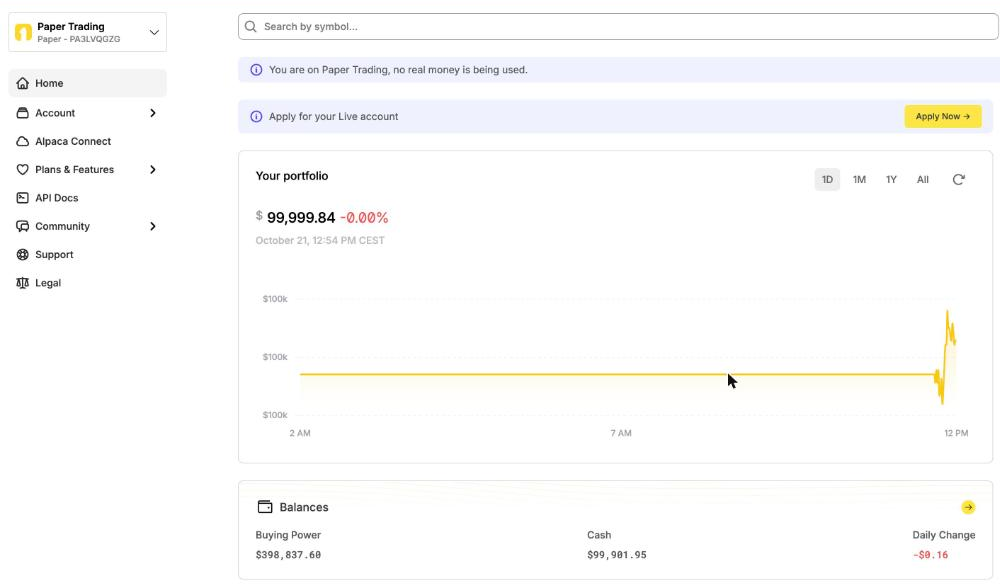 Click to enlarge
Source: Screenshot of the Alpaca dashboard by Kagels Trading.
| Order | What happened |
|---|---|
| Buy $100 of Bitcoin at market, 12:32 CEST | Simulated fill in about 2 milliseconds, in three parts, average price $83,254.16 |
| Buy 1 Apple share, limit $100, good till cancelled | Accepted while the market was closed, cancelled seconds later without problems |
| Buy 1 SPY share at market, day order | Queued while the market was closed, simulated fill at $769.94 at 9:32 AM Eastern Time |
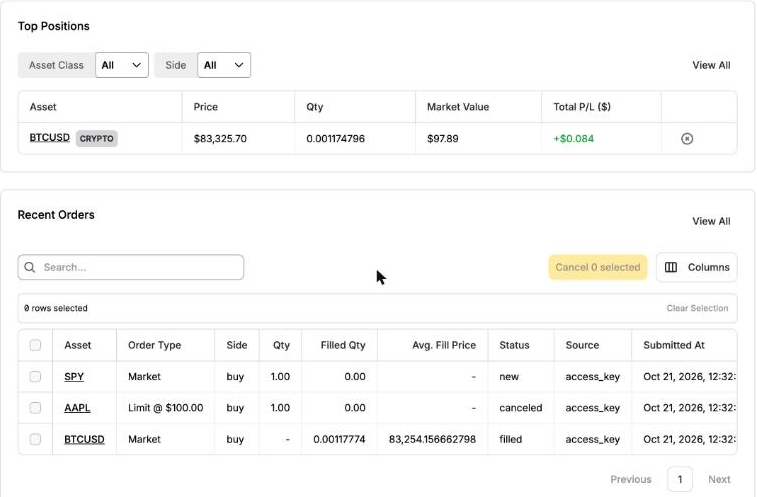 Click to enlarge
Source: Screenshot of the Alpaca dashboard by Kagels Trading.
The Bitcoin order shows three details worth checking in your own account. First, the simulated fill came in three parts at $83,234.98 and $83,267.60; the best offer we saw just before was $83,234.70, and the average was 0.02 percent above it. A paper fill does not prove how a live order would execute. Second, the taker fee of 0.25 percent was taken in Bitcoin: we bought 0.001177741 BTC and our position showed 0.001174796 BTC. Third, our $100 order bought only $98.05 of Bitcoin, and the cash balance fell by the same $98.05, so no money went missing. We found no explanation for the gap in Alpaca’s documentation; whether a live account behaves the same, our test cannot say. After any dollar-based order, compare the filled amount with what you asked for.
The stock orders behaved as the documentation says. A good-till-cancelled order stays open for up to 90 days, and a cancel went through at once. The SPY market order waited for the regular session and was filled at $769.94 at 9:32 AM Eastern Time, two minutes after the open. The first IEX trade of the day was at $771.20, so the order did not get the opening price; like all paper fills, this one was simulated.
Paper trading at Alpaca is useful, but not identical to live trading. Fills are simulated against real quotes, and Alpaca adds random partial fills. But according to Alpaca’s paper trading documentation, the paper account pays no dividends, charges no regulatory fees and does not move the market with your order. Treat paper results as a test of your code, not of your profit. For chart-based practice without code, TradingView paper trading is the simpler start.
Is Alpaca safe? Regulation, protection and fines
Shares and cash at Alpaca are protected by SIPC up to $500,000, including $250,000 in cash. SIPC steps in if a broker fails, not if your investments lose value. On top of that, Alpaca has excess SIPC insurance from Lloyd’s of London of up to $75 million in securities and $75 million in cash per customer, capped at $250 million for all customers together, according to its SIPC disclosure. Crypto at Alpaca Crypto LLC is not covered by SIPC or the FDIC.
FINRA’s BrokerCheck lists two final regulatory actions against Alpaca Securities. On March 17, 2026, FINRA fined Alpaca $300,000 because about 1.87 million trades were reported late and more than 2 million reports were inaccurate; its systems could not handle the volume spikes at the market open. On September 24, 2024, the SEC ordered a $400,000 penalty because staff used personal devices for business messages that were not stored. The SEC fined many large firms for the same failure in that period. Both cases are on Alpaca’s BrokerCheck page (CRD 288202).
The SEC case had a formal consequence: it made Alpaca subject to a statutory disqualification. That means a broker may only stay a FINRA member with FINRA’s approval; FINRA gave it on March 6, 2025, after reviewing Alpaca’s fixes. Neither case was about lost customer money, but together they show failures in trade reporting, record keeping and supervision. The official status page also lists short outages, for example about 9 minutes on May 29, 2026, during the overnight session. Login protection uses two-factor authentication with an authenticator app; API keys are not covered by it, so keep them secret.
Opening an account: US and international traders
US residents open an account online with ID and Social Security number, and there is no minimum deposit. You fund it by ACH for free or by wire. Margin and short selling need at least $2,000 in equity. Crypto trading depends on your state: New York is not on any of Alpaca’s crypto lists.
Alpaca also accepts many traders from outside the US, but it publishes no country list. It says it serves customers in 195+ countries, excludes Canada and asks everyone else to contact support. International accounts are held in US dollars at the US broker, under US law, with a W-8BEN tax form. You can fund them by USD wire or by a local-currency transfer, which costs 1.5 percent, at most $40. Ask support before you send money if you live outside the US.
Pros and cons of Alpaca
| Pros | Cons |
|---|---|
| $0 commission on US stocks, ETFs and equity options | US markets and crypto only, no futures or forex |
| Strong API with official Python library | No full mobile app found, no phone or chat support |
| Official AI connector (MCP), paper by default | Free data is IEX only, full data $99 a month |
| Free paper account with $100,000 | Two regulatory fines (2024, 2026) |
| 24/5 trading and no PDT rule since June 2026 | Crypto not protected by SIPC |
| TradingView integration | Payment for order flow on market orders |
Alpaca is not the right broker for everyone. If you trade by hand on your phone, a classic app broker is more comfortable. If you need futures, forex or global stocks in one account, Interactive Brokers covers far more markets, at the price of a more complex platform. Alpaca’s strength is where code meets US stocks: a documented API, official libraries and a free paper account take you from a Python script to an order with few steps.
Alpaca rating
Our rating for Alpaca is 7.3 out of 10. The scores are our editorial judgement, based on Alpaca’s documents and a limited paper test; the rating is the plain average of five areas. Each score asks how well Alpaca serves the trader it is built for: someone who automates and trades US markets. Not tested: live execution, deposits and withdrawals, and support response times.
| Area | Score | Why |
|---|---|---|
| Costs | 8.5 / 10 | No commission, low crypto fees; data and margin cost extra |
| Products and markets | 6.5 / 10 | Broad US offer with options and 24/5, but no futures, forex or global stocks |
| API and platform | 9.0 / 10 | Excellent API, official AI connector, TradingView; weak without code |
| Safety and regulation | 7.0 / 10 | SIPC plus excess insurance, but two fines and crypto without SIPC |
| Support | 5.5 / 10 | Form, email, forum; no phone, no chat, no full app found |
Conclusion: who should use Alpaca?
Alpaca is built for automated trading in US stocks, and that is where it is strong. The API, the free paper account and the official AI connector make it easy to test a strategy and take it live without changing tools. The costs are low, as long as the free IEX data is enough for your strategy.
For manual traders, Alpaca is the wrong tool. We could not verify a current full-featured official mobile app as of October 21, 2026, and without phone support or futures, Alpaca offers less than classic brokers. And the two regulatory fines are a reason to keep an eye on the company. Our advice: start in the paper account, test your code there for a few weeks, and only then fund a live account with money you can afford to lose. Website: alpaca.markets.
Frequently asked questions about Alpaca
Is Alpaca a legit broker?
Yes, Alpaca Securities LLC is a registered US broker-dealer and a member of FINRA and SIPC. You can check it on FINRA BrokerCheck under CRD number 288202. BrokerCheck also lists two final actions: a $300,000 FINRA fine in 2026 and a $400,000 SEC penalty in 2024.
Is Alpaca trading free?
Trading US stocks, ETFs and equity options costs no commission for normal retail orders. You still pay small regulatory fees and options fees per contract. Crypto costs 0.15 to 0.25 percent per trade, and full market data costs $99 a month.
Does Alpaca have a minimum deposit?
No, Alpaca has no minimum deposit. You need at least $2,000 in equity for margin, short selling and 4x intraday buying power. The paper account needs no deposit at all.
Is the Alpaca paper account free?
Yes, anyone can open a paper account with an email address, free of charge. It starts with $100,000 in virtual money and uses real prices from the IEX feed. It pays no dividends and charges no regulatory fees, so paper results can differ materially from live trading.
Does Alpaca still have the pattern day trader rule?
No, Alpaca replaced the pattern day trader rule on June 4, 2026. FINRA’s new intraday margin standard removed the $25,000 minimum and the day-trade count. At Alpaca, 4x intraday buying power now starts at $2,000 equity.
Can I connect Alpaca to an AI assistant like Claude?
Yes, through Alpaca’s official MCP server, which works with Claude, Cursor, Gemini and other assistants. It reads your account, prices and news and can place orders. It uses the paper account by default; switch to live trading only with clear limits, because the AI then trades real money.
Can I use Alpaca outside the US?
Many international traders can open an account, but Alpaca publishes no country list. Canada is excluded. Accounts are held in US dollars at the US broker; ask Alpaca’s support before you fund one.