
Kalshi Review 2026: Is Kalshi Legit and Legal?


Contents
- Kalshi in 30 seconds
- What is Kalshi?
- Is Kalshi legit?
- Is Kalshi legal in the US?
- How does Kalshi work?
- Kalshi for traders: Fed odds next to the FedWatch Tool
- What does Kalshi cost? Fees explained
- Kalshi vs Polymarket
- Pros and cons of Kalshi
- Our verdict on Kalshi
- Frequently asked questions about Kalshi
- About the author
Kalshi runs a CFTC-regulated exchange in the United States. The CFTC approved it as an exchange in 2020, and today it trades more volume than any other prediction market. What is still disputed is sports contracts: some US states call them gambling, and three federal appeals courts have not agreed on who is right.
For this review I checked Kalshi from the outside, not with my own money. My sources are the CFTC approval and enforcement orders, Kalshi’s member agreement, fee schedule and help center, the court rulings, and Kalshi’s market data next to the CME FedWatch Tool. Market data and fees were checked on October 6, 2026, the legal status on October 7, 2026. How we research and write is described on our editorial policy page.
Kalshi in 30 seconds
- What it is: a US exchange for event contracts, approved by the CFTC as a designated contract market since November 2020. You trade in US dollars, not crypto.
- Is it legit? Yes, in the sense that matters: a federally regulated exchange with a public rulebook, not an offshore betting site. That does not make every trade a good idea.
- Is it legal? Kalshi operates under federal CFTC oversight and names 18 as its minimum age. Sports contracts are fought over in several states; in Nevada a state court has blocked sports, election and entertainment contracts.
- Outside the US: the UK, Canada, Australia and more than 50 other countries are on Kalshi’s restricted list. Canadians reach some Kalshi markets through Wealthsimple Predict.
- Cost: the taker fee is 0.07 × contracts × price × (1 - price). 100 contracts at 50 cents cost $1.75.
- For traders: Kalshi’s Fed market priced 82 percent for an unchanged rate on October 6, 2026, close to the FedWatch Tool’s 80.6 percent.
What is Kalshi?
Kalshi is a US exchange for event contracts that the Commodity Futures Trading Commission (CFTC) approved as a designated contract market in November 2020. Users buy yes or no contracts on the outcome of an event, settle in US dollars and trade against other users, not against a bookmaker.
The approval is the core of the business model. On November 4, 2020, the CFTC designated KalshiEX LLC as a contract market, the same legal category as the big futures exchanges in Chicago. Kalshi opened to the public in July 2021. Its rival Polymarket only returned to the regulated US market in 2025, through the purchase of the exchange QCX.
You can trade almost anything with a clear result. The categories range from economics and finance to politics, sports, culture, crypto, commodities and climate. For traders, the markets on Fed decisions, inflation and the jobs report matter most, because they turn expectations into percentages.
By volume, Kalshi is now the largest prediction market. According to The Block, Kalshi traded about $37.17 billion in August 2026, Polymarket including its US platform $8.16 billion. Kalshi’s volume fell 7.3 percent from July, after a summer peak around the World Cup. Our guide to prediction markets compares all the main platforms.
Who is behind Kalshi?
Kalshi was founded in 2018 by two MIT graduates. Tarek Mansour is co-founder and CEO, Luana Lopes Lara is co-founder and runs operations. They met as students at MIT.
| Operator | KalshiEX LLC (exchange), Kalshi Inc. |
| Founded | 2018, trading since July 2021 |
| Founders | Tarek Mansour (CEO), Luana Lopes Lara |
| Regulator | CFTC, designated contract market since Nov 4, 2020 |
| Settlement | US dollars |
| Minimum age | 18 (signup page) |
| Restricted countries | 55, including the UK, Canada and Australia (Oct 7, 2026) |
| US iPhone app | 4.8 of 5 from about 583,000 ratings (Oct 6, 2026) |
Is Kalshi legit?
Kalshi is a legitimate, federally regulated exchange. It holds a CFTC designation, publishes its rules, fee schedule and member agreement, and can ask for identity documents. The regulator has even sided with Kalshi against states: in an April 2026 release the CFTC announced a brief supporting Kalshi in Massachusetts and said it had sued Arizona, Connecticut, Illinois and New York over their rules for prediction markets.
Search results for this question are full of forum threads that call Kalshi a scam. Being regulated and being a good deal are two different questions. A forum post about lost bets is not evidence that an exchange keeps customer money. It is a good reason, though, to read each market’s rules before you buy.
The regulator also polices trading on Kalshi. In August 2026 the CFTC ordered a White House teleprompter operator to pay $172,000 for insider trading in so-called mention contracts and thanked KalshiEX for its help. In July 2026 the CFTC ordered former congressman George Santos to pay $35,000 for manipulative trading in a State of the Union event contract. Cases like these show oversight, and they also show that insiders try their luck.
Is Kalshi legal in the US?
Kalshi operates a CFTC-regulated exchange, and its signup page names no excluded states. The signup page asks that you are 18 or older and pass identity checks if requested; the member agreement sets out further eligibility rules. The fight is about state gambling laws, and almost all of it concerns sports contracts.
Kalshi argues that federal law preempts state gambling law. Its event contracts trade on a CFTC-regulated exchange, so in its view only the CFTC can regulate them. Several states disagree and say a contract on a game result is a sports bet, whatever it is called. The federal appeals courts are split:
| Court and state | Decision | Result for Kalshi |
|---|---|---|
| Third Circuit, New Jersey | April 6, 2026, 2 to 1 | win: New Jersey may not enforce its gambling law for now |
| Ninth Circuit, Nevada | August 28, 2026, 3 to 0 | loss: “The substance … is sports gambling” |
| Sixth Circuit, Ohio and Tennessee | September 25, 2026, 3 to 0 | loss: sports contracts are not shown to be swaps |
Sources: opinions of the Third Circuit, Ninth Circuit and Sixth Circuit, checked October 7, 2026. All three were decisions on preliminary injunctions, not final judgments.
The Supreme Court may settle the question. New Jersey has asked it to review the Third Circuit ruling (No. 26-299). On October 7, 2026, the Court had not yet agreed to hear the case, and Kalshi’s reply was due on November 9, 2026. Kalshi has also asked the full Ninth Circuit to rehear the Nevada case.
In Nevada, a state court has gone further. According to the Nevada Gaming Control Board, a preliminary injunction of May 18, 2026 bars Kalshi from offering sports, election and entertainment contracts within Nevada. Kalshi had to put geofencing in place by August 12, 2026. The order names those three categories, not economic or climate markets.
For you as a US user, this means the offer can differ by state, and it can change quickly. The appeals cases are about sports contracts, not about Fed or CPI markets. If you trade sports contracts, check what Kalshi shows in your state. This article is not legal advice.
Can you use Kalshi outside the US?
Kalshi blocks trading from 55 countries, including the UK. The member agreement names them as restricted jurisdictions, among them the United Kingdom, Canada, Australia, France, Italy, Ireland, Switzerland and Singapore. The ban covers “solely” the trading of event contracts, not visiting the site, so you can still read the prices from anywhere.
A country missing from the list is not a green light. In the same clause, every member confirms that event contract trading is not prohibited where they live. Germany, for example, is not on Kalshi’s list, but the German gambling regulator GGL stated on August 13, 2026 that bets on political and economic events cannot be licensed there. Check the law where you live, not only the list.
Canadians have a regulated route through a broker. Wealthsimple Predict gives Canadians access to Kalshi contracts through Wealthsimple Investments Inc., a dealer regulated by CIRO. According to Wealthsimple, only three categories can be traded: financial metrics, economic data and climate. Sports and election markets are view-only, and there is no margin.
How does Kalshi work?
Every Kalshi market is a yes or no question about a future event. A contract pays $1 if the answer turns out right and nothing if it turns out wrong. The price therefore moves between 1 and 99 cents and reads directly as a probability: a contract at 18 cents means the market gives the event about 18 percent.
Kalshi is an exchange, not a sportsbook. Buyers and sellers meet in an order book, and according to Kalshi the company earns its money from trading fees, not from the outcome. You can sell a position before the market settles if someone takes the other side; your profit or loss is then the price difference. If the market settles against you, the whole purchase price is gone, plus the fees.
Who decides the outcome of a market?
Kalshi decides the result itself, based on written market rules. Every market has a rulebook. In the Fed market for October, for example, a 25 basis point cut on October 28, 2026 settles the matching contract as yes, and if the meeting is cancelled, “rate unchanged” counts as the result. According to the help center, settlement requests go to Kalshi’s Markets team. On the international Polymarket site, holders of a crypto token vote instead.
Both models come with a trade-off. A central team decides faster, and as a regulated exchange Kalshi answers to the CFTC. The last word still lies with the operator, not with an open process. Read the full rules of a market before you buy: you trade the question that is written there, not the one you think you are trading.
Kalshi for traders: Fed odds next to the FedWatch Tool
For me as a trader, Kalshi is above all a data source. Its markets on rate decisions, inflation data and the jobs report show how people with real money price probabilities. You can read the prices without an account and without placing a trade.
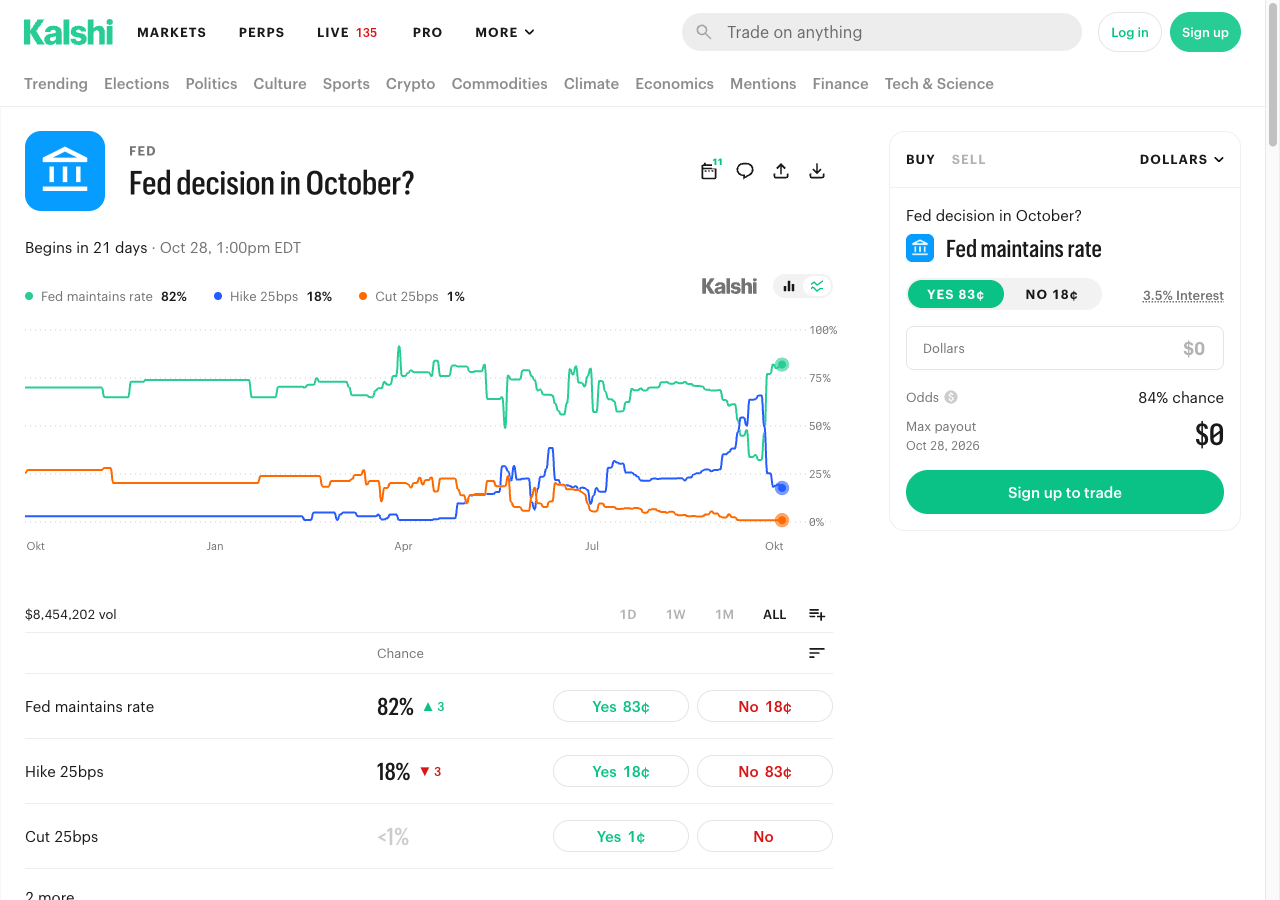
On October 6, 2026, Kalshi and the CME FedWatch Tool were close together. At about 3:40 p.m. ET, Kalshi priced an 82 percent chance that the Fed keeps rates unchanged at its October 28 meeting and 18 percent for a hike of 0.25 percentage points. The CME FedWatch Tool, which derives its numbers from 30-Day Fed Funds futures, showed 80.6 to 19.4 percent when I checked it later that evening.
 Click to enlarge
| Outcome on Oct 28 | Kalshi | FedWatch |
|---|---|---|
| Rate unchanged | 82% | 80.6% |
| Hike of 0.25 | 18% | 19.4% |
| Cut of 0.25 | under 1% | 0.0% |
Kalshi checked on October 6, 2026, at about 3:40 p.m. ET, FedWatch later the same evening. Kalshi: displayed probability per outcome; the executable buy prices were slightly higher. FedWatch: derived from 30-Day Fed Funds futures prices with CME’s method.
Both sources showed similar priced-in probabilities at that moment. They do not tell you how many traders share a view. When the numbers drift far apart, look closer: one market may be absorbing news faster, one may be thinly traded, or the methods differ. Kalshi’s October market had about $8.45 million in volume when I checked it.
Three weeks before the October 28 decision, a pause was the stronger scenario. Another hike after the move on September 16 was priced at just under one fifth. This is a snapshot: the numbers change with every data release, and they alone do not tell you how markets will react to the Fed’s decision.
Rate expectations can also be traded in regulated futures. Fed Funds futures and SOFR futures at CME are the classic instruments, with leverage that works in both directions. Access and suitability depend on your broker and your own situation.
What does Kalshi cost? Fees explained
Kalshi charges its fee on the expected profit, not on the stake. According to the fee schedule (version of July 7, 2026), an order that executes at once against the order book pays 0.07 × contracts × price × (1 - price), rounded up to the next cent. That applies to buying and selling. A contract at 50 cents is the most expensive; towards the edges the fee drops sharply.
| Price per contract | Fee for 100 contracts |
|---|---|
| 10 cents | $0.63 |
| 30 cents | $1.47 |
| 50 cents | $1.75 |
| 70 cents | $1.47 |
| 90 cents | $0.63 |
Taker fee with Kalshi’s standard formula for 100 contracts traded together at one price, our own calculation. Some markets use different rates.
If you wait in the order book, you usually pay nothing. Orders that do not fill at once are generally fee-free. In selected markets such an order pays a maker fee at a rate of 0.0175 when it fills later. There is no settlement fee and no membership fee.
Card deposits can cost more than the trade. Kalshi reserves the right to charge up to 2 percent on card deposits. On a $500 deposit that would be $10, more than the taker fee on 500 contracts at 50 cents.
Compared with Polymarket, Kalshi sits at the upper end. For standard single contracts, Polymarket US uses the same formula with a rate of 0.0695 and pays makers a small rebate; combos and a few sports have their own rates. On the international Polymarket site the rate varies by category between 0 and 0.07, and only crypto markets reach Kalshi’s standard rate. Details are in our Polymarket review.
Taxes on Kalshi winnings
Kalshi’s tax help page lists forms for interest, rewards and crypto, plus a P&L statement. As of October 7, 2026, its tax help page names 1099-INT for interest, 1099-MISC for credits and rewards, and forms for crypto transfers. For trading activity it provides a profit and loss statement. Kalshi says it cannot give tax advice, so ask a tax professional how to report your results.
Kalshi vs Polymarket
Both trade the same product on different foundations. Kalshi settles in US dollars through a classic exchange that was regulated from the start. Polymarket runs two platforms: the international site settles in the stablecoin USDC on a blockchain, and Polymarket US is a CFTC-regulated exchange since its purchase of QCX in 2025.
| Feature | Kalshi | Polymarket |
|---|---|---|
| Founded | 2018 | 2020 |
| CFTC exchange | since 2020 | since 2025 (Polymarket US) |
| Settlement | US dollars | USD (US), USDC (international) |
| Outcome decided by | Kalshi team | exchange (US), token vote (international) |
| Volume Aug 2026 | $37.17 billion | $8.16 billion |
Status October 7, 2026. Volume according to The Block, Polymarket including its US platform.
For US users, both now run regulated exchanges. The international polymarket.com site excludes US residents. Our guide to IBKR Prediction Markets shows a third route: Interactive Brokers clients can trade Kalshi contracts from their brokerage account, without a separate Kalshi account.
Pros and cons of Kalshi
Kalshi is strong as an exchange and as a data source. The weak points are the legal fight over sports, the fees at the middle of the price range and the operator’s final say on results.
Pros
- Regulated US exchange: CFTC-designated since 2020, public rulebook and fee schedule.
- US dollars, no crypto wallet: you trade and settle in dollars.
- Free market data: the probabilities work as an indicator, for example next to the FedWatch Tool.
- Largest prediction market: high activity can support liquidity, but check the spread in each market.
- Resting orders mostly fee-free: if you add liquidity to the order book, you pay nothing in most markets.
Cons
- Sports contracts under legal fire: three appeals courts are split, and Nevada blocks sports, election and entertainment contracts.
- Restricted abroad: 55 countries, including the UK, Canada and Australia, cannot trade directly.
- High standard rate: the taker fee matches Polymarket’s highest category rate, and card deposits can cost up to 2 percent.
- Total loss possible: if a market settles against you, the purchase price is gone.
- Operator decides the outcome: Kalshi’s own team rules on disputed settlements.
Our verdict on Kalshi
Kalshi is the most established regulated prediction market in the US. It has been a CFTC-designated exchange since 2020, it settles in dollars, and it has overtaken Polymarket by more than four times in volume. Investors are reportedly discussing a valuation of about $40 billion, according to CoinDesk.
The US state cases discussed here mainly concern sports contracts. The appeals courts ruled on whether a game result is a swap or a bet, and the Nevada case also touches election contracts. The outcome of the Supreme Court petition can shape the whole industry, including markets on economic data.
My verdict: for traders, Kalshi is most useful as an indicator. The Fed probabilities in October 2026 were within a few points of the FedWatch Tool. As an extra data source next to the futures markets, the free prices are worth a look. If you trade there, treat it as speculation with total loss risk, read each market’s rules, and keep the stake small.
- Good fit for: US traders who want to watch or trade event probabilities on economic data, and who read market rules carefully.
- Not a fit for: readers in the UK, Canada (directly), Australia and other restricted countries, and anyone looking for steady income.
Event contracts carry a high risk of loss. This review describes Kalshi’s rules and costs; it is not investment advice and not legal advice.
Frequently asked questions about Kalshi
Is Kalshi legit or a scam?
Kalshi is a legitimate exchange regulated by the CFTC. It has held a designated contract market status since November 2020, publishes its rules and fees, and checks the identity of its users. Regulation does not protect you from losing trades, though: if a market settles against you, the money you paid is gone.
Is Kalshi legal in all 50 states?
Kalshi’s signup page names 18 as the minimum age and lists no excluded states. Sports contracts are disputed in several states. In Nevada a state court has blocked sports, election and entertainment contracts since May 18, 2026. Federal appeals courts are split, and New Jersey has asked the Supreme Court to decide.
Can I use Kalshi in the UK?
No, the United Kingdom is on Kalshi’s list of restricted jurisdictions. UK residents cannot trade event contracts on Kalshi. You can still visit the site and read the prices as a source of market expectations.
How much does Kalshi charge per trade?
It depends on the price of the contract. A taker pays 0.07 × contracts × price × (1 - price), rounded up. 100 contracts at 50 cents cost $1.75, at 10 cents $0.63. Resting maker orders are free in most markets, and card deposits can cost up to 2 percent.
Does Kalshi actually pay out?
Winning contracts settle at $1 each into your Kalshi account. Kalshi’s team decides the result according to the written rules of each market. If the wording differs from what you expected, the wording wins, so read the rules before you buy.
Who is the CEO of Kalshi?
Co-founder Tarek Mansour is the CEO. He founded Kalshi in 2018 with Luana Lopes Lara, who runs operations. Both studied at MIT.
Can I buy Kalshi stock?
Not on a stock exchange, because Kalshi is a private company. According to CoinDesk, Kalshi was in talks in August 2026 about a funding round at a valuation of about $40 billion. Offers of private shares are something different, so check carefully what is actually being sold.
This US edition is based on our German edition on kagels-trading.de and has been adapted for US readers.
More Prediction Markets guides
- Understand prediction markets
Prediction Markets: How They Work and Where They Are Legal
How event contracts work, where they are legal and what traders can read from the prices.
- Check Polymarket
Polymarket Review 2026: Is Polymarket Legal in the US?
Polymarket US and the international site: legal status, fees and who decides disputed markets.
- Trade event contracts at a broker
IBKR Prediction Markets: ForecastEx, Kalshi and Fees
IBKR Prediction Markets with ForecastEx, Kalshi and CME: who can trade and what it costs.