
Trading Bots: How They Work, Costs and Risks


Contents
- Trading bots: everything in 30 seconds
- What is a trading bot?
- How a trading bot works
- Can trading bots actually earn money?
- Six common bot approaches
- Pros and cons of trading bots
- Trading-bot providers
- Open-source trading bots
- What does a trading bot cost?
- Are trading bots legal?
- Spotting a scam: CFTC advisory and warning signs
- AI trading bots: rule-based or really learning?
- Setting up a trading bot: a sequence that reduces risk
- Building a trading bot yourself
- Can you make money with trading bots?
- Conclusion: trading bots are tools, not money machines
- Frequently asked questions about trading bots
- About the author
A trading bot is a computer program that places buy and sell orders by preset rules, without you clicking each trade. Real bots connect to an exchange or a trading platform and execute a strategy that you or someone else wrote. The marketing around them is loud, and the January 2024 CFTC customer advisory on AI trading bots exists because the gap between a working product and an outright scheme is often invisible from the sales page. This piece follows our editorial guidelines.
What this guide covers. You will learn how a trading bot works, which approaches are common across markets, what a bot really costs, and the checks to run before you connect an account. Rules on who can operate a bot for other people and which platforms you can open an account with vary by jurisdiction; the sections below name the places where you have to check for yourself.
Trading bots: everything in 30 seconds
- What a trading bot is: a computer program that places buy and sell orders by preset rules, without you clicking each trade.
- Where bots run: in crypto, software that connects to an exchange over an API key; in forex and CFDs, programs inside the MetaTrader platform (Expert Advisors) or inside cTrader (cBots).
- What they cost: the subscription prices of the checked crypto platforms depend on the billing cycle; WunderTrading has a free plan, the monthly-billed list of 3Commas is $20 to $140 and Cryptohopper $29 to $129, and provider-side fees come on top of exchange trading fees.
- Legal angle in one line: running a bot on your own account is widely allowed, but handling other people’s money, placing orders you do not intend to fill, or offering automated services to customers may trigger rules that vary by activity, instrument and jurisdiction.
- Four material risks: fraud, a strategy that stops working, broken execution and credential or custody problems. The CFTC advisory lists several defendants prosecuted for schemes that promised automated-AI returns, including one case with more than $1.7 billion in bitcoin stolen from at least 23,000 people.
- Testing sequence: backtest with costs, then a paper or demo account, then a small live amount with a hard loss limit and a kill switch you have actually tested. The sequence reduces the odds of a surprise; it cannot eliminate losses or technical failures.
What is a trading bot?
A trading bot is a computer program that places orders in financial markets by preset rules, without the trader clicking each trade.
A bot runs a trading system, not an opinion. The system says when to buy and when to sell, for example on a breakout above a prior high or when a short average crosses a longer one. In the manual version the system fires a signal and you decide. The bot skips that step and sends the order itself.
A trading bot is a subset of algo trading, not a synonym for it. Our algo trading guide covers the wider field, from institutional execution systems down to a Python script you wrote yourself. Bots can be ready-made subscription products or custom-built by the person who runs them, often with open-source frameworks like Freqtrade or NautilusTrader.
Not every automation is a bot. Copy trading mirrors the trades of a human; a signal service computes the trade and you still place the order; a trade copier forwards the same manual trade to several accounts. These are automation, but the decision maker is a person.
Trading bot, trading robot, Expert Advisor: the vocabulary
Several words describe the same software. Trading robot and auto-trading program mean the same thing as trading bot. In forex, people often say forex robot; inside MetaTrader the same object is called an Expert Advisor, and inside cTrader a cBot. The important point in a comparison is what the program does, not what the sales page calls it.
How a trading bot works
 Click to enlarge
Source: Graphic by Kagels Trading.
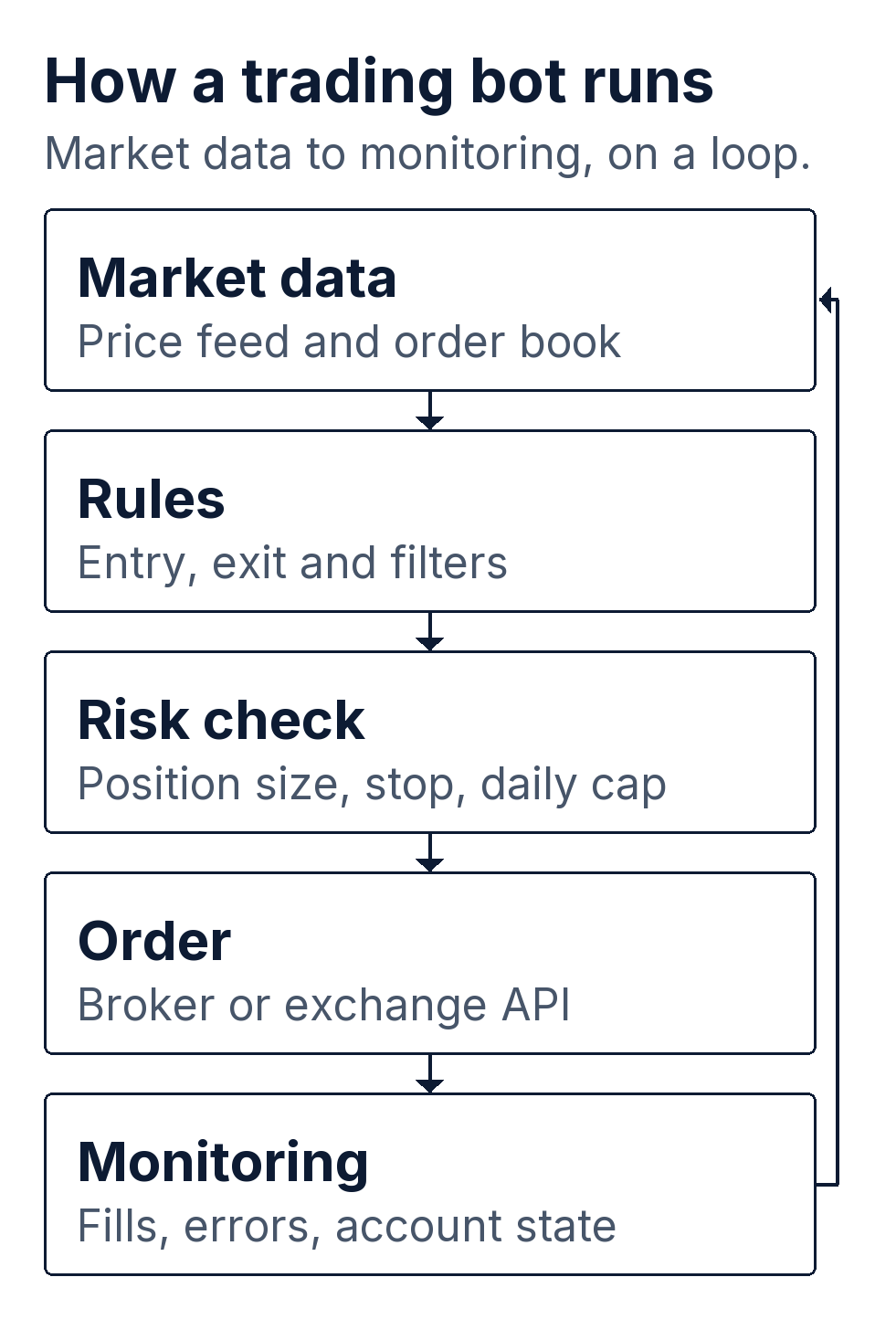
A bot runs the same five-step loop on repeat. It reads market data, checks the data against its rules, runs a risk check on the proposed order size, sends the order to the exchange or broker, and then monitors fills, errors and account state. The image above is the plain picture.
A simple example with a moving average
The simplest bot is a single rule on a moving average. The bot calculates a 10-period moving average and places an order on the next bar’s open after a close that crosses the line. A long position after a close above the line, a flat or short after a close below. The timing of the signal and the executable entry matter: a cross observed on a 1-minute chart is not the same as a cross executed on the next 1-hour open, and the rule needs to specify both.
A rule this simple is a teaching example and not a tested strategy. During a sideways market price crosses the line again and again, and every flip pays trading fees and spread. Whether a filter, a trend check or a different time frame turns it into something tradable is a question for a backtest, not for a sales page. Our backtesting guide covers one way to run that test on a long price history.
How the bot connects to your account
In crypto, the bot talks to your exchange through an application programming interface. You create an API key on the exchange, which is a code that lets a program place orders. You paste the key into the bot. Your coins stay with the exchange. When you create the key, you can leave the withdrawal permission off, so the bot can trade but cannot move money out of the account. Our European crypto exchanges comparison checks the five brands we have reviewed on licence, published fees and the real charges on a 1,000 euro bitcoin buy.
In forex and CFDs, the bot runs inside the trading platform. In MetaTrader it is an Expert Advisor (EA); the MetaQuotes help page on trade robots says the platform’s “Allow Auto Trading” option “limits the trading activities of Expert Advisors,” and that “if you disable it, scripts and Expert Advisors can work, but are not able to trade.” In cTrader the equivalent object is a cBot; the cTrader cBots FAQ distinguishes a local instance that runs on your own computer and stops when you close the app from a cloud instance that “runs 24/7 in an environment provided by cTrader and does not depend on your device or cTrader app.”
Can trading bots actually earn money?
Automation can execute a strategy consistently, but code, data feeds, exchanges and networks all fail from time to time, and the live result is only as good as the strategy itself and the plumbing underneath.
Four things decide whether a bot earns on a long horizon. The quality of the strategy, how the strategy behaves when the market regime shifts, the costs per trade, and the quality of the price data. If any one of those is weak, the account bleeds, and the live performance moves away from the backtest.
The most dangerous mistake is a backtest that looks too good
A set of rules can be tuned to the past until it looks perfect. Practitioners call this overfitting. The rules then fit the random details of one data set, not a repeatable market pattern. The live account breaks away from the backtest, sometimes gradually and sometimes in the first week.
Two tests reduce the risk of overfitting but do not eliminate it. Freeze the rules and run them over a period you did not use when you built them, which is out-of-sample testing. Then run the frozen rules forward on a paper or demo account across several market phases. Divergence between backtest and forward test can come from the market itself, from fills, from fees or from data; a difference is a signal to inspect, not automatic evidence of a configuration error.
What a trader can do that a bot cannot
I bought my first shares in 1980 and have traded discretionary since 1986. In those decades I have learned that the biggest moves come from situations no rulebook has seen in the same shape before: a central bank that surprises the market, a stock that falls on good news, an exchange that halts a symbol. A rule-based bot does not read the room; it keeps trading its rules.
Market patterns exist, and they age. A rule that worked for three years can lose money in the fourth, because too many participants trade the same setup. Someone needs to measure the live performance and switch the bot off when the statistics turn, which is as true for a professionally built system as it is for a retail subscription. Bots can include news feeds, volatility filters or trading-halt checks, so “trades through anything” is not a universal description; the right question is which of these checks a given product actually implements and tests.
Six common bot approaches
 Click to enlarge
Source: Graphic by Kagels Trading.
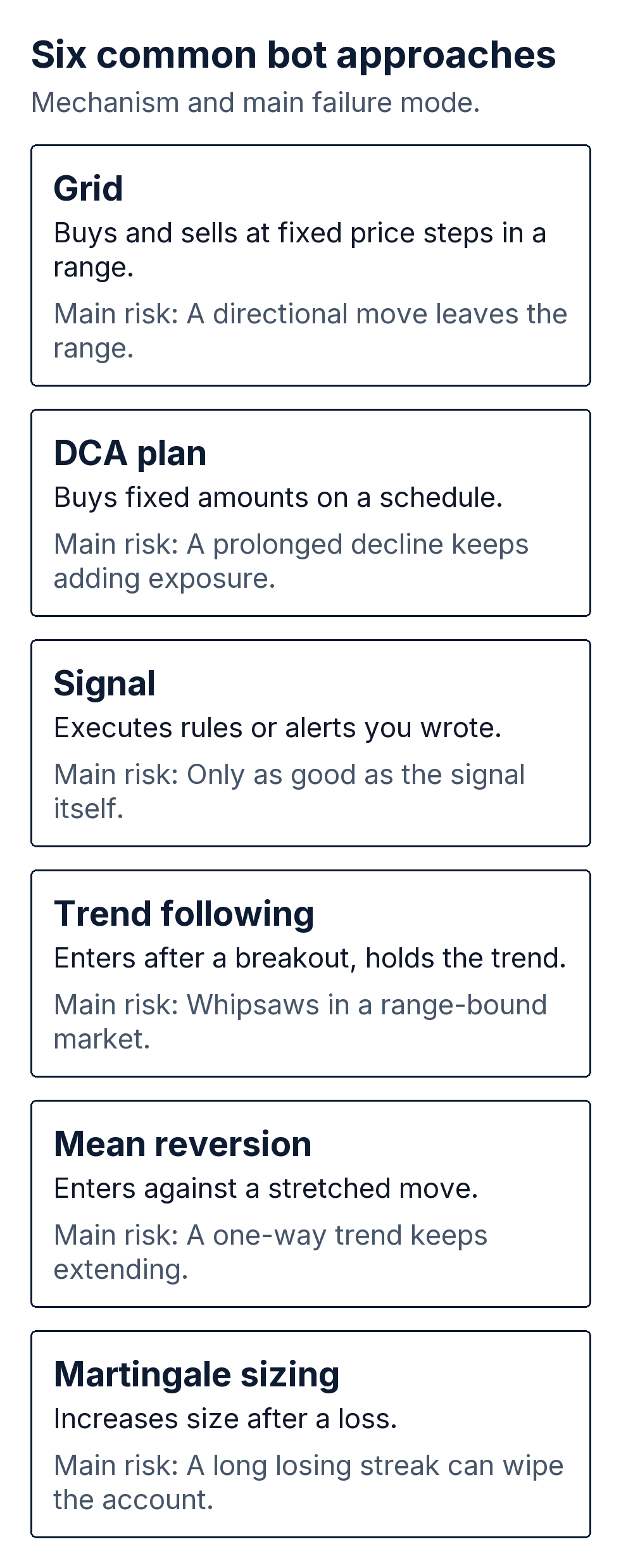
Most retail bot products combine one or more of six approaches. These are not six exclusive classes; a single product can mix a sizing scheme with an execution path and a market view. The point of a comparison is the mechanism each piece uses, the assumption behind it, and the main failure mode.
| Approach | Mechanism | Main failure mode |
|---|---|---|
| Grid | Buys and sells at fixed price steps inside a range | A directional move that leaves the range |
| DCA plan | Buys fixed amounts on a schedule | Continued buying into a prolonged decline grows exposure and can leave lasting losses |
| Signal execution | Executes rules or alerts written by the user | Signal quality drives the result; the engine itself has no view |
| Trend following | Enters after a breakout and holds while the trend lasts | Vulnerable to whipsaws in a range-bound market |
| Mean reversion | Enters against a stretched move and targets a snap-back | Vulnerable to a one-way trend that keeps extending |
| Martingale sizing | Increases size after a loss until a win covers the chain | Exposure escalates; a long enough losing streak can wipe the account |
Watch the vocabulary. “Day-trading bot” is a marketing label and can describe a signal, a trend or a mean-reversion engine on a short time frame; the label does not describe the mechanism. A DCA plan that buys a fixed sum on a schedule is different from “averaging down” after an adverse price move, and the two are often sold under the same name. Arbitrage across venues and market making are real strategies, but at retail scale they tend to compete badly with professional operators that run colocated infrastructure.
Pros and cons of trading bots
A bot takes work off your hands; it does not take responsibility with it. The two short lists below name the places where an automated system behaves differently from a hand trader, grouped by advantages and drawbacks.
Pros
- Rules, not mood: the bot keeps to the rules after three losses, where a human often hesitates or doubles down.
- Twenty-four hours a day: the crypto market never closes, and the bot does not miss moves while you sleep.
- Fast order path: signal to order is a fraction of a second; by hand it is often several seconds.
- Rules that can be measured: a fixed strategy can be tested in a backtest; a gut feeling cannot.
Cons
- Narrow situational awareness: a rule-based bot does not notice an exceptional situation unless the exception is explicitly in the rules.
- Strategies age: markets change behaviour; a bot that worked for years can slowly turn into a loss machine.
- Technical risk: a code bug, a changed API, a dropped connection or a credential leak each costs real money.
- Fraudulent offers in the market: regulator advisories such as the January 2024 CFTC bulletin on AI trading bots describe recurring scam patterns around automated trading. Checks before you fund are not optional.
Trading-bot providers
What follows is a desk-research summary of a few widely visible providers, not a product test. We have not opened an account at every provider; the information below comes from each provider’s own documentation, cross-checked against the sources named in the article. Current provider pages name features, licences and fees that change often; read the latest page at the vendor’s own URL before you fund.
Crypto bot platforms that connect to your exchange
These providers do not hold customer money; they connect to your exchange over an API key. Your coins stay with the exchange, and your trade sits on the exchange’s balance sheet. The important question is which exchange you can reach from your country; we have dedicated reviews of Kraken and Coinbase that cover licence, fees and custody for each.
- WunderTrading is software for automated crypto trading from Wunderbit SIA (Riga, Latvia). Its own exchange list shows 16 exchanges, while the pricing page advertises “18+” integrations. There is a lifetime Free plan, a 7-day Pro trial and signal, DCA and grid bots driven by TradingView alerts. A 0.035% builder fee per trade applies only to trades placed on Hyperliquid through WunderTrading; it is not a surcharge on every venue.
- 3Commas offers DCA, grid and signal bots across nine integrated exchanges, including Kraken, Coinbase, KuCoin and OKX. On 11 September 2026 it switched off its old v1 platform; bots and API keys did not carry over and had to be set up again in v2. Under the current terms, the contracting party for the v2 service is Wunderbit SIA, the company behind WunderTrading, which uses the 3Commas brand under licence from the Estonian 3Commas Technologies OÜ. There is no free plan; each paid plan starts with a 7-day trial, the terms require a payment method for it, and the trial turns into the paid plan automatically unless you cancel.
- Cryptohopper is run by the Dutch company Cryptohopper B.V. and connects to eleven exchanges, including Kraken, Coinbase and Bitvavo. There is no free plan any more; a three-day Explorer trial remains. Prices exclude VAT where it applies.
- Coinrule is a platform of the UK company Coinrule Limited where strategies are assembled from if-then rules without code. It names 350+ ready-made strategy templates and a free starter plan with two strategies on one exchange. Readers in the EU and EEA cannot use it: Coinrule says it does not currently serve customers there because of MiCA, the EU crypto-asset regulation.
Crypto exchanges with built-in bots
A few exchanges offer bots directly in the account. That removes the API step but ties the service to the registration status of that one venue. Account eligibility differs by country, and global brands often operate separate national entities (for example a US-only subsidiary) with different products and different oversight; verify eligibility and the specific product list on the operator’s own compliance page for your jurisdiction before you fund an account.
Forex and CFD trading bots: Expert Advisors and cBots
An Expert Advisor is a program written in MQL4 or MQL5 that runs inside MetaTrader. The MetaQuotes marketplace at mql5.com/en/market sells thousands of them, from free demos to expensive licences. An EA only runs with a broker that offers MetaTrader, and whether that broker accepts you depends on your residence; retail forex and CFD rules differ sharply by country, so a brand available in one region is often not available in another. A cTrader cBot is the equivalent object with code written in C#.
Fraudulent offers are a documented pattern in the retail forex-robot market. The CFTC advisory above cites several cases involving MetaTrader demo balances staged as real live results. Independent third-party verification is a useful check, not an endorsement, and past verified results do not promise a future return.
Stock trading bots
Fully automated stock bots are a smaller category than crypto bots. Stock markets have fixed trading hours, and many retail brokers do not expose a programmable interface to private clients. Our Interactive Brokers review covers one broker that does offer an API; other common choices in the retail Python community include Alpaca and TradeStation. Market-data permissions, pattern-day-trader rules and account minimums are checks the reader has to run in their own jurisdiction.
Open-source trading bots
Open-source bots are frameworks you can download, read and run yourself. They vary in licence, included strategies, paid add-ons, hosting model and the amount of community support behind them; inspect each project’s documentation before you choose, because what one framework does well is not what another one does.
Five widely used projects
- Freqtrade: a Python crypto framework with its own backtesting and parameter-search tooling and an operator interface over Telegram or a web UI. Example strategies ship with the framework; a shipped example is a template, not evidence of an edge.
- Hummingbot: a Python framework whose documented focus is market making and arbitrage across centralised and decentralised venues; the project also offers paid hosted components separately.
- OctoBot: Python with a graphical interface and a plug-in catalogue, some free and some paid.
- Jesse: a Python crypto framework with a focus on clean backtesting and strategy research.
- NautilusTrader: an open-source engine with a Rust core and Python strategies; handles multiple asset classes.
Free software is not a free bot
The code can be free; running it is not. A bot that trades around the clock needs a server that stays up. Exchange trading fees apply to every trade, and a bot that trades often pays those fees often.
The bigger line item for most users is time. Installation, exchange connection, test runs and ongoing maintenance add up. If an exchange changes its API, the bot stops until you or the community push a fix. Each framework publishes its own licence, support channels and warranty terms; read them before you deploy a project to real money.
Who open-source bots suit
Self-authored or forked code is easier to inspect than a closed subscription product, which can matter for traders who read the language it is written in. Framework choice follows what the project actually ships: Freqtrade and Jesse publish research-grade backtesting tooling, Hummingbot ships market-making primitives and a strategy-template catalogue, NautilusTrader handles multi-asset flow. Shipped examples and templates are starting points, not proof of a future edge; a framework runs what you give it, with any edge or lack of edge coming from the strategy you load into it.
What does a trading bot cost?
Pricing moves more often than the sales pages suggest, so each row below is dated against the provider’s own current page. The table shows the monthly-billed rate alongside the annual-plan monthly equivalent where the provider displays both, with trial length and the primary link.
| Provider | Monthly billing | Annual-plan monthly equivalent | Trial | Dated |
|---|---|---|---|---|
| 3Commas (pricing) | $20 (Starter), $50 (Pro), $140 (Expert) | $15, $38, $105 | 7-day trial, payment method required | 2026-11-07 |
| Cryptohopper (pricing) | $29 (Explorer), $69 (Adventurer), $129 (Hero), excl. VAT | $24.16, $57.50, $107.50 | 3-day Explorer trial | 2026-11-07 |
| WunderTrading (pricing) | Free, then €17 (Basic), €42 (Pro), €85 (Premium) as shown to us in euros | €13, €32, €64 | Lifetime Free plan plus 7-day Pro trial | 2026-11-07 |
| Coinrule (pricing) | Free starter plan; billing basis of paid plans unclear (see below) | Unclear | Free plan; not available in the EU/EEA | 2026-11-07 |
| Open-source frameworks | Software 0, plus server and fees | Software 0, plus server and fees | n/a | 2026-11-07 |
The subscription is only part of the bill. Exchange trading fees or the broker spread come on top of the subscription for every trade. WunderTrading’s own text ties a 0.035% builder fee to trades on Hyperliquid specifically, not to every venue it connects to; on $10,000 of Hyperliquid volume that is $3.50. WunderTrading showed us euro prices, while the structured data on the same page lists dollar amounts, so the currency you see may depend on your region. Coinrule’s pricing page shows its entry plan at $29.99 per month right next to “$359 billed yearly”, and elsewhere lists “0.02% of traded volume” for paid plans; the pages do not make clear whether $29.99 is also the monthly-billed price or whether the 0.02% comes on top. A bot that trades dozens of times a day pays trading fees every time, and a very active grid bot can run into real volume quickly.
For Expert Advisors a server is usually part of the cost. To keep MetaTrader connected around the clock, most traders rent a Windows VPS from a specialist provider. Add every line together and compare the total to your account size; on a small account, the subscription and server alone can eat the entire potential return.
Are trading bots legal?
Running a trading bot on your own account is widely allowed; rules may still apply depending on activity, instrument and jurisdiction. Running a bot for other people’s money, offering automated services across borders, trading an instrument you are not eligible to trade or using a venue that is not open to your residence can all trigger supervision somewhere. The paragraphs below name the US framework as one concrete example; readers outside the United States must check the equivalent regulators and venue rules in their own country.
In the United States, running a bot for other people usually triggers registration somewhere. Managing securities for others points to registration as an investment adviser with the SEC or a state regulator. Handling pooled commodities trading points to registration as a commodity pool operator or trading advisor with the CFTC, with NFA membership (public records visible at NFA BASIC). Routing orders to exchanges on behalf of customers points to broker-dealer registration with the SEC and FINRA membership. A software vendor that only publishes code is not automatically a registered firm; the exact answer depends on the activity, the market and whether a bot acts with discretion over customer accounts.
In the European Union, crypto-asset services need a MiCA authorisation or an equivalent entitlement. The transition period under the EU’s Markets in Crypto-Assets Regulation ended on 1 July 2026 at the latest, and earlier in member states that shortened it; Germany ended it on 31 December 2025. Banks, investment firms and certain other already supervised financial entities can offer the crypto-asset services that Article 60 covers for their type of firm after a notification instead of a separate authorisation. An authorisation from one member state can be passported to the others. The ESMA interim MiCA register lists crypto-asset service providers; it is not a general register of brokers. Some bot platforms react by not serving EU customers at all; Coinrule is one example.
Automated-order rules apply to the broker’s side. SEC Rule 15c3-5, the Market Access Rule adopted in 2010, requires US broker-dealers to build pre-trade and post-trade controls on any flow that reaches an exchange or alternative trading system; the SEC’s first enforcement under the rule was its 2013 settlement with Knight Capital for $12 million. FINRA Regulatory Notice 15-09 is effective-practice guidance for FINRA member firms engaging in algorithmic trading, not a universal retail requirement; it points firms to “a holistic review of their trading activity” and “controls, monitors, alerts and reconciliation processes” around every algorithm.
Market abuse is market abuse, regardless of who sends the order. Entering orders you do not intend to fill in order to influence prices falls under market-manipulation statutes in US law and in many other jurisdictions. Some brokers also exclude specific bot behaviour in their terms of service, like latency arbitrage or very aggressive scalping; a strategy that is legal can still get an account closed if it breaks the broker’s rulebook.
Spotting a scam: CFTC advisory and warning signs
 Click to enlarge
Source: Graphic by Kagels Trading.
The CFTC’s January 2024 customer advisory on AI trading bots, linked in the introduction, describes the pattern directly. The advisory names “automated trading algorithms, trade signal strategies, and crypto-asset trading schemes that promise unreasonably high or guaranteed returns” and refers to CFTC prosecutions of several defendants who defrauded customers under these headings. The headline example in the advisory is Mirror Trading International, where one operator stole over $1.7 billion in bitcoin from at least 23,000 people over about three years, with a promised 10% monthly return “trading foreign currencies” and fake account balances created inside MetaTrader demo accounts.
How the typical trading-bot scam runs
The pattern is almost always the same. A professional-looking website promises high returns from “AI trading”, often with fabricated quotes from well-known people. After a sign-up form, a so-called account manager calls and presses for a deposit. The dashboard shows large early gains to encourage a top-up. When a withdrawal is requested, surprise fees or “taxes” appear that have to be paid first.
Warning signs
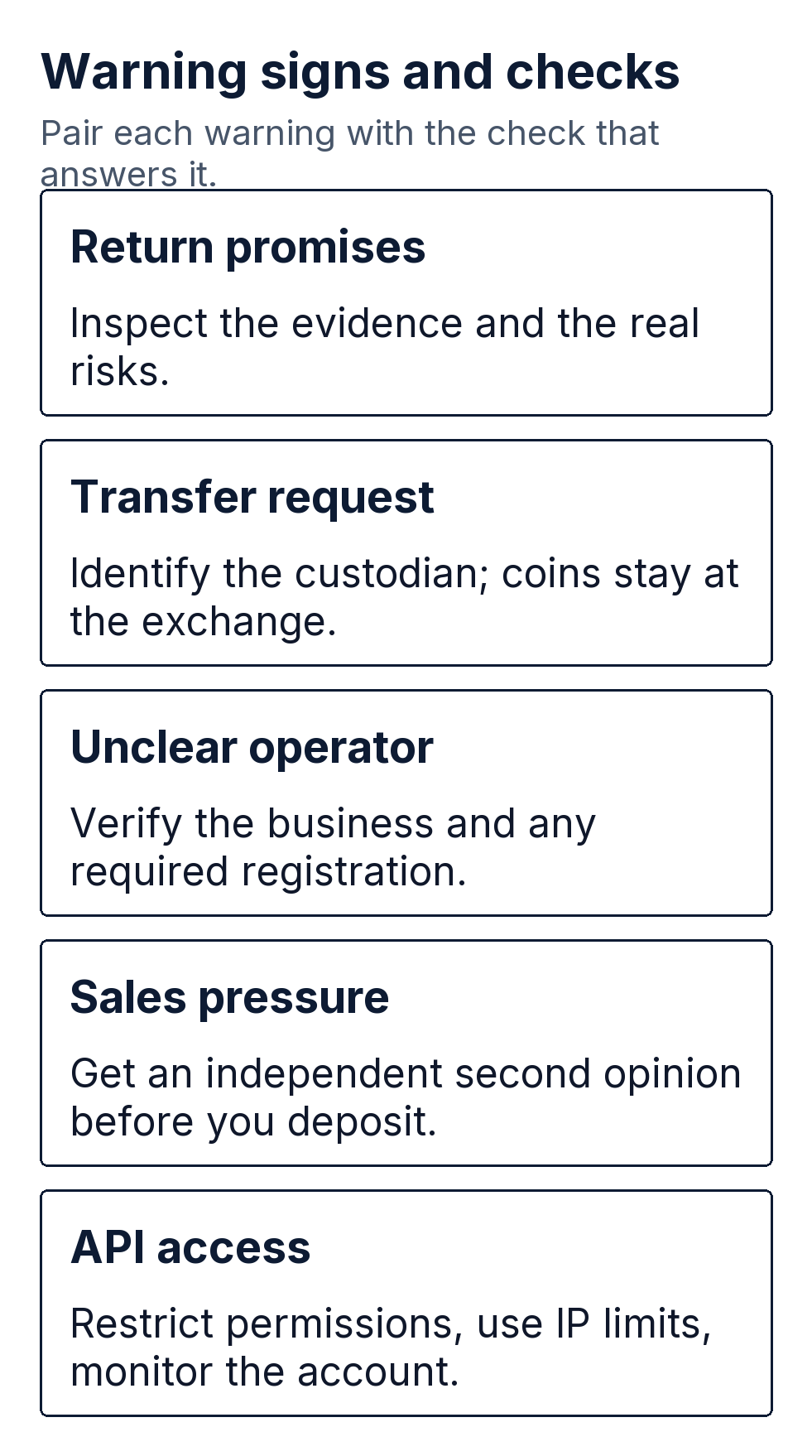
Any single sign below is reason to pause and investigate; several together are reason to walk away.
- Guaranteed returns: promises like “99 percent win rate” or a fixed monthly return do not match how markets behave.
- A request to send money to the platform: a bot that trades on your account does not need custody of your funds; a request to transfer assets to the operator is a reason to investigate, not automatic proof of fraud, but it is a very common feature of scams.
- Unclear operator identity: verify the business or person behind the service and a working contact address. Financial registration depends on the activity; absence of a registration number alone does not prove fraud.
- Phone pressure: calls after sign-up that push a fast deposit are a feature of boiler-room sales, not of software companies.
- No independent track record: results that only live as a chart on the sales page, verified by no third party, are not evidence of past performance.
Checks before you fund
The CFTC advisory suggests a short list. Research the company and its named people, including a reverse image search on the key personnel. Look up the age of the domain at lookup.icann.org; a domain registered three weeks ago is not a track record. Get a second opinion before you deposit. For US investment advisers and broker-dealers, the current record is on FINRA BrokerCheck and the SEC’s IAPD database; readers in other countries can run the equivalent register lookup for their own regulator.
Trade-only API keys reduce exposure, they do not remove it. A key configured for trading only cannot pull funds from your exchange account. It can still be abused through unauthorized API trading. 3Commas documented one mechanism in a December 2022 incident update: victim accounts received counter-trades on the exchange that drained the balance without any withdrawal taking place. The post’s preliminary attribution has been overtaken by later reporting and should not be taken as the final cause; the mechanism remains the point. Separate account partitions, strict scope on the key, IP restrictions where the exchange supports them, revocation at the first sign of abnormal activity, and separate monitoring on the exchange side all reduce the risk; none of them eliminate it.
AI trading bots: rule-based or really learning?
An AI trading bot uses machine learning or similar methods to make or score trading decisions, either with a model that was trained offline and then runs fixed, or with a model that keeps learning as new data arrives.
Many products marketed as AI are rule-based. They run plain if-then rules like “buy when the 14-period RSI is below 30” and do not learn. That is not a flaw on its own, but it has to be stated honestly on the sales page. The CFTC advisory above exists because the gap between a bot that uses an actual model and a product that only has AI on its landing page tends to be invisible from the outside.
Machine-learning bots carry their own risks. A model trained on an old regime can overfit that regime, a model trained on fewer samples than it has parameters can memorise, and even a model that produced good hold-out numbers can underperform live for an extended period. The right questions are: what did you train on, how was the model validated, what is the retraining cadence, and who is on call when the model drifts? Our AI trading guide separates research, signal and execution uses of AI and lists the questions to ask before a model touches your account.
Setting up a trading bot: a sequence that reduces risk
The order below is a risk-reduction sequence, not a guarantee of a safe start. Loss limits can fail, demo environments do not match production, and a strategy that passed every check can still misbehave.
- Write the strategy down: state in two sentences when the bot buys, when it sells and how much it risks. If you cannot state it, you do not know the strategy yet.
- Pick a regulated exchange or broker that accepts you: check the regulator in your country and the venue’s own compliance page before you fund an account.
- Create an API key with no withdrawal right: allow trading only. Where the exchange supports it, also restrict the key to the IP address of the bot provider and to the smallest set of permissions and sub-accounts you can tolerate.
- Backtest with realistic costs: include trading fees and slippage, and run the test over several market phases. A test that leaves costs out will flatter the result.
- Run a demo across different market phases: compare the results against the backtest. Divergence is a signal to inspect, not automatic proof of a configuration error.
- Start small and set a loss limit: commit only an amount you are willing to lose, and decide in advance at which drawdown you switch the bot off.
After the start, the work is not done. Review trades regularly and keep a trading journal that records every deviation. Our risk management guide covers the account-level limits that protect you from a single bad week.
Operational checklist
- Stale data: if a feed stops updating or lags, pause new orders until the clock, the sequence number and the quote match what the venue says they should.
- Partial and rejected fills: read every order response and treat a rejection as its own event; do not assume the trade is on until the venue confirms it.
- Duplicate orders on retry: rely on venue-supported idempotency (such as a client order ID the venue honours) and look up the existing order status before you retry; a client ID alone does not guarantee deduplication on every API.
- Reconnection and reconciliation: after any disconnect, reconcile your open positions, resting orders and balance against the venue before you place anything new.
- Alerts for every stop: every halt condition should send a message to a human, not just a log line nobody reads.
- New-order halt vs. kill switch: a new-order halt stops fresh entries but leaves resting orders and existing positions in place; a full kill switch cancels resting orders and may also close exposure, which is a destructive action and needs testing.
- Human recovery path: write down who touches the bot, with which credentials, when it is 03:00 and the alert fires.
Stops and stop-limit orders are attempts to limit loss, not guarantees. The US SEC Investor Bulletin on order types describes the two main execution risks: a triggered stop becomes a market order, so the fill price is not guaranteed and can gap through the stop; a stop-limit order can fail to fill at all. Combine stops with position sizing and a daily loss cap, and remember that stopping the bot process may leave open orders or open positions behind for a human to clean up.
Building a trading bot yourself
Self-authored code is easier to inspect than a closed subscription product; it is not automatically cheaper or safer. You still pay for the data feed, the hosting and the time you spend on maintenance, and bugs remain in code you wrote yourself. The most common language in retail is Python, because the data, backtest and broker libraries are already written. A fair first project is a simple trend-follower, for example a daily moving-average cross with a position-size rule from position sizing. Our Python trading bot guide builds exactly that kind of bot step by step, with an SMA200 backtest on the Nasdaq 100 and the path to paper trading.
Platform-specific paths exist for traders who already live inside those apps. Expert Advisors are written in MQL5 for MetaTrader; cBots are written in C# for cTrader. In TradingView the rules are written in Pine Script and simulated in the Strategy Tester; TradingView’s help solution on Pine autotrading says that “Strategy trading is limited to the backtesting mode only. Automated strategy trading with a brokerage account is not available on TradingView yet.” Readers who want a Pine signal to place real orders at a broker have to combine Pine alerts with a separate execution bridge, which then runs on its own account with its own permissions and its own risks.
Code assistants write some of the boilerplate; they do not write the strategy. Large language models can help with syntax, library choice and inspection, but they also hallucinate functions that do not exist. Treat generated code the same way you would treat a bot you did not write: test it against known inputs before it ever trades real money.
Can you make money with trading bots?
You can earn money with a trading bot if the underlying strategy has a documented edge and the running costs are below that edge; there is no guarantee that you will.
A software fee buys functionality, not a promised return. A subscription or a licence pays for the engine, the maintenance and sometimes the hosting; it does not pay for a tested strategy. The strategy still has to come from somewhere, and tested evidence of an edge is independent of what the product costs.
An automated system can also lose money very fast. (US-specific example.) On 1 August 2012 the SEC later wrote that Knight Capital’s “router rapidly sent more than 4 million orders into the market when attempting to fill just 212 customer orders” during the first 45 minutes after the open. The firm’s loss was more than $460 million, and the SEC fined it $12 million in 2013 in its first enforcement under Rule 15c3-5. The event is cited here as the mechanism of what runaway automation looks like; the rule itself applies to US broker-dealers, which is a separate point.
Only commit money whose loss you can accept. A bot can supplement your own trading if you understand the strategy and watch it. It does not replace the understanding.
Conclusion: trading bots are tools, not money machines
A trading bot is not the magic from a sales advert, and it is not automatically useless. It executes a strategy more consistently than a human. Whether the result is money depends on the strategy, and the strategy still has to come from you or at least be understood by you.
Fraud, a strategy that stops working, broken execution and credential or custody problems are separate material risks, and all four need their own checks. The CFTC advisory covers the fraud side; a documented edge, out-of-sample testing and a live small-size run cover the strategy side; the operational checklist above covers execution and credential problems.
My own habit is a simple sequence: start small and let the numbers decide. Backtest first, then paper trade, then a small live amount you can afford to lose. If the automation attracts you but you do not have your own strategy, do more work on the strategy before you buy a bot.
Risk note. This article is educational material. It is not personal investment advice or a recommendation of any specific broker, exchange or product. Trading involves the risk of loss, including the full amount committed; past results, including backtests and demo runs, are not evidence of future returns. Decisions on venue, instrument and strategy are the reader’s own, in their own jurisdiction.
Frequently asked questions about trading bots
Do trading bots actually work?
Trading bots work in the technical sense, which is a different question from whether they earn money. A well-written bot places orders faster and more consistently than a human. It still needs a strategy with a documented edge, running costs below that edge, and someone to switch it off when the strategy stops working.
Which trading bot is best for my needs?
There is no single best bot; the right choice follows the market, the strategy and your eligibility to use the venue. For crypto, platforms like WunderTrading, 3Commas or Cryptohopper are visible options that connect to several exchanges, and the match depends on which exchange accepts you in your country. For forex and CFDs, an Expert Advisor in MetaTrader or a cBot in cTrader fit the way those platforms work, if your broker supports them. For stocks, a broker API like Interactive Brokers or Alpaca is enough for most readers who want to automate.
Are trading bots legal?
Running a bot on your own account is widely allowed; separate rules can still apply. Instrument eligibility (for example, derivatives rules in your country), venue rules (which brokers and exchanges accept you) and market-abuse laws apply to you no matter who clicks the button. Running a bot for other people, routing orders for them or offering automated services can trigger registration in the US (SEC as an investment adviser, CFTC and NFA for commodities, broker-dealer registration with the SEC and FINRA membership for order routing) and equivalent rules elsewhere. Check your regulator and venue before you fund.
How much does a trading bot cost?
The checked crypto platforms range from a free tier to over $100 a month on the top plan. 3Commas lists $20 to $140 per month with monthly billing and $15 to $105 on an annual plan; Cryptohopper lists $29 to $129 per month monthly-billed and $24.16 to $107.50 on an annual plan; WunderTrading has a free plan and paid plans up to €85 per month as shown to us. Prices as of 7 November 2026. Exchange trading fees apply to every trade, and an Expert Advisor usually needs a VPS that is not free. Prices change often, so re-check the vendor pages before you buy.
Can a trading bot withdraw my money?
A bot that only has a trade-only API key cannot pull funds from your exchange account. It can still cause losses through unauthorized API trading; the 3Commas December 2022 incident is one documented mechanism where counter-trades on the exchange drained a user’s balance without any withdrawal taking place. Keep API-key permissions narrow, add IP restrictions and separate account partitions where you can, and treat a provider request to transfer assets off your exchange as a serious warning sign.
How do I test a trading bot before I use real money?
Backtest with costs first, then paper trade for a stretch that includes different market phases, then start live with a small size. Run the rules on historical data with trading fees and realistic slippage included, then run the frozen rules forward on a demo or paper account at the venue you will trade. Even a lined-up backtest and demo do not promise a profit; they help catch obvious failures before they move money.
Do I need to know how to code to use a trading bot?
No, but reading at least some code helps you check what a bot does. Subscription platforms are built for traders who click rules together. If you want full control, Python is the standard language in retail, and reading an Expert Advisor’s code lets you see what it does before you let it trade.
This English edition is based on our German edition on kagels-trading.de and has been adapted for international readers.
More Algo Trading guides
- Get started
Algo Trading: How It Works, Platforms and Risks
What algo trading is, the six stages of a trading system, platforms and languages, risks and US rules.
- Choose an API broker
Alpaca Trading Review 2026: API Broker Tested
Alpaca tested with paper-trading orders: fees, data plans, the API and AI connector, regulation and fines.
- Compare an options API broker
Tradier Review 2026: Pricing, API and MCP Server
Tradier from its own documents: the three plans, the API and sandbox, the MCP server for AI assistants and two fines.
- Code your first bot
Python Trading Bot: Step-by-Step SMA200 Backtest
A four-block SMA200 backtest in Python on the Nasdaq 100, with honest results and the path to paper trading.