
ECB Interest Rate Decision 2026: Dates and Latest Decision


Contents
- The ECB rate decision in 30 seconds
- ECB rate decision dates for 2026 and 2027
- The latest ECB rate decision of 10 September 2026
- What time is the ECB rate decision announced?
- What is the ECB rate decision?
- What the ECB rate decision means for traders and investors
- ECB vs. Fed: comparing interest-rate policy
- Outlook: ECB rate forecast for 2026
- Conclusion: the ECB rate decision in 2026 and what traders should watch now
- Frequently asked questions about the ECB rate decision
- About the author
On 10 September 2026 the European Central Bank raised all three key interest rates by another 0.25 percentage points. The deposit facility rate rises to 2.50%, the main refinancing rate to 2.65% and the marginal lending rate to 2.90%. It is the second rate rise this year, after the first step on 11 June and the pause on 23 July. For traders and active investors, the ECB rate decision is one of the most important dates in the economic calendar.
ECB interest-rate policy moves stock, bond and currency markets directly. Since the Iran war broke out on 28 February 2026, financial markets have been under particular pressure: inflation is rising, growth is weak, and the ECB faces a classic stagflation dilemma. Instead of further rate cuts, money markets now price in rate rises.
In this article I explain the ECB rate decision in detail: the latest decision, all upcoming dates with times, what it means for the markets and what traders should watch now. The deposit rate also feeds directly into the interest brokers and banks pay on cash, and they pass decisions on at very different speeds.
The ECB rate decision in 30 seconds
- Current key rates: deposit facility 2.50% · main refinancing operations 2.65% · marginal lending facility 2.90% (second rise in 2026)
- Latest decision: 10 September 2026, all three key rates raised by 0.25 percentage points
- Next ECB meeting: 29 October 2026 (decision at 14:15, press conference at 14:45, Frankfurt time)
- Inflation in August 2026: 3.3% in the euro area, core inflation 2.4% (well above the ECB’s 2.0% target)
- New ECB projections for 2026: inflation 3.0% (unchanged from June) · growth 0.9% (revised up)
- Market expectations: at least one more rate rise in 2026; euro area GDP shrank in the first quarter of 2026
ECB rate decision dates for 2026 and 2027
The table shows the next monetary policy meetings of the ECB Governing Council, where the key rates are decided. The dates come directly from the official ECB meeting calendar.
| Date | Press conference (Frankfurt time) | Status |
|---|---|---|
| 23 July 2026 | 14:45 | Pause (rates unchanged) |
| 10 September 2026 | 14:45 | Rate rise (+0.25 percentage points) |
| 29 October 2026 | 14:45 | Upcoming |
| 17 December 2026 | 14:45 | Upcoming |
| 4 February 2027 | 14:45 | Upcoming |
| 18 March 2027 | 14:45 | Upcoming |
Each meeting runs over two days. On the second day the rate decision is published at 14:15 Frankfurt time, followed by the press conference at 14:45. You can follow the press conference live on the ECB’s official webcast.
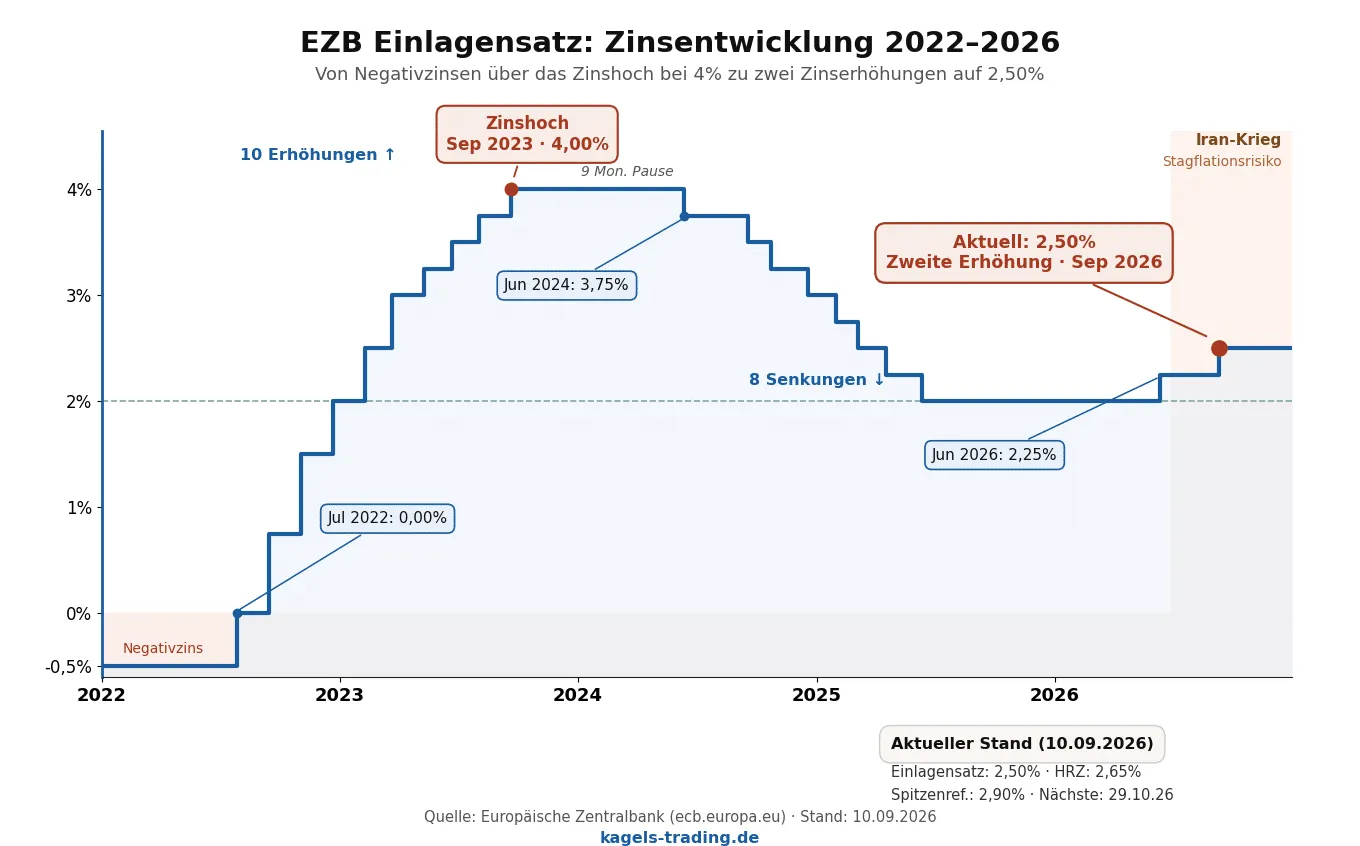 ECB deposit facility rate 2022 to 2026: 10 rises to the 4.00% peak in September 2023, 8 cuts to 2.00%, then two rises to 2.50% in 2026. Chart labels in German: Zinshoch = rate peak, Senkungen = cuts, Aktuell = current, Iran-Krieg = Iran war. Source: ECB, as of 10 September 2026.
The latest ECB rate decision of 10 September 2026
On 10 September 2026 the European Central Bank raised all three key rates by 0.25 percentage points. The deposit facility rate rises to 2.50%, the main refinancing rate to 2.65% and the marginal lending rate to 2.90%, with effect from 16 September. It is the second rate rise this year. The ECB justifies the step with inflation rising again: it reached 3.3% in August, well above the 2.0% target.
At the press conference, ECB President Christine Lagarde did not commit to any further rate path. She said the Governing Council had not discussed future steps and decides meeting by meeting, depending on the data. According to the new staff projections, inflation will only return to target towards the end of 2027: 3.0% on average in 2026, 2.5% in 2027 and 2.1% in 2028.
Before that, the ECB had decided on 11 June 2026 on its first rate rise since September 2023, and paused on 23 July 2026. With the September step it confirms the turn towards higher rates.
In its official monetary policy statement on the June decision, the ECB stressed that the Iran war was creating inflation pressure and that the decision to raise rates held up across a range of scenarios. Lagarde made clear that the ECB was not committing to a particular rate path and would keep deciding meeting by meeting, depending on the data.
The new ECB projections from September keep inflation for 2026 at 3.0% on average (in December the forecast was still 1.9%) and raise it to 2.5% for 2027 and 2.1% for 2028. Growth, on the other hand, was revised up, to 0.9% for 2026 and 1.4% for 2027. The ECB puts this down to the euro area economy proving more resilient than expected. In the first quarter of 2026 the euro area economy had even shrunk.
The background to the June rise was the inflation rate in May 2026, which climbed to 3.2%, after 3.0% in April and 2.6% in March. Core inflation (excluding energy and food) rose to 2.5%. Energy prices, driven higher by the Iran war, remained the main cause.
The background: the Iran shock of March 2026
At the meeting on 19 March 2026, ECB President Christine Lagarde already called the Iran war a significant shock. ECB staff raised the inflation forecast for 2026 sharply, from 1.9% to 2.6%. At the same time, the growth forecast was cut from 1.2% to just 0.9%.
Lagarde pointed to one key difference from the inflation wave after the Ukraine war in 2022: the labour market is solid, but wage growth is slowing. The starting point for the feared second-round effects was therefore much better than back then. Even so, the ECB would pay close attention to commodity prices, companies’ selling prices and wage indicators.
From rate cuts to rate rises: the U-turn
Before the Iran war broke out on 28 February 2026, markets had priced in small rate cuts. That has turned around completely. Money markets anticipated the U-turn correctly: the first rise in June was priced in with a 75% probability and came on 11 June. For the rest of the year, markets expect at least one more rise.
Just one day after the April decision, Bundesbank President Joachim Nagel confirmed this direction: a rate rise in June was possible if the inflation outlook did not improve clearly. From today’s point of view, he said, the situation was developing less favourably than assumed in March.
In an additional scenario analysis (March 2026), the ECB showed what a longer blockade of the Strait of Hormuz could mean: in that extreme case, inflation could rise to between 3.5% and 4.4%. It has not come to that, but the risks remain clearly tilted to the upside.
What time is the ECB rate decision announced?
The ECB rate decision is published on every meeting day at exactly 14:15 Frankfurt time. At 14:45 the press conference begins, where ECB President Christine Lagarde explains the decision and answers journalists’ questions.
For traders, the press conference matters most, because that is often where the real market moves happen. Markets analyse Lagarde’s wording in real time. Terms like “data-dependent”, “upside risks” or “flexibility in both directions” can move EUR/USD, Bund futures and European stock indices clearly within minutes.
The decision comes in the middle of the European trading day, while US exchanges are still closed.
What is the ECB rate decision?
The ECB rate decision is the European Central Bank’s monetary policy decision on the level of the three key interest rates in the euro area. The ECB Governing Council usually takes it every six weeks.
The European Central Bank (ECB) is the central bank of the 21 EU member states that use the euro. It is based in Frankfurt am Main.
The ECB sets three key interest rates: the deposit facility rate, the main refinancing rate and the marginal lending rate. The deposit facility rate is the most important, because it sends the central interest-rate signal to money and capital markets. Through the key rates, the ECB steers borrowing costs for banks, companies and consumers, and so influences inflation and economic growth across the euro area.
At the top of the ECB is the Executive Board, chaired by ECB President Christine Lagarde. The Governing Council, the main decision-making body, consists of the Executive Board and the governors of the national central banks of the euro area. This body takes the key monetary policy decisions.
How rate decisions are made
The ECB bases its rate decisions on extensive economic data and analysis. At its regular meetings, the Governing Council assesses the current economic situation in the euro area, looking at inflation, economic growth, labour market data and other indicators. The ECB’s primary goal is price stability: specifically, it aims for an inflation rate of 2% over the medium term.
What the ECB rate decision means for traders and investors
Every ECB rate decision has a direct impact on several asset classes. These links matter most for active traders:
Impact on the markets
Stock market: lower interest rates make stocks more attractive, because discounting future earnings becomes cheaper and cheap credit encourages investment. Higher rates weigh on share prices, because rising borrowing costs reduce company profits. Rate-sensitive sectors such as real estate and utilities react strongly to rate changes.
Every rate decision hits the Euro Bund future most directly. It is seen as the most important interest-rate barometer in the euro area and reacts during the press conference itself.
Bond market: when interest rates rise, the prices of existing bonds fall, because new bonds offer higher yields. The Bund future, the most important interest-rate future in Europe, reacts to every ECB meeting. The yield on ten-year German government bonds recently rose above 3.0% and reached 3.1% on 30 April 2026, its highest level since 2011.
Currency market: for EUR/USD traders, the interest-rate gap between the Fed and the ECB remains the main driver. As long as the Fed is more likely to ease than the ECB, the euro stays relatively well protected on the downside. The ECB press conference is regularly one of the most volatile moments in currency trading. How ECB rates feed through to currencies shows clearly in the euro against the yen, which reacts especially strongly to the rate gap.
Savings rates: an ECB rate rise tends to lead to higher interest on savings and fixed-term deposits. However, the real return can stay negative because of inflation: money saved loses purchasing power despite higher interest.
The rate gap has its clearest effect on the euro crosses. The Bank of England’s higher rates, for example, are currently holding the euro back against the British pound. When the Bank of England decides next and how the pound reacted on past decision days is explained in the BoE rate decision. Against the Swiss franc the euro has the higher rate, because the SNB has kept its policy rate at zero since June 2025, see the SNB rate decision.
ECB vs. Fed: comparing interest-rate policy
The interest-rate policies of the ECB and the Fed differ in one important point: the ECB focuses solely on price stability, while the Fed has a dual mandate covering both price stability and maximum employment. In practice, this means the Fed takes a broader range of data into account when the economy is hit by a shock.
How strongly rate differences feed through to currencies shows in the Japanese yen: despite the Bank of Japan’s turn to higher rates, the dollar trades at a 40-year high against the yen.
Rate changes by both central banks have global effects, but in different ways. Fed decisions move global financial markets more, because the US dollar is the world’s reserve currency. ECB decisions matter above all within the euro area and for the EU’s trading partners.
At the moment both central banks face similar dilemmas but react differently. The Fed also left rates unchanged at its April 2026 meeting, but internal tensions are growing: for the first time since 1992, four members voted against the majority. While the ECB leans towards raising rates, US markets still price in rate cuts. For EUR/USD traders, this divergence is a key factor.
For expectations about the US central bank there is a comparable tool, the CME FedWatch Tool. It is based on Fed funds futures and shows the probabilities for every FOMC meeting in real time. Our interest rate forecast compares the Fed path and US Treasury yields with the ECB and the German Bund.
Outlook: ECB rate forecast for 2026
With the rate rises of 11 June and 10 September 2026, interrupted by a pause on 23 July, the ECB has lifted the deposit facility rate to 2.50%. The risks remain tilted to the upside. Three scenarios can be distinguished:
Scenario 1, further rate rises (most likely): the ECB already delivered on 11 June and 10 September 2026. Inflation was well above target in August at 3.3%, with the core rate at 2.4%. If the energy shock becomes entrenched, another rise to 2.75% by the end of the year is realistic. The ECB has deliberately left its future rate path open.
Scenario 2, a longer pause: if oil prices stabilise and inflation falls back towards 2%, the ECB could keep its wait-and-see course. This scenario becomes more likely if the geopolitical situation eases.
Scenario 3, a rate cut (unlikely): with a clear economic slowdown and inflation below 2%, moderate cuts towards 1.75% would be possible. At the moment this is the least likely scenario.
The next ECB meeting on 29 October 2026 will show whether the ECB raises rates again. The autumn inflation data will be decisive, as will the question of whether the economic weakness after the first-quarter contraction becomes entrenched or a recovery sets in.
Conclusion: the ECB rate decision in 2026 and what traders should watch now
In 2026 the ECB rate decision is shaped by the Iran war and its effects on inflation and growth. As a trader I have followed ECB meetings for decades, and the current situation is one of the most complex since the euro crisis.
My assessment: the turn towards higher rates has begun. The ECB delivered on 11 June and raised rates for the first time since 2023. After the pause on 23 July, the second rise to 2.50% followed on 10 September. Whether further steps follow depends on how inflation and the economy develop by the end of the year. The stagflation dilemma remains: inflation is rising, and the economy already shrank in the first quarter.
For traders this means: the ECB meeting dates belong in your calendar. The press conference at 14:45 Frankfurt time is one of the most volatile moments in European trading. EUR/USD, Bund futures and the DAX in particular react immediately to every nuance in Lagarde’s words. Anyone who ignores these dates risks being caught unprepared in an increasingly uncertain environment.
Frequently asked questions about the ECB rate decision
What is the ECB rate decision?
The ECB rate decision is the European Central Bank’s monetary policy decision on the level of the three key interest rates in the euro area. The Governing Council usually takes it every six weeks, and it affects borrowing costs, savings rates and overall economic activity.
When is the next ECB meeting?
The next ECB meeting takes place on 29 October 2026. The rate decision is announced at 14:15 Frankfurt time, and the press conference with ECB President Christine Lagarde begins at 14:45.
What time is the ECB rate decision published?
The ECB rate decision is published on every meeting day at 14:15 Frankfurt time. The press conference follows at 14:45 and can be watched live on the ECB’s official webcast.
How does the ECB rate decision affect inflation?
Lower interest rates encourage lending and can boost the economy, which tends to push inflation up. Higher rates make credit more expensive, slow economic growth and so work against inflation. The ECB’s primary goal is an inflation rate of 2% over the medium term.
How often does the ECB review its interest rates?
The ECB Governing Council usually holds a monetary policy meeting every six weeks. There are eight such meetings a year where the key rates are decided. There are also non-monetary policy meetings, which matter less for financial markets.
What is the ECB?
The European Central Bank is the central bank of the 21 EU member states that use the euro. It is based in Frankfurt am Main and was founded in 1998. Its main task is to keep prices stable in the euro area.
This article is based on publicly available sources from the European Central Bank, current market data and Karsten Kagels’ personal market assessment. It is not investment advice.
This article is translated from the German edition on kagels-trading.de.
More Central Banks guides
- Follow the US dollar
Fed Interest Rate Decision 2026: Dates, Rate and Outlook
Every FOMC date, the latest decision and dot plot, and how much a Fed decision moves markets.
- Follow the yen
BoJ Interest Rate Decision: Dates, Times and Japan's Rate
Bank of Japan meeting dates to the end of 2027 and how much the yen and the Nikkei move on BoJ days.
- Follow the British pound
Bank of England Interest Rate Decision: Dates and Times
Every MPC date to the end of 2027 with times, the named votes of 2026 and how much EUR/GBP moves on BoE days.
- Follow the Swiss franc
SNB Interest Rate Decision: Dates, Times and the Swiss Franc
SNB meeting dates to the end of 2027 with times, the latest decision and how much the franc moves on SNB days.
- Follow the Canadian dollar
Bank of Canada Interest Rate Decision: Dates and Times
Bank of Canada dates with times in New York and Europe, the latest decision and how much USD/CAD moves after BoC days.
- Follow the Australian dollar
RBA Interest Rate Decision: Dates, Times and the Aussie
RBA dates with the Monday-evening times in New York, the 2026 votes and how much the Australian dollar moves.
- Read Fed expectations
CME FedWatch Tool Explained: Forecasting Fed Rate Decisions
How FedWatch turns futures prices into rate probabilities, and how accurate it has been.