
SNB Interest Rate Decision: Dates, Times and the Swiss Franc


Contents
- The SNB rate decision in 30 seconds
- When is the next SNB rate decision?
- What is the SNB rate decision?
- The latest SNB decision: September 2026
- SNB meeting dates and times for 2026 and 2027
- Switzerland’s policy rate: from minus 0.75% to zero
- How much does an SNB decision move the franc?
- Why the SNB works differently from the ECB and the Fed
- SNB, ECB and Fed compared
- How to handle the SNB date as a trader
- Conclusion: a quiet rate does not mean a quiet date
- Frequently asked questions about the SNB rate decision
- About the author
The Swiss National Bank has kept its policy rate at zero since 20 June 2025, and the franc has still moved. On 2 January 2026 a euro cost 0.9296 francs, and on 25 September 2026, the day after the latest decision, it cost 0.9445 (ECB reference rates). The franc had weakened, and the SNB itself names this weakening as one reason for its higher inflation forecast. By 7 October 2026 the franc had regained almost all of that ground, at 0.9309 per euro. So if you read the SNB interest rate decision as a number only, you miss the part that actually moves prices.
Here you will find every meeting date to the end of 2027 with times, the state of play after the assessment of 24 September and my own analysis across 30 decisions. It shows how much the Swiss franc really moves on SNB days, and why with this central bank the foreign exchange market often matters more than the rate itself. This article follows our editorial policy.
The SNB rate decision in 30 seconds
- The SNB rate decision is the Swiss National Bank’s quarterly decision on the SNB policy rate. It is taken at the monetary policy assessment.
- The SNB policy rate is 0.00 percent. It has applied since 20 June 2025 and has been confirmed five times in a row, most recently on 24 September 2026.
- The next decision comes on Thursday, 10 December 2026. After that follow 18 March and 24 June 2027.
- The press release comes out at 9:30 Zurich time, and the news conference starts at 10:00. That is 8:30 in London and 3:30 in the morning in New York on 10 December.
- Swiss inflation was 1.0 percent in September 2026, according to the Federal Statistical Office on 1 October, after 0.8 percent in August.
- In my measurement across 30 dates, EUR/CHF moved 1.8 times as much on SNB days as on normal days. On 24 September the move was 0.20 percent.
- In September the SNB removed the word “increased” from its willingness to intervene in the foreign exchange market. The willingness itself stays. That change in wording was the real news of the day, because the rate itself did not change.
When is the next SNB rate decision?
The next SNB rate decision is on Thursday, 10 December 2026. The press release comes out at 9:30 Zurich time, which is 8:30 in London and 3:30 a.m. in New York.
After that, the SNB decides on 18 March, 24 June, 23 September and 16 December 2027. The dates are fixed well in advance in the SNB’s event schedule, and the time has been the same for years. On 10 December 2026 the SNB decides one day after the Fed, whose meeting runs on 8 and 9 December. The table with all dates and time zones follows below, together with the one date in 2027 when New York time shifts by an hour.
What is the SNB rate decision?
The SNB rate decision is the Swiss National Bank’s quarterly decision on the level of the SNB policy rate. It is taken at the monetary policy assessment, at which the Governing Board reviews the economy and publishes a conditional inflation forecast.
The decision is not taken by a large committee but by a very small one. The SNB’s Governing Board has three members, and its chairman is Martin Schlegel. Unlike the Fed or the Bank of Japan, the SNB publishes no vote count. There are no minutes with named dissents, only a joint press release.
The policy rate works through the sight deposits that banks hold at the SNB. Up to a certain threshold they earn the policy rate; above it, a discount of 0.25 percentage points applies. Through this threshold the SNB steers how expensive short-term money is in the market, without touching the policy rate itself.
The mandate is short, and it matters for traders. The SNB has to ensure price stability while taking account of economic developments. By its own definition, price stability means inflation of zero to two percent a year. The details are in the SNB’s monetary policy strategy.
The second lever appears in almost every press release and is still often overlooked. The SNB regularly states that it is willing to be active in the foreign exchange market. This sentence is not filler; it is the second instrument next to the rate. How it works is explained further down.
The latest SNB decision: September 2026
On 24 September 2026 the SNB left its policy rate unchanged at 0.00 percent. It was the fifth confirmation in a row since the last cut in June 2025. The discount on sight deposits above the threshold also stays at 0.25 percentage points.
The real news was not in the rate line. In March and June the SNB wrote that its willingness to intervene in the foreign exchange market had increased. In September the standard wording is back: the SNB “is also willing to be active in the foreign exchange market as necessary”. The press release gives no reason for the change in wording. It does say that the recent depreciation of the franc is supporting the economy.
On inflation, the summer picture was confirmed. According to the SNB, inflation rose from 0.6 percent in May to 0.8 percent in August. The driver was higher prices for oil products, and inflation for goods was positive again in August for the first time since May 2024.
Since the decision, the next inflation figure has come in higher. According to the Federal Statistical Office, Swiss inflation was 1.0 percent in September 2026 (published on 1 October), after 0.8 percent in August. The index itself was unchanged from August: higher prices for heating oil, petrol and diesel were offset by cheaper package holidays and hotels. In its press release of 24 September the SNB had expected inflation to rise somewhat further in the fourth quarter and to fall again in the course of 2027.
The conditional inflation forecast is now higher than in June. The SNB expects an annual average of 0.7 percent for 2026 and 0.8 percent each for 2027 and 2028. In June the figures were 0.6, 0.6 and 0.7 percent. It gives two reasons: oil prices that were higher than expected and, in the medium term, the weaker franc. This forecast, too, assumes a policy rate of zero for the whole period. That is a calculation assumption for the forecast, not a commitment about future decisions.
The SNB raised its growth forecast clearly. For 2026 it now expects 1.5 to 2 percent, after around 1 percent in June; for 2027 it still expects around 1.5 percent. The second quarter was exceptionally strong, but the SNB puts that into context: an unusually strong chemical and pharmaceutical industry lifted GDP beyond the underlying momentum. The figures are in the press release of 24 September 2026.
A comparison with the press release of 18 June 2026 shows the shift in a single word. In June the SNB still had an increased willingness to intervene. In the September release that word was gone.
The market took the date calmly. The ECB reference rate for EUR/CHF on the day of the decision was 0.20 percent higher than the day before. That is below the average of 0.40 percent that I measure across all 30 dates, and it fits the pattern: a decision that changes nothing usually moves little.
What speaks against a rate move in December
- The conditional forecast stays within the price stability range at 0.7 to 0.8 percent for the whole period.
- The rise in inflation comes from oil prices, so from abroad.
- The SNB has only just removed the reference to an increased willingness to intervene.
What still makes the December date risky
- The forecast was raised in September for the second time in a row.
- Goods inflation is positive again for the first time since May 2024, and overall inflation reached 1.0 percent in September (Federal Statistical Office, 1 October 2026).
- The wording on the foreign exchange market changes from date to date, and every nuance is traded.
- The SNB itself names the weaker franc as a reason for the higher forecast. Since then the franc has regained ground against the euro: EUR/CHF stood at 0.9445 on 25 September and at 0.9309 on 7 October 2026 (ECB reference rates).
SNB meeting dates and times for 2026 and 2027
The SNB decides four times a year, each time on a Thursday in March, June, September and December. That is far fewer dates than the ECB and the Bank of Japan, which meet eight times a year each. So each single date carries more weight.
| Thursday | Zurich | New York |
|---|---|---|
| 10 Dec 2026 | 9:30 | 3:30 |
| 18 Mar 2027 | 9:30 | 4:30 |
| 24 June 2027 | 9:30 | 3:30 |
| 23 Sept 2027 | 9:30 | 3:30 |
| 16 Dec 2027 | 9:30 | 3:30 |
Dates of the monetary policy assessments according to the SNB’s event schedule, checked on 7 October 2026. Times of the press release, New York in the morning. London is always one hour behind Zurich (8:30), because the UK and Switzerland change clocks on the same days. The news conference follows at 10:00 Zurich time. On 18 March 2027 the US is already on summer time (from 14 March) and Europe is not yet (from 28 March), so New York is only five hours behind.
About four weeks after each decision a second document follows that many traders miss: a summary of the discussion. The SNB has published it since September 2025. It shows which arguments stood against each other in the Governing Board. If you want to know how close the SNB came to a change, you will find the answer there and not in the press release of the decision day. The summary for the September 2026 decision is due on 22 October 2026 at 9:30 Zurich time.
Between the scheduled dates the SNB can act at any time, and it has done so. Its overview of monetary policy decisions lists every scheduled assessment since 2000 and a number of unscheduled decisions, among them the introduction of the minimum exchange rate in September 2011 and its abandonment in January 2015.
Switzerland’s policy rate: from minus 0.75% to zero
Switzerland went through a complete rate cycle in about three years and is almost back where it started. In June 2022 the policy rate was minus 0.75 percent, in June 2023 plus 1.75 percent, and since June 2025 it has been zero.
Every rate change since the turn in 2022
| Decision | Change | New policy rate |
|---|---|---|
| 16 June 2022 | +0.50 points | −0.25% |
| 22 Sept 2022 | +0.75 points | 0.50% |
| 15 Dec 2022 | +0.50 points | 1.00% |
| 23 Mar 2023 | +0.50 points | 1.50% |
| 22 June 2023 | +0.25 points | 1.75% |
| 21 Mar 2024 | −0.25 points | 1.50% |
| 20 June 2024 | −0.25 points | 1.25% |
| 26 Sept 2024 | −0.25 points | 1.00% |
| 12 Dec 2024 | −0.50 points | 0.50% |
| 20 Mar 2025 | −0.25 points | 0.25% |
| 19 June 2025 | −0.25 points | 0.00% |
All changes to the SNB policy rate since June 2022, taken from the SNB’s press releases. A step of 0.25 points means 0.25 percentage points, or 25 basis points. The new rate applies from the following day.
The last line of the table is where many articles go wrong. The decision is taken on a Thursday, but the new rate applies from Friday. The press release of 19 June 2025 says so directly: the new rate applies from 20 June 2025. A sentence like “the rate has been zero since 19 June” is therefore wrong.
For you as a trader, the difference is more than pedantry. The price reaction comes on the decision day, while the interest on sight deposits changes the day after. If you calculate overnight funding costs, for example on franc positions you hold, you need the effective date and not the meeting date.
Just as remarkable is what happened between 2015 and 2022: nothing. The SNB cut its negative rate to minus 0.75 percent on 15 January 2015 and left it there for seven years; the SNB policy rate, introduced in June 2019, simply took over that level. It was one of the lowest policy rates in the world, and for traders the dates were a non-event for years. That calm has been over since 2022, even though the rate is standing still again.
How much does an SNB decision move the franc?
For this article we recalculated every decision since the SNB policy rate was introduced in June 2019, 30 dates in total. The price source is the ECB euro reference rates, because the ECB sets them in a daily concertation around 2:10 pm CET, well after the Swiss decision, and publishes them around 4 pm. We compare the daily change on SNB days with the daily change on all other trading days in the same period, from reference rate to reference rate.
The result is clear, but smaller than many expect. EUR/CHF moved on average 0.40 percent on decision days, against 0.22 percent on normal days. That is a factor of 1.8. For USD/CHF the figures were 0.62 against 0.35 percent, also a factor of 1.8. On 22 of 30 dates the move was larger than on a median normal day.
If you look only at the years since the turn in rates, the picture is sharper. Since June 2022 the factor for EUR/CHF is 2.2, and on 14 of 18 dates the move was above the median. So the dates are not always hot, but they are when the market is not sure what the SNB will do.
Please read these figures for what they are: daily changes of an official reference rate. A reference rate is not a price you can trade, and a daily change also contains everything else that happened that day, not only the decision. The figures show how restless SNB days were, not how much of that was caused by the SNB alone. The calculation runs up to 25 September 2026.
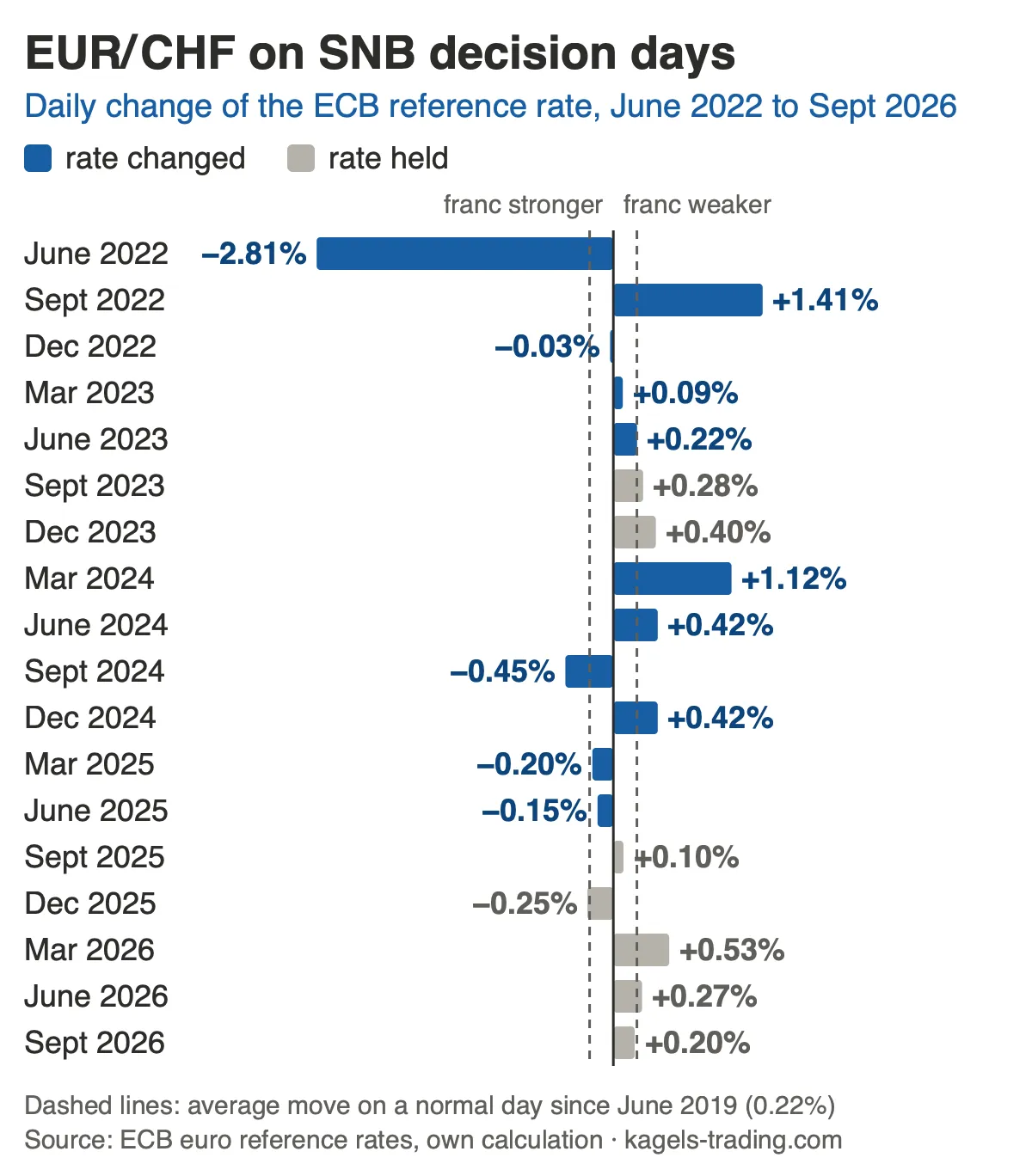 EUR/CHF on every SNB decision day since June 2022: daily change of the ECB reference rate. A minus means a stronger franc. The two largest moves came in June 2022 and March 2024, while both rate cuts of 2025 moved less than an average normal day (0.22%, since June 2019). Source: ECB euro reference rates, own calculation.
The pattern behind it matters more in practice than any single value. The two biggest moves since 2022 came with turning points: the first rise in June 2022 and the first cut in March 2024. On most other dates the move stayed below half a percent, even when the SNB changed the rate. Daily reference rates cannot show what traders expected, but a turn in direction is the kind of step that can catch a market off guard.
- MarketExpectationBefore 9:30, prices already reflect what traders expect the SNB to do.
- SNBDecisionRate line, the sentence on the foreign exchange market and the new inflation forecast.
- ComparisonSurpriseThe part that differs from expectations can move prices. A step the market already expects may be largely priced in.
- MarketReactionEUR/CHF and USD/CHF reprice. A hike is not automatically a stronger franc, and a cut not automatically a weaker one.
A dark line marks each hand-over. The direction of the rate step alone says little; the gap between expectation and decision is what traders react to.
The direction in June 2022 is worth a closer look. EUR/CHF fell 2.8 percent between two ECB reference rates, so the franc rose sharply, although the SNB’s rate rise was smaller than the Fed’s the day before, which had raised rates by 0.75 percentage points. The ECB had not raised rates at all at that point. So the size of the step alone does not explain the move; the fact that the SNB moved at all may have mattered more.
Why the SNB works differently from the ECB and the Fed
The Swiss National Bank has a problem that the ECB and the Fed do not know. The franc is seen as a safe haven. During periods of global stress, money often flows into the franc, it gains in value, imported goods get cheaper and inflation falls. A franc that is too strong can therefore threaten price stability in Switzerland just as much as inflation that is too high elsewhere.
From this follows the second instrument. When necessary, the SNB buys foreign currencies to slow the franc down. In its press release of 19 March 2026 it put it this way, with a view to the conflict in the Middle East: its willingness to intervene in the foreign exchange market “has increased”. In June 2026 the increased willingness was in the press release again.
For traders, this wording is the real news when the rate stays unchanged. If one word in the sentence on the foreign exchange market changes, that is a monetary policy statement, even without a rate step. If you look only at the rate line, you will wrongly treat such a date as a non-event.
15 January 2015 as a warning
How seriously this is meant was shown by one of the biggest shocks the currency market has seen this century. From September 2011 the SNB defended a minimum exchange rate of 1.20 francs per euro. On 15 January 2015 it abandoned it without warning.
The ECB reference rate fell on that one day from 1.2010 to 1.0280 francs, a drop of 14.4 percent. For comparison: the second-largest daily move since 2014 was 2.8 percent, and it also fell on an SNB date. Several brokers got into serious trouble; the UK broker Alpari formally entered special administration insolvency proceedings on 19 January 2015, according to the FCA. In such a free fall, stop orders can be filled far from the stop price. The press release of 15 January 2015 is still online.
The lesson is not panic but a sober approach to risk. A stop-loss is not a guaranteed price; it is an order that is filled at the next available price, and that can be far away in a fast market. Today the SNB no longer defends a fixed rate, but it has never given up the instrument itself.
SNB, ECB and Fed compared
The Swiss date only makes sense in relation to the two big central banks. The rate gap to the euro area decides how attractive it is to borrow francs and invest in euros, and this gap drives many franc moves.
| Central bank | Policy rate | Next decision |
|---|---|---|
| SNB (Switzerland) | SNB policy rate 0.00% | 10 Dec 2026 |
| ECB (euro area) | deposit facility rate 2.50% | 29 Oct 2026 |
| Fed (US) | target range 3.75% to 4.00% | 28 Oct 2026 |
As of 7 October 2026. The ECB deposit facility rate has applied since 16 September 2026; the Fed decided on its target range for the federal funds rate on 16 September 2026.
The figures sum up the situation in one sentence: between the franc and the euro there are 2.5 percentage points, between the franc and the dollar almost four. That makes the franc the cheapest of the three currencies to borrow. Against the dollar it has weakened in 2026, which fits this rate logic: USD/CHF rose from 0.7931 on 2 January to 0.8329 on 7 October (ECB reference rates). Against the euro it was back near its January level on 7 October. In a crisis, however, the safe-haven effect described above can override it at any time.
For the other dates in the calendar, the sister articles help. How the European Central Bank decides is explained in the article on the ECB interest rate decision, the US central bank in the article on the Fed interest rate decision. The fourth big date comes from Japan, in the article on the BoJ interest rate decision. The Bank of England publishes every single vote, see the BoE rate decision. The Bank of Canada decides by consensus and publishes no individual votes, as the Bank of Canada rate decision shows. The RBA at least gives the vote count: in March 2026 it was 5 to 4, see the RBA rate decision. All of them are collected on our central banks topic page.
How to handle the SNB date as a trader
The first point is the least comfortable: a date without a rate change is not a date without risk. On the last three dates without a step, 19 March, 18 June and 24 September 2026, my measurement shows moves of 0.53, 0.27 and 0.20 percent in EUR/CHF. That is enough to hit a tight stop, without anything changing in the rate outlook.
Second, it pays to read the press release in the right order. First the rate line, then the sentence on the foreign exchange market, then the conditional inflation forecast with its three annual values. The first two are the quickest to read; the forecast needs more time to digest.
Third, the instruments. The franc trades most directly through EUR/CHF and USD/CHF. My current price levels for the dollar pair are in the USD/CHF forecast.
Fourth, position size. On a date when a surprise is possible, your position size belongs down, not up. 15 January 2015 is the extreme example, but 16 June 2022, when EUR/CHF fell 2.8 percent in one day, was also enough to wipe out accounts built on tight stops.
Fifth, look beyond the franc. An SNB decision affects the rate gap, and with it every position that lives on the relationship between currency areas. If you want to know what the market expects from the Fed at the same time, the CME FedWatch Tool shows the priced probabilities. How US Treasury and German Bund yields are developing is covered in our interest rate forecast.
Conclusion: a quiet rate does not mean a quiet date
The SNB rate decision is the most predictable of the big central bank dates. Four meetings a year, always on a Thursday, always at 9:30 Zurich time, with a calendar that is fixed to the end of 2027. If you put the five dates in your calendar, the timing of the scheduled decisions will not surprise you; unscheduled decisions remain possible.
The content can. My analysis across 30 dates shows that the franc moves almost twice as much as usual on these days, and that the biggest moves came at turning points in its policy. 24 September 2026 confirmed it: the rate stayed, the price moved 0.20 percent, and the news was in the text: the reference to an increased willingness to intervene was removed, while the willingness itself remains.
I have traded franc pairs for decades, and on the day of the decision I do not hold anything large. Not because I expect a rate rise, but because this central bank has shown twice that it can act without warning. A halved position costs almost nothing on a quiet Thursday and much less on a loud one.
Frequently asked questions about the SNB rate decision
What time does the SNB announce its rate decision?
The press release comes out at 9:30 Zurich time, and the Governing Board’s news conference starts at 10:00. That is 8:30 in London and usually 3:30 a.m. in New York. On 18 March 2027 it is 4:30 a.m. in New York, because the US switches to summer time two weeks before Europe.
What is the Swiss interest rate now?
The SNB policy rate is 0.00 percent, in force since 20 June 2025. The SNB has left it unchanged at the five assessments since then, most recently on 24 September 2026. Sight deposits above a certain threshold are also subject to a discount of 0.25 percentage points.
How often does the SNB decide on interest rates?
Four times a year, each time on a Thursday in March, June, September and December. The ECB and the Fed each meet eight times a year. The SNB can also decide outside the schedule at any time, as it did on 15 January 2015.
Who decides on rates at the SNB?
The Governing Board, with three members under its chairman Martin Schlegel. Vote counts are not published. About four weeks after each date, however, the SNB publishes a summary of the discussion.
How much does the franc move on an SNB day?
In my measurement across 30 dates since June 2019, EUR/CHF moved on average 0.40 percent on decision days against 0.22 percent on normal days. That is about 1.8 times as much. Since the turn in rates in 2022 the factor is 2.2. The biggest moves came at turning points in policy.
This article is based on publicly available sources from the Swiss National Bank, the Federal Statistical Office and the ECB, my own calculations and my personal market assessment. It is not investment advice. Trading currencies involves the risk of loss.
This article is translated from the German edition on kagels-trading.de.
More Central Banks guides
- Follow the US dollar
Fed Interest Rate Decision 2026: Dates, Rate and Outlook
Every FOMC date, the latest decision and dot plot, and how much a Fed decision moves markets.
- Follow the euro
ECB Interest Rate Decision 2026: Dates and Latest Decision
Current ECB rates, every meeting date with times and what traders should watch.
- Follow the yen
BoJ Interest Rate Decision: Dates, Times and Japan's Rate
Bank of Japan meeting dates to the end of 2027 and how much the yen and the Nikkei move on BoJ days.
- Follow the British pound
Bank of England Interest Rate Decision: Dates and Times
Every MPC date to the end of 2027 with times, the named votes of 2026 and how much EUR/GBP moves on BoE days.
- Follow the Canadian dollar
Bank of Canada Interest Rate Decision: Dates and Times
Bank of Canada dates with times in New York and Europe, the latest decision and how much USD/CAD moves after BoC days.
- Follow the Australian dollar
RBA Interest Rate Decision: Dates, Times and the Aussie
RBA dates with the Monday-evening times in New York, the 2026 votes and how much the Australian dollar moves.
- Read Fed expectations
CME FedWatch Tool Explained: Forecasting Fed Rate Decisions
How FedWatch turns futures prices into rate probabilities, and how accurate it has been.